(Mis)understanding predation

Imagine, if you will, a future government policy for raptor ‘control’ based on the biased, uninformed and unscientific opinion of someone like Robin Page.

‘Ah, that’d never happen’, you might say. ‘Government policy on biodiversity and species protection has to be based on peer-reviewed scientific evidence, not on the prejudices of those with a vested interest in game shooting, right?’

Well, not necessarily.

Moorland Forum logo - Copy

A new ‘study’ being carried out by Scotland’s Moorland Forum is seeking to use such prejudicial opinions to inform the debate around predator-prey interactions, which will lead, inevitably, to further calls for licences to ‘control’ (kill) raptors, particularly buzzards.

Certain members of the Moorland Forum have been pushing for licences to kill raptors for over a decade (because of the perceived impact of raptors on game birds such as pheasants and red grouse), although so far with little success. This time they’ve changed tactics. Instead of focusing on the (perceived) impact of raptors on game birds, they’re also looking to see whether they can make a case against raptors for their (perceived) impact on certain species of wader.

The ‘study’ has been named ‘Understanding Predation’ (see web page here) and it will combine a review of the scientific literature relating to predator-prey relationships, as well as the opinions of ‘stakeholders’. Incredibly, these opinions are to be given the same weight in this ‘study’ as the scientific evidence. Personal opinions are usually termed ‘anecdotal evidence’ and definitely not ‘scientific evidence’, and for very good reason. But apparently in this ‘study’ opinions are to be referred to as ‘local ecological knowledge’ – perhaps as a way to make them sound more scientifically credible. It doesn’t wash. Anecdotal evidence can be useful, no doubt about that, but to give it the same measure of importance and usefulness as peer-reviewed science is just laughable.

As an example, have a look at the comments that have been made on the Understanding Predation blog (see here). Each of these comments will apparently be used as part of the ‘study’. Apart from one or two exceptions, the majority of the comments made so far are by gamekeepers – some of them prominent members of the Scottish Gamekeepers’ Association. Seriously, have a read and see the ‘quality’ of the comments that are going to be used to inform this ‘study’. If Robin Page chooses to post his ridiculously flawed article as a comment, then that, too, will be used as part of the study’s result.

There’s also a questionnaire for participants to fill in (see here). We have serious issues with the design of this questionnaire, not least because the questions are leading and inherently devised to place predation as an issue of concern. There’s also plenty of potential for the person filling in the questionnaire to lie. Information is sought about the individual’s interests, occupation and experience. What’s to stop gamekeepers filling this in, claiming to be scientists or claiming to be staff members of prominent conservation organisations, in order to create an illusion that conservationists are concerned about the supposed negative impact of raptors on other bird species?

It’s interesting to look down the list of organisations that have been invited to participate in this ‘study’. The usual suspects are all there, including Songbird Survival. We wonder whether they will be highlighting the results of a study they funded that found no evidence that an increase in predators was associated with large scale population declines in songbirds (see here).

The ‘study’ apparently welcomes input from members of the public so we’d encourage you to participate, either by adding a comment to the project’s blog (here) and/or filling in the questionnaire (here). We’d also encourage you to highlight any concerns you have about the study design – make sure the organisers are aware of your views, either via the comment boxes on the questionnaire or via the project blog.

Robin Page’s anti-raptor rhetoric torn to shreds

In response to Robin Page’s idiotic rant against raptors that was published in the Daily Mail yesterday (see here), the Guardian has published a cracking retort.

When Page (Boring Ape) was asked why he hadn’t cited any scientific evidence to support his claim that raptors are causing population declines in other avian species, he said: “I don’t want to, why should I?“.

It’s a shame the grouse-moor-owning editor of the Daily Mail didn’t ask him the same question before deciding to publish.

The article in the Guardian, written by Karl Mathiesen, includes comments from Ben Sheldon (Professor of Field Ornithology, Oxford University), Jeff Knott (Head of Nature Policy, RSPB), Chris Packham and Mark Avery.

Well worth a read.

Guardian article here.

Henry’s tour day 27: where Bowland Betty breathed her last

Tues 12 May  Copy

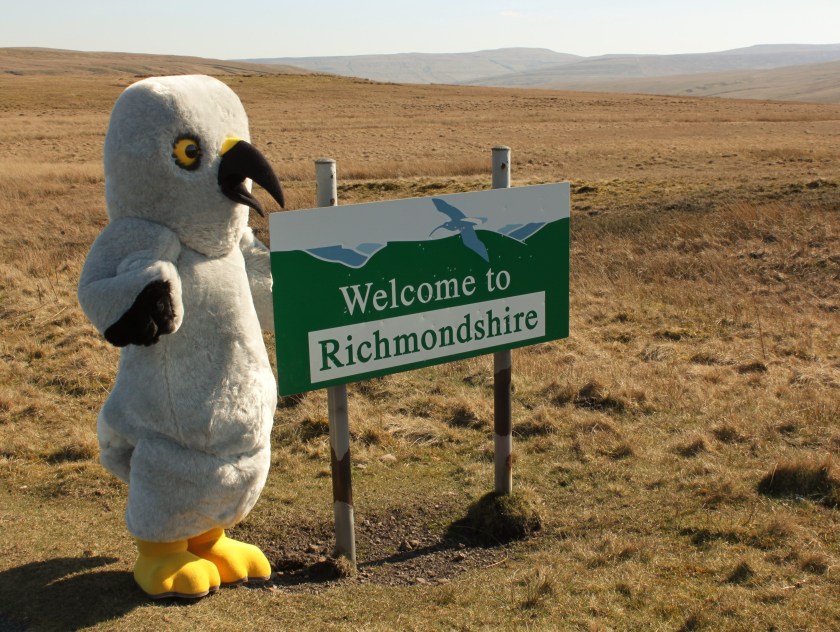
Henry is visiting the Swinton Estate today – a vast area of moorland in the Yorkshire Dales that is managed for driven grouse shooting.

This is a particularly poignant visit. In July 2012, not very far from where this photo was taken, the dead body of Bowland Betty was found.

Bowland Betty was a young hen harrier from a 2011 nest in Bowland, Lancashire. She was named after Bet Lynch, the barmaid from Corrie. Bowland Betty was satellite-tracked and the public followed her movements across England and Scotland until her miserable death the following year. She’d been shot. You can read her story here.

You might also be interested in the Countryside Alliance’s view of this crime – here.

Anti-raptor rhetoric continues

The Daily Mail has published an article today written by Robin Page (Boring Ape for you anagram fans) which claims that ‘do-gooders’ (that’ll be conservationists) are letting ‘killer birds’ (that’ll be raptors) ‘terrorise the countryside’ (that’ll be behaving as natural predators).

He doesn’t quite go as far as saying raptors will kill your children and bring a plague on your houses, but he does suggest that your pets aren’t safe while these ‘aggressive killers’ are on the loose.

The anti-raptor rhetoric is nothing new from the Boring Ape – he’s been at it for years (see here). Safe to say he’s not best known for his grasp of science, ecological principles, and especially predator-prey relationships. He is quite good though at cherry-picking data and presenting them out of context. He implies that the hen harrier population doesn’t need to be increased, using national (UK) population figures to support this claim but omitting to mention that (a) the UK population overall is in decline and (b) the English population is on its knees, thanks to the illegal persecution it suffers at the hands of gamekeepers on driven grouse moors.

No surprise, either, that his latest offering has been published by the Daily Mail; editor Paul Dacre just happens to own a grouse shooting estate in Scotland.

Daily Mail article here

The Boring Ape will be taking part in a debate on raptors next weekend (assuming he hasn’t been carried off by one of those frightening sparrowhawks), pitted against Mark Avery at the Norfolk and Norwich Festival (see here).

UPDATE 12th May 2015: Robin Page’s anti-raptor rhetoric torn to shreds (see here).

Henry’s Tour: Day 26

Monday 11 May  Copy

Henry has arrived in the Yorkshire Dales National Park.

So many grouse moors, so few hen harriers.

The last successful hen harrier breeding attempt here was in 2007, and it was only successful thanks to the provision of supplementary feeding after the male parent ‘disappeared’.

Eight years later….where are all the breeding harriers?

Henry will be visiting several grouse moors this week as he searches in vain for a mate and a safe place to breed.

Meanwhile, campaign group Birders Against Wildlife Crime are fundraising to help support Henry’s Tour and other campaigning initiatives such as this year’s Hen Harrier Day (Sunday August 9th). If you’ve got a few quid to spare and you want to help out, please see here.

New trial date set for gamekeeper Neil Wainwright

A trial date has been set in the case against gamekeeper Neil Wainwright, accused of the alleged mis-use of a trap last year.

Wainwright, 54, of Norbury, near Bishop’s Castle in Shropshire, has denied charges relating to the use of live quail inside a trap in Birch Hill Wood in Gatten, Stiperstones on 22 and 28 July 2014.

At a hearing in February he pleaded guilty to three other charges relating to the storage of firearms, ammunition and poison.

The trial will begin on 16th June 2015.

Previous blog on this case here.

Henry’s Tour Day 25: Deadly silence

Fri 8 May  - Copy

Today Henry went to visit the Hawk & Owl Trust.

He wanted to hear their view on the ‘disappearance‘ of three adult male hen harriers from active nests in Lancashire’s Forest of Bowland.

What does the Hawk & Owl Trust think might have happened to those three breeding birds?

Does the Hawk & Owl Trust think their ‘disappearance’ has anything to do with the grouse-shooting community in Bowland?

How will the ‘disappearance’ of those three breeding birds affect the Hawk & Owl Trust’s proposed brood-meddling trial?

48 hours after the news broke, the Hawk & Owl Trust has yet to publish a formal statement on their website or even casually mention it on their Twitter account.

Perhaps they’re still in talks with other pro-brood meddlers as to how to play this one, because the GWCT, Moorland Association and National Gamekeepers’ Organisation are all still to make formal statements.

Meanwhile, the RSPB has issued a second statement and has offered a £10,000 reward for any information which leads to a conviction. They clearly think crimes have been committed, as does Lancashire Constabulary (who are investigating) and as does anybody with a passing knowledge of the history of hen harrier persecution on driven grouse moors.

Even Natural England, the Government’s statutory conservation agency tasked with protecting hen harriers has managed to make a statement (here), for what it’s worth. Although they still haven’t managed to release the full results of their hen harrier satellite tagging study which began 8 years ago (see here).

Aftermath

Thur 7 May - Copy

This photograph of Mark Avery occupying a grouse butt in the North York Moors was supposed to illustrate a post entitled ‘Henry’s Tour: Day 25’, which was going to be all about voting for the environment in today’s general election. Circumstances have dictated a change of plan.

In the aftermath of yesterday’s appalling news that three adult male hen harriers have ‘disappeared’ from three active nests in the Forest of Bowland, emotions have been running high.

Many of us were engulfed by a thick red mist and we reacted angrily on social media last night – and quite right too. No apologies from us on that score. It felt personal and that’s exactly how it needs to feel if we’re to maintain this fight because it’s going to be a long-running and bloody battle.

This morning the red mist has subsided but has been replaced with a deep burning anger that won’t be shrugged off, nor appeased by superficial expressions of sadness from those within the grouse-shooting industry.

In the midst of last night’s fury it was tempting (and indeed some of us were tempted) to suggest some radical, unlawful action. That’s hardly surprising given the almost entirely absent political will and enforcement measures that could stop this travesty. But calmer heads must prevail; unlawful activity is what we’re protesting against so we have to stick within the law ourselves.

That doesn’t mean that our resolve has been tempered. Far from it. If anything, yesterday’s news has only served to inflame that resolve. It just means we have to be smarter, more creative and even more visible than before. Make no mistake, this is a war and we’re not going to run for cover now.

There were a lot of phone calls made last night and there will be many more meetings of minds as we work out our next moves. For now, there are several ways you can channel your anger:

1. Occupy the butts.

Go to a grouse moor, find a grouse butt, take a photograph of yourself occupying the butt. In the very near future there will be a webpage where these images can be posted. Finding one of these butts is easy – you don’t have to walk for miles across the moors – a lot of them are right there by the roadside. Grouse butts are normally marked on OS maps at 1:25000 scale. Try www.streetmap.co.uk and zoom in on your favourite moor.

It’s not illegal to stand in a grouse butt and take a photograph, as long as you are not damaging it nor interfering with ‘lawful activity’ (i.e. disrupting a driven grouse shoot). Some people have suggested doing this on the Inglorious 12th – that’s not a good idea. We’d encourage you to visit a grouse butt at any time between now and Hen Harrier Day (Sun 9th August) – just 3 months away – before the shooting starts on 12th August.

2. Vote Hen Harrier as the National Bird.

This is a campaign organised by David Lindo (The Urban Birder) to try and find the nation’s favourite bird. To be honest, we haven’t paid much attention to it before now, partly because we are supporting RSPB Scotland’s petition to name the golden eagle as Scotland’s national bird (although it has since become mired in ludicrous bureaucracy as Ministers argue whether there’s a ‘need’ for a national bird – see here), and partly in respect of nationalist sensitivities. However, what is clear is that the hen harrier’s plight needs far greater public awareness than it currently has and an easy way to raise that awareness is to get this species noticed in a ‘national’ (UK) albeit unofficial poll. Incredibly, it has already made the final ‘top ten’ so in many ways this is already a success, but the closer it gets to being voted as number one, the more publicity it will receive. Voting closes at midnight tonight. You can vote here.

Finally, this isn’t over. The only thing necessary for the triumph of evil is that good people do nothing.

3 male hen harriers ‘disappear’ from active nests in Bowland

Bastards.

http://www.rspb.org.uk/community/ourwork/b/martinharper/archive/2015/05/06/bad-news-from-bowland.aspx

Pesticide disposal scheme reveals massive stash of banned poisons

In February this year the Scottish Government launched the latest ‘pesticide disposal scheme’ – a free service allowing those who are still in possession of certain banned poisons an opportunity to get rid of them without fear of consequence.

We had mixed feelings about this scheme (see here), not least a sense of frustration that ten years after many of these poisons were banned, the criminals still in possession would have yet another opportunity to escape justice. However, this feeling was outweighed by the importance of removing these substances so they could no longer be (illegally) held / used.

Two and a half months in to the scheme, the Scottish Government has today announced that the scheme will end on 29th May 2015 – press release here.

According to this press release, so far the scheme has received requests for 99 poisons to be collected. These are as follows:

Sodium Cyanide (44)

Strychnine (30)

Aluminium Phosphide (8)

Mevinphos (5)

Carbofuran (5)

(Alpha)Chloralose (4)

Unknown (2)

Aldicarb (1)

We were particularly interested in the amount of Carbofuran that had been handed in – apparently more than 80kg from just five sites.

80kg of the gamekeepers’ ‘poison of choice’! That’s an incredibly large stash. To put it in context, the largest stash found to date was 10.5kg – recovered during a raid on Skibo Estate in 2010 after the discovery of three poisoned golden eagles. The RSPB calculated that that was enough to kill every single raptor in Scotland six times over (see here). Bear in mind that Carbofuran is so highly toxic that it only takes a couple of grains to kill; imagine how much damage 80kg of the stuff could do – imagine the equivalent of 80 bags of 1kg sugar and the hundreds of thousands of granules inside each of those bags!

It’s frightening to think how much more Carbofuran has been stockpiled on estates and farms across Scotland. If 80kg has been recovered from land users who have no intention of using it, imagine how much is being kept hidden by those who have no intention of handing it in but every intention of continuing to use it.

It’ll be interesting to see just how much more is handed in before the end of the disposal scheme, and even more interesting to see what sort of sentence the next inevitable poisoning case will bring.

The release of today’s information is interesting to us for another reason, too. On 27th March, one of our blog readers submitted an FoI to the Scottish Government to ask for the following information relating to the pesticide disposal scheme:

1. The type and number of poisons handed in since the scheme began on 23 February 2015 to date.

2. The cost of the scheme to date.

3. The first three letters of postcodes from where the poisons had been collected.

Our blog reader knew that all this information was being collated by the Scottish Government and he also knew that the scheme was on-going, so he qualified his questions by adding ‘to date’ at the end.

Here’s the reply he received last week:

Dear XXXXX

REQUEST UNDER THE ENVIRONMENTAL INFORMATION (SCOTLAND) REGULATIONS 2004 (EIRs)

Thank you for your request dated 27 March 2015 under the Environmental Information (Scotland) Regulations 2004 (EIRs).

Your request

You asked to be provided with the following information:

  1. The type and number of poisons handed in since the scheme began on 23 Feb 2015 to date.
  2. The cost of the scheme to date.
  3. The first three letters of postcodes from where the poisons have been collected.

As the information you have requested is ‘environmental information’ for the purposes of the Environmental Information (Scotland) Regulations 2004 (EIRs), we are required to deal with your request under those Regulations.  We are applying the exemption at section 39(2) of the Freedom of Information (Scotland) Act 2002 (FOISA), so that we do not also have to deal with your request under FOISA.

This exemption is subject to the ‘public interest test’.  Therefore, taking account of all the circumstances of this case, we have considered if the public interest in disclosing the information outweighs the public interest in applying the exemption.  We have found that, on balance, the public interest lies in favour of upholding the exemption, because there is no public interest in dealing with the same request under two different regimes.  This is essentially a technical point and has no material effect on the outcome of your request.

Response to your request

While our aim is to provide information whenever possible, in this instance an exception under regulation 10(4)(d) (unfinished or incomplete information) of the EIRs applies to all of the information you have requested. This exemption applies because that information is still in the course of completion.  We are unable to provide the information you have requested because the scheme has not been concluded. As the scheme has not yet closed the data you have requested is still being collated, some of this work is being undertaken by an external administrator. We intend to publish some details in respect of your points 1 and 3 in a press release ahead of the closure of the scheme; this is likely to be issued before the end of May 2015.  When the scheme is formally closed and a final report is given to the Minister for Environment, Climate Change and Land Reform, further information, including costs related to the scheme will be published.

This exception is subject to the ‘public interest test’. Therefore, taking account of all the circumstances of this case, we have considered if the public interest in disclosing the information outweighs the public interest in applying the exception. We have found that, on balance, the public interest lies in favour of upholding the exception. We recognise that there is some public interest in release as part of open, transparent and accountable government, and this will be met by our planned publication. However, this is outweighed by the public interest in ensuring that unfinished or incomplete information which is still in being worked on is not disclosed when it might misinform the public.

END

That’s a fascinating response. They refused to release ‘unfinished or incomplete information’ to an individual member of the public, and yet a week later they publish, er, ‘unfinished or incomplete information’ in an official government press release!

It’s also interesting to note that Scottish Land & Estates published a news article on their website, dated 9th April 2015, stating that more than 80 calls had been taken by the scheme (see here). The question is, how did SLE get that privileged information and did they get it from the Scottish Government?

One rule for one and one rule for another? Surely not.