Special Constables pilot scheme in Cairngorms National Park a waste of time & money

Two and a half years ago, Environment Cabinet Secretary Roseanna Cunningham announced a pilot scheme whereby Police Special Constables would be deployed in the Cairngorms National Park to tackle wildlife crime.

This initiative was one of a number of measures announced in May 2017 in response to the findings of the golden eagle satellite tag review which showed clear evidence of deliberate and sustained illegal raptor persecution, particularly on some driven grouse moors in and around the Cairngorms National Park (CNP).

This RPUK map shows the last known location of satellite-tagged golden eagles that were either found illegally killed or had disappeared in suspicious circumstances in and around the CNP (data from the golden eagle satellite tag review):
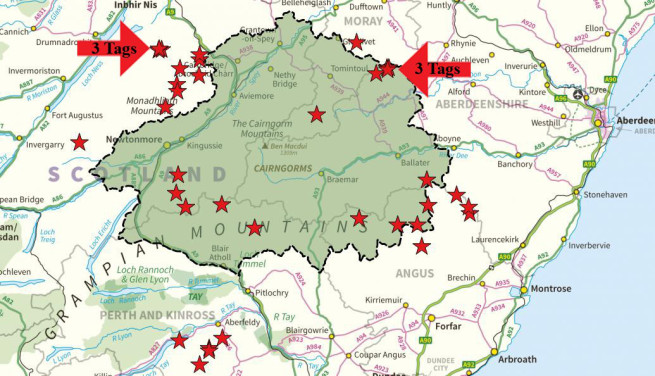
Golden eagles are not the only victims of wildlife crime in and around the CNP. This RPUK map below, based mostly on RSPB data, shows raptor persecution incidents between 2005-2016. Only one of these (just outside the CNP boundary on Kildrummy Estate) has resulted in a successful prosecution. With such clear evidence of wildlife crime it’s easy to see why the CNP was chosen as the first location for this pilot scheme.

This pilot scheme was the Government’s alternative to extending the powers of the SSPCA to allow it to investigate a wider suite of wildlife crime (including raptor persecution) – a decision made after six years of Governmental deliberation under five different Environment Ministers.

It also emerged in 2018 that this pilot scheme was an alternative to the Government’s 2016 manifesto pledge to establish a Wildlife Crime Investigation Unit as part of Police Scotland – a pledge on which it has now reneged (see here).

The idea was that the police special constable scheme could be rolled out across Scotland “if judged to be successful” in the CNP, but we weren’t told the criteria that would be used to judge this ‘success’.

The scheme was formally launched in March 2018 (see here) and nothing more was heard of it.

Just over a year later in April 2019 we asked the Cairngorms National Park Authority the following questions about the scheme:

Here’s the response:

So basically after a year of operation, one of the main project partners couldn’t tell us anything about the scheme.

Fast forward six months to November 2019 and Scottish Greens MSP Mark Ruskell thought it was time more questions were asked. Here are his two Parliamentary questions and Roseanna Cunningham’s answers:

S5W-26349 Mark Ruskell (Mid Scotland and Fife) (Scottish Green Party): To ask the Scottish Government how much funding (a) it and (b) the Cairngorms National Park Authority allocated each year to the Wildlife Special Constables pilot project.

Roseanna Cunningham: The Scottish Government agreed to contribute £18,000 and the Cairngorms National Park Authority agreed to provide £10,000 for the Wildlife Special Constables pilot project.

S5W-26346 Mark Ruskell (Mid Scotland and Fife) (Scottish Green Party): To ask the Scottish Government what the outcome was of the Wildlife Special Constables pilot project; how many constables participated each month in this, and how many suspected crimes they reported, also broken down by how many led to subsequent (a) arrests, (b) charges, (c) prosecutions and (d) convictions.

Roseanna Cunningham: a)The Scottish Government is currently undertaking an evaluation of the Special Constable Pilot Project in conjunction with Police Scotland and the Cairngorms National Park Authority. We will announce a decision on the future direction of the project in due course.

b) There were five special constables in the project, employed on a part-time basis.

c) and d) From the information gathered in the review conducted by Police Scotland, there were no recorded crimes reported by the Special Constables during their patrols in the 12 month trial period. However, Special Constables were involved in meeting stakeholders and partners operating within the Cairngorms National Park to build relationships and understand the needs and demands of National Park users which will aid future intelligence gathering.

Gosh, it’s easy to see why the Scottish Government’s evaluation of the pilot scheme is taking so long, what with having to count ZERO reported wildlife crimes.

Meanwhile satellite tagged raptors continue to disappear in suspicious circumstances in the Cairngorms National Park (white-tailed eagle here; hen harrier here; hen harrier here and hen harrier here); birds are still being illegally poisoned in the Cairngorms National Park (here) and birds of prey are still being caught by illegally-set traps in the Cairngorms National Park (golden eagle here).

But it’s ok, nothing to worry about because £28K has just been spent on ‘building relationships and understanding the needs and demands of National Park users’.

FFS.

Tabloid hysteria over ‘giant psycho eagle’

We’re often asked by colleagues overseas why attitudes in the UK towards birds of prey are so ignorant and outdated.

Here’s one explanation – sensationalist nonsense being published in the media. We’ve seen this many times before, including here and here when the Scottish Gamekeepers Association were writing to the Scottish Government fearing that white-tailed eagles might eat children.

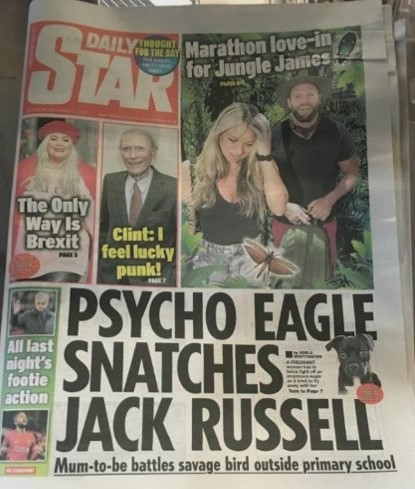
Here’s another classic example of unfounded hysteria from the last few days. This is an unsubstantiated story about an alleged eagle attack on a dog in Essex and unbelievably it made front page news! (Thanks to the blog reader who sent this photo).

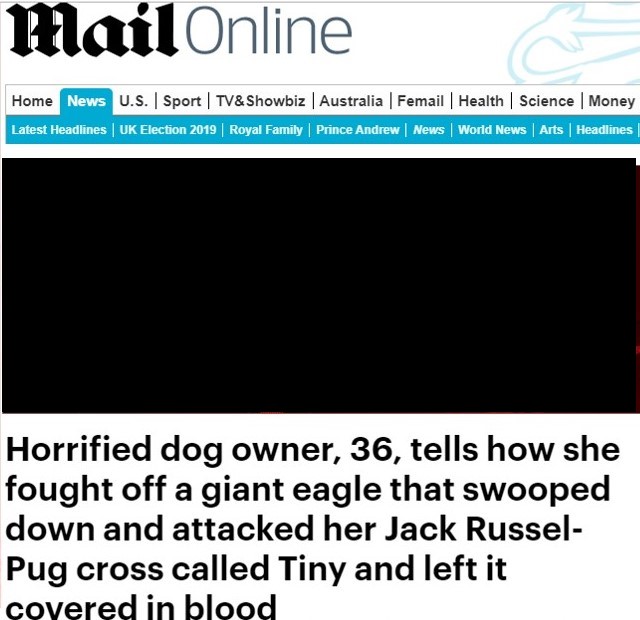
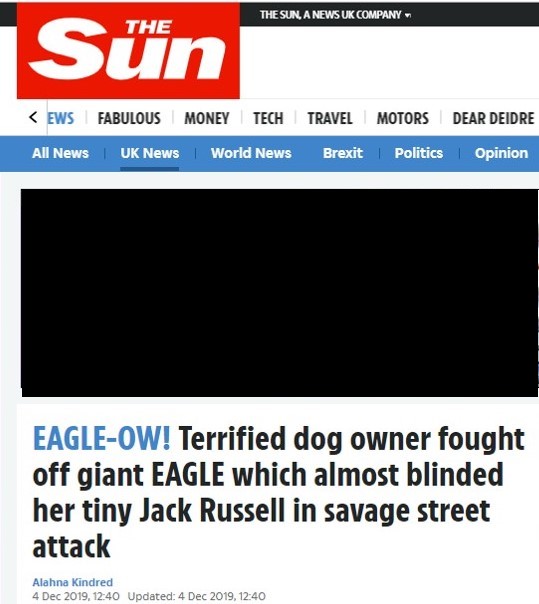
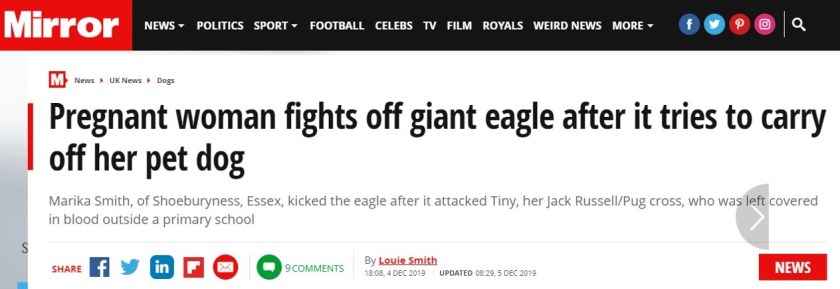
At least three other tabloids also covered it:

Note the telling hallmarks of a tabloid story – the woman was pregnant, the alleged incident happened near a primary school, there was blood, the eagle was ‘giant’, it ‘almost blinded’ the dog and it was a ‘savage attack’.

The fact that there was no photographic evidence nor credible ID of the bird matters not, apparently. Some of the tabloids have illustrated the news article with a stock photo of a white-tailed eagle and others have mentioned golden eagles.

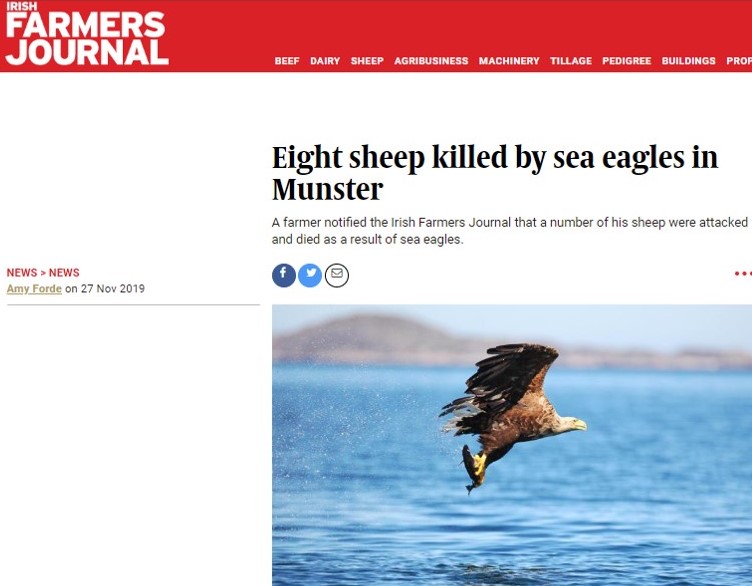
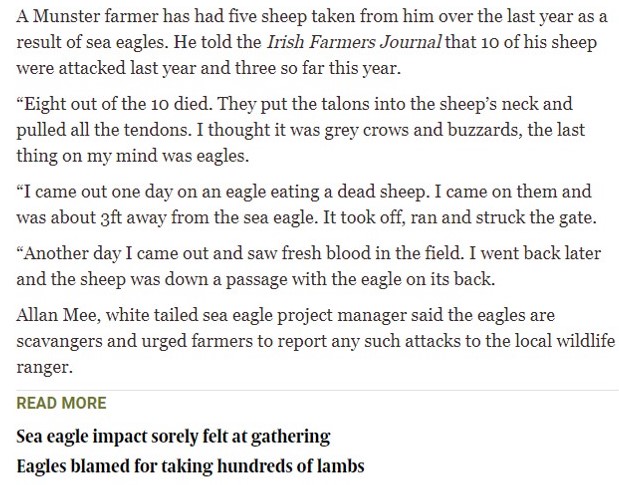
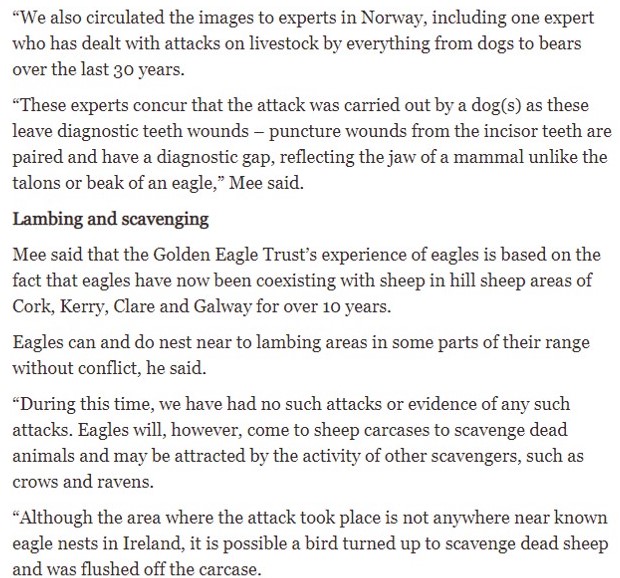
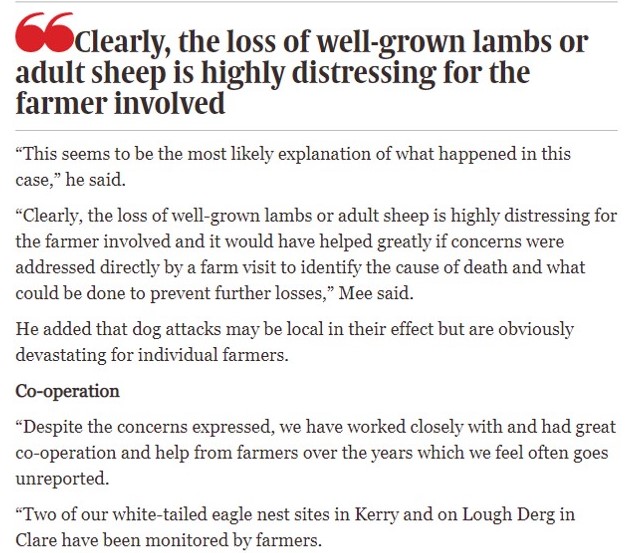
Meanwhile, the Irish Farmers Journal ran with an article recently, claiming that white-tailed eagles had been killing sheep:

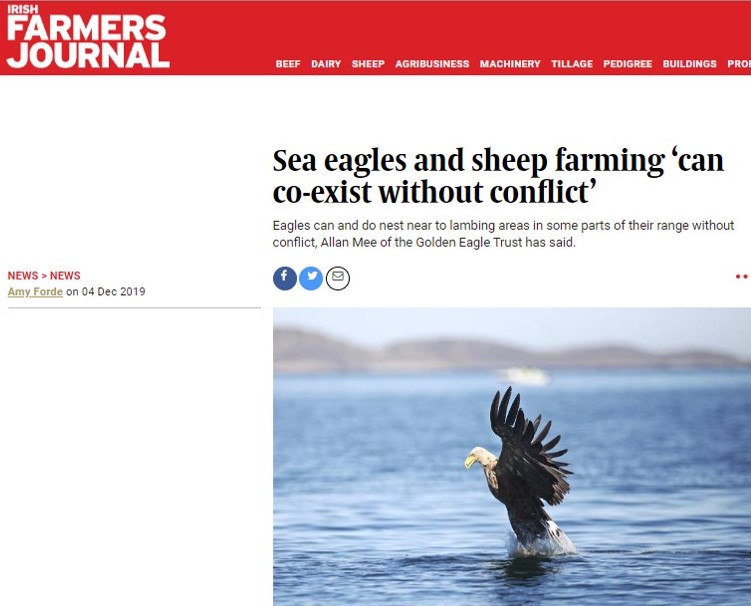
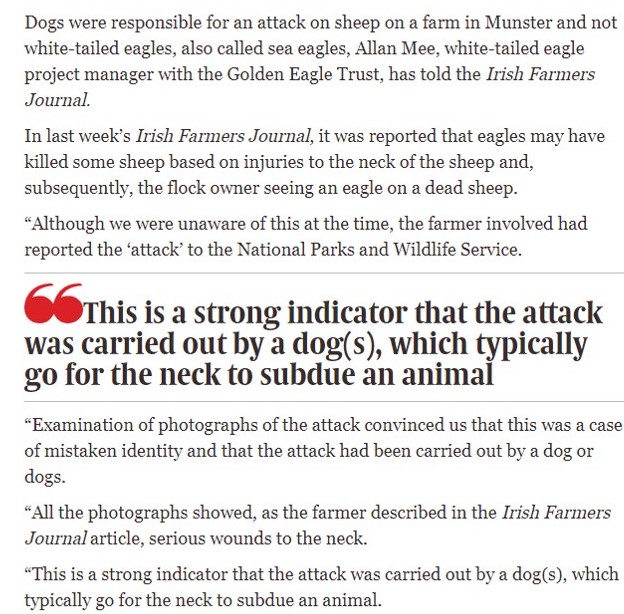
In an unusual but welcome u-turn, the paper then ran with this follow-up article a couple of days ago after being contacted by Dr Allan Mee who has led the white-tailed eagle reintroduction project in Ireland since 2007. Well done, journalist Amy Forde and the editor of the Irish Farmers Journal for more measured, responsible reporting.

‘New Deal for Nature’ report is good but could be stronger

Green Party press release (5 Dec 2019)

Lucas launches New Deal for Nature

Caroline Lucas, Green parliamentary candidate for Brighton Pavillion, has today (5 December) launched a New Deal for Nature, an independent report commissioned to inform the Green Party’s policies on nature and stimulate debate on the future of UK wildlife.

The report, which has been written by a group of leading UK conservationists and nature writers, focuses on eight areas, including farming, schools and young people, urban wildlife, the marine environment and biosecurity. Among its 80 recommendations are suggestions for new national parks, with a goal of designating 20 per cent of Britain as a national park, and for all farmers to be paid to devote a minimum of 15 per cent of their land to nature.

With regard to schools and young people, the report suggests that all primary schools should deliver one hour a day outdoor learning and each primary school in the UK should be twinned with a farm.

Launching the report at The Linnean Society in central London, Lucas also outlined the Green Party’s commitments on nature, explaining that the party’s manifesto has more than 70 proposals dedicated to nature and wildlife.

[Report launch panel. Photo by Ruth Tingay]

The party’s pledges include a 10-year transition to agro-ecological farming, more outdoor learning and the introduction of a GCSE in Natural History to encourage better knowledge and understanding of nature.

The manifesto also includes proposals for a new Sustainable Economy Act, which will set legally-binding targets for biodiversity, soil health and water quality.

With the 2019 State of Nature report revealing that 41 per cent of species in the UK have declined since 1970, Lucas stressed the urgency of the situation: “We are not only running out of time on the climate emergency, there’s also little time left to reverse the catastrophic decline in nature and wildlife. This election has to mark a turning point and the moment when people vote for nature.”

Other parties still ignore the fundamental economic and infrastructure changes we need to truly protect the natural world. We’re looking ahead to what’s being called the ‘2020 super year’ for nature and climate with crucial international summits taking place.

Yet we’re also looking at a Johnson Brexit deal that is even worse for the environment and nature than the May hard-Brexit deal. Now more than ever, we need more Green MPs to stand up for wildlife and put the wellbeing of people and nature first across all policy making.”

Commenting on the report, Michael McCarthy, Former Environment Editor at The Independent and author of ‘The Moth Snowstorm – Nature and Joy’, said: “The terrible destruction of British wildlife over the last half century has only just begun to dawn on the public in the last five years, and it has still barely touched the political agenda.

So it is hugely heartening to see the Greens commission a report which explicitly addresses this tragedy, and suggests the political measures necessary for the recovery of our lost birds, butterflies and wild flowers, as well as the other steps needed for our part of the natural world to regain its health. This issue affects us all, every citizen, indeed every voter. It may not decide the election, but thank God the Greens are pushing it up the agenda, which is where it needs to be.

ENDS

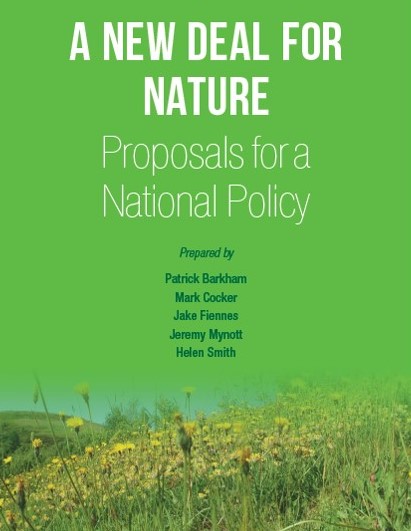
You can download the report here: A New Deal for Nature

Overall, this is a strong set of proposals, many of them influenced by the Peoples Manifesto for Wildlife, coordinated by Chris Packham et al and published in 2018. This influence has been acknowledged by the report’s authors and Rob Sheldon has also blogged about it this morning.

And as Mark Avery noted yesterday, a lot of the proposed policies in this report will find favour with many in the conservation and environmental sector but probably not with the likes of the Moorland Association, BASC, GWCT or the Countryside Alliance. One of the report’s co-authors, Jake Fiennes, a former gamekeeper and now General Manager (Conservation) at Holkham Estate can expect to be at the receiving end of some nasty abuse for daring to put his name to some of these proposals.

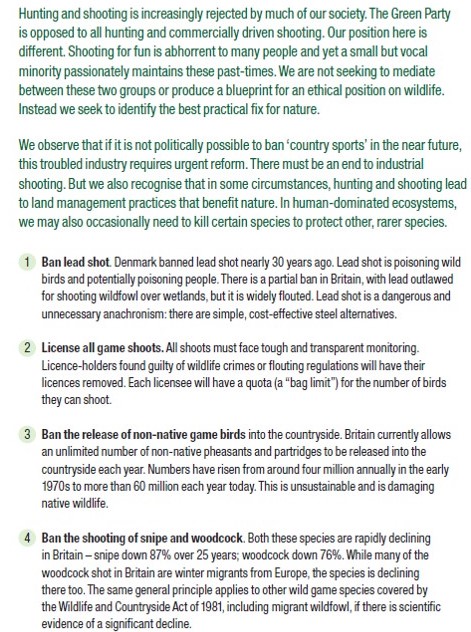
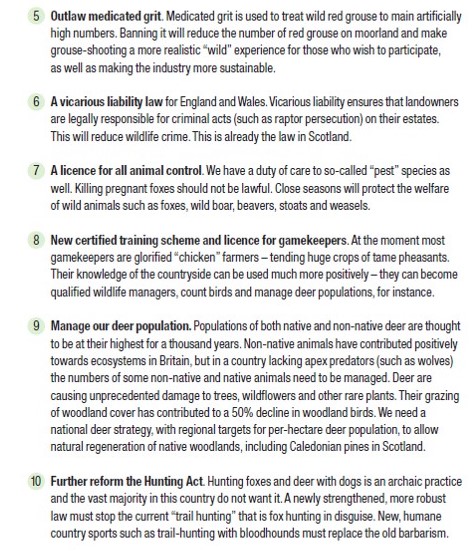
Of particular interest to us was the section on Hunting and Shooting, as follows:

Interestingly, despite what could be described as some hard line policies (e.g. banning the release of non-native game birds), a proposal to ban driven grouse shooting is notably absent. There’s a bit of tinkering around the edges of grouse moor management, e.g. banning medicated grit and licensing of all game shoots, but no mention of heather burning and no explicit suggestion of an outright ban on driven grouse shooting.

A question was posed to the panel about this obvious omission and the response went along the lines of, ‘We have suggested a ban but we’ve just been a bit cleverer about doing it’. It was argued that the ban on medicated grit would effectively cause the artificially-high density of grouse to diminish and thus driven grouse shooting would become unviable.

Unfortunately this simplistic argument doesn’t stand up to scrutiny. Even if medicated grit was banned, there’s still the practice of direct dosing where red grouse are captured at night to have oral anti-wormer drugs forced down their throats but even without direct dosing (assuming that too, was banned), some grouse moors are still able to maintain high densities of red grouse, as discussed by grouse shooting ‘guru’ Mark Osborne here. All that would happen if medication was banned would be a return to the cyclical ‘boom and bust’ years where periodically the grouse stocks would fall to the effect of the strongyle worm but would then recover for shooting to resume all over again.

There’s no question that medicated grit should be banned, not least because it’s been identified as an emerging environmental contaminant of acute and chronic toxicity in studies elsewhere, as well as being implicated in the rapid spread of disease (via grit trays on grouse moors), but to consider a ban to be an effective way of bringing down driven grouse shooting is just naive.

It seems strange that a report that’s so radical in some ways has gone out of its way to avoid explicitly calling for a ban on driven grouse shooting. That’s disappointing and a bit of a missed opportunity, to be honest.

Well-deserved awards for two police officers fighting illegal raptor persecution

Big congratulations to Sgt Stu Grainger (North Yorkshire Police) and Superintendent Nick Lyall (Chair, Raptor Persecution Priority Delivery Group) who have both been recognised for their work fighting illegal raptor persecution.

At the Wildlife Crime Enforcers Conference last weekend Stu Grainger received a Superintendents Commendation from Nick Lyall for his ‘tireless and outstanding commitment’ to this field.

Stu has been actively involved in Operation Owl since it began as a regional awareness-raising campaign in 2018 and this year he coordinated the roll-out of the national campaign. He’s been involved in the organisation and delivery of raptor persecution training events for national park rangers and others across North Yorkshire as well as giving talks to local interest groups. He also turns up to support other awareness-raising events that aren’t even in his patch, in his own time and at his own cost.

North Yorkshire Police are lucky to have him and we’re lucky to have such a dedicated and committed officer looking out for birds of prey. Well done and thank you, Stu.

Nick Lyall needs no introduction to the readers of this blog and he received the WWF Wildlife Crime Operation of the Year Award for his vision of turning Operation Owl from a regional to a national awareness-raising campaign.

Nick’s written a blog about his and Stu’s awards here.

Nick’s brought an unprecedented level of energy, enthusiasm and transparency to his role as Chair of the RPPDG this last year and that’s been very, very welcome. It’s also meant he’s drawn unwanted and defamatory attention and harassment from some within the game-shooting sector. His first meeting of the RPPDG was boycotted by the tantrum-throwing BASC, Countryside Alliance, Moorland Association, National Gamekeepers Organisation and others (see here) and then his personal integrity was publicly questioned by the National Gamekeepers Organisation (see here), leading to further abuse from individuals on social media.

Most others would have thrown in the towel by now. Who’d want to put up with that sort of abuse, especially when volunteering to do this role in addition to full-time duties as a police superintendent? Fortunately, Nick Lyall is a resilient bugger and he’s also determined to make a difference for birds of prey in the UK.

Thank you, Nick.

Poisoned red kite in Nidderdale: two local businesses put up a reward

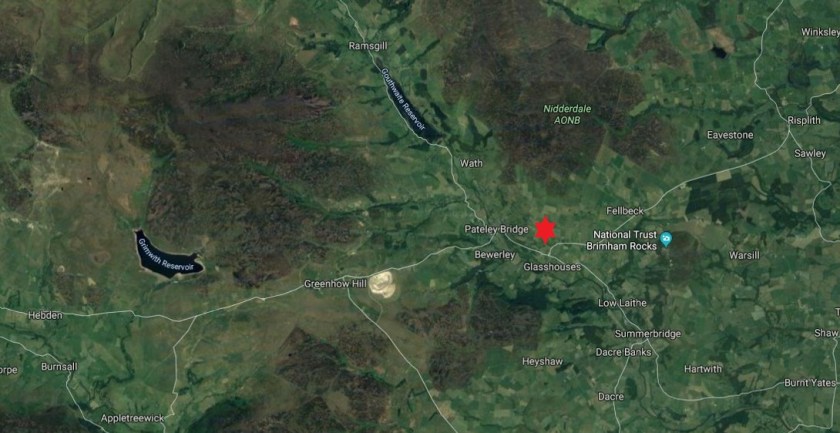
Following the news last week that yet another red kite had been found poisoned in Nidderdale (see here), the Northern England Raptor Forum (NERF) has published a statement.

It’s well worth a read, here.

[A poisoned red kite]

A selected quote from the NERF statement:

‘The population of Pateley Bridge and surrounding area is less than 3,000 people. Whoever put the poisoned bait out in the open countryside and killed the Red Kite is most likely to live locally, shop locally, use the local pub and may have children or grand-children in the local school. In short if you live in the Pateley Bridge area the person indiscriminately putting poisoned baits out in your countryside, putting your life, the life of your pets and local wildlife at risk is your neighbour.

In addition to the physical threats posed by the use of dangerous poison there is also the reputational damage caused to this Area of Outstanding Natural Beauty and local businesses. This potential reputational damage was recognised by Pateley Bridge businessman Keith Tordoff in 2017 when he and a fellow businessman, jointly offered a reward for information following the unlawful killing of another Red Kite. On that occasion the bird was shot near Greenhow‘.

[Photo by Ruth Tingay]

A few days ago RPUK was contacted by a local businessman from Pateley Bridge who has once again put up a £1,000 reward for information leading to the arrest of the suspected poisoner(s). The businessman prefers to stay anonymous at this point for fear of retribution but he told us that another local businessman has also agreed to put up a £1,000 reward if the information received leads to a conviction. There may well be other members of the local community stepping forward. The businessmen have been in contact with the RSPB and North Yorkshire Police to facilitate the reward process.

Ongoing concern about the level of wildlife crime in Nidderdale has been raised by residents and visitors alike for a number of years, particularly on the extent of illegal raptor persecution and such is the strength of feeling that the Nidderdale AONB Partnership has now included a specific objective on raptor conservation in its AONB Management Plan. As part of this work, an evidence report was published in September 2019 which placed grouse moor management firmly in the frame.

Incidentally, those of you who read last week’s report on this latest poisoned red kite will know that there was an inexplicable eight-month delay between the discovery of the poisoned red kite and a police appeal for information. It was the latest in a number of cases (as yet unpublished) in North Yorkshire that have caused raised eyebrows, not least because of the previous exemplary efforts (e.g. here) of the North Yorkshire Police Rural Task Force, a team which includes some of the UK’s most dedicated and knowledgeable police officers tackling raptor persecution crimes through Operation Owl.

Last weekend at the annual Wildlife Crime Enforcers Conference we were able to have some full and frank discussions about recent events, including the delayed appeal for information about this poisoned red kite, with some senior members of North Yorkshire Police. The response was impressive, the explanations plausible (it would be inappropriate to provide detail here), the admission of mistakes made admirable, and the determination and commitment to target the offenders was unquestionable.

We look forward to being able to report some more success stories from the UK’s worst raptor persecution hotspot.

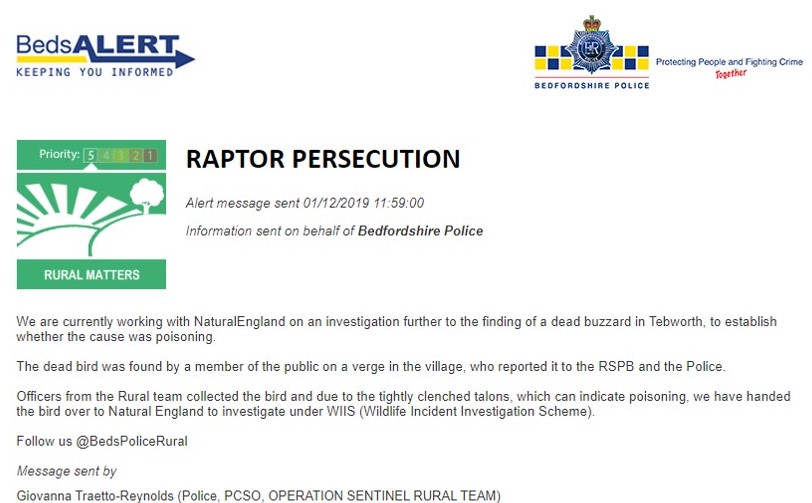
Police warn public about potential buzzard poisoning in Tebworth

Bedfordshire Police issued the following statement yesterday:

This is good communication from the police. Although the alert doesn’t say when the buzzard was found it sounds as though it was a recent discovery and IF it does turn out to have been poisoned, the toxicology results may not be available for several weeks so this early police alert provides local dog walkers etc with due warning.

Good work, Bedfordshire Police.

SNH explains decision to impose General Licence restriction on Leadhills Estate

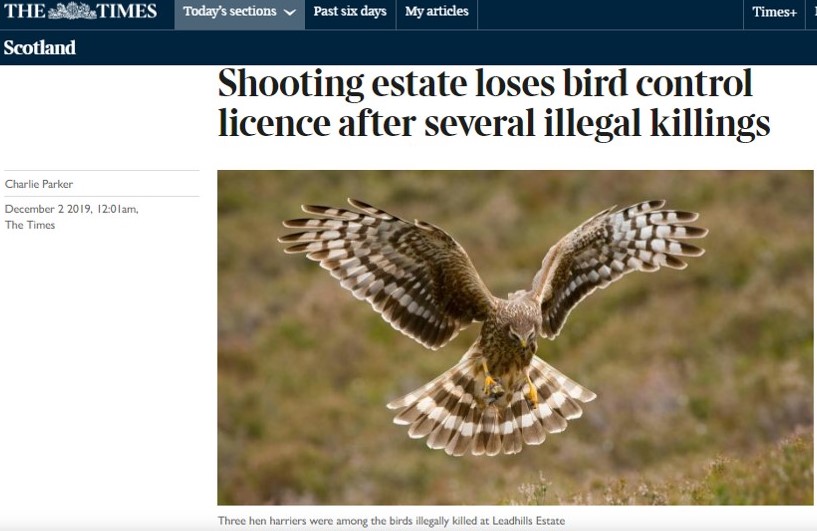
Further to last week’s news that Scottish Natural Heritage (SNH) has finally imposed a three-year General Licence restriction on the Leadhills Estate in South Lanarkshire (see here and here), there is now an explanation, of sorts, from SNH on the decision to issue the restriction notice.

It wasn’t just one alleged incident of illegal raptor persecution that triggered this sanction, but a series of them.

Well done to journalist Charlie Parker at The Times (Scotland) for getting the information.

According to Charlie’s article, SNH’s decision was based on “clear evidence” of the ‘illegal killing of a short-eared owl, two buzzards and three hen harriers’ that were ‘shot or caught in traps’ on Leadhills Estate since 1 January 2014 (when SNH was given the power to impose a General Licence restriction on estates or individuals in Scotland). SNH has also claimed that ‘wild birds’ nests have also been disturbed’, although there is no further detail on this.

An unnamed SNH spokesperson is quoted in the article as follows:

The police have investigated each of these cases and while it is very clear that offences have been committed, as is often the case with these types of crime it hasn’t been possible to gather the evidence to identify the person responsible.

There is also similar historic evidence of incidents on this property pre-dating the incidents, although SNH’s decision is based on incidents which occurred since January 1, 2014“.

Most of the incidents listed by SNH have been well publicised –

However, the alleged incident relating to a third hen harrier is less clear. SNH may be referring to the discovery in 2015 of a satellite-tagged hen harrier called Annie who had been shot, although her corpse was found on a neighbouring estate, not on Leadhills Estate. Or, perhaps there is another alleged incident relating to the shooting or trapping of a hen harrier on Leadhills Estate that has yet to be publicised? Time will tell.

There are two more quotes in The Times article that are worth a mention. First, one from Ian Thomson (Head of Investigations, RSPB Scotland) who said Leadhills Estate had a “long and appalling history” of confirmed raptor persecution incidents and,

While this sanction is positive news, it is becoming increasingly clear that the threat of such a penalty is no deterrent to those whose sole motivation is the maximising of grouse numbers. Until sporting estates face the potential removal of the right to shoot, we do not believe there is a sufficient deterrent to those who continue to slaughter our birds of prey.

Meanwhile, an unnamed spokesperson for Leadhills Estate is quoted as follows:

The decision to restrict the general licence does make clear it is not inferring any criminal activity on the part of the estate. The estate condemns all forms of wildlife crime and all employees and agents of the estate are in no doubt as to their responsibilities“.

It’s our understanding that the General Licence restriction ‘does not infer any responsibility for the commission of crimes on any individuals‘ This is the exact wording from SNH’s restriction notice (see here). This statement is not the same as the one being claimed by Leadhills Estate, which argues that the restriction ‘is not inferring any criminal activity on the part of the estate’.

This sounds like real twilight zone material. SNH is holding the estate to account by imposing a sanction for alleged wildlife crimes because there is insufficient evidence to attribute the activity to an individual estate employee and the estate is saying that SNH’s decision to impose the sanction doesn’t infer any responsibility on the estate. Er….

All clear?

More to come on the Leadhills Estate case soon…


General Licence restriction at Leadhills Estate: welcome to the Twilight Zone

Earlier this week it was announced that Scottish Natural Heritage (SNH) had finally imposed a three-year General Licence restriction on Leadhills Estate in South Lanarkshire ‘on the basis of evidence provided by Police Scotland of wildlife crime against birds’ (see here).

Before we proceed any further you should be aware that you are now entering the twilight zone, suspended somewhere between reality and fantasy.

[Leadhills Estate, photo by Ruth Tingay]

We’re in that bonkers scenario where despite Police Scotland providing “clear evidence that wildlife crimes have been committed on this property” (according to Nick Halfhide of SNH), the imposition of the General Licence restriction “does not infer responsibility for the commission of crimes on any individuals“. This leaves us on wafer-thin legal ice, not able to state what to us is the bleedin’ obvious for fear of a defamation claim, even though the original intention of Scottish Ministers was to use a General Licence restriction as a “reputational driver“.

General Licence restrictions have been available to SNH (although rarely used) since 1 January 2014, introduced by then Environment Minister Paul Wheelhouse in response to continuing difficulties securing criminal prosecutions for those people still killing birds of prey. Paul instructed SNH to withdraw the use of General Licences (available for legal predator control) on land where crimes against raptors are believed to have taken place but where there was insufficient evidence to instigate criminal proceedings. The decision to withdraw the licence is based on a civil standard of proof which relates to the balance of probability as opposed to the higher standard of proof required for a criminal conviction.

A General Licence restriction is not without its limitations, and has even been described as farcical, particularly as estates can simply apply for an individual licence instead which allows them to continue predator control activities but under slightly closer scrutiny.

The Leadhills Estate and the surrounding area has been at the centre of wildlife crime investigations for decades. According to RSPB Scotland there have been over 60 confirmed raptor persecution incidents uncovered here, but only two successful prosecutions: a gamekeeper convicted for shooting a short-eared owl in 2004 and a gamekeeper convicted for laying poisoned baits out on the moor in 2009.

There have been a number of reported wildlife crimes here in recent years but because SNH isn’t keen on transparency, we don’t know which ones triggered the decision to impose the General Licence restriction. Was it the alleged witnessed shooting of a hen harrier in May 2017; the alleged witnessed shooting of a short-eared owl just a few weeks later and whose body was recovered; the discovery of a buzzard in 2018 that was found to have been shot twice; the filmed buzzard that according to the RSPB was likely killed in a crow trap in January 2019, or was it the discovery of a male hen harrier in May 2019 whose leg was almost severed by an illegally-set trap next to its nest?

We do know, from SNH’s press statement, that SNH believes “there is clear evidence that wildlife crimes have been committed on this property……” which sounds like multiple incidents have informed SNH’s decision to impose the restriction:

And because this is the twilight zone we also need to draw to your attention the Estate’s outright denials of any involvement in any of these alleged crimes – we particularly liked this one, in response to the illegally-trapped hen harrier earlier this year. Bless those little gamekeepers, finding it “very difficult” to cope with repeated crimes carried out by ‘unknown third parties’.

It’s probably just kids in stolen vehicles, right? Riding around the estate in 4 x 4s or on quad bikes, firing shotguns at protected wildlife. Let’s face it, who else would have vehicular access, firearms and a motive for wanting to kill birds of prey? Nope, nobody that we can think of.

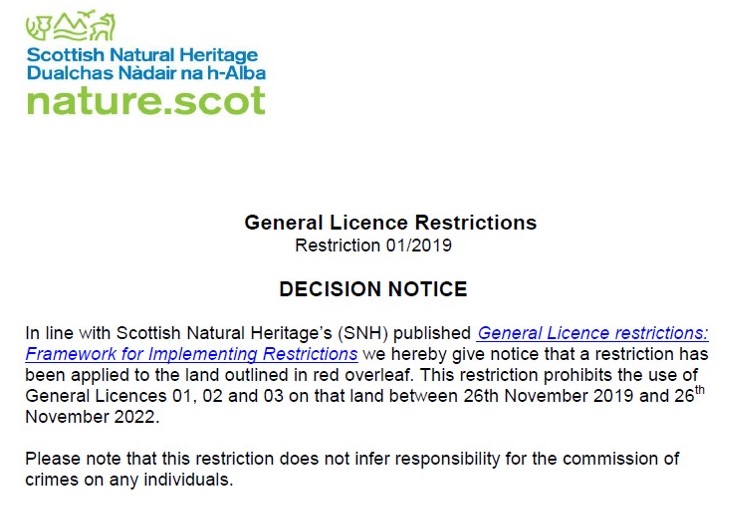
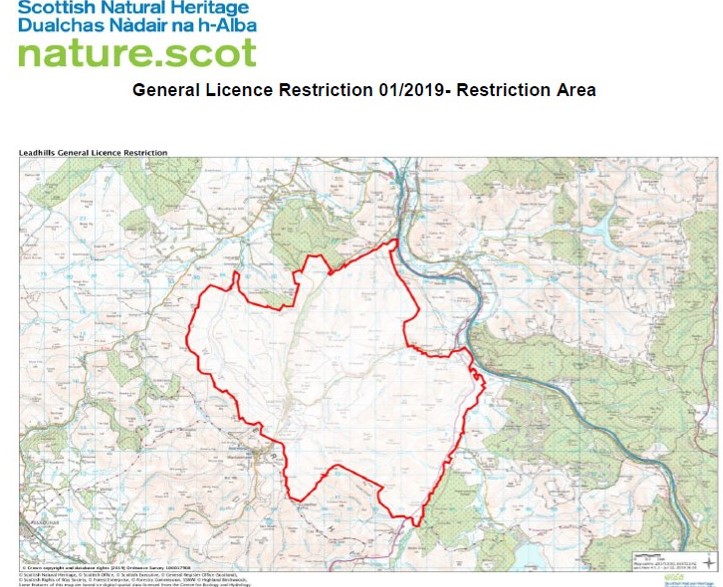
Here is a copy of SNH’s restriction notice for Leadhills Estate, for the record:

We’ve got a lot more to say about this particular General Licence restriction but we’ll have to come back to it, hopefully within a few days. There are all sorts of interesting aspects to explore……

UPDATE 2 December 2019: SNH explains decision to impose General Licence restriction on Leadhills Estate (here)

Yet another red kite found illegally poisoned in Nidderdale AONB

Press release from RSPB (28 November 2019)

Red Kite poisoned in Nidderdale

North Yorkshire Police and the RSPB are appealing for information after a protected red kite was found poisoned in an area of North Yorkshire with the worst record for the illegal killing of birds of prey in England.

A member of the public found the bird dead under a tree in Blazefield, just outside Pateley Bridge, Nidderdale in March 2019. North Yorkshire Police submitted the bird to be tested for poison, and results show the bird tested positive for the insecticide bendiocarb. This is one of the top five most commonly abused substances involved in raptor poisoning cases. It is also extremely toxic to people and pets.

Killing a bird of prey is illegal under the Wildlife and Countryside Act 1981. Anyone found responsible for this bird’s death faces an unlimited fine and/or up to six months in jail. The police are now appealing for information. 

[A dead red kite]

[Blazefield, sandwiched between some of the most notorious wildlife-killing grouse moors in the UK]

Howard Jones, RSPB Investigations Officer, said: “Poison baits deliberately placed out in the open, where anyone could find them, puts people, pets and wildlife in danger. Based on government toxicology data, from 2009 to 2018 the RSPB recorded an astonishing 369 incidents of the illegal use of pesticides to kill or target birds of prey. Bendiocarb, a very toxic insecticide, is something we come across again and again being used for this purpose.”

According to data collated by the RSPB, the Nidderdale area – which is dominated by extensive driven grouse shooting – is the worst black spot for raptor persecution crimes in England, clocking up more incidents in the last seven years than anywhere else.

In September 2019, the Nidderdale AONB published their ‘bird of prey evidence report’ which highlighted the impact of illegal persecution upon the protected landscape’s birds of prey. The report stated that ‘The spread of red kites into the AONB is being restricted by illegal persecution’.

In August 2019, North Yorkshire Police appealed for information after a red kite was found shot and also poisoned in Wath, near Harrogate, within the Nidderdale AONB. This bird contained two pieces of shot, one of which was from an older injury which it had survived, indicating it had been shot on two occasions. But it was also found to contain a cocktail of highly toxic pesticides, and this was deemed the ultimate cause of death.

And in April 2019, a satellite-tagged hen harrier named River was found dead on Nidderdale’s Swinton Estate, following a search by North Yorkshire Police and RSPB Investigations. She too had been illegally shot.

Howard Jones added: “Nidderdale has become a death zone for birds of prey. Our message to the community is this: If you enjoy spending time in the countryside, please be vigilant. Report anything suspicious. If you have information about someone killing birds of prey, please speak out. This is happening on your doorstep, to your wildlife. Let’s make it known that this barbaric, relentless destruction of wildlife is not something North Yorkshire will tolerate.

“Finally, if you are being instructed to kill birds of prey, please do not break the law on someone else’s behalf. Call our confidential hotline on 0300 999 0101.”

ENDS

Eight months for this appeal for information to emerge? That’s pathetic. Let’s hope there was at least a local appeal for information – a spokesperson from North Yorkshire Police is quoted in this article in today’s Yorkshire Post saying “Despite extensive investigations……” so perhaps this included warnings to the local community that some criminal psychopath had been laying out deadly poisons in the area. Also interesting to note that the Yorkshire Post article says the banned poison Isophenphos was also detected in the kite’s carcass.

Regular readers of this blog will be only too aware of Nidderdale AONB’s reputation as a massive wildlife crime scene. We’ve blogged about it many, many times including the poisoning and shooting of red kiteshen harriersbuzzardsmarsh harriers on Nidderdale grouse moors (as reported by the AONB partnership in September 2019). We’ve also seen how the local community is turning against the criminals in their midst which is hardly surprising when according to the Chair of the Nidderdale AONB these crimes are “starting to have a damaging effect on tourism businesses”. 

[Photo by Ruth Tingay]

Here’s a map we produced a while ago showing the boundary of the Nidderdale AONB (yellow line), illegally killed red kites (red dots), missing satellite-tagged hen harriers (orange stars), shot hen harrier Bowland Betty (red star), shot hen harrier River (red triangle, which we now know should be closer to the red star on the Swinton Estate).

UPDATE 3 December 2019: Poisoned red kite in Nidderdale – two local businesses put up a reward (here)

Hen harrier Ada ‘disappears’ on grouse moor in North Pennines AONB

Joint press release from Northumbria Police and RSPB (27 November 2019)

Hen Harrier Ada Disappears

Today, Northumbria Police and the RSPB have issued an appeal for information following the sudden disappearance of yet another satellite tagged hen harrier, a female bird known as Ada.

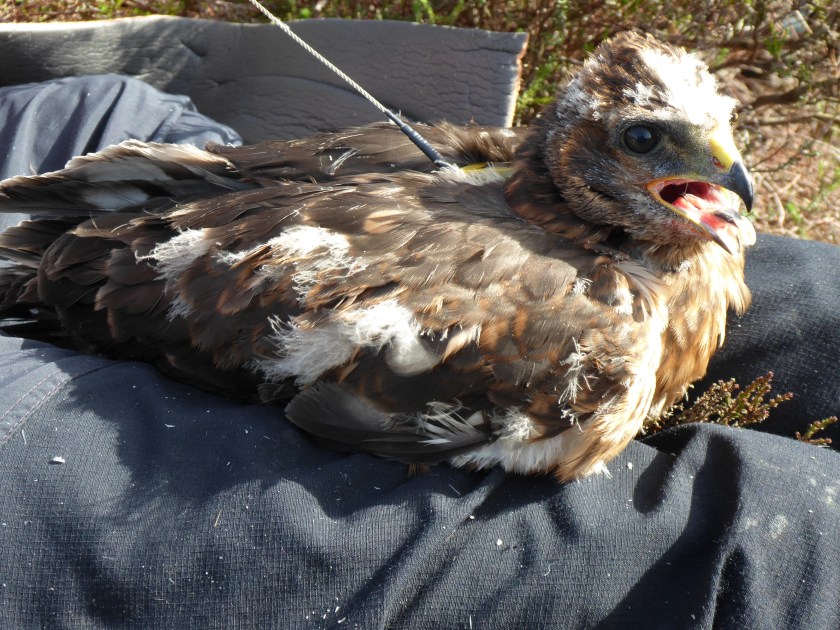
[Hen Harrier Ada being satellite tagged in the summer. Photo from RSPB]

Ada hatched on a nest on the Scottish borders this summer (2019). She was fitted with a lightweight satellite tag as part of the RSPB’s Hen Harrier LIFE project, to learn more about the journeys made by these rare birds of prey and the survival challenges they face.

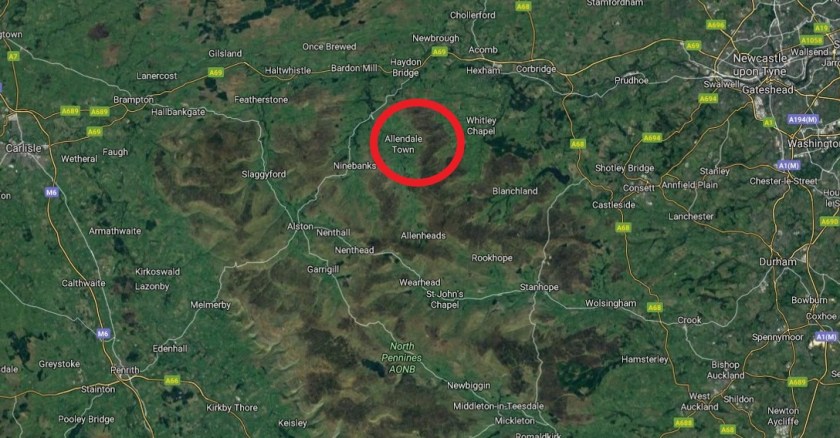
Ada was the first of the chicks tagged this summer to leave her nest and proved to be naturally adventurous. After fledging she flew north, spending some time on a disused golf course near Dunbar, then she headed south to the North Pennines. On the morning of 10 October 2019 she sent her last transmission from an area of grouse moor east of Allendale, Northumberland. Her tag showed no signs of malfunction and there were several satellites passing over, so it was expected to continue to provide data. RSPB staff were in the area at the time the tag would have transmitted, but neither the bird nor her tag could be found nor have been heard from since.

Her disappearance is being treated as suspicious and was reported to the police.

All birds of prey are protected by the Wildlife and Countryside Act 1981. To kill or injure one is a criminal offence and could result in an unlimited fine or up to six months in jail. Yet the evidence shows hen harriers continue to be killed, or disappear in suspicious circumstances, particularly on or near land managed for driven grouse shooting.

Scientific research published in March 2019 showed that 72% of the satellite tagged hen harriers in their study were killed or very likely to have been killed on British grouse moors, and that hen harriers were 10 times more likely to die or disappear over areas of grouse moor relative to other land uses.

Dr Cathleen Thomas, Senior Project Manager for the Hen Harrier LIFE project, said:

Over 30 chicks were tagged this summer and we’ve watched with interest as they’ve grown up and flown around the country. We’re absolutely gutted that Ada has disappeared in suspicious circumstances at just a few months’ old.

Emma Marsh, Director for RSPB England, said:

Hen harriers have become a rare breeding bird across the UK mainly due to illegal persecution by humans. In England, the last population survey recorded only four territorial pairs, despite scientific studies showing enough food and habitat to support over 320 pairs. Our own tagging work has shown that survival of young birds post-fledging is very low. This won’t change until something is done about illegal persecution. The Government’s own data has highlighted a loss of 72% of their tagged birds in suspicious circumstances, and we are calling on them to take vital measures to address this appalling situation.”

The RSPB is calling for the Government to introduce of a system of licensing for driven grouse moors, whereby this license to operate could be taken away should illegal activity be uncovered. We believe that this approach will act as a far greater deterrent than current legislation.

If you have any information relating to this incident, call Northumbria police on 101.

If you find a wild bird of prey which you suspect has been illegally killed, contact RSPB investigations on 01767 680551 or fill in the online form.

ENDS

It looks like Ada has vanished in the North Pennines Area of Outstanding Natural Beauty (AONB):

The tag Ada was carrying is believed to be the same make and model as the other tags deployed by the RSPB on hen harriers (the tag with a known reliability rate of 94%). Technical failures are possible (of course) but are rare (6%), and according to this researchtag failures have always been preceded by irregular transmission periods and, most importantly, a drop in battery voltage (another parameter monitored by the transmitter). This makes it relatively straightforward to distinguish between a likely mortality event and a likely transmitter failure”.

The hen harrier tags deployed by the RSPB are completely different to the new and untested tags that were deployed by Natural England on some of this year’s brood meddled hen harriers; tags that are known to have a high failure rate.