
It’s all change at Scottish Land & Estates (SLE), the landowners’ lobby group, with Dumfriesshire Dave (otherwise known as Lord David Johnstone) leaving and Mark Tennant replacing him as Chairman.
We’ve blogged a little about this change of leadership before (see here) as we were particularly interested in Mr Tennant’s association with Innes Estate in Morayshire where a gamekeeper was convicted for poison and firearms offences back in 2007 (and he was still listed as an estate employee three years later). We were curious to find out what Mr Tennant’s attitude would be now, 13 years later, to bird of prey protection and whether he’d be able to steer SLE away from the constant denials and distortions about ongoing raptor persecution that had characterised his predecessor’s term in office, and the one before that (e.g. see here, here, here, here, here, here, here, here, here, here, here, here, here).
We didn’t have to wait too long.
Yesterday Mr Tennant had a letter published in the Scottish Farmer (here). It’s reproduced here as follows:

Dear Sir,
In the last few months, as the perpetual noise of traffic and of that long line of planes landing at nearby airports has dimmed, those of us living in the cities have heard, some for the first time, the wonderful noise of songbirds. It is a sound that country dwellers take for granted. But in the cities, it has lit up our spring.
Yet we would not be hearing these sounds were it not for the campaigning of organisations like SongBird Survival to ensure these lovely birds’ preservation. Colin Strang Steel, a trustee of SongBird Survival, has written specifically about lapwings on his own farm and the effect of predation on waders by crows, gulls and badgers, the latter species having proliferated from 50,000 in the UK in 1980 to over 500,000 today. If we do not keep predator numbers within sustainable levels, our songbirds will slowly die out.
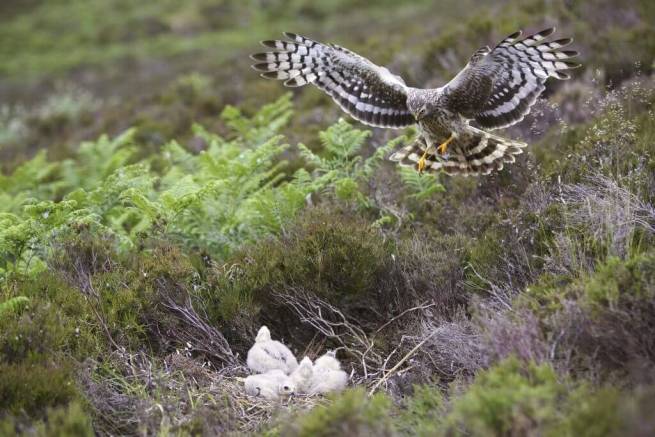
Nature is the world’s greatest gift, but it also provides our wildlife’s food chain, at whose head sits the human race. In that role we have a duty to ensure that, at no level, predation becomes so excessive that it threatens the smaller species. That is not to condone in any way the persecution of protected birds. To do so is both unacceptable and a crime. After all, who, with any appreciation of beauty, whether gamekeeper or landowner, does not marvel at the sight of the great wings of a hen harrier or hawk or kite catching the thermals as it floats majestically over the moors?
‘Protected status’ was originally accorded to animals and birds which were considered at risk, yet many currently enjoying this status, are no longer at risk. As with other predators we must ensure that they do not proliferate in a way that threatens the lapwings, and curlew chicks on which they feed, as other species such as foxes and crows already do.
If we are to allow our song birds to continue to thrive, we have to do two things: first control the species which are growing at such a rate that they threaten the songbirds’ existence – restrictions on predator control to the extent that it becomes unviable, poses a serious threat to the very species that we all want to protect – and, secondly, continue to increase the amount of natural habitat, which can foster their growth. I hope that this could be one of the outcomes of a future farming support system which rewards biodiversity and the delivery of public goods.
Land managers and farmers are the key to bringing this about. Many are members of Scottish Land and Estates and I would urge them to do everything they can to support SongBird Survival and to ‘Save Our Songbirds’. I also hope the RSPB and other like-minded organisations will join us in this task.
Yours sincerely
Mark Tennant
Chairman, Scottish Land and Estates
ENDS
For those who don’t know who Songbird Survival is (you lucky, lucky people), without whose campaigning there’d be no songbirds, apparently, take a look at the various entries on Mark Avery’s blog (listed here) for a flavour. It’s not difficult to see from where Mr Tennant has ‘learned’ his (mis)’understanding’ about predator/prey relationships.
Still, waxing lyrical about ‘the sight of the great wings of a hen harrier or hawk or kite catching the thermals as it floats majestically over the moors’ was utterly convincing, right?
Perhaps it’d be more convincing if SLE explained why Leadhills Estate is still a member of SLE and why Lord Hopetoun (Leadhills Estate) is still Chair of SLE’s Moorland Group. These are questions we’ve been asking for some time, e.g. here, and particularly since SNH imposed a three year General Licence restriction on Leadhills Estate in November 2019 following what it described as ‘clear evidence from Police Scotland that wildlife crimes had been committed on this estate’ (see here, here, and here).
Oh, and we’re also still waiting to hear from SLE about whether the Longformacus Estate was a member of SLE last year when gamekeeper Alan Wilson was convicted for a string of utterly depraved wildlife crimes (here) and if so, has SLE since expelled this estate from its membership?
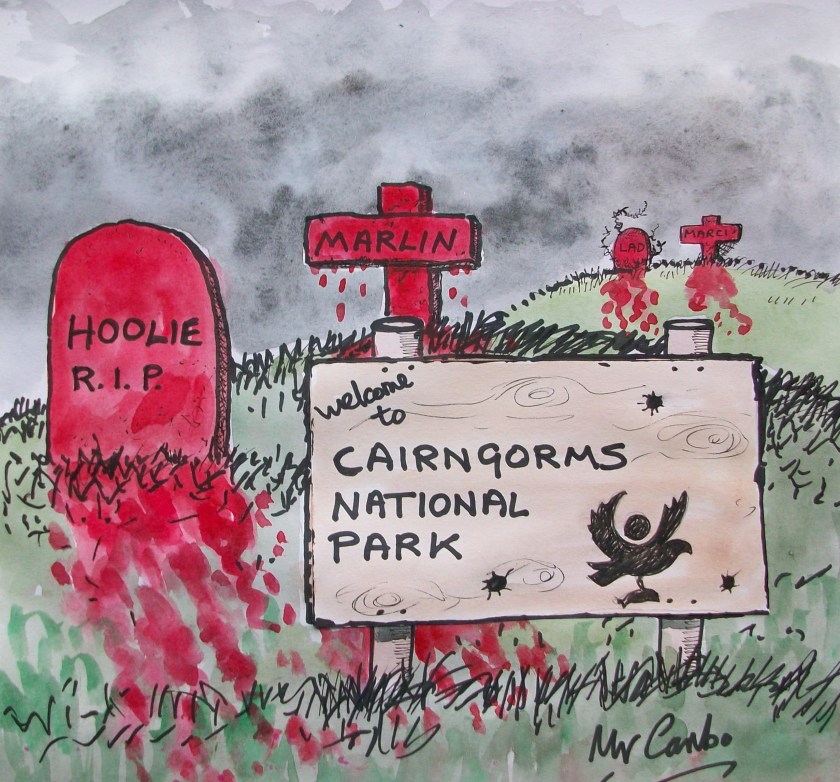
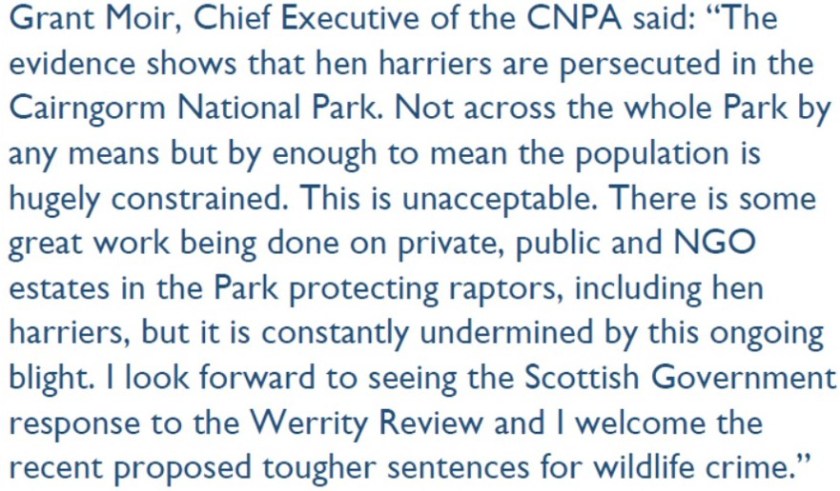
These seem perfectly legitimate questions to ask of an organisation that has a seat on the PAW Scotland Raptor Group and has enjoyed much publicity of its declared ‘zero tolerance of raptor persecution’ (claimed as recently as four days ago (here) in response to the news that two more satellite-tagged hen harriers had ‘disappeared’ in suspicious circumstances on grouse moors in the Cairngorms National Park, here).
To be honest, the other PAW Scotland Raptor Group members should also be pushing hard for answers to these questions. Perhaps they already are? If so, they need to start publishing the responses or reporting the silence.





 Raptor Persecution UK