Another golden eagle and another hen harrier suspiciously ‘disappeared’ on two Scottish grouse moors this year

Further to the RSPB press release accompanying the publication of the RSPB’s latest Birdcrime report this morning (here), RSPB Scotland has issued a separate press release.

It reveals the suspicious disappearance of a satellite-tagged golden eagle on an unnamed grouse moor in Inverness-shire in July this year and the suspicious disappearance of a satellite-tagged hen harrier on an unnamed grouse moor in the Angus Glens in September this year.

A young golden eagle in Scotland. Photo: Ruth Tingay

Both of these areas have long been identified as raptor persecution hotspots. I’ll come back to this news shortly.

Here is a copy of RSPB Scotland’s press release:

Charity asks MSPs to support grouse moor licensing legislation as news emerges of further “suspicious disappearances” of protected raptors.

RSPB Scotland is urging Members of the Scottish Parliament to support new legislation to regulate grouse shooting after a new report was published by the RSPB today. The 2022 Birdcrime report highlights the continued illegal killing of Scotland’s birds of prey and the ongoing link between these crimes and land being managed intensively for driven grouse shooting.

In 2022, there were 61 confirmed bird of prey persecution incidents across the UK. As well as incidents for Scotland, the report revealed that 35 satellite-tagged birds of prey suspiciously disappeared on Scotland’s grouse moors from 2017 to 2022, including 8 Golden Eagles, 21 Hen Harriers and 5 White-tailed Eagles.

Duncan Orr-Ewing, RSPB Scotland’s Head of Species and Land Management said: Despite welcome improvements to legislation from successive Scottish Governments and very good partnership-working between Police Scotland, the National Wildlife Crime Unit, the Scottish SPCA and RSPB Investigations staff in following up incidents, clearly these actions have not been enough to protect our precious birds of prey.

 “These crimes have continued for decades, because the chances of being caught are tiny, and even in the rare instances when the links to individuals or landholdings have been clear, sanctions imposed have proven to have had little effect in stopping criminal activity in many cases.

A meaningful deterrent in the form of licensing of grouse shooting is now urgently required, including the sanction to stop or suspend grouse shooting if links between land management activities and raptor crimes are confirmed by Police Scotland and NatureScot.  We are calling on our all MSPs to support the Wildlife Management and Muirburn Bill proposals now passing through the Scottish Parliament”.

The Scottish Government’s sharp focus on taking further action to stop raptor crimes began in 2016, when RSPB Scotland raised concerns about the suspicious disappearance, over several years, of multiple satellite-tagged Golden Eagles on grouse moors in the northern Monadhliath, in Inverness-shire. An independent Grouse Moor Management Group report (the “Werritty Review”) was subsequently commissioned by the Scottish Government, which confirmed that these birds were being systematically killed on some grouse moors.

Ian Thomson, RSPB Scotland’s Head of Investigations said: “As members of the Scottish Parliament prepare to debate the Wildlife Management and Muirburn Bill at Holyrood next week, they will be very concerned to hear that in late July this year, yet another satellite-tagged Golden Eagle vanished, in identical suspicious circumstances to its many predecessors, in this same intensively managed area of grouse moors in Inverness-shire.”

 Just a few weeks later, in early September, a tagged Hen Harrier similarly disappeared, and is also presumed killed, in the Angus Glens, another area where some estates have a long history of confirmed raptor persecution incidents.

Ian Thomson continued: “This new legislation makes the undertaking of raptor persecution a significant business risk that, at last, will be a meaningful deterrent. Some criminals operating on Scotland’s grouse moors still think they are above the law. We hope the Scottish Parliament will show them that they are not by enacting this new legislation before the start of the grouse shooting season in August 2024”.

ENDS

Stage 1 report on Wildlife Management & Muirburn (Scotland) Bill published

The Stage 1 report on the Wildlife Management & Muirburn (Scotland) Bill has been published this morning.

This is the report prepared by the Scottish Parliament’s Rural Affairs & Islands Committee, the lead committee responsible for scrutiny of the Bill, and provides its conclusions and recommendations for the various parts of the Bill, e.g. provisions to ban glue traps, to address raptor persecution with a licensing scheme, to licence the use of certain traps, to licence muirburn, to ban snares, and to extend the investigatory powers of the Scottish SPCA. The Committee’s conclusions and recommendations are based on the evidence the Committee has heard over the last several months and, undoubtedly, on the individual biases and interests of the Committee members.

The Stage 1 report is published in advance of the Stage 1 debate, where the entire Scottish Parliament has an opportunity to vote on the general principles of the Bill to decide whether it progresses to Stage 2, which is when amendments can be proposed.

The Stage 1 debate is anticipated to take place before the end of this month although there seems to be some uncertainty about the actual date at the moment. I’ve heard various suggestions that it’ll be on either 29 or 30 November.

The Stage 1 report can be read/downloaded here:

UPDATE 30 November 2023: Environment Minister provides additional evidence ahead of today’s Stage 1 debate on grouse moor licensing bill (here)

Supplementary evidence on snares from Scottish Animal Welfare Commission

The Scottish Animal Welfare Commission (SAWC) has submitted supplementary evidence to the Rural Affairs & Islands Committee on the issue of snaring, as a follow up to last week’s evidence session as the Committee prepares its Stage 1 report on the Wildlife Management and Muirburn (Scotland) Bill.

Dead fox found in a snare. Photo: Scottish SPCA

The SAWC has provided this supplementary evidence because it wasn’t given the opportunity to challenge various claims that were made during last week’s evidence session, particularly the oft-repeated statement that so-called ‘humane cable restraints’ (just a re-branded snare) meet the required standards of the Agreement on International Humane Trapping Standards (AIHTS) for restraining traps.

The SAWC points out that this claim isn’t supported because ‘foxes are not one of the species covered by the AIHTS’ but even if they were, the AIHTS for restraining traps are ‘considered to be low and have been widely criticised by wildlife biologists, conservationists and animal welfare organisations’.

The SAWC’s supplementary evidence can be read here:

Now you might think that this supplementary evidence is redundant given that Environment Minister Gillian Martin MSP has since announced her intention to push forward with a complete ban on all snares, but the proposed ban is still a long way from the statute book.

Besides, the Rural Affairs & Islands Committee should have ALL the available evidence in front of it as it prepares its Stage 1 report, although I can’t imagine anyone is expecting an especially supportive Stage 1 report given the Committee is dominated by several MSPs whose obvious disdain for the proposed Bill has been only too apparent over recent months. Indeed, it is chaired by Conservative MSP Finlay Carson who in May this year reportedly told a GWCT-hosted grouse symposium that the Bill amounts to “unnecessary legislation“, and that was before he’d even heard the evidence he was responsible for scrutinising!

It’s clear from media reports that the grouse-shooting lobby intends to challenge the proposed snare ban as the Bill reaches the Scottish Parliament for debate at stage 2 and I dare say that various MSPs have already been briefed on amendments they could make.

For this reason, the SAWC’s supplementary evidence will be crucial to challenge the predicted line that ‘humane cable restraints’ meet international welfare standards.

The stage 1 debate for this Bill is scheduled for 29 November 2023. This debate (by the whole Parliament) is simply to decide whether the general principles of the Bill should be accepted and progressed. Stage 2 is when proposed changes (amendments) can be made and that’s when the debate will heat up.

Gamebird shooters furious at Minister’s proposed snare ban in Scotland

Following yesterday’s news that Environment Minister Gillian Martin MSP is pressing on with a proposed full ban on all snares, with no intention of including a licensing scheme (here), the game-shooting industry has reacted with predictable fury.

Imagine being angry about banning a device that can cause so much suffering and distress to any animal unfortunate to encounter it.

This snared badger suffered horrific injuries. Photo: NE Essex Badger Group

Although to be honest, their fury seems to derive from the fact that they didn’t get their way. This self-entitled retort from grouse moor lobby group Scottish Land & Estates (SLE) is quite telling:

Perhaps what is most exasperating is the timing of this decision – which comes just 24 hours after representatives of Scotland’s land management community gave evidence to the Rural Affairs and Islands Committee on the subject.

It is not unreasonable to suggest that any meaningful consideration of that evidence at the Ministerial level would take longer, and it rather feels like yesterday’s evidence session was a meaningless exercise. It is especially frustrating given the time, effort and preparation that goes into engaging with the democratic process“.

What SLE fails to comprehend is that the issue of snaring has been in front of Scottish Ministers time and time and time again, over a period of many years.

The argument that snares are inherently cruel isn’t a new one and the current Environment Minister hasn’t just made up her mind in a 24 hour period, as suggested by SLE. She has spent several months examining the evidence since her appointment in June 2023 and, rather graciously I thought, allowed SLE additional time to present a last-ditch proposal for the licensing of snares.

That proposal wasn’t good enough, clearly (and as I’ve written previously, it didn’t offer anything new anyway) and the evidence session on Wednesday simply repeated all the previous arguments without bringing anything new to the table. Oh, apart from an apparent ‘survey’ of 129 land managers which resulted in a claimed 98% of them believing that a snare ban would be bad for biodiversity. That’s not compelling evidence, I’m afraid, and given how the industry still refers to snare victims as ‘vermin’, their claimed concern for ‘biodiversity’ isn’t credible either.

A ban on snares will not prevent gamekeepers from killing foxes. In some, limited circumstances, there is justification for some form of control (although I don’t accept that the protection of gamebirds is justifiable) but there is simply no justification whatsoever for killing them in such a brutal, barbaric manner as snaring.

The bigger picture, as mentioned by OneKind’s CEO Bob Elliot during Wednesday’s evidence session, and which should really be the focus of attention, is the release of millions of non-native gamebirds into the countryside for shooting, and the management of land to create artificially high numbers of red grouse, also for shooting. If the industry sorted that out then perhaps the density and abundance of foxes in these areas wouldn’t be so high.

Here’s the astoundingly arrogant letter sent to the Minister by SLE yesterday, in response to her decision to ban all snares:

Meanwhile, the Scottish Government has published its analysis of the consultation responses held over the summer, in which it sought the public’s views on a snare ban and on extending the powers of the Scottish SPCA. The headlines are that 70% of respondents agreed with the proposal for a ban on ALL snare types (including so-called ‘Humane Cable Restraints’) and 73% of respondents did not want any exceptions to a full ban on the use of snares:

Also just published is further evidence from the Scottish SPCA, as requested during Wednesday’s evidence session, on the number of recent snaring incidents in Scotland, which show that non-target species continue to be caught and injured in snares, including snares that have been legally, as well as illegally, set:

Breaking news…Scottish Environment Minister proposes full ban on all snares

Breaking news…..

Scottish Environment Minister Gillian Martin MSP has informed the Rural Affairs Committee that she intends to call for a full ban on ALL snares (including so-called ‘Humane Cable Restraints’) and will not endorse a licensing scheme for any purpose.

The Minister’s letter to the Committee (see below) comes after two recent evidence sessions as part of the Wildlife Management & Muirburn (Scotland) Bill, which is currently at Stage 1 of its progression through the Scottish Parliament:

As I’ve written previously, the grouse shooting lobby has made last-ditch attempts to avoid a full ban and had recently proposed a licensing scheme (see here), which was discussed at length during yesterday’s evidence session (here).

I’m delighted that the Minister has seen through all the snorting entitlement on display yesterday and has put the welfare of wildlife at the centre of her proposal.

Let’s hope a full ban will also lead to the end of ‘stink pits‘ (also known as ‘middens’)- piles of rotting animal carcasses, encircled by snares, designed to attract more wildlife into a centralised kill zone.

Huge congratulations to the individuals and organisations who have campaigned so hard for this, over many, many years, especially Libby Anderson (Scottish Animal Welfare Commission), League Against Cruel Sports, OneKind, Scottish Badgers, Revive and the Scottish SPCA.

There’s no doubt that the Minister’s proposal will be challenged by snare-users as the Bill progresses but let’s hope that the view of the majority of MSPs is based in the 21st Century and not the 18th.

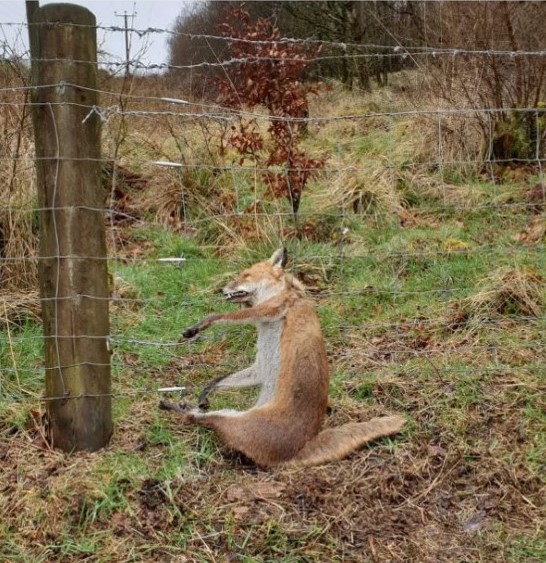
Snared fox. Photo contributed by blog reader
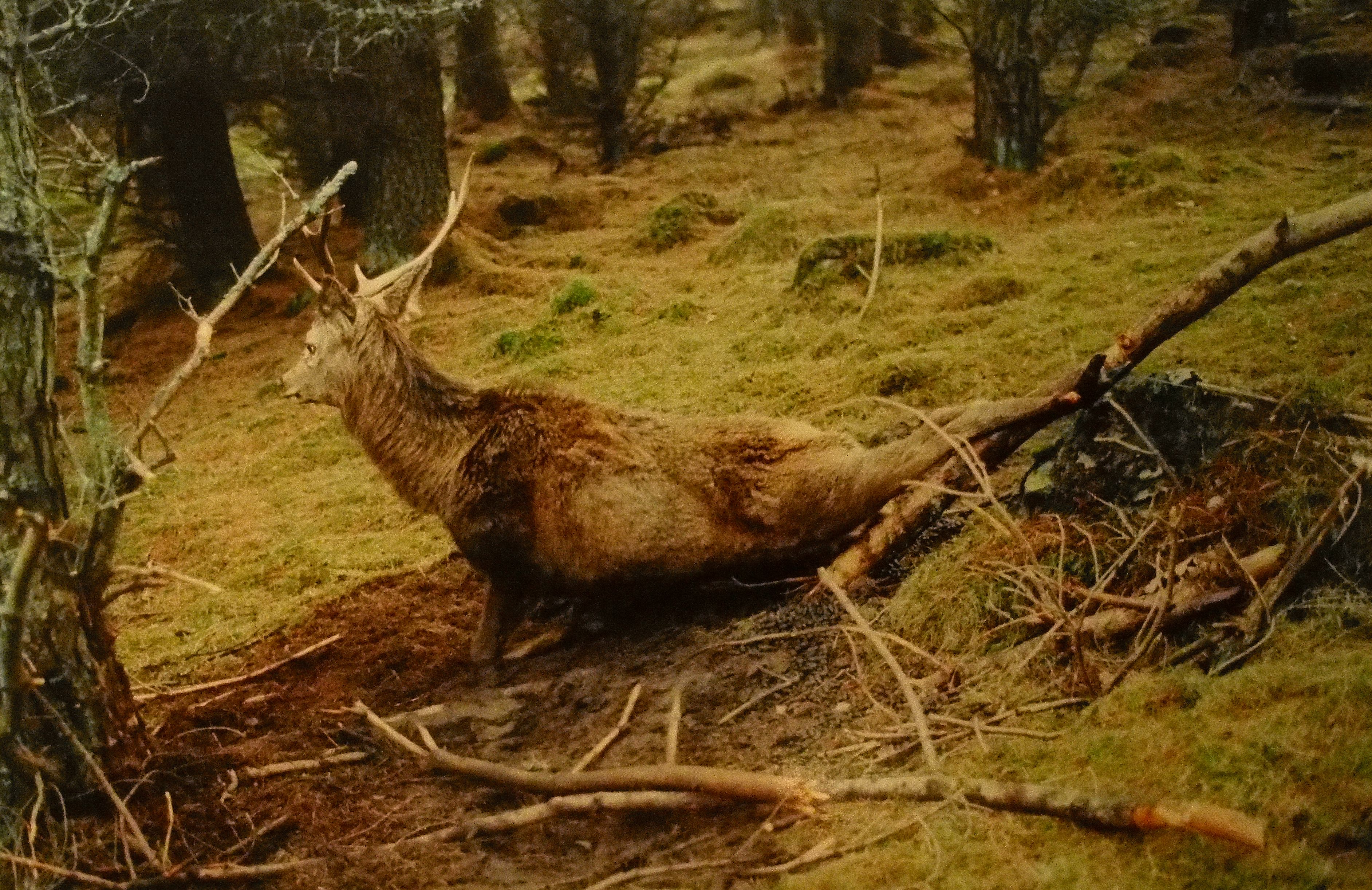
Snared red deer. Photo contributed by blog reader

UPDATE 10th November 2023: Gamebird shooters furious at Minister’s proposed snare ban in Scotland (here)

Over 600 attendees expected at REVIVE’s conference on Sunday – tickets still available

REVIVE, the coalition for grouse moor reform, is holding its annual conference this Sunday (12 November) at Perth Concert Hall.

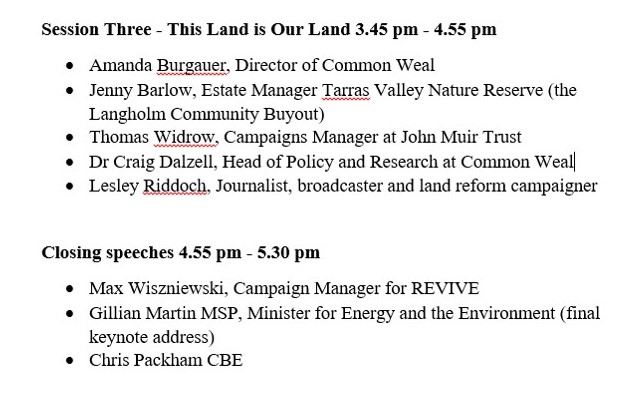
Hosted by Chris Packham, over 600 attendees have booked to hear from a wide range of expert speakers, including two Scottish Government Ministers (Lorna Slater MSP and Gillian Martin MSP).

The event really couldn’t be better timed as the Scottish Parliament prepares to debate the Wildlife Management & Muirburn (Scotland) Bill (known colloquially as the Grouse Moor Reform Bill) at Stage 1 of its passage through Parliament.

Here’s the REVIVE conference programme:

Tickets to attend are still available (sales close this Friday, 10 Nov), here.

I look forward to seeing some of you there!

Stakeholders to give evidence tomorrow on Scottish Government’s proposed snare ban & extended powers for SSPCA

Tomorrow (Weds 8 November 2023) will see another evidence session in front of the Rural Affairs & Islands Committee on the Scottish Government’s proposed ban on all snares and a proposed extension of powers for the Scottish SPCA.

This is all part of the Committee’s scrutiny of the Wildlife Management & Muirburn (Scotland) Bill. For new blog readers, this is the Bill that has been introduced by the Scottish Government in response to the recommendations made in the 2019 Werritty Review and is designed to bring in licensing for grouse moor management and introduce measures to put an end to the illegal killing of birds of prey on grouse moors.

Last week the Committee heard evidence from Environment Minister Gillian Martin MSP. The video archive of that session can be seen here and the transcript can be read here.

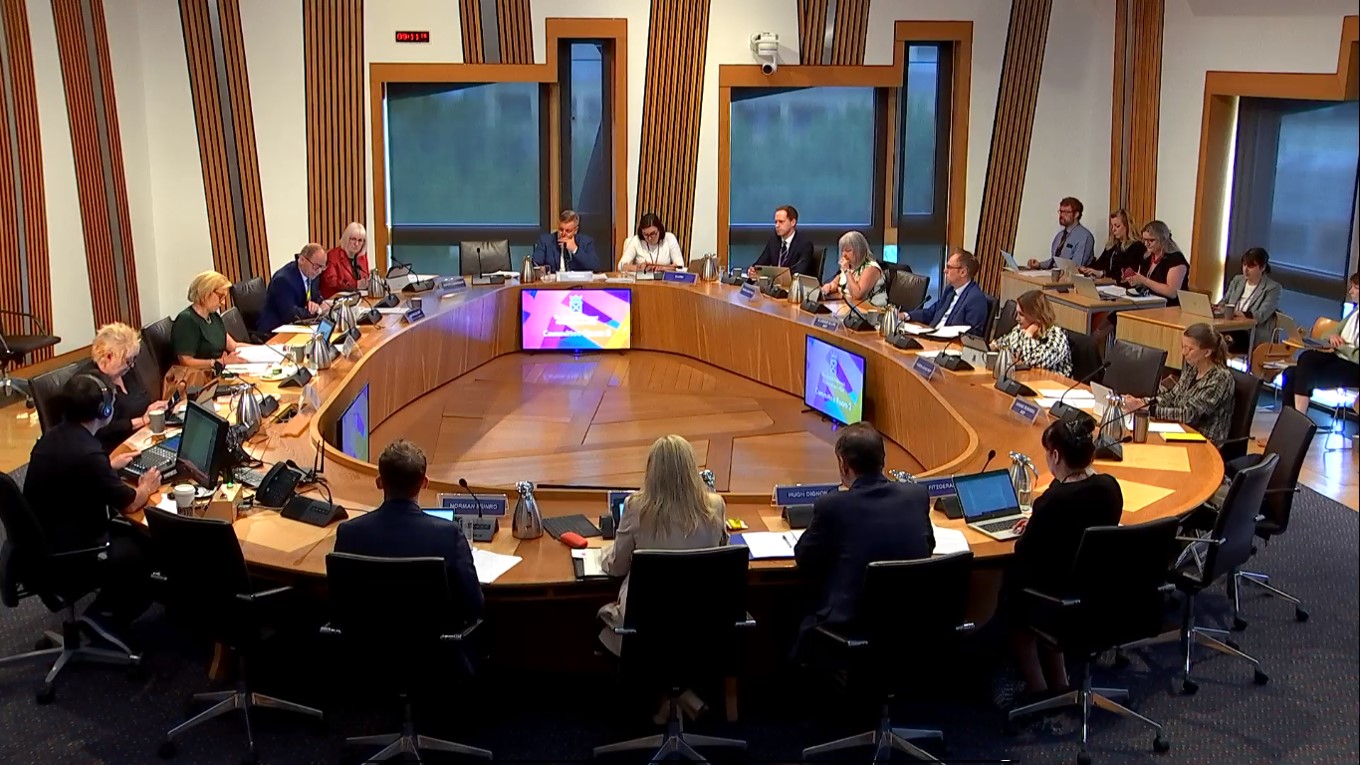
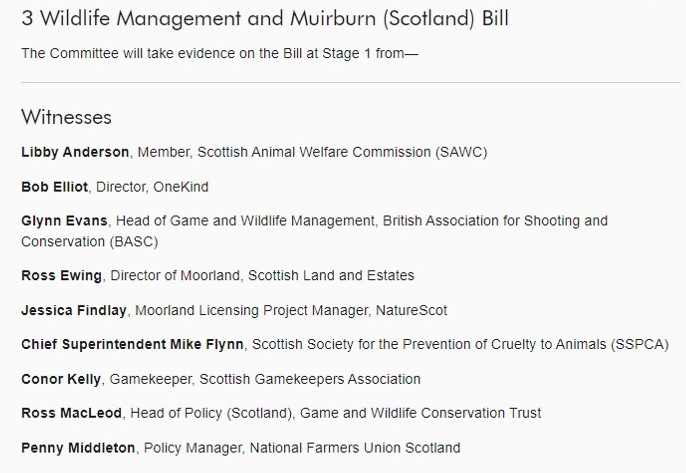
Tomorrow’s session will include evidence from various stakeholders, first on the issue of a snare ban, and then on increased SSPCA powers, as follows:

SNARING BAN panel:

INCREASED POWERS FOR SCOTTISH SPCA panel:

I think it’s fair to predict, given the participants listed for both panels, that there’ll be very little support for the proposed snare ban and for extended powers for the SSPCA, except from Libby Anderson, Bob Elliot, Mike Flynn and Ian Thomson.

We already know the position of each organisation on these issues because it’s been talked to death in previous evidence sessions held earlier this summer (and prior to that, multiple times over the last ten years as these topics have been raised again and again). For whatever reason, it’s been decided that the Committee needs to hear from everyone again, simply because the Scottish Government held yet another public consultation this year (which resulted in overwhelming public support for a ban on all snares and for increased powers for the SSPCA – see here).

This’ll just be yet another opportunity for the grouse shooting lobby to claim that rural Armageddon will befall the Scottish countryside if barbaric snares that cause animal suffering are banned and if the SSPCA are permitted to investigate the wildlife crimes that seem to happen on a lot of driven grouse moors.

You can watch proceedings live on Scottish Parliament TV (here) and there’ll be a video archive and a transcript available shortly afterwards.

The session begins at 9am on Wednesday morning although the Committee is dealing with two other items on the agenda before these panels start.

UPDATE: Video archive of the session available to watch HERE

UPDATE: Transcript of the evidence sessions available here (from p27):

UPDATE 9 November 2023: Scottish Environment Minister proposes full ban on all snares (here)

UPDATE 15 November 2023: Supplementary evidence on snares from Scottish Animal Welfare Committee (here)

Last ditch attempt by grouse moor lobby to water down Scottish Government’s proposed ban on snares

Yesterday, Scottish Environment Minister Gillian Martin MSP gave evidence to the Rural Affairs Committee on the Government’s proposed ban on snares and an extension of powers to the SSPCA as part of its Wildlife Management and Muirburn (Scotland) Bill (here).

The video recording is available to watch here and a transcript should be available in the next day or so. [Update: transcript now available at foot of this blog post]

It was an assured and confident performance by the Minister and I admired her patience in dealing with thinly-veiled, repeated attempts by some Committee members to portray the Government’s proposals as an ‘attack’ on the countryside, and especially on gamekeepers.

The Minister was clear – the use of snares, even those cynically re-named as ‘humane cable restraints’, is inherently cruel, no matter who is deploying the snare and no matter for what purpose.

It became apparent during the Minister’s evidence that following a meeting with stakeholders from the grouse moor management sector in September, they had wanted to propose an alternative to a complete ban on the use of snares and instead had ideas about a licensing scheme for their use. The Minister, in all fairness, invited them to submit their proposals in writing for her consideration.

The Minister told the Committee yesterday that she’d received the licensing proposal late on Monday evening (30 October 2023) and that she hadn’t yet had chance to review it but would do so this month, and in time for the Committee to consider her decision for their Stage 1 Report, which is due towards the end of November.

The snare-licensing proposal from the grouse moor lobby has now been published on the Rural Affairs Committee’s website, as follows:

What’s immediately apparent about the grouse moor managers’ proposed licensing scheme is that they pretend to be proposing “a narrow range of licensable purposes” [for the continued use of snares] but in fact what they propose is the continued use of snares for all the same purposes they currently use snares, i.e.

(i) preventing, or reducing the risk of, predation causing harm to wildlife or gamebirds,
(ii) preventing serious damage to livestock, foodstuffs for livestock, crops,
vegetables or fruit
;
(iii) preventing, or reducing the risk of, disease in people or animals;
(iv) conserving, restoring, enhancing or managing the natural environment; and
(v) for scientific, research or educational purposes.

Fundamentally, they have failed to grasp the underlying argument against the use of snares, and that is, as the Minister made clear yesterday, that they are inherently cruel, whether they’re called ‘snares’ or ‘humane cable restraints’ (see here). There’s nothing in the grouse moor managers’ proposed licensing scheme that will end the indiscriminate suffering of animals caught in a snare, and nothing in there that should change her mind against a total ban on the use of all snares with no exceptions, as the Welsh Government has recently enacted.

Given the preliminary analysis of the responses made to the Scottish Government’s recent public consultation on the use of snares, it is also very clear that the public supports a ban on the use of all snares and does not support any exceptions to the ban:

Importantly, the public consultation did not ask the specific question about whether a licensing scheme for the use of snares should be considered (although question 4 comes close and the public responded with a resounding 73% ‘no’) so if the Minister is minded to give any credence to the grouse moor managers’ proposed licensing scheme, I think the Government would be obliged to consult on that specific option.

Accepting a last-ditch attempt by the grouse moor managers to water down the Government’s proposed legislation, without providing an opportunity for the public to comment, would be wide open for a legal challenge and I dare say there’d be a number of organisations prepared to take up such a challenge.

UPDATE 4th November 2023: The transcript from the evidence session on 1st Nov is now available:

UPDATE 9 November 2023: Scottish Environment Minister proposes full ban on all snares (here)

Environment Minister to give evidence on snare ban & extending investigatory powers of SSPCA

Scottish Environment Minister Gillian Martin MSP will give evidence tomorrow morning (Wednesday 1 November 2023) to the Rural Affairs & Islands Committee as part of the Committee’s continued Stage 1 scrutiny of the Wildlife Management & Muirburn (Scotland) Bill.

For new blog readers, this is the Bill that has been introduced by the Scottish Government in response to the recommendations made in the 2019 Werritty Review and is designed to bring in licensing for grouse moor management and introduce measures to put an end to the illegal killing of birds of prey on grouse moors.

The Minister’s previous appearance before the Committee in June 2023

The Minister will be joined by some specialist civil servants from the Government’s Wildlife Management Unit who have been responsible for drafting this Bill.

The focus of tomorrow’s evidence session will be on the Government’s proposed ban on snares and on extending the investigatory powers of the Scottish SPCA.

A further evidence session will take place next week (Weds 8 November) where stakeholder groups will be providing evidence on these two issues. I’ll provide more detail about that nearer the time.

The Stage 1 debate, where the whole of the Scottish Parliament has an opportunity to discuss/accept/challenge the Committee’s Stage 1 report in the main Chamber, is scheduled for Wednesday 29 November 2023.

The clerks to the Rural Affairs Committee have prepared some helpful background notes to tomorrow’s meeting for those who may be new to the subject:

You may recall that the Scottish Government recently held (yet another!) public consultation on its proposal to ban snares and its proposal to extend the investigatory powers of the SSPCA. That consultation closed on 3 October 2023 and I know that many of you participated (thank you!).

In preparation for tomorrow’s hearing, the Environment Minister today wrote to the Rural Affairs Committee with a preliminary analysis of those 5,289 consultation responses.

The headline news from that analysis is that a significant majority of respondents support the Government’s proposals to ban snares and so called ‘humane cable restraints’ (70% in support, compared to just 29% against), and a significant majority of respondents support the Government’s proposals to extend the investigatory powers of the SSPCA (71% in support, compared to just 26% against).

Here is the Minister’s letter to the Committee:

Tomorrow’s hearing begins at 9am and can be watched live on Scottish Parliament TV (here). A video recording will also be available for those who can’t watch the live proceedings and of course there’ll be a transcript of the session which I’ll post here as soon as it becomes available (usually a couple of days afterwards).

UPDATE 2nd November 2023: Last ditch attempt by grouse moor lobby to water down Scottish Government’s proposed ban on snares (here)

UPDATE 4th November 2023: The transcript from the session is now available:

UPDATE 9 November 2023: Scottish Environment Minister proposes full ban on all snares (here)

Scottish Raptor Study Group holds Parliamentary reception to discuss details of grouse moor reform Bill

The Scottish Raptor Study Group (SRSG) was generously hosted at the Scottish Parliament earlier this week by John Mason MSP, for a drop-in reception to discuss the Wildlife Management and Muirburn (Scotland) Bill, which is currently at Stage One of its progress through Parliament.

SRSG Chair Keith Duncan and John Mason MSP. Photo: SRSG

For new blog readers, this is the Bill that has been introduced by the Scottish Government in response to the recommendations made in the 2019 Werritty Review and is designed to bring in licensing for grouse moor management and introduce measures (such as a revoked licence) to put an end to the illegal killing of birds of prey on grouse moors.

MSPs in attendance at the reception included Edward Mountain (Conservative), Findlay Carson (Conservative), Rachael Hamilton (Conservative), Colin Smyth (Labour), Rhoda Grant (Labour), Jim Fairlie (SNP), Bob Doris (SNP), Elena Whitham (SNP), John Mason (SNP) and Ariane Burgess (Green).

The SRSG viewed the event as a valuable and productive meeting, attracting cross-party MSPs and discussions focused on the following key themes:

  • The raptor persecution data that underpin the Scottish Government’s decision to bring in the Bill;
  • Whether or not the proposed licence period should be greater than one year;
  • Issues around white tailed sea eagles, ravens and sheep;
  • How the licensing regime should operate and the amount of administration involved;
  • How any revocation or suspension of a licence might happen and discussion of the existing General Licence restrictions and what evidence NatureScot would be looking for when considering a sanction on a grouse-shooting estate;
  • Concern around potentially vexatious claims;
  • In which specific areas birds of prey are being persecuted or ‘disappearing’ in suspicious circumstances;  
  • Change to burning dates (finishing earlier than the current regulations allow);  
  • And how the Bill is now encompassing more areas (i.e. SSPCA powers and snaring).
Ian Thomson, Kelvin Thomson, Keith Duncan, Logan Steele & Duncan Orr-Ewing. Photo: SRSG

The Scottish Raptor Study Group was represented by Kelvin Thomson (Advocacy Officer, SRSG), Keith Duncan (Chair, Highland Raptor Study Group & current Chair of the SRSG’s National Management Committee), Logan Steele (Communications Secretary, SRSG) and Duncan Orr-Ewing (Chair, Central Raptor Study Group). Also in the delegation was Ian Thomson, Head of Investigations at RSPB Scotland.

The Bill is currently still with the Rural Affairs & Islands Committee (and interesting that a number of Committee members attended this reception) as they continue to prepare their Stage One report, which will then be debated in Parliament.

The date of that Stage One debate keeps being put back, mainly to accommodate the most recent consultation (the latest in a long, long line!) on proposed new powers for the SSPCA and a proposed ban on snaring, which the Rural Affairs Committee would like to include in its report.

It is currently anticipated that the debate will take place in mid-late December, prior to the Xmas recess (which begins on 23 Dec 2023), but don’t hold your breath!