Wildlife Management & Muirburn Bill approaches Stage 2: cue ridiculous amendments!

The Scottish Government’s Wildlife Management & Muirburn (Scotland) Bill is making its way through the parliamentary process. For new readers, this is proposed new legislation to regulate grouse shooting and its associated management practices by way of licensing schemes, introduced because of the continued illegal persecution of birds of prey on many Scottish grouse moors.

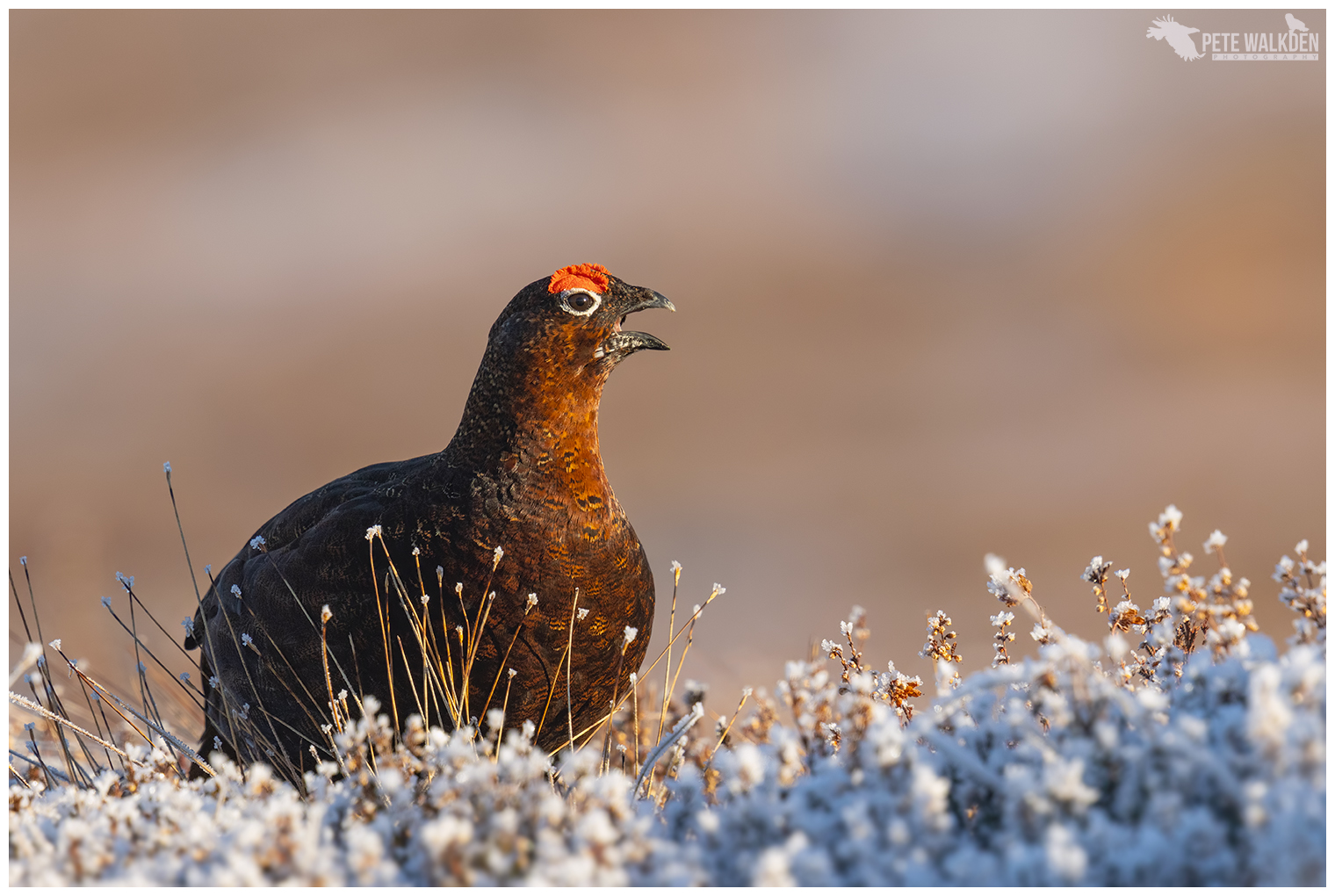
Red grouse photo by Pete Walkden

The Bill passed Stage 1 on 30 November 2023 (here) when the Parliament voted to approve the general principles of the Bill.

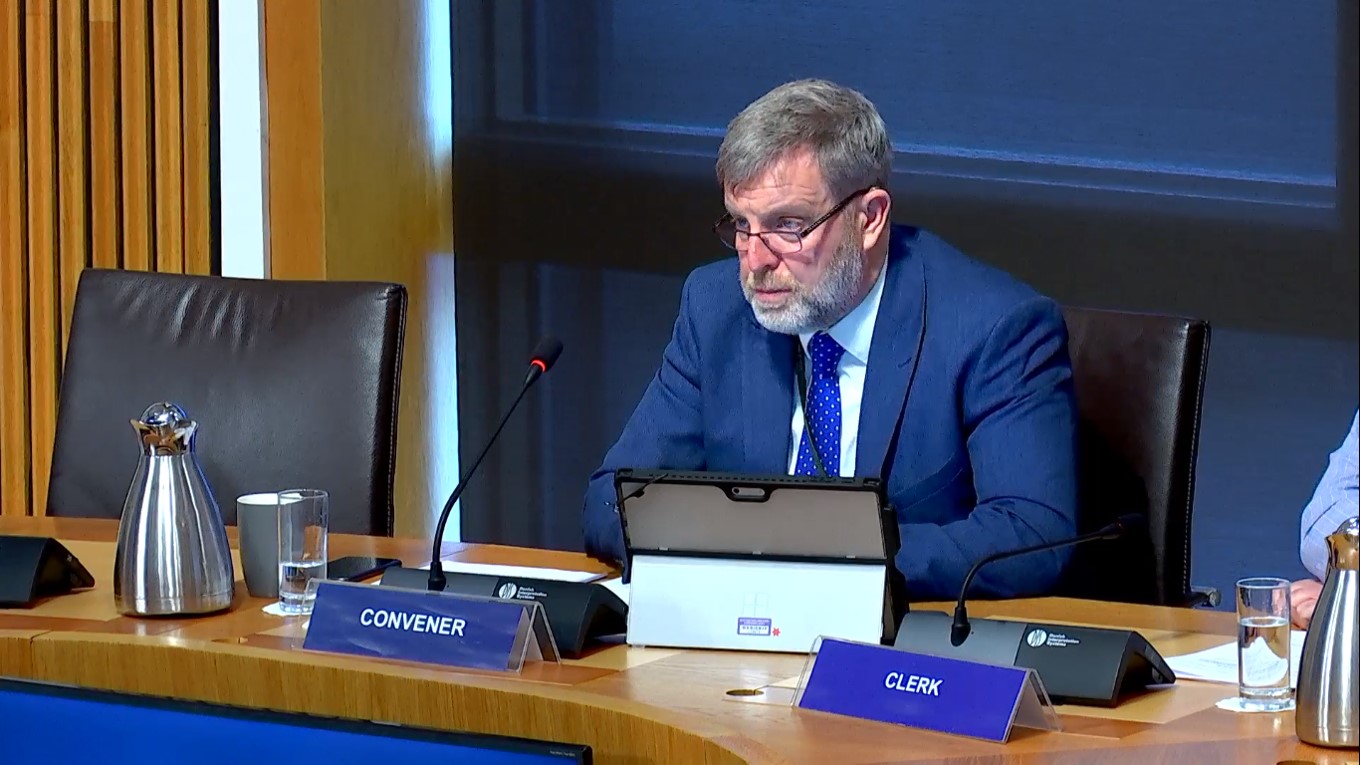
Stage 2 is now fast approaching. This is the stage where any MSP can lodge amendments to the Bill (there is no restriction on how many may be lodged and, given the contentious nature of the Bill, it is anticipated that there will be hundreds of them).The cross-party Rural Affairs & Islands Committee will begin to consider the amendments at a meeting on 24th January 2024.

This may cause some alarm, given that some prominent members of the Rural Affairs Committee, including its Chair, voted against even the general principles of the Bill, but whatever amendments the Committee chooses to accept/reject at Stage 2, there will be an opportunity for amendments to be challenged/overturned at Stage 3, especially where they go against Government policy. [For a useful guide to what happens during the progression of a Bill in the Scottish Parliament, see here].

The deadline for submitting amendments for Stage 2 is 18 January 2024 so as you can imagine, there is a huge amount of background lobbying going on at the moment, both by conservationists and by the game shooting sector, in an attempt to (a) strengthen the Bill [the conservationists] and (b) weaken the Bill [the game shooting industry].

The tabled amendments are all being published on this page so it’s well worth keeping an eye on this over the coming week.

Two MSPs have tabled amendments so far – some are very sensible, others are simply bonkers (but entertaining, nevertheless). To help you interpret the amendments, you’ll need to refer to the details of the Bill (as introduced in March 2023) to understand the context of these amendments. Here’s the Bill (as introduced) to help you:

A sensible amendment has been tabled by John Mason MSP (SNP), who is suggesting that any fees charged to those applying for a grouse shooting licence ‘must be sufficient to cover any expenses and costs incurred by the relevant authority in carrying out its functions‘.

I’ve got no disagreement with that at all. Ten years ago journalist George Monbiot pointed out that the taxpayer already subsidises shotgun licencing in the UK as well as grouse moor owners – the Scottish Government needs to ensure that its grouse shooting licensing scheme is fully funded by the industry and not subsidised by taxpayers.

Edward Mountain MSP (Conservative) (who has featured on this blog previously here, here, here and here) has tabled 44 amendments, a few of which are sensible, but most of which are predictably designed to undermine the strength of the Bill.

Here are some amusing examples that I picked out from Ed’s amendments (this is not an exhaustive list by any means, just ones that jumped out).

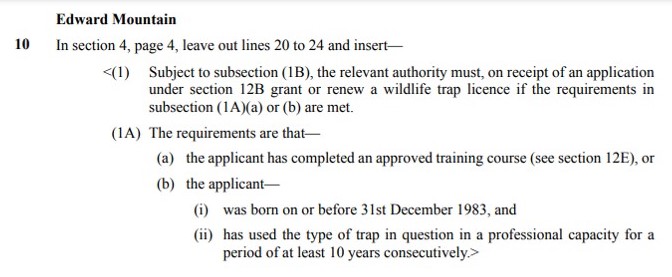
Ed’s amendment #10 suggests that any trap user over the age of 40 years and who has used the trap in question for at least 10 years consecutively can skip having to complete an approved training course and should just get a trap licence automatically:

Eh? Why should anyone over the age of 40 years be exempt from completing a training course?! Nobody should be exempt if they are using traps to kill a sentient being, let alone anyone over the seemingly arbitrarily-chosen age of 40! Given the wide age-range of gamekeepers convicted for wildlife crime, including trap offences, there’s no evidence to support an exemption from training for the over 40s.

Moving on, Ed’s amendment #17 appears to be an attempt to prevent the ability of the Government to add pheasants and red-legged partridges to the licensing scheme if required:

As you may recall, the Government has not included pheasants or red-legged partridges in its proposed grouse moor licensing scheme, despite the recent upsurge of these gamebirds being released on grouse moors (see here), but the Bill does provide the capacity for these species to be added (i.e. a licence would be required to shoot them) if evidence emerges that wildlife crimes are being committed on grouse moors where these species have been released for shooting.

Ed is proposing that only gamebirds listed on the Red or Amber list could be added to the licensing scheme, which would obviously exclude the addition of pheasants and red-legged partridges as these are not endangered in any way – they are non-native, invasive species released in their millions each year for ‘sport’ shooting. The whole purpose of the licensing scheme is not to protect ‘rare’ (Red/Amber listed) birds – it is to enable the sanctioning of estates who commit wildlife crime when shooting these species. I hope this amendment is treated with the contempt it deserves.

Ed’s amendment #21 is to ‘leave out Section 8‘ of the Bill:

What is Section 8? Ah, that’s the Government’s proposal to extend the investigatory powers of the Scottish SCPA:

Given the Scottish Government’s (long awaited) commitment to extending the powers of the SSPCA (see here), this amendment is just a last-ditch attempt to prevent it from happening. Even if it gets past Stage 2, I fully expect it to be overturned at Stage 3 as it goes directly against Government policy and the Minister’s repeatedly stated intentions.

The remainder of Ed’s amendments focus on muirburn licencing where first of all he proposes excluding entire sections of the Bill relating to this (thus removing the requirement for a muirburn licence), but then goes on to suggest changes to the very sections he wants removed, presumably because he knows that the Government will never agree to removing the requirement for a muirburn licence!

Amongst the changes he proposes are the definition of peat depth to be changed from 40cm to 60cm, the ability to extend the muirburn season to 30 April at landowner discretion, and the management of gamebirds to be included as a legitimate reason to burn on peatland. He also suggests a public register of muirburn licences – that, at least, is a sensible amendment. As for the rest, they’re hard to take seriously in light of the climate crisis and I can’t see the SNP, Labour and Greens being supportive.

These amendments provide us with a flavour of what to expect from certain MSPs over the coming week – I dare say there will be even more outlandish attempts to overturn the provisions of the Bill given the ferocity of the grouse shooting industry’s objections to the Bill’s general principles. Let’s see.

UPDATE 15 January 2024: The National picked up on this blog post and published an article about it (here).

New study reveals burning on deep peat is widespread on many Scottish grouse moors: Muirburn Code is being ignored

A new peer-reviewed scientific study has revealed that burning on deep peat is widespread on many Scottish grouse moors.

This is despite a revision to the national guidelines (the Muirburn Code) in 2017 which states that burning on peatland should not take place unless it is part of a habitat restoration plan approved by the statutory regulator, NatureScot.

It’ll come as no surprise whatsoever to regular blog readers that these findings suggest that the revised guidelines ‘have not been widely adopted by land managers‘.

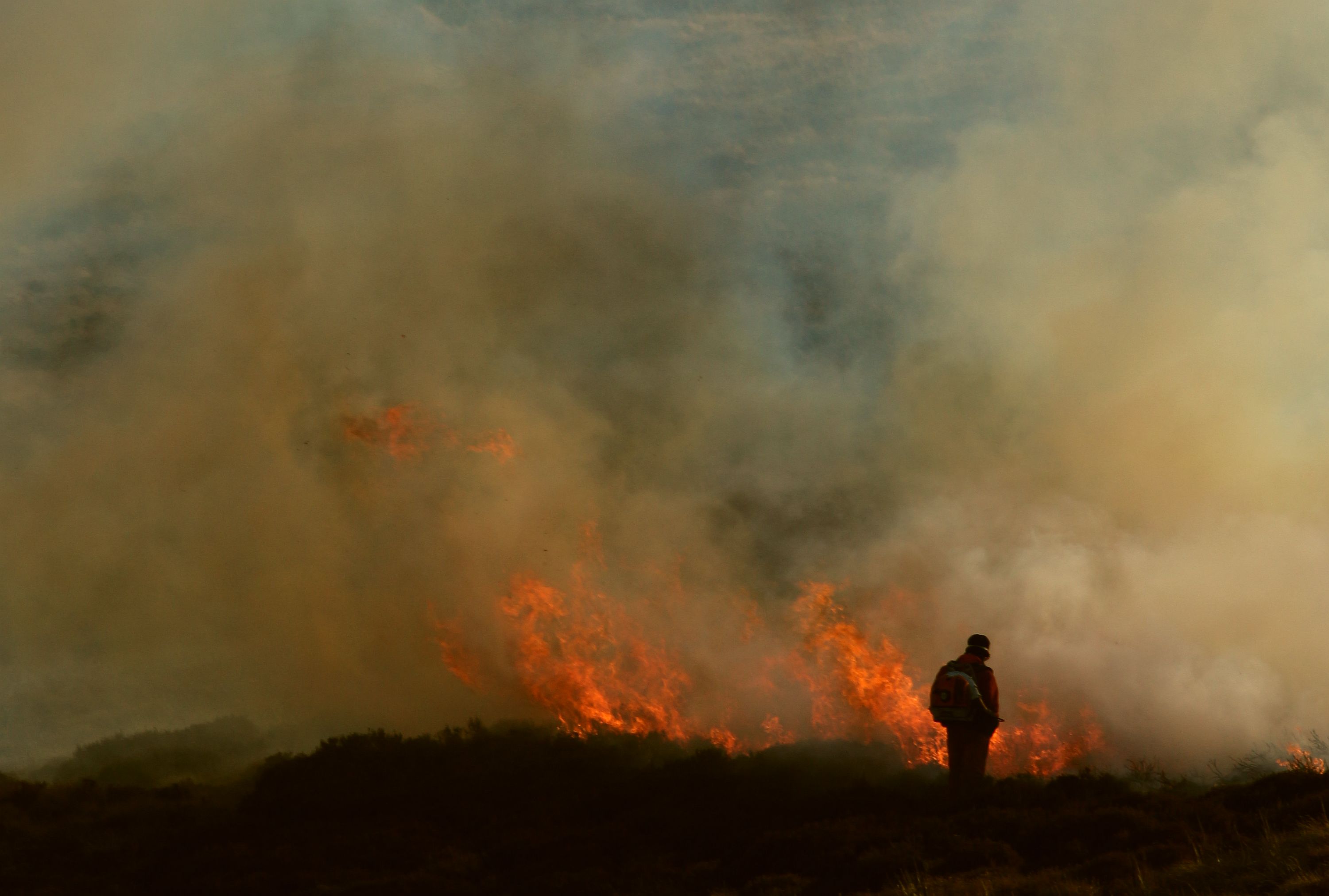
Grouse moor fire in Cairngorms National Park, Feb 2022

The paper, Assessment of peatland burning in Scotland during 1985-2022 using Landsat imagery, was authored by B.D. Spracklen and D.V. Spracklen and was published on 14 December 2023 in the journal Ecological Solutions and Evidence.

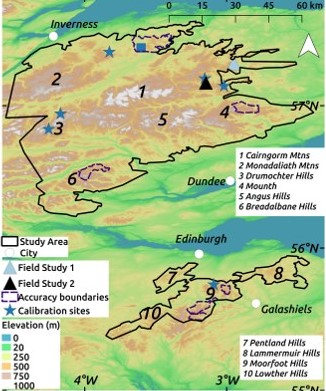
Here’s the study area, which includes a large portion of Scotland’s grouse moors:

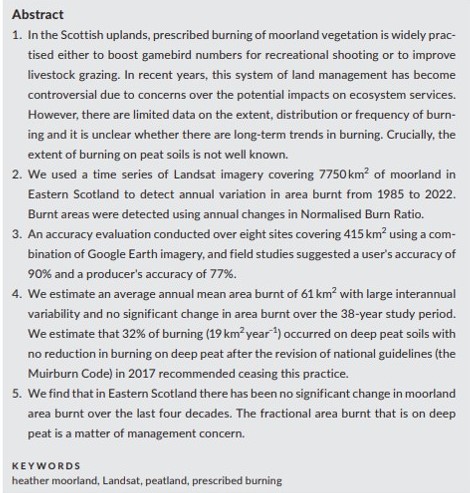
Here’s the abstract:

This new paper should help inform MSPs and Ministers as we approach Stage 2 of the Wildlife Management and Muirburn (Scotland) Bill in January, where proposals to introduce a licensing scheme for muirburn are set to be challenged by the grouse-shooting sector, which seems to think that burning the moors to facilitate excessively large numbers of red grouse for a few selfish people to shoot for fun is more important than the global climate crisis.

Yet again, what this latest paper does is to demonstrate that any licensing scheme will require robust monitoring AND enforcement measures for it to be effective because if that’s not in place, the entitled ones will simply carry on as normal.

The paper is open access and can be read/downloaded here:

UPDATE 17 January 2024: Wildlife Management & Muirburn Bill – will it properly protect peatlands? (here)

UPDATE 23 January 2024: Extent of burning on Scottish peatlands, including many grouse moors, is why regulation is needed urgently (here)

New podcast: Will a grouse shoot licensing scheme bring an end to the illegal persecution of birds of prey on Scotland’s grouse moors?

RSPB Scotland has just published a podcast discussing whether the Wildlife Management & Muirburn Bill will finally bring an end to the illegal killing of birds of prey on Scottish grouse moors.

Some of it was recorded at REVIVE’s national conference in Perth last month, and some of it immediately prior, and after, yesterday’s Stage 1 debate of the Bill. It includes contributions from RSPB Scotland (Duncan Orr-Ewing and Ian Thomson), the REVIVE coalition for grouse moor reform (Robbie Marsland), Biodiversity Minister Lorna Slater, Chris Packham and me, with Stephen Magee from the RSPB hosting the discussions.

It’s available to listen, for free, HERE.

Landmark vote in Scottish Parliament to bring in grouse moor licensing

That landmark vote in the Scottish Parliament last night, in support of the general principles of the Wildlife Management & Muirburn (Scotland) Bill, was a significant milestone in what has been a long and often challenging campaign.

And although it’s a long way from being over, we should all take a breath and take the time to celebrate this achievement, as well as contemplate the years of hard grind that brought us to this point.

At the heart of it, and indeed was the trigger for putting this proposed legislation on the table, has been the ongoing illegal killing of birds of prey on driven grouse moors, despite raptors supposedly having full legal protected status since the 1954 Protection of Birds Act, almost 70 years ago.

I’ve heard several MSPs in the last few months, and indeed in the Chamber yesterday, talking about how we all owe a debt of gratitude to the gamekeepers and their lords and masters in the grouse shooting industry. I’d agree to a point, because without that industry’s ongoing criminality against birds of prey it would have been even more difficult to achieve yesterday’s result.

I don’t believe that they’re all ‘at it’; I personally know a few who feel as strongly as I do about protecting birds of prey, but unfortunately they are in the minority and not enough of them were prepared to stand up against what has become a pantomime of denial, attempting to mask what can only be described as archaic savageness. The world has moved on and now that industry must, too.

There are indeed people to whom we owe a great debt of gratitude and foremost amongst them are the members of the Scottish Raptor Study Group (SRSG), not least to those who argued so persuasively when they presented their petition for gamebird licensing to the Scottish Parliament back in 2016.

But also to all those SRSG fieldworkers who have dedicated years, sometimes decades, of their lives to voluntarily monitoring the status of birds of prey across Scotland, whose hard-won data allowed many talented academics to join the dots and present a compelling argument that the scale of illegal persecution was so extensive it was having population-level effects on the distribution and abundance of a number of species across Scotland, notably the golden eagle, hen harrier, red kite and peregrine.

Without those data, and the subsequent scientific publications on which they’re founded, the Scottish Government would not have had the incontrovertible evidence it needed to be convinced that raptor persecution on some (many) Scottish grouse moors continues, even to this day.

There are many others who also deserve credit but I’m going to save that until we reach the end and the Bill gains Royal assent (I do wonder whether the bloke in the crown will be able to snatch victory from the jaws of defeat, given his long-standing personal involvement in grouse shooting).

And yes, there is still a long way to go with this Bill but the bottom line is that a licensing scheme for grouse shooting, in whatever form it takes, will now become a legal requirement. I don’t think any of us doubts for one minute the struggles that lie ahead at Stage 2 against those who will seek to water down the restrictions as far as they can – representatives from the grouse shooting industry have made no secret of their intentions and judging by some of the comments made in the Chamber yesterday, they have the ear of not just the Scottish Conservatives to ease their way.

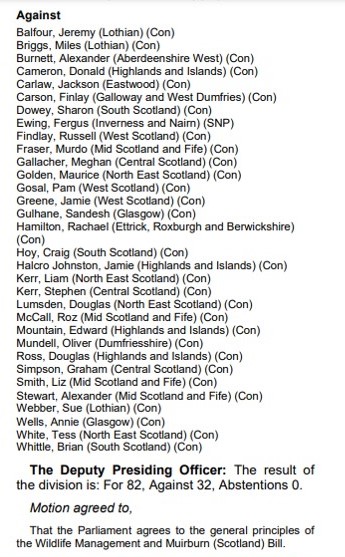
In the end though, only 32 voted against the general principles of the Bill and 82 voted to support it. Of the 32 who voted against it, 31 were Conservatives and 1 was the SNP’s Fergus Ewing:

But in the bigger picture, even if the industry succeeds in weakening the Bill and this new legislation turns out to be as unenforceable as all the previous attempts have been to make this industry accountable for its criminal and environmentally damaging actions, then it will simply make the case for a ban on grouse shooting all the more appealing, and, actually, achievable.

If you missed yesterday’s debate you can watch a video archive here and you can read the official report below (starts at page 31). The Tory contributions weren’t quite as dishonourable as those we saw on display in the Westminster debate on grouse shooting back in 2016 (here) but some were still decidedly unpleasant:

Grouse moor licensing bill passes Stage 1

BREAKING NEWS….

The Scottish Parliament has this evening voted to support the general principles of the Wildlife Management & Muirburn Bill and it will now pass to Stage 2.

Votes for = 82; votes against = 32, no abstentions.

The vote followed a fairly predictable debate in the Chamber this afternoon with no real surprises. I’ll come back to that tomorrow.

For now, it’s time to celebrate because the Scottish Parliament has, after many, many years of campaigning by so many people, finally voted to support, in principle, significant reform of an industry that has been out of control and unaccountable for far too long. Grouse shooting and its associated criminality and environmental destruction simply cannot survive in its current format and for that I’m bloody delighted.

Well done to everyone involved.

UPDATE 1 December 2023: Landmark vote in Scottish Parliament to bring in grouse moor licensing (here)

Environment Minister provides additional evidence ahead of today’s Stage 1 debate on grouse moor licensing bill

Ten days ago the Rural Affairs & Islands Committee published its Stage 1 report on the Wildlife Management & Muirburn (Scotland) Bill (here).

The Committee’s report contained requests for further detail / clarification from the Scottish Government on many aspects of the Bill, prior to today’s Stage 1 debate in the Scottish Parliament.

Those information requests included more information on the level of threat to raptors on grouse moors and the levels of ‘recovery’ of raptor populations, the provisions of NatureScot to suspend / revoke a grouse shooting licence, the range of relevant offences that would trigger a suspension / revocation, various questions about muirburn, various questions about the proposed ban on snares, and various questions about the proposed extension of powers for the SSPCA.

An illegally poisoned red kite found on Dava Moor, just outside the Cairngorms National Park, 2021

Yesterday, Environment Minister Gillian Martin MSP responded to the Committee with the following letter (see below), in which she provides a summary of the status of several raptor species whose populations have been affected by ongoing illegal persecution on grouse moors (regular blog readers won’t learn anything new – it’s all information that’s been in the public domain for some time). She also answers the unfounded and arrogant criticism from some in the grouse shooting industry that her speedy decision to ban snares was made fast because (a) the Committee had pushed her for a speedy response ahead of its deliberations for the Stage 1 report and (b) because the grouse shooting industry’s proposals for a licensing scheme for snare use didn’t contain any evidence that the Government hadn’t heard before.

Here’s her letter – well worth a read. She’s standing firm on the fundamental issues of importance but is prepared to consider her position on some of what I would consider minor, less important issues such as potentially changing the length of the licence period from an annual licence to one that is issued for a three to five year period. It’s also worth noting her cover letter to the Committee in which she points out that, unusually, the Committee’s Stage 1 report does not indicate whether the Committee supports or rejects the general principles of the Bill!

It’ll be all eyes on the Scottish Parliament this afternoon as the Stage 1 report is debated in the main Chamber, followed by a vote on whether the Bill can progress to Stage 2.

You can watch live on Scottish Parliament TV from 2.30pm HERE

Thank you to all of you who sent emails to your MSPs and to the three Ministers ahead of this debate, urging their attendance and support of the Bill following the news that one of the South Scotland golden eagles has ‘disappeared’ and which Police Scotland ‘believe has come to harm‘. It’s been important for MSPs to understand ahead of this debate the extent of public anger that these criminal atrocities against birds of prey continue.

Let’s see which MSPs agree.

Grouse moor licensing Bill: Stage 1 debate scheduled for Thurs 30 November 2023

The Scottish Parliament’s Stage 1 debate of the Wildlife Management and Muirburn (Scotland) Bill will take place in the Chamber this Thursday, 30 November 2023, from 2.30pm.

This debate provides all MSPs with the opportunity to discuss the general principles of the Bill and vote to either throw it out or allow it to proceed to Stage 2, which is when the finer details would be debated and amended.

The Stage 1 debate follows the publication last week of the Stage 1 scrutiny report written by the Rural Affairs & Islands Committee which has been taking evidence for the last six months.

Lobbying of MSPs continues apace, from both conservationists and from the grouse-shooting industry. I read the other day a quote from BASC Scotland Director Peter Clark, who wrote that BASC was urging MSPs, “…to work with us to make the enormous yet vital changes to the Bill to avert the decimation of the rural economy, biodiversity and conservation“.

Quite how a licensing scheme designed to regulate a supposedly lawful industry will ‘decimate the rural economy, biodiversity and conservation’ is anyone’s guess. It’s almost as if Peter thinks the industry is so reliant on criminality that it can’t possibly function under a licensing framework and will thus collapse.

This level of hysterical fearmongering is nothing new. Here’s an excerpt from a blog I wrote three years ago when a similar outcry was heard from the grouse-shooting sector in response to the announcement that the Scottish Government intended to introduce a grouse shooting licence scheme:

This hysterical scaremongering about so-called threats to the rural economy from the introduction of a grouse moor licensing scheme is nothing new from this lot (e.g. see hereherehere and here for previous histrionics).

Nor is it the first time we’ve heard the claim that any sort of enforced regulation will ‘threaten’ or ‘damage’ the rural economy.

When the Land Reform Bill was being debated [in 2003] the Scottish Landowners Federation (which later re-branded to call itself the Scottish Rural Property & Business Association (SRPBA) and then re-branded again to its current name of Scottish Land & Estates) warned that the legislation would do irreversible damage to rural economies and they threatened to block the legislation at the European Court of Human Rights (see here).

Scottish Land & Estates also bleated about further land reform measures [in 2015] when the Scottish Government proposed removing the two-decades-old exemption from business rates enjoyed by shooting estates. SLE claimed that, “We believe that there would be a negative impact on rural jobs, tourism and land management” (see here).

And then there was more bleating when the Scottish Government brought in vicarious liability to tackle the continued illegal persecution of birds of prey. David Johnstone, the then Chair of Scottish Land & Estates claimed this would introduce another layer of bureaucracy “When the Government should be doing what it can to help landowners and the rural economy” (see here).

Has the rural economy fallen flat on its arse as a result of these measures? Not according to the grouse shooting industry, which is still declaring itself indispensable to the Scottish economy (a claim strongly contested by others, e.g. see here).

As has been said before on this blog, the grouse shooting industry should be thanking its lucky stars that a licensing scheme is all it’s getting. The case for a ban on driven grouse shooting has been made many times over.

There are those of us who don’t believe for one second that a licensing scheme will be effectively enforced, although we’ll do our bloody level best to ensure it is enforced when breaches have been detected and are fully evidenced. And if/when the licensing scheme is shown to be failing, there’s only one place left to go.

It seems to me that the grouse shooting industry should be welcoming a licensing scheme, which should protect those who are complying with the law and remove those who are not. Gosh, a world where there are consequences for criminality. Imagine that! Is that really what this backlash is all about?

Meanwhile, lobbyists from the conservation sector will this week be reminding MSPs that even in the midst of all this political scrutiny and threat, there are still some in the grouse-shooting industry that simply refuse to stop killing birds of prey, as evidenced in last week’s RSPB Birdcrime report where we learned that as recently as July this year yet another satellite-tagged golden eagle ‘vanished’ in suspicious circumstances on a grouse moor in the Monadhliaths and as recently as September this year yet another satellite-tagged hen harrier ‘vanished’ on a grouse moor in the Angus Glens.

These are in addition to the suspicious disappearances of a further 35 satellite-tagged birds of prey on Scotland’s grouse moors between 2017-2022, including including 8 golden eagles, 21 hen harriers and 5 white-tailed eagles (here).

The time for pretending that this is all ‘historical’ and no longer an issue is well and truly over and I hope that the Scottish Parliament finally makes a stand on Thursday.

Proceedings in the main Chamber can be watched live on Scottish Parliament TV from 2.30pm on Thursday, here.

Another golden eagle and another hen harrier suspiciously ‘disappeared’ on two Scottish grouse moors this year

Further to the RSPB press release accompanying the publication of the RSPB’s latest Birdcrime report this morning (here), RSPB Scotland has issued a separate press release.

It reveals the suspicious disappearance of a satellite-tagged golden eagle on an unnamed grouse moor in Inverness-shire in July this year and the suspicious disappearance of a satellite-tagged hen harrier on an unnamed grouse moor in the Angus Glens in September this year.

A young golden eagle in Scotland. Photo: Ruth Tingay

Both of these areas have long been identified as raptor persecution hotspots. I’ll come back to this news shortly.

Here is a copy of RSPB Scotland’s press release:

Charity asks MSPs to support grouse moor licensing legislation as news emerges of further “suspicious disappearances” of protected raptors.

RSPB Scotland is urging Members of the Scottish Parliament to support new legislation to regulate grouse shooting after a new report was published by the RSPB today. The 2022 Birdcrime report highlights the continued illegal killing of Scotland’s birds of prey and the ongoing link between these crimes and land being managed intensively for driven grouse shooting.

In 2022, there were 61 confirmed bird of prey persecution incidents across the UK. As well as incidents for Scotland, the report revealed that 35 satellite-tagged birds of prey suspiciously disappeared on Scotland’s grouse moors from 2017 to 2022, including 8 Golden Eagles, 21 Hen Harriers and 5 White-tailed Eagles.

Duncan Orr-Ewing, RSPB Scotland’s Head of Species and Land Management said: Despite welcome improvements to legislation from successive Scottish Governments and very good partnership-working between Police Scotland, the National Wildlife Crime Unit, the Scottish SPCA and RSPB Investigations staff in following up incidents, clearly these actions have not been enough to protect our precious birds of prey.

 “These crimes have continued for decades, because the chances of being caught are tiny, and even in the rare instances when the links to individuals or landholdings have been clear, sanctions imposed have proven to have had little effect in stopping criminal activity in many cases.

A meaningful deterrent in the form of licensing of grouse shooting is now urgently required, including the sanction to stop or suspend grouse shooting if links between land management activities and raptor crimes are confirmed by Police Scotland and NatureScot.  We are calling on our all MSPs to support the Wildlife Management and Muirburn Bill proposals now passing through the Scottish Parliament”.

The Scottish Government’s sharp focus on taking further action to stop raptor crimes began in 2016, when RSPB Scotland raised concerns about the suspicious disappearance, over several years, of multiple satellite-tagged Golden Eagles on grouse moors in the northern Monadhliath, in Inverness-shire. An independent Grouse Moor Management Group report (the “Werritty Review”) was subsequently commissioned by the Scottish Government, which confirmed that these birds were being systematically killed on some grouse moors.

Ian Thomson, RSPB Scotland’s Head of Investigations said: “As members of the Scottish Parliament prepare to debate the Wildlife Management and Muirburn Bill at Holyrood next week, they will be very concerned to hear that in late July this year, yet another satellite-tagged Golden Eagle vanished, in identical suspicious circumstances to its many predecessors, in this same intensively managed area of grouse moors in Inverness-shire.”

 Just a few weeks later, in early September, a tagged Hen Harrier similarly disappeared, and is also presumed killed, in the Angus Glens, another area where some estates have a long history of confirmed raptor persecution incidents.

Ian Thomson continued: “This new legislation makes the undertaking of raptor persecution a significant business risk that, at last, will be a meaningful deterrent. Some criminals operating on Scotland’s grouse moors still think they are above the law. We hope the Scottish Parliament will show them that they are not by enacting this new legislation before the start of the grouse shooting season in August 2024”.

ENDS

Stage 1 report on Wildlife Management & Muirburn (Scotland) Bill published

The Stage 1 report on the Wildlife Management & Muirburn (Scotland) Bill has been published this morning.

This is the report prepared by the Scottish Parliament’s Rural Affairs & Islands Committee, the lead committee responsible for scrutiny of the Bill, and provides its conclusions and recommendations for the various parts of the Bill, e.g. provisions to ban glue traps, to address raptor persecution with a licensing scheme, to licence the use of certain traps, to licence muirburn, to ban snares, and to extend the investigatory powers of the Scottish SPCA. The Committee’s conclusions and recommendations are based on the evidence the Committee has heard over the last several months and, undoubtedly, on the individual biases and interests of the Committee members.

The Stage 1 report is published in advance of the Stage 1 debate, where the entire Scottish Parliament has an opportunity to vote on the general principles of the Bill to decide whether it progresses to Stage 2, which is when amendments can be proposed.

The Stage 1 debate is anticipated to take place before the end of this month although there seems to be some uncertainty about the actual date at the moment. I’ve heard various suggestions that it’ll be on either 29 or 30 November.

The Stage 1 report can be read/downloaded here:

UPDATE 30 November 2023: Environment Minister provides additional evidence ahead of today’s Stage 1 debate on grouse moor licensing bill (here)

Supplementary evidence on snares from Scottish Animal Welfare Commission

The Scottish Animal Welfare Commission (SAWC) has submitted supplementary evidence to the Rural Affairs & Islands Committee on the issue of snaring, as a follow up to last week’s evidence session as the Committee prepares its Stage 1 report on the Wildlife Management and Muirburn (Scotland) Bill.

Dead fox found in a snare. Photo: Scottish SPCA

The SAWC has provided this supplementary evidence because it wasn’t given the opportunity to challenge various claims that were made during last week’s evidence session, particularly the oft-repeated statement that so-called ‘humane cable restraints’ (just a re-branded snare) meet the required standards of the Agreement on International Humane Trapping Standards (AIHTS) for restraining traps.

The SAWC points out that this claim isn’t supported because ‘foxes are not one of the species covered by the AIHTS’ but even if they were, the AIHTS for restraining traps are ‘considered to be low and have been widely criticised by wildlife biologists, conservationists and animal welfare organisations’.

The SAWC’s supplementary evidence can be read here:

Now you might think that this supplementary evidence is redundant given that Environment Minister Gillian Martin MSP has since announced her intention to push forward with a complete ban on all snares, but the proposed ban is still a long way from the statute book.

Besides, the Rural Affairs & Islands Committee should have ALL the available evidence in front of it as it prepares its Stage 1 report, although I can’t imagine anyone is expecting an especially supportive Stage 1 report given the Committee is dominated by several MSPs whose obvious disdain for the proposed Bill has been only too apparent over recent months. Indeed, it is chaired by Conservative MSP Finlay Carson who in May this year reportedly told a GWCT-hosted grouse symposium that the Bill amounts to “unnecessary legislation“, and that was before he’d even heard the evidence he was responsible for scrutinising!

It’s clear from media reports that the grouse-shooting lobby intends to challenge the proposed snare ban as the Bill reaches the Scottish Parliament for debate at stage 2 and I dare say that various MSPs have already been briefed on amendments they could make.

For this reason, the SAWC’s supplementary evidence will be crucial to challenge the predicted line that ‘humane cable restraints’ meet international welfare standards.

The stage 1 debate for this Bill is scheduled for 29 November 2023. This debate (by the whole Parliament) is simply to decide whether the general principles of the Bill should be accepted and progressed. Stage 2 is when proposed changes (amendments) can be made and that’s when the debate will heat up.