Timetable announced for evidence sessions on Wildlife & Muirburn (Scotland) Bill

The Scottish Parliament’s Rural Affairs & Islands Committee has announced the timetable for hearing stakeholder evidence as part of its Stage 1 scrutiny of the Wildlife & Muirburn (Scotland) Bill.

For new blog readers, this is the Bill that has been introduced by the Scottish Government in response to the recommendations made in the 2019 Werritty Review and is designed to bring in licensing for grouse moor management and attempt to put an end to the illegal killing of birds of prey on grouse moors.

The Committee hasn’t yet publicised who has been called to give evidence (other than the Scottish Government Bill Team on 31st May, members of the Werritty review group on 14th June and the Cabinet Secretary Mairi Gougeon on 28th June) but presumably other contributors have been selected from amongst those who submitted written evidence during the Committee’s recent review period (see here).

The evidence sessions will be held in public and will be live-streamed on the Scottish Parliament’s TV channel. Recordings will be available for those unable to watch live proceedings.

The first evidence session will take place this Wednesday (Scottish Government Bill Team, which includes Hugh Dignon, Head of Wildlife Management Unit, Leia Fitzgerald, Team Leader, Wildlife Legislation Team, Norman Munro, solicitor, and Sam Turner, Team Leader, Wildlife Management Team) and you’ll be able to watch it live here. (Search for the link to the Rural Affairs Committee).

UPDATE 13th June 2023: Transcript & video from first evidence session available here

Disdainful comments on Wildlife & Muirburn Bill from Convenor of Committee responsible for Stage 1 scrutiny

Last month I wrote about how the Scottish Parliament’s Rural Affairs & Islands Committee had put out a public call for views in advance of this committee beginning its Stage 1 scrutiny of the Wildlife Management and Muirburn (Scotland) Bill – see here.

This is the draft Bill that has been introduced by the Scottish Government in response to the recommendations made in the 2019 Werritty Review and is designed to bring in licensing for grouse moor management and put an end to the illegal killing of birds of prey on grouse moors.

The Stage 1 scrutiny of the Bill is due to be completed by 6 October 2023 after the Scottish Parliament recently agreed to a motion to this effect (see here).

The Rural Affairs & Islands Committee’s call for views closed on 5th May 2023 and according to a recent article in The Scotsman (unfortunately behind a paywall), over 4,000 responses were received, which was described as ‘staggering’.

The information gleaned by The Scotsman apparently came from Finlay Carson MSP (Scottish Conservatives, Dumfries & Galloway) who also happens to be the Convenor of the Committee scrutinising the Bill. Mr Carson was reportedly speaking at a GWCT-hosted grouse symposium in Perthshire on 5th May and his words were reported by Scotsman journalist Katherine Hay as follows:

I checked the replies this morning and there has been more than 4,000 responses; 99 per cent of which have come from individuals. That is a staggering response“.

The Scotsman reports, ‘To put the figure into perspective, Mr Carson spoke about the Hunting with Dogs Bill, which made it an offence to hunt a wild animal with a dog. The Bill was passed in January and Mr Carson said drew about 2,000 replies’.

Mr Carson was then further quoted in the article:

What we have now is a draft of unproven, and, in my view, unnecessary legislation, which could have the effect of reversing traditional conservation efforts, and to curtail the ability of land managers to effectively protect Scotland’s biodiversity and support rural livelihoods. There is a misunderstanding of the contribution grouse moors make to biodiversity“.

Mr Carson is entitled to hold a view, of course, and it’s really no surprise what his view is. However, I’d question how wise it was for him, in the influential position of the Rural Affairs Committee Convenor, to express such a partial view, no matter who his audience, whilst the serious matter of Parliamentary scrutiny of the Bill is underway.

The Committee will be calling forward various organisations to give evidence before summer recess begins on 1st July 2023 and these sessions should be available to view on Scottish Parliament TV. Given Mr Carson’s early show of hands, his performance as Convenor will be closely observed by many of us.

Other members of this cross-party committee include:

Beatrice Wishart MSP, Deputy Convenor (Scottish Liberal Democrats)

Karen Adam MSP (SNP)

Alasdair Allan MSP (SNP)

Ariane Burgess (Scottish Greens)

Jim Fairlie MSP (SNP)

Christine Grahame MSP (SNP)

Rhoda Grant (Scottish Labour)

Rachael Hamilton MSP (Scottish Conservatives)

Humza Yousaf’s cabinet reshuffle leaves Scotland without an Environment Minister

At the end of March, Scotland’s new First Minister Humza Yousaf appointed a new Government Cabinet, which involved some reshuffling and the addition of some new faces.

Photo: Andrew Milligan

I’ve been waiting for the Government to announce the new responsibilities for each Cabinet Secretary and each junior Minister before I blogged about the changes. Those responsibilities have now been published on the Scottish Government’s website (here).

Bizarrely, the role of Environment Minister seems to have been dropped.

Up until Yousaf’s election in March, Mairi McAllan MSP had served as the Minister for Environment and Land Reform since 2021, and was responsible for introducing the Wildlife Management and Muirburn (Scotland) Bill in March.

Following Yousaf’s election and subsequent Cabinet reshuffle, Mairi McAllan was deservedly promoted and now serves as the Cabinet Secretary for Net Zero and Just Transition. Her new responsibilities, although aligned to her previous portfolio, are now quite different:

Cabinet Secretary McAllan will be supported by three junior Ministers:

*Minister for Transport – Kevin Stewart MSP

*Minister for Green Skills, Circular Economy & Biodiversity – Lorna Slater MSP

*Minister for Zero Carbon Buildings, Active Travel & Tenants’ Rights – Patrick Harvie MSP

The Land Reform portfolio appears to have been transferred to Mairi Gougeon. Prior to the reshuffle, Mairi Gougeon was the Cabinet Secretary for Rural Affairs and Islands. Her new title is Cabinet Secretary for Rural Affairs, Land Reform and Islands. Her new, expanded portfolio is listed as follows:

Surprisingly, she does not appear to be specifically supported by any junior Ministers, and hence the position of Environment Minister no longer exists.

What does this mean in real terms? Well that remains to be seen. The good news is that Mairi Gougeon is already highly experienced in the portfolio areas on which this blog focuses – indeed, as a former Environment Minister, it was Mairi Gougeon who announced in 2020 that the Scottish Government intended to introduce a licensing scheme for grouse shooting in response to the recommendations made in the Werritty Review (see here).

Mairi is well-versed on the issue of raptor persecution, having previously acted as the Scottish Parliament’s Species Champion for hen harriers, enthusiastically offering her support for this species by way of a parliamentary debatespeaking at Hen Harrier Day, and accompanying licensed members of the Scottish Raptor Study Group on field visits to hen harrier sites (here and here).

She is an accomplished and bright politician and I look forward to her engagement with the grouse moor licensing Bill as it progresses through Parliament.

UPDATE 13th June 2023: New Environment Minister appointed to Scottish Government (here)

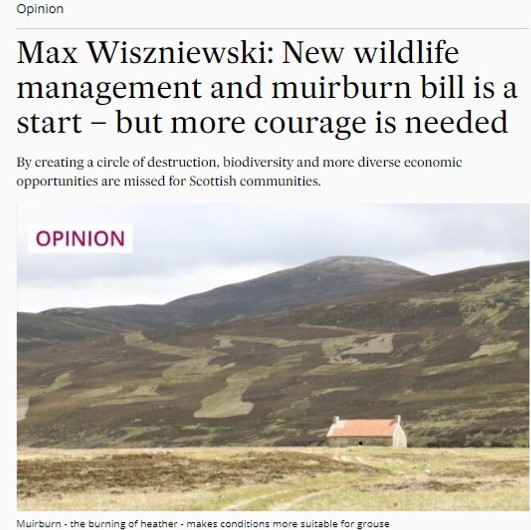
“The shooting industry is laughing in the face of the legislation it will be fighting tooth & nail to oppose” – opinion piece by Max Wiszniewski

There’s a good opinion piece in the Press & Journal today by Max Wiszniewski, Campaign Manager for REVIVE, the coalition for grouse moor reform.

It’s reproduced below:

The systematic, illegal persecution of birds of prey has been a blight in Scotland’s countryside now for decades, so much so that it was described by former first minister, Donald Dewar, as a “national disgrace”.

So, the recent publication of the Wildlife Management and Muirburn (Scotland) Bill, with the primary purpose of tackling wildlife crime, is something to be welcomed.

Yet, on the same day that our new first minister was sworn into office, news broke that another bird of prey – this time a red kite – had been found dead on a grouse moor [Ed: see here]. The shooting industry is laughing in the face of the legislation it will be fighting tooth and nail to oppose.

The new bill proposes to licence the shooting of grouse. If the terms of that licence are broken – such as a licence holder indulging in wildlife crime – then it can be removed.

So far, it seems sensible. But, beyond the illegal destruction of our protected species, hundreds of thousands of foxes, stoats, weasels, crows and so-called “non-target species” like hedgehogs are killed on grouse estates every year, so more grouse can be shot for sport.

Will this unsustainable practice be addressed by the new bill? The answer is: somewhat.

All legal traps will require a “licence”, serial numbers and, presumably, regular checking. Scottish Government oversight of the monitoring of the many thousands of traps on grouse moors to ensure legality will be no easy feat, and it would be expensive to do effectively. Should we be jumping through hoops just so a few people can shoot more grouse for sport?

Bill is an important intervention that should go further

Some big changes in muirburn could be brought about, though. On grouse moors, burning heather shapes the landscape to make it more suitable for grouse – so more of them can be shot.

About 40% of muirburn for grouse has taken place on deep peat, which is an internationally important carbon sequestration resource. Much of it lies in a degraded state on grouse moors, and continued burning is stopping it from regenerating and from rewetting and, therefore, actually emits carbon.

The Wildlife Management and Muirburn Bill proposes an effective ban on peatland burning but, once again, effective monitoring of huge land areas will be difficult and expensive.

Muirburn may still continue under licence in areas with no deep-peat, but should we be dishing out licences when the purpose is increasing grouse numbers for sport shooting? Scotland shouldn’t be pandering to the needs of this cruel, unsustainable and intensively managed industry.

By creating a circle of destruction around huge areas of our land, biodiversity and more diverse economic opportunities are missed for Scottish people and communities.

Overall, this bill as it stands is an important intervention. With a bit more courage to take on large estates and landed interests, it could become the very intervention Scotland’s people, wildlife and environment desperately need.

ENDS

Moy gamekeeper convicted: cue damage limitation exercise by grouse shooting industry

Further to today’s news that gamekeeper Rory Parker (24) has pleaded guilty to shooting a sparrowhawk on Moy Estate in September 2021 (see here), it’s worth examining the narrative that’s being pumped out by the grouse-shooting industry representatives in a desperate attempt to distance the industry from yet another raptor persecution crime.

This conviction couldn’t have come at a worse time for the industry, as the Wildlife Management & Muirburn (Scotland) Bill begins its passage through the Scottish Parliament. Obviously, the industry won’t like the media attention of yet another raptor persecution crime being committed on a grouse-shooting estate so they’ll want to manipulate the media narrative to influence/minimise the scope of the forthcoming grouse shoot licensing scheme.

And so it begins.

It actually began this morning prior to the court hearing. I received a message from an individual within the industry (I won’t name him, he’s generally one of the good guys and I value his willingness to converse). He told me that, ‘in the spirit of accuracy and transparency’, that the shooting of this raptor hadn’t taken place on a grouse moor (as I’d previously reported) but that it was in fact in an area managed for pheasant and partridge. I told him that wasn’t my understanding but that I’d be happy to clarify this detail once the evidence had been heard in court. He told me this particular issue would be clarified during today’s hearing.

As it turns out, it wasn’t really clarified in court. But the RSPB has since published its video footage of the shooting (see link at foot of the RSPB press release, here) and it looks very much like a grouse moor to me.

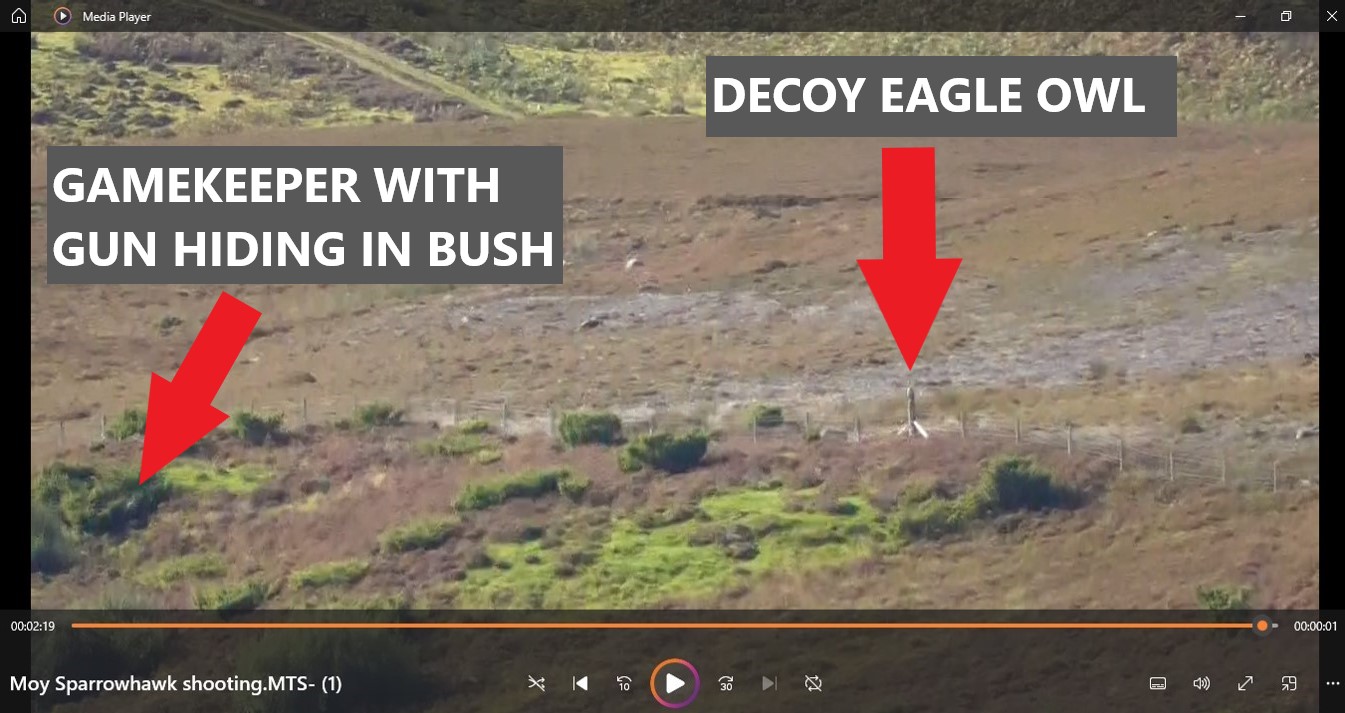
Here’s a screengrab I took from the RSPB video, where incidentally I’ve highlighted the position of the gamekeeper, close to a large plastic decoy eagle owl that had been placed on a fencepost, presumably to try and draw in raptors to shoot at close quarters – we’ve seen gamekeepers using this technique many times before (e.g. see here, here, here, here, here, here).

The location of the shooting was given in court as a hill called Tom na Slaite. Here it is on an OS map – complete with a track leading up to some grouse butts:

Now, it’s quite possible that pheasants and partridge have been released on this part of the grouse-shooting estate – it’s becoming a common theme to release these birds for shooting on grouse moors (e.g. see here), either to supplement the grouse shooting days or, in some circumstances, to replace the grouse-shoot days when grouse stocks are too low to attract paying guests. It’s one of the significant faults in the proposed grouse shoot licensing Bill, in my opinion, but that’s a bigger discussion for another day.

The bottom line is that this gamekeeper, Rory Parker, shot this sparrowhawk on an upland grouse moor, not on a lowland game shoot as the industry would have us believe.

The narrative continues with a quote for the media from Moy Estate’s unnamed shooting tenant (I’ll return to the identity of the tenant/sporting agent in a future blog). His statement, quoted in the Scottish Daily Mirror, includes this line:

As the sporting tenant on this area of land, which is used for pheasant and partridge shoots, we were shocked when made aware of the incident….blah blah”.

It appears to be casual, but that phrase “….which is used for pheasant and partridge shoots…” is carefully and deliberately placed, in my opinion.

As is the phrase quoted in the same article given by Dee Ward from landowners’ lobby group Scottish Land & Estates (SLE), whose statement includes the line:

In this case, the illegal persecution of a sparrowhawk near pheasant and partridge release pens is particularly disappointing….”

It’s slick PR, designed to be consumed by an unassuming, uninformed audience who wouldn’t otherwise link the crime to grouse moor management.

It’s nothing new. We saw it in 2021 when a poisoned golden eagle was found dead, next to a poisoned bait, on a grouse moor on Invercauld Estate in the Cairngorms National Park. Estate Manager Angus McNicol was quoted in the press, claiming:

The area where the bird was found is on a let farm in an area which is managed for sheep farming and is on the edge of an area of native woodland regeneration. It is not managed for driven grouse shooting” (see here).

This claim was swiftly rebutted by Ian Thomson, Head of RSPB Investigations in Scotland (who was directly involved in the investigation) who said:

For the avoidance of doubt, the eagle was found poisoned next to a mountain hare bait, in an area of strip muirburn within 200m of a line of grouse butts and a landrover track” (see here).

The most blatant example of damage limitation by the grouse shooting industry I’ve seen was when SLE issued a statement in response to the appalling crimes committed by gamekeeper Alan Wilson on the Longformacus Estate a few years ago.

In that statement, SLE described the Longformacus Estate as being ‘managed for low ground pheasant shooting‘ (see here). It may well have been, but strangely, they forgot to mention that the crime scene (Henlaw Wood) also just happened to be at the foot of a driven grouse moor! This omission was probably just an innocent, forgetful moment, and nothing whatsoever to do with the fact that the Werritty Review on grouse moor management was imminent.

I’ll write more about today’s conviction of the Moy Estate gamekeeper in another blog, shortly.

UPDATE 1st April 2023: The sentencing of raptor-killing Moy Estate gamekeeper Rory Parker (here)

UPDATE 4th April 2023: Game-shooting industry’s response to the conviction of Moy Estate gamekeeper Rory Parker (here)

Game-shooting industry seething at grouse moor licensing bill

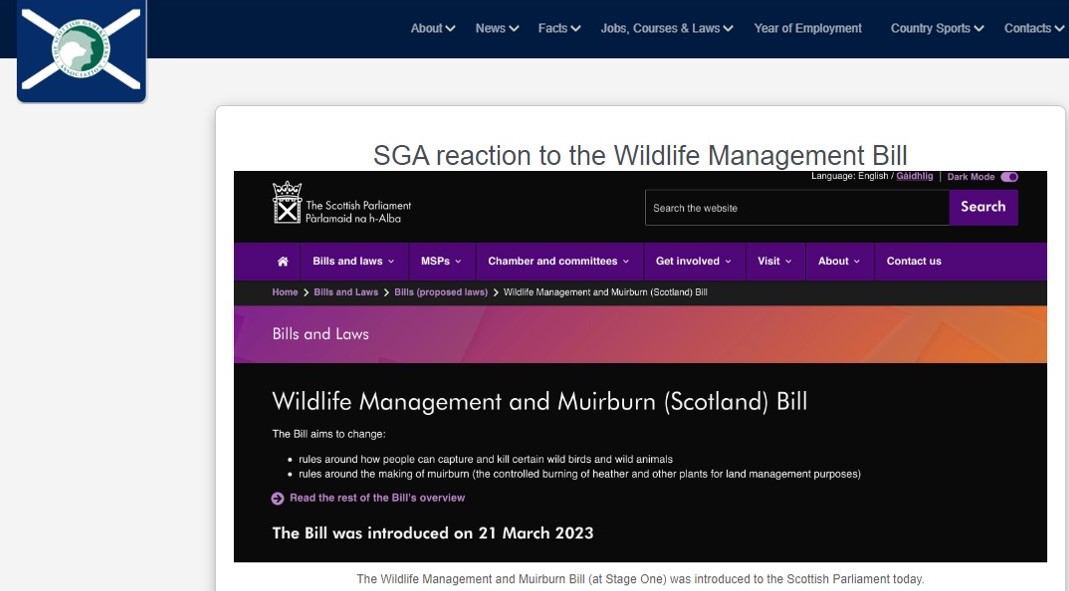
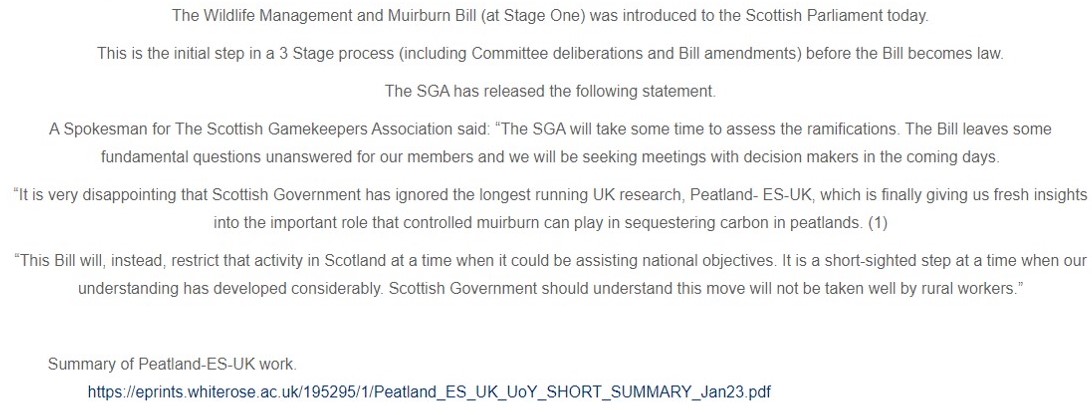
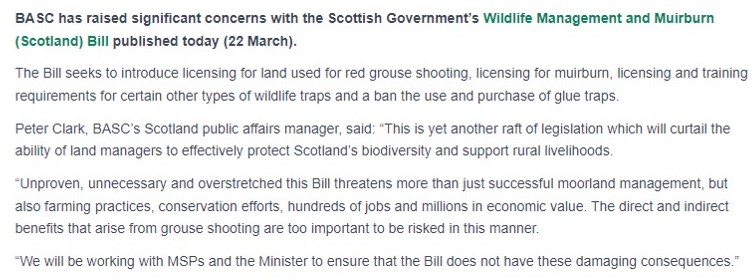
Further to this morning’s news (here) that the Scottish Government has introduced its long-promised grouse shooting bill, formally known as the Wildlife Management & Muirburn (Scotland) Bill, the game-shooting industry is seething.

Probably because the penny has finally dropped that the game is up. Despite years of expensive and extensive lobbying, their arguments haven’t been sufficiently persuasive and their posturing hasn’t been sufficiently convincing. As a result, the Scottish Government has produced draft legislation that, if passed, will bring wide-sweeping reforms, none of which the shooting industry wants, nor until this morning, believed would happen.

This is where the fight really starts as that Bill makes its way through the Scottish Parliament.

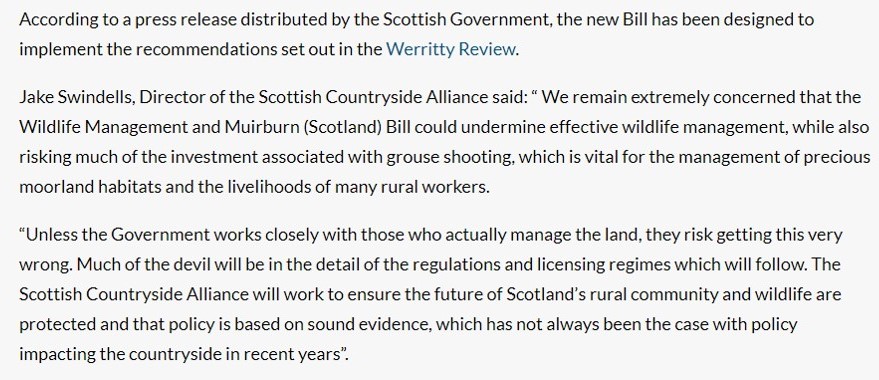
Here are the furious responses of Scottish Land & Estates, Scottish Gamekeepers Association, BASC, and Countryside Alliance:

Response to grouse shooting Bill from REVIVE, the coalition for grouse moor reform

Further to this morning’s news (here) that the Scottish Government has introduced its long-promised grouse shooting bill, formally known as the Wildlife Management & Muirburn (Scotland) Bill, REVIVE, the coalition for grouse moor reform has published the following press statement in response:

REVIVE coalition urges Parliament to be bold on new wildlife Bill

Scottish Government’s draft Wildlife Management and Muirburn (Scotland) Bill marks biggest intervention in land management for generations

The Scottish Government has today published its draft Wildlife Management and Muirburn (Scotland) Bill. The Bill has been introduced to protect the environment and tackle the persecution of birds of prey. It is expected to significantly change the way in which large areas of Scotland are managed, making it one of the biggest interventions in this area for generations.

Campaign Manager for REVIVE, Max Wiszniewski said: “The proposed Bill is a major intervention in land management that regulates destructive practices through licensing, instead of stopping them.

Intensively managed grouse moors are unnatural monocultures that are burned and stripped of competing wildlife so more grouse can be shot for sport. By creating a circle of destruction around huge areas of our land, biodiversity and more diverse economic opportunities are missed for Scottish people and communities.

With a new First Minister on the horizon, as the Bill progresses through Parliament, we hope it will be even bolder and braver to meet the expectations of the Scottish people.”

The Bill follows a review into grouse moor management led by Professor Werritty, the findings of which were published in December 2019. A year later the Scottish Government committed to introduce measures which will hold land managers far more accountable for their activities.

The Bill proposes to strictly regulate the use of muirburn, the controlled burning of vegetation, on peatland as well as ending raptor persecution. It also includes measures to ensure grouse moors are managed sustainably, to ban the use of glue traps for rodents and tighten regulations for the use of other types of wildlife traps.

Robbie Marlsand, Director of the League Against Cruel Sports Scotland, a REVIVE coalition partner added: “When it comes to grouse shooting, this Bill appears well intentioned but kicks a couple of contentious cans down the road. Snares are primitive, cruel and indiscriminate. This Bill should remove them from the Scottish countryside – with no ifs and no buts.

The impact of this Bill on killing grouse for sport will also depend much on the content of a yet to be written code of conduct that shooting estates must comply with. Only when that is finalised will we be able to appreciate the potential impact of this legislation. For example, hundreds of thousands of animals are killed each year so that there can be more grouse to shoot for fun and it’s not yet known if this Bill will change that.

Killing any animal for entertainment is repugnant to the majority of people in Scotland. We therefore welcome any incremental steps that will make it more difficult to do.”

ENDS

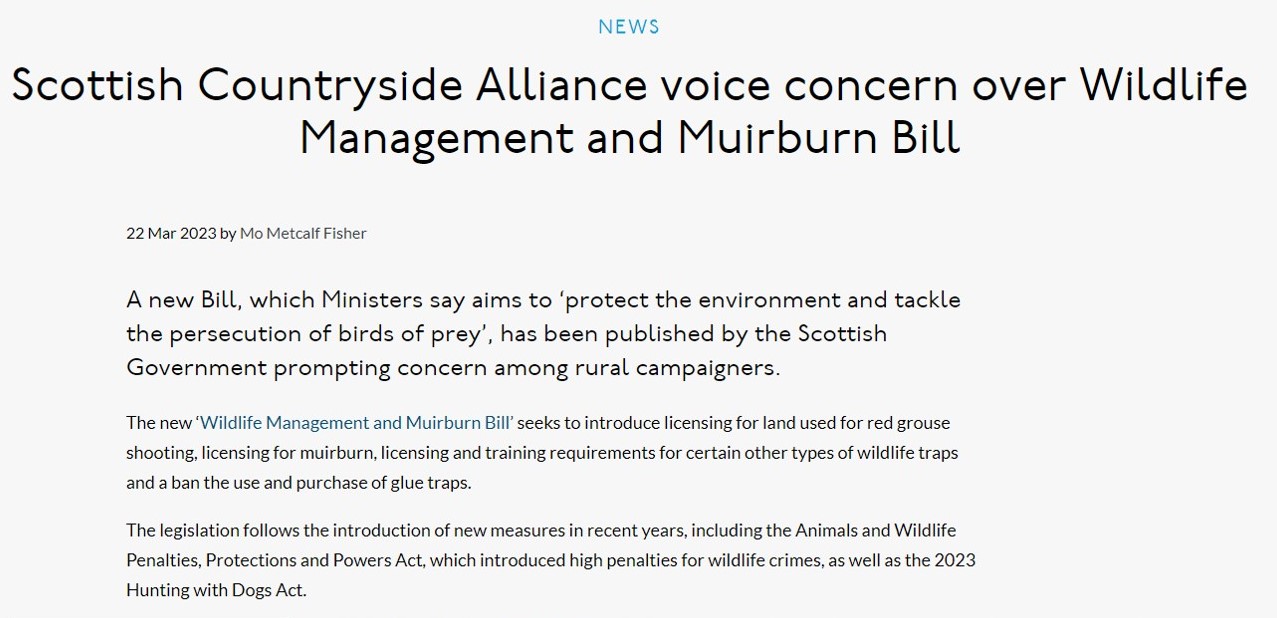
Breaking news….Scottish Government introduces grouse shoot licencing bill

BREAKING NEWS…..

This morning the Scottish Government has introduced its long-promised grouse shooting bill, formally known as the Wildlife Management & Muirburn (Scotland) Bill.

This draft legislation is a direct result of the game-shooting industry’s failure to stop illegally killing birds of prey on many Scottish grouse moors. That was the trigger, and there are also now other aspects to the Bill that are an attempt to tackle other poorly-regulated aspects of unsustainable grouse moor management.

The Bill contains provisions to:

  • Ban the use and purchase of glue traps and introduce licensing and training requirements for certain other types of wildlife traps;
  • Introduce a licensing regime for land used for the shooting of red grouse;
  • License all muirburn; and
  • Introduce enabling powers to allow the Scottish Ministers to extend the role of inspectors appointed under the Animal Health and Welfare (Scotland) Act 2006 to investigate certain wildlife offences.

As it has only just been published, I haven’t had time to read it properly or analyse its contents. I’ll comment further in due course.

Scottish Government has provided this overview:

Now the Bill has finally been introduced, this is how it will progress through Parliament over the coming months. There will be plenty of opportunity for comment on, and amendments to, this Bill.

Here are the all important documents:

The Bill, as introduced:

Scottish Government’s Explanatory Notes:

Scottish Government’s Policy Memorandum (i.e. explaining why the Bill has been created):

Wildlife crime: key conservation organisations ‘excluded’ from Scottish Government’s review on increasing SSPCA powers

In July last year, the Scottish Government finally got around to establishing an independent Taskforce to consider whether the Scottish SPCA should be granted additional powers to help investigate raptor persecution and other wildlife crime (see here).

As a quick recap, the SSPCA’s current powers (under animal welfare legislation) limits their investigations to cases that involve a live animal in distress (including some wildlife crimes). The proposed new powers would allow them to also investigate wildlife crimes under the Wildlife & Countryside Act legislation, e.g. where the victim is already dead, and also incidents where a victim may not be present (e.g. if an illegally-set pole trap or a poisoned bait was discovered). See here for further detail.

This Taskforce, chaired by Susan Davies FRSB, was established after 11 long years of political can-kicking by the SNP only because the Scottish Greens insisted on its inclusion in the historic Bute House Agreement, the power-sharing policy document published by the two parties in 2021:

The independent taskforce to consider whether the Scottish Society for the Prevention of Cruelty to Animals (Scottish SPCA) should be given extra powers to investigate wildlife crime will be asked to report back in a timeframe that will allow any changes to the Scottish SPCA powers to be delivered by legislation implementing changes to grouse and other wildlife management in the course of this parliamentary session‘.

It was expected that the Taskforce’s recommendations would feed into the forthcoming draft legislation on grouse moor licensing (the Wildlife Management (Grouse) Bill) that is expected to progress to Stage 1 of parliamentary scrutiny in the coming weeks (see here).

Indeed, in December 2022, the Scotsman ran an article suggesting that the Scottish Government had said the Taskforce’s review was complete and would be published ‘within weeks‘ (see here), just in time to be considered alongside the Wildlife Management (Grouse) Bill.

However, as has happened so often on this particular issue, it looks like the Scottish Government has moved the goal posts.

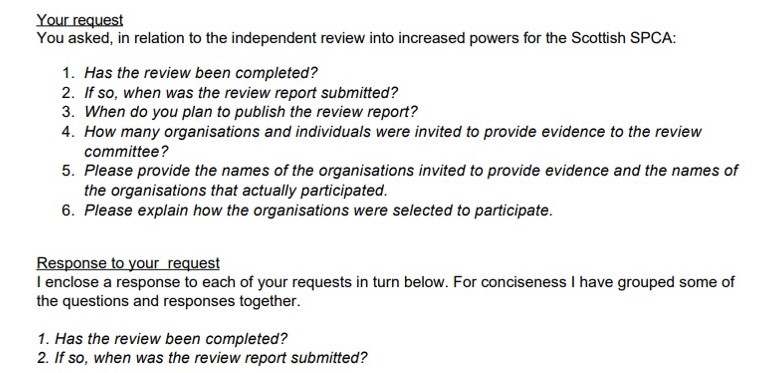
I submitted a Freedom of Information request to the Scottish Government at the beginning of January 2023, asking, amongst other things, for details of when the Taskforce’s review would be published.

The Government’s response, which I received yesterday evening, said the review had been submitted to the Government on 22nd October 2022 but wasn’t expected to be published until ‘prior to summer 2023‘. That’s quite a different response to the one the Scotsman reported of the Government expecting it to be published ‘within weeks‘.

Does that mean the Taskforce’s recommendations won’t be fed into the Scottish Parliament’s consideration of how the forthcoming grouse shooting licencing scheme will operate and be enforced? How does that meet the requirements laid out in the Bute House Agreement between the Scottish Greens and the SNP?

But that’s not the only concern uncovered by the FoI response.

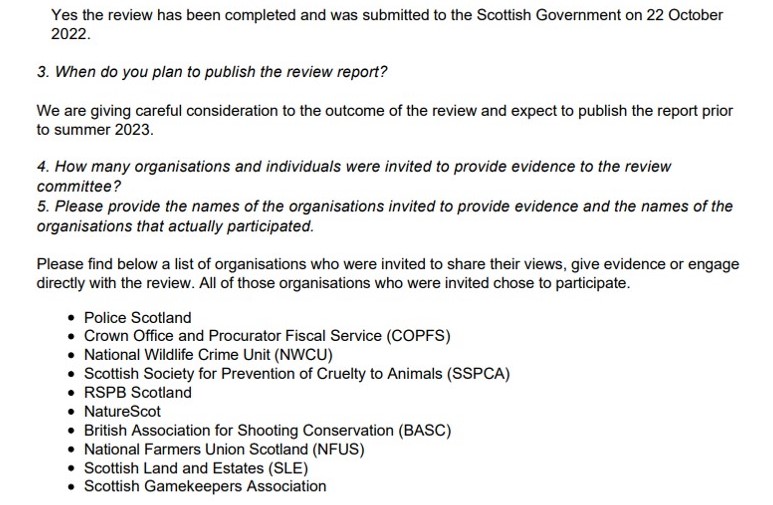
I also asked the Scottish Government some questions about which organisations and individuals were invited and had contributed evidence to the Taskforce review. The answer is alarming to say the least, with invited participants heavily weighted to the game-shooting industry:

Apart from RSPB Scotland, where were the invites to other conservation and wildlife organisations such as Scottish Badgers, Scottish Raptor Study Group, OneKind, League Against Cruel Sports, REVIVE coalition, Scottish Wildlife Trust, Scottish Environment Link etc? Why were they excluded, when they all have legitimate and evidenced concerns about the poor level of wildlife crime enforcement that has led to the proposed extended powers for the SSPCA?

Why were the majority of invited non-governmental organisations those who have previously been vociferous in their opposition to increased SSPCA powers (e.g. see here, here and here) and who presumably, despite their rhetoric about having a ‘zero tolerance’ for raptor persecution/wildlife crime, are still dead set against measures that would help tackle it?

I’ve gone back to the Scottish Government to ask for the ‘key list of stakeholders and those who had previously engaged with [the Scottish Government] on the matter of SSPCA powers‘ that was provided to the Taskforce Chair, to determine whether this bias was determined by the Scottish Government or by the Taskforce Chair.

Either way, if the Taskforce recommendations do not support increased powers for the SSPCA, this inherent bias in participation leaves the Government wide open to a potential legal challenge by conservationists who could argue that their exclusion from participating in the review has resulted in an unfair process.

There is an alternative view. Let’s say that the Taskforce review does recommend increased powers for the SSPCA, then by inviting an overload of anti-SSPCA game shooting organisations, the Taskforce Chair has cleverly covered off any opportunity for them to suggest their views were under-represented in the review process.

Unfortunately, it looks like we have many more months of waiting to find out what, exactly, the Taskforce review recommends. And if our experience of the Werritty Review is anything to go by, we may be waiting a further year for the Government to set out its response to the Taskforce’s recommendations.

UPDATE 7th February 2023: Scottish Government will provide response at same time the Taskforce review on SSPCA powers is published (here).

UPDATE 7th March 2023: More detail provided on why key conservation organisations were excluded from Scottish Government’s review on increasing SSPCA powers (here).

For those new to this subject, here’s the political timeline, now in its 12th year, that has led to the current position:

February 2011: Increased powers for the SSPCA was first suggested by MSP Peter Peacock as an amendment during the Wildlife & Natural Environment (Scotland) Bill debates. The then Environment Minister Roseanna Cunningham rejected it as an amendment but suggested a public consultation was in order.

September 2011: Seven months later Elaine Murray MSP (Scottish Labour) lodged a parliamentary motion that further powers for the SSPCA should be considered.

November 2011: Elaine Murray MSP (Scottish Labour) formalised the question in a P&Q session and the next Environment Minister, Stewart Stevenson MSP, then promised that the consultation would happen ‘in the first half of 2012’.

September 2012: Nine months later and nothing had happened so I asked Paul Wheelhouse MSP, as the new Environment Minister, when the consultation would take place. The response, in October 2012, was:

The consultation has been delayed by resource pressures but will be brought forward in the near future”.

July 2013: Ten months later and still no sign so I asked the Environment Minister (still Paul Wheelhouse) again. In August 2013, this was the response:

We regret that resource pressures did further delay the public consultation on the extension of SSPCA powers. However, I can confirm that the consultation document will be published later this year”.

September 2013: At a meeting of the PAW Executive Group, Minister Wheelhouse said this:

The consultation on new powers for the SSPCA will be published in October 2013“.

January 2014: In response to one of this blog’s readers who wrote to the Minister (still Paul Wheelhouse) to ask why the consultation had not yet been published:

We very much regret that resource pressures have caused further delays to the consultation to gain views on the extension of SSPCA powers. It will be published in the near future“.

31 March 2014: Public consultation launched.

1 September 2014: Consultation closed.

26 October 2014: I published my analysis of the consultation responses here.

22 January 2015: Analysis of consultation responses published by Scottish Government. 233 responses (although 7,256 responses if online petition included – see here).

I was told a decision would come from the new Environment Minister, Dr Aileen McLeod MSP, “in due course”.

1 September 2015: One year after the consultation closed and still nothing.

25 February 2016: In response to a question posed by the Rural Affairs, Climate Change & Environment Committee, Environment Minister Dr Aileen McLeod said: “I have some further matters to clarify with the SSPCA, however I do hope to be able to report on the Scottish Government’s position on this issue shortly“.

May 2016: Dr Aileen McLeod fails to get re-elected and loses her position as Environment Minister. Roseanna Cunningham is promoted to a newly-created position of Cabinet Secretary for the Environment.

12 May 2016: Mark Ruskell MSP (Scottish Greens) submits the following Parliamentary question:

Question S5W-00030 – To ask the Scottish Government when it will announce its decision regarding extending the powers of the Scottish SPCA to tackle wildlife crime.

26 May 2016: Cabinet Secretary Roseanna Cunningham responds with this:

A decision on whether to extend the investigatory powers of the Scottish SPCA will be announced in due course.

1 September 2016: Two years after the consultation closed and still nothing.

9 January 2017: Mark Ruskell MSP (Scottish Greens) submits the following Parliamentary question:

Question S5W-05982 – To ask the Scottish Government by what date it will publish its response to the consultation on the extension of wildlife crime investigative powers for inspectors in the Scottish SPCA.

17 January 2017: Cabinet Secretary Roseanna Cunningham responds:

A decision on whether to extend the investigatory powers of the Scottish Society for the Prevention of Cruelty to Animals will be announced in the first half of 2017.

31 May 2017: Cabinet Secretary Roseanna Cunningham rejects an extension of powers for the SSPCA ‘based on legal advice’ and instead announces, as an alternative, a pilot scheme of Special Constables for the Cairngorms National Park (here). It later emerged in 2018 that this pilot scheme was also an alternative to the Government’s 2016 manifesto pledge to establish a Wildlife Crime Investigation Unit as part of Police Scotland – a pledge on which it had now reneged (see here).

November 2019: The pilot scheme of Special Constables in the Cairngorms National Park was an absolute failure as a grand total of zero wildlife crimes were recorded by the Special Constables but plenty were reported by others (see here).

June 2020: Mark Ruskell (Scottish Greens) proposed further powers for the SSPCA at Stage 2 of the Animals and Wildlife Bill. The latest Environment Minister, Mairi Gougeon persuaded him to withdraw the proposed amendment on the basis that she’d consider establishing a taskforce to convene ‘this summer’ to consider increased powers (see here).

December 2020: Mark Ruskell (Scottish Greens) submits two Parliamentary questions asking about the status of the taskforce and who is serving on it (see here).

January 2021: New Environment Minister Ben Macpherson says the taskforce has not yet been appointed but that it is “expected to be established later this year“ (see here).

September 2021: In the 2021 to 2022 Programme for Government it was announced that the ‘independent taskforce [Ed: still to be appointed] will report before the end of 2022’ (see here).

May 3 2022: In an interview with Max Wiszniewski of the REVIVE coalition for grouse moor reform, new Environment Minister Mairi McAllan said: “It’s imminent and I wish I could tell you today but we are just finalising the last few points for the membership but I’m hoping to be able to make an announcement about that in the next few weeks“ (see here).

1 July 2022: Scottish Government announces Susan Davies has been appointed to lead the taskforce review and will ‘publish a report later this year’ (see here).

27 December 2022: A Scottish Government spokesperson tells Scotsman journalist the taskforce has completed its review and its findings will be published ‘within weeks’ (see here).

31 January 2023: An FoI response from the Scottish Government to this blog’s author reveals the Taskforce’s review was submitted to the Scottish Government on 22nd October 2022 and will be published ‘prior to summer 2023’.

7 February 2023: Scottish Government tells journalist from The Scotsman that it will provide a response at the same time the Taskforce review on SSPCA powers is published (here).

Barely-suppressed contempt for Scottish Environment Minister Mairi McAllan in petitions committee meeting on mountain hare protection vs falconry

The Scottish Parliament’s ‘Citizen Participation and Public Petitions Committee’ is currently considering a petition that was first submitted in February 2021 by a falconer, Barry Blyther, calling on the Scottish Parliament to urge the Scottish Government to amend the Animals and Wildlife (Penalties, Protections and Powers) (Scotland) Act 2020 to allow mountain hares to be hunted for the purposes of falconry (Petition PE1859, here).

The basic premise of the petition (and I’m simply summarising here – if you want the full details please read the petition details) is that Barry wants to be able to hunt mountain hares with his golden eagle for ‘sport’. Barry argues that since the mountain hare received full legal protection in 2020 after a late amendment from Scottish Green’s MSP Alison Johnstone to the drafting of the Animals and Wildlife Bill (here and here), he can no longer legally hunt mountain hares for fun, and he wants the Scottish Government to amend the legislation to provide an exemption for falconers.

Some of you may recall the furore that erupted amongst the shooting industry after the mountain hare was given full legal protection, because it meant an end to the grotesque annual slaughter of thousands of mountain hares on some driven grouse moors. For example, the Scottish Gamekeepers Association said it was thinking of setting up a new political party “to ensure the working countryside is represented better” (here) and landowners’ lobby group Scottish Land & Estates wasn’t happy either (here).

The raw fury when their sense of entitlement had been so adeptly overridden was palpable, and that contempt was very much still in evidence by several pro-fieldsports MSPs during a Petitions Committee hearing on 21st December 2022, held to further consider Mr Blyther’s petition on ‘upland falconry’ and his desire to hunt mountain hares for ‘sport’.

I watched the archived video of that hearing this afternoon and would encourage you to do the same, if you have time (it’s here and it’s the first item on the agenda).

If you’d prefer to read the transcript, that’s here:

Environment Minister Mairi McAllan had been invited to this committee hearing to answer questions on this petition. She was accompanied by her senior civil servant Hugh Dignon and Stan Whittaker from NatureScot.

The rude, disrespectful and frankly unpleasant manner of some of the Petitions Committee members towards Mairi McAllan is quite shocking. I’ve seen behaviour like this, first hand, from the pro-grouse shooting MPs in Westminster (here) but I haven’t previously seen this in the Scottish Parliament. Convenor Jackson Carlaw MSP (Conservative), Fergus Ewing MSP (SNP) and Alexander Stewart MSP (Conservative) deserve particular rebuke for their style of questioning. Jackson Carlaw told the Minister the committee was “quite exercised” by the Government’s response to the petition – that’s one way of describing it.

Mairi McAllan handled it brilliantly, calling them out a few times and delivered a well-considered response, superbly supported by Hugh Dignon, explaining that the mountain hare is protected because there are concerns for its conservation status, that falconers could still practice falconry without the threat of prosecution if they take care to hunt in areas with a low density of mountain hare, and in a nature emergency, the conservation status of the mountain hare is of greater importance than sporting or recreational activity.

I particularly enjoyed her wry smile when the Convenor spoke over her (again) and instead turned his attention to Hugh Dignon for an answer:

I think the considered explanations from Mairi and Hugh fell on deaf ears though because at the next hearing of the Petitions Committee, held on 18th January 2023, the Committee decided to go back to the Minister for further clarification on a few points (they seem to have missed the main point about the conservation status of the mountain hare being the primary priority) and Fergus Ewing, who likes to get his own way, says:

I forgot to say that, at the very end of the letter to the minister, we could perhaps politely indicate that all members of the committee feel particularly exercised and concerned about this matter, and it is therefore our intention to pursue it. We should indicate that we are treating it very seriously indeed, and perhaps thereby inject a little bit of lead into the ministerial pencil“.

Here is the transcript from the hearing on 18th January 2023:

We’re all well aware of Fergus Ewing’s strong support for the fieldsports industry – I’ve blogged about it many times before (e.g. see here) so his position on this particular pro-fieldsports petition is no surprise whatsoever.

The other two, Jackson Carlaw MSP and Alexander Stewart MSP are both Scottish Conservatives so their positions shouldn’t come as a surprise either, although the evident vitriol in their questioning style is a bit more perplexing.

I note with interest that Alexander Stewart MSP attended this BASC lunch in November to celebrate Great British Game Week. Purely coincidental, I’m sure.