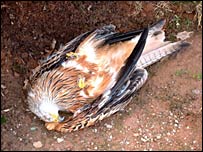
Police are investigating the deaths of five red kites in the North-East of England. The deaths in the Northumberland area span a period of seven months and appear to be the results of poisoning.
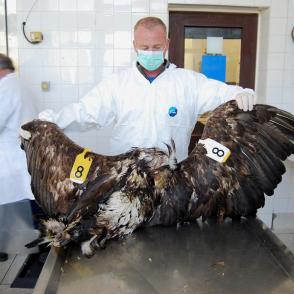
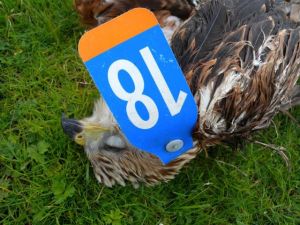
This 3 yr old sea eagle was poisoned in Ireland earlier this year
New regulations came into force in the Irish Republic yesterday, finally banning the use of all poisons for pest control, apart from those used for rats and mice.
This has been a long time coming, and full credit should be given to The Golden Eagle Trust, who have long campaigned for this ban as they try to re-introduce the golden eagle, white-tailed eagle and red kite to their former ranges across the country.
Whilst the ban will not stop poisoning incidents (look at the continued number of poisoning incidents in Scotland and England where the ban has been in force for several years), it does send a clear message from the Irish government that they wish to address the issue of illegal raptor persecution. Kudos to them for taking this important step.
At least 12 re-introduced raptors have been killed by poison in Ireland this year alone, including golden eagles, sea eagles and red kites. Both the Scottish and Norwegian governments, who licence the capture of eagles in their countries for release in Ireland, have expressed grave concern at the poisonings, and failure to tackle the problem could result in the governments withdrawing their co-operation. This is quite a laughable position for the Scottish government to take, given their complete inability to effectively address raptor persecution in this country. So far, at least. They do have a chance to make significant improvements with the forthcoming WaNE bill, but the bill is still only in Stage 1 of the legislation process so there’s a long way to go yet.
A side-benefit of the new Irish legislation may be in reducing the amount of illegal poison that arrives in Scotland each year, believed to be smuggled in from Ireland where, prior to the new legislation, poison could be bought legally. Clearly it will take some time for all the poison currently in circulation in Ireland to be disposed of, but the long-term view is optimistic.
The RSPB’s annual Birdcrime 2009 report was published today and shows that 2009 was the second worst year for raptor persecution in the last decade.
This depressing report shows that there were 384 reported persecution incidents against birds of prey in the UK during 2009, 123 in Scotland, 224 in England, 17 in Wales and 11 in Northern Ireland, 9 incidents could not be allocated to a single country and were recorded at a UK level. Incidents include trapping, shooting, poisoning and nest destruction.
Again the trend showed that most incidents involved game shooting interests with a bias towards the upland grouse moors in Scotland and Northern England where the main victims of persecution are: golden eagle, white-tailed eagle, hen harrier, goshawk, peregrine and red kite.
In the report, the RSPB has made 11 recommendations for government action, so that these appalling crimes can be eradicated. These include the introduction of a “vicarious liability” offence which would make land managers and owners responsible for the actions of their employees.
Despite several successful prosecutions the conviction rate and subsequent sentencing appears pitifully poor and ineffective.
An un-named gamekeeper from the estate in Tayside where a poisoned red kite was found in July 2010 has denied all involvement and claims the dead bird was “planted“.
The self-proclaimed SGA member said: “There is something funny about this and I think someone else has killed this bird and planted it on my estate. Why they have done that, I don’t know“. This view will come as no surprise to the regular readers of this blog – it is the standard line that is heard so often from the SGA.
He went on: “Anybody who does this should be jailed because it’s not on and I have never done anything like this inmy life“.
Interesting that over the last 15 years, the following have all been found dead, confirmed poisoned, on this estate: 9 buzzards, 2 sparrowhawks, 2 crows, 1 gull, 1 tawny owl, 1 pole cat, 1 domestic cat, and now 1 red kite. In addition, 12 poisoned baits have been discovered there (see blog post Aug 27 2010). Whoever is doing the “planting” is managing to maintain a long-term campaign of illegal killing.
30 young red kites were released into the Grizedale Forest in August 2010
Just five weeks after being released as part of the latest red kite reintroduction scheme, a young male kite has been found dead in Artengill, Cumbria. A post mortem examination revealed the young bird had been shot 4 times in the chest.
Police have begun an investigation, in partnership with the Forestry Commission and Natural England.
Will the culprit be brought to justice? Unlikely. It is yet another disgusting mindless act of violence by someone in the shooting community who knows he/she will get away with it. How many more of these incidents are we going to have to read about?
The location where the dead red kite was found in July (now confirmed to have been poisoned – see earlier blog below) was given by Tayside Police as “Strathtay, near Aberfeldy”, Perthshire. I mentioned a number of sporting estates in my earlier post that have their addresses in this area. I’ve since investigated further and look what I’ve found –
According to Tayside Police’s press release about the latest dead red kite, over the last 15 years the following have been found poisoned in the same area where the recent red kite was found dead – 9 buzzards, 2 sparrowhawks, 2 crows, 1 common gull, 1 tawny owl, 1 pole cat and 1 domestic cat. In addition, they say 12 poisoned baits have also been found.
Compare the above list of dead animals & poisoned baits with the following list of dead animals & poisoned baits, which was reported in the RSPB’s LegalEagle newsletter (January 2005, #43, page 3) – “In 14 separate incidents since 1998, 16 poisoned victims (9 buzzards, a cat, a tawny owl, 2 sparrowhawks, a common gull, a pole cat and a crow and 12 poisoned baits [rabbits, woodpigeons and a pheasant]) have been found, with traces of the pesticides mevinphos, carbofuran and alphachloralose“.
The 2005 RSPB report relates to the Edradynate Estate, which is situated in Strathtay, near Aberfeldy. Coincidence? You decide.
Nobody was convicted for the earlier alleged offences at Edradynate Estate thanks to the apparent chronic mishandling of the prosecution case. The Edradynate Estate head gamekeeper (aged 55) and underkeeper (22), both of Aberfeldy, were arrested in 2002 and charged with nine offences relating to the use of poisoned baits and also bird cruelty, including the use of spring traps. On 22 July 2004, two years after the original arrests and 13 court hearings later, the Fiscal dropped the case against them at Perth Sheriff Court. A spokeswoman for the Crown Office admitted the time taken to prepare the case for a trial had been a major factor in the decision to scrap it.
Tayside police have launched an investigation after yet another incident of illegal raptor poisoning. A red kite was found dead in the Strathtay area (near Aberfeldy, Perthshire) at the end of July, and government toxicology reports have confirmed the kite was poisoned.
According to Tayside police, 5 buzzards and a tawny owl met with the same fate in the same area last year. In addition, 9 buzzards, 2 sparrowhawks, 2 crows, 1 gull, 1 tawny owl, 1 pole cat and 1 domestic cat have also been found poisoned in the same region over the last 15 years.
According to the Scottish Raptor Study Groups website, a total of 12 poisoned baits have also been recovered from the same estate where the red kite was found dead.
Tayside Police’s Wildlife Crime Officer Alan Stewart had the following insight:
“There is no doubt that the scourge of poisoning wildlife in Scotland has decreased in general terms in recent years. However, there remain a number of ‘hotspots’ that blight our civilisation and our reputation worldwide“.
Alan Stewart
It’s an interesting perspective from someone closely involved with the PAW Scotland group and who really should know better. Has he not read the latest figures that were only published in August this year that demonstrate an increase in illegal wildlife poisoning events? The only thing that has decreased in recent years is probably Tayside Police’s track record of successful prosecutions for raptor persecution incidents.
It’s also interesting to note that once again, the name of the estate involved has not been made public, even though poisoned baits have been found there. There are a number of sporting estates in this area, and it could be any one of the following:
Or may be it’s another estate? Who knows. That’s reassuring for those of you who live in the area, whose children play in the area, whose pets walk in the area, and also for you visitors who come to our countryside to enjoy it, not to find dead raptors or have your dog/child poisoned while out on your holidays.
A pair of red kites which became well known to birdwatchers and tourists have been found dead near Stocksfield, Northumberland. The bird carcasses have now been sent to the London Institute of Zoology for forensic analysis to determine how they died.
Numerous birdwatchers travelled to the kites’ nesting site near Whittonstall, Northumberland, last year, where they were clearly visible at long-range for several months. Visitors used the vantage point provided by the Highland Cattle Centre on the opposite side of a small valley to view the isolated nest high in trees.
This suspected case of persecution comes only a few months after 2 red kites were found dead illegally poisoned near Hexham, Northumberland.
Published on Friday an annual RSPB Scotland report confirmed that 2009 marked the highest number of raptor poisoning incidents for 2 decades. “The Illegal Killing of Birds of Prey in Scotland in 2009” indicates that human persecution continues to have a serious impact on the populations of some of the country’s most vulnerable species.
Last year, 21 buzzards, 4 red kites, 2 golden eagles and 1 white-tailed eagle, the latter gifted to Scotland from Norway as part of a reintroduction programme, were among the victims in 46 poisoning cases confirmed by Scottish Government testing.
Illegal killing, through shooting, nest destruction or the use of spring traps, were also confirmed in nine incidents. As many raptors are long-lived and have slow reproduction rates the killing of these species, particularly adult breeding birds, has dire consequences for their populations as a whole. This illegal persecution is affecting the conservation status of raptors such as hen harriers, golden eagles and red kites.
The vast majority of poisoning incidents were associated with shooting estates and in particular grouse moors. Predictably, various pro-shooting bodies have attempted to discredit the RSPB Scotland figures and fudge the issue. Notably, the landowners’ organisation, the Scottish Rural Property and Business Association (SRPBA) said the figures were misleading.
A spokesman said: “The official government report on the illegal poisoning of birds of prey for 2009, published in March 2010, shows the level has stayed the same for the last three years with the exception of 2008 when there were 16 incidents. There is ample legislation in existence to deal with this problem and we support the full weight of the law being brought to bear on those using illegal poisons.”
As these crimes are mainly committed in extremely remote areas and discovered by hill walkers and similar outdoor enthusiasts stumbling upon dead birds, it must be remembered that these “confirmed” cases must represent only a fraction of the true number of raptors illegally killed each year.
The increase in these incidents proves beyond reasonable doubt that the perpetrators of these crimes have little fear of the Scottish judiciary system. Perhaps if the penalties for killing our birds of prey were more of a deterrent we would see this disgraceful trend reverse.
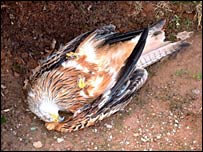
2 Northumberland red kites have been confirmed as having been poisoned.
The birds were found close to each other in Hexham, Northumberland on 12th February 2010 and were sent for post mortem analysis to a specialist veterinary surgeon in Newcastle. It was recently confirmed that the birds died as a result of eating meat which had been laced with poison.



 Raptor Persecution UK