Paul Allen, 54, the gamekeeper convicted last month of multiple wildlife, poisons and firearms offences committed on the Shaftesbury Estate, Dorset in March 2021 (here) is due to be sentenced at Weymouth Magistrates Court this afternoon.
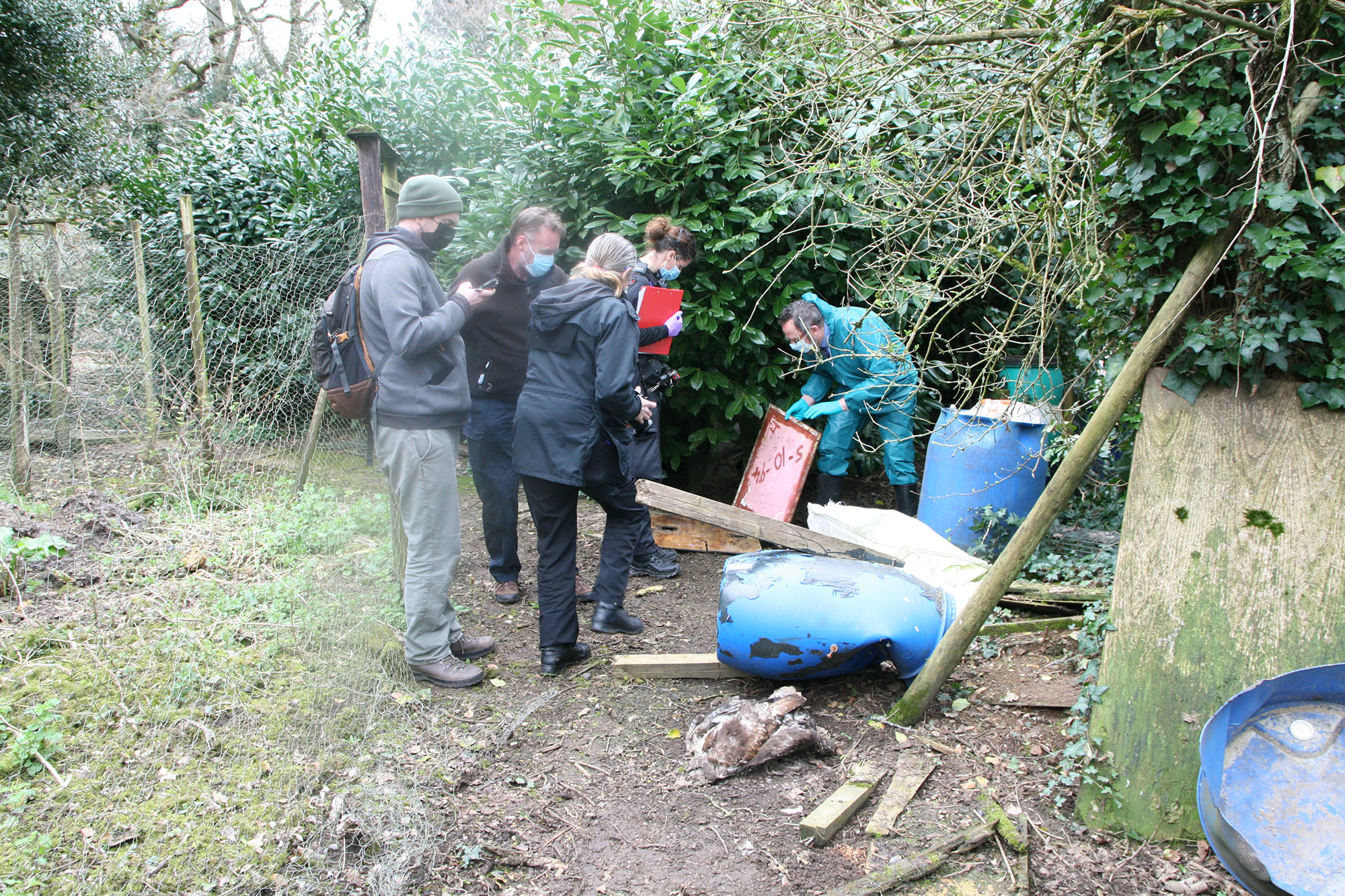
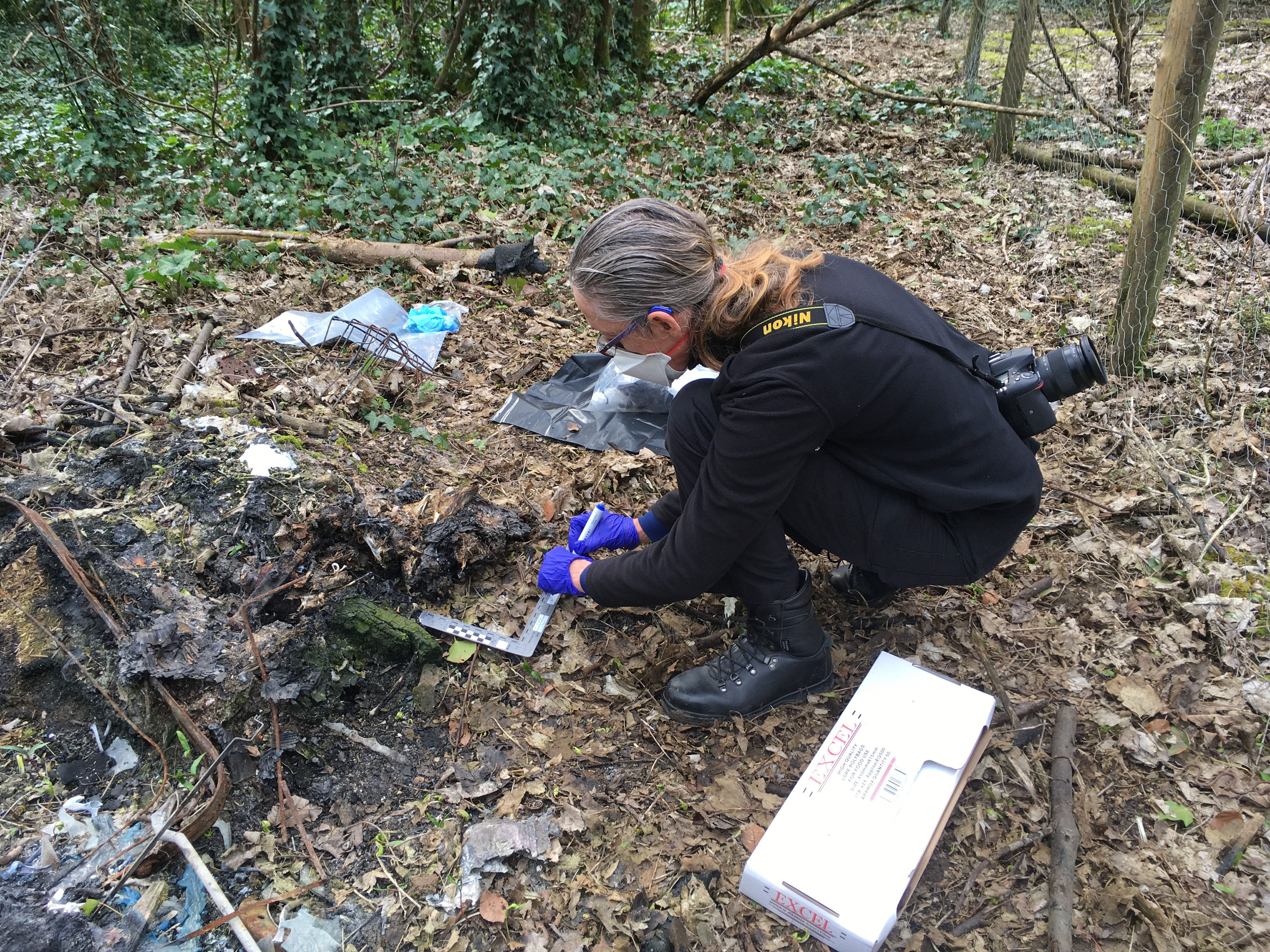
You may recall, following the discovery of a poisoned red kite on the estate in November 2020, a multi-agency raid led by Dorset Police’s (now former) wildlife crime officer Claire Dinsdale took place in March 2021 (see here) where the corpses of six dead buzzards were found by a pen behind his house (tests later showed they had all been shot, including one that was was estimated to have been shot in the last 24hrs). Officers also found the remains (bones) of at least three more buzzards on a bonfire.
A loaded shotgun was found propped up behind a kitchen door (!) and 55 rounds of ammunition were found in a shed. Both the gun and the ammunition should have been inside a locked, specifically-designed gun cabinet, by law. The ammunition was not covered by Allen’s firearms certificate.
Officers also found a number of dangerous, and banned, chemicals, including two bottles of Strychnine, two containers of Cymag and a packet of Ficam W (Bendiocarb) in various locations, including in a vehicle used by Allen.
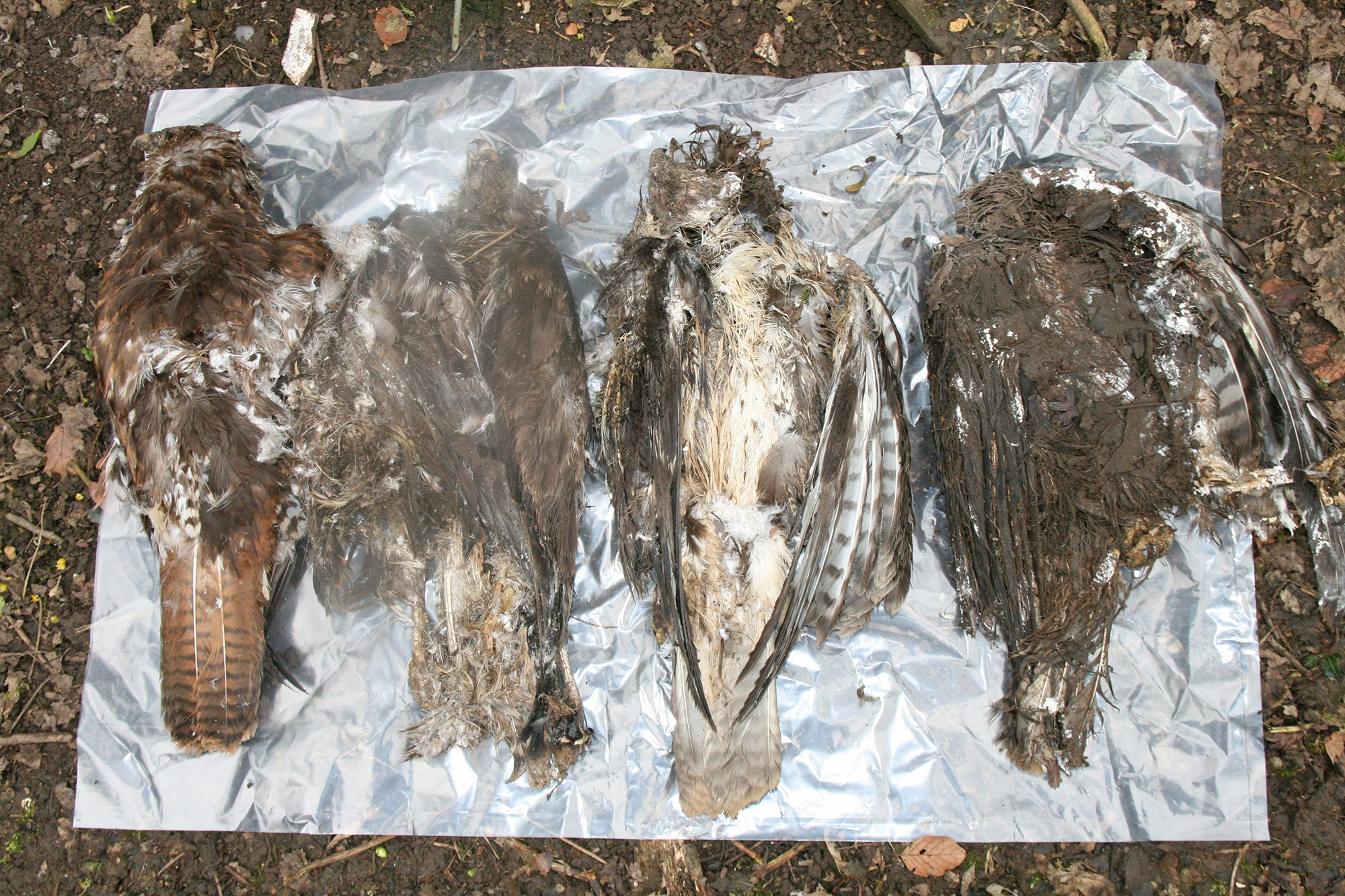
Four of the nine dead buzzards found. Photo: RSPB
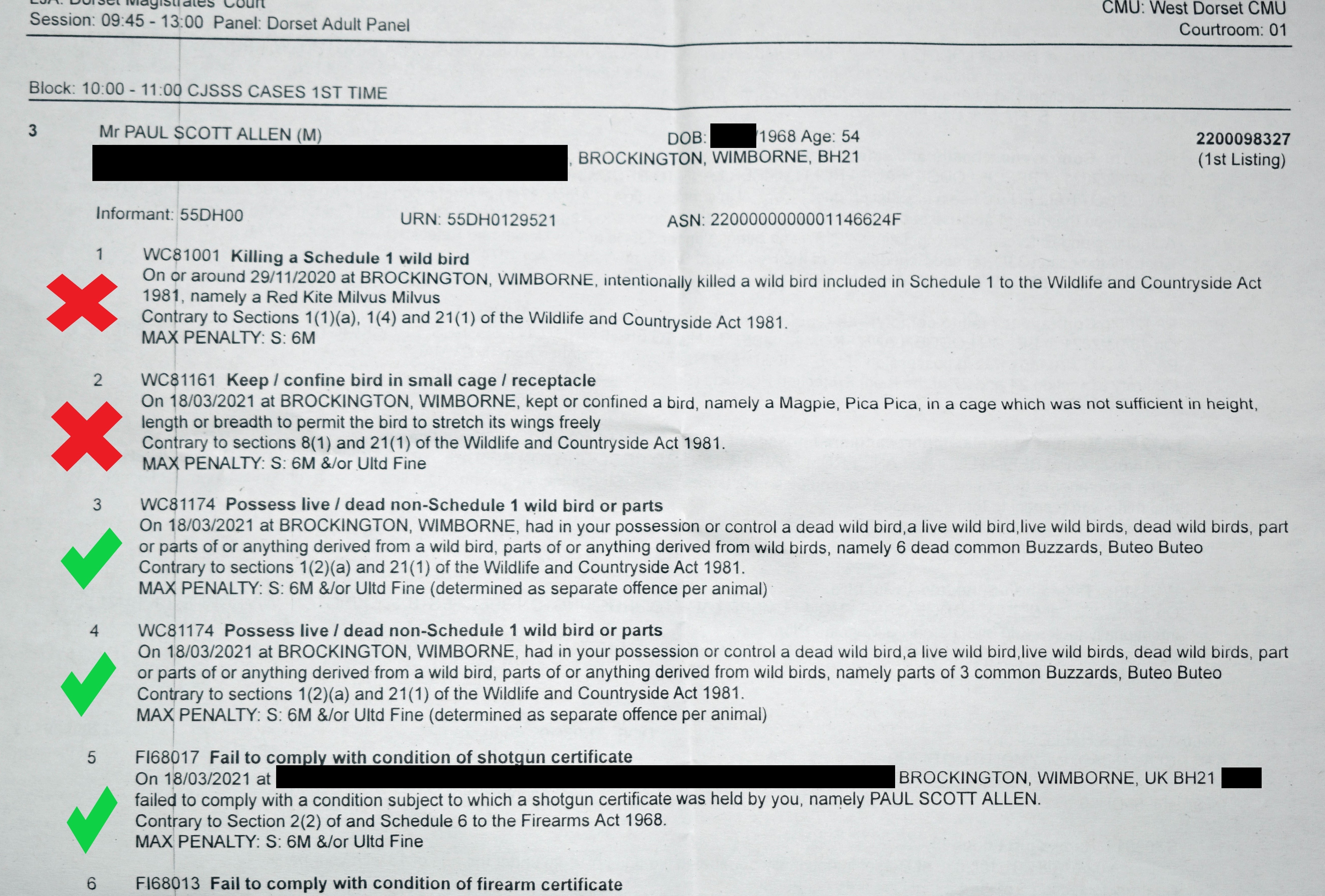
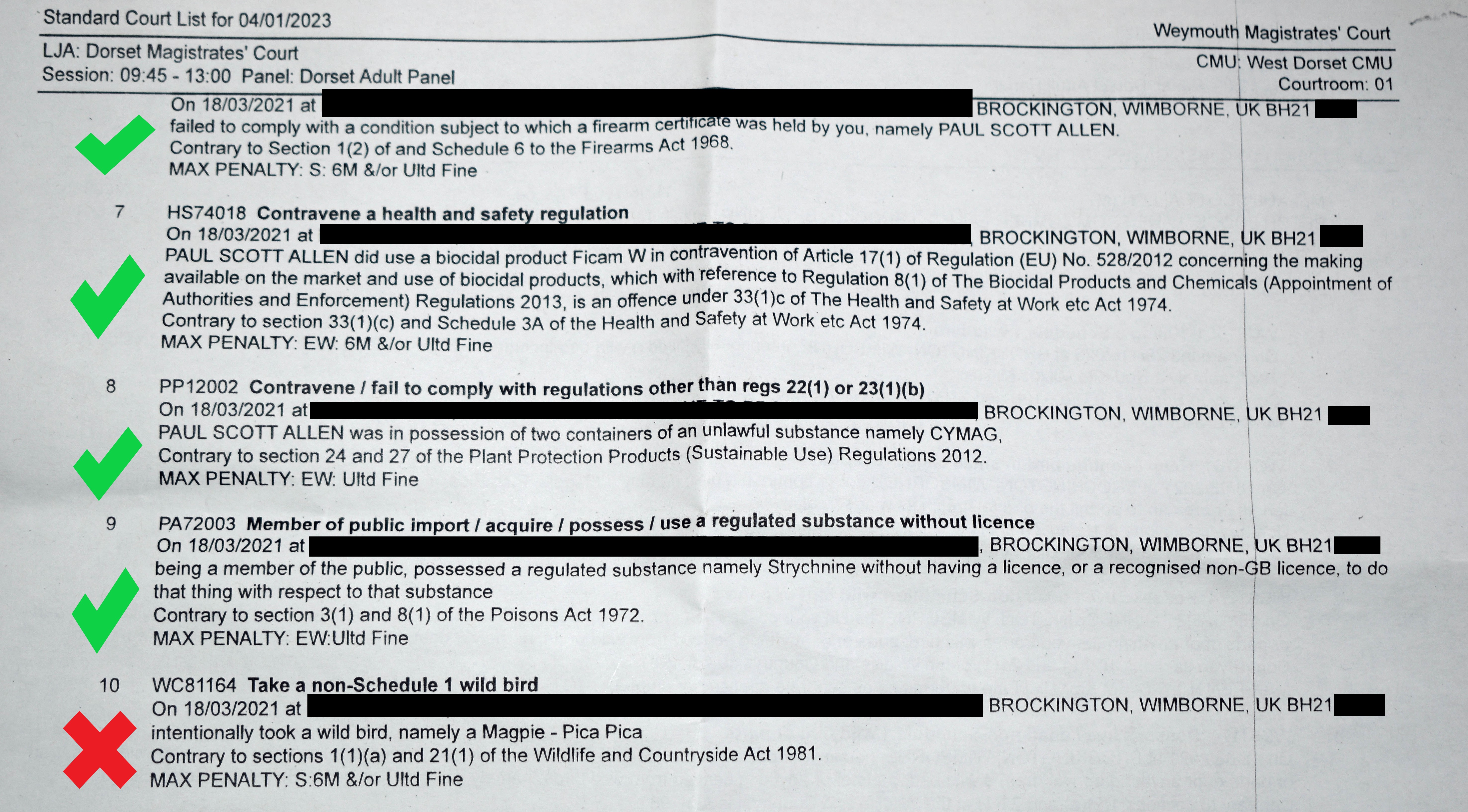
At a hearing on 4th January 2023, Allen pleaded guilty to seven charges including two counts of possessing a live or dead bird, or parts thereof, one charge of failing to comply with the conditions of a shotgun certificate, one charge of failing to comply with the conditions of a firearms certificate, one count of possessing a regulated substance without a license, one count of failing to comply with regulations in accordance with the Plant Protection Products (Sustainable Use) Regulations 2012 and one charge of contravening a health and safety regulations.
A number of other charges were dropped minutes before the start of the hearing after some discussion between the defence and the CPS. I’ve annotated this court listing to demonstrate the changes. The court listing was provided by a court clerk at last month’s hearing (thanks to the blog reader who sent it to me).
The court deferred sentencing until today to allow reports to be complied on Allen, to help inform sentencing. In my view these crimes pass the custody threshold but the court will need to consider any mitigating factors. For example, it has been reported elsewhere that Allen is recently widowed and has two teenage children. If he is the sole carer for these children then that will likely impact on the type of sentence he receives, although I would argue that having unsecure, highly dangerous poisons and an unsecure loaded shotgun propped up behind his kitchen door is questionable behaviour for an apparently responsible parent.
Sentencing takes place this afternoon and a large amount of media coverage is anticipated. I’ll report back later.
UPDATE 16.30hrs: Criminal Dorset gamekeeper Paul Allen receives suspended custodial sentence despite committing multiple wildlife, poisons and firearms offences (here)
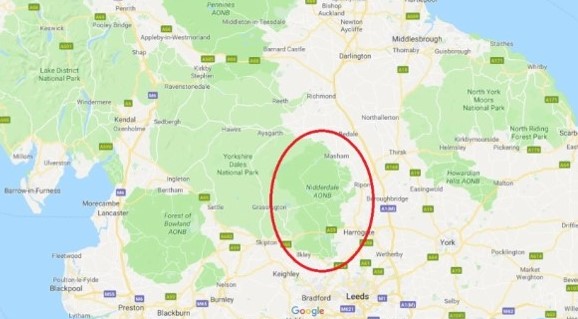
Last November I was reading an online article on the Teeside Live website about the Nidderdale Area of Outstanding Natural Beauty (AONB) in North Yorkshire being dubbed ‘the bird poisoning capital of the UK‘ (here).
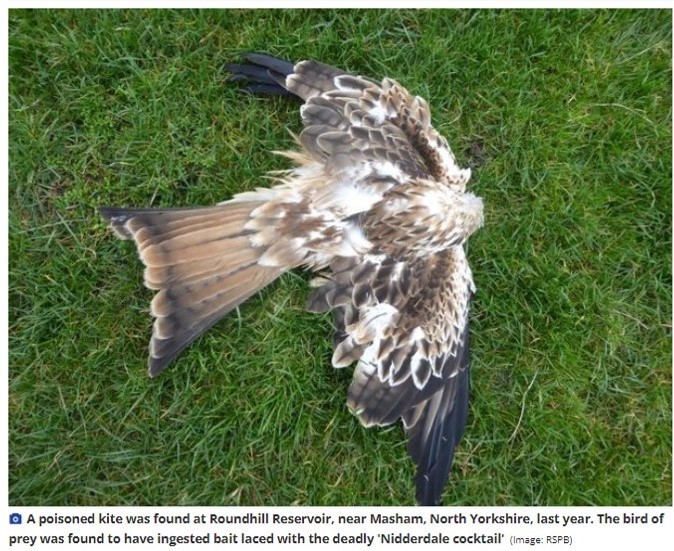
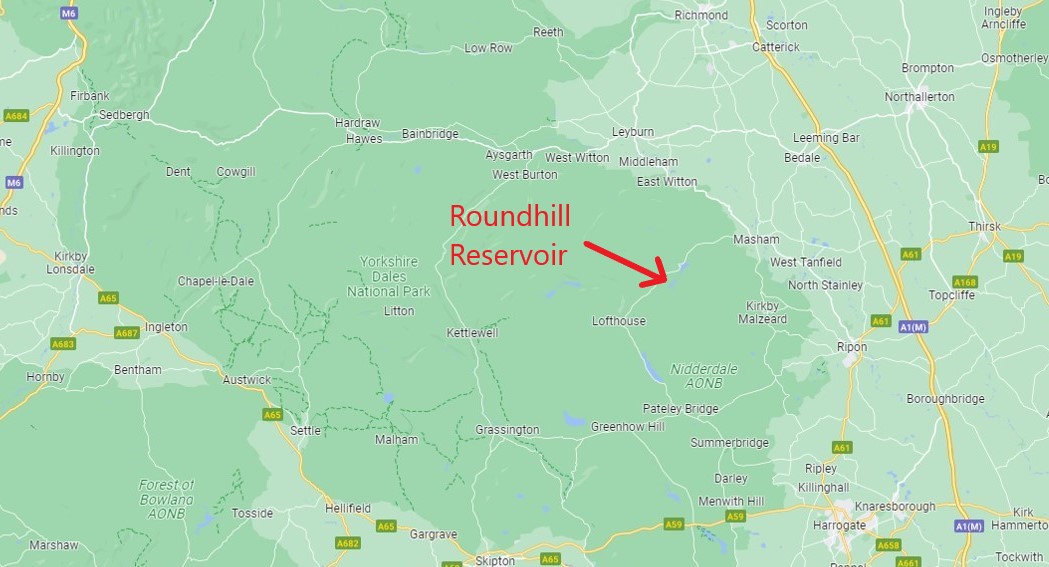
The article was illustrated with various photographs, including this image of a poisoned red kite that was reportedly found dead at Roundhill Reservoir, near Masham in 2021:
The given location caught my eye as I understand the Roundhill Reservoir is surrounded by the Swinton Estate, a notorious grouse-shooting estate that has been at the centre of police investigations into confirmed and alleged raptor persecution for years.
For example, this is the estate where hen harrier ‘Bowland Betty’ was found dead in 2012, later confirmed to have been shot (here & here) although it has never been established whether she was shot on or off the estate. It’s also where a Swinton Estate gamekeeper was convicted for twice setting an illegal pole trap in 2013 (here) and where another hen harrier, ‘River’, was found shot dead in 2019 (here). Around the same time as River’s demise, an unidentified gunman had been filmed with two dogs walking through a hen harrier roost on the estate (here). There have also been reports from local raptor workers of the ‘mysterious disappearances’ of many raptors on this estate for over a decade.
The owner of Swinton Estate is Mark Cunliffe-Lister, Earl of Swinton, who in 2020 became the new Chairman of the grouse moor owners’ lobby group, the Moorland Association (here). This is a high profile position and in recent years Mr Cunliffe-Lister’s estate has become somewhat of a poster child for DEFRA’s ludicrous hen harrier brood meddling trial, where the estate has championed the removal of some hen harrier chicks in return for permitting others to remain and to be diversionary fed by estate staff, although this hasn’t been without controversy either after it emerged that Natural England had appeared to ‘bend the rules’ in favour of estate activities (e.g. see here). Controversially, in 2021 a Guardian journalist described Swinton Estate as the ‘hen harrier’s friend’ (here), supported by a statement from Stephen Murphy (Natural England) about the estate’s head gamekeeper, “What he’s done for harriers, word’s can’t describe“. Murphy also claimed that hen harrier Bowland Betty had definitely been shot elsewhere and merely flew on to the estate to die – an unevidenced claim that was later amended in the article. Last year the estate won what was described as ‘a prestigious conservation award’ for its involvement in the hen harrier brood meddling trial (here).
So, back to that article I was reading in November 2022. I didn’t recall hearing about a poisoned red kite being found on the Swinton Estate in 2021 and I’m pretty sure I would have remembered, given the location, so I did some digging to make sure the poisoning had been confirmed and the location verified, just in case the journalist had cocked up (she’d already mistakenly described Nidderdale as a ‘village’ instead of a region so I couldn’t rely on her account of the poisoned red kite to be accurate).
The Nidderdale Area of Outstanding Natural Beauty (AONB), North Yorkshire
Roundhill Reservoir in the Nidderdale AONB
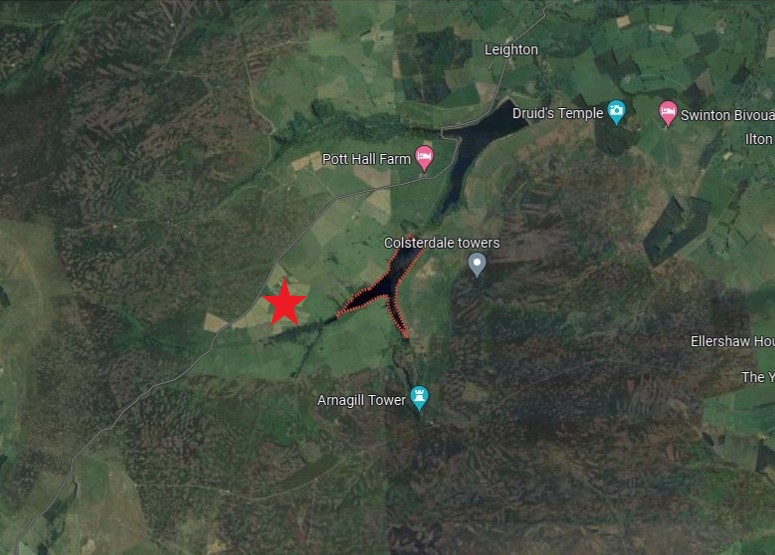
I found details about this crime on the HSE’s Wildlife Incident Investigation Scheme spreadsheet, which confirmed the kite had been found poisoned on a Right of Way footpath in November 2021. The poisons found in the kite’s stomach included Bendiocarb, Carbofuran, Chloralose and Isofenphos – this highly toxic combination has become known as the ‘Nidderdale Cocktail’ as it’s so frequently used to kill birds of prey in this region, especially red kites (e.g. see here, here, here).
The red star denotes the approximate location of the poisoned red kite found in November 2021, close to Roundhill Reservoir and surrounded by the grouse moors of Swinton Estate
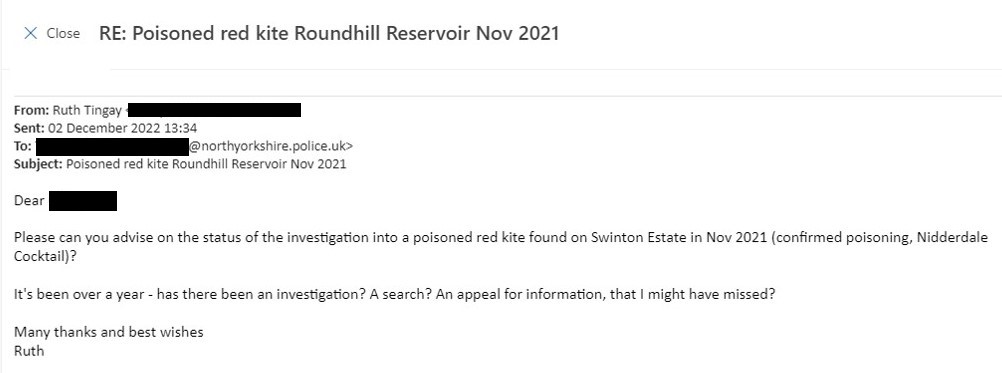
However, I couldn’t find any media coverage of this crime, nor any police appeals for information, nor any warnings to the public about the continued use of poisons so dangerous that some of them have been banned for years. Given that a year had already passed since the poisoned kite was discovered, I found this puzzling. So I contacted North Yorkshire Police’s rural crime team and asked them about the status of the investigation:
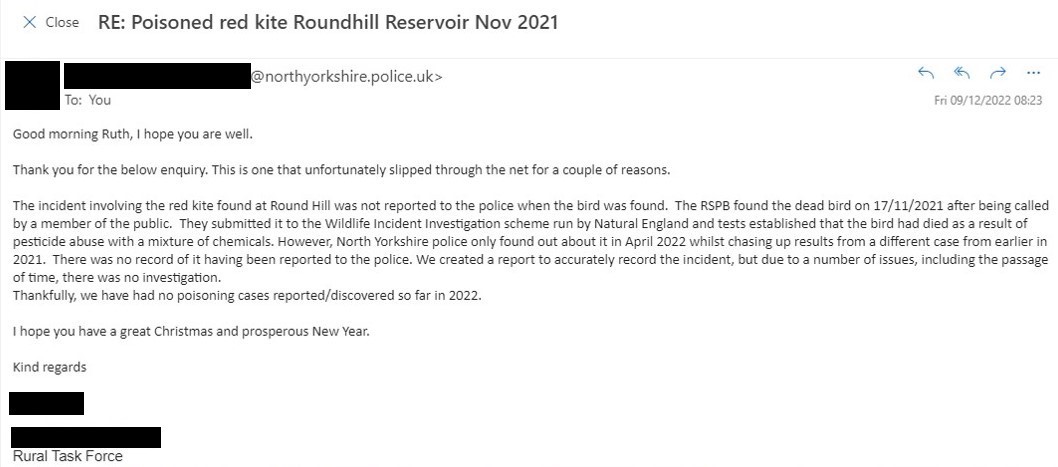
Here’s the astonishing response I received:
This North Yorkshire Police Inspector admitted that this poisoned red kite “unfortunately slipped through the net” but then went on to justify the police’s decision not to investigate by accusing the RSPB of failing to notify the police about this incident when the poisoned kite was first picked up. He claimed the police only found out about it five months later, in April 2022, whilst chasing the lab for the results of another investigation.
His allegations about the RSPB aside (and which I’ll come to, below), I was still stunned that he thought that launching an investigation, and issuing a public appeal for information, let alone issue a warning to the public about the use of poisons in the countryside, wasn’t worthwhile due to the ‘passage of time’ (five months), especially given the location where the poisoned kite had been found.
A couple of years ago a previous North Yorkshire Police Inspector had issued a public appeal/warning, ten months after the discovery of another poisoned red kite in Nidderdale (see here), so it seemed to me that there was no reason not to issue one after a five month delay.
I wrote back to North Yorkshire Police asking for an explanation:
Apparently, it wasn’t up for debate. Here’s the response I received:
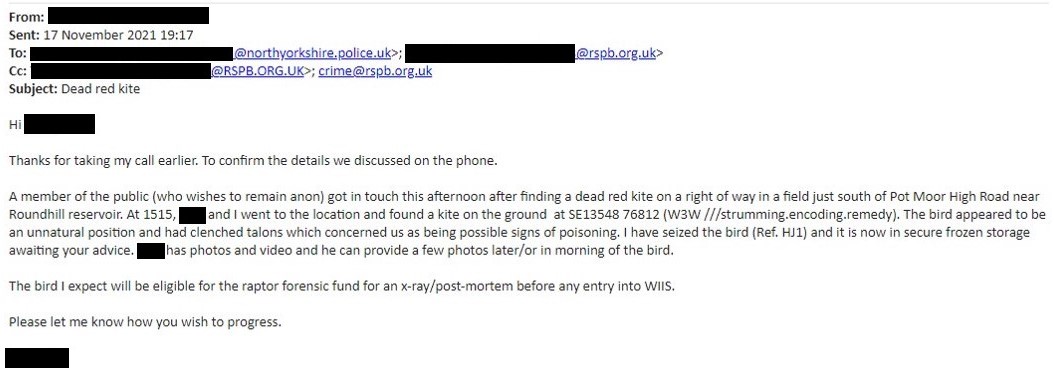
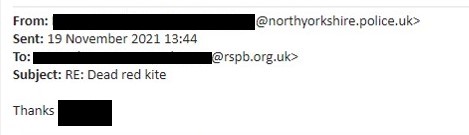
Meanwhile, I contacted the RSPB and put to them the allegations this Inspector had made, that the RSPB hadn’t notified the police about the discovery of this red kite. It turns out those allegations were utterly unfounded/untrue. The RSPB DID contact North Yorkshire Police, on the day the poisoned kite was discovered, and took instruction from the police about submitting the corpse for toxicology analysis. Furthermore, they had the email correspondence to prove it:
So what are we to make of North Yorkshire Police’s refusal to investigate a confirmed poisoning incident (a so-called national wildlife crime priority), on an estate with a long history of alleged wildlife crime, that has enjoyed recent adulation from Natural England staff and the media, that has played a significant role in the hen harrier brood meddling trial, and whose owner is a high profile representative of the grouse-shooting industry?
Does Mr Cunliffe-Lister even know about this poisoned kite being found on his estate? Given the Moorland Association’s claimed ‘zero tolerance’ of raptor persecution, and Mr Cunliffe-Lister’s widely-reported apparent welcoming of birds of prey on his estate, I’d have expected him to speak out and condemn this disgraceful poisoning incident, as any decent landowner would. It’d be interesting to know whether North Yorkshire Police have informed him, or not.
Whatever, North Yorkshire Police’s refusal to investigate this crime is wholly unacceptable. In the first instance, I’ll be writing a letter of complaint to the North Yorkshire Police, Fire and Crime Commissioner, Zoe Metcalfe.
In her Police and Crime Plan 2022-2025 (here), she details an objective of ‘an improved [police] response to crime in rural areas, especially wildlife crime...’ as this had been identified as a major concern for North Yorkshire residents in the recent PCC consultation.
UPDATE 23.30hrs: Natural England’s senior management team has a lovely day out…on Swinton Estate!! (see here).
In March last year a young, satellite-tagged white-tailed eagle was found dead on the Isle of Wight in what were considered to be suspicious circumstances and a police investigation was launched (see here).
This was the third white-tailed eagle death since October 2021 and all three birds were from the Isle of Wight Reintroduction Project, a Government-backed five-year project bringing young sea eagles from Scotland and releasing them on the Isle of Wight to re-establish this species in part of its former range.
The two other dead eagles found during that period included the one found on the Shaftesbury Estate in Dorset in January 2022, which was confirmed to have been illegally killed by ingesting an extraordinary high quantity of the rat poison Brodifacoum but the subsequent police investigation was botched by Dorset Police (see here); and the eagle found dead on a game shoot in West Sussex in October 2021, confirmed to have been illegally killed by ingesting the poison Bendiocarb and whose death is currently the subject of an on-going police investigation (see here).
A preliminary post-mortem on the eagle found dead on the Isle of Wight revealed it was carrying avian flu, but at that time it was unknown whether avian flu had been the cause of death. Later tests revealed it had not.
The presence of avian flu has important consequences for how the corpse is handled and stored under strict government rules, and unfortunately this impacts on the ability to conduct standard toxicology analyses for other potential causes of death, notably the detection of certain poisons.
Last week Hampshire & Isle of Wight Constabulary issued the following statement about the death of this eagle:
Death of White-tailed Eagle remains uncertain after conclusion of police investigation.
A police investigation into the death of a satellite-tracked White-tailed Eagle on the Isle of Wight has found no evidence of unlawful killing.
It comes after Hampshire Constabulary were called shortly after 5pm on Thursday 24 February 2022 to a report of a dead sea eagle on Bowcombe Road on the Isle of Wight.
The circumstances surrounding the death were investigated by local Country Watch officers, along with the support of various partners including the Animal and Plant Health Agency, DEFRA, Forestry England and the Roy Dennis Wildlife Foundation.
Officers explored all possible lines of enquiry into the death, including; analysis of satellite tracking data, evidential land searches in and around the site where the bird was found deceased, obtaining accounts from witnesses in the local area at the time, comprehensive veterinary x-rays as well as conducting specialist post mortem examinations.
The bird initially tested positive for Avian Influenza (AI), but subsequent post-mortem examination carried out under strict AI protocols concluded that this was not the cause of death.
Standard toxicology testing was not possible due to the AI positive test, but the limited analysis that was undertaken did reveal elevated background levels of two rodenticides, brodifacoum and difenacoum, though not at sufficiently high levels to have caused the death of the bird. As such the post-mortem concluded that the actual cause of death of the White-tailed Eagle remains uncertain.
During the post mortem, there was no evidence of any lesions on the sea eagle to explain the cause of death.
Police Sergeant Stuart Ross of Hampshire Constabulary’s Country Watch team, said: “Hampshire Constabulary has carried out a thorough criminal investigation into the death of the White-tailed Eagle and have found no evidence of unlawful killing from the lines of enquires carried out and evidence gathered by officers.
“As such, we are satisfied that there is no evidence of criminal offences having taken place and that the death of the White-tailed Eagle is being treated as uncertain at this time”.
“The criminal aspect of this investigation has now concluded, but we urge all users of rodenticides, particularly brodifacoum, which is known to be highly toxic to wildlife, to follow all guidelines regarding use. Brodifacoum should only be used in and around buildings.”
The reintroduction of White-tailed Eagles on the Isle of Wight is part of a dedicated scheme run, under a Natural England licence, by Forestry England and the Roy Dennis Wildlife Foundation.
ENDS
There are no complaints about Hampshire & Isle of Wight Police’s handling of this investigation. They were responsive, thorough and transparent.
The police statement, above, is fairly detailed and informative. However, caution should be applied when interpreting the statement about the presence of ‘elevated background levels of of two rodenticides, brodifacoum and difenacoum, though not at sufficiently high levels to have caused the death of the bird. As such the post-mortem concluded that the actual cause of death of the White-tailed Eagle remains uncertain‘.
Whilst this is factually accurate, and I’m sure not intended to mislead in any way, readers should be aware that the storage of the eagle’s tissues in formalin (as required for AI positive birds) reduces the laboratory’s ability to determine the significance of these rodenticides.
Here is an excerpt from the final lab report:
‘It was suspected that this white-tailed sea eagle had been poisoned, or possibly exposed to anticoagulant rodenticides. Laboratory analysis for some likely pesticides has been undertaken on samples of fixed tissue only, although it is possible that typical abuse pesticides (such as bendiocarb) would not be detected within this sample type. These tests have detected and confirmed a residue of the anticoagulant rodenticides brodifacoum and difenacoum in the fixed liver from this eagle, but the significance of these residues is uncertain given the prior treatment of the sample with formalin. Therefore, the actual cause of death of this white-tailed sea eagle remains uncertain, but this result confirms that it had been exposed prior to death to brodifacoum and difenacoum’.
Unfortunately we won’t ever now know whether this eagle had ingested high quantities of rodenticides, or whether it had been poisoned with a banned substance such as Bendiocarb, because of the rules on the handling and storing of tissues containing Avian Influenza. And this may prove to be an issue that hampers other investigations if avian flu is detected in a raptor that has died in what are perceived to be suspicious circumstances.
But at least in this case, the police did conduct searches of the land where the eagle was found dead, and have also included a warning in their press statement about the proper use of rodenticides.
To follow news about the reintroduced white-tailed eagles please visit the Roy Dennis Wildlife Foundation website here.
Last week I blogged about how a major shooting industry organisation, BASC, had attacked Suffolk Police for what BASC perceived to be an ‘offensive’ police appeal for information about the shooting of five young goshawks found dead at the edge of woodland near Thetford (here).
BASC complained that the police’s appeal was “disparaging to the shooting community” simply because the police had asked the shooting community for help to identify the shot gun-wielding criminal(!). Astonishingly, BASC’s complaint resulted in the police’s tweet/appeal for information being deleted.
Later, Suffolk Police released a joint press release with the RSPB, which seemed to enrage BASC even further. Bizarrely, BASC wrote on a blog:
“Can we assume the RSPB has more information on the matter than BASC as they were very quick yesterday to offer a £5,000 reward for information leading to conviction; shortly followed by a similar pledge from Wild Justice? It would be useful to know whether RSPB are complainants, victims, witnesses or have any other relationship with Suffolk Constabulary“.
I would argue that this is a cack-handed but sinister attempt by BASC to try and influence the narrative on raptor persecution crimes. If the police are too scared to publicise a raptor persecution incident or appeal for information about it, because they’re scared of a backlash from the industry who are, let’s not forget, responsible for 73% of convictions for raptor persecution crimes, then it’s job done for the shooting industry. No reports = no publicity = no bad press = no public pressure on politicians to tackle these relentless, systemic crimes.
And it’s not just BASC that appears to be at it. The National Gamekeepers Organisation (NGO) has recently written on its website its dissatisfaction with Lincolnshire Police and the RSPB about the reporting of raptor persecution offences in that county. It’s mostly about a recent incident where the remains of three barn owls, one tawny owl and one red kite were found dumped in a ditch (here), and the NGO incorrectly accuses RSPB Investigations Officer Howard Jones of ‘insinuating that a gamekeeper might be to blame for the Lincolnshire incident‘ in a BBC news article.
Actually, Howard Jones did no such thing, he was talking about raptor persecution crimes in general and he was simply stating facts – the “vast majority” of raptor persecution cases being dealt with by the courts involve gamekeepers. That is a factually accurate statement from Howard, however unpalatable/embarrassing that may be to the NGO. Neither the RSPB or Lincolnshire Police laid any blame on anybody after the discovery of those bird of prey remains in Lincolnshire – they simply said it was an ‘unusual’ case and were appealing for information (here).
The ridiculous NGO, though, has written on its website:
“The NGO are in contact with DC Flint of Lincolnshire Police and are hoping to meet with him in the near future to discuss both this case and to highlight our concerns about the reporting surrounding this case“.
Meanwhile, the NGO has failed (refused?) to publicise the recent conviction of Dorset gamekeeper Paul Allen, who pleaded guilty to multiple wildlife, poisons and firearms offences after the discovery of six shot buzzards, the burnt remains of three more buzzards, and three different types of banned poisons on his pheasant shoot and a loaded shotgun found propped up behind his kitchen door with rounds of unlicensed ammunition in an out-building.
The NGO has also remained silent about the discovery of the five shot goshawks found dumped in Suffolk last week.
Like BASC, you’ll know that the NGO is a member of the Raptor Persecution Priority Delivery Group (RPPDG), a so-called partnership (it’s a sham) whose main objective is to help eradicate raptor persecution by highlighting these crimes and publicly condemning the criminals involved.
Long-term blog readers will know this attempted manipulation of the narrative by the game-shooting industry is nothing new and has been going on for years, mostly behind the scenes and only uncovered via Freedom of Information requests (e.g. see here and here).
I’ve just been sent yet another example of it, this time in the Yorkshire Dales National Park. More on that shortly…
A young white-tailed eagle, released into the wild as part of a conservation reintroduction project, has been found poisoned with the banned pesticide Carbofuran.
The National Parks & Wildlife Service in Ireland is appealing for information after the discovery of the dead eagle in November 2022 on land between counties Cavan and Westmeath.
The juvenile male white-tailed eagle who was just over a year old had been brought in as a chick in 2021 from Norway under phase two of a national re-introduction programme (e.g. see here and here).
It had been fitted with a satellite tag prior to its release on Lough Derg in 2021 and subsequent monitoring showed the eagle had been spending time around Lough Sheelin in Co Westmeath with two other white-tailed eagles, but tag data indicated the eagle had become stationary in November.
The corpse was retrieved and toxicology tests undertaken at the State Laboratory confirmed the eagle had been poisoned with Carbofuran, a deadly pesticide so dangerous it was withdrawn for use in Ireland over a decade ago.
NPWS regional manager, Maurice Eakin, said white-tailed eagles were a protected species under the Wildlife Acts. The death of the bird last November highlighted “once again” the extent of the illegal practice of using poisonous material as pest control.
“In this instance, it is particularly disturbing that the reckless laying of poison has resulted in the death of a white-tailed eagle, one of our largest and most majestic bird species, which had been persecuted to extinction by the early 1900s,” he said.
The NPWS is seeking any information from the public in the Westmeath/Cavan region, particularly anyone who may have seen anyone or any vehicles acting suspiciously in recent weeks in the area between Lough Sheelin and Lough Ramor.
Over 100 white-tailed eagles, donated by Norway, have been reintroduced to the Irish Republic since 2007, with the first successful breeding taking place in 2012 and there have been many successes over the last decade, bringing biodiversity and ecosystem benefits as well as a boost to local economies via ecotourism.
However, a scientific review of the reintroduction project in 2019 indicated that the small population was still vulnerable to illegal poisoning events so additional eagles have been reintroduced as part of phase two of the reintroduction to help bolster the population. It’s sadly ironic that one of those eagles has become the latest poisoning victim.
Last month I blogged about a poisoned red kite that had been found dead, laying close to a poisoned bait (a Lapwing, of all things) on Dava Moor, a grouse moor in the Scottish Highlands, just outside the boundary of the Cairngorms National Park (see here).
The poisoned red kite laying dead next to poisoned bait (a lapwing)
The poisoned red kite and the poisoned bait had been found after the kite’s satellite tag indicated the bird was dead on 21st May 2021 and Police Scotland launched an investigation. They collected the kite and the bait and sent them off to a specialist lab for toxicology analysis and they conducted a search of the grouse moor the following week. Toxicology tests confirmed the presence of poison in both the kite and the lapwing.
Sixteen months later in September 2022, Police Scotland notified the finder that ‘enquiries are complete, nobody has been charged and the case is now closed‘.
However, the police withheld the name of the poison, failed to issue an appeal for information, and failed to warn the public that dangerous poisons were in use in the area. The crime was only made public after a tip off to this blog. If I hadn’t been told about it, none of us would be any the wiser.
After writing the blog and criticising Police Scotland’s decision to keep this crime a secret, a journalist from The Strathy decided to submit a Freedom of Information request to Police Scotland to ask for more details. Last week they received a response:
The poison used to kill the red kite was Bendiocarb, a dangerously toxic substance so lethal that it has been an offence to even possess it in Scotland, let alone use it, since 2005.
The police also revealed that, “One individual was arrested, interviewed and released without charge due to insufficient evidence.
“No charges were ever brought because one of the main responsibilities of Police in Scotland is to investigate crimes and criminal offences and where there is a sufficiency of evidence, report the circumstances to the Crown Office and Procurator Fiscal Service.
“Investigation of this particular incident did not provide sufficient evidence to charge any individual.
“To clarify, corroborative evidence is required to liable any charge in relation to the poisoning of birds of prey. The decision not to issue a press release was an operational one, balancing risk versus reward.
“To explain, the locus was remote, the bait and bird had been removed and no longer posed a risk.
“Given there was no nearby path it was deemed highly unlikely that any members of the public would have been able to provide useful or relevant witness evidence.
“From the main road nearest the locus any persons on the land would not have been able to identify any suspect given the distance involved. Further consideration was given in regards to the requirement not to alert the accused to the investigation at this time to aid further investigative strategies.
“Any intelligence identifying the methodology or focus of this activity could have been used to the advantage of the perpetrator to frustrate such investigations and/or seek support other individuals to do so.
“As such, any press release would have been detrimental to planned further enquiry and police activity.”
That’s just not acceptable. Yes of course, withhold details during the early stages of the investigation so as not to alert the offender, but not saying anything about it for 19 months after the offence was committed? That plays straight into the hands of the grouse-shooting industry whose representatives will (and have been) quite happily writing letters to national newspapers claiming that raptor persecution on grouse moors is an ‘historical issue’ and no longer a problem.
And even more importantly, it puts members of the public, and their pets, at risk of coming into contact with deadly poisons where they’d be least expecting it. Somebody had deliberately placed a deadly poisoned bait out in the open on that moor, with the intention to kill. Police Scotland stated, “the bait and bird had been removed and no longer posed a risk” but who knows how many more baits have been placed there? Where’s the duty of care from Police Scotland, to warn the public of this danger?
Police Scotland’s silence also misses an important opportunity to raise awareness amongst the public that these crimes ARE still being committed, and to encourage them to report anything suspicious that they may stumble across whilst out on the hills, as well as eroding public confidence and trust in the police’s interest in dealing with wildlife crime.
To be clear, I’m not criticising the initial police response to the report of the poisoned kite and the poisoned bait. By all accounts it was a rapid reaction and a thorough investigation by officers on the ground. This isn’t like Dorset Police’s botched response to a confirmed poisoning – where they refused to conduct a follow-up search to look for evidence after the discovery of a poisoned white-tailed eagle (see here). That the Dava Moor poisoning didn’t lead to a prosecution is not a reflection on the investigating officers at Police Scotland – everyone knows how difficult it is to get these despicable offenders into court.
But the decision, presumably made by senior officers, to keep quiet about it for so long? That sounds like a deliberate cover up to me.
I await with interest NatureScot’s decision about whether a General Licence restriction will be imposed on this grouse moor (see here).
This case exemplifies the importance of the Government’s forthcoming Wildlife Management (Grouse) Bill, where there is a proposal to utilise the civil burden of proof (the balance of probability) to determine whether a sanction should be imposed (i.e. the estate’s grouse shooting licence removed), rather than relying upon the criminal burden of proof (beyond reasonable doubt). Police Scotland has admitted, in its FoI response, that in this case corroborative evidence was required to progress any sanction. Had a grouse-shooting licence scheme been in place, the licence would probably, and in my opinion justifiably, have been revoked.
A wildlife crime officer from Lincolnshire Police is warning of the risk to humans, dogs and cats from the dangerous substances used to illegally kill birds of prey.
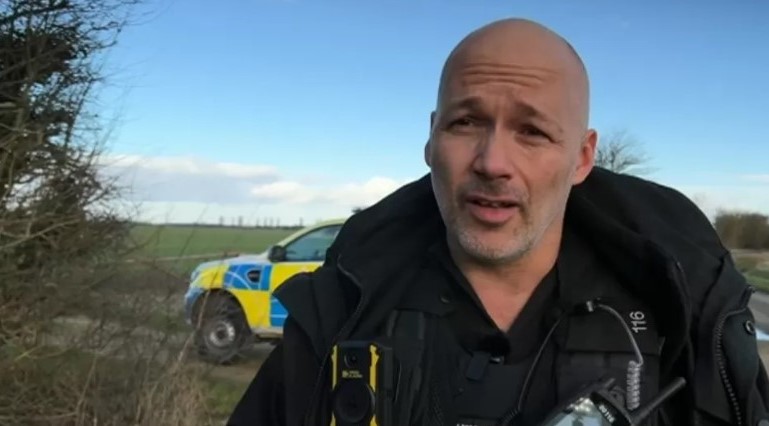
Detective Constable Aaron Flint, from the Lincolnshire Police Rural Crime Action Team, is quoted in an article published two days ago on the BBC News website (here), where he says he is currently investigating four cases of bird poisonings (some examples here and here).
Detective Constable Aaron Flint from Lincolnshire Police’s Rural Crime Action Team
“It’s too many and it’s only a small proportion of the number of birds killed,” he said.
The wildlife officer said the substances used posed a real danger to dogs and cats, as well as people.
“I honestly think that one day we are going to have a human fatality.”
“Often the offenders will get a pigeon or a pheasant – cut it open and rip out the flesh so the meat is exposed and sprinkle on some poison.
“The poisons are often blue or green – or some other bright colour a child may be attracted to, and I really fear that one day a child is going to come across this, [touch it] and put their fingers in their mouth.”
He said those involved often used poison in an attempt to protect game birds, pigeons and chickens and wild fowl, with offending often fuelled by money.
The BBC article also quotes Howard Jones, an investigator from the RSPB, after the RSPB identified Lincolnshire as a ‘national hotspot’ for bird of prey persecution and reiterated that incidents are often linked to the raptors being targeted to protect pheasants and partridges raised for organised shoots.
“The danger with poisons is that they are completely indiscriminate,” said Howard.
The investigations officer said they had seen a record number of incidents across the UK in recent years, including in Norfolk, Dorset and Yorkshire, with a significant number of reports currently being investigated in Lincolnshire.
According to Mr Jones, the “vast majority” of cases being dealt with by the courts involved gamekeepers.
He said the motivation to kill birds of prey was driven by the fact they were viewed as a predator of game birds, but the sentences handed out were often too lenient to act as a deterrent.
Cases involving poisons or illegal shooting should result in a jail sentence, he said.
“If there is someone out there placing poison baits in the open countryside anything that can come into contact with the poison is at risk,” he said.
“It is highly dangerous – some of the substances being used would be fatal to humans,” he added.
Well done to DC Aaron Flint and his colleagues at Lincolnshire Police. This is exactly the sort of proactive police messaging, and strong partnership-working, that should be routine rather than the exception.
Five days ago, 54 year old gamekeeper Paul Allen pleaded guilty to seven counts of wildlife, poisons and firearms offences, which he committed in March 2021 whilst working on the Shaftesbury Estate in Dorset (see here).
A poisoned red kite had been found dead on the estate in November 2020 (confirmed Bendiocarb poisoning) which triggered a multi-agency search of his premises in March 2021. During that search, investigators found nine dead buzzards (six confirmed shot, the remains of 3 others were pulled out of the ashes of a bonfire), three lots of banned poisons (Bendiocarb, Strychnine and Cymag), a loaded shotgun propped up behind his kitchen door (instead of being inside a locked gun cabinet) and some shotgun ammunition, for which he didn’t have a licence, was found in an unlocked outbuilding.
Four of the nine dead buzzards found by investigators. Photo: RSPB
Allen’s court hearing last week generated widespread local, regional and national media coverage so I fully expected to see full and frank statements of condemnation of his crimes by the game-shooting industry – you know, the industry that claims to have ‘zero tolerance’ of raptor persecution.
I was especially interested in the responses of those game-shooting organisations that serve on the national Raptor Persecution Priority Delivery Group (RPPDG). One of the main stated objectives of the RPPDG is to raise awareness of raptor persecution crimes with the wider public and to encourage people to report such crimes to the police.
Five days on from Allen’s multiple guilty pleas, here’s what those organisations had to say in condemnation:
British Association for Shooting & Conservation (BASC) – nothing
Countryside Alliance – nothing
Country, Land & Business Association (CLA) – nothing
National Gamekeepers Organisation (NGO) – nothing
Oh, no, hang on a minute, something was posted on the National Gamekeepers Organisation website, the day after Allen’s guilty pleas, as follows, under the headline, ‘Gamekeeper has NGO membership suspended‘:
Does this statement of ‘membership suspension’ relate to gamekeeper Paul Allen? Who knows? It’s deliberately cryptic and any casual visitor to the NGO membership wouldn’t have a scoobies to who or what this statement referred. I think that’s the intention. ‘Don’t draw attention to our criminal members and certainly don’t condemn the crimes this one has committed and subsequently admitted to after being caught with all those dead raptors, banned poisons and unsafe firearms and ammunition because it’ll tarnish the image we’ve been so desperately trying to present to the world‘.
It’s been suggested to me that perhaps all these organisations are waiting to make their statements of ‘zero tolerance’ until after Allen has been sentenced next month. Perhaps they are. Although I remember the same excuse was suggested when gamekeeper John Orrey was convicted last year and then sentenced at a later date. How many of them condemned his criminal activities (beating buzzards to death with a stick) after he was sentenced? Take a look for yourselves (here).
I don’t know who’s advising the PR strategy of the game-shooting industry but I suspect the decent, law-abiding members of these shooting organisations will be furious that their so-called leaders are refusing to distance them from the criminals within.
So, the illegal killing continues, the shooting industry organisations say nothing, and public anger grows.
Thanks, BASC, CA, CLA, NGO et al – this is only heading in one direction and you’re all helping it reach the end game so much more quickly than we could get it there on our own. Cheers.
You’d think, after the high profile conviction of gamekeeper Paul Allen two days ago, who pleaded guilty to multiple counts of wildlife, poisons and firearms offences on the Shaftesbury Estate (see here), that Dorset Police might have issued a statement.
You might think that Dorset Police would have wanted to publicise the conviction, not only to inform the public that a conviction had been secured thanks to the hard work and expertise of its wildlife crime officer Claire Dinsdale and the other partner agencies that Claire drafted in (National Wildlife Crime Unit, RSPB Investigations and Natural England), but also to send a message of deterrence to any other person thinking of committing these crimes.
It’s not as though Dorset Police doesn’t routinely publish statements on its website about other forthcoming court appearances and subsequent convictions for a wide range of offences such as assault, drug supply, sexual assault, murder, driving offences, fatal collisions etc (e.g. see here, here, here, here, here, here, here) and yet Dorset Police has remained tight-lipped about how this long and complex investigation, led by one of its own officers (the now former WCO Claire Dinsdale), resulted in seven guilty pleas at court on Wednesday.
Why would they want to keep quiet about that, do you think? It’s almost as though Dorset Police isn’t that bothered about raptor persecution, a police national wildlife crime priority.
*Multiple illegally killed birds of prey, six of which were confirmed shot and one poisoned, were uncovered by Dorset Police and the RSPB on the Shaftesbury Estate near Wimborne St Giles
*The recently published RSPB Birdcrime report identified Dorset as the second worst county in the UK for confirmed bird of prey incidents in 2021
*The conservation charity is calling for greater regulation of larger scale pheasant shoots in order to help address the climate and nature crises and to reduce these appalling crimes against birds of prey
At Weymouth Magistrates’ Court today (4 January 2023), Paul Allen, 64, of Brockington Down, Wimborne St Giles, pleaded guilty to multiple charges of raptor persecution and related offences.
The Dorset gamekeeper will be sentenced on 16 February.
Dorset Police were first alerted in November 2020 when a member of the public found a dead red kite lying close to a dead rat on a private pheasant shoot on the Shaftesbury Estate, near Wimborne St Giles. Toxicology examinations confirmed the presence of the highly toxic pesticide bendiocarb in both species. Bendiocarb, which in some forms has now been banned, has been persistently abused for the illegal poisoning of birds of prey and other animals for years. It is believed the rat was laced with the poison and deliberately placed as a poisoned bait.
A multi-agency search of Allen’s home and surrounding land was undertaken in March 2021, led by Dorset Police and assisted by the National Wildlife Crime Unit (NWCU), Natural England and RSPB Investigations. Officers discovered six dead buzzards (which, following official post-mortem, were confirmed to have been shot) near the remains of a bonfire, including one that was suspected as having been shot within the preceding 24 hours. Tragically, this bird also contained shot from two previous shooting incidents, which it had survived.
Dorset Police, NWCU, Natural England & RSPB investigators at the scene where four of the nine buzzards were found. Photo: RSPB
Four of the six shot buzzards found by investigators. Photo: RSPB
Two more shot buzzards found during the search. The buzzard on the top was believed to have been shot less than 24 hours before being found. Photo: RSPB
An avian specialist at the Natural History Museum examined the remains of the fire, which was collected by investigators and confirmed the presence of at least three further buzzards.
CSI officer from Dorset Police examining the remains of three buzzards on a bonfire. Photo: RSPB
A banned product containing the pesticide bendiocarb was found in Allen’s vehicle and in an insecure outbuilding, along with two bottles of strychnine: another deadly poison banned in 2006. Two full tins of Cymag – a lethal fumigant pesticide banned since 2004 – were also found outside under an upturned pond liner.
Officers from Dorset Police & Natural England with two containers of Cymag. Photo: RSPB
Sachet of banned pesticide Ficam W (Bendiocarb) found in unlocked outbuilding. Photo: RSPB
All birds of prey are protected under the Wildlife and Countryside Act 1981 and killing them is against the law, punishable by an unlimited fine and/or jail.
Thomas Grose, RSPB Investigations Officer, said: “Finding so many illegally killed buzzards was truly shocking. This is yet another example of a gamekeeper being prosecuted in connection with raptor persecution offences on land managed for gamebird shooting.
“In addition to all the agencies involved in this case, we would particularly like to thank Claire Dinsdale, formerly of Dorset Police, and currently with the NWCU, an exemplary officer who has devoted her career to tackling wildlife crime.”
Nationally, the RSPB’s recently published Birdcrime report for 2021 found that over two-thirds of confirmed raptor persecution incidents were in relation to land managed for gamebird shooting and identified Dorset as the county with the second-highest number of confirmed raptor persecution incidents in the UK that year.
Mark Thomas, UK Head of Investigations at the RSPB, said: “Tragically, only days into the New Year, we already have yet another highly significant bird of prey persecution case before a court. This is a national problem which requires urgent Government attention and solutions, as identified in their own report published in December 2021.
“In the time of a climate and nature emergency there can be no place for raptor persecution. We are therefore calling on Government to better enforce existing regulations relating to pheasant shoots, and to consider the introduction of new sanctions to act as a meaningful deterrent to such appalling crimes.”
The guilty pleas were –
· Two charges of possession of six dead common buzzards and remains of three more in March 2021
· Three charges of the keeping of banned pesticides (strychnine, bendiocarb and Cymag) in March 2021
· Two charges of failing to comply with conditions of shotgun and firearms certificates in March 2021
Charges relating to the killing of a red kite were dropped.
ENDS
The RSPB has also released a few minutes of video footage from the search – well worth viewing. You can find it on the ITV News website here