Good news! Sidelined Dorset wildlife crime cop joins National Wildlife Crime Unit

Claire Dinsdale QPM, the wildlife crime officer who was leading on the Dorset eagle poisoning case until senior officers decided to close the investigation prematurely after what looked suspiciously like political interference (here), has left Dorset Police and has taken up a new role with the National Wildlife Crime Unit (NWCU).

This is really good news! Claire was held in very high regard by those involved in tackling wildlife crime and her dedication to the role saw her contributing thousands of hours of her own time, on top of her normal police duties, to gather evidence to identify suspects and increase the chances of them being charged. She was awarded the Queen’s Police Medal in 2020 for her efforts.

A twitter spat with local Conservative MP Chris Loder, followed by senior officers’ inexplicable decision to block the investigation into the poisoned eagle, led to Claire going on long-term sick leave in March this year.

I’m delighted to see her move to the NWCU where hopefully her contributions will be valued and supported.

Moy Estate loses appeal against General Licence restriction imposed for wildlife crime

Moy Estate in the Scottish Highlands has lost its appeal against a General Licence restriction that was imposed on the estate in June 2022 (see here) after Police Scotland provided the licensing authority (NatureScot) with evidence of wildlife crime against birds of prey on the estate, notably the discovery of a poisoned red kite in 2020 and ‘incidents in relation to trapping offences’.

[RPUK map showing Moy Estate boundary, based on information provided by Andy Wightman’s website, Who Owns Scotland]

Regular blog readers will know that the three-year General Licence restriction on Moy Estate took effect on 21st June 2022, prohibiting the use of General Licences 01, 02 and 03 on the estate until 21st June 2025.

However, the estate appealed the restriction (as is permitted by NatureScot’s restriction process) in July and the official ‘restriction notice’ was temporarily removed from NatureScot’s website whilst the appeal was underway.

It’s all a massive farce, of course, because the estate has already had one opportunity to appeal the decision, as part of the formal restriction process. I.E. NatureScot has to provide a written ‘notification’ to an estate when a restriction has been recommended, but before the final decision has been made. The estate then has 14 days to respond (appeal) and explain why the restriction is unwarranted. On receipt of that appeal, Naturescot makes its final decision and if it’s decided to go ahead and impose the General Licence restriction, then the estate is given ANOTHER opportunity to appeal the decision within 14 days.

I don’t have the details of Moy Estate’s appeal(s) because when I asked for similar documents relating to an appeal by Leadhills Estate against its second General Licence restriction last year, NatureScot came under pressure from the solicitor representing the estate who argued that the information was ‘of a sensitive nature and disclosure into the public domain ‘may prejudice the right to any future proceedings’. NatureScot upheld that view and refused to disclose the details of the appeal (see here). Given that the same solicitor is believed to be representing Moy Estate, I haven’t wasted my time by applying for the details, although I’d suggest, given the hilarious appeal that Leadhills Estate made against its first GL restriction (see here) that the real reason for withholding the information of any similar appeals is to avoid the embarrassment of having the laughable appeal letter torn to shreds by public scrutiny.

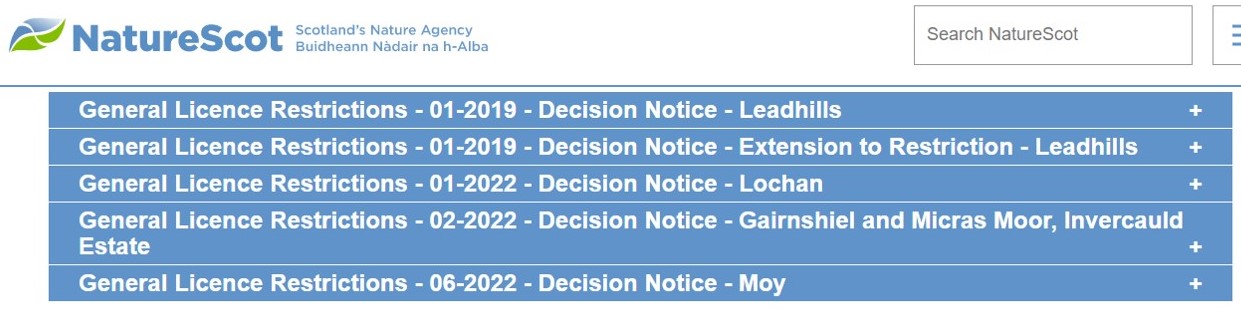
No matter really, because it’s NatureScot’s response to the appeal that’s really of interest, and in this case, Moy Estate’s appeal has failed and as of last week, the official restriction notice is back on public view on NatureScot’s website:

There’ll be more news from Moy next month when a man appears in court to face charges concerning the alleged shooting of a sparrowhawk.

Edward Mountain MSP disregards sanctions imposed on Moy Estate for wildlife crime

Here’s another senior MSP who decided to disregard the three-year sanction imposed in June this year on Moy Estate after Police Scotland provided evidence to demonstrate wildlife crime had taken place on the estate, notably the discovery of a poisoned red kite and incidents related to alleged trapping offences, although the estate has long been recognised as a raptor persecution hotspot (e.g. see here, scroll down to below the press release).

Sir Edward Mountain, 4th Baronet, the Scottish Conservative’s Deputy Chief Whip, attended Moy Game Fair earlier this month to present prizes on behalf of BASC:

So that’s now two senior MSPs (former Cabinet Secretary Fergus Ewing MSP was the other one), the Scottish Gamekeepers Association, Scottish Land & Estates, and BASC who all seem to have a very strange approach to the notion of ‘zero tolerance’ of raptor persecution.

Some of you might remember Ed Mountain claiming, in 2017, that he’d be “the fiercest critic” of anyone killing raptors. It was a claim he made in a guest article he wrote for the Scottish Gamekeepers Association’s quarterly rag. Here’s a reminder of what he wrote:

I believe that challenging the ‘spectre’ [of land management reform] is vital, if the very countryside we all value and love is to be maintained. The way to do this is by standing tall and laying out a stall, for all to see the benefits positive management has to offer. The problem is that every time it looks like the right story is being delivered another case of wildlife crime comes to light. If there is any chance of moving forward we must stop these idiots, who believe illegally killing raptors is acceptable.

I therefore would urge all organisations that represent country folk to stand up and let people know all the good work that is being done for conservation. At the same time, they also need to vilify those that break the law.

Over the next 4.5 years I look forward to working with the SGA and I will do all I can to defend the values you and your members believe in. However, I must also say that I will be the fiercest critic of those that jeopardise these values by breaking the law‘.

I asked at the time whether he’d put these strong words into action, but just a few months later he seemed reticent (see here).

This year he had the perfect opportunity to stand by his stated commitment against raptor persecution and boycott the Moy Estate. His actions, and those of his shooting industry mates, speak volumes.

Fergus Ewing MSP & his shooting industry pals disregard sanctions imposed on Moy Estate for wildlife crime

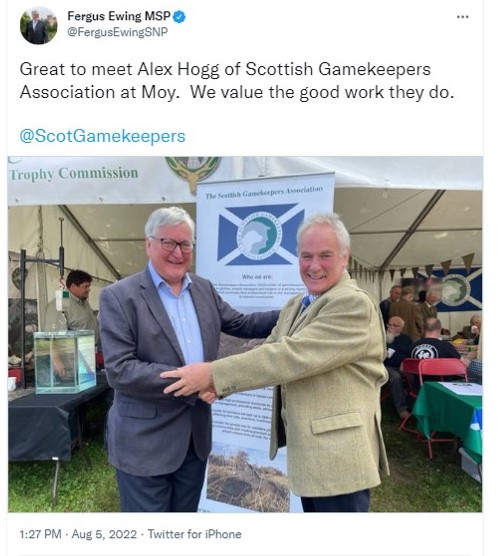
Look at the state of this.

A tweet by Fergus Ewing MSP, former Cabinet Secretary for Rural Economy, posted yesterday at the Scottish Gamekeeper Association’s stand at the Moy Game Fair. I wonder who he’s referring to when he says ‘We’? Is he speaking on behalf of the Scottish Government?

The Moy Game Fair is hosted by the Moy Estate. That’ll be the disgraced Moy Estate that had a three-year General Licence restriction imposed on it in June this year (see here) after Police Scotland provided evidence to demonstrate wildlife crime had taken place on the estate, notably the discovery of a poisoned red kite and incidents related to alleged trapping offences, although the estate has long been recognised as a raptor persecution hotspot (e.g. see here, scroll down to below the press release).

An estate gamekeeper has recently been charged with the alleged shooting of a sparrowhawk and is due in court in September.

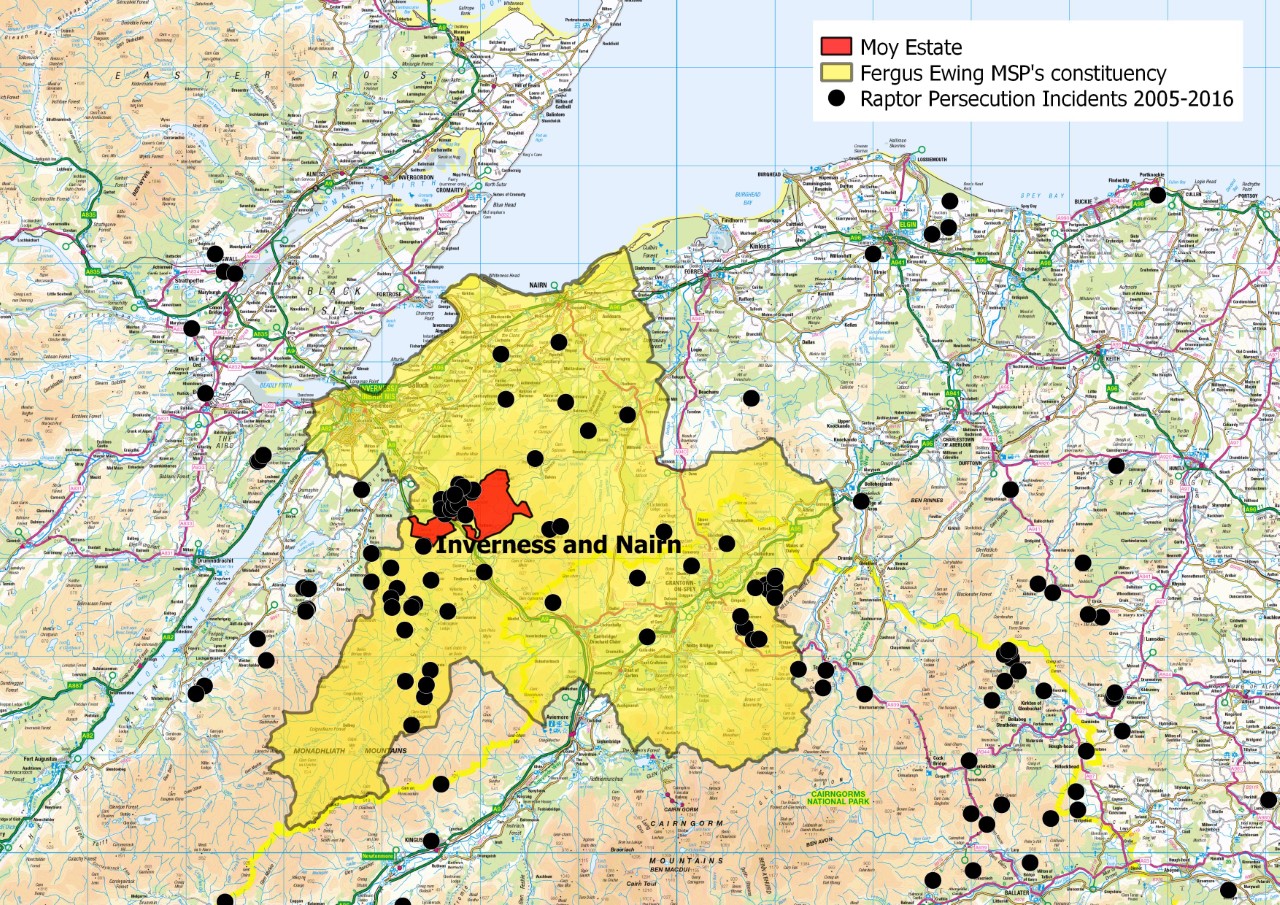
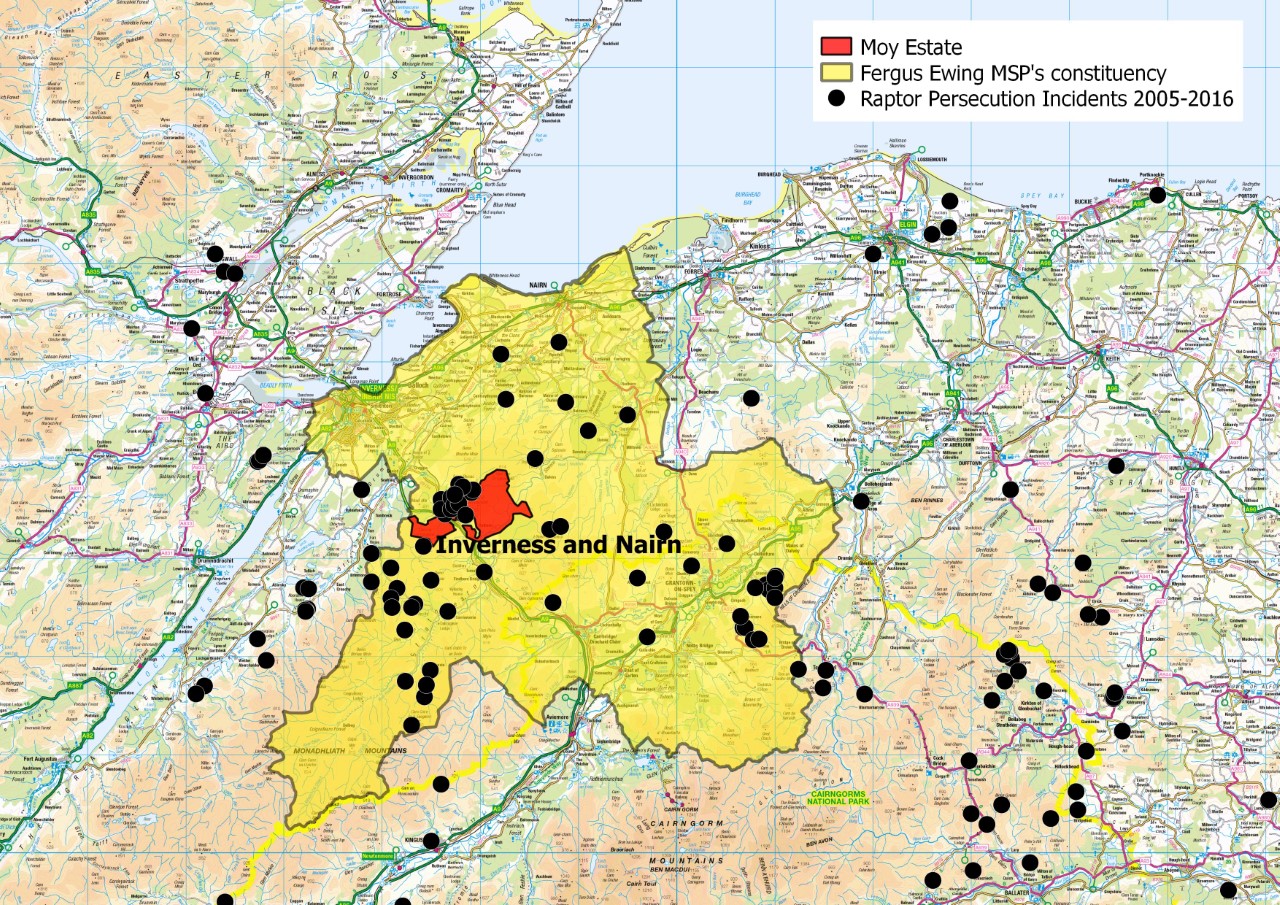
Here is a map we created way back in 2016 to highlight the extent of raptor persecution crimes in Fergus Ewing’s constituency and this shows the concentration of incidents on and close to Moy Estate. There have been further incidents since this map was created, hence the General Licence restriction imposed this year:

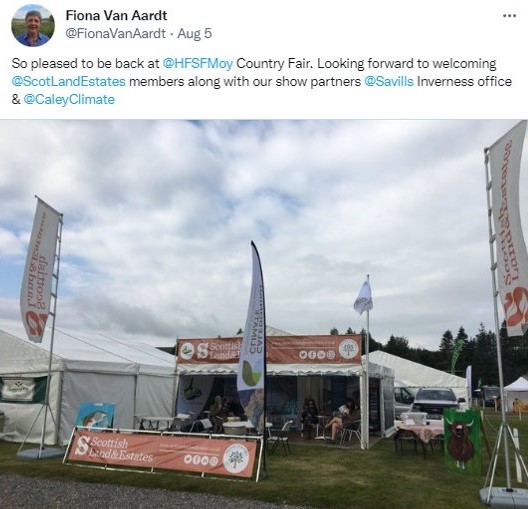
Also ignoring the sanction for wildlife crime on Moy Estate is Scottish Land & Estates (SLE), the lobby group for game-shooting estates across Scotland, as demonstrated by this tweet yesterday from SLE’s North of Scotland Regional Coordinator, Fiona Van Aardt:

So here’s a senior politician from the SNP Government, the Scottish Gamekeepers Association and Scottish Land & Estates, all effectively sticking up two fingers to the Government’s policy of sanctioning estates for raptor persecution.

When the policy of imposing General Licence restrictions as a tool for tackling rampant bird of prey persecution was first introduced in 2014, the then Environment Minister Paul Wheelhouse described the restrictions as being a ‘reputational driver‘. In other words, a sanctioned estate would not enjoy the benefits of being part of the shooting industry because the industry, with its claimed ‘zero tolerance’ approach to raptor persecution, would not wish to be associated with wildlife crime and this (hoped for) ostracization would stimulate a clamp-down on raptor-killing estates.

So much for that idea. It appears that the shooting industry, along with its political supporters, couldn’t give a monkeys. There’s been previous evidence of this on other so-called sanctioned estates (e.g. see here for examples).

Technically speaking, Mr Ewing and his shooting industry pals could argue that Moy Estate is not currently serving a General Licence restriction. How come? Well, because under the rules, if an estate appeals the GL restriction decision, the restriction is temporarily lifted whilst NatureScot considers the estate’s appeal. This is completely bonkers, of course, because a sanctioned estate has already had a chance to appeal the decision, when NatureScot first issues the notification for a restriction. But they’re then given another opportunity to appeal once the restriction has been imposed, and during that appeal process (typically four weeks) NatureScot removes the restriction so the estate can carry on as if the restriction never existed. I’m pretty sure that that’s what’s going on at Moy because the GL restriction decision notice for Moy Estate has been removed from the section of NatureScot’s website where currently-restricted estates are listed (here).

Although if Mr Ewing, the SGA and SLE were to rely upon this technicality, I don’t think that many people would view it as the shooting industry working in the spirit of wishing to stamp out raptor persecution, do you?

RSPB wants ‘action & delivery’ from Scottish Government on grouse moor licensing scheme

RSPB Scotland has published a blog today calling for ‘action and delivery’ from the Scottish Government on its promised grouse moor licensing scheme.

The Government announced in November 2020 that grouse shooting businesses in Scotland will need to be licensed to operate, under new proposals to tackle raptor persecution.

It also announced that muirburn will also only be permitted under licence, in order to protect wildlife and habitats, regardless of the time of year it is undertaken and whether or not it is for grouse moor management or improving grazing.

The Government stated there will also be a statutory ban on burning on peatland, except under licence for strictly limited purposes, such as approved habitat restoration projects.

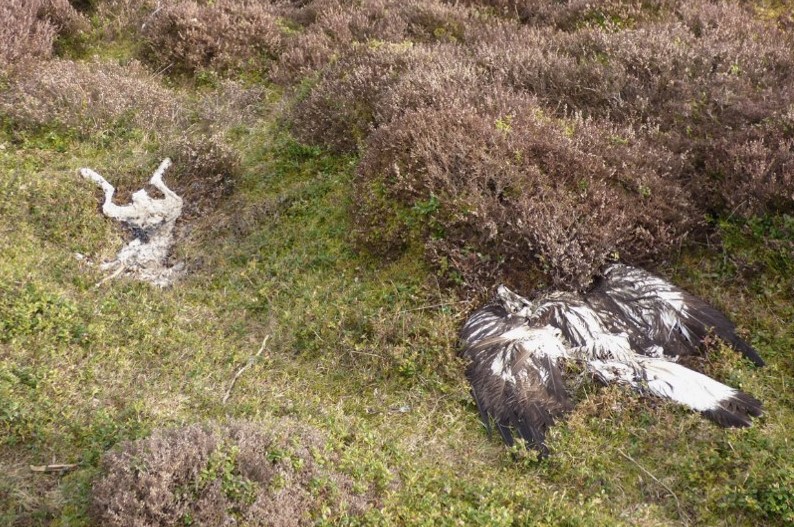
Since that announcement in November 2020, there hasn’t been any further action, but there has been plenty more evidence of illegal raptor persecution, including the poisoning of this golden eagle on a grouse moor at Invercauld Estate in the Cairngorms National Park:

RSPB Scotland writes:

We have been very patient, but nearly 20 months on from this announcement, we want to see some action and delivery on these promises by the Scottish Government. Proposals must be brought forward in the forthcoming Programme for Government in autumn 2022 for the introduction of grouse moor and muirburn licensing legislation in the next Parliamentary year“. 

You can read the full RSPB blog here.

No prosecution for shot raptors found on Millden Estate, Angus Glens

On 8th October 2019, the Scottish SPCA executed a search warrant with Police Scotland on various properties on Millden Estate in the Angus Glens looking for evidence of animal cruelty and animal fighting, including badger baiting, after 58 gruesome photographs were reportedly sent to a printing shop in England by a Millden Estate employee.

Millden Estate is known for its grouse shooting (having been described in a sales brochure in 2011 as being ‘The Holy Grail‘ of grouse moors and ‘One of the finest sporting estates in Scotland‘) The estate also hosts pheasant and partridge-shooting on its low ground.

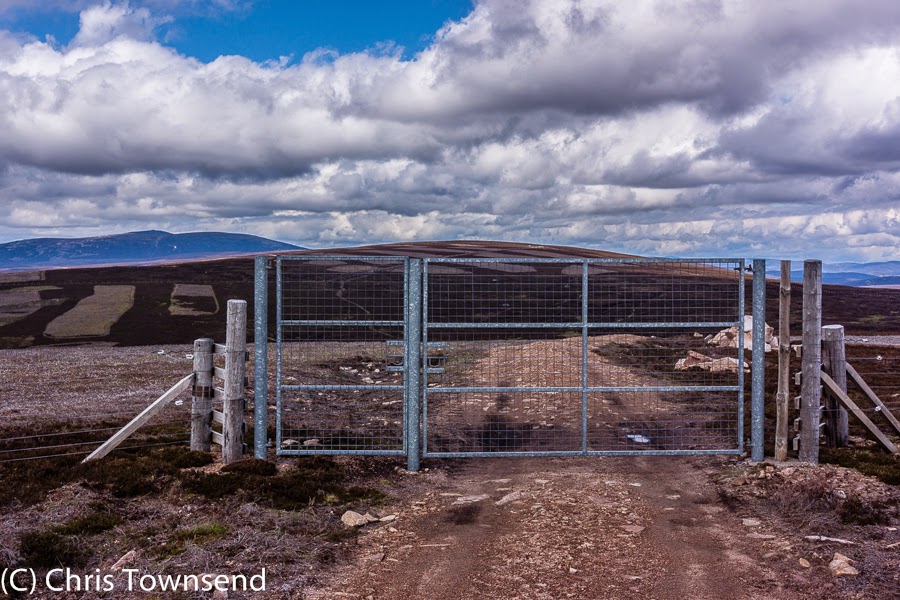
Millden Estate has also been described as a ‘savage, stripped, blasted land‘ by author and photographer Chris Townsend (here).

Millden Estate gamekeepers, along with others in the Angus Glens, have previously been feted by senior politicians, including former Cabinet Secretary for Rural Affairs, Fergus Ewing MSP, former Minister Graeme Dey MSP, and by Prince Charles who was photographed with Millden keepers as he opened a tweed workshop in Beauly in 2019.

Millden Estate was also visited by Professor Werritty and his colleagues in 2018 during the review of grouse moor management; they visited the estate apparently to see an example of ‘best practice for managing grouse moors’.

The estate, one of a number in the Angus Glens, is also long- known amongst conservationists as a raptor persecution hotspot after the discovery of poisoned and shot buzzards in 2009 and 2011 (here), a poisoned golden eagle (Alma) in 2009 (here), and a satellite-tagged golden eagle seemingly caught in a spring trap and then apparently uplifted overnight and dumped on Deeside with two broken legs & left to die (here). Nobody has ever been prosecuted for any of these alleged offences and Millden Estate has denied any responsibility.

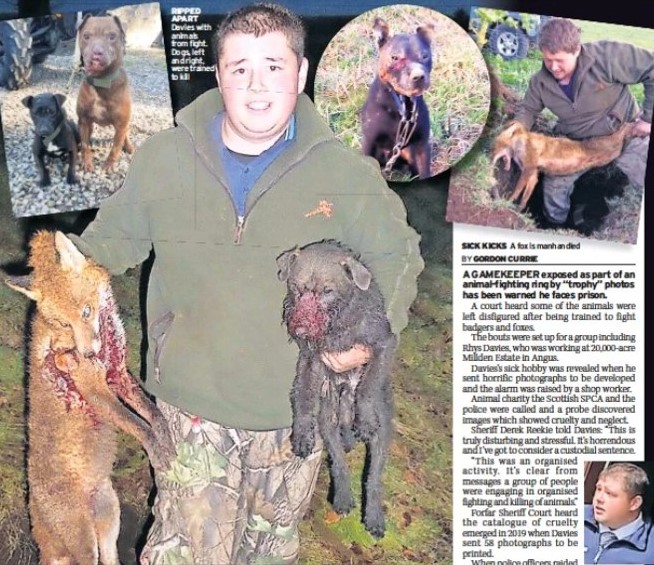
In October 2019 during the morning raid at Millden Estate the SSPCA did find evidence of animal fighting and cruelty, including badger baiting, and after two and a half years of protracted legal process, in May this year 28 year old gamekeeper Rhys Owen Davies was convicted of a number of animal cruelty, animal fighting, and firearms offences: (for previous blogs on this case see here, here, here, here, here, here, here, here, here, here, here). Davies is due to be sentenced on Monday.

Other evidence of alleged wildlife crime was also uncovered during that search of Millden Estate back in October 2019, including the discovery of a number of dead raptors wrapped in bags at at least three separate locations, apparently including at the residences of two estate employees.

Whilst the SSPCA led on the investigation into animal cruelty/animal fighting, Police Scotland led on the investigation into the dead raptors (because the SSPCA don’t, yet, have the powers to investigate cases where a wild animal is already dead – bonkers, I know – see here for the background on this).

I have spent the last two and a half years chasing Police Scotland about these dead raptors and asking for status updates on the investigation. I have to say I’ve been summarily unimpressed. The investigation has been conducted at a snail’s pace and communication has been dire. I understand that the dead raptors all underwent post mortems and it was determined they’d been shot. No information has been provided about the number of species involved (although it’s been reported that some were buzzards), nor the number of individuals confirmed to have been shot, although I know of at least three.

Earlier this week I asked the Crown Office & Procurator Fiscal Service (COPFS) about this case and whether it was progressing (i.e. has anyone been charged?). To its credit, the COPFS response was fast, but the case outcome familiarly frustrating:

The Procurator Fiscal received a report relating to a 28 year old male and incidents said to have occurred between 1 January 2019 and 8 October 2019. After careful consideration of the facts and circumstances of the case, including the available admissible evidence, the Procurator Fiscal decided that there should be no proceedings taken at this time. The Crown reserves the right to proceed in the future should further evidence become available‘.

I doubt we’ll ever be informed about the extent of the raptor persecution uncovered (even now, nearly three years after the raptor corpses were found, Police Scotland has failed to issue any press statement) and we’ll certainly not learn any more detail about why charges weren’t brought because the COPFS is not obliged to inform the public about its decision-making process. Apparently transparency doesn’t apply.

To be fair, a prosecution would depend on an individual suspect being identified but there are multiple employees at Millden Estate (16 were listed in the estate’s sales brochure in 2011) and a recent photo on social media suggests there are multiple gamekeepers (there’s a photo online showing 13 men dressed as gamekeepers in Millden Estate tweed at the start of the 2020 grouse season).

I think it’s fair to say that any employee could have the motivation, means and opportunity to commit wildlife crime – we now know that at least one of them, Rhys Owen Davies, was doing exactly that, apparently right under the noses of his colleagues and bosses on Millden Estate – but just having the motivation, means and opportunity isn’t sufficient evidence for a criminal prosecution. Having a carrier bag full of shot raptors at your house isn’t enough for a court of law to convict, although if there was a bag of dead raptors at my house I’m pretty sure I’d notice them and I’m pretty certain I’d have notified the police.

So where does that leave us? We await the sentencing of gamekeeper Rhys Owen Davies on Monday but I don’t expect any of us have high hopes for a fitting sentence.

Millden Estate must surely now qualify for a General Licence restriction, a monumentally ineffective sanction but the only thing left on the table until the Scottish Government pulls its finger out and introduces the licensing scheme it promised to develop in November 2020.

But even if the authorities do decide to impose a General Licence restriction on Millden Estate, that won’t curtail the estate’s ability to continue to host grouse, pheasant and partridge shoots. The estate, which is run through a series of companies and limited liability partnerships (LLPs), including one called Millden Sporting LLP, reported tangible assets in 2021 of £17.5 million.

That’s a lot of money, and with it comes a lot of influence.

UPDATE 30th August 2022: 3 shot buzzards found on Millden Estate – confirmation from Police Scotland (here)

Investigative journalists discover more evidence of alleged raptor persecution on Queen’s Sandringham Estate

Investigative journalists from The Guardian newspaper have uncovered more evidence of alleged raptor persecution crimes, not previously reported, at the Queen’s Sandringham Estate in Norfolk.

They’ve also uncovered documents which reveal that the police have to seek the Queen’s permission before they are allowed to enter the estate and search for evidence if alleged wildlife crimes are suspected / have been reported.

Long-term blog readers will know that this royal estate has been at the centre of a number of police investigations into alleged raptor persecution, (e.g. see herehereherehere, here), including the most notorious incident back in 2007 where witnesses observed two hen harriers being shot over Dersingham Bog at the same time that Prince Harry, his mate William van Cutsem (whose Hilborough Estate is currently under police investigation for alleged raptor persecution), and an estate gamekeeper were out duck-shooting. No-one was charged, as with all the other reported incidents except one in 2005, where an estate gamekeeper was convicted for pole-trapping a tawny owl next to a pheasant pen (see here, page 3).

However, it now appears that at least two other raptor persecution incidents on the estate have been kept under wraps for years – a poisoned red kite found in 2006 and a dead Marsh harrier (cause of death not given) found on the estate border in 2007 – according to documents published on Friday by The Guardian – the article is well worth a read, here.

Why has it taken 16 years for these raptor persecution incidents to become public knowledge? And given the timings, wouldn’t it have been pertinent for them to have been in the public domain at the time that Prince Harry, his ‘high society’ mate van Cutsem, along with an estate gamekeeper, were all under police investigation into the alleged shooting of two hen harriers in 2007?

It’s no wonder ‘nothing was found’ during the police investigation into those alleged shootings, given that the police weren’t allowed on site until the following morning.

And surprise, surprise, none of the investigating authorities want to comment on any of these latest revelations. Too scared and too obsequious.

There is a follow-up article in today’s Guardian (here), including quotes from me about these very shady processes that amount to what I would call a massive cover-up.

Well done to journalists Sev Carrell, Rob Evans and David Pegg for having the balls to challenge this nonsense.

Scottish Gamekeepers Association plan awards ceremony at disgraced Moy Estate

Remember all those recent headlines from the game shooting industry, declaring a ‘zero tolerance’ stance against raptor persecution?

Well quelle surprise, it seems their interpretation of ‘zero tolerance’ isn’t quite the same as everyone else’s.

Last month Moy Estate, a shooting estate in the Monadhliaths was given a three-year General Licence restriction, imposed by NatureScot on the basis of evidence provided by Police Scotland of wildlife crime against birds, specifically the discovery of a poisoned red kite in 2020 (here).

It was just the latest in a long line of raptor persecution incidents reported on or next to Moy Estate for over a decade, and another court case is due to be heard this autumn.

For an example of the history, here is a map we created way back in 2016 to highlight the extent of raptor persecution crimes in former Cabinet Secretary Fergus Ewing’s constituency (given his strong support of the Scottish Gamekeepers Association) and this shows the concentration of incidents on and close to Moy Estate:

The General Licence restriction is a bit like putting a school into ‘special measures’ – a status applied by regulators to indicate the school has fallen short of acceptable standards, although the main serious difference here of course is that a General Licence restriction is imposed on the basis of wildlife crimes being committed on the estate, rather than merely a shortfall in standards.

The main idea behind the introduction of General Licence restrictions back in 2014 was that they would act as a “reputational driver” for those sanctioned estates, according to the then Environment Minister Paul Wheelhouse (see here).

However, there has been no evidence that the game-shooting industry takes any notice whatsoever of such sanctions. For example, the Game & Wildlife Conservation Trust hosted a guided tour and BBQ on ‘the renowned Corsehope Shoot‘ in June 2017, at the same time that this estate was serving a three year General Licence restriction for wildlife crime; Edradynate Estate bragged about “a belter season“ at the same time it was serving a three-year General Licence restriction for wildlife crime; and this estate was also endorsed by the British Game Alliance, the game shooting industry’s own ‘assurance’ scheme, membership of which is supposed to indicate ‘rigorous and ethical standards’, whilst the estate was under a General Licence restriction for wildlife crime (see here).

So it comes as no surprise to see that the Scottish Gamekeepers Association (SGA) is not only intending to have a stand at the forthcoming Highland Field Sport Fair hosted by Moy Estate (now rebranded as the Moy Country Fair, presumably in an attempt to make it more palatable), but the SGA is also planning an awards ceremony at the event to announce the winner of the SGA Young Gamekeeper of the Year Award as well as presenting various Long Service Medals!

You couldn’t make this up!

The Moy game fair has previously attracted the likes of former Cabinet Minister Fergus Ewing who used his attendance to give a rallying speech to the game-shooting sector (here) and Scottish Land & Estates (SLE) also usually has a stand. I can’t remember if Moy Estate is a member of SLE, but it’ll be interesting to see if SLE puts in an appearance this year.

Farmer receives pathetic fine for poisoning two buzzards & a raven

This article appeared in The Journal today:

Farmer fined €500 for poisoning protected bird species in Co Wicklow

By Lauren Boland

A FARMER HAS been fined for poisoning protected birds in Co Wicklow after pleading guilty to what a judge described as a “serious crime”.

Christopher Thomas Noel Doyle, also known as Noel Doyle Senior, with an address at Crehelp in Co Wicklow, came before the Carlow District Court over a breach of restrictions on the use of poisoned bait.

The judge imposed a €500 fine and €1,500 in expenses that he must pay within four months.

A conservation ranger told the court he had discovered two dead buzzards, a dead raven, and a sheep carcass on lands at Athgreaney, Co Wicklow.

[Buzzard, photographer unknown]

The court heard that the ranger first found a dead buzzard and after further investigation identified a second dead buzzard, a dead raven, and a sheep carcass placed near a fox den.

Post-mortems by the Department of Agriculture and testing by Dublin Regional Veterinary Laboratory and the State Laboratory found that the birds died due to high levels of poison (carbofuran) in their systems.

The sheep had been cut open and the wound was laced with large amounts of carbofuran.

The ranger said that the levels of poison were extremely hazardous to all forms of life and that it was very fortunate that no humans had been accidentally poisoned.

He said it was likely that other wild animals had scavenged the carcasses and died from poisoning but were never found. 

Judge Marie Keane said there was an “astonishing amount of poison” used in what she described as a “serious crime” and “a deliberate enterprise” to try to persecute the local wildlife.

In a statement, Minister of State for Heritage Malcolm Noonan called it a “particularly heinous and disturbing wildlife crime”.

Buzzards are a protected species and deliberate poisoning of them is an offence under the Birds and Natural Habitats (Restrictions on the Use of Poisoned Bait) Regulations 2010.

Carbofuran was previously used as a pesticide in agriculture but is now banned because of its toxicity to wildlife, especially to birds.

Approval for the use of carbofuran products was withdrawn throughout the EU in 2007, including in Ireland in December of that year.

After an 18-month period to use up remaining stock, it was banned fully from 2009.

ENDS

Raptor persecution “hasn’t been a problem for years”, claims Scottish Gamekeepers committee member

There was a jaw-droppingly half-baked article published in The Courier last week, featuring commentary from a Scottish gamekeeper.

Bob Connelly, who is reportedly a Committee member of the Scottish Gamekeepers Association (SGA), had been speaking at the Scottish Game Fair and the Couriers environment journalist Scott Milne took the comments at face value and wrote the following article, which has to be read to be believed.

People will not realise the importance of land management and the shooting industry until campaigners force the end of the sector.

That is the view of gamekeeper Bob Connelly, who works in an estate in north east Perthshire.

Bob was speaking at the Scottish Game Fair, which took place in Scone over the weekend.

The Scottish Government is preparing legislation that could see gamekeeper grouse shooting licenced.

This has come after a campaign by animal rights advocates [Ed: he’s referring to this blog!] releasing evidence which appears to show wildlife crimes such as raptor persecution and misuse of traps.

The theory goes that predators such as buzzards and hen harries are killed in order to protect grouse, which brings in a lot of money during shooting season.

ARE GAMEKEEPERS VICTIM OF A HATE CAMPAIGN?

Bob feels much of this evidence has been manufactured as part of a “malicious” campaign to turn public opinion against gamekeepers and the shooting industry.

He said: “They want to get rid of us.

“But people don’t understand what we do and why we do it.”

A case in point is the controversial practice of heather burning.

It has been criticised as unnecessary and potentially damaging to peatland, which can release large swathes of carbon.

But Bob has a different perspective.

“You have to accept that there are going to be fires in places like that if you let it overgrow.

“So if it’s inevitable, do you want to have a controlled fire or let a wild one get out of hand?

“That would be even more damaging.”

Bob also feels it’s important gamekeepers are allowed to control predator populations in order to protect smaller species.

He said: “What we do is we build it from the ground up. We make sure the right environment is in place for insects and other small species and then bigger ones can naturally thrive on top of that.

“There’s more and more red-listed birds. If you want to protect them, it’s important to control predators such as foxes and buzzards.

“There’s a lot of people who have been manipulated to feel a certain way on social media, but don’t fully understand what we do.

“They’ll will miss us when we’re gone.”

WILL LEGISLATION CHANGE THINGS?

Bob thinks the upcoming gamekeeper shooting legislation is not needed.

“There is already rules surrounding things like traps. I can’t see how it can be legislated anymore.

“Yes, there were problems in the past with raptor persecution and things like that.

“But if you discount one or two recent examples, it hasn’t been a problem for years.”

GAMEKEEPERS AND LAND MANAGERS ARE WORRIED

Tim Baynes is director of moorland with Scottish Land and Estates.

Also speaking at the Scottish Game Fair, he said many gamekeepers and land managers he knows are worried for their jobs.

“A lot of these people have a very specific skillset that has come down from generations.”

Tim wouldn’t go as far as Bob and say anti-shooting campaigners have adopted “malicious” practices, but he does feel they “have an agenda”.

“They want to remove shooting.

“But they are not involved in it or in managing land so they are coming at it from a different perspective.”

Tim hopes the shooting industry can work with politicians to have legislation that works for everyone.

However, he is concerned that last-minute changes might be brought in that would work against their favour.

“At the end of the day, we have to work with the government that has got the votes.

“There are people within the government who are pragmatic about the industry.

“But it can be difficult for them to publicly say so.”

ENDS

The level of idiocy in this article is quite staggering, even for an SGA committee member. I guess it’s what we’ve come to expect from the SGA though, who have been in denial about the extent of these crimes for at least the 12 years I’ve been writing this blog and probably for years prior to that, as their standard response to the most glaring of truths.

And it is that level of idiotic denial, combined with ongoing raptor persecution and the SGA’s inability to influence those within the shooting industry who continue to commit these disgusting wildlife crimes (e.g. see here, here, here, here, here), that has brought about the Government’s decision to introduce a grouse shooting licensing scheme.

That decision wasn’t based on so-called ” manufactured evidence“. It was based on the number of raptor corpses found dead and mutilated on game-shooting estates over many, many years, including poisoned eagles found on grouse shooting estates even inside our National Parks for God’s sake, combined with the massive weight of incontrovertible scientific evidence that all points to an outright refusal to abide by the law by many members of the game-shooting industry.

It’s not the fault of this blog, nor the fault of the many other campaigners who have been fighting against this abuse of our raptors for decades. The blame lies entirely, and obviously, with the criminals.