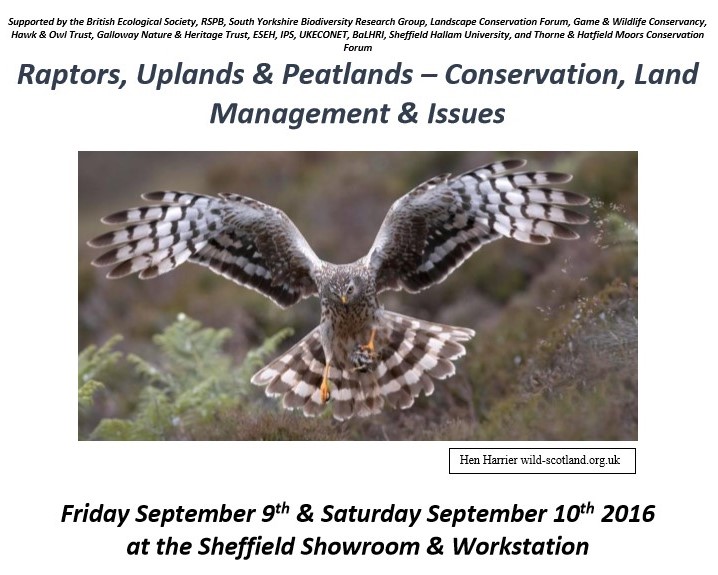
There was a conference in Sheffield last Friday and Saturday: ‘Raptors, Uplands & Peatlands – Conservation, Land Management & Issues’. Mark Avery has written a blog giving an overview of his impressions (here).
We will be publishing a selection of transcripts from this conference and here is the first of those. Note, this is NOT a parody. You’ll probably need to remind yourself of that if you manage to reach the end.
Philip Merricks, Chair of the Hawk & Owl Trust: ‘The Hawk & Owl Trust’s involvement in the Hen Harrier Recovery Action Plan‘.
It’s very good to be at Sheffield. Our daughter spent four happy years here at uni and she very much enjoyed it and got to know and love the moors, and when I took her to meet her brother at another university, ultimately, you know, she was always thought to be brighter than him, after a day of going around his college she said, walking back to the parking, she said: ‘Dad, why do I want to have to come here and do two essays a week when I can go to Sheffield and have a real life?’. But to be serious she got to know the moors and love the moors and now she and her husband are managing a nature reserve in Kent, a long way from the moors, below sea level in Kent, but you know, she has many, many happy, well many happy years out on the moors.
Now I completely agree with everything that Angela Smith said. I don’t know her, but I thought that as local MP everything she said made a huge, huge amount of sense. And it’s a real, real disgrace, I mean a real disgrace that she and other people, Sheffield people, can’t see hen harriers, peregrines and everything else on those moors, it really is an utter, utter disgrace. She made a very good point that to resolve this issue we should remember that politics is the art of the possible, and that it’s always preferable to act on the basis of consensus and partnership, and that’s driven me all of my life and hopefully it drives the Hawk & Owl Trust. Just remember that she said that politics is the art of the possible.
Quick introduction about myself. I manage two National Nature Reserves, Elmley and Swale, and two former RSPB reserves, all below sea level, all in Kent, and the two National Nature Reserves on the Sheppey marshes, they now hold the largest concentration of breeding raptors, breeding birds of prey, in south east England, something we’re really, really pleased about, and also really large numbers of marsh harriers, which I’m sure you will all know are rarer than hen harriers. And as Ian [Ed: Professor Ian Rotherham, Sheffield Hallam University] said were incredibly rare when he was as a student or when he was a young lecturer many years ago. And then 40 miles south in Kent we manage the Romney Marsh reserve, which similarly holds, I’m told, the largest number of birds of prey on the south coast, or south east coast.
I come from a land management background, as you can understand, I’m passionately interested in management for nature conservation and I’m passionately interested in getting an understanding of land management and getting managers to understand, I mean are there any land managers, grouse moor managers in the audience? Does anybody have responsibility for managing grouse? Yeah brilliant, so there’s one guy, who, well I, I’m very keen on talking to land managers to get them to manage their land, you know, for conservation. Whether it’s, and of course I’m a long way away from the moors, but quite clearly, at the end of the, pragmatic point, at the end of the day the overwhelming majority of countryside is managed by farmers and landowners, and that’s a crucial point.
And another introduction point, I should say, I don’t shoot and I never have shot, for those that like to write about me, I’ll just repeat that, I don’t shoot and I never have shot. Ok. But I Chair the Hawk & Owl Trust, I served as a trustee over 20 years ago, a couple of terms which was six years and then the Chairman died, I was no more than an ordinary member then and I was asked to see if I would come back and Chair, which I did, and quite clearly the Hawk & Owl Trust is a pragmatic organisation and it works, its strap line is ‘Working for wild birds of prey and their habitats’. And as you might imagine, the overwhelming majority of wild birds of prey are on land managed by, well by farmers and landowners and of course on the moors and by gamekeepers. So that’s pretty important point, you know, if we’re going to work with those who manage the habitats throughout most of the UK we have to manage, we have to work with farmers and landowners and up here on the moors we have to work with the gamekeepers again.
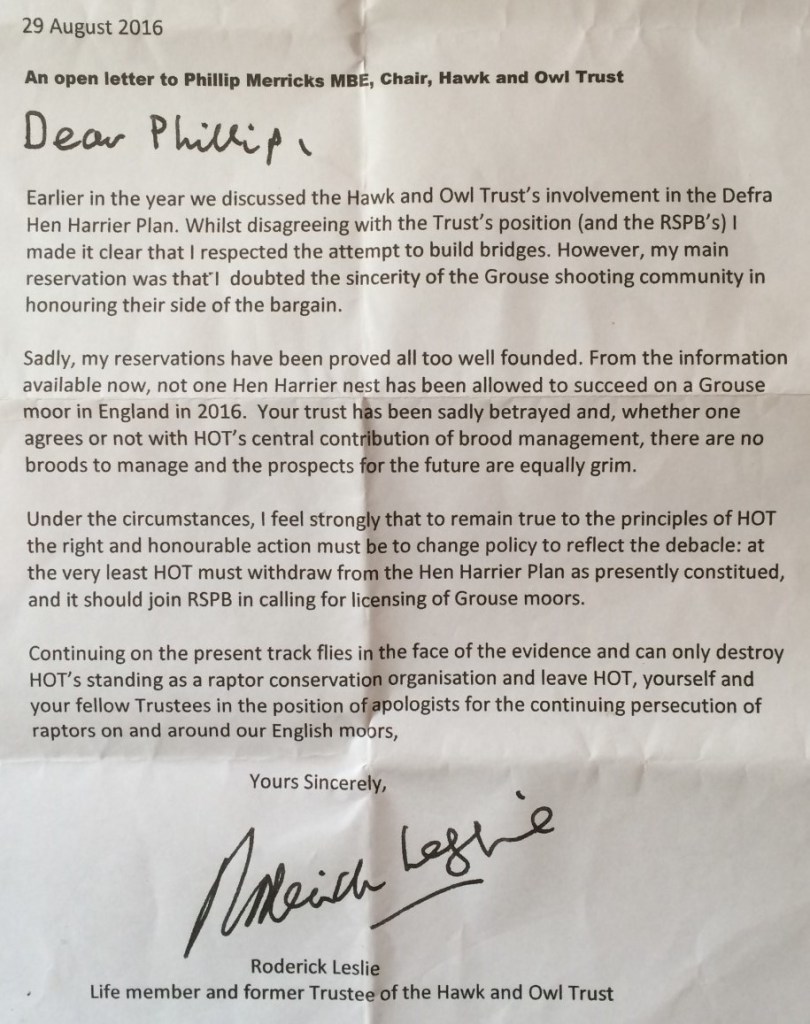
And this is where we come to the crux of the problem for this whole conference. The Hawk & Owl Trust is more than happy to be working with those who manage the habitats, farmers and landowners, we do that every day, sometimes I do it all day, but it’s not so easy to do it with gamekeepers when it’s pretty bloody clear that a number of them are continuing to break the law, and persecuting these birds, especially hen harriers. So I’ll just repeat that, it really is a despicable crime and something that’s been going on for far too long, and, which we’ve heard today, is continuing. On that line, it’s going on, I recently called in to see a great guy, a former RSPB Chairman, former RSPB Gold medallist, one of the great guys, and he gave me, he showed me, this invitation to a press release, and it just shows that this is something, I think then he was the incoming Chairman of the Council, became Chairman of the RSPB, and it just shows, 1971, you can possibly see that closer I think, 1971 the RSPB were, basically this is staff and council members, were giving a press conference on the persecution of birds of prey. And I mean clearly they were raising awareness of it then and they’re raising awareness of it now, so I’m just showing this is nothing new. What I do like about that, the way the RSPB operated, they stopped at 12.15 for cocktails. Can you see that at the bottom there? I’m sure things go on like that exactly the same way at The Lodge today.
Right. But I said, and I’ll put this up, the position is no damn different or better today. And one of the dreadful examples we’ve seen and you’ve all heard about is the setting of a pole trap on the Mossdale grouse moor. And that is appalling. As soon as I heard about that or was told about it, I went up to Mossdale because I’m always someone who likes to see things at first hand. I’ve got to the age now where actually, I actually want to see things and talk to people about it first hand. Has anybody been to Mossdale by the way? Brilliant, some of you have.I’ve talked to the head gamekeeper, I’ve talked to the owner, has anybody done that? A couple anyway. And I, you know, it was quite appalling, you know, it’s easier in some ways for me to give them a piece of my mind because I can almost speak landowner to landowner, although, you know, they might well be up in, you know, up on the moors and I’m down below sea level but I mean the principle is just the same. It is quite a disgusting incident, despicable act. And you know, I’m sure you’re all aware of it, this is a thing on a post, it holds birds by the legs until they die. I mean, and it was done by an untrained, unsupervised twenty-something year old, 22 year old, and it was a real, real dereliction of management, of supervision, and of training, absolutely appalling. And you know, that is lack of those, supervision and management and training by the head keeper and ultimately by the landowner. And, you know, I, it’s relatively easy for me, landowner to landowner, to say, ‘Look you bloody fool, you, you are, well, not just breaking the law but you’re letting all of us down whether we’re in below sea level in Kent or whether you’re up here’. And I, I, think, you know, perhaps things like that are easier.
So, how do we bring this to an end? We all want the same thing, everyone in this room wants the same thing. I think that’s the one thing that unites us, and the only thing that we may differ about is how we do it and that’s why I think we can all agree with that. Mark, [Avery] down on the front row, will say that banning grouse shooting is the best bet, and the RSPB will say that licensing is the best bet, but as Angela Smith said this morning, politics is the art of the possible, and I did clock that pretty strongly. And, you know, on that government has made it abundantly clear that they won’t go down the route of banning it and they won’t go down the route of licensing it and it seems now that this government is stabilised, with, with, Theresa whats-her-name, Theresa May, but, you know, stabilised for another three years and probably another term after that, so for a long time, you know, this government is in power and they’re not going to change their minds. So, on the art of the possible, if the first two routes are off the table that only leaves the government’s preferred option of the DEFRA six point plan which we heard about in detail from Adrian [Adrian Jowitt, Natural England] today. And of course, there are many people who for whatever reason don’t like that, but I bring you back to this point, this Angela Smith point, about, you know, politics being the art of the possible.
But another guy I went to see, you know, and who’s a good friend of mine who I’ve known for 20 years and is one of the great, great conservationists, well he’s a guru to me more than a friend. I like, I’m proud to call him a friend, he’s a guru to me, probably for 30 years, he’s guided all my steps in conservation, possibly for 35 years, and he’s one of the great, I mean he is of probably of all conservation biologists of all time, he’s probably done more for birds of prey than anyone else. You know, we heard from Ian [Rotherham] about the effect of persistent organochlorides [sic], DDT, on raptors, and this is the guy who started and appointed the team, and that team that included great people like Derek Ratcliffe, he, he set up that team at the research and then eventually cracked the problem of the birds of prey and of course, you know, I guess many of you will know who that is, Norman Moore. He really was one of the greats and I’m proud, well, we all need our gurus don’t we. He was, he was one for me. And it was such a privilege, I had the honour of speaking at his memorial service at the cathedral earlier this year and it was a huge, huge privilege to do that, and you know, he was immensely effective and was one of the greats.
So we get to the next one [next image on screen], and this is what he said. Can everybody at the back read that? Well, you don’t need me to tell you about it, you don’t need me to read it, but I’ll just leave you with it. You. Are you comfortable now, having read it? Well the point being, now who was it made that point this morning? Was it, was it Ian? Made that point, or somebody who made it, it’s just not science. And a couple of issues, people with different points of reference, well, we know that grouse moor managers have got different points of reference so things have to be explained, but, I’m pretty certain it was Ian who made that point this morning. But what for me, we just have to, if we want to get things across we have to get them across to people who are culturally completely different.
Right, my, the subject of my talk which I hope I haven’t wandered from, you know, I’m talking about the Hawk & Owl Trust’s involvement in the DEFRA plan and we heard from Adrian this morning and he went through it, so the first one, prevention, intelligence, led by senior police officers […inaudible…]. Well done to all involved and more power to your elbow.
Second one is monitoring of hen harrier breeding sites and winter roost sites. Well I do know a bit about this because winter roost sites on, in fact all four of our, well three of the, our four reserves are winter roost sites for raptors and marsh harriers and that’s when we see these hen harriers, down with us in the south east, that’s when we see them, and it’s absolutely crucial they’re monitored everywhere and protected everywhere, so well done to the guys who do that and usually on a voluntary basis.
So, and then of course number three, the sat tagging and the satellite tracking. Well, I mean nobody knows more about that than the other Steve [Stephen Murphy, Natural England] and he’s told me all about it, and I’m really pleased to see, to say that a number of tags have been fitted this year, tags funded by the Trust and fitted by, by Steve, and, and, and Trust staff and volunteers I think were with him when, when, it was, I mean they were fitted. And I think you’ll soon, as soon as they, well Steve will be able to tell you more of the detail, but soon you’ll be able to see the, their movements on the website. I mean it’s something I’m not very good on IT but I mean it’ll be really, really interesting that, and I, and I think it’s crucial, the more sat tags that are fitted, by everyone, the RSPB have obviously fitted them in the EU LIFE campaign means they can fit a lot, the less likely it will be, criminal gamekeepers to shoot them in other areas, you know, the risk will become increasingly greater because, you know, and I think this, this really does prevent it.
And then number four, diversionary feeding. I’ve been to Langholm a couple of times, well actually three, but once in early days and I’ve seen how effective this is and we’ll hear about this tomorrow from the speaker tomorrow, Sonja [Sonja Ludwig, GWCT], the speaker tomorrow, and of course this obviously is something that’s strongly supported and it should be carried out more widely and it is of course I’m told that people do it and where they, yeah, and it’s so damn obvious.
Number five, southern reintroductions, that was explained by Adrian and that’s something that obviously hasn’t started yet but of course it’s important and that’s where it’s crucial to get some confidence of landowners, farmers and others in the areas where they’re going to be reintroduced or where it’s proposed that they’re going to be reintroduced. It’s all about getting the confidence of the guys who manage the land, and there are several places been suggested, and, and that should be very interesting.
And then number six, which is what we hear so much about, we’ve already heard today, the trialling, and I do say trialling, people seem to think it’s an action, it is a trial. It’s the trial removal of eggs and young chicks where a certain threshold’s been reached. The incubating of them, the rearing of them, and you know, and don’t forget the Hawk & Owl Trust has got world class facilities to do this, owned and managed by a Trustee, and these really are world class facilities. And then of course, as Steve was telling us, released back on to the moors. And the other thing that we’ve done, the Trust, is make a really, really determined effort to get to know moorland owners and moorland managers and we’ve got quite a, quite a list of moorland managers and moorland owners who would be keen, no, more than keen, they would be proud, I’ll say that again, they would be proud to have hen, a pair of hen harriers on their moors. Of course they know that there’s, they’re semi-colonial nesters and everything but they’re proud to act as receptor moors for those translocated birds.
And I think the key issue about the DEFRA recovery, hen harrier recovery plan, is that while that hen harriers benefit hugely from and are largely dependent on the habitats created by good moorland management, large number of hen harriers and once again as I’ve said, don’t forget they are semi-colonial nesters can make grouse shooting unviable and we’ve heard about that hence, you know, that the management has that choice. As Langholm has shown, or, I mean, you’ll dispute what it’s shown, but I’m no expert on Langholm, but that, but that, oh I’m sorry I’m just losing my place, but, well you all know what Langholm does and you’ve all made up your own mind what Langholm did but it’ll get written up over the years and then we’ll all know more about it.
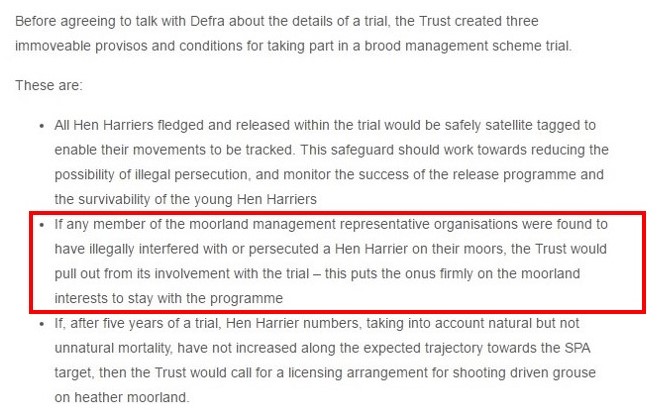
But I guess that, I guess the issue is, on the moors, that gamekeepers fear for their jobs, and their income and their houses, and they do continue with this appalling persecution, or some of them continue with this appalling persecution of these lovely birds and this is quite appalling. But, I mean and Mark said, in his book, it’s an understandable crime and there’s a reason for it, and I’m going to put Mark’s book up on the thing which is a really good read, it’s an interview with many bird watchers, and Mark’ll probably tell us about it. Right, good, now I’m almost at the end which I’m sure several of you will be relieved about. Right. Behind the Binoculars, and interesting one, on we go to the next one, this is where he interviewed, that’s right, Ian Newton, Ian obviously an eminent guy, eminent guy, Hawk & Owl Trust Vice President and he Chairs the Hawk & Owl Trust scientific advisory panel, so on to what he said. Mark, the first paragraph is Mark and I’ll just read the bits that I think, clearly he had the viewpoint that it [hen harrier persecution] was understandable, so what are we going to do about it? And Ian then on the second paragraph goes through and says well there are three possibilities as we heard about this afternoon and then on to the next one and then he says, this is Ian Newton again, really I think you’re left having to accept a third proposal: that harrier densities could be limited on grouse moors, to levels that allow some hen harriers to survive but allow grouse shooting, driven grouse shooting, to survive also. Ok, the idea then was the difficulty was in finding landowners. Well the good thing is that we’ve done that work, you know, because we’ve found landowners, we’ve got as I said, quite a respectable list. Then he says that would be a potential solution, and I bring you back to this word ‘potential’. Everybody thinks well we don’t know if it’ll work but it’s a potential solution.
So, where do we go to now? And I’m being hurried up, which is good, right. So, it goes on to say that we have, and it is a trial, I’m rattling through that, and I’ll just bring you back to something that Professor Redpath said. There’s a lot of evilness out there, and I like that word, it’s been used lots of times, Chris Packham, I picked up, it is because there is a lot of evilness out there but this trial will find out whether this evilness ceases or not, it’ll discover whether removing the reason for the crime reduces the crime, which’ll be the key. Whether it’ll work, I don’t know but grouse moor owners, or some of them, say that it will and I sincerely hope it will but it’s up to the guys out on the moors. We’ll find out whether this attempt at conflict resolution, and I’m a great believer in conflict resolution, we’ll find out whether it works or not. And for the sake of our hen harriers I hope it does.
END