Scottish landowners pretend that raptors are ‘thriving’ on driven grouse moors

Gift of GrouseWe’ve come to expect outlandish propaganda from the Gift of Grouse campaign group, designed to portray driven grouse moors as models of excellence for raptor conservation. But this time they’ve exceeded all expectation. Forget their usual unsubstantiated post-truth drivel, wholly disconnected to reality, because that’s got nothing on their latest effort, which takes the stretching of credibility to new depths.

The following press release from the Gift of Grouse is set to hit the headlines tomorrow:

ENCOURAGING NUMBERS OF BIRDS OF PREY SIGHTED ON SCOTTISH MOORLANDS

An increasing number of birds of prey are thriving on Scottish grouse moors due to gamekeepers’ conservation efforts.

More than 10 different raptor species including golden eagles, red kites and hen harriers have been identified on prominent grouse moors this year. They are among the 86 bird species that have been recorded on estates in the Angus Glens.

A snap shot from a range of estates across the Angus Glens Moorland Group highlighted encouraging evidence with gamekeepers on Invermark Estate in particular sighting nine raptor species including buzzards and golden eagles. Some of these are nesting and successfully breeding on the estate.

A number of other estates also reported healthy numbers with Ballogie Estate, Royal Deeside, revealing a total of 15 buzzards regularly hunting on the moor. Figures from the Speyside Moorland Group were equally as strong with 12 species of birds of prey recorded on Strathspey Estate alone. Atholl Estate in Perthshire are also monitoring 12 different raptor species.

Garry MacLennan, head gamekeeper on Invermark Estate, said: “Scottish grouse moors are far from being raptor deserts, as some opponents of shooting claim. We have monitored a growing number of buzzards, kestrels, golden eagles and white-tailed eagles. Keepers and estate managers do recognise there are some areas of the country where there are fewer raptor species but there is plenty of hard evidence to show that raptors are successfully nesting on grouse moors.”

The findings from Invermark are part of annual surveys undertaken using SNH guidelines.  These surveys were conducted by Taylor Wildlife, an ecological consultancy specialising in upland environments.

Richard Cooke, manager of Invermark Estate, said: “The survey is an extremely helpful way for us to monitor the biodiversity of the estate and which species are benefitting the most from our habitat management practices. Throughout the year we carry out rotational muirburn and control predation under the general licence, including foxes, stoats and other mustelids in particular.  This is to the benefit of many ground nesting birds and is reflected in the rich birdlife recorded by the annual audit.

The Tayside Moorland Group has also carried out species monitoring at a number of estates throughout the region with Glenturret Estate in Perthshire recording no less than 12 different raptor species hunting and nesting on the moorland this year. The estate tally included several breeding pairs of hen harriers, a nesting pair of peregrine fledging four chicks, short eared owls and numerous red kites.

Conservation training, conscientious moorland management and favourable weather conditions can all impact positively upon species numbers found on Scottish moorland.

Figures revealed in Wildlife Estates Scotland’s latest annual report show that 11 accredited estates reported the presence of golden eagles, with seven of these reporting 19 pairs. Eleven estates also recorded sightings of hen harriers with four reporting 18 breeding pairs. Buzzards were also reported on 20 estates, with a total estimated population of over 920 birds.

It was also recently revealed in a national survey that golden eagle numbers have surpassed 500 pairs giving them a ‘favourable conservation status’ in the UK. Eagles have made a home on several moorland estates across Scotland with Millden Estate, a member of the Angus Glens Moorland Group, recording a particularly high number of sightings.

Jason Clamp, head gamekeeper on Millden Estate, commented: “We are fortunate enough at Millden to have regular sightings of golden eagles. Seeing several of these magnificent birds on a daily basis has to be one of the highlights of my job. We are also very careful to leave a sustainable population of mountain hares for birds of prey, such as golden eagles, to hunt.

At Millden our team of gamekeepers has taken a proactive role in ensuring that we have a suitable breeding habitat for various birds of prey such the merlin, of which we currently have four nesting pairs. This has been brought about through controlled heather burning ‘muirburn’, which creates micro habitats suited to ground-nesting birds like the merlin.

We are delighted that the golden eagle, a species of conservation concern, amongst many other species, has found a safe and suitable environment in which to flourish in such impressive numbers, where careful moorland management has been imperative.”

ENDS

Wow! Where to start with this? It’s such ludicrously far-fetched bollocks it could have come straight from the mouths of gamekeepers and grouse moor managers. Oh, hang on…

Perhaps the idiots behind the Gift of Grouse campaign didn’t see the results of the latest national golden eagle survey, published just a few short weeks ago. You know, the survey that showed breeding golden eagles are still largely absent from driven grouse moors in the Eastern Highlands, just as they were in the last national survey conducted in 2003. Only 30% of known territories were occupied in this area – that’s a pathetic 34 out of 91 territories.

Perhaps the idiots behind the Gift of Grouse campaign didn’t see the results of the recent study on northern red kites, showing that illegal persecution on driven grouse moors in this region is just as bad now as it was in 1989.

Perhaps the idiots behind the Gift of Grouse campaign didn’t read the recent scientific paper showing hen harriers have suffered a ‘catastrophic decline’ on the driven grouse moors of NE Scotland.

Perhaps the idiots behind the Gift of Grouse campaign didn’t read the scientific paper showing peregrines continue to suffer a ‘long-term decline’ on the driven grouse moors of NE Scotland.

It’s all very well saying that raptors have been ‘sighted’ on grouse moors – of course they’ve been seen there – they are drawn to those areas precisely because of the absence of territorial breeding adults (as well as an abundant food supply). Nobody disputes that you can see raptors over these moors – the crucial distinction, which the Gift of Grouse idiots have carefully avoided, is how many raptors are breeding there? Remember, no breeding hen harriers in the Angus Glens for ten years!

It’s interesting that this press release refers to the grouse moors of the Angus Glens – a well known hotbed of illegal raptor persecution for over a decade. Here’s a map to illustrate the point:

Four grouse moor estates are highlighted in red (Invermark, Millden, Hunthill, Glenogil [with thanks to Andy Wightman’s Who Owns Scotland website for estate boundaries]). You see those purple dots? They represent confirmed illegal raptor persecution crimes. Are we seriously being asked to believe that raptors are ‘thriving’ in this region?

It’s also interesting to note that the ‘data’ behind the Gift of Grouse propaganda come from an ‘annual audit’ carried out by Taylor Wildlife consultancy. We’ve blogged about this group before – these are the ‘experts’ who claimed to have recorded 81 species of birds ‘feeding or breeding’ on an Angus Glens grouse moor last year. The problem is, their survey methods didn’t adhere to the usual industry standard – rather than conduct their breeding bird survey between March and June, when you’re supposed to do it, they conducted their survey between June and August, which is, er, after the breeding season!

Will we get to see this year’s report to scrutinise the methods and results? Highly unlikely – we’re still waiting to see their 2015 report but apparently it’s a secret and we’re not allowed to read it. Can’t think why.

Also of note in this latest press release is the reference to Glenturret Estate in Perthshire, another well-known driven grouse moor. We’ve blogged about this estate before, when it was claimed that Hen Harrier Day protesters might ‘disturb’ hen harriers – a species that has consistently failed to breed successfully on this moor. This year, they are claiming to have ‘several breeding pairs of hen harriers’ amongst other species. That’s interesting, because according to monitoring data from the Scottish Raptor Study Group, there was only one hen harrier breeding attempt on Glenturret this year, and, as has so often happened here in recent years, the nest failed for ‘unknown reasons’. Unfortunately it’s not possible to work out why hen harriers keep failing here because the estate has apparently refused to allow nest cameras to be installed.

Glenturret used to have lots of successfully breeding raptors, but these days, not so much. They certainly don’t have breeding golden eagles anymore because the eagle’s eyrie was burnt out last year. Here’s a photograph of the cliff face, taken in April 2015 – note the blackened hillside. Spontaneously combusting eagle eyries are a common problem on some Scottish grouse moors. Either that or golden eagles need to learn to discard their fag butts with more care.

We’ll add updates to this blog tomorrow when we see which newspapers have swallowed the Gift of Grouse guff hook, line and sinker. We’ll be particularly interested to see whether SNH issues a statement to rebutt the claims being made – SNH has access to the actual raptor breeding data via the Scottish Raptor Monitoring Scheme – let’s see them put it good use.

UPDATE 5 December 2016: “Risible, make-believe tosh”: RSPB responds to Gift of Grouse propaganda (here).

Case against gamekeeper Stanley Gordon re: shot hen harrier, part 7

Criminal proceedings continued at Elgin Sheriff Court today against Scottish gamekeeper Stanley Gordon.

Mr Gordon, 60, of Cabrach, Moray, is facing a charge in connection with the alleged shooting of a hen harrier in June 2013.

Here’s a summary of what’s happened so far in this case:

Hearing #1 (19 May 2016): Case continued without plea until 16 June 2016.

Hearing #2 (16 June 2016): Case continued without plea until 14 July 2016.

Hearing #3 (14 July 2016): Case continued without plea until 11 August 2016.

Hearing #4 (11 August 2016): Case continued without plea until 1 September 2016.

Hearing #5 (1 September 2016): Mr Gordon enters a not guilty plea. A provisional trial date is set for 19 December 2016, with an intermediate diet set for 18 November 2016.

Hearing #6 (18 November 2016): Case adjourned for another intermediate diet on 2 December 2016.

Hearing #7 (2 December 2016). Provisional trial date of 19 December is dumped. Case adjourned for another intermediate diet on 10 February 2017.

Hen harrier ‘reintroduction’ to southern England: an update

One of the six action points in DEFRA’s Hen Harrier Inaction Plan is to ‘reintroduce’ hen harriers to southern England:

hh-reintro

DEFRA’s HH Inaction Plan has been widely criticised by conservationists, with the main focus being on the brood meddling part. The proposed southern ‘reintroduction’ hasn’t received much attention, largely because the scoping project on which it is based is still unpublished – it’s hard to scrutinise something that’s being kept secret.

There had been concerns that chicks removed from the northern uplands as part of the brood meddling scheme would be used as the source birds for the southern ‘reintroduction’. This would have been unacceptable on a number of fronts, not least because it would be in breach of IUCN guidelines – you can’t source birds from a donor population if their removal would negatively affect the donor population. However, our recent FoI to Natural England has shown that those brood-meddled birds will be released back to the northern uplands, and not in to southern England (see here).

We’re now in a position to shed a bit more light on the proposed southern ‘reintroduction’ (it’s not actually a reintroduction because hen harriers are not extinct in southern England). Revealed through another FoI, the following update was provided by Adrian Jowitt (Natural England) to Paul Ballinger (DEFRA) on 23 September 2016:

Southern reintroduction: the main work undertaken over the last few months has been setting up and starting early conversations with stakeholders in the areas proposed. We have had discussions with landowners on Exmoor and in early October are going to meet with some key farmers and landowners in southern Wiltshire. The discussions have in the main been cautiously positive although there is still a way to go. We have also been exploring different funding routes and are starting to explore possible sources for chicks. We will also be considering whether we need to do any further habitat suitability checks beyond what was done for the original feasibility study and to that end will be carrying out some basic field visits with our hen harrier ecologist‘.

So, it looks like Exmoor may be a potential ‘reintroduction’ site, as well as somewhere in southern Wiltshire. That’s interesting.

exmoor

There has been at least one hen harrier breeding attempt in Wiltshire since 2002, although we don’t know the outcome. Here’s an image from a recent talk given by Natural England’s Stephen Murphy showing hen harrier breeding records between 2002-2015 (apologies for the poor quality photo – a reflection on us, not on the quality of Stephen’s slides):

hh-breeding-distribution

Wintering hen harriers are seen around Exmoor, albeit relatively infrequently – indeed, a satellite-tagged hen harrier from Bowland (2014 – ‘Burt’) is known to have visited Exmoor, because that’s where his last sat tag transmission came from, although in Burt’s case his ‘disappearance’ was thought to be as a result of a genuine tag failure rather than anything more sinister.

Exmoor, including Exmoor National Park, is well known for game shooting. This report from 2004 demonstrates just how much driven game shooting takes place there (predominantly pheasant & partridge) and how many gamekeepers work there. Perhaps that’s why Natural England’s discussions with landowners are described as being only ‘cautiously positive although there is still a way to go‘. If this ‘reintroduction’ is to go ahead, as Natural England appears to expect, these landowners MUST be on-side before any birds are released. It’ll be interesting to see how things develop on that score.

There are still huge question marks about this proposed ‘reintroduction’. Many of us are not entirely supportive because we believe the grouse shooting lobby and Natural England/DEFRA are using it as a way of diverting attention from the ongoing criminal persecution of hen harriers in the northern uplands. Releasing some birds in to southern England (assuming a source population can be found) will not stop the grouse moor managers from killing hen harriers in the northern uplands, the fundamental cause of this species’ decline in the first place.

You could argue that, theoretically at least, the southern England ‘reintroduction’, if successful, would increase the range and conservation status of English hen harriers, and it would also bolster the English population, increasing its resilience from population decline. That’s true. However, it’s also true that if hen harriers were not still being routinely killed in the north, their breeding range would increase naturally, their conservation status would improve, and the population’s resilience to decline would increase.

You could also argue that the estimated half-a-million quid (and the rest!) of taxpayers’ money that’ll be spent on this attention-diverting scheme would be better spent on improving enforcement measures so the hen harrier killers can finally be brought to justice.

Brood meddling: the proposed social science study

We’ve recently been blogging about DEFRA’s hen harrier brood meddling scheme, due to start in the 2017 breeding season. A series of FoIs has uncovered some of the plans to date (e.g. see here, here, here).

Today’s blog relates to the proposed social science study, which is being viewed as an integral part of the brood meddling trial.

The proposal has been submitted by Steve Redpath (Aberdeen Uni & Trustee of the Hawk & Owl Trust) and Freya St John (Kent Uni), both well known for their interest in wildlife conflict management.

Here’s the proposal: social-science-proposal-brood-meddling-june-2016

Basically the proposal is for a seven-month long study, estimated to cost ~ 50K, to assess how grouse moor managers, gamekeepers and conservationists ‘feel’ about hen harriers and about the different aspects of the wider Hen Harrier Inaction Plan.

Not being social scientists there’s a very good chance that we’re missing something here, and we’d be happy to be corrected, but we’re struggling to see the point/value of this study. Apart from the obvious flaw that the study will rely upon grouse moor owners and gamekeepers telling the truth (good luck with that, researchers!), the attitudes of all these ‘stakeholders’ are already blindingly clear, surely?

The vast majority of driven grouse moor owners and gamekeepers don’t tolerate hen harriers, to the extent that the English hen harrier breeding population is on its knees because these birds are routinely killed. Conservationists place a high nature conservation value on hen harriers and want grouse moor owners and gamekeepers to abide by the law and stop killing them.

The whole premise of the brood meddling scheme is to see whether driven grouse moor owners and gamekeepers will ‘tolerate’ hen harriers if they can be assured that there won’t be more than one breeding pair per 10 sq km. The claimed purpose of brood meddling is to reduce the pressure of predation on red grouse caused by parent hen harriers hunting to provide for their broods (and yet strangely, the industry isn’t up for trialling diversionary feeding). But this predation pressure is not the only aspect of hen harrier ecology that the grouse shooting industry objects to. It is also known that they don’t like to see hen harriers flying over the moors during the grouse-shooting season because the harrier might disrupt the flights of red grouse being driven towards the guns. So who thinks that releasing young hen harriers back to the uplands in August/September is going to work?!

The proof will be in the pudding. Will those captive-reared hen harriers survive once they’ve been released? Their satellite tag transmissions will provide the real answer, not the result of some questionnaire that’s been answered by members of an industry that’s based on criminality and that has proven itself untrustworthy time and time and time again.

Case against gamekeeper Stanley Gordon re: shot hen harrier, part 6

Criminal proceedings continued at Elgin Sheriff Court on Friday against Scottish gamekeeper Stanley Gordon.

Mr Gordon, 60, of Cabrach, Moray, is facing a charge in connection with the alleged shooting of a hen harrier in June 2013.

Here’s a summary of what’s happened so far in this case:

Hearing #1 (19 May 2016): Case continued without plea until 16 June 2016.

Hearing #2 (16 June 2016): Case continued without plea until 14 July 2016.

Hearing #3 (14 July 2016): Case continued without plea until 11 August 2016.

Hearing #4 (11 August 2016): Case continued without plea until 1 September 2016.

Hearing #5 (1 September 2016): Mr Gordon enters a not guilty plea. A provisional trial date is set for 19 December 2016, with an intermediate diet set for 18 November 2016.

Hearing #6 (18 November 2016): Case adjourned for another intermediate diet on 2 December 2016.

Brood meddling: the role of the ICBP

We’ve learned, through a series of FoIs about DEFRA’s planned hen harrier brood meddling scheme, that the practical aspect of the trial (i.e. the removal of eggs/chicks from the nests and the subsequent captive-rearing) will be undertaken by the International Centre for Birds of Prey in Gloucestershire (see here and here for previous blogs).

The ICBP is directed by Jemima Parry-Jones, who, along with several others involved in this brood meddling scheme (Philip Merricks, Steve Redpath and Philip Holms), also serves on the Hawk & Owl Trust’s Board of Trustees.

As part of her input, she has produced an estimated costing. Given the number of uncertainties about the trial, the costing is, inevitably, largely guesswork. Nevertheless, it’s pretty detailed and provides an insight to what will be involved.

You can read it here: harrier-brood-management-draft-ballpark-costings

Jemima Parry-Jones’ knowledge and expertise on the breeding and captive rearing of raptors is undeniable. She is a recognised and highly respected world authority on this subject. We can be assured that any hen harrier eggs/chicks that the ICBP receives during this trial will be given the utmost care and attention to ensure they’re fit enough for release.

But what’s so baffling, and yes, disappointing, is that Jemima would want to play any part in this brood meddling scheme. As a lifelong advocate for raptor conservation, why would she support a plan to remove these harriers from the wild, just to enable an industry to kill an artificially-high number of grouse, for personal gratification, and then release those harriers back to the wild knowing that their chance of survival (at the hands of that same criminally-based industry) is virtually nil?

Why go to all the effort of rearing those birds, knowing that in fact all you’re doing is delaying the inevitable? There isn’t a scrap of evidence, not one tiny shred, to suggest that those released juveniles will be left alone; on the contrary, ALL the evidence suggests otherwise.

All we have is the word of the grouse shooting industry that they’ll abide by the law, but who in their right mind would take them at their word?! They don’t even believe it themselves – why else would they propose that the cessation of illegal persecution is not a condition of this brood meddling trial!

Wake up Jemima, you’re being played.

More brood meddling revelations

Following on from yesterday’s blog on some of the details emerging about DEFRA’s hen harrier brood meddling scheme (see here), here are some more revelations that have come to light from a series of FoIs.

There’s a document written by Steve Redpath, Adam Smith (GWCT) and Martin Gillibrand (then secretary of the Moorland Association) dated August 2013. It’s titled ‘Improving the conservation status of hen harriers in the UK – establishing a research trial of a brood management scheme‘.

You can read it here: harrier-trial-brood-management-scheme-final-draft

It’s not clear for whom this document was written, but we’d take a guess that it was produced for DEFRA as an overview of /justification for, a hen harrier brood meddling scheme. Some of the brood meddling plans mentioned in this document may well have been developed further since August 2013. However, there are definitely parts of it still being cited (by Amanda Anderson), word for word, in discussions about the planned 2017 launch of brood meddling.

A few things jumped out at us. The first thing isn’t a revelation as such – the justification for using a brood meddling scheme based on the successful use of this management tool on Montagu’s harriers in western Europe. We’ve heard this a lot, especially from GWCT, and yes, at a superficial level, it does sound like a reasonable comparison. Montagu’s harrier nests in cereal fields are at high risk from mechanised harvesting equipment, and so broods have been removed from the danger areas, captive-reared, and then released back to the wild. And it has worked well.

But what the pro-brood meddlers never mention is the fact that the risk to those Montagu’s harriers is limited to a very short time period when harvesting takes place. Once the crops have been harvested, the risk is gone until harvest time the following year. That is not comparable with the hen harrier situation in the UK. The risk to hen harriers on UK driven grouse moors is year-round. They are killed at the beginning of the breeding season when they try to settle, they are killed during the breeding season, and they are killed during the autumn and winter, particularly at roost sites. Year-round harrier persecution is the name of the game in the UK so to argue that brood meddling will work for hen harriers on grouse moors in the UK just because it’s worked for Montagu’s harriers in agricultural fields abroad is totally absurd. The circumstances are nowhere near comparable.

One revelation that did jump out at us from this document is a sentence in the Introduction section:

Should a trial brood management scheme be successful, the next phase would be to offer this as a management option across the whole of the UK“.

Jesus.

The other revelation we found was this, in the section describing how the trial might work:

Once harriers start settling the trial will commence. As soon as a pair of harriers lays eggs within 10km of another pair, that will activate the brood management scheme. At least one pair must be settled on a grouse moor employing one or more full-time grouse keepers where a suppressed grouse population poses the greatest social, economic and conservation risk“.

Eh? A “suppressed” grouse population? There’s nothing “suppressed” about an artificially-high grouse population with 300-500 birds per sq km, crammed on to a driven grouse moor!

More revelations to follow….

UPDATE 16 Nov 2016: Brood meddling: the role of the International Centre for Birds of Prey (here)

Hen Harrier brood management working group: what they’ve got planned

Hen harrierIn January 2016, DEFRA published its Hen Harrier (In)Action Plan (see here).

There are six ‘action’ points, including #6, a brood management (meddling) trial, where it is proposed to remove hen harrier eggs/chicks from driven grouse moors when breeding pairs have reached a certain density on that moor or on nearby moors, hatch and rear them in captivity, and then release them back to the uplands at fledging age.

At the time of publication, the actual details of this brood meddling scheme were very sketchy. Where would the trial take place? When would it start? Who would fund it? Who would be involved? Was it even legal, given the catastrophically low number of breeding hen harriers in England?

A working group was established to scope out the trial. Since then, very little information has reached the public domain. We learned from Amanda Anderson (Moorland Association) during the e-petition evidence session at Westminster that there were hopes brood meddling would begin during the 2017 breeding season, but that’s about all we’d heard.

Until now.

A series of FoIs have revealed what this working group has been up to.

The working group comprises various individuals and organisations: GWCT (Teresa Dent, Adam Smith), Hawk & Owl Trust (Philip Merricks, Phil Holms), Moorland Association (Amanda Anderson, Robert Benson), Natural England (Rob Cooke, Adrian Jowitt), Jemima Parry Jones (International Centre for Birds of Prey) and Steve Redpath (listed as an ‘independent academic’ although we note he has recently joined the Hawk & Owl Trust Board of Trustees).

The working group has met four times this year and has agreed on some details of the trial, and other details are still being assessed.

Here’s what we know so far:

  • The brood meddling trial area has yet to be established. The Moorland Association wants all its members’ grouse moors to be included but the licence for the trial will have to comply with various legislative instruments concerning wildlife and habitat.
  • Brood meddling will be triggered if the initial ‘ceiling density’ has been reached. For the purposes of this trial, the initial ceiling density is one pair of breeding hen harrier per 80 sq km or 20,000 acres, or a (straight line) distance between pairs of 10km or 6.3 miles.
  • Brood meddling will begin without the need for the English hen harrier population to reach a pre-determined level. In other words, even if there are only two hen harrier breeding attempts in 2017, and at least one of those breeding attempts is on a driven grouse moor and is within 10km of the other nest (even if the other nest is on an RSPB reserve) then the eggs/chicks of that grouse moor nest will be removed. (Absurd, we know).
  • Legal advice given to Natural England suggests there are no legal barriers to the brood meddling trial, despite the failed status of the hen harrier Special Protection Areas.
  • Brood meddling can only take place with landowner permission, regardless of whether the site lies within the licensed trial area. In other words, hen harrier nests on, say, RSPB reserves, cannot be touched unless the RSPB says it can.
  • The brood meddling trial is not dependent on the cessation of illegal persecution. So, even if the released captive bred birds (all satellite tagged) are found to have been bumped off post-release, the trial will continue for five years.
  • The practical aspect of brood meddling will be undertaken by the International Centre for Birds of Prey. The Natural England licence will be in this organisation’s name.
  • All hen harriers reared in captivity will be released back in to the uplands; they will not be used as the source birds for DEFRA’s proposed ‘reintroduction’ of hen harriers to southern England.
  • Possible release sites (not on “prime grouse moor”) for these captive-reared birds have been suggested in Northumbria, West Pennine Moors and Wensleydale. However, the group has since realised that any proposed release sites must not only have a willing landowner, but they must also meet stringent ecological criteria. Natural England is currently assessing various potential sites.
  • A social science study will run parallel with the practical brood meddling trial, to assess whether the attitudes of the grouse shooting lobby change towards hen harriers over the course of the trial. A proposal for this study has been submitted by Steve Redpath and Freya St John (Kent Uni).
  • Funding options for both the practical trial and the social science study are still under discussion.

Here are the official ‘notes’ from the brood meddling working group’s four meetings this year:

draft-note-1st-bm-meeting-29-march-2016

note-of-2nd-bm-meeting-5-may-2016

note-of-3rd-bm-meeting-27-june-2016

note-of-4th-bm-meeting-29-sept-2016

Further documents from this working group provide much more detail about certain aspects of the trial, including the practicalities of brood meddling and release and its estimated costs, the proposed social science study and its estimated costs, the ecological requirements of proposed release sites, and some interesting information about the proposed ‘reintroduction’ of hen harriers to southern England. We’ll publish these in due course.

Photograph of hen harrier nest by Mark Hamblin

UPDATE 15 Nov 2016: More brood meddling revelations (here)

UPDATE 16 Nov 2016: Brood meddling: the role of the International Centre for Birds of Prey (here)

Satellite-tagged hen harrier Tarras ‘disappears’ in Peak District National Park

‘Tarras’, a young hen harrier from this year’s Langholm cohort, has ‘disappeared’ in the Peak District National Park.

tarras

The following statement has been issued on the Langholm blog:

We have concerns for ‘Tarras’ a young female Hen Harrier tagged by Stephen Murphy (Natural England) at Langholm this summer.

The transmitter on the juvenile Hen Harrier Tarras has not transmitted since the 23rd October. The area has been searched and nothing was found and no hen harriers were seen in the area.

The last known fix area is on land owned by United Utilities in the north Peak District.

Tarras flew south from Scotland in the last weeks of September, arriving in the Nottingham area on the 11th October. She then headed north through Staffordshire and was roosting in the Peak District, near to the last known fix area on 13th October.

Tarras’ transmission period (duty cycle) was regular until 23rd October; on 23rd October it ran a complete transmission period (e.g. no sudden cessation of data within the 10hr transmission period). The local weather in the days immediately after 23rd were damp and overcast so this can delay the recharge time. However, by 26th concerns were raised. We have some evidence that suggest this may be a tag failure and we are currently trying to gather more information to help us resolve this.

END

That final sentence is a bit strange, and is at odds with what has been reported about the tag’s last smooth-running duty cycle. It’s worth revisiting a comment about tag reliability made recently by experienced researcher Dr Raymond Klaassen, who has been using satellite tags to track the movements of Montagu’s Harriers:

Technical failures generally are rare. We have recorded a few throughout the years (6% of all cases), however failures have always been preceded by irregular transmission periods and, most importantly, a drop in battery voltage (another parameter monitored by the transmitter). This makes it relatively straightforward to distinguish between a likely mortality event and a likely transmitter failure“.

So, given Tarras’ tag was not transmitting irregularly prior to her disappearance, what ‘evidence’ does Natural England have to ‘suggest this may have been a tag failure’?

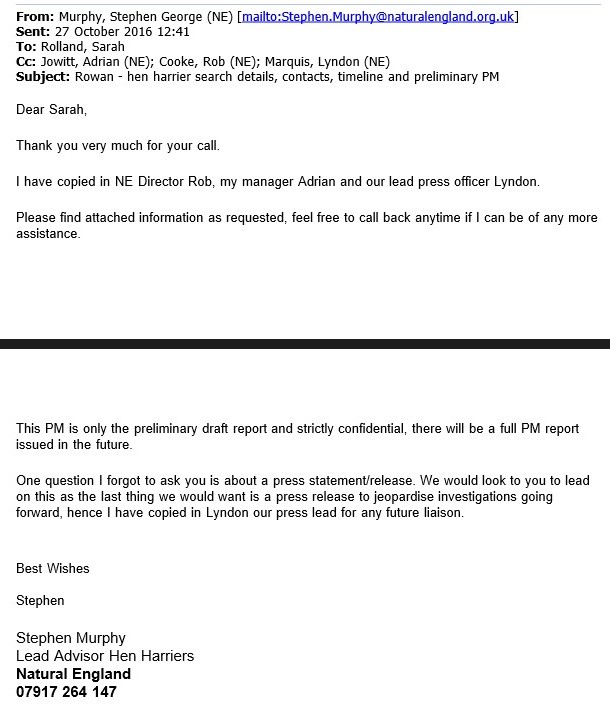
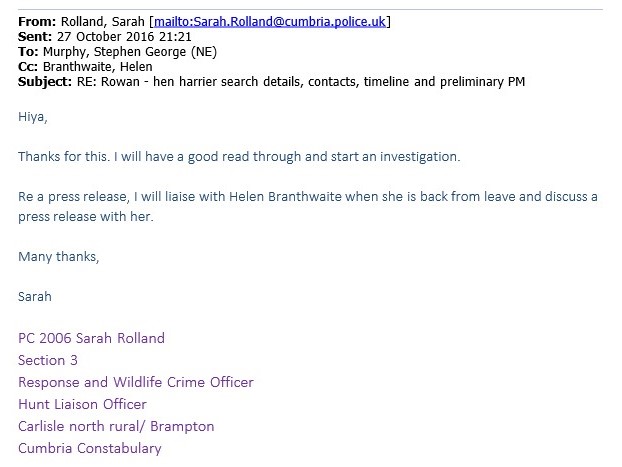
It’s all a bit vague, isn’t it? A bit like the information put out about hen harrier Rowan who, according to Cumbria Police, was “likely to have been shot” in the Yorkshire Dales National Park.

We look forward to a timely update from Natural England about Tarras’ disappearance in the Peak District National Park.

UPDATE 16 March 2021: Interestingly, ‘Tarras’ is not listed on Natural England’s database of satellite-tagged hen harriers – why is that? See: https://www.gov.uk/government/publications/hen-harriers-tracking-programme-update/hen-harrier-annual-tracking-update

Hen Harrier Rowan ‘likely to have been shot’ in Yorkshire Dales National Park

On 28 October 2016 we learned that one of this year’s young hen harriers had been found dead in Cumbria in suspicious circumstances (see blog here).

This was a hen harrier called Rowan, who had hatched at Langholm this summer and was one of two hen harriers being satellite-tracked by the Hawk & Owl Trust.

rowanhh

The press release from the Hawk & Owl Trust and Natural England had just said Rowan’s body had been found in Cumbria on 22 October 2016, and following a post mortem, details had been passed to the police.

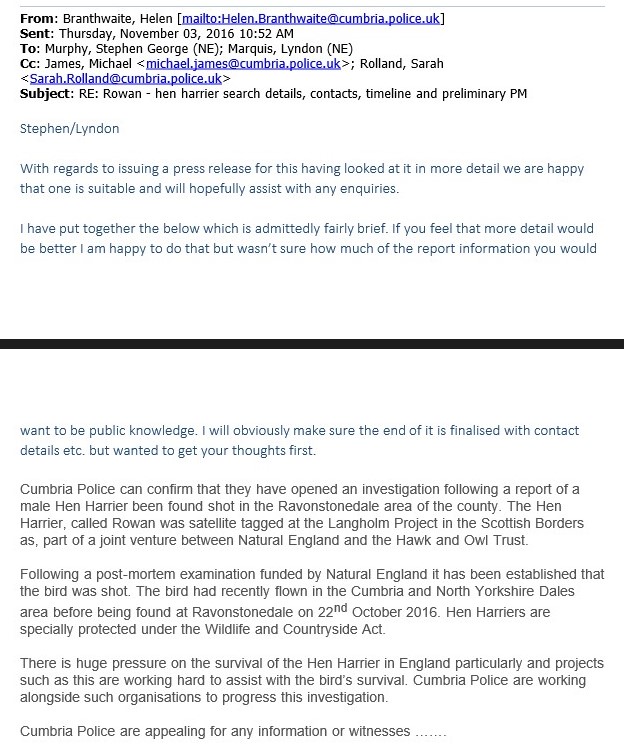
Today, Cumbria Police have issued a press statement as follows:

Cumbria Police have opened an investigation into the death of a hen harrier.

The body of a male Hen Harrier was found in the Ravenstonedale area of the county on 22nd October 2016. A post-mortem examination funded by Natural England and carried out by the Zoological Society of London has established that the bird was likely to have been shot.

The hen harrier, called Rowan, was satellite tagged at the Langholm Project as part of a joint venture between Natural England and the Hawk and Owl Trust. The bird had recently flown in the Cumbria and North Yorkshire Dales area before being found at Ravenstonedale.

Hen Harriers are specially protected under the Wildlife and Countryside Act, and the Government has set raptor persecution as one of their wildlife crime action priorities.

There is huge pressure on the survival of the hen harrier in England particularly and projects such as this are working hard to assist with the bird’s survival. Cumbria Police are working alongside such organisations to progress this investigation.

Anyone with information is asked to contact police on 101 and ask to speak to PC 2059 Helen Branthwaite.

END

Ravenstonedale lies within the Yorkshire Dales National Park (the bit that was recently added in August 2016).

ravenstonedale

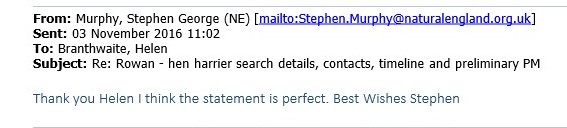
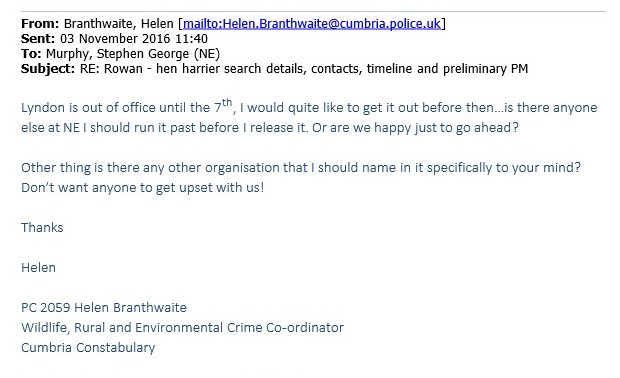
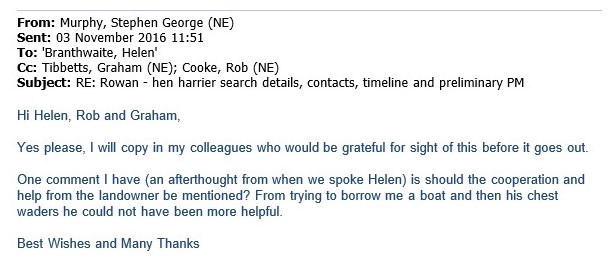
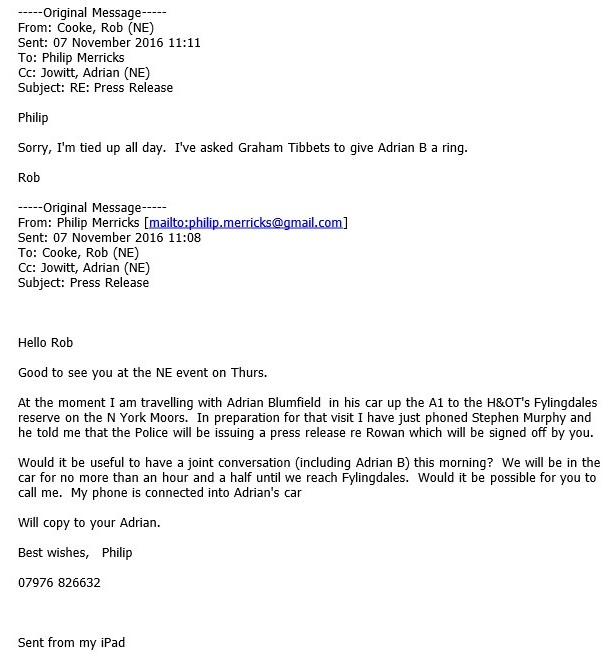
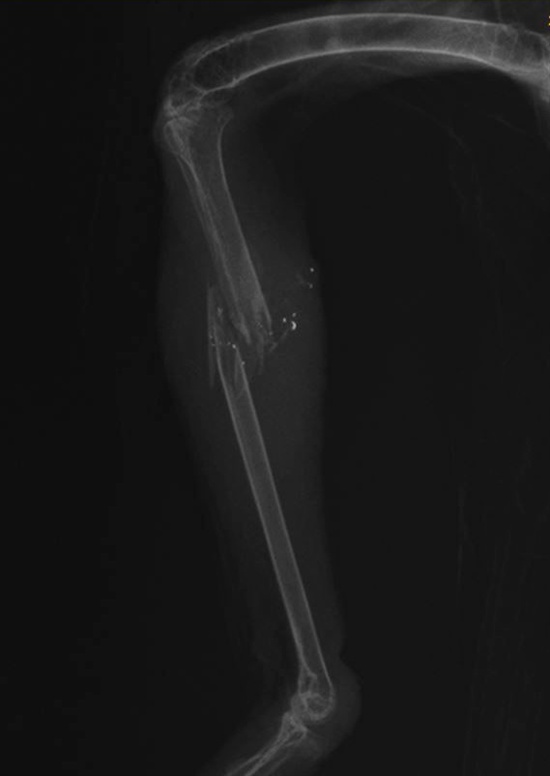
The statement that Rowan “was likely to have been shot” is a bit odd. It would have been useful for Cumbria Police to release a copy of the x-ray, as other police forces often do when appealing for information about shot birds. Perhaps there is justification for the vague statement about the cause of death, but then again, perhaps there isn’t. Did the post mortem report use the words ‘likely shot’? That would be an unusual phrase. Usually they say something like ‘injuries consistent with’ (being shot). There’s a big difference in interpretation. There’s a faint whiff of a cover up here. Not an overpowering stench, but definitely an aroma of something….

The reputation of the Yorkshire Dales National Park as a hell hole for hen harriers (and most other raptors) continues to grow. Hen harriers haven’t bred in this National Park since 2007 and young birds that visit don’t last very long either. Here are some YDNP hen harrier data (2007-2014) from Natural England we’ve blogged about before:

Female, tagged N England 26/6/07: last known location YDNP 5/10/07. Status: missing.

Female, tagged N England 16/7/09: last known location YDNP 27/9/09. Status: missing.

Male, tagged Bowland 29/6/09: last known location YDNP 17/8/09. Status: missing.

Female, tagged N England 29/6/10: last known location YDNP 25/11/10. Status: missing.

Female (Bowland Betty), tagged Bowland 22/6/11: last known location YDNP 5/7/12. Status: shot dead.

Female (Kristina), tagged N England 25/6/12: last known location YDNP 9/10/12. Status: missing.

Male (Thomas), tagged N England 4/9/12: last known location YDNP 4/9/12. Status: missing.

Male (Sid), tagged Langholm 21/9/14: last known location YDNP 21/9/14. Status: missing.

Female (Imogen), tagged N England 26/6/14: last known location YDNP 1/9/14. Status: missing.