Heads Up for Harriers: Tim Baynes claims illegal persecution an “historical controversy”

Another week and another duplicitous article from Tim (Kim) Baynes, Director of SLE’s Scottish Moorland Group. This guy seems to live in a perpetual state of denial when it comes to the illegal persecution of raptors on driven grouse moors.

This time he’s penned an article for the latest edition of Shooting Times about the ridiculous Heads Up for Hen Harriers project (more on this below).

The front cover of the Shooting Times has a headline banner: “The hen harrier: how much do we really know?”, which laughably infers that the cause of long-term hen harrier decline in the UK is still a bit of a mystery that needs solving, and then inside there’s a two-page spread from Tim (Kim) who suggests that ‘weather’ and fox predation are the big culprits, as recorded by Heads Up for Hen Harrier cameras. Astonishingly, he also claims that the illegal persecution of hen harriers on grouse moors is an “historical controversy”.

You can read the full article here: Shooting Times 7 June 2017_HaveYouSeenAHenHarrier_TimBaynes

Perhaps he missed the Government-commissioned 2011 Hen Harrier Conservation Framework, which set out very clearly what the main issue is: Illegal persecution is the biggest single factor affecting hen harriers and it is having a dramatic impact on the population, not only in northern England but also in Scotland:

  • The potential national hen harrier population in Scotland is estimated (conservatively) to be within the range 1467-1790 pairs.
  • The current national hen harrier population in Scotland as recorded during the 2010 national survey is 505 pairs, more than a 20% decline from the numbers recorded during the 2004 national survey.
  • In Scotland, the hen harrier has a favourable conservation status in only five of 20 regions.
  • Two main constraints were identified: illegal persecution, and in one region, prey shortages.
  • The species is particularly unsuccessful in the Central Highlands, Cairngorm Massif, Northeast Glens, Western Southern Uplands and the Border Hills. There is strong evidence in these grouse moor regions that illegal persecution is causing the failure of a majority of breeding attempts.

Tim (Kim) also appears to have missed the video published by RSPB Scotland last month showing exactly what happens when a camera is installed at a hen harrier nest without the grouse moor owner and gamekeeper’s knowledge:

He must also have missed last month’s news that Police Scotland are investigating the illegal shooting of yet another hen harrier on a grouse moor near Leadhills (see here), which incidentally is alleged to have happened on the estate owned by the Hopetoun family – that’ll be the family of Lord Hopetoun, Chair of the Scottish Moorland Group, of which Tim (Kim) is, er, Director.

The only ‘historical’ aspect of hen harrier persecution is that it’s been going on for over a hundred years. Pretending that it’s now stopped, in the face of such overwhelming evidence to the contrary, is the response of an idiot.

We’ve blogged about the Heads Up for Hen Harriers project many times (e.g. see here, here, here). The idea is that estates give permission for cameras to be installed at active hen harrier nests ‘to help build a picture of why these birds aren’t doing as well as they should be’. The major flaw in this ‘study’ design is that gamekeepers will know on which nests the cameras are pointing, so obviously they’re not going to shoot the adults or stamp on the eggs/nestlings at those sites. Instead, the cameras will record natural failures (e.g. poor weather, predation) and then the grouse shooting industry can use this information to claim that illegal persecution isn’t an issue, but poor weather and predation is. This is exactly what Tim (Kim) Baynes has done in this latest article.

Now, some might argue that having grouse moor owners’ agreement to install cameras at hen harrier nests on their estates is a good thing – at least those nests will be left alone and the birds might be able to produce some young. There is that, of course. But leaving the birds alone long enough to produce fledglings isn’t enough. What happens to those young fledglings once they leave the safety of a monitored nest? You only have to look at what happened to young hen harrier Elwood to answer that question. He survived for approximately two weeks after dispersing from his monitored nest site before un-mysteriously vanishing on a grouse moor in the Monadhliaths – funnily enough in an area where many satellite tagged golden eagles have also un-mysteriously vanished.

Tim (Kim) talks about the number of estates that have agreed to participate this year (at least 15) and makes much of the fact that some of these are grouse moor estates. The same thing happened last year, although what was covered up last year was the fact that only three nests were successful and none of those was on a driven grouse moor. This wasn’t a surprise given that most of the driven grouse moor estates that agreed to ‘participate’ were located in the Angus Glens – an area that hasn’t seen a successful hen harrier breeding attempt since 2006.

What would be more interesting to know is not how many estates have agreed to ‘participate’, which is a largely meaningless figure unless they actually have an active nest, but how many estates have refused to participate? Again, this information is not made public, presumably because it’ll spoil the image of this so-called ‘widespread cooperation’ from grouse moor estates.

We’ve got another question for Tim (Kim). In this article he says:

“A better idea of current numbers will emerge when the results of the 2016 UK harrier population survey are published, but the overall picture is expected to be broadly the same in Scotland“.

Really? On what basis is he making this claim? The results of the National HH Survey have not yet been released (held back, we believe, due to the General Election, but due out shortly), so what makes Tim (Kim) think that “the overall picture is expected to be broadly the same in Scotland”? Is this based on factual information or is Tim (Kim) just making up some nonsense to suit his agenda?

It’s not like he/Scottish Moorland Group/Gift of Grouse hasn’t done this before (e.g. see here, here, here).

Crown Office drops 5th case of alleged wildlife crime

Public prosecutors from Scotland’s Crown Office have dropped yet another case of alleged wildlife crime.

According to an article in the Sunday Post (see here), gamekeeper John Charles Goodenough, 32, had been charged after he was allegedly caught with illegal gin traps covered in animal blood, with dead fox cubs found nearby, in May 2016. It is reported Goodenough was employed at the time by Dalreoch Farming & Sporting Estates, owned by the well-connected Wellesley family. It was alleged that Goodenough was using the illegal traps on a neighbouring farm in Ayrshire.

The case was due to be heard at Ayr Sheriff Court on 27 March 2017 but two days prior to the hearing, the Crown Office dropped the case ‘after getting the dates wrong on its paperwork’.

This latest case brings the total of recently abandoned prosecutions for alleged wildlife crime to five. That’s five abandoned cases in the space of two months:

25 March 2017 – gamekeeper John Charles Goodenough (Dalreoch Estates), accused of the alleged use of illegal gin traps. Prosecution dropped due to paperwork blunder by Crown Office.

11 April 2017 – landowner Andrew Duncan (Newlands Estate), accused of being allegedly vicariously liable for the actions of his gamekeeper who had earlier been convicted for killing a buzzard by stamping on it and dropping rocks on to it. Prosecution dropped due to ‘not being in the public interest’.

21 April 2017 – gamekeeper Stanley Gordon (Cabrach Estate), accused of the alleged shooting of a hen harrier. Prosecution dropped as video evidence deemed inadmissible.

25 April 2017 – gamekeeper Craig Graham (Brewlands Estate), accused of allegedly setting and re-setting an illegal pole trap. Prosecution dropped as video evidence deemed inadmissible.

21 May 2017 – an unnamed 66 year old gamekeeper (Edradynate Estate), suspected of alleged involvement with the poisoning of three buzzards. Crown Office refused to prosecute, despite a plea to do so by Police Scotland.

Given how difficult it is to get just one wildlife crime case anywhere near a court, to have five abandoned in the space of two months does not inspire confidence in the criminal justice system.

In fact such was the public concern about some of these cases being abandoned due to the supposed inadmissibility of video evidence, last month the Scottish Parliament’s Environment Committee wrote to the Crown Office to ask for an explanation (see here).

The Crown Office has now responded with this: COPFS letter to ECCLR_EvidenceAdmissibility_May2017

We are not legally qualified to comment in depth about how good or how poor the Crown Office’s response is. If any of our legally-minded readers (Adam?) would like to comment, please do so.

However, what we can say is that this response does not address the question of why the Crown Office made the decision about inadmissibility instead of allowing a court to decide, as has happened in previous cases (e.g. see here).

Nor does this response address the question of why the Crown Office did not believe the RSPB ‘s explanation for their use of video surveillance for monitoring a hen harrier breeding attempt at Cabrach Estate. The Crown Office maintains, without explanation, that the RSPB had installed the video ‘for the purpose of detecting crime’, whereas the RSPB maintains the camera was installed as part of a legitimate monitoring study, an explanation which had been accepted by both the Crown and the court in a similar situation in another case (here).

The RSPB’s case is not so strong in the Brewlands Estate case, where a camera was installed to monitor an illegal pole trap (a trap that the RSPB had since made safe by flicking on the safety catch), although the circumstances might have been different had the police been able to attend the scene as soon as they were notified of an illegally-set trap. Nevertheless, the fact that the Crown Office allowed a year’s worth of court hearings to pass by before deciding to abandon this case, and their unwillingness to communicate their specific concerns to the RSPB, is yet to be adequately addressed by the Crown Office.

The Crown Office’s response also does not explain (although to be fair, it wasn’t asked to) why dropping the prosecution against Andrew Duncan for alleged vicarious liability was deemed to be ‘not in the public interest’, and nor does it explain why a prosecution was not brought against the unnamed Edradynate Estate gamekeeper for the alleged poisoning of three buzzards, despite pleas from Police Scotland to do so.

The Crown Office’s letter to the Environment Committee ends with this:

‘COPFS remains committed to tackling wildlife crime, including raptor persecution. There is a strong presumption in favour of prosecution in cases reported to the Service where there is sufficient admissible evidence and prosecution is in the public interest‘.

You could have fooled us.

To be honest, as frustrating as it was to see these cases abandoned for what seem to us to be spurious reasons, the Crown Office’s unimpressive performance has probably helped move things along, because these dropped cases came at the time when the Scottish Government was already under severe public pressure to do something other than make vague promises to tackle wildlife crime. That’s not to say we are pleased with the outcome of these cases – far from it – but it’s quite likely that these failed prosecutions helped tip the balance and persuaded the Scottish Government that actually, the current system is failing and they need to find new ways of addressing the problem.

Job opportunity: Project Manager, RSPB’s Hen Harrier LIFE Project

The RSPB is recruiting for a new Project Manager to run its Hen Harrier LIFE Project for the final two years of its duration.

Details of the role and how to apply can be found here

Closing date for applications is 26 June 2017.

Whoever gets this job will have some pretty big shoes to fill. Blanaid Denman has steered this award-winning project with passion, drive and outstanding professionalism. And apart from anything else, she’s an absolute star. The RSPB has been lucky to have her, and they’re even luckier to be keeping hold of her as she moves to a more senior role as Area Manager for the Northeast and Cumbria.

Here she is (on the right) with Amanda Miller collecting a National Lottery Best Education Project Award in 2014.

Well done, Blanaid, and best of luck with your next adventure!

Hen harrier brood meddling – a quick update (of sorts)

As a brief interlude from what’s going on in Scotland, we thought we’d turn our attention back to England and the Government’s bonkers Hen Harrier brood meddling scheme….
As you know, in January 2016, DEFRA published its Hen Harrier (In)Action Plan (see here). There are six ‘action’ points, including #6, a brood management (meddling) trial, where it is proposed to remove hen harrier eggs/chicks from driven grouse moors when breeding pairs have reached a certain density on that moor or on nearby moors, hatch and rear them in captivity, and then release them back to the uplands at fledging age.

As you’ll also know, last year we spent quite a bit of time trying to find out the details of this brood meddling scheme and through a series of FoIs we learned what was being planned (here), a bit more about what was being planned (here), who was likely to be involved in the practicalities of brood meddling (here), and a bit about an even more bonkers social science survey that was to run parallel with the bonkers brood meddling scheme (here).

Since November 2016 it all went a bit quiet. So on 23 February 2017 we submitted another FoI asking Natural England for copies of more recent correspondence relating to the brood meddling and southern re-introduction schemes. Natural England responded on 21 March 2017 with a bit of information (see below), but told us that other information related to the wildlife licensing process had been withheld ‘as it would prejudice the process of determining the licence application and potentially the quality of that licence‘. They also told us, ‘The discussions are confidential up until the point the licence application has been determined. Once this has happened then details of the licence are available to the public‘.

Hmm.

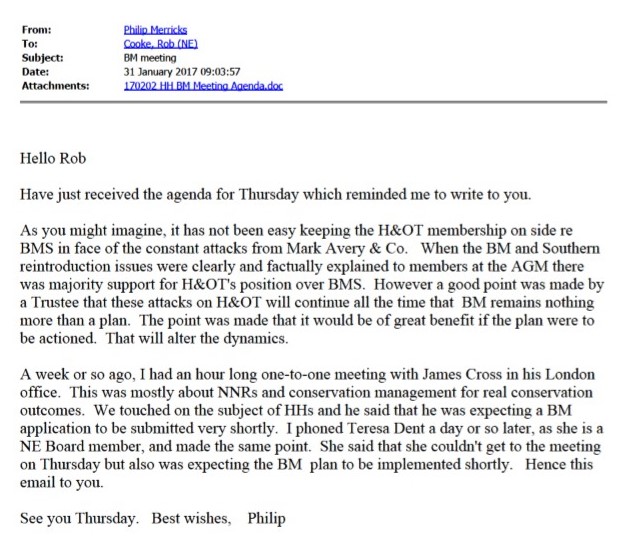
What they did release were the notes from the 5th meeting of the Brood Meddling Project Team, held on 2 February 2017, see here: HH Brood meddling team meeting_No5_2Feb2017 (not especially informative) and a copy of an email from Philip Merricks (Hawk & Owl Trust) to Rob Cooke (Natural England) dated 31 January 2017:

Apart from being amused at Philip’s delusional expectation that criticism of brood meddling will cease once brood meddling actually begins, the information contained within the second paragraph is actually quite useful. We presume James Cross is the same James Cross who is listed as the chief executive of Natural England – take note that at the end of January 2017, James Cross and Teresa Dent (GWCT) were anticipating the imminent submission of a ‘BM application’, which we assume is a brood meddling licence application (although of course we could be wrong). The relevance of this date will become clear in a minute….

So, having had our FoI rejected in February 2017, we thought we’d give it a couple of months to allow time for Natural England to get the licence application sorted out – we know that the plan was for brood meddling to begin in the 2017 breeding season (assuming they can find any active nests on any grouse moors) and we assumed from Merricks’ email that the submission of the licence application was expected to be imminent in January/February 2017.

Three months later on 29 May we submitted a further FoI to Natural England, asking for all the relevant information about HH brood meddling, assuming the licence application had now been sorted. On 31 May we received this response:

‘The application you refer to is still being determined. I’m afraid that we do not have an estimate of when it will be. With that in mind, would you like to withdraw your request, and submit it at a later date?‘

Eh? The licence application is still to be determined? At the end of May, when any brood meddling, if it’s going to happen this year, would probably start in May/June? Isn’t that cutting it a bit fine?

And Natural England doesn’t have an estimate of when the licence application will be determined? Eh? Isn’t Natural England the licensing authority for this, er, Natural England-led project? And they can’t say when they’ll decide to licence their own project?

Is it just us or does this all sound a bit dodgy? Is anybody else convinced by this or is it Natural England once more bending the truth when it comes to hen harriers?

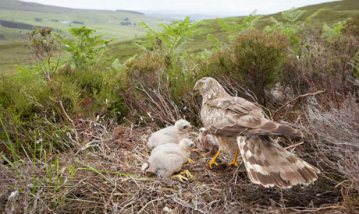
Photo of hen harrier by Mark Hamblin

Richard Lochhead MSP to meet Environment Secretary today to discuss wildlife crime

Richard Lochhead MSP, who represents the SNP in Morayshire, continues to impress.

Last night, he posted the following on his Facebook page:

Richard Lochhead MSP will meet with Roseanna Cunningham tomorrow to discuss the need for more to be done to catch those who commit wildlife crime.

Mr Lochhead’s meeting with the Cabinet Secretary for Environment and Climate Change follows his exchange with Nicola Sturgeon at First Minister’s Questions, where he highlighted the disappointment at the Crown Office’s decision to drop the case relating to the alleged illegal killing of a hen harrier in the Cabrach in 2013.

Moray’s MSP has been contacted by many constituents who were shocked that the Crown Office had taken the view that video footage supplied by RSPB Scotland was inadmissible despite such evidence being accepted in the past.

Whilst Mr Lochhead welcomes the progress that has been made by the Scottish Government in recent years in tackling wildlife crime, he will convey to the Cabinet Secretary that the Crown Office must take into account how difficult it can be to detect wildlife crime given that it most often takes place in remote areas and that they must ensure the justice system doesn’t miss opportunities to hold to account those who illegally kill endangered species.

Former Environment Secretary and Moray MSP Richard Lochhead said:

“The justice system needs to reflect the fact that wildlife crime often occurs in very remote areas and therefore every scintilla of evidence must be captured and used in the courts given how difficult it is to gather in the first place.

The alleged perpetrator caught on film who appears to have shot and killed a protected hen harrier in my constituency probably can’t believe his luck that he’s getting away with it. When the public view with their own eyes video footage showing an alleged crime being committed they expect it to count in the courts.

It’s clear we need a further package of measures to build on the good work already underway to tackle wildlife crime in Scotland. Nothing should be ruled out at this stage including the enhanced use of cameras by the authorities at nesting sites and improved enforcement and deterrents“.

END

Richard has been tweeting about this (@RichardLochhead) as has his Moray Parliamentary Office (@MorayParlOffice). If you’re on Twitter, or Facebook, please drop him a line to thank him for his interest and his efforts.

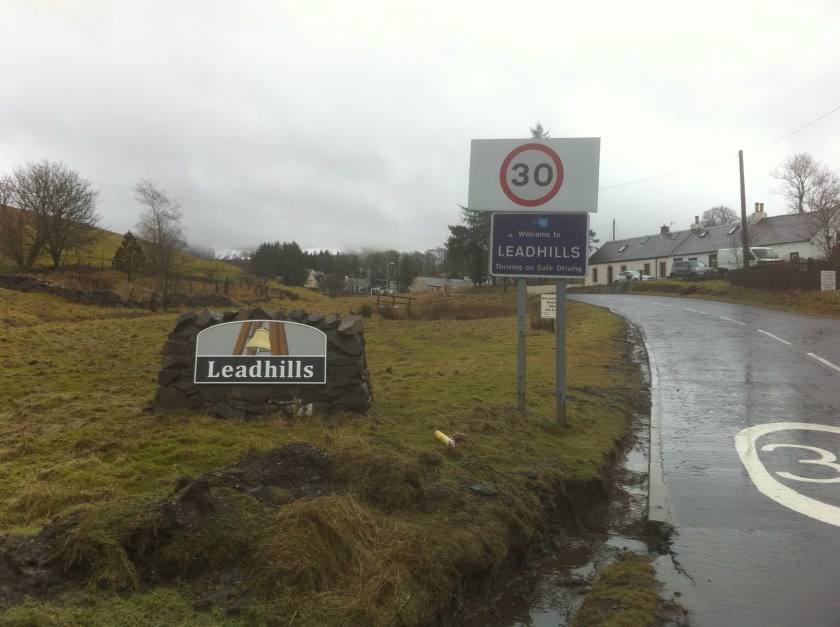
More on the shot hen harrier near Leadhills

RSPB Scotland has issued a press statement following this morning’s news that a hen harrier was shot near Leadhills on 4 May 2017:

Following the issuing of a press statement by Police Scotland, RSPB Scotland has today added its voice to the appeal for information following the shooting of a protected hen harrier on a grouse moor near the village of Leadhills in South Lanarkshire. The incident happened at 5.15pm on 4th May, when the female bird was killed. An individual, armed with a shotgun and with his face covered, was observed at the scene, but left hurriedly, on a quad bike before the police were able to attend.

RSPB Scotland’s Head of Investigations, Ian Thomson said: “This latest incident shows very clearly how protected birds of prey continue to be treated in some areas of our uplands, particularly where there is intensive grouse moor management. The hen harrier is an increasingly rare bird in southern and eastern Scotland, with illegal killing the main driver of this long term decline. This incident occurred only a few miles from where a satellite-tagged harrier, known as “Annie”, was found shot a couple of years ago, and is close to where another tagged bird, “Chance” disappeared mysteriously last spring. We ask that, if anyone has information about this latest incident at Leadhills, they contact Police Scotland on 101.”

Ian Thomson continued “The recent decision by the Crown Office to discontinue a court case where there was clear video evidence of the alleged shooting of another hen harrier, has clearly sent out a message to those that wish to kill our protected birds of prey, that they can continue to do so with impunity, knowing that even if their alleged crimes are caught on film, they are unlikely to be called to account. We need this last matter to be addressed by the public authorities as a matter of urgency. ”

END

So, it has now been confirmed that the hen harrier was shot ‘on a grouse moor near the village of Leadhills’ by an armed, masked man who escaped on a quad bike. According to Police Scotland, the shooting took place ‘near to the B7040 Elvanfoot to Leadhills road’. We thought we’d take a closer look:

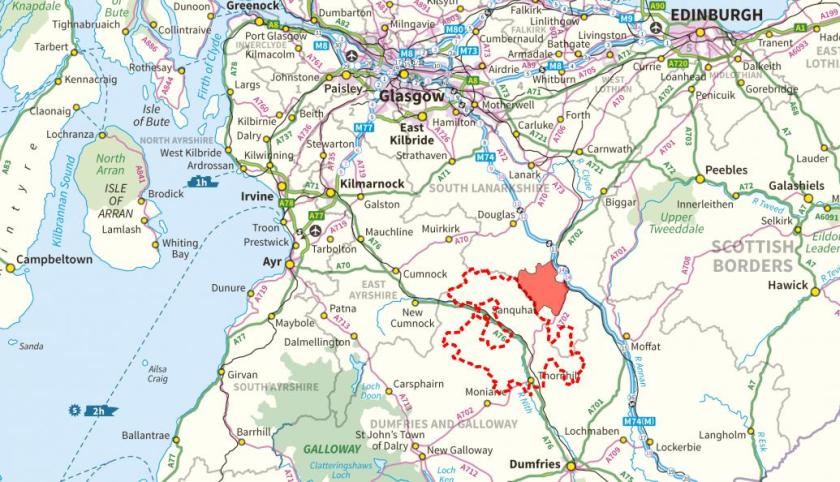
According to information from Andy Wightman’s brilliant Who Owns Scotland website, the B7040 runs from Elvanfoot right across the Leadhills (Hopetoun) Estate (estate shown in block red):

Was this hen harrier shot on the Leadhills Estate?

Regular blog readers will be very familiar with the Leadhills Estate and neighbouring Buccleuch Estate (Leadhills Estate gamekeepers have previously undertaken ‘pest’ control on parts of Buccleuch Estate) in south Scotland. For new readers, here’s a map showing the location (Leadhills Estate in block red, dotted line denotes Buccleuch Estate boundary, info from Who Owns Scotland). Look how close this is to the Moffat hills, where the Scottish Government plans to translocate golden eagles next year.

Here’s a list of 48 reported raptor persecution crimes from this area over the last 14 years. Only two resulted in successful convictions (2004 – Leadhills Estate gamekeeper convicted of shooting a short-eared owl; 2009 – Leadhills Estate gamekeeper convicted of placing out a poisoned rabbit bait).

Here’s the list, all from Leadhills unless otherwise stated:

2003 April: hen harrier shot [prosecution failed – inadmissible evidence]

2003 April: hen harrier eggs destroyed [prosecution failed – inadmissible evidence]

2004 May: buzzard shot [no prosecution]

2004 May: short-eared owl shot [gamekeeper convicted]

2004 June: buzzard poisoned (Carbofuran) [no prosecution]

2004 June: 4 x poisoned rabbit baits (Carbofuran) [no prosecution]

2004 June: crow poisoned (Carbofuran) [no prosecution]

2004 July: poisoned rabbit bait (Carbofuran) [no prosecution]

2004 July: poisoned rabbit bait (Carbofuran) [no prosecution]

2005 February: poisoned rabbit bait (Carbofuran) [no prosecution]

2005 April: poisoned buzzard (Carbofuran) [no prosecution]

2005 June: poisoned rabbit bait (Carbofuran) [no prosecution]

2005 June: poisoned rabbit bait (Carbofuran) [no prosecution]

2006 February: poisoned buzzard (Carbofuran) [no prosecution]

2006 March: poisoned buzzard (Carbofuran) [no prosecution]

2006 March: poisoned pigeon bait (Carbofuran) [no prosecution]

2006 April: dead buzzard (persecution method unknown) [no prosecution]

2006 May: poisoned rabbit bait (Carbofuran) [no prosecution]

2006 May: poisoned rabbit bait (Carbofuran) [no prosecution]

2006 May: poisoned egg baits (Carbofuran) [no prosecution]

2006 June: poisoned buzzard (Carbofuran) [no prosecution]

2006 June: poisoned raven (Carbofuran) [no prosecution]

2006 June: 6 x poisoned rabbit baits (Carbofuran) [no prosecution]

2006 June: poisoned egg bait (Carbofuran) [no prosecution]

2006 September: 5 x poisoned buzzards (Carbofuran) [no prosecution]

2006 September: poisoned rabbit bait (Carbofuran) [no prosecution]

2006 September: poisoned rabbit bait (Carbofuran) [no prosecution]

2007 March: poisoned buzzard (Carbofuran) [no prosecution]

2007 April: poisoned red kite (Carbofuran) [no prosecution]

2007 May: poisoned buzzard (Carbofuran) [no prosecution]

2008 October: poisoned buzzard (Carbofuran) [listed as ‘Nr Leadhills’] [no prosecution]

2008 October: poisoned rabbit bait (Carbofuran) [listed as ‘Nr Leadhills’] [no prosecution]

2008 November: 3 x poisoned ravens (Carbofuran) [listed as ‘Nr Leadhills’] [no prosecution]

2009 March: poisoned rabbit bait (Carbofuran) [no prosecution]

2009 March: poisoned raven (Carbofuran) [no prosecution]

2009 April: poisoned rabbit bait (Carbofuran) [gamekeeper convicted]

2009 April: poisoned magpie (Carbofuran) [no prosecution]

2009 April: poisoned raven (Carbofuran) [no prosecution]

2010 October: short-eared owl shot [no prosecution]

2011 March: illegally-set clam trap [no prosecution]

2011 December: buzzard shot [no prosecution]

2012 October: golden eagle shot (just over boundary with Buccleuch Estate) [no prosecution]

2013 May: shot otter found on estate [no prosecution]

2013 June: significant cache of pre-prepared poisoned baits found on estate [no prosecution]

2013 August: red kite found shot and critically-injured in Leadhills village [no prosecution]

2014 February: poisoned peregrine (Carbofuran) [‘Nr Leadhills’] [no prosecution]

2015 April: hen harrier ‘Annie’ found shot [Leadhills/Buccluech] [no prosecution]

2016 May: hen harrier ‘Chance’ ‘disappeared’ [Leadhills/Buccleuch] [no prosecution]

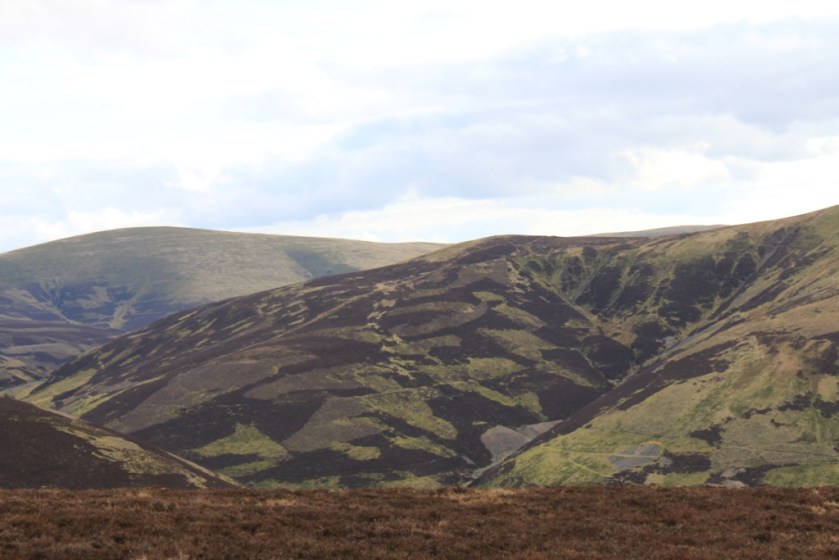
Here’s a photo of one of the many intensively-managed driven grouse moors on Leadhills Estate (photo by RPUK)

We’ve previously blogged about the Leadhills (Hopetoun) Estate at length and in detail. We know it is a member of landowners’ lobby group Scottish Land & Estates (at least it was in 2015, see here) and Earl Hopetoun is still currently listed as the Chair of Scottish Land & Estate’s Moorland Group.

Earl Hopetoun has previously denied that Hopetoun Estate has any involvement with grouse moor management at the Leadhills (Hopetoun) Estate. In 2012 his spokesperson was quoted:

“The Earl of Hopetoun’s position on wildlife crime is unequivocal. He has constantly condemned any such activity. More importantly, Hopetoun Estate has no role whatsoever in the management of Leadhills Estate. Leadhills Estate is run on a sporting lease completely separately and there is no connection between Hopetoun Estate and the sporting management of Leadhills”. 

We disputed this claim about Hopetoun Estates having ‘no role whatsoever in the management of Leadhills Estate’  – see here, here and especially here.

However, at this stage, we’ve gone past the arguments of who owns it, or who owns the sporting lease, or who is responsible for the day-to-day management. Despite Earl Hopetoun’s clear condemnation of raptor persecution, and despite the sporting lease stating clearly that wildlife protection legislation must be adhered to, raptor persecution has been persistent in this area, over a long period of years, and almost all of it has gone unpunished. It is clearly beyond the control of those responsible for managing this land which leaves no other option but for state-regulated control. It’s gone too far. It’s time for the Scottish Government to implement the action that has been promised for years.

Later today we’ll be publishing an open letter on this subject to Environment Secretary Roseanna Cunningham.

UPDATE 6PM: Open letter to the Cabinet Secretary here

UPDATE: Statement from Leadhills Estate (via Media House PR) here

Hen harrier shot near Leadhills

Police Scotland are appealing for witnesses after a hen harrier was reported shot near Leadhills, South Lanarkshire.

According to this article in the Carluke Gazette, Police received a report at 5.15pm on 4 May 2017 that a man had shot and killed a hen harrier near to the B7040 Elvanfoot to Leadhills road.

“A number of witnesses have come forward, and significant enquiry is underway,” said Inspector Martin Speirs.

“I urge anyone who witnessed the incident, or saw a male near the area on a quad bike at the time to come forward.  I also ask that anyone who has CCTV in the area review their cameras. Wanton killing of wildlife in these circumstances is unacceptable“.

We’ve blogged about Leadhills and the surrounding grouse moors many, many, many times. Too many, in fact.

UPDATE 11am: More on the shot hen harrier near Leadhills (here).

UPDATE 6pm: Open letter to the Cabinet Secretary here

Photo by RPUK

Cabrach hen harrier shooting reaches First Minister’s Question Time

Today at First Minister’s Question Time, Richard Lochhead MSP (Moray, SNP) asked the following question:

The First Minister may be aware that there is huge disappointment and some shock following the decision by the Crown Office and Procurator Fiscal Service after a prolonged police investigation—and I am told, nine separate court hearings—to drop the case relating to the alleged illegal killing of a hen harrier in the Cabrach in my constituency in 2013. The Crown Office appears to have taken the view that the video footage supplied by the RSPB Scotland was inadmissible, despite such evidence being accepted in the past. Notwithstanding the progress that has been made by ministers in recent years to tackle wildlife crime, will the First Minister acknowledge that that case represents a serious crime against a threatened species? Given that wildlife crime is very difficult to detect, because most often it takes place in remote areas, will she acknowledge that the law and the approach of the Crown Office must take into account such factors? I ask the First Minister whether she would be willing to investigate this case, with a view to ensuring that the justice system does not miss any opportunity to hold to account those who illegally kill our endangered species?

The First Minister responded:

I agree with Richard Lochhead. As he well understands, decisions about the prosecution of crime are, of course, decisions for the Crown Office and in that respect law officers act independently of ministers. However, it is important that we take wildlife crime very seriously indeed, particularly in cases where, as Richard Lochhead has highlighted, it threatens a threatened species. I will be happy to ask the relevant minister, Roseanna Cunningham, to meet with Richard Lochhead to look at what more we can do, particularly taking into account his point about those crimes often taking place in remote areas and, therefore, being more difficult to detect. It is important that we make sure that the policy framework, the law around this and the decisions that are taken by the Crown Office in respect of prosecutions—although, as I say, it is independent of ministers—do everything possible to crack down on those kinds of crime. I assure Richard Lochhead that we will continue to do everything that we can to make sure that that is the case.

Well done, and thank you, Richard Lochhead. More of this, please.

Some more thoughts on the shot hen harrier video

Three days on and our anger has not subsided. If anything, it’s grown. The more we’ve watched that video, and the more we’ve tried to comprehend the reasoning behind the Crown’s decision to drop all criminal proceedings, and the more we’ve contemplated the injustice and wider implications of the Crown’s decision to drop all criminal proceedings, and the longer the silence from a Government that repeatedly claims a ‘zero tolerance’ policy on raptor persecution, the more incensed we’ve become. And we’re not alone.

This 59-second video is actually a microcosm of a war that has been raging for over 60 years, ever since birds of prey were afforded full legal protection. It’s got everything, all the characteristics with which we’re now so familiar: the remote upland landscape, an area with a long history of raptor persecution, the supposedly protected hen harrier so vulnerable as she waits until the last second to abandon her eggs and flee her nest, the violent gunshots, the explosion of feathers as she’s hit, the poignant silent aftermath as her feathers float to the ground, the armed man apparently removing and hiding the evidence of the crime. Only this time the crime was witnessed, captured on film and now, finally, exposed for the world to see.

And then comes the ridiculous pantomime of legal protocol that forces fearful commentators to describe this as an ‘alleged’ crime, which implies it might not have happened. Our eyes work just fine and it is our opinion that it did happen. The only questionable part is who pulled the trigger (twice). The video footage is not conclusive on this point and the man who was charged had pleaded not guilty. It’s fair to comment that the charges against him were alleged (in other words it’s not known whether he was responsible or not) but let’s not pretend that this crime didn’t happen. Somebody shot that hen harrier in June 2013 and whoever it was has escaped justice as the case is now time-barred.

There are several aspects of this case that fan the flames of our exasperation. We’ve already discussed the role of the Crown Office and the questions raised by their decision to drop all proceedings. These matters are deeply concerning and need to be addressed as a matter of urgency.

Other issues concern the long history of confirmed raptor persecution on Cabrach Estate. Two gamekeepers have previously been convicted for such crimes: one for having a poisoned peregrine in the back of his vehicle (here) and one for shooting two buzzards (here). Other crimes were also detected including the discovery of 11 shot buzzards that had been stuffed inside rabbit holes, 24 poisoned baits, three illegal pole traps and an owl with smashed legs (here) but nobody was charged. We want to point out that the current team of gamekeepers is very recently employed and there isn’t, to our knowledge, any evidence of further crimes since the shooting of the hen harrier in 2013. But the appalling history provides a long-term perspective on what had been going on for a number of decades and that is hard to ignore.

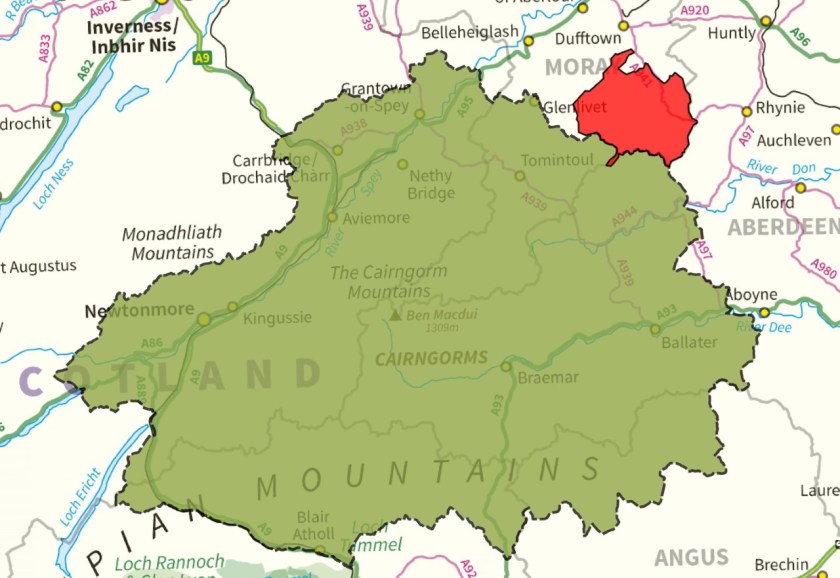
Map showing the location of Cabrach Estate, bordering the Cairngorms National Park (estate boundary based on information from the Who Owns Scotland website).

The publication of this video by RSPB Scotland last Friday has provoked an outpouring of public outrage. Social media has been alight all weekend, and commentary has been provided by many, including a 15-year-old schoolboy (here), a leading figure in conservation (here), another well-known campaigner (here) and a retired police officer (here).

Statements from the game-shooting industry have been thin on the ground but where they have been made, the words chosen have very carefully avoided discussing the killing of a hen harrier.

The Scottish Gamekeepers’ Association said they had no comment to make as they didn’t have a membership interest in this case. The video footage was totally ignored (see here).

Scottish Land & Estates also ignored the video content and instead opened with the vague statement, “Evidence of apparent ill-treatment of any protected species is, of course, deeply concerning“. There then followed the usual denials about the extent of raptor persecution, the same old spin about their involvement with the partnership working sham that is the Heads up for Hen Harriers project (which we have previously addressed, here) and then a bit more spin with this line: “In this instance, the estate in question was praised in an RSPB report last year as a potential model sporting estate given its commitment to species conservation, including Hen Harriers“. We were intrigued by this ‘RSPB report’ until we realised that it wasn’t an official RSPB report written by professional upland scientists based on a long-term & detailed assessment, but rather a report of a day trip to the estate, escorted by the new Head Keeper, of the local RSPB members’ group. Hmm, not quite as compelling an endorsement as SLE try to portray. Has Lord Johnstone been taking spin lessons from Beefy Botham on how to make a report sound more credible than it actually is?

So far, there has been no comment from the Scottish Government.

UPDATE 11 May 2017: Cabrach hen harrier shooting reaches First Minister’s Question Time (here)

Hen harrier shooting: fury at decision to drop prosecution

Two weeks ago, the public prosecutors in Scotland (Crown Office & Procurator Fiscal Service) decided to discontinue criminal proceedings against a (now former) gamekeeper who was alleged to have shot a hen harrier on a grouse moor at Cabrach Estate in June 2013 (see here).

No explanation was given for this decision.

Earlier this morning, RSPB Scotland released video footage of the incident and issued a press statement (here). Here is the video in case anyone missed it:

After watching this video, it’s hard to find words to express the disbelief, frustration and fury about that decision to discontinue the prosecution. Social media has erupted in outrage and the Crown Office is seen as a laughing stock. Most reasonable, law-abiding people who don’t have a vested interest in driven grouse shooting would be hard pressed to disagree.

The RSPB Scotland statement said that the Crown Office had indicated they could not use the video as evidence, but no further detail was provided. RSPB Scotland quite rightly pointed out that other cases that have relied upon video footage have been used successfully in Scottish courts (the most high profile one being the conviction of gamekeeper George Mutch in 2014), and the RSPB was bewildered by the inconsistency of the COPFS’ approach in this case.

However, this morning, in response to the release of the video, the Crown Office has finally decided to provide an explanation, as published in a BBC news article:

“In accordance with the Crown’s ongoing duty to keep prosecutions under review and after carrying out a detailed review of all of the relevant material, Crown counsel considered that the inevitable conclusion was that RSPB investigators entered the land in question and embarked upon evidence gathering for the purpose of prosecution.

Discussions have taken place over a number of years between RSPB and COPFS about the admissibility of evidence obtained through the use of covert surveillance.

The Crown has consistently made it clear that strict legal tests must be met before evidence which has been obtained irregularly, such as the evidence in this case, is admissible. We will continue to have further dialogue with RSPB.

In the whole circumstances, Crown counsel concluded that the evidence would not be admissible in court.

In light of that conclusion it was entirely appropriate that proceedings were brought to an end.”

This statement begs several questions:

  • Essentially, this statement implies that RSPB Scotland was lying about the deployment of the video camera. RSPB Scotland had clearly explained that the camera was positioned as part of a routine research/monitoring study focusing on the breeding success of a threatened species. There’s a Scottish Government project (Heads up for Hen Harriers) that is deploying cameras at hen harrier nests for exactly this purpose for Christ’s sake! The Crown Office apparently disputes the RSPB’s explanation for camera deployment. Why? What evidence do they have that makes them think the RSPB is lying? [NB: see update at foot of blog]
  • If the COPFS believed this camera had been placed “for the purpose of prosecution“, why on earth did it take them three years from the date of the shooting to decide to charge the suspect, and why did it take a further year of court hearings (nine in total) before the decision was made to discontinue proceedings? Why did the COPFS even mark this case for proceedings if they didn’t believe the RSPB’s version of events? What changed in the four years the COPFS have been considering this case?
  • Why is the admissibility of video footage such a controversial issue in cases of alleged raptor persecution, and yet we see it being used in a current court case of alleged fox-hunting? We’ve spoken to one of the investigators who filmed the footage being used in the hunt case and he has confirmed he was filming covertly on private land without landowner permission as part of a wider research project on the behaviour of hunts, whether the hunts were involved in alleged criminal activity at the time or not. That’s no different to the circumstances of this hen harrier case.
  • If the circumstances of how this camera footage was obtained were so controversial, why didn’t the COPFS allow the evidence to be assessed by the court? In a very similar case to this current one, in 2006 a gamekeeper was convicted of stalking a hen harrier and his conviction was based on RSPB video evidence. During that trial, there were several hours of legal argument about the admissibility of the video evidence. The Sheriff accepted the video evidence, commenting that the RSPB presence on the gamekeeper’s estate [from where the video was filmed] was “neither illegal nor irregular, and the intent to obtain evidence did not make it so“.
  • We’ve discussed the issue of the admissibility of video evidence time and time and time again. In 2013, the then Environment Minister Paul Wheelhouse told us that this very issue had been raised with the Lord Advocate (see here). Why then, four years later, is there still such inconsistency and lack of clarity about video admissibility?
  • Why did it take the publication of this video footage, two weeks after the Crown’s decision to discontinue proceedings, for the COPFS to provide an explanation for their decision? Hen harrier persecution is one of the highest national wildlife crime priorities and there is huge and legitimate public concern about it. By remaining silent for two weeks, we would argue the COPFS has displayed an arrogance and contempt for that public concern. It’s not the first time the COPFS has been criticised for poor communications – the Scottish Environment LINK report on wildlife crime enforcement published two years ago was damning on this issue, and this year’s Scottish Parliament’s Justice Committee report on the role and purpose of the COPFS reached a similar conclusion.

The general public, is, quite rightly, furious about how this case has been handled. It seems to us that the Crown Office is more concerned about how the evidence was obtained than the actual alleged crime of killing a protected, national priority species. Of course, the COPFS has to assess the evidential circumstances on a case by case basis, and we don’t question that at all. What we do question is, in this case, on what basis the COPFS decided to disbelieve the RSPB’s explanation for deploying the camera, and why it took so long, at such huge cost to the public purse, to decide to discontinue proceedings.

And let’s not forget that this case is one of three that the Crown Office has recently discontinued, all in the space of two weeks (see here).

For a comical interlude, have a read of the statement issued by the Scottish Gamekeepers’ Association in response to the video footage. They say, “The SGA has no membership interest in this case. It is not our place to comment, therefore, on individuals involved in the alleged incident or to provide a critique of COPFS“. This is the organisation that is supposedly signed up to the Partnership for action Against Wildlife Crime and who serves on the PAW Raptor Group.

Do we have any confidence in the Scottish criminal justice system to address the on-going persecution of birds of prey? On current evidence, the answer is a resounding NO.

What to do about it? We would urge you to contact your MSP (find out who yours is here) and ask him/her to contact the Scottish Government’s Justice Minister, Michael Matheson to complain on your behalf about the handling of this case. The more MSPs that see this video footage, and hear about the public’s serious concerns, the better.

If you don’t live in Scotland but still want to voice your concerns, please email the Convener of the Scottish Parliament’s Justice Committee, Margaret Mitchell MSP (Scottish Conservatives). Email: margaret.mitchell.msp@parliament.scot

Don’t be fobbed off with platitudes or claims of “We can’t comment on individual cases”. Public scrutiny is fundamental to democracy and the public has every right to be asking questions about this ongoing, disgraceful shambles.

UPDATE 14.30hrs: RSPB Scotland has issued a statement in response to the claims of the Crown Office that the camera had been “deployed for prosecution purposes”. Here’s what it says:

In response to the Crown Office’s statement of 5th May as to why the video evidence would not be admissible in court Ian Thomson, Head of Investigations, RSPB Scotland said: “We do not agree with the opinion from the Crown Office that we were attempting to gather evidence for a prosecution. We installed a camera to monitor a protected breeding bird’s nest site, core business for a conservation organisation. We did not share the information about the nest site with anyone, as would be the case with any rare and vulnerable breeding bird species. 

“The fact that an individual came and allegedly shot the female harrier, and that this was captured on film, was an incidental consequence of the camera’s deployment, in the same way that it could easily have captured footage of the nest being naturally predated or failing due to bad weather. It is very disappointing that the opportunity for the court to consider the issue of the admissibility or otherwise of this evidence, as has happened in previous cases, has been removed. Until today, we have received no rationale for the decision to drop the case despite the fact that a number of our staff have provided significant time and expertise in supporting the authorities with the prosecution case.” 

ENDS

UPDATE 8 May 2017: Some more thoughts on the shot hen harrier video (here)

UPDATE 11 May 2017: Cabrach hen harrier shooting reaches First Minister’s Question Time (here)