Golden eagle Fred: some facts

The rumour mill about our satellite-tagged golden eagle Fred has been in full-on overdrive since we announced his highly suspicious disappearance last week.

As we’d promised at the start of this project, we set out to provide as much transparency as we could about the circumstances of Fred’s disappearance, including detailed information about his last known location. The problem with doing this is that information then gets accidentally misinterpreted, or deliberately distorted in some cases by those who seek to play down the possibility that Fred has become yet another victim of illegal persecution.

There are many reasons why some would want the public to believe that illegal persecution couldn’t possibly have played a role in Fred’s disapearance. It has become clear to us over the last week or so that various organisations are, behind the scenes, actively pursuing a damage-limitation offensive, particularly some of those involved with the planned reintroduction of golden eagles to south Scotland later this year, and that includes senior officials at the statutory nature conservation agency SNH.

Obviously the highly suspicious disappearance of a golden eagle in south Scotland is going to raise questions about how wise it is to release eagles in a region where persecution is still a problem. Indeed, this has been a long-standing concern about the reintroduction project but has previously been brushed aside by some officials claiming that eagle persecution was an historical, not a current issue. Fred’s suspicious disappearance suggests otherwise but rather than address this concern head on, attempts are currently being made to discredit members of our project team and the project itself.

Let’s just be clear here. At no point have we stated that Fred was killed on a driven grouse moor. We haven’t even stated that he is dead. What we have said is that Fred’s disappearance is highly suspicious, and that, like many other satellite-tagged eagles, he disappeared in an area close to a driven grouse moor. These are indisputable facts.

We have suggested that he was illegally killed, and we have very good reason to think so, which will become clear when we’re able to discuss the details after the police investigation.

At this stage we can address some of the statements that have been made (some of which have been made in good faith, others have not).

  1. Fred’s last tag signal came from a wind farm – incorrect.
  2. Fred last tag signal came from Bonaly Country Park – incorrect.
  3. Nobody went to check on Fred’s welfare while he was alive in the Pentlands – incorrect.
  4. Fred’s tag battery failed to charge in low winter light – incorrect.
  5. There has been no raptor persecution in the Pentlands – incorrect.
  6. There are no driven grouse moors in the Pentlands – incorrect.
  7. Fred did not disappear in an area where driven grouse shooting takes place – incorrect.
  8. Satellite tag mapping suggests that Fred was not actively foraging – incorrect.
  9. Because mountain hares are locally extinct, Fred must have been weak and starving – incorrect.
  10. Fred’s tag was not functioning properly because it was in woodland – incorrect.
  11. A decision was taken not to search for the tag in the North Sea – incorrect.
  12. The police aren’t interested because they are siding with the landowners – incorrect.
  13. Fred’s body was found and the tag had killed him so the story of his disappearance was fabricated to lay the blame elsewhere – incorrect.
  14. Fred was never tagged in the first place – incorrect.

Fred’s story has generated a lot of media interest over the last week, which has been very welcome. Obviously, a lot of people are very angry about Fred’s suspicious disappearance and they have every reason to be. Anger is the appropriate reaction to what looks like yet another incident of illegal raptor persecution. However, we’ve been informed that some people are directing their anger in an abusive way towards members of the Pentlands Ranger Service. Please, think about what you’re saying and to whom. The Ranger Service certainly doesn’t deserve it and we are working closely with them as this investigation continues. Thanks.

Further information about missing satellite-tagged golden eagle Fred

Last week we blogged about the suspicious disappearance of one of our satellite-tagged golden eagles.

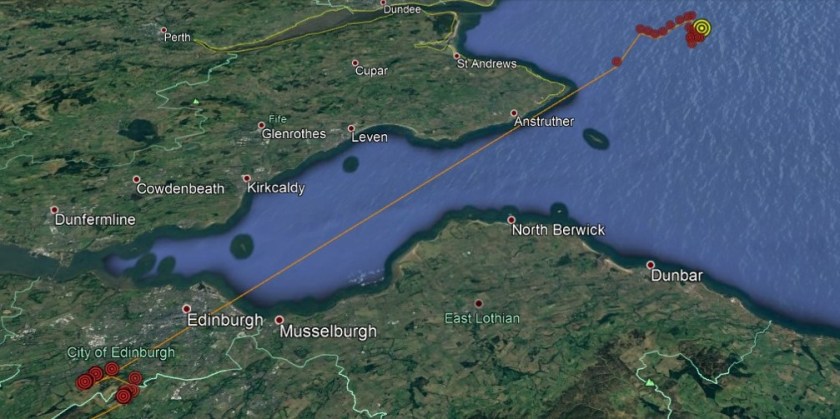
‘Fred’ vanished in the Pentland Hills close to Edinburgh in late January and then 3.5 days later his satellite tag indicated that he (or at least his tag) was in the North Sea, some 15 miles offshore from St Andrews until the tag finally stopped sending data a couple of days later (see here).

Since Fred’s disappearance, we have been talking to many experts and among them, the engineers at the tag manufacturing company. They have recently provided us with some further technical data from the tag which are shedding light on the circumstances of Fred’s highly suspicious disappearance.

These new data have been passed to Police Scotland who are following up. Obviously at this stage we are unable to comment further but rest assured we will have more to say in due course.

In the meantime, if anyone has any information about Fred’s disappearance please contact Police Scotland, Tel: 101, or alternatively call the RSPB’s new confidential raptor crime hotline: 0300-999-0101.

Golden eagle ‘Fred’ disappears 7 miles from Scottish Parliament

Last summer, in partnership with Chris Packham, we satellite tagged a shedload of golden eagles in Scotland (see here for project details).

We haven’t blogged much about these eagles since then because they’ve been hanging around in their parents’ territories and those locations need to remain secret.

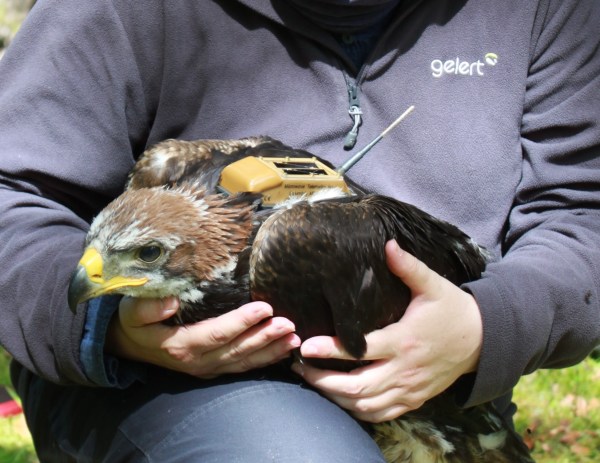
However, in mid-January 2018, one of those young golden eagles finally decided to leave home and go exploring. He had hatched at a nest site in the Scottish Borders and his parents are the only breeding pair of golden eagles in the region. This nest site has been protected for decades by the landowner and he is fiercely proud of his eagles, so much so that he named this eagle chick Fred after his grandson. The landowner and his gamekeeper joined us last June as we fitted Fred with a state-of-the-art transmitter and we were all excited at the prospect of following Fred’s movements over the coming years, with the hope that he would thrive and help to increase this tiny, vulnerable breeding population in the Borders.

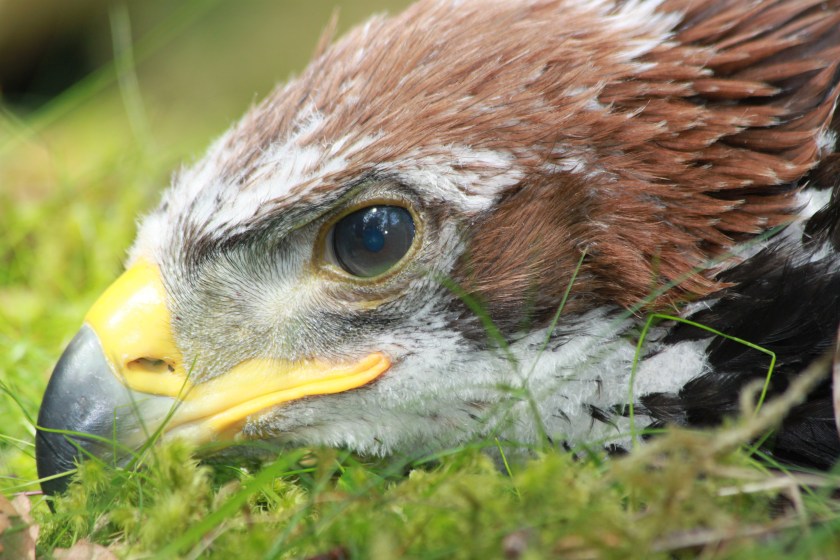
Golden eagle Fred, June 2017. Photo by Ruth Tingay

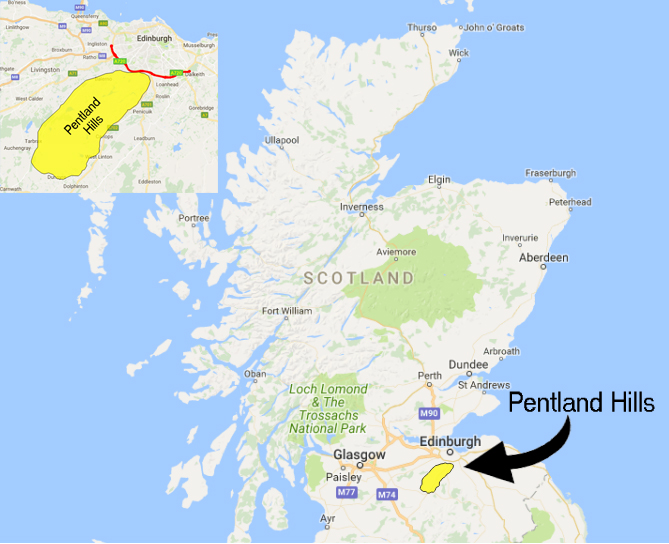
Fred headed to the Pentland Hills and spent a few days ‘woodland hopping’ around the northern edge, at one point just half a kilometre from the City Bypass.

His tag was working perfectly and was providing us with accurate and frequent GPS locations.

Maps copyright RPUK:

On 20th January, Fred roosted overnight in a shelter belt overlooking a grouse moor (Black Hill) near Balerno. This is a photograph of the roost site. Fred was in the trees at the top left-hand corner of this field.

Fred’s tag continued to record his position there until just before 10am on 21st January, when his tag suddenly and inexplicably stopped. The last signal came from the trees half-way along this shelter belt:

We didn’t receive any new GPS locations from Fred’s tag until three and a half days later when, on the evening of 24 January, Fred’s tag began transmitting again but the GPS location showed it was in the North Sea, some 10 miles offshore from St. Andrews. His tag continued to provide GPS data until 26 January, showing his final position at approximately 15 miles offshore. No further data have been received.

Dr Tingay of RPUK said: “It is beyond doubt that Fred’s disappearance is highly suspicious. Golden eagles don’t generally fly out for miles over large bodies of sea water but even if Fred had done so, apart from defying everything we’ve learned about Scottish golden eagle behaviour, we would have seen excellent tracking data plotting his route given the reliability of his tag.

“While we will probably never know for sure, it seems likely that Fred was killed soon after 10am on 21 January, his tag was hidden to suppress the signal and then he and the tag were dumped in the North Sea. If this is indeed the case, it’s just the latest example of when those who have killed a protected bird of prey have tried to cover up evidence of their crime”.

Chris Packham said: “Once again, we have the suspicious disappearance of a satellite-tagged golden eagle in an area managed for driven grouse shooting. What’s truly shocking about this case is that it didn’t take place in a remote Highland glen miles from anywhere, but it happened within a stone’s throw of Edinburgh, right under the noses of the Scottish Government. What must the good people of Edinburgh think, to learn that golden eagles aren’t even safe on their doorstep? That they’ve been denied the opportunity to see this iconic, magnificent bird in their local hills? This doesn’t bode well for the planned reintroduction of golden eagles to south Scotland, due to begin later this year”.

Over the coming days we’ll be blogging about the implications of Fred’s disappearance for the proposed South Scotland Golden Eagle Reintroduction Project, which was already a controversial issue before Fred’s story even began.

When we launched this golden eagle satellite tagging project at the British Birdfair last year, we said that our project would be different from other satellite-tagging projects in that if any of our tagged eagles ‘disappeared’ in suspicious circumstances, rather than sit on that information for months/years and then only give a vague description of the location where the bird had vanished, we would publish much more detailed information as soon as any police investigation was complete. We’ve fulfilled this promise and we’ve also made a video which includes an exclusive interview with Environment Cabinet Secretary Roseanna Cunningham. You can watch it here:

We are immensely grateful to Roseanna Cunningham for granting us an audience despite her incredibly busy schedule. We are also grateful to Police Wildlife Crime Officer Andy Loughlin and the RSPB Scotland Investigations for their quick and diligent response to our concerns.

If anyone has any information about Fred’s disappearance, please contact Police Scotland on 101.

MEDIA COVERAGE

Daily Express here

Scotsman here

STV news here with a fascinating quote from Scottish Land & Estates:

We understand that the bird’s disappearance is not being investigated as a crime.

We need to learn the full facts prior to establishing any conclusions but it should be noted that the location where the eagle disappeared is not an area of intensive grouse shooting“. We’ll be blogging about this quote soon.

The Times here (behind a paywall)

Herald here

BBC news here

Guardian here

Courier here

Press & Journal here

Concern for the safety of one of our satellite-tagged golden eagles

Last summer, in a joint project with Chris Packham, we satellite-tagged a shedload of golden eagles in Scotland (for background project information please see here).

We haven’t blogged much about these eagles yet because they are still hanging out in their natal territories and we need to keep these locations confidential. As soon as the eagles begin to disperse, we’ll be able to share much more information.

However, one of our eagles has recently left its parents’ territory and we are deeply concerned about its safety. We are working closely with Police Scotland and will report in more detail in the very near future.

We are immensely grateful to the Police Wildlife Crime Officer leading this investigation who has been proactive, communicative and very quick to respond.

South Scotland golden eagle project gets final go-ahead

The South Scotland Golden Eagle Project, which proposes to translocate eaglets from the Highlands to southern Scotland in an effort to boost the tiny remnant population in the Borders & Dumfries & Galloway, has finally been given the funds and licence to begin.

Earlier this year the project was awarded £1.3 million from the Heritage Lottery Fund (see here) and has now received match funding of £158,024 from local LEADER programmes. SNH has also now granted the licence required to move the eagles, fit them with satellite tags and release them in the Moffat Hills.

[Photo of a young satellite-tagged golden eagle, by Ruth Tingay]

This additional funding has triggered the recruitment of four new project staff – an eagle officer, two community engagement officers, and one stakeholder engagement officer. Details of these positions and how to apply can be found on the Project website here (scroll to the bottom of the homepage). Closing date is 12 January 2018.

As an aside, can we just congratulate the Project team on their website – full of information & official reports, keeping the public informed about the proposed Project. Take note, Natural England!

A press release (unfortunately with far too many naff metaphors) from the Project has been picked up by various media outlets (e.g. BBC News here, Scotsman here) although the Guardian has taken a different angle and focuses on the threat these birds might face if they fly south of the border in to northern England (here).

We’ve blogged about this Project before (see here, here) and have mixed feelings. Unsurprisingly our biggest concern is the on-going threat of illegal persecution, both north and south of the border. To date, nobody has EVER been successfully prosecuted for the illegal killing of golden eagles, despite plenty of opportunities (e.g. see here and here).

Dr Cat Barlow, the South Scotland Golden Eagle Project Manager, has been questioned about the threat of illegal persecution at several conferences where she has delivered an otherwise strong presentation about the Project. On each occasion she has acknowledged the threat and has recognised that not all estates in southern Scotland are supportive of this translocation. She recently told a conference in Edinburgh that she “will be talking to the estates not yet on board“.

It’s going to take more than a chat to stop these deranged raptor killers in their tracks.

[Photo of an adult golden eagle found shot & critically injured on a grouse moor in south Scotland in 2012. He didn’t make it]

Update on our shedload of satellite-tagged golden eagles

Earlier this year we satellite-tagged a shedload of golden eagles in Scotland as part of a joint initiative with Chris Packham, funded by two very generous philanthropists (see here for project background).

Our eagles are doing well, all of them still hanging out in their natal territories although a few have started to make some short exploratory excursions beyond these local areas. For obvious reasons, we will not be providing location information until the young birds have dispersed far from their parents’ territories.

We’re getting fantastic data from the tags. These are different tags to those used to track hen harriers so there’s none of this, say, ‘on for a few hours/off for 48 hours’ cycle – our tags are providing positional data around the clock, sometimes at just a few minutes’ interval, so we know EXACTLY where our eagles are at all hours of the day, and night.

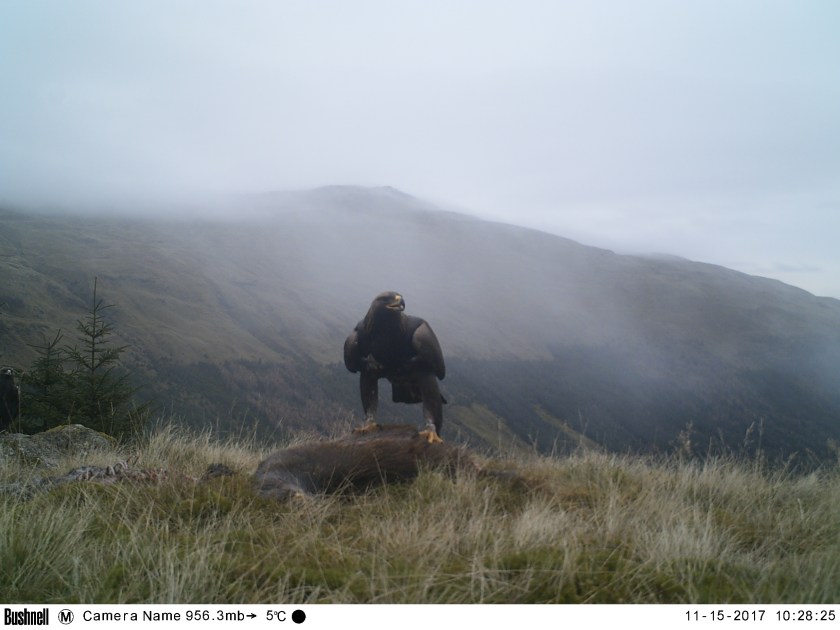
Here’s one of our eagles (#929) caught on camera a few weeks ago coming in to feed on a carcass, along with her Mum! (Our field team tell us 929’s Dad has also visited this carcass but is not photographed here).

More updates in due course.

Scottish Government announces Grouse moor management review group

Back in May 2017, Cabinet Secretary Roseanna Cunningham announced an intention to set up an independently-led group to review grouse moor management practices, and to advise on the introduction of an estate shoot licensing scheme. This was mainly in response to the publication of the Golden Eagle Satellite Tag Review, which found that almost one third of sat-tagged golden eagles had disappeared in highly suspicious circsumstances on intensively managed driven-grouse moors. But make no mistake, this was also in response to increased public pressure from the SRSG’s petition calling for game shoot licensing and also in response to increasing public anger about the continuing illegal persecution of birds of prey on driven grouse moors.

[Photo: Conservationist Roy Dennis with dead golden eagle ‘Alma’ – one of Roy’s first satellite-tagged eagles that was found illegally poisoned on an Angus Glens grouse moor]

Finally, almost six months after that first announcement, the Scottish Government has just released the news about who will serve on this review group.

Here’s the Scottish Government press statement:

New group to focus on sustainability of driven-grouse moors.

Membership of an independent group to ensure grouse moor management practices are sustainable and legally compliant has been confirmed.

The new group will be led by Professor Alan Werrity, who previously chaired a Scottish Natural Heritage review into sustainable moorland management. It includes scientists, moorland managers, regulatory experts and advisers from SNH, Scottish Wildlife Trust, the Game and Wildlife Conservation Trust and the Scottish Environmental Protection Agency.

The group has been set up in response to SNH research that found almost a third of golden eagles being tracked by satellite died in suspicious circumstances and that the majority of cases were where land is intensively managed for driven grouse shooting.

The group will look at the environmental impact of grouse moor management practices such as muirburn, the use of medicated grit and mountain hare culls and advise on the option of licensing grouse shooting businesses.

Environment Secretary Roseanna Cunningham said:

We have been clear that the continued killing of protected species of birds of prey damages the reputation of law-abiding gamekeepers, landowners and the country as a whole.

This new group will look at what we can do to balance our commitment to tackling wildlife crime with grouse moor management practices, so it continues to contribute to our rural economy, while being sustainable and compliant with the law.

The group membership reflects the complex nature and wide range of issues that need to be considered and I look forward to hearing their advice in due course.”

Professor Werrity said:

This is truly challenging work given the traditions underlying moorland management and the concerns coming to light over some mal-practices.

My earlier work chairing the SNH Moorland review also sought to reconcile nature conservation interests with promoting the rural economy. I will be taking an evidence-based approach, and for this we have the right mixture of experience, expertise and knowledge on the group to get to grips with the subject. I look forward to getting started on this review. ”

Background

Read the Golden Eagle Satellite Tag Review

The confirmed membership of the group includes Professor Alan Werrity FRSE, Professor Ian Newton OBE, FRS, FRSE, Professor Alison Hester FSB, (Professor Colin Reid FRSA – see update below) and moorland managers Alexander Jameson BLE MRICS FAAV and Mark Oddy MRICS CEnV MIAagrM.

[Update 28 Nov 2017: Law professor joins grouse moor management review group, here ]

Dr Calum Macdonald (SEPA), Professor Des Thompson (SNH), Dr Adam Smith (GWCT Scotland) and Susan Davies (SWT) will be specialist advisers to the group.

ENDS

Here is the response from RSPB Scotland to today’s announcement:

RSPB Scotland welcomes announcement of grouse moor enquiry

RSPB Scotland has welcomed today’s announcement by the Scottish Government on the grouse moor enquiry panel. Duncan Orr-Ewing, Head of Species and Land Management for RSPB Scotland said: “We very much welcome the announcement of this enquiry and of the independent panel. We look forward to giving evidence to the panel in due course.

The remit of the panel includes consideration as to how grouse moors can be managed sustainably and within the law. There are significant public concerns about how grouse moors are currently being managed in Scotland, including clear evidence gathered over decades of the illegal killing of birds of prey.

In recent years these concerns have broadened to encompass wider grouse moor management practices, as commercialisation has taken place, with an emphasis on producing very large and unsustainable grouse numbers for sport shooting. These practices include muirburn on peatland habitats which are important as carbon stores for combating climate change, the culling of mountain hares and the medication of ‘wild’ red grouse, both designed to prevent grouse diseases and artificially boost grouse bags.

We support the introduction of an effective licensing system for driven grouse shooting, with sanctions including the removal of such licences where illegal practices are confirmed. A licensing system could be supported by a statutory Code of Practice setting out clear management standards to protect public interests and prevent bad management practices. These kind of licensing systems are common place in other European countries and equally support legitimate and well run shooting enterprises.”

ENDS

[Photo: the typical landscape of an intensively-managed driven grouse moor in Scotland. Photo by Ruth Tingay]

Here is the response from the Scottish Raptor Study Group to today’s announcement:

Scottish Raptor Study Group warmly welcomes today’s announcement by the Scottish Government on the grouse moor enquiry panel.

Patrick Stirling Aird, Secretary of the Scottish Raptor Study Group said, “We are delighted that the membership of the panel has been announced and look forward to providing evidence when called upon to do so“.

The public have increasing concerns around the way in which grouse moors are being operated with a substantial body of science proving beyond all doubt the widespread and illegal persecution of birds of prey on many such moors.

We support the introduction of licensing for driven grouse shooting with enforceable sanctions where illegal practices are confirmed. Such a licensing scheme could incorporate a statutory code of practice which helps to protect the public interest and to prevent bad management practices. This concept is widespread in Europe and elsewhere and works well with legitimate shooting interests.

ENDS

Here are our first thoughts.

Hallelujah! The panel has finally been announced and presumably its work will now get underway, although notice there is no mention of timescales in the Scottish Government’s statement. That’s not too much of a concern right now – as Roseanna mentions, this work will be complex and it’s in everyone’s interests that it is done thoroughly, so we probably shouldn’t expect any output until at least 2019.

This panel has some serious intellectual heavy weights (Chair, Professor Werrity, and panel members Professors Newton and Hester). All three are at the top of their respective fields and have been for years; their academic achievements and scientific authority are undisputed. We are delighted to see these three involved, especially given Professor Werrity’s intention for having an “evidence-based approach” to the review. Excellent.

The other two panel members (Mr Jameson and Mr Oddy) are a bit of a surprise, to be honest. We didn’t expect to see anybody with such obvious vested interests be part of what had been described as an independently-led review group. Nevertheless, there is probably good reason for having them on board, not least to get buy-in to the review from the game-shooting sector. We know very little about Mr Jameson and only a little bit about Mr Oddy – he’s the chap who, when working for Buccleuch Estates on the Langholm Moor Demonstration Project, suggested that lethal control of buzzards should be a considered option…..but his suggestion was based on no scientific evidence whatsoever, in fact it was the exact opposite of what the science was showing. Hmm.

All in all, just like RSPB Scotland and the Scottish Raptor Study Group, we very much welcome today’s announcement. It is the next step on the road to what many see as the inevitable introduction of an estate licensing scheme in Scotland. We look forward to giving evidence, if invited to do so.

UPDATE 28 November 2017: Law professor joins grouse moor management review group (here)

UPDATE 24 April 2018: Grouse Moor Management Review Group: 1st meeting report (here)

National golden eagle survey 2015: low occupancy on Eastern Highland grouse moors remains a concern

Every year a proportion of the Scottsh golden eagle population is surveyed by licensed experts from the Scottish Raptor Study Group. This phenomenal voluntary effort (currently 373 home ranges [approx 53% of known ranges] monitored by 150 eagle experts) provides invaluable data that are submitted to the Scottish Raptor Monitoring Scheme and are used to inform conservation policy at local, regional and national level.

In addition to this annual monitoring, a national survey is periodically undertaken with both paid and voluntary experts in an effort to visit every known home range throughout Scotland.

Photo by Mark Hamblin

The latest national golden eagle survey took place in 2015 and the interim results were announced in November 2016. The main headline was that overall, the national population had increased by 15%, rising from 442 pairs recorded during the last national survey in 2003, to 508 territorial pairs in 2015, and the species was now considered to be in favourable conservation status.

This was excellent and welcome news, but as we pointed out at the time, the headline masked a more sinister situation. Although the national population had surpassed 500 territorial pairs, the magic number needed to upgrade the species’ national conservation status from ‘unfavourable’ to ‘favouable’, it was still well below the estimated capacity of 700 pairs. This meant that approx 200 pairs of golden eagles were still ‘missing’.

Unsurprisingly, the national survey revealed that golden eagle populations in the driven grouse moor areas of eastern and southern Scotland were still being suppressed and had not shown any significant sign of recovery since the previous national survey in 2003. Illegal persecution has been identified time and time again as the main constraint on population growth in these regions.

The formal scientific peer-reviewed results of the 2015 national survey were published last week in the journal Bird Study [Hayhow, D., Benn, S., Stevenson, A., Stirling-Aird, P. and Eaton, M. (2017). Status of golden eagle Aquila chrysaetos in Britain in 2015. Bird Study].

Unfortunately publishing restrictions do not permit us to upload the full paper (you’ll have to subscribe to Bird Study for full access) but here is the abstract:

[UPDATE: This paper is now fully available online, free access, thanks to the BTO. Click here]

In additon to details about the continued low occupancy on grouse moors in the eastern Highlands, the paper also provides information that dispels a couple of myths that are frequently claimed as ‘facts’ by the SGA and co.

You might remember the SGA giving evidence to a parliamentary committee earlier this year where they claimed that “the Cairngorms National Park held the highest density of eagles in the world“. They might want to have a look at this map. This is the distribution of pairs of golden eagles in 2015 and shows the densities of occupied home ranges by 10 x 10 km squares. As you can see, the highest densities of golden eagles were recorded in the Outer Hebrides and on Mull (no grouse moors in these areas):

Another commonly-heard myth, usually trotted out to support calls for the ‘control’ of white-tailed eagles, is that re-introduced white-tailed eagles are displacing golden eagles and taking over their territories/nest sites, even though recent research has demonstrated that these two species partition their habitat and prey preferences in western Scotland. In this latest paper, the authors comment:

Although we have not assessed this in the current study, we report increases in golden eagles numbers in regions such as the Hebridean Islands in which there has been a rapid increase in white-tailed eagles (Holling 2016), which suggests that, at least at current population levels, there has been no major impact“.

The authors do acknowledge that the white-tailed eagle population is predicted to continue its expansion and this may, potentially, create competition between the two species in the future but right now, based on the currently available data, there is no evidence to suggest this is a population-level concern.

The main current threat to Scottish golden eagles is the same as it was following the previous national survey, fourteen years ago. And that is illegal persecution on some driven grouse moors in the eastern Highlands and south Scotland. The grouse-shooting representatives can continue to deny it, but this latest paper is yet another nail in the coffin of this filthy industry.

Imagine that! Satellite tags continue to function after non-suspicious deaths of two hen harriers

This morning the RSPB announced that two of this year’s satellite-tagged hen harriers, Mannin & Grayse, had died in non-suspicious circumstances.

Both had been tagged at a nest on the Isle of Man in July 2017. Grayse was discovered dead on the island on 9th August. Her brother Mannin left the island on 14th August and made a failed attempt to cross the sea to the Galloway coast in SW Scotland. After ten days at sea, his body was found washed up on the Scottish shoreline on 24th August 2017.

Photo of Mannin & Grayse before they fledged (photo by James Leonard).

The bodies of both birds were submitted for post mortems, neither of which indicated their deaths were suspicious.

Although the deaths of these two harriers is disappointing, natural mortality is, well, natural and not unexpected.

What’s unusual about these two harriers is that their satellite tags continued to transmit data after the birds had died. That shouldn’t be a surprise, because that’s how these tags are designed to work and in most countries, that is how they work. Researchers are routinely able to use the data from the still-transmitting tags to locate the dead body and work out what happened to cause the animal’s death.

It seems it’s only in the UK, and particularly on grouse moors, where satellite tags on dead raptors routinely and abruptly stop transmitting, and vanish off the radar, along with the raptor’s corpse.

Funny, that.

The recent Golden Eagle Satellite Tag Review found that this happened much more often in Scotland than in any other countries where the same tags are deployed (England was not included in the analysis because Natural England is still sitting on the tag data – probably because NE knows just how devastatingly embarrassing a data analysis of tagged hen harriers will be).

Cabinet Secretary Fergus Ewing’s constituency a hotspot for ‘disappearing’ sat-tagged raptors

A few weeks ago we created a map for Mairi Gougeon MSP (Angus & Mearns, SNP) to show her the areas of her constituency where satellite-tagged raptors had either been found illegally killed or had ‘disappeared’ in suspicious circumstances. Unsurprisingly, the main hotspot area was centred on the grouse moors of the Angus Glens.

Mairi, as the Hen Harrier Species Champion, attended this year’s Hen Harrier Day at Loch Leven where she acknowledged the issues and spoke passionately about the need to address illegal raptor persecution. We welcomed her interest and enthusiasm and look forward to seeing her use her position to good effect.

We’ve now created another map, this time for MSP Fergus Ewing’s constituency of Inverness and Nairn. For new readers, Fergus also holds a senior position in the Scottish Government – he is Cabinet Secretary for the Rural Economy and Connectivity.

This latest map is based on data from the recent expert review of golden eagle satellite tag data and also from the RSPB’s recent map showing the locations of ‘disappeared’ or illegally killed satellite-tagged hen harriers and red kites. Here it is, showing the locations of 15 satellite-tagged raptors (8 x golden eagles, 6 x red kites, 1 x hen harrier) that were either illegally killed in Fergus’s constituency or ‘disappeared’ in suspicious circumstances in his constituency:

And just like the map we created for Mairi, the hotspot areas within Fergus Ewing’s constituency all just happen to be on land managed for driven grouse shooting. Imagine that!

Unlike Mairi Gougeon MSP, as far as we can tell, Cabinet Secretary Fergus Ewing has never publicly spoken out about the illegal persecution of raptors on grouse moors, either within his own constituency or beyond (if anyone has any evidence to the contrary we’ll be happy to post it here).

He did, sort of, hint at it in a statement he made about grouse shooting in 2015 when he was Minister for Business, Energy and Tourism:

I am very pleased to be able to extend support to all of those who make a success of fields sports in a professional and responsible fashion. Their efforts bring to Scotland a number of visitors who are very welcome and make a significant financial contribution to the sector”

but you’ll note that he very carefully avoided mentioning raptor persecution crimes or any of the other environmentally damaging effects of intensive grouse moor management.

And he can’t claim that he’s unaware of what’s going on – we’ve contacted him on social media many times about this issue, especially when persecution incidents have been detected in his constituency (most recently in July – see here). He has chosen to ignore us at every turn and has given his full public support to grouse moor management in well known raptor persecution hotspots including the Angus Glens and the Monadhliaths.

If you live in Fergus Ewing’s constituency of Inverness and Nairn, you might want to contact him to ask him what he’s doing about the illegal killing of raptors on grouse moors in this area. He has a responsibility to respond to the concerns of his constituents. Email: Fergus.ewing.msp@parliament.scot

If you don’t live in Inverness and Nairn but wish to raise concerns about the level of illegal raptor persecution on the grouse moors of this Cabinet Secretary’s constituency, please use this email address: Scottish.Ministers@gov.scot [and mark it for the attention of Fergus Ewing].

For far too long we’ve allowed certain politicians to get away with wilful blindness about this ongoing criminality. It’s up to all of us to hold these elected representatives to account.