Modern criminal

Modern Poisoner Mike Wood article March 2015 - CopyA few days ago we blogged about an attack on the campaign group Birders Against Wildlife Crime that had appeared in this month’s edition of Modern Gamekeeping (see here).

We also said we’d be blogging about another article that had been published in this industry rag. It’s a full-page spread on page 18, written by Mike Wood. Here’s the bio that accompanies this piece:

Michael Wood is a partner at Westfield Farms in Pickering, North Yorkshire. Founded in 1953, the farm has 59 years of experience breeding game birds, including pheasant, mallard, red-leg partridge and grey partridge“.

What the bio doesn’t say is ‘Michael Wood is a criminal with eight wildlife crime convictions to his name’.

See here and here.

Interesting, eh? How many times are we told not to tar all gamekeepers with the same brush? But why should we distinguish between lawful and criminal gamekeepers when the game-shooting industry itself doesn’t seem to bother? We already know that the National Gamekeepers’ Organisation doesn’t mind that Wood has wildlife crime convictions – they’ll still accept fund-raising donations from him and Charles Nodder from the NGO will still work with the Game Farmers’ Association, even though convicted wildlife criminal Wood is the GFA’s current Chairman (see here).

So we know that Noddy and the NGO don’t shun convicted wildlife criminals. But what about BASC? Surely they’ve got standards? Hmm. Take a look at this header from the front of Modern Gamekeeping:

 Modern Poisoner header March 2015 - Copy

It’s hard to read from this image so here’s what it says:

Modern Gamekeeping is proud to be in partnership with The British Association for Shooting and Conservation”.

Does that mean that BASC (a member of the Partnership for Action against Wildlife Crime (PAW UK)) endorses the idea that a wildlife criminal with multiple convictions should be given column inches in an industry publication to discuss the ‘management’ of his game-rearing farm? Surely not.

All in it together…?

Convicted vicarious liability landowner loses nearly £66,000 in subsidies

In January we blogged about the subsidy penalty given to Ninian Johnston Stewart, the first landowner to be convicted under vicarious liability legislation in Scotland after his gamekeeper laid out poisoned bait that killed a buzzard in 2012. At the time of Johnston Stewart’s conviction we knew that he’d lost some of his agricultural subsidy but we didn’t know how much. The only information in the public domain was the following quote from his defence agent, David McKie, who was discussing Johnston Stewart’s (derisory) fine of £675:

He [Johnston Stewart] had already been penalised substantially via a high five-figure deduction to his Single Farm Payment“.

The size of his subsidy penalty has now been revealed in the latest edition of the RSPB’s Investigations newsletter, Legal Eagle:

In 2012, Johnston Stewart’s business received nearly £120,000 in Single Farm Payments. Under ‘cross-compliance’ there is a requirement to comply with a number of conditions in order to receive payments. The poisoned bait and buzzard were found on land used for agriculture by the business and consequently he lost nearly £66,000 of the 2012 payment“.

That’s a good result, although you have to question why his entire 2012 subsidy (nearly £120,000) wasn’t withdrawn.

In other subsidy penalty news, regular blog readers will be aware that we’ve been trying to find out (unsuccessfully so far) whether the Stody Estate (Norfolk) has also received a subsidy penalty, following the conviction of gamekeeper Allen Lambert for poisoning 11 raptors (10 buzzards and a sparrowhawk) in 2012 and a series of other related crimes (see here, here, here, herehere and here). According to our reckoning, Stody Estate has potentially breached two Statutory Management Requirements: SMR1 (intentional killing of wild birds) and SMR9 (use of pesticides).

Thanks to the determination of one of our blog readers, here’s the latest response from the Rural Payments Agency:

12 February 2015

Ref: XXXXXX

Dear XXXXX

Re: Freedom of Information – Information Request

Thank you for your request for information dated 15 January 2015 which has been dealt with under Freedom of Information Act 2000 (FoIA).

To answer your questions:

1. Has the illegal poisoning of birds of prey carried out by an employee of the Stody Estate been reported to the RPA as a possible breach of Cross Compliance SMR1?

We can confirm that members of the public approached RPA following the media reporting of the prosecution, with several suggesting that SMR1 had been breached.

2. If the answer to the above question is yes, how many individuals have reported the potential breach to the RPA?

RPA can confirm that we have received e-mails from 20 individuals mentioning a possible breach in RPA regulations by the Stody Estate.

3. Is the RPA currently investigating a reported breach in cross-compliance at the Stody Estate relating to SMR1?

We previously answered a similar question in our response to you, reference XXXXX, and advised we do not hold any information that answers this question. RPA is obliged by European legislation to follow up these reports. We can assure you that RPA will take action, including cross compliance reductions to CAP subsidy payments, if this is found to be appropriate.

If you are not happy with the way we have handled your request, you can ask for an internal review. These requests should be submitted within two months of the date of receipt of the response to your original letter and should be addressed to: Access to Information, Rural Payments Agency, North Gate House, 21-23 Valpy Street, Reading, RG1 1AF.

Yours sincerely

Rural Payments Agency

You’d think that it would be a lot easier for members of the public to find out how their taxes have been spent, or more importantly, whether they’ve been withdrawn from those involved with criminality, wouldn’t you?

National Gamekeepers’ Org linked to another convicted wildlife criminal

Regular blog readers may recall us writing previously about the National Gamekeepers’ Organisation’s unwillingness to expel a member who had been convicted of poison offences (see here).

We found this interesting, especially as the NGO is an organisational member of the Partnership for Action Against Wildlife Crime (PAW UK) – supposedly committed to helping tackle wildlife crime. Refusing to expel a member with a criminal conviction for, er, wildlife crime, should surely have resulted in PAW UK booting them off the Partnership? Apparently not – the NGO is still there.

And now we have evidence of the NGO’s connection with another convicted wildlife criminal – Michael Wood. We blogged about Michael Wood yesterday – he’s the pheasant/partridge/duck breeder in North Yorkshire who was found guilty of permitting the use of a banned pole trap at his breeding facility – Westfield Farm. In fact, a total of FIVE pole traps had been found there, but two of Wood’s employees escaped a criminal trial because North Yorks Police decided their crimes only merited a police caution.

Thanks to some investigative work by one of our blog readers (Marco McGinty), it turns out that the NGO accepted a fundraising donation from Michael Wood for their 2014 auction. Now, Wood hadn’t been convicted of the pole-trapping offence at that time, but he had been convicted, along with his company Yorks Sports Ltd., of seven offences under the Wildlife & Countryside Act in 2011 – these offences related to the unlawful release of thousands of pheasants (for shooting) which caused ‘significant damage’ to a noted conservation area in the Farndale valley (see here). So why did the NGO accept a fundraising donation from him in 2014?

NGO auction catalogue 2014 Mike Wood donation - Copy

Not only that, but as we mentioned yesterday, the NGO’s PR and political advisor, Charles Nodder, is also the Game Farmers’ Association’s contact for media and political enquiries. The current Chair of the Game Farmers’ Association is…..Michael Wood.

And let’s not forget the NGO’s recent attack on another PAW UK partner organisation – the RSPB (see here).

Isn’t it time the PAW UK Steering Group is asked to justify the continued membership of the National Gamekeepers’ Organisation as a partner member of PAW UK? Let’s ask them. Emails will have to be sent to the PAW UK Secretariat and ask for your message to be forwarded to the Steering Group. Emails to: paw.secretariat@defra.gsi.gov.uk  We’ll be very interested to hear what the Steering Group has to say.

Masked gunmen caught on camera attacking goshawk nest in Cairngorms National Park

Police Scotland and the RSPB have released video footage showing a gang of masked gunmen attacking a goshawk nest in the Cairngorms National Park.

The gunmen, wearing balaclavas, were filmed on a secret camera set up to monitor the nest site on Forestry Commission Scotland land at Glen Nochty, Strathdon. They made at least four visits to the nest tree – 14th May 2014 at 10.26hrs and again at 20.08hrs, and 15th May 2014 at 09.11hrs and again at 20.01hrs.

The video has been released in an appeal for information – nine months after the crimes were committed.

You can watch it here. [Update: this video appears to have been removed from YouTube. You can still see it on BBC News website here]

Interestingly, this FCS forest is very close to the boundaries of three grouse moor estates. Now, it’s not apparent from the video whether the criminals are gamekeepers (hard to tell when they wear balaclavas) but we’ll take an educated guess that it isn’t a gang of District Nurses having a bit of recreational downtime in between home visits, out for a little spot of armed trespass, dressed up in camouflage and firing bullets at the nest of a protected species. A species that just happens to be hated by those involved with game-bird shooting.

Media coverage:

BBC news (with a quote from Environment Minister Aileen McLeod) here

RSPB Scotland press statement here

There’s actually been a great deal of media coverage, which is excellent, including P&J, Daily Record, STV News, and the video was broadcast on Reporting Scotland. Strangely, no publicity from the SGA….

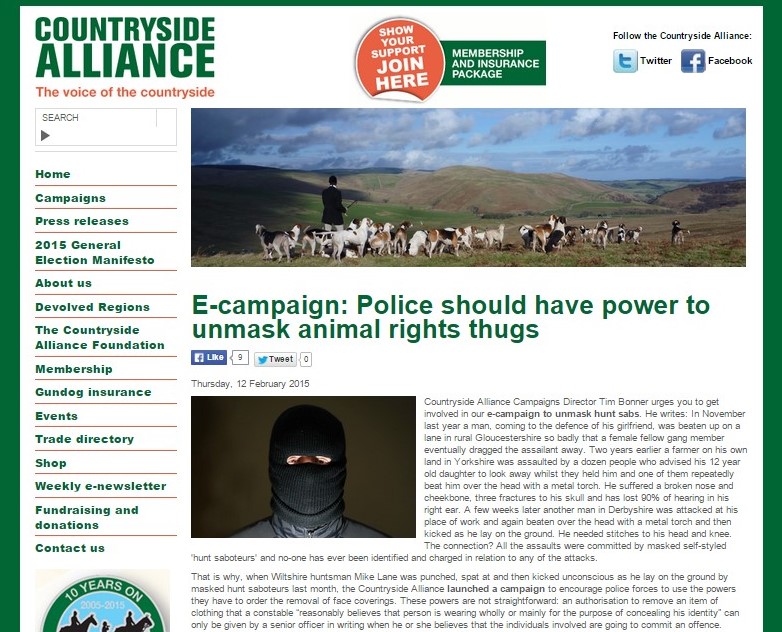
Amusingly, this shocking video footage coincides with a campaign currently being run by the Countryside Alliance who are lobbying for police to ‘unmask’ hunt sabs. In the longer term, they also want the next Government to review the law around wearing balaclavas. You can read their campaign notes here – and they really are worth a few minutes of your time. The Countryside Alliance should be careful what they wish for – there’ll be a lot of gamekeepers who won’t be happy if they’re banned from covering their faces while committing their crimes (see recent convictions of balaclava-wearing criminal gamekeepers such as George Mutch and Glenn Brown).

Countryside Alliance masked thugs - Copy

Gamekeeper Neil Wainwright faces trial for alleged mis-use of trap

Shropshire gamekeeper Neil Gordon Wainwright is to face trial accused of alleged mis-use of a Larsen trap in July 2014.

At a plea hearing at Shrewsbury Magistrates last week, Wainwright denied possessing a Larsen trap at Birch Hill Wood in Gatten, Stiperstones on 22 and 28 July 2014. He also denied charges relating to using live quail in the trap to catch wild birds.

He did, however, plead guilty to three other charges relating to the storage of firearms, ammunition, and poison. He admitted failing to comply with his firearms licence by not keeping his ammunition in a secured cabinet at his home on 5th August 2014. He also admitted failing to keep the poison Phostoxin in a secure manner on 5th August 2014.

Wainwright, 54, of Norbury near Bishop’s Castle, will next appear before a District Judge at Telford Magistrates Court on 8th May 2015.

News item from Shropshire Star Jan 2015 here

News item from Shropshire Star Feb 2015 here

North Yorks Tory candidate thinks grouse shooting is ace

Kevin Hollinrake is the Conservative’s prospective parliamentary candidate, standing in the next general election for the Thirsk & Malton constituency, a Tory ‘safe seat’ in North Yorkshire.

Kevin Hollinrake is an estate agent.

Here are his views on grouse shooting in North Yorkshire, as reported in a local newspaper yesterday:

GROUSE shooting on the North Yorkshire Moors is worth millions of pounds to the local economy, says Kevin Hollinrake, prospective Conservative parliamentary candidate for Thirsk and Malton, much of which covers the moors.

Speaking at a meeting with landowners, managers and gamekeepers at Lastingham, he said that grouse moor management was worth some £67 million and provided some 1,500 jobs, as well as safeguarding 860,000 acres of heather moorland.

He praised a £52.5 million annual spend on conservation on the moors, adding that the Moorland Association had played a key part in DEFRA’S hen harrier recovery plan, and lobbied for a crack down on wildlife crime.

We have in this country, 75 percent of what is left of the world’s heather moorland. Shooting creates the necessary income for its upkeep, along with 42,500 days of work a year.

“It benefits many rural people, from food suppliers to hoteliers and clothing manufacturers to dry stone wallers. When calls are made to ban or licence driven grouse shooting, thought is seldom given to the harmful consequences to rural economies and conservation.”

END

It’s good that he’s lobbying for a crack down on wildlife crime – North Yorkshire is recognised as the worst county in the UK for reported raptor persecution incidents, a title it has held for six of the past seven years (see here), so he’s got his work cut out. It is, of course, purely coincidental that the dominant land-use in North Yorkshire is driven grouse shooting.

In the same article, the following appears:

Robert Benson, chairman of the Moorland Association, said that thanks to careful moorland management and co-operation of gamekeepers, had led to the successful fledgling of 16 hen harrier chicks.

On the North York Moors we have seen notable improvements in a number of other ‘at risk’ species, such as endangered lapwing, curlew and ring ouzel. Breeding records for merlin are four times more abundant where there are game keepers.”

Mr Benson said peatland habitats, damaged by wildfires, bracken, over-grazing and historic drainage, had been restored. “This helps capture carbon and improve water quality,” he added.

Without the work and passion of our gamekeepers and land managers, working in tandem with farmers, many moors would revert to scrub and be lost to all those who depend on them.”

END

Surely Mr Benson isn’t trying to suggest that the fledging of 16 hen harrier chicks last year can be hailed as some sort of success? It’s “thanks to careful moorland management and co-operation of gamekeepers” that only four hen harrier nests in the whole of England managed to produce young last year (none of which were on grouse moors in North Yorkshire) – what happened to the other 300+ pairs? Perhaps Mr Benson needs a new soundbite: “Breeding records for hen harriers are 75 times less abundant where there are gamekeepers”.

If you think Mr Hollinrake and Mr Benson are talking out of their arses, you can join 20,767 others who have signed a petition to ban driven grouse shooting HERE

Gamekeeper trial collapses after court dismisses RSPB video evidence

The case against Head gamekeeper Ian Sleightholm of the Bolton Hall Estate in North Yorkshire collapsed yesterday after magistrates at Northallerton ruled the RSPB’s video evidence inadmissible.

Sleightholm had been accused of alleged mis-use of a cage trap – specifically that the trap he was operating did not have adequate shade and that the water provided was unsuitable, in contravention of the terms of the General Licence.

The court ruled that the RSPB’s video evidence amounted to ‘an abuse of process’ because RSPB investigations staff “were trespassing on another farmer’s land when they visited the site, saw the trap and set up covert surveillance cameras”. The court ruled that because Sleightholm was unaware of the cameras, ‘he didn’t have the opportunity to discuss the issues with the RSPB or prepare his defence’ and this denied the accused the opportunity of a fair trial.

Eh?

The magistrates also ruled that the case should be dismissed because the only evidence put forward was photographic. It was argued that samples of the water should also have been collected to determine whether it was suitable or unsuitable drinking water.

This is fascinating. According to the terms of the English General Licence (under which Sleightholm was operating the trap), the following criteria apply:

Water must always be available to decoy birds and drinkable; it should be free from chemical additives and changed regularly to ensure that it is clean“.

As far as we’re aware, there is no legally-binding definition of what constitutes ‘drinkable’ water for birds. There’s plenty of legislation defining ‘drinkable’ water that is fit for human consumption (e.g. The European Drinking Water Directive) but these standards are unlikely to be applicable to water provided for decoy birds. So quite what test parameters the magistrates would be looking for to demonstrate that the water was suitable or unsuitable is a bit of a mystery.

We’d have thought that it’s pretty obvious when water is ‘clean’ or not, and photographic evidence should suffice. If the water container contains, say, green sludge, most people would consider that to be unclean. The terms of the General Licence do not define what constitutes “changed regularly” – does that mean daily, weekly, monthly, annually? Once again, the vagueness of the General Licence conditions do not stand up to legal scrutiny.

The collapse of this case is a bit of a surprise. Video evidence has long been considered admissible in English courts (as opposed to the difficulty of using it in the Scottish courts) and it’ll be interesting to see how the ruling in this case affects future cases where video evidence plays a central role in the prosecution’s case.

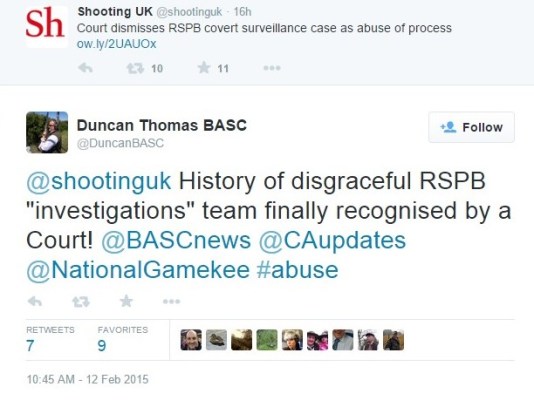
As you can imagine, there has been much crowing from the Dark Side about this result, and we were particularly interested in the following tweet from Duncan Thomas:

Duncan Thomas tweet RSPB covert video case

The name Duncan Thomas may sound familiar to some of you. He is a former Police Wildlife Liaison Officer with Lancashire Constabulary and now works as the North West Regional Officer for BASC. We recently blogged about him here. BASC is a member of the Partnership for Action against Wildlife Crime (PAW). Do you think his published opinion (which, incidentally, was also re-tweeted by the National Gamekeepers Organisation) is conducive to ‘partnership’ working, or do you think it exposes the ‘partnership’ sham for what it actually is?

UPDATE 20:00hrs: Does the spokesman of the National Gamekeeper’s Organisation have a headmaster fetish?

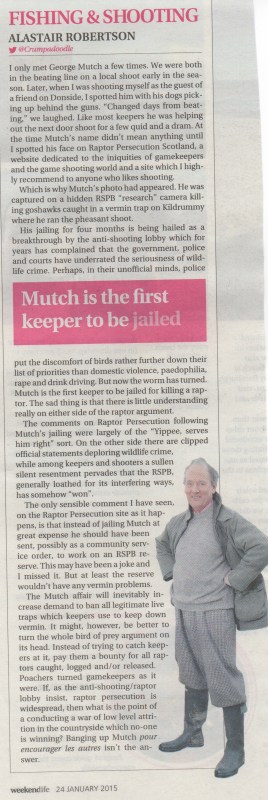
Jailing raptor-killing gamekeepers ‘not the answer’, says Robertson

Alastair Robertson Scotsman 24 Jan 2015The fall-out from the shock custodial sentence for raptor-killing gamekeeper George Mutch continues….
The following appeared in yesterday’s Scotsman weekend magazine (24th January 2015). It’s the regular country sports column written by Alastair Robertson, the pro-game shooting journalist who also contributes to Daily Mail, Mail on Sunday, Telegraph, The Sun, Country Life & The Field.

“I only met George Mutch a few times. We were both in the beating line on a local shoot early in the season. Later, when I was shooting myself as a guest of a friend on Donside, I spotted him with his dogs picking up behind the guns. “Changed days from beating”, we laughed. Like most keepers he was helping out on the next door shoot for a few quid and a dram. At the time Mutch’s name didn’t mean anything until I spotted his face on Raptor Persecution Scotland, a website dedicated to the iniquities of gamekeepers and the game shooting world and a site which I highly recommend to anyone who likes shooting.

Which is why Mutch’s photo had appeared. He was captured on a hidden RSPB “research” camera killing goshawks caught in a vermin trap on Kildrummy where he ran the pheasant shoot.

His jailing for four months is being hailed as a breakthrough by the anti-shooting lobby which for years has complained that the government, police and courts have underrated the seriousness of wildlife crime. Perhaps, in their unofficial minds, police put the discomfort of birds rather further down their list of priorities than domestic violence, paedophilia, rape and drink-driving. But now the worm has turned. Mutch is the first keeper to be jailed for killing a raptor. The sad thing is that there is little understanding really on either side of the raptor argument.

The comments on Raptor Persecution following Mutch’s jailing were largely of the “Yippee, serves him right” sort. On the other side there are clipped official statements deploring wildlife crime, while among keepers and shooters a sullen silent resentment pervades that the RSPB, generally loathed for its interfering ways, has somehow “won”.

The only sensible comment I have seen, on the Raptor Persecution site as it happens, is that instead of jailing Mutch at great expense he should have been sent, possibly as a community service order, to work on an RSPB reserve. This may have been a joke and I missed it. But at least the reserve wouldn’t have any vermin problems.

The Mutch affair will inevitably increase demand to ban all legitimate live traps which keepers use to keep down vermin. It might, however, be better to turn the whole bird of prey argument on its head. Instead of trying to catch keepers at it, pay them a bounty for all raptors caught, logged and/or released. Poachers turned gamekeepers as it were. If, as the anti-shooting/raptor lobby insist, raptor persecution is widespread, then what is the point of conducting a war of low level attrition in the countryside which no-one is winning? Banging up Mutch pour encourager les autres isn’t the answer”.

END

So, no real surprises. Gamekeepers and shooters apparently ‘loathe’ the RSPB for ‘interfering’ (= catching raptor-killing gamekeepers and reporting them to the police). Oh, and killing raptors doesn’t really merit a custodial sentence because it doesn’t rank as a priority crime, even though the Government and Police Scotland have both stated that tackling wildlife crime IS a priority, and even though the penalty available for EACH offence could be a £5,000 fine and/or a six month custodial sentence. Some would say Mutch got off lightly with just a four-month jail sentence.

Instead of trying to catch gamekeepers at it, Robertson’s theory is that gamekeepers should be paid a bounty for each raptor they manage not to kill. A bit like giving a bank robber a bounty for each bank he manages to walk past without robbing it. ‘Ah, well done lad, you’ve managed to go a whole day without committing a crime – here, have some tax-payer’s money in recognition of your self-control’.

Talking of Mutch, we were interested to receive a photo taken on a grouse moor in September 2014.  This was on Edinglassie Estate in Aberdeenshire. Edinglassie is an award-winning estate, receiving the GWCT’s Golden Plover Award in 2013 for their progressive & sustainable moorland management, and becoming WES-accredited (SLE’s Wildlife Estates Scotland thing). Is that George Mutch, clearing the butts after a drive? Who would employ Mutch to help out on a game shoot? (There’s no more helping out for a few quid and a dram – new rules mean that, unless in exceptional circumstances, HMRC views beaters etc as ’employees’ for tax purposes). Interesting. Although to be fair, in September he was still denying his guilt and hadn’t yet been convicted (that came in Dec). Can’t imagine an esteemed estate like Edinglassie would employ him now he’s been convicted of raptor persecution…..

Subsidy penalty for Stody Estate?

stody buzzardsOn 1st October 2014, gamekeeper Allen Lambert from the Stody Estate in Norfolk was found guilty of poisoning 10 buzzards and one sparrowhawk, which had been found dead on the estate in April 2013. He was also convicted of storing banned pesticides & other items capable of preparing poisoned baits (a ‘poisoner’s kit’), and a firearms offence (see here and here).

On 6th November 2014, Lambert was sentenced. Even though the magistrate acknowledged that Lambert’s crimes passed the custody threshold, he only received a 10 week suspended sentence for poisoning 11 raptors (suspended for one year), a six week suspended sentence for possession of firearms and nine poisoned buzzards (suspended for one year), and was ordered to pay £930 prosecution costs and an £80 victim surcharge.

On 5th October 2014, we blogged about the millions of pounds worth of subsidies that had been awarded to Stody Estate in recent years (see here) and we encouraged blog readers to contact the Rural Payments Agency (RPA) to ask whether Stody Estate would receive a financial penalty in the form of subsidy withdrawal for being in breach of the terms & conditions of their subsidy-fest.

On 10th October 2014, the RPA responded by saying they would consider what action could be taken against Stody Estate (see here).

Then it all went quiet.

One of our blog readers decided to submit an FoI to the RPA in December 2014, to see what was going on. Here is his letter:

12 DECEMBER 2014

To whom it may concern

I am making this request for information under the Freedom of Information Act.

The information I request relates to the conviction in October 2014 of Mr Allen Lambert, a gamekeeper employed by the Stody Estate, Melton Constable, Norfolk, NR24 2ER for illegally poisoning ten buzzards and a sparrowhawk.

I would be grateful if you could provide me with all the information you hold relating to the following questions:

  1. Whether the RPA consider the illegal poisoning carried out by an employee of the Stody Estate as being in breach of Cross Compliance Statutory Management Requirement 1 – Wild Birds.
  2. Did the RPA investigate any breach of cross compliance at the Stody Estate relating to the illegal poisoning offence and what was the outcome of the investigation.
  3. Whether the RPA has imposed a fine on the Stody Estate’s Single Farm Payment, Environmental Stewardship Payment or any other public subsidy the estate receives and if so, how much.

I look forward to hearing from you.

Yours sincerely

XXXXX XXXXX

On 14th January 2015, the RPA responded with this:

14 JANUARY 2015

Dear XXXXX XXXXX

Re: Freedom of Information – Information Request

Thank you for your request for information dated 12 December 2014 which has been dealt with under Freedom of Information Act 2000 (FoIA).

You have asked:

‘1. Whether the RPA consider the illegal poisoning carried out by an employee of the Stody Estate as being in breach of Cross Compliance Statutory Management Requirement 1 – Wild Birds.’

‘2. Did the RPA investigate any breach of cross compliance at the Stody Estate relating to the illegal poisoning offence and what was the outcome of the investigation.’

‘3. Whether the RPA has imposed a fine on the Stody Estate’s Single Farm Payment, Environmental Stewardship Payment or any other public subsidy the estate receives and if so, how much.’

Having considered your request we regret that we are unable to provide you with any meaningful response as we do not hold any information that answers your questions. However, RPA would like to make clear that it is required to assess cross compliance reductions to CAP subsidy claims based on intent, extent, severity, permanence and repetition of the non-compliance. We can assure you that RPA will take action, including cross compliance reductions to CAP subsidy payments applicable, if this is found to be appropriate.

In order to qualify for most CAP subsidy payments, claimants are required to keep their land in Good Agricultural and Environmental Condition and comply with a set of Statutory Management Requirements (SMRs). This is known as cross compliance. One of the SMRs covers wild birds (SMR 1) and this includes a rule about killing, injuring or taking wild birds.

Further information is published on the GOV.UK website (Page 43 – deals with wild birds).

https://www.gov.uk/government/uploads/system/uploads/attachment_data/file/320833/The_Guide_to_Cross_Compliance_in_England_2014_complete_edition.pdf

If you are not happy with the way we have handled your request, you can ask for an internal review. These requests should be submitted within two months of the date of receipt of the response to your original letter and should be addressed to: Access to Information, Rural Payments Agency, North Gate House, 21-23 Valpy Street, Reading, RG1 1AF.

Yours sincerely

Rural Payments Agency

Not very helpful, is it?

Thanks to the blog reader who followed up with the FoI and shared the response with us. We understand the RPA can expect further FoIs until a satisfactory response is received. Watch this space….

Meanwhile, you might be interested to compare Lambert’s pathetic sentence with that of an anti-badger cull protester. Lambert was given a 10 week suspended sentence and ordered to pay £930 costs for the mass poisoning of protected birds, the illegal storage of banned poisons and a firearms offence. The badger cull protester, who breached the terms of an injunction designed to stop him disrupting badger culls (he filmed someone involved with the cull and stood outside the NFU office wearing a t-shirt that said: ‘FCK NFU’), was given a six month suspended sentence and ordered to pay costs that could amount to £55,000 (see here). The first installment of £25,000 is due on 1st May. A crowd-funding page has been set up for those who want to help – see here.

Hawk and Owl Trust getting it badly wrong

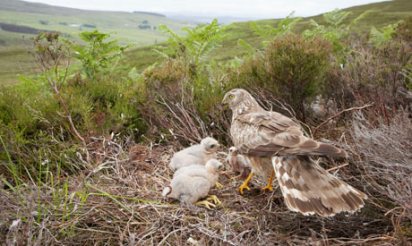
Hen harrierUp until yesterday, we had a lot of respect and admiration for the Hawk & Owl Trust. They’ve got some fantastic staff and volunteers, their conservation work has been exemplary, as has their educational work, and they’ve stood shoulder to shoulder with the rest of us to make a stand against the illegal persecution of raptors. Such was their unity, in 2013 they even walked away from the ridiculous Hen Harrier Dialogue shortly after the RSPB and the Northern England Raptor Forum had walked. They were one of us, with shared ideals and whose patience with the grouse moor owners had been sucked dry. Read their exit statement here.

So it was with an overwhelming sense of shock and disbelief yesterday that we found out the Hawk & Owl Trust’s Board of Trustees had, late last year, “agreed unanimously that a hen harrier brood management scheme trial (NB trial) is the way forward for the recovery of hen harrier populations“.

That is a direct quote from the Hawk & Owl Trust’s Chair, Philip Merricks.

To read more about this staggering statement, read this and this (including the comments) on Mark Avery’s blog.

WTF?

What has changed within the grouse-shooting industry since the Hawk & Owl Trust penned their exit letter from the Hen Harrier Dialogue in 2013? Absolutely nothing. The industry is still deeply in denial that it is involved in any way with the illegal persecution of hen harriers, the English hen harrier population is still on its knees as a direct result of illegal persecution, and the grouse-shooting industry is still firmly based on widespread criminality. The only thing that has changed is that the Hawk & Owl Trust has a new Chair – Mr Merricks.

Later in the day, and in response to the outcry on social media, the Hawk & Owl Trust tried to clarify their position with a further statement from Mr Merricks – see here. It hasn’t inspired much confidence. Apparently, the Trustees have come up with two “immoveable conditions” that would need to be agreed by all parties before the Trust will engage in more detailed talks with DEFRA. Those two conditions are as follows:

1. “All hen harriers fledged within a brood management scheme trial would be satellite tagged so that their movements could be tracked. And the knowledge that they were tagged (and the fear that other HHs might be) would prevent any gamekeepers from shooting them in the sky“.

This is so extraordinarily naive it beggars belief. Surely the Hawk & Owl Trust are aware that 37 of the 47 hen harriers sat tagged between 2007-2014 are listed as ‘missing’? That’s a staggering 78.7%. Only four tagged birds were known to still be alive in Oct 2014 (see here). Fitting a sat tag to a hen harrier does not “prevent gamekeepers shooting them in the sky” (nor catching them in spring traps and clubbing them to death, or stalking them at their night roosts and filling them with lead shot as they huddle on the ground).

2. “Should any Moorland Association, Game & Wildlife Trust, or National Gamekeepers Organisation member be proved to have illegally interfered with a hen harrier nest or to have persecuted a hen harrier on their grouse moors, the Hawk & Owl Trust would pull out its expertise from the brood management scheme trial“.

Again, complete naivety. The key word here is ‘proved’. By ‘proved’, do they mean a conviction? It’s hard to ‘prove’ criminal behaviour when birds, and their sat tags, suddenly ‘disappear’, and the grouse-shooting industry denies any knowledge of, and/or involvement in, any criminal activity. Even if one of them did slip up and leave enough evidence for a subsequent prosecution, the court case would likely take a few years to conclude and in the meantime, the Hawk & Owl Trust would have to continue to remove hen harriers from grouse moors because they wouldn’t yet have the ‘proof’ that one of their partners had been involved with the crime.

There is a tiny glimmer of hope. A further statement on the Hawk & Owl Trust website says this:

Addressing raptor persecution is a pre-requisite of our talking to DEFRA and landowners. Until this issue is addressed in a satisfactory manner, any form of management of hen harrier is impossible“.

The questions is, how will the Hawk & Owl Trust define “addressed in a satisfactory manner“? That could mean anything. And will it apply just to hen harrier persecution or will it include all the other persecuted raptor species that are either found on (or more often ‘disappear’ on) these moors?

Depending on how the Hawk & Owl Trust defines this condition, there’s every chance that the brood management scheme will never see the light of day because, as we all know only too well, the grouse-shooting industry has been reliant on criminal behaviour for more than a century and it shows no sign of changing.

But let’s just suppose for a second that the Hawk & Owl Trust IS satisfied that illegal persecution has been “addressed in a satisfactory manner” and they do decide to go ahead and partner with the grouse-shooting industry to remove hen harriers from grouse moors…

In our view, (and it’s shared by many others if you read the comments on Mark’s blog and on social media), the Hawk & Owl Trust would be heading for hell in a handbasket with this move. The issue is not just about illegal persecution – there are many wider associated issues about the questionable management of intensively managed grouse moors, and there’s also the fundamental ethical issue: why should one of our most treasured and relatively rare (even if it wasn’t being persecuted) species be removed from grouse moors, just so a minority group can farm an artificially-high population of red grouse so they can brag to their mates about how many they’ve shot? By partnering with the grouse-shooting industry on a brood management scheme, the Hawk & Owl Trust would be tacitly supporting these practices.

We think the Hawk & Owl Trust has under-estimated the impact this move may have on their organisation. There is a high risk that (a) they’ll lose their President, Chris Packham (we’ve yet to hear his views but we look forward to them in due course); (b) they’ll lose a lot of members (although they may gain a lot of members from within the grouse-shooting industry) and (c) they’ll lose their hard-earned credibility within the conservation community. That would be a great shame.

Hen harrier photo by Mark Hamblin

UPDATE 7th February 2015: Chris Packham resigns from Hawk & Owl Trust (here).