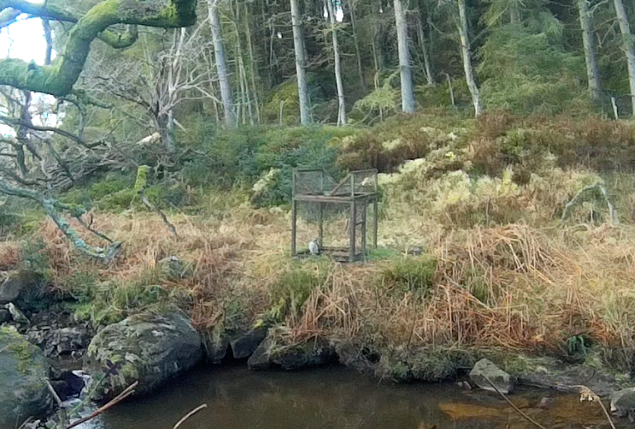
Gamekeeper convicted as birds of prey die in trap

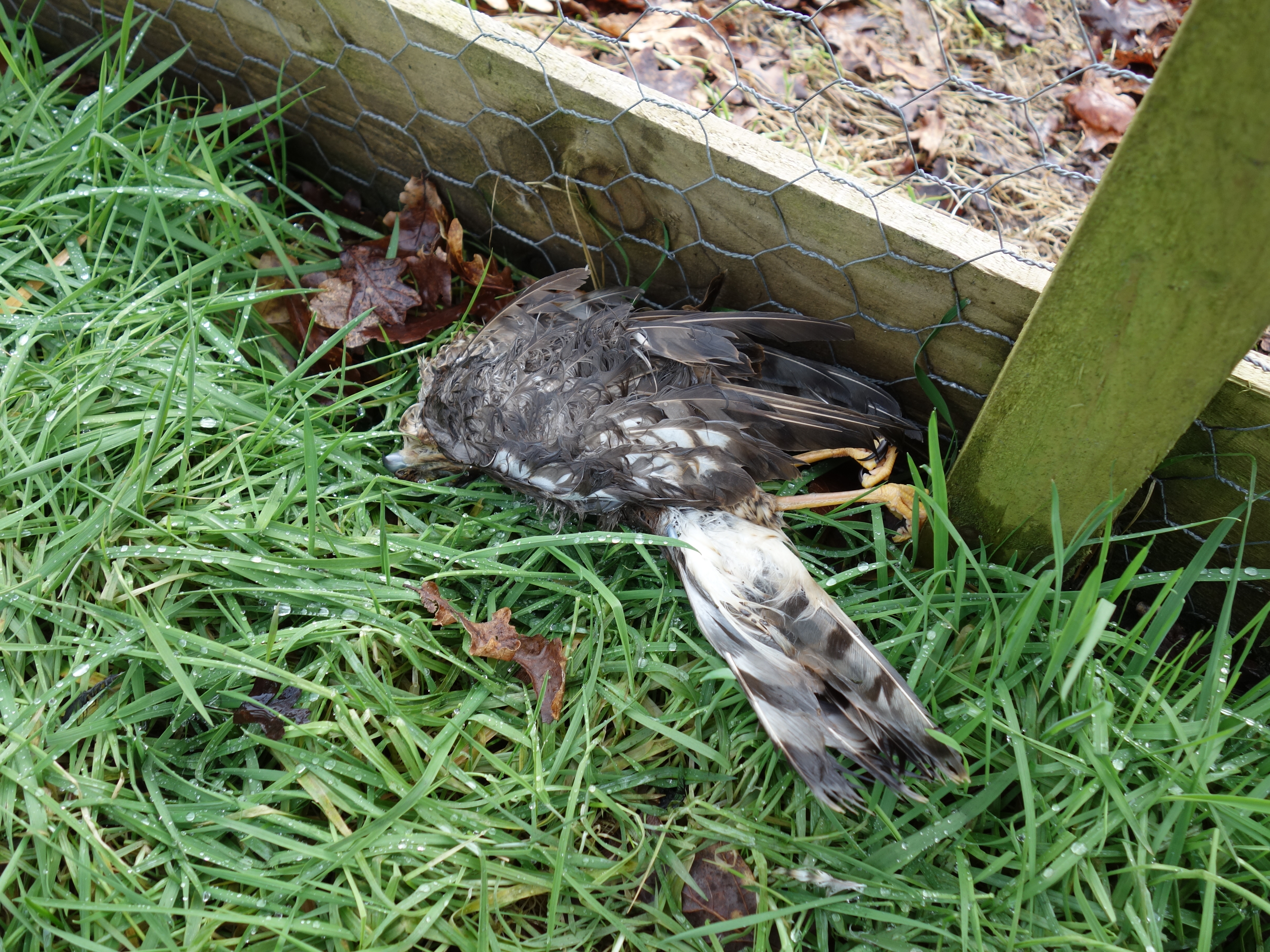
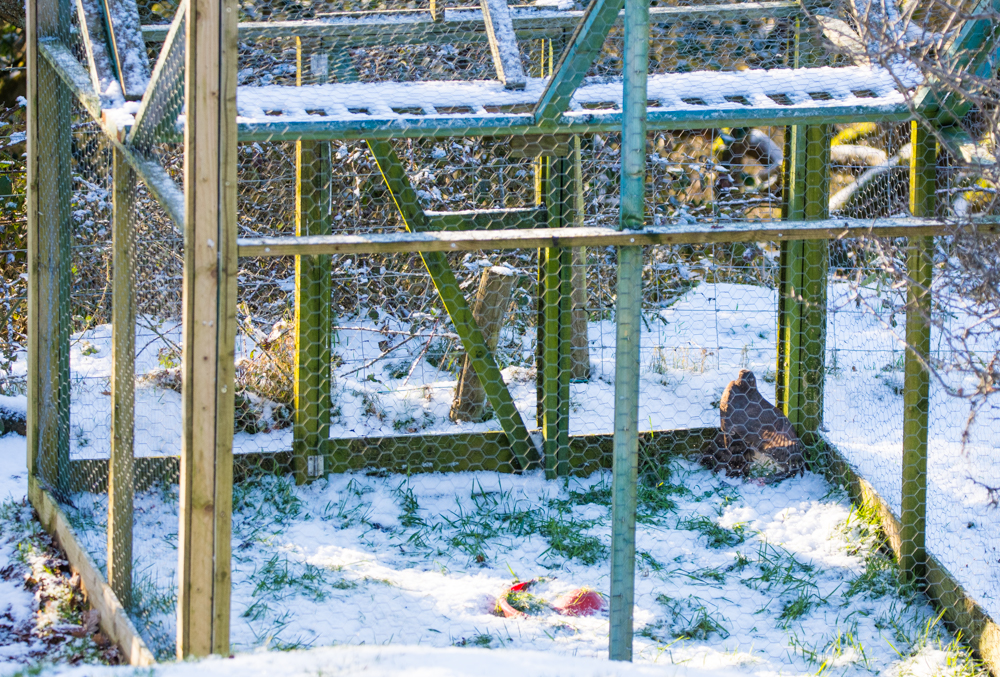
A gamekeeper in the Scottish Borders has been convicted today after two supposedly protected birds of prey (a barn owl and a goshawk) died inside a trap which he neglected to check.

There’s an article about this case in the Border Telegraph this evening, which I’ll copy below, and then I’ll add some further commentary below that.

Here’s the Border Telegraph piece:

Borders gamekeeper ‘recklessly’ killed two protected birds

A GAMEKEEPER who recklessly killed two protected birds on a Borders estate by leaving open the door of a multi crow cage trap [Ed: see commentary at foot of this blog] has been fined £300 at Selkirk Sheriff Court.

An owl and a goshawk perished from exposure and a lack of food and water at Cathpair Farm near Stow on September 13 last year.

Fifty-three-year-old Peter Givens, of Keepers Cottage, Cathpair, pleaded guilty to recklessly taking and killing the wild birds under the Wildlife and Countryside Act.

His lawyer explained that Givens had used the crow trap for the lambing season earlier in the year but thought had had [sic] secured it properly when no longer required.

Wildlife and environmental crime depute fiscal Joe Stewart said: “An ecologist carrying out a survey on the estate came across a crow cage trap near some woodland.

“He noticed a barn owl lying deceased in the trap which was in an advanced state of decomposition and had obviously been there for a long time.

“The door was closed and the trap was in use.

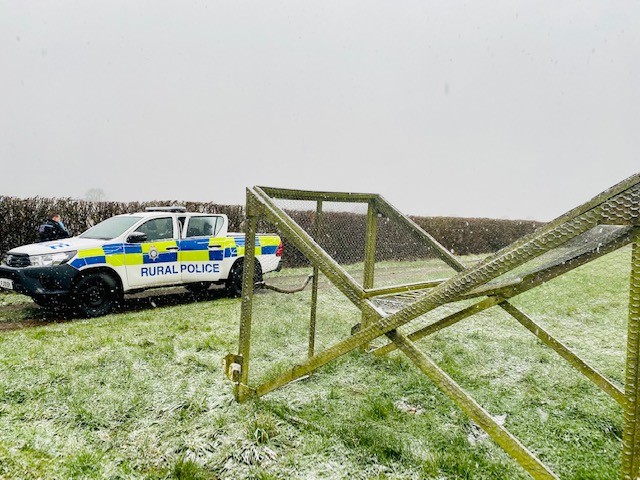
“The local wildlife police attended carrying out a search and he found another bird in the trap which was a goshawk.”

An identification tag on the trap was traced to Givens.

Mr Stewart said the trap should have been removed.

Givens’ lawyer said his client had been a gamekeeper for more than 30 years and had no previous convictions.

He said around the start of the COVID pandemic in March 2020 the trap was put in place and checked on a regular basis in case other birds were trapped.

He explained that there had been a lot of crows at the start of the lambing season but this had tailed off by May.

The lawyer continued: “He thought the trap had been deactivated. There was no intention to keep the trap operating.

“What happened on September 13 came as a shock to him and a source of embarrassment and sadness for the damage he has caused.

“He has accepted he failed to deactivate the trap properly.

“He accepts his conduct was reckless but it was not intentional and he is very remorseful.”

Sheriff Peter Paterson said: “This was an oversight rather than an intentional act.

“It was not a deliberate act to trap predators with the unintended consequences.”

Sheriff Paterson added: “I take into account your spotless record and while this was reckless, it was not intentional.”

He reduced the fine from £375 to £300 to reflect the guilty plea with a £20 victim surcharge added.

ENDS

Ok, so first a technical correction on the court reporter’s write up in the Border Telegraph. The article states the gamekeeper had killed the two birds of prey ‘by leaving open the door of a multi crow cage trap’. This can’t be accurate. Had he left the door open, the barn owl and the goshawk would have been able to escape! What is more likely to have happened is the gamekeeper kept the cage door shut, which is an offence if the trap is no longer in use because, as we’ve seen, birds can enter the trap through a roof opening (either a ‘ladder’ or funnel design) but then they cannot escape back up.

Anybody who operates a multi-cage crow trap under the General Licences in Scotland MUST render the trap ‘incapable of use’ if the trap is not being used, and this means either removing the door entirely or padlocking it open. Leaving the door closed when the trap is not in use is an offence.

I was interested to read the gamekeeper’s lawyer’s defence: “…..the gamekeeper thought he had secured it properly when no longer required“. I’m not sure how someone can believe they’ve secured a cage trap ‘properly’ if they haven’t obeyed the General Licence terms and conditions and either (a) removed the door or (b) padlocked it open. There’s no possibility of ‘accidentally’ doing half a job here – you either remove the door or you don’t, or you padlock the door open, or you don’t.

I was also interested to see that the guilty gamekeeper was 53 years old and had been a gamekeeper for ‘more than 30 years’. These were details given by his lawyer in his defence. I’d argue that those details should have gone against the gamekeeper – he’s been in the wildlife-killing business for long enough to know the risks and certainly to know the law. Indeed, I understand Peter Givens was the former Head Gamekeeper on nearby Raeshaw Estate. This is an estate that has been at the centre of multiple wildlife crime investigations for many, many years and was the subject of the very first General Licence restriction in 2015, based on clear police evidence that wildlife crimes had been committed there, although there was insufficient evidence to prosecute any individual (see here).

Even after the General Licence restriction was imposed on Raeshaw Estate, even more alleged wildlife crimes were uncovered which resulted in the estate’s Individual licences being revoked by SNH in 2017 (here).

There is no evidence nor indeed suggestion that Peter Givens was involved in any of those alleged offences but the point of highlighting this background is that he would certainly have been aware of the police investigations and thus the importance of adhering to the law, which he failed to do in this latest case (which incidentally did not take place on Raeshaw Estate – Givens has since moved to a smaller shoot].

The lawyer also made a point of telling the Sheriff that Givens had no previous convictions, and his ‘spotless record’ was taken in to account by Sheriff Paterson when Givens was sentenced.

And the punishment for ‘recklessly’ killing two Schedule 1 birds of prey? A £300 fine and a £20 victim surcharge.

You can decide for yourselves whether this will be sufficient deterrent for other gamekeepers to ensure they adhere to the terms and conditions of the General Licences to prevent protected species being trapped in a literal death trap and starving to death.

Long-eared owl illegally held in trap on same Strathbraan grouse moor where shot peregrine found

Further to yesterday’s blog about a shot peregrine being found dead on a grouse moor in the notorious raptor persecution hotspot of Strathbraan (see here), further news has just emerged of another offence being committed on the same shooting estate.

Ian Thomson, Head of Investigations at RSPB Scotland has just tweeted the following:

The dead peregrine was found during a police/SSPCA follow-up to incidents of cage trap abuse on the same estate – eg. this LE Owl had been illegally held in a trap, in pouring rain, for >24hrs. IMO there is no legitimate reason for a grouse moor be using crow traps in October…

Here is a photo of the illegally-trapped Long-eared owl:

Crow cage traps are not illegal to use under the General Licences, as long as certain conditions are met. Birds of prey can often enter these traps and are then unable to escape. Catching a raptor is not an offence in itself. However, the trap operator has a legal obligation to check the trap at least once every 24 hours and if a trapped raptor (or any other non-target species) is found and it is uninjured, the trap operator MUST release it back to the wild immediately. If the trapped raptor is held for longer than 24 hours then the trap operator has committed an offence under the Wildlife & Countryside Act 1981.

To not release this long-eared owl within 24 hours of capture is a clear offence and there may also be other welfare offences to consider under the Animal Health & Welfare (Scotland) Act 2006 if the owl did not have adequate food, water and shelter.

Ian also raises the question of the legitimacy of operating a crow cage trap in October. He’s absolutely right to question this. Crow cage traps can be used under the General Licences in Scotland for three purposes:

  • GL 01/2021: To kill or take certain birds for the conservation of wild birds.
  • GL 02/2021: To kill or take certain birds for the prevention of serious damage to livestock, foodstuffs for livestock, crops, vegetables and fruit.
  • GL 03/2021: To kill or take certain birds for the preservation of public health, public safety and preventing the spread of disease

For what legitimate purpose was this crow cage trap being deployed on a Strathbraan grouse moor in October??

I’m very curious about why a charge has not been brought against the trap operator in this case. All crow cage traps now have to be registered with NatureScot by the trap operator and a sign affixed to the trap to show the trap operator’s registration number. Police Scotland can use this number to identify the trap operator and pursue a prosecution if an offence has been committed.

I’m even more curious to know why NatureScot has not imposed a General Licence restriction on this estate. The crow cage trap offence was committed in October 2020. The shot peregrine was discovered in November 2020. The Scottish SPCA is pursuing a case for alleged snaring offences also discovered in November 2020.

It’s now September 2021.

Just what is going on here? There are serious questions to be asked of Police Scotland and NatureScot.

Why no publicity?

Why no prosecution?

Why no General Licence restriction?

Trial date set for gamekeeper accused of killing buzzards

A gamekeeper appeared in court on 12th August 2021 accused of the alleged killing of a number of buzzards in Nottinghamshire in January 2021.

He was charged after a joint investigation by Nottinghamshire Police and the RSPB’s Investigations Team (see here).

The gamekeeper pleaded not guilty so this case will now progress to trial.

Trial dates have been set for 6th-7th January 2022.

Please note, as this is a live case no further detail will be provided here until the case has concluded or there is official commentary from the court reporter. Comments on this particular blog also won’t be accepted until the case concludes so as not to prejudice proceedings. Thanks for your understanding.

Police investigate illegal killing of buzzards in Nottinghamshire

Press release from Nottingham Police (17 January 2021)

Investigation begins into killing of wild birds

A local man is assisting police with their enquiries in relation to the killing of wild birds.

Nottinghamshire Police officers have worked closely with the RSPB after they were called on 12 January following concern to wildlife in the Kneeton area.

All birds of prey are protected by the Wildlife and Countryside Act 1981. To intentionally kill or injure one is a criminal offence and could result in an unlimited fine or up to six months in jail.

Wildlife Crime Officers from Newark and West Bridgford officers were assisted by investigators from the RSPB.

Rushcliffe Inspector Craig Berry said: “Following excellent partnership work by the police and the RSPB we have interviewed a man under caution at the police station in connection with the death of buzzards.   

The incident was called into the RSPB following a report that the birds were killed  and officers are now making further enquiries.”  

Wildlife crimes are often under reported and can pose some practical difficulties in the investigation, however this example demonstrates the police will seek to gather evidence and prosecute offenders.

Officers have urged anyone with any information to contact police by calling 101, the RSPB or Crimestoppers and report similar matters.

ENDS

UPDATE 11th August 2021: Gamekeeper on trial for alleged killing of buzzards (here)

Channel 4 News re-visits the grouse moors of the North York Moors National Park

The illegal killing of birds of prey on the grouse moors of North Yorkshire was firmly back in the news headlines this evening with another excellent piece fronted by Alex Thomson of Channel 4 News.

You may remember an earlier piece from Alex back in May this year (here) which featured various police investigations in Nidderdale AONB and the discovery of five dead buzzards stuffed into a hole on a Bransdale grouse moor in the North York Moors National Park during lockdown – four were later confirmed to have been shot (here).

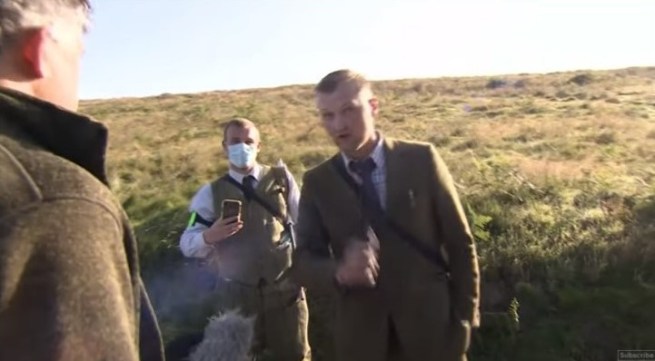
This time the TV crew filmed a grouse-shooting party near Goathland in the North York Moors, where earlier this year film footage emerged purporting to show an individual killing a trapped goshawk on the Queen’s grouse moor in May (see here and here).

In this latest film there’s some hilarious footage of various members of the shooting party denying all knowledge of the alleged goshawk incident and providing a display of arrogance that the general public doesn’t often get to see, usually hidden as it is behind carefully-worded propaganda pieces.

Speaking of the alleged goshawk incident, Alex said,

The police told us, a gamekeeper will soon be prosecuted for killing the goshawk“.

The Duchy of Lancaster says if there is a successful prosecution, the sporting tenant, BH Sporting, may lose its lease.

Interesting times.

Here’s the six minute video that appeared on Channel 4 News this evening:

UPDATE 24th September 2020: Channel 4 bats away shooting industry hysteria (here)

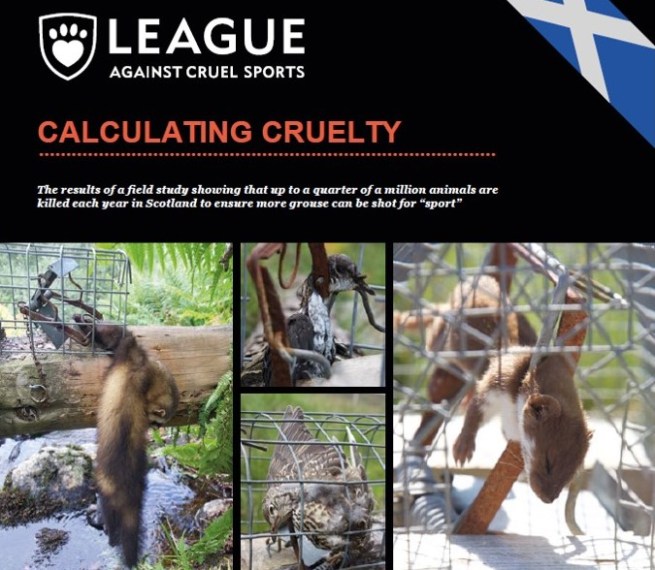
New report suggests up to quarter of a million animals killed in traps & snares on Scottish grouse moors each year

Press release from League Against Cruel Sports (Scotland), 13th August 2020

Shocking new statistics show up to 260,000 animals killed each year on Scottish shooting estates to increase the number of grouse to be shot for ‘sport’

Charity publishes ‘Calculating Cruelty’, a field study of Scotland’s hidden shame

  • 57,000 killing devices deployed each day in Scotland representing the equivalent of over 10,000,000 active trapping and snaring days per year.
  • Up to a quarter of a million animals are killed each year in an attempt to totally eradicate foxes, stoats, weasels and crows to increase the number of grouse.
  • Nearly half of the animals killed are non target species such as hedgehogs, dippers and mistle thrush.

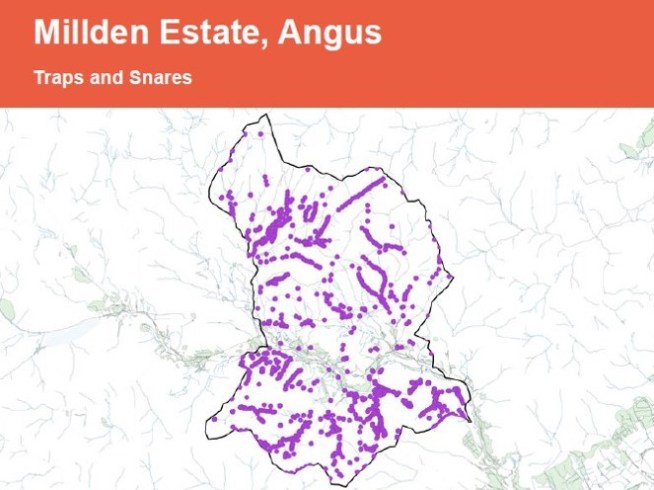
The League Against Cruel Sports Scotland has published the most comprehensive and robust field study of ground predator control on Scotland’s shooting estates. Over 15 months, an independent surveyor mapped the location and frequency of traps and snares set on seven shooting estates to calculate the true extent of animal killing as a result of predator control to sustain the driven grouse shooting industry.

Analysis of the survey data by a leading scientist concludes that up to a quarter of a million animals are killed every year to maintain high numbers of grouse for sport shooting, with nearly half of these non target species. The study also found that failure to comply with existing codes of practice is widespread on Scottish grouse moors, and that best practice guidelines produced by professional organisations that represent the shooting industry appear to serve little useful function.

Robbie Marsland, Director of the League Against Cruel Sports, Scotland said: “These figures have shocked and appalled us. This is the most comprehensive, quantitative study of predator control giving an illustration of the grim reality of Scotland’s grouse moors, where up to a quarter of a million animals are simply wiped out to ensure grouse numbers are kept artificially high.

Our report ‘Calculating Cruelty’ leaves us in absolutely no doubt that managing such large parts of Scottish moorland for an industry which makes a woefully low contribution to the economy is entirely misguided and outdated.

Between June 2018 and September 2019 a surveyor, with over 20 years experience of game management recorded the scale, distribution and use of legal grouse moor management equipment and practices. Using the Scottish right to responsible access, the estates were walked and all ground was viewed so that the items being specifically surveyed were likely to be found. All ground was covered at least once with all tracks and watercourses checked carefully. The estates surveyed were had various intensities of management practices, and included:

● Millden Estate, Angus

● Tillypronie Estate, Aberdeenshire

● Glenmazeran Estate, Inverness-shire

● Easter Clunes, Inverness-shire

● Kildrummy Estate, Aberdeenshire

● Invermark Estate, Angus

● Skibo Estate, Sutherland

The survey was carried out without the estates being notified so that the data were not biased by management practises changing as a result of the survey and no legally set trap or snare was interfered with in any way. This is the first time that such a widespread and detailed survey of estates has been undertaken.

The report published by the League, is part of a series of reports by the various partners of Revive, the coalition for grouse moor reform, a campaign group bringing together social justice, environmental and animal welfare organisations. Since its inception in 2018 Revive has shone the spotlight on the circle of destruction surrounding driven grouse moors, campaigning for their radical reform.

Robbie Marsland added: “The enormity of the figures produced by the data in this report is simply staggering. The League and our partners in Revive, the coalition for grouse moor reform think it is unconscionable to kill any animal, let alone up to a quarter of a million, to ensure that hundreds of thousands of grouse can then be shot for ‘sport’.

Driven grouse shooting is surrounded by a circle of destruction which is Scotland’s hidden shame. This cruelty and willful disregard for the environment and our wildlife needs to stop once and for all starting with a complete ban on all snares and traps.

ENDS

The League has published two new reports, ‘Calculating Cruelty’ and ‘Hanged by the Feet until Dead’, both of which can be downloaded below:

Calculating Cruelty

Hanged by the Feet until Dead

A copy of both reports has been sent to every MSP in the Scottish Parliament.

There is also a short video highlighting the key findings of this study:

38 Degrees has launched a new petition, ‘Stop grouse shooting’s war on wildlife‘ which can be signed HERE

There has been the usual criticism of these two reports by the game shooting industry although so far this criticism appears to be focused on personal and defamatory abuse of one of the report’s lead author Professor Stephen Harris rather than any criticism of substance about the reports’ actual findings. This is what we’ve all come to expect – anybody who dares try to shine a light on the murky practices of this industry immediately becomes a target and attempts are made to smear, distort, misrepresent and undermine that person’s professional and personal integrity.

Read the reports for yourselves, look at the eye-watering number of traps recorded on some of these estates and judge for yourselves whether this level of intensive and largely unsupervised slaughter of wildlife, to facilitate a ‘sport’, is acceptable in modern Scotland.

You’ll notice Millden Estate in the Angus Glens was one of the seven estates surveyed, and also reported as the most intensively-managed of all seven. That won’t be a surprise to many readers as this area has been accurately described by Chris Townsend as ‘savaged, stripped and blasted land’ (see here for some shocking photos).

Millden has featured on RPUK many times and readers may recall the most recent Millden blog – last October there was a huge multi-agency raid for suspected animal fighting and during that raid a number of dead raptors were also discovered and as a result a gamekeeper was suspended (see here, here and here).

We understand that cases are progressing on the animal fighting allegations as a result of the SSPCA investigation but it is not known whether any of the wildlife crime allegations are progressing – these are apparently being investigated by Police Scotland.

Three gamekeepers suspended from Queen’s grouse moor after wildlife crime investigation

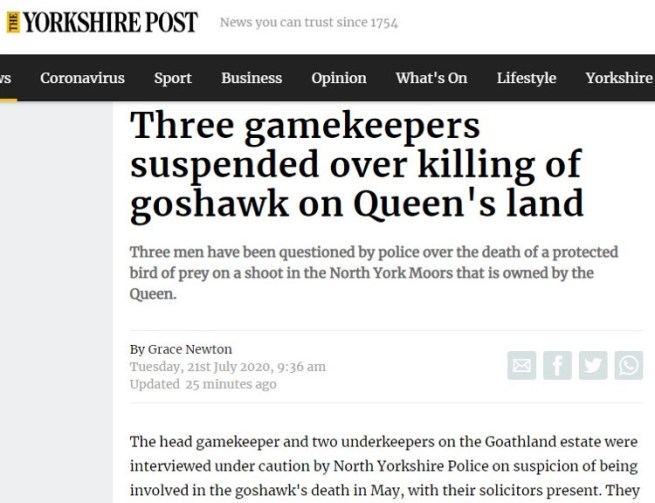
Following the news that a goshawk was recently trapped and apparently killed by a masked individual on the Queen’s grouse moor in North Yorkshire (see here and here), the Yorkshire Post is claiming that three gamekeepers were suspended.

According to the article, the Head gamekeeper and two underkeepers were suspended after being interviewed by North Yorkshire Police in relation to the alleged killing of the goshawk. Two have since been reinstated while the third one has been allowed to resign, and apparently allowed to work his notice period before he went!

The police investigation continues as officers await forensic results from items seized during a search of the estate.

Full article in the Yorkshire Post available here

UPDATE 21st July 2020: An article in The Independent names BH Sporting as the agents managing the land on behalf of the Duchy of Lancaster (here).

Queen’s North Yorkshire grouse moor named at centre of police investigation

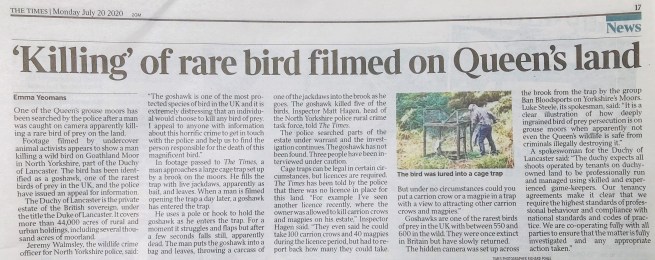
Further to last week’s news that North Yorkshire Police were appealing for information after the alleged killing of a goshawk that was caught inside a trap on a grouse moor in the North York Moors National Park (see here), the location has now been revealed to be one of the Queen’s grouse moors, part of the Duchy of Lancaster, according to an article in The Times today.

It’s reported that ‘the Duchy of Lancaster is the private estate of the British sovereign, under the title the Duke of Lancaster. It covers more than 44,000 acres of rural and urban holdings, including several thousand acres of moorland‘.

The video footage of the goshawk caught in the trap is described:

A man approaches a large cage trap set up by a brook on the moors. He fills the trap with live jackdaws, apparently as bait, and leaves. When a man is filmed opening the trap a day later, a goshawk has entered the trap.

He uses a pole or hook to hold the goshawk as he enters the trap. For a moment it struggles and flaps but after a few seconds falls still, apparently dead. The man puts the goshawk into a bag and leaves, throwing a carcass of one of the jackdaws into the brook as he goes. The goshawk killed five of the birds, Inspector Matt Hagen, head of North Yorkshire Police Rural Task Force told The Times.’

North Yorkshire Police have searched part of the estate under warrant and interviewed three individuals under caution. The investigation is ongoing.

We understand there is a sporting agent on this estate and it’s a name we’ve heard many times before.

This isn’t the first time that a royal estate has been at the centre of a police investigation about goshawks – see here for a very mysterious story from the Queen’s Sandringham Estate in Norfolk a couple of years ago.

Police appeal after goshawk killed on grouse-shooting estate in North York Moors National Park

Press release from North Yorkshire Police (15 July 2020)

Police appeal for information after goshawk killed near Goathland

North Yorkshire Police is appealing for information about an incident in which a goshawk appeared to be killed after becoming caught in a cage trap.

Video footage, which was passed on to North Yorkshire Police, shows the bird becoming caught in the trap in the early hours of 2 May 2020. Shortly afterwards, an individual with their face obscured is seen entering the trap and appears to deliberately kill the bird before removing the body in a bag.

The trap was located on Howl Dale Moor near Goathland in the North York Moors National Park.

[The goshawk trapped inside the cage trap prior to being killed, photo via North Yorkshire Police]

North Yorkshire Police Wildlife Crime Officer, Jeremy Walmsley, is urging anyone with information to come forward:

The goshawk is one of the most protected species of bird in the UK and it is extremely distressing that an individual would choose to kill any bird of prey. I appeal to anyone with information about this horrific crime to get in touch with the police and help us to find the person responsible for the death of this magnificent bird.

We see far too many incidents of birds of prey killed or injured in North Yorkshire and as a police force we are doing all we can to put a stop to this inhumane and callous crime.”

Andy Wilson, Chief Executive of the North York Moors National Park Authority said:

We are deeply saddened to hear about this incident. Goshawks were persecuted to extinction in the UK in the late 19th century and, despite an improvement in numbers, persecution and habitat loss remain a constant threat to their survival.

Killing or injuring a bird of prey is illegal, cruel and must be prosecuted wherever possible. We are working alongside the police to support them in their investigations and we would strongly urge any witnesses or anyone who has any information to come forward. With your help the offender(s) can be brought to justice.”

A cage trap can be used to catch certain species of birds and is designed to trap birds alive and unharmed, in case of any non-target species becoming caught. Any non-target birds, such as birds of prey, should be released as soon as possible after being caught. Killing a bird of prey is an offence under the Wildlife and Countryside Act 1981.

If you have any information which could help this investigation, please call 101 quoting reference: 12200073462 or if you wish to remain anonymous contact Crimestoppers on 0800 555 111.

ENDS

UPDATE 20 July 2020: Queen’s grouse moor named at centre of wildlife crime investigation in North Yorkshire (here)

Scottish Gamekeepers Association ‘negotiating with Government’ for new offence of trap damage

News emerged this week, via the Scottish Gamekeepers Association’s (SGA) e-newsletter for members that it is currently ‘negotiating with Government’ for the creation of a new offence relating to trap damage:

This is really quite interesting. The SGA, with others, has been arguing for several years that legally-set traps have been ‘tampered with’ or damaged by members of the public and these claims usually occur just after an illegally-set trap has been discovered and reported in the media. A recent example of this was the male hen harrier that was found in considerable distress with its leg almost severed in an illegally-set trap on Leadhills Estate (see here).

[Male hen harrier found with an almost severed leg, caught in an illegally-set spring trap next to its nest on Leadhills Estate (see here). Nobody has been prosecuted for this barbaric crime but the estate has had its use of the General Licence restricted by SNH as a direct result of this and other offences (see here)].

The implication of such claims has seemed clear – instead of accepting that some gamekeepers continue to break the law (e.g. by setting illegal traps), the shooting industry would rather deflect the blame on to so-called ‘animal rights extremists’ who are accused of ‘setting up estates’.

During a cross-party RACCE committee hearing in 2013, then Environment Minister Paul Wheelhouse said there was no evidence to support claims of widespread trap tampering/damage by ‘activists’ (see here) although it emerged that BASC was undertaking a survey to assess the extent of this alleged problem.

A couple of years later in 2015 that BASC survey revealed that trap tampering/damage did take place but according to industry evidence, it couldn’t be described as being a ‘widespread’ issue (see here).

In 2017 the SGA again complained of a so-called ‘escalation’ in trap damage and again attributed this to ‘activists’ but as we reported at the time (see here), yet again the evidence was lacking.

Let’s be clear here though. It is quite evident, just looking through social media, that some members of the public are indeed deliberately damaging traps to render them unusable, either because they have an ethical objection to the killing of native wildlife to increase gamebird stocks, or because they’ve become so frustrated with what they perceive to be a lack of enforcement action against the criminal gamekeepers, or because they believe the trap to be illegal. The legislation on trap use is complicated and many members of the public are simply unaware of what is legal and what is illegal. (For a basic introduction have a look at this from OneKind and this from Revive).

To be honest, we’d welcome some clarity on what constitutes ‘tampering’ or ‘damage’. At the moment it is not at all clear and trap tampering may not always constitute a criminal offence. For example, the SGA’s lawyer, David McKie, wrote in a 2013 edition of the SGA’s members’ rag:

As a matter of law, there is a significant difference between interference and vandalism.

Vandalism would involve the breaking of a crow cage trap by someone punching or kicking a hole in it, for example, or the deliberate smashing up of a Fenn trap. It would also include the cutting of snares.

Interference does not necessarily involve a criminal offence….That can involve the removal of traps from their set location, the release of decoy birds or the pulling of snares.

The police can probably not charge the individual with interference’.

In some cases there may be a legitimate defence to causing trap damage – e.g. if a trapped animal is seen to be injured inside a padlocked crow cage trap and needs urgent veterinary attention, but the location is remote and there’s no phone signal to call for help, it might be considered reasonable to cut the trap wire to extricate the wounded animal. Much will depend on the individual circumstances of each incident.

Another example might be the discovery of what is obviously an illegally-set trap. Is it an offence to disable it if there is absolutely no question that it’s been set unlawfully? As an example, here’s a pole trap that was photographed on an estate in the Angus Glens. It’s been an offence to set pole traps for over 100 years!

[An illegal pole trap, photograph by RSPB]

It’d be kind of ironic if a member of the public was prosecuted for disabling such a pole trap, when the person who allegedly set it (a gamekeeper was filmed by the RSPB attending the trap) had the prosecution against him dropped by the Crown Office because the video evidence was deemed inadmissible!

So, yes, regardless of the extent of trap tampering / damage, greater clarity is certainly required on what constitutes an offence. However, given how long we’ve been waiting for the Scottish Government to bring in new legislation to tackle the persistent illegal persecution of birds of prey on sporting estates, that’s happening at such a scale it’s known to be affecting entire populations of some of these species, the trap tampering offence that the SGA claims to be ‘negotiating’ should be way down the list of Government priorities.

UPDATE 12 May 2020: Parliamentary questions on proposed new offences for trap damage (here)

UPDATE 16 May 2020: Scottish Government denies ‘negotiating’ with gamekeepers on new offences for trap damage (here)