Scottish gamekeeper ‘admonished’ for wildlife crimes

Scottish gamekeeper Robert Alexander Christie (58) was convicted today at Forfar Sheriff Court for wildlife crimes relating to the illegal use of a crow cage trap. He was ‘punished’ by receiving an admonishment.

Christie pled guilty to taking a wild bird, possessing a wild bird, and using an illegal trap by failing to adhere to the terms of the general licence (this general licence governs the use of crow cage traps in Scotland).

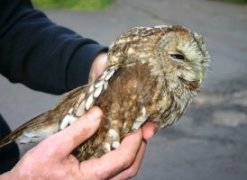
The offences took place on the Lindertis Estate near Kirriemuir, Angus on 8 August 2010. Lindertis Estate is listed as a sporting estate providing pheasant and partridge shooting (see here). A tawny owl was rescued from inside a crow cage trap in a wood on the estate by a member of the public. The owl was reportedly in poor condition (severely malnourished and unable to hold its own bodyweight on its legs) when it was found and it was sent to a vet for treatment. The owl was released back into the wild on 13 August.

The crow cage trap reportedly did not contain food or shelter, and a tray of water contained green algae, and the trap did not have an identification tag, all contrary to the terms of the general licence.

Christie has 24 years of gamekeeping experience and has been employed as a full-time gamekeeper on this estate for approximately 18 years.

Also due to appear in court was Christie’s employer, who according to Burke’s Peerage is a hereditary peer: The Rt Hon The Lord Colyton, although in the court listing his name was given as Alisdair John Munro Hopkinson. Charges against Hopkinson related to allegedly causing/permitting the gamekeeper to use an illegal trap (Wildlife & Countryside Act). However, charges against Hopkinson were not proceeded, perhaps because Christie pled guilty.

This case was prosecuted by one of the new specialist wildlife fiscals, Shona McJannett. She is quoted as saying:

Today’s conviction highlights the importance of ensuring that crow cage traps are operated legally in terms of the general licence. The protection of our wildlife is a priority and a robust view will be taken by the Crown Office and Procurator Fiscal Service in relation to any reports alleging breach of these general licence conditions.”

Now, it’s refreshing news to hear that COPFS will take a ‘robust view’ of this type of wildlife crime and hopefully they will continue to prosecute these cases, but the penalty handed out by the court doesn’t quite match the Fiscal’s view of the seriousness of the offence. Christie’s ‘punishment’ (the admonishment) is effectively no punishment at all. It’s basically a ‘telling off’ (see here for a definition) and because he wasn’t given a more serious penalty (e.g. a fine) it means he is NOT banned from continuing to operate crow cage traps under the general licence. What sort of deterrent is a telling off? What message does this send to other wildlife criminals? Does anyone think Christie will lose his job now he’s got a conviction for wildlife crime?

It is not known whether Christie is a member of the Scottish Gamekeeper’s Association. Anyone interested in finding out can ask the SGA by emailing: info@scottishgamekeepers.co.uk. We would be very interested to learn whether he is a member, and if so, does his wildlife crime conviction mean that he is now barred from the club professional body?

Despite the pathetic ‘penalty’ (can you even call it that?), big kudos to the SSPCA for leading on this investigation, and well done also to COPFS for prosecuting; it’s not often we have cause to congratulate COPFS but on this occasion its deserved.

If you are out and about in the Scottish hills and glens and  come across a trapped raptor caught inside a crow cage trap (or any other trap for that matter), then you should call the SSPCA hotline immediately: 03000-999-999

SSPCA press release here

News article on Deadline News website here

COPFS press release here

See here for another blog on why Christie only got a telling off

STOP PRESS: One of our readers (thank you!) has contacted us to say he thinks this is the same estate that we blogged about last June (see here). Obviously we’re unable to confirm or refute this as the name of the estate in the June blog was kept a big secret, although the location is very similar!

“There does not seem to have been a welfare offence”, says SLE about crow video

The representative body of Scottish landowners, ‘Scottish Land and Estates’ (SLE), has made a statement on its website about the crow-beating incident recorded on video earlier this month (see here, here and here for background info).

SLE writes: “…and despite the impression given by the OneKind film there does not seem to have been a welfare offence…” (link to SLE statement here).

Maybe the SLE people watched a different video to the rest of us, or maybe they think the method of killing was acceptable? Their view is certainly not shared by the 1,993 signatories to the OneKind open letter to the Scottish Environment Minister (see here), and judging by the comments made by the general public on the OneKind website, a lot of people are understandably angry about what they saw in that video (see here to view the comments).

SLE goes on to warn its members about the potential for criminal damage being done to legal traps, cages and snares, and is encouraging them to report any suspicious activity to the police.

Blog readers are encouraged not to take the law into their own hands, but instead, report any suspicious-looking devices or suspected animal welfare incidents to the police and to the SSPCA. (We recomend reporting to both the police and the SSPCA so that the SSPCA can follow-up if the police fail to investigate). There is an excellent guide to help identify a legal trap from an illegal trap on the OneKind website, and we encourage everyone to take a look. The guide can be found here.

Whether you share the SLE’s view or not, a legal decision about whether the gamekeeper’s actions amounted to a welfare offence, or not, will never be known, as the Procurator Fiscal deemed the video inadmissable evidence, and this decision was later supported by the Lord Advocate. Although a private commentator on this blog has suggested that it was not the Fiscal’s role to deem the evidence inadmissable; he thinks that only a Sheriff has the authority to rule on such an issue. If there are any legal experts reading this (and we know there are a few of you!!) we’d be happy to hear your opinion.

Meanwhile, we’ll sit and wait for the Scottish Environment Minister’s response to the questions raised about wildlife crime reporting in Scotland.

No court proceedings for allegedly beating crows to death on scottish sporting estate

Following a comment made on this blog by an investigator from the animal charity OneKind, we would like to draw your attention to a blog on the OneKind website.

The blog, written by the OneKind field investigator, discusses the recent decision by the Crown Office and Procurator Fiscal Service (COPFS), supported by the Lord Advocate, not to prosecute an individual (identified by OneKind as a ‘head gamekeeper’ on a Scottish sporting estate) for allegedly beating crows to death inside a crow trap. The explanation given for this decision not to prosecute is astounding.

OneKind blog here

Convicted gamekeeper Glenn Brown was a member of the National Gamekeepers’ Organisation

Well finally, the National Gamekeepers’ Organisation has responded to one of the many emails we know were sent to them asking whether convicted gamekeeper Glenn Brown was one of their members (see here).

Here is the reply sent to one of our readers today:

From Ann Robinson-Ruddock (NGO) – “Thank you for your enquiry. I can confirm that Mr Brown was a member of the NGO but that following his convictions he has resigned“.

Fascinating. I guess we now know why the NGO has been reluctant to make a public statement on its website since Brown’s conviction in June 2011. Although to be fair, perhaps they’ve waited seven months to see whether his appeal, based on the assertion that he’d been ‘framed’ by the RSPB, was successful. We found out a week ago that his appeal  had failed, some might say spectacularly. Yet still the NGO has failed to make a public statement.

Wouldn’t you expect an organisation, that not only promotes itself as a member of the Partnership for Action against Wildlife Crime, but states on its website that “Our organisation has a strict disciplinary code  and does not tolerate those who bring the gamekeeping profession into disrepute“, to make a big song and dance about publicly condemning Brown’s criminal activities, and making sure that everyone knew he’d been expelled from the organisation? What we get instead is a delayed private response, that says Brown has resigned, and no mention of condemnation or expulsion.

Is there any wonder that conservationists are so cynical when it comes to trusting the sincerity of the National Gamekeepers’ Organisation? At least when twice-convicted gamekeeper David Whitefield was outed as being a member of the Scottish Gamekeepers’ Association in December 2011, the SGA had the sense to immediately and publicly admit that he was a member, outrightly condemn his criminal activities and kick him out of the club (although the phrase they used was ‘suspended’ rather than ‘expelled for good’ – see here). UPDATE: the SGA has now reportedly given Whitefield “a life ban” (see here).

Come on National Gameepers’ Organisation – when the Scottish Gamekeepers’ Association is making you look bad you know your public credibility rating is probably at rock bottom!

Thank you to the contributor who sent us the NGO email and thanks to everyone who contacted the NGO and pressurised them for an answer.

Is he, or isn’t he?

Last Tuesday (24 Jan), Derbyshire gamekeeper Glenn Brown lost his appeal against his conviction for seven offences under the Wildlife & Countryside and Animal Welfare Acts (see here).

On 25 January 2012, we asked whether Glenn Brown was a member (or now an ex-member) of the National Gamekeepers’ Organisation (NGO), and encouraged readers to contact the NGO and ask for themselves. I don’t know about you, but the NGO has so far ignored the email we sent to them about it.

Interestingly, the NGO was very quick to post a statement on its website recently about the conviction of a Norfolk head keeper and his apprentice for animal cruelty offences (see here). The NGO stated that neither of the offenders were members of the NGO, and this statement was posted the day after the two were sentenced (sentenced on 11 Jan, NGO web statement posted 12 Jan 2012). UPDATE 8 FEB 2012: the NGO has now removed the statement on its website about the Norfolk head keeper and his apprentice.

So, why the silence over Glenn Brown? Was he a member of the NGO or not? It’s a simple enough question, isn’t it?

If anyone else wants to ask the NGO, you can contact them at: info@nationalgamekeepers.org.uk

‘Unscrupulous liars’ in the Glenn Brown gamekeeper trial

Following the report that convicted gamekeeper Glenn Brown lost his appeal yesterday (see here), one of the RSPB investigators has blogged about his experience, and that of his colleagues, in the appeal process.
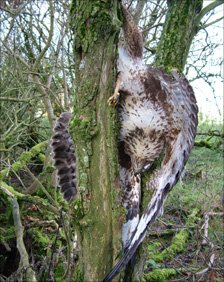
Mark Thomas discusses how he and three other RSPB investigation colleagues (Guy Shorrock, James Leonard and John McMahon) were repeatedly accused of being ‘unscrupulous liars’ by Glenn Brown’s defence team. Not for the first time (see here), the RSPB has been publicly accused of ‘planting evidence’ in order to gain a successful prosecution against a gamekeeper accused of raptor persecution. Also not for the first time, this ridiculous accusation has been found to be completely fabricated. I think we can probably make up our own minds as to the identity of the ‘unscrupulous liars’ based on all the evidence available in the public domain.

Mark Thomas goes on to suggest that the reason for the repeated attacks on the credibility and integrity of RSPB investigators is “…because RSPB Investigations working with the Police and the Crown Prosecution Service is the only dedicated team able to pull off these complex gamekeeper- related investigations and convictions, making us an obvious target“. Well, that’s almost true – in Scotland we also have the expertise of the SSPCA to rely upon – but nevertheless, Mark’s conclusion about why the RSPB is an obvious target is, well, obvious and accurate (see link in above paragraph for multiple examples of unfounded hostility from the game-shooting industry towards the RSPB).

Also included in Mark’s blog is a fascinating PDF that gives the full judgement notes from the judge at Brown’s original trial in June 2011. This really is well worth a read, and full credit to the RSPB for allowing this document to be published.

Mark Thomas (RSPB Investigations blog) here

Full judgement notes from Glenn Brown’s original trial: Glenn Brown full judgement notes June 2011

Convicted gamekeeper Glenn Brown loses his appeal

The RSPB reports that Derbyshire gamekeeper Glenn Brown has lost his lengthy appeal against his conviction for seven offences relating to the illegal use  of a baited trap to take birds of prey, the intentional taking of a sparrowhawk, and numerous animal welfare offences.

Brown was convicted in June 2011 for the offences that took place on the National Trust’s Howden Moor in Derbyshire. Despite the penalties available, he was only given 100 hours of community service and ordered to pay £10,000 costs (see here, here, here and here for background).

According to the RSPB press release, Brown’s appeal, which began on 3 January 2012 at Derby Crown Court, included ‘a blistering attack against the integrity of the RSPB, claiming evidence had been planted to incriminate Brown’. The appeal was dismissed on 24 January 2012 by Judge Watson, who commented on the credibility of the RSPB witnesses. Brown was ordered to pay a further £7,000 costs.

It is not known whether Brown was/is a member of the National Gamekeepers’ Organisation. You can find out by sending an email to: info@nationalgamekeepers.org.uk

RSPB press release here

Joke sentence for second-time convicted gamekeeper

David Alexander Whitefield, the former gamekeeper at Culter Allers Estate in South Lanarkshire, was today sentenced following his December 2011 conviction for illegally poisoning four buzzards (see here for conviction report).

Before we discuss his latest sentence, let’s remind ourselves of Whitefield’s criminal record: This keeper, who was also a member of the Scottish Gamekeepers’ Association, was convicted in October 2008 for offences relating to the unlawful capture and subsequent welfare of a buzzard. His sentence for that conviction was a £300 fine. He kept his job as the sole gamekeeper and he was not expelled from the SGA. Just six months later, in April 2009, RSPB investigators were alerted to the signs of an illegal poisoning spree on this estate. Obviously, these subsequent poisoning activities, for which Whitefield has now been convicted, demonstrate that the £300 fine had zero effect as a deterrent (no great surprise really).

So then you might expect today’s sentence to reflect not only the seriousness of the crime of poisoning wildlife (and potentially any human and/or domestic animals that happened to wander through the well-used public walking trails on this estate), but also to acknowledge that Whitefield, already previously convicted for wildlife crime there, had shown a complete disregard for wildlife legislation.

You might reasonably expect that the sheriff in this case, Nicola Stewart, might utilise her full sentencing powers and go for the most serious sentence available for this type of crime, which includes a custodial sentence and/or a financial penalty for each poisoned bird. That would see Whitefield put away for a while and would send out a very clear message that this type of crime will no longer be tolerated in this country, just as the Scottish Government has claimed over and over again in recent years.

So why then, was Whitefield handed down a 100 hour community service order as his ‘punishment’?

According to an RSPB press release, Sheriff Stewart is reported to have said the punishment was a direct alternative to a custodial sentence and that poisoning is a serious offence. Why was he given a direct alternative to a custodial sentence and where, in his 100 hour community service order, is there any indication that illegal poisoning is considered a serious offence?

This is a joke sentence, to add to all the other joke sentences that have been handed out to the few criminals that are actually prosecuted for these crimes. As we keep seeing, over and over again, these punishments are not providing the required deterrent so surely it’s now time to introduce mandatory sentences for these offences, and that includes custodial sentences. These are already available to the judiciary – so far, for whatever reason, not one custodial sentence has been given to a convicted raptor poisoner. We need to be asking why that is, and we need to keep asking.

Well done to the SSPCA for some serious doggedness with this case – it’s been a long time in the works and looked at one point to be in danger of failing on a legal technicality. Perseverance paid off, and despite the pathetic sentence, those involved with the groundwork deserve much credit.

BBC news article here

RSPB Scotland press release on Birdguides Blog here

Howden Moor sporting tenant is a Purdey Award winner

Following the conviction this week of gamekeeper Glenn Brown on the National Trust’s Howden Moor in the Upper Derwent Valley, Derbyshire, the sporting tenant has been named on the Birdguides website as Geoff Eyre (scroll to the comments section under the article).

According to The Moorland Association website, Geoff Eyre won the 2005 Purdey Award for Game and Conservation, for his Howden Regeneration Project. (As an aside, scroll down the page to see another 2005 Purdey Award winner, head gamekeeper Jimmy Shuttlewood from the Snilesworth Estate North Yorkshire – who was later convicted in 2008 with two underkeepers for the use of cage traps to capture birds of prey – story here).

Geoff Eyre has had a lot written about his pioneering work to restore Howden Moor to its former glory as a viable grouse moor. Here in 2006 he spoke about the ‘beneficial’ work of his gamekeeper. Also in 2006, this article was written in The Telegraph about the return and then subsequent loss of a pair of hen harriers on Howden Moor. In 2007, he hosted a visit by a DEFRA Minister for Landscape and Rural Affairs, reported here in The Shooting Times, accompanied by gamekeeper Glenn Brown. The Minister was impressed with what he saw, calling the project an ‘inspiration’ and a good use of public money.

One can only assume that Geoff Eyre was completely unaware of the criminal activities of his gamekeeper. You can ask him about it, and whether Brown has been sacked, at National Trust activity days in September 2011 – details here.

More on convicted Derbyshire gamekeeper Glenn Brown’s case

It was good to see so much media coverage following the conviction of criminal gamekeeper Glenn Brown on Monday. It made local, regional, national and international news, probably because he committed his crimes on National Trust property – which isn’t somewhere you’d normally expect to hear about wildlife crime taking place. Let’s hope that the National Trust are reviewing the lease of their land to the ‘un-named third party’ as we speak.

Despite the broad media coverage, very few articles mentioned the dead sparrowhawk that was found close to one of the traps that criminal gamekeeper Glenn Brown was operating.  Also found close by was the body of a white pigeon. Mark Thomas, one of the RSPB investigators involved with catching Brown at it, has written an excellent little piece about the investigation here, alluding to what might have happened to the dead sparrowhawk and dead pigeon.

Thomas also writes that since 2006, goshawk and peregrine productivity in the Derwent Valley has collapsed. By coincidence, gamekeeper Brown is reported to have been employed as a gamekeeper since 2006. Amazing.

Thomas and his colleagues from the RSPB Investigations team deserve a great deal of credit, especially for the innovative techniques they used to catch Brown. So too does Derbyshire Constabulary and the CPS. The resulting punishment for Brown, convicted of seven offences – 100 hours community service – delivered by District Judge Caroline Goulborn (famed for the recent cat-in-the-bin-case) is pathetic, especially when you consider the sentencing options available, which include fines up to £5,000 and a six month prison term for each offence. Had Brown not been ordered to pay £10,000 costs, some might have concluded that he had got off very lightly. Depending on who pays for these costs, and whether he keeps his job as a gamekeeper, some may be certain he got off lightly.