
 Hot off the press from the team who brought you Eagles Could Eat Children (see here), this month’s lesson is all about Why Eagles Don’t Nest on Grouse Moors.
Contrary to the endless scientific papers that show unequivocally that eagles (and lots of other raptor species) are absent from many upland grouse moor areas in the UK due to high levels of persecution, the Scottish Gamekeepers Association has today informed us of the real reason they’re absent:
“Many grouse moors do not have the isolated nesting habitat which is required by eagles so it should come as no surprise they don’t nest there“.
Strange then, that there are ‘many’ (see quote below) unoccupied eagle nesting territories in Scotland where eagles are known to have bred historically, and that these old nest sites just happen to be on land that is managed for red grouse shooting! Here’s a quote from the Golden Eagle Conservation Framework Report that was published by Scottish Natural Heritage in 2008 (available here) –
“The most serious failures to meet favourable conservation status tests were in Natural Heritage Zones in the central and eastern Highlands where less than half of all known territories were occupied. Based on the production of young golden eagles, the populations in these regions should be expanding markedly, but instead they continue to decline (there was a loss of 15 occupied territories between 1992 and 2003, and 86 vacant territories by 2003). This indicates, in the absence of any evidence for emigration, that survival of subadult and/or adult birds is low“.
It’s also strange that before the sentence about ‘many grouse moors do not have the isolated nesting habitat required by eagles’, the SGA tells us this: “A large portion of all eagles fledging takes place on grouse moors across Scotland“. Eh? How can that be, if the habitat ‘isn’t there’?
The SGA article continues with some name-calling (and this from the group who have recently complained to the Scottish Government about how they were being portrayed!) and then some partly-accurate but mostly inaccurate information about siblicide amongst eaglets, before getting in another dig at the Irish Golden Eagle Reintroduction Project (yawn). This all builds up to a grand finale where we’re told:
“If you were to read all the media reports you could be forgiven for thinking that raptors only breed safely on reserves. The truth is there are possibly 500’000 raptors in the UK and 350’000 of them will be breeding successfully on land used for game sport shooting of some kind. This fact is completely ignored by those attempting to take the moral high ground“.
Hmm, I’d be really interested to see the data that this “fact” is based upon. Especially in light of the recently published scientific paper (see here) that shows, again unequivocally, that peregrines nesting on grouse moors in northern England are 50% less successful than peregrines that breed on non-grouse moor habitat.
Interestingly, the SGA article makes no comment about the poisoned buzzard and poisoned bait that was found on Glenlochy Estate and was reported in the media two days ago (see here). The SGA wouldn’t be trying to deflect attention from yet another disgusting and illegal poisoning incident, would they?
SGA article here
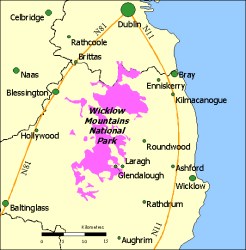 Meanwhile, back in the real world, an article in the Wicklow People yesterday says that a red kite and a buzzard have been found poisoned in County Wicklow, Ireland.
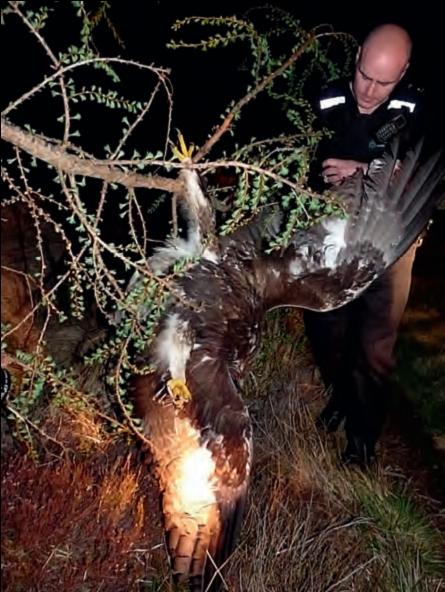 The RSPB has published its annual report on raptor persecution in the UK (Birdcrime 2010). Poisoning reports are down (128 reported in 2010; 153 reported in 2009). Birds confirmed poisoned in 2010 include:
 Well finally, on behalf of the Scottish Government, SASA (Science and Advice for Scottish Agriculture) has published the poisoning figures from the second quarter of 2011 (covering the period from April to June), and guess what? More raptors were illegally poisoned during this period. Seems a bit of a coincidence that these figures have been published four months late and on the very day that people were encouraged to make a Freedom of Information request to SASA to obtain the 2011 poisoning data. Nevertheless, the publication of these data is still welcome and provides us with cold hard facts about the continuing illegal poisoning of our native species.
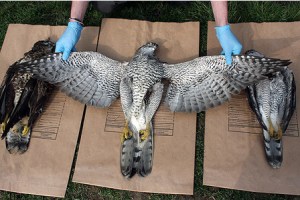 The RSPB has put up a reward of £1,000 for information about the deaths of four goshawks and one buzzard which have been found poisoned in Devon. They were discovered in Forestry Commission woods near to Exeter and had been poisoned with the bannned pesticide Carbofuran.
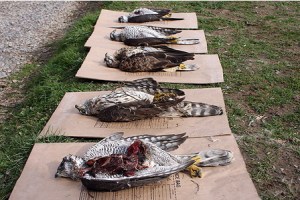 Anyone with information about these crimes is urged to call Crimestoppers, in confidence, on: 0800-555-111, or email Devon & Cornwall Police Wildlife Crime Officer P.C. Josh Marshall directly:
  Police are investigating after four birds of prey were poisoned and dumped in a lay-by in Midlothian, according to a report in today’s Scotsman.
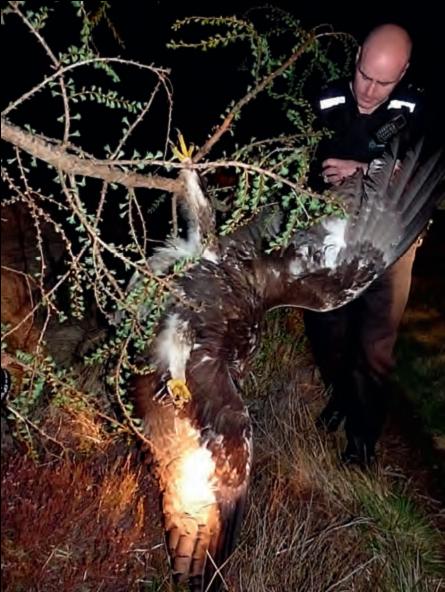 The RSPB has just published its annual report on raptor persecution in Scotland. The report, ‘The Illegal Killing of Birds of Prey in Scotland 2010‘ is the only known published record of all known persecution incidents including poisoning, shooting and trapping, in contrast to the PAW Scotland annual report which only details poisoning incidents. As well as the confirmed incidents of persecution, the report also provides information about ‘probable’ incidents (those where the available evidence points to illegality as by far the most likely explanation but where the proof of an offence is not categorical) and ‘possible’ incidents (where an illegal act is a possible explanation but where another explanation would also fit the known facts).
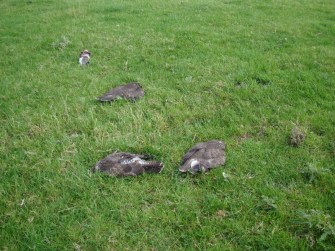 Late last week, three dead buzzards were found next to a suspected poisoned rabbit carcass in an area with a long track record of raptor poisoning incidents. The person who found the dead birds took some photographs before returning home to alert the police. The police allegedly informed him later that night that they couldn’t attend, and instead they asked him to collect the evidence(!). When he returned to the scene, unsurprisingly the three dead buzzards and the suspected rabbit bait had vanished. A dead magpie, perhaps missed by the suspected poisoners, was recovered from the scene and has been sent for toxicology testing.
