Licences to kill buzzards were unlawfully refused, says High Court

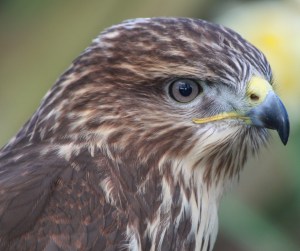
buzzard 3The High Court has this morning ruled that Natural England acted unlawfully when it refused to issue licences to kill buzzards.

In 2013, Natural England issued licences to Northumberland gamekeeper Ricky McMorn, allowing him the right to destroy buzzard eggs and nests ‘to protect’ his pheasant shoots.

Later the same year, McMorn applied for further licences, this time to shoot 16 buzzards and 3 sparrowhawks. Natural England refused his application.

In 2014, McMorn submitted more applications, wanting to shoot ten buzzards ‘to prevent serious damage’ to his pheasant poults. Natural England refused his application again.

McMorn, financially supported by the National Gamekeepers’ Organisation, brought a judicial review against Natural England and claimed NE had acted unfairly and inconsistently when considering his licence applications.

The High Court judge, Mr Justice Ouseley, has agreed with McMorn’s case. He held:

(1)   Natural England had unlawfully operated an undisclosed policy about how buzzard applications were to be treated. Natural England’s undisclosed policy had been to require more factors to be proved and proved by far higher quality evidence than for other species, to require individual birds to be identified as predators with proof that only those would be controlled, and to require any suggestions it made to be carried out punctiliously on pain of refusal;

(2)   Natural England unlawfully took into account public opinion by applying a different and more demanding approach to the grant of a licence to kill buzzards than other species because public opinion is in part hostile to the grant of such licences;

(3)   Natural England unlawfully applied published policy inconsistently as between buzzards and other species. The substantial reason for the difference in approach was some hostile public opinion;

(4)   Natural England’s decision was unreasonable because it operated the derogation under the Birds Directive so as to render it excessively difficult to obtain a licence;

(5)   Natural England acted unfairly in failing to raise with the claimant its own technical assessor’s suggestion of a live capture licence instead of a licence to kill.

The full decision can be read here: Judicial review buzzard licence verdict Nov 2015

So what does this all mean? For sure, this ruling will encourage more gamekeepers to submit more applications to kill buzzards ‘to protect’ their pheasants. It doesn’t mean that all licence applications will be successful, as each case will still have to be assessed on its individual circumstances and all tests will still have to be met (e.g. has the gamekeeper done everything else in his/her power to solve the perceived problem?). Nevertheless, Natural England will no doubt be wary of appearing ‘unreasonable’ when assessing future applications. This is where things will get really interesting because there is still no scientific evidence to demonstrate that buzzards have a significant impact on pheasants. Indeed, even the game-shooting industry’s own science has shown the impact to be virtually negligible, with an average of only 1-2% of pheasant poults taken by birds of prey. There are also numerous alternative measures for reducing alleged predation that should be tried and tested before the ‘kill’ option is chosen, including diversionary feeding.

If, however, buzzard-killing licences are issued, this will pave the way for what is effectively a criminal’s charter. The game-keeping industry is rife with criminals who are not averse to breaking the law; we see it time and time again, particularly in relation to the illegal killing of raptors. Let’s say a gamekeeper successfully applies for a licence to shoot ten buzzards. What’s to stop him from shooting 50? Who will know whether he’s shot his permitted ten, or whether he’s shot 50? Who is going to supervise his buzzard-killing activities to ensure that he sticks to his allotted number? Nobody! If a member of the public sees him shooting a buzzard (a highly unlikely scenario anyway but let’s just go with it for now), and reports him to the police, the gamekeeper will simply wave his buzzard-killing licence at the investigating police officer and say, “Look Guv, I’m allowed to kill ten and this is only the third one I’ve shot this year”. The police officer will have no option but to withdraw and let him get on with killing as many buzzards as he likes because it’ll be virtually impossible to prove that the gamekeeper has acted illegally, unless of course the keeper is stupid enough to leave the shot buzzards lying around as evidence, but even then it’ll be impossible to show that that individual gamekeeper had shot all the dead birds – he’ll simply claim someone else did it and dumped them on his ground.

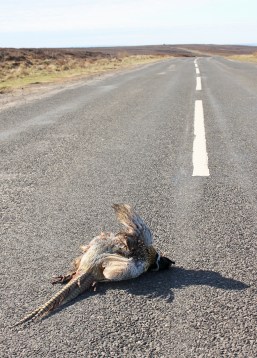
IMG_5013 (2) - CopyAs absurd as it is, the bottom line is that DEFRA (and thus Natural England, acting on DEFRA’s behalf), permits gamekeepers (even those with criminal convictions) to apply for licences to kill protected native species like the buzzard, to allow the wholesale slaughter of millions of non-native gamebirds like pheasants, just for fun. There’s something fundamentally askew with that logic, even if you’re a die-hard supporter of game-bird shooting. A recent analysis of the GWCT’s National Gamebag Census revealed that by 2011, approx 42 million pheasants and almost 9 million red-legged partridges were released annually into the British countryside, for ‘sport’ shooting. The impact on biodiversity of releasing 50 million non-native gamebirds hasn’t been formally assessed. The game-shooting industry should accept that if they’re releasing birds in such magnitude, they should expect losses. How many are killed on the roads? An educated guess would suggest it’s a far higher number than the known 1-2% lost to raptors. If the game-shooting industry can’t operate without accepting such losses (as they claim they can’t), then it’s pretty clear evidence that this industry is unsustainable and as such, has no future.

The National Gamekeepers’ Organisation response to today’s ruling can be read here

We’ll update this blog later today as more responses are published.

Photographs copyright RPS

UPDATE: 15th November 2015: There’s a fascinating blog on the legal issues of this case, written by a legal academic at a London barristers’ chambers – see here.

UPDATE: 19th November 2015: A response to the judgement from the Northern England Raptor Forum – see here.

Previous blogs on this issue:

12 Nov 2015: https://raptorpersecutionscotland.wordpress.com/2015/11/12/licences-to-kill-buzzards-judicial-review-decision-expected-tomorrow/

12 June 2015: https://raptorpersecutionscotland.wordpress.com/2015/06/12/judicial-review-underway-for-gamekeeper-who-wants-to-kill-buzzards/

25 Nov 2014: https://raptorpersecutionscotland.wordpress.com/2014/11/25/buzzard-licence-applicant-gets-high-court-approval-for-judicial-review/

1 Oct 2013: https://raptorpersecutionscotland.wordpress.com/2013/10/01/why-we-dont-trust-the-national-gamekeepers-organisation/ 

26 Sept 2013: https://raptorpersecutionscotland.wordpress.com/2013/09/26/buzzard-licence-applicant-tries-for-four-more-licences/

13 Aug 2013: https://raptorpersecutionscotland.wordpress.com/2013/08/13/natural-england-claims-release-of-buzzard-licence-info-not-in-public-interest/

20 June 2013: https://raptorpersecutionscotland.wordpress.com/2013/06/20/hand-in-of-buzzard-petition-today-at-holyrood/ 

5 June 2013: https://raptorpersecutionscotland.wordpress.com/2014/06/05/natural-england-says-no-to-buzzard-killing-licence/

5 June 2013: https://raptorpersecutionscotland.wordpress.com/2013/06/05/surely-the-buzzard-licence-applicant-doesnt-have-prior-convictions-for-poison-offences/

3 June 2013: https://raptorpersecutionscotland.wordpress.com/2013/06/03/buzzard-licensing-turning-up-the-heat/

30 May 2013: https://raptorpersecutionscotland.wordpress.com/2013/05/30/two-important-questions-to-ask-about-the-buzzard-licence-applicant/

25 May 2013: https://raptorpersecutionscotland.wordpress.com/2013/05/25/new-petition-snh-do-not-licence-buzzard-culling-in-scotland/

23 May 2013: https://raptorpersecutionscotland.wordpress.com/2013/05/23/natural-england-issues-licence-to-destroy-buzzard-eggs-nests-to-protect-pheasants/

10 Jan 2013: https://raptorpersecutionscotland.wordpress.com/2013/01/10/the-buzzard-blame-game/

13 June 2012: https://raptorpersecutionscotland.wordpress.com/2012/06/13/buzzardgate-aftermath/

30 May 2012: https://raptorpersecutionscotland.wordpress.com/2012/05/30/defra-backs-down-on-buzzard-management-trial/

24 May 2012: https://raptorpersecutionscotland.wordpress.com/2012/05/24/defra-responds-to-public-outcry-over-buzzard-management-trial/

23 May 2012: https://raptorpersecutionscotland.wordpress.com/2012/05/23/rspb-response-to-defras-proposed-illegal-buzzard-trial/

21 May 2012: https://raptorpersecutionscotland.wordpress.com/2012/05/21/buzzard-management-trial-gets-govt-approval-and-375k-funding/

Licences to kill buzzards: judicial review decision expected tomorrow

The long-running legal battle about Natural England’s refusal to issue a gamekeeper with licences to kill buzzards and sparrowhawks to ‘protect’ his pheasants is due to reach a climax tomorrow.

Northumberland gamekeeper, Ricky McMorn, backed by financial support from the National Gamekeepers’ Organisation, brought a judicial review to challenge Natural England’s decision. The judicial review took place in the High Court (London) over three days in June 2015 and the decision was deferred. We understand the decision is due to be announced tomorrow.

A quick re-cap:

In 2013, Natural England secretly provided Mr McMorn with a licence to destroy buzzard eggs and nests in order ‘to protect a pheasant shoot’ in Northumberland.

Later in 2013, McMorn submitted four more licence applications to Natural England, this time to shoot 16 buzzards and 3 sparrowhawks. Natural England rejected the application.

In 2014, McMorn submitted another licence application, this time to shoot ten buzzards “to prevent serious damage” to pheasant poults. Natural England rejected the application.

We’ve blogged extensively about this issue (see here for a summary).

It’s worth noting that the judicial review concerns whether Natural England acted fairly when rejecting McMorn’s licence applications. McMorn has argued that Natural England has unlawfully acted inconsistently in the way it has dealt with the licensing of buzzards as compared with other species of bird and that Natural England has been unlawfully influenced by public opinion. He has also argued that it was unreasonable for Natural England Directors repeatedly to reverse the recommendations of Natural England’s specialist scientific advisers that a licence should be granted.

The review is NOT about whether DEFRA/Natural England should entertain a licence application from a gamekeeper with a previous conviction for possession of banned poisons (apparently that’s not a problem, according to DEFRA/Natural England), nor whether the National Gamekeepers’ Organisation should expel a member with a conviction for possession of a banned poison (apparently not, according to the NGO), and nor whether there’s any scientific evidence to demonstrate that buzzards (and sparrowhawks) have a substantially detrimental effect on game bird shoots (there isn’t any evidence).

Tomorrow’s long-awaited decision will no doubt be interesting, whichever way it goes.

General licences suspended on four Scottish grouse moors in response to raptor persecution crimes

Yesterday, SNH published the following press release:

General licences restricted in wildlife crime hotspots

Scottish Natural Heritage (SNH) has restricted the use of general licences on four properties in two wildlife crime hotspots – one in Stirlingshire and one in the Borders – this week. The decision was made on the basis of evidence provided by Police Scotland of wildlife crime against birds.

Nick Halfhide, SNH Director of Operations, said:

“There is clear evidence that wildlife crimes have been committed on these properties. Because of this, and the risk of more wildlife crimes taking place, we have suspended the general licences on these four properties for three years. They may though still apply for individual licences, but these will be closely monitored.

“This measure should help to protect wild birds in the area, while still allowing necessary land management activities to take place, albeit under tighter supervision. We consider that this is a proportionate response to protect wild birds in the area and prevent further wildlife crime.”

General licences allow landowners or land managers to carry out actions which would otherwise be illegal, including controlling common species of wild birds to protect crops or livestock.

The new measure complements other recent actions to reduce wildlife crime, including vicarious liability for offences against wild birds, which was introduced in 2011.

Restrictions will prevent people from using the general licences on the land in question for three years. This period will increase if more evidence of offences comes to light.

END

As promised in earlier correspondence with SNH about potential General Licence restrictions (e.g. see here), SNH has published ‘details’ of the current restrictions on its website. Although when we say ‘details’ we use the term loosely. The names of the estates have not been published (but see below) and the specific reasons (crimes) that triggered the restriction orders are also absent.

Instead, SNH has published two maps showing the areas where the three-year restriction orders will be in place.

Restriction order #1 can be viewed here: GL restriction order 1_ Nov 2015-2018

The map denoting the area relating to Restriction order #1 is here:

Raeshaw Corshope GL restriction map 2015

Having consulted Andy Wightman’s brilliant website Who Owns Scotland to check estate boundaries, we now know that the delineated area shown in Restriction order #1 includes parts of Raeshaw Estate and the neighbouring Corsehope Estate.

This is fascinating. Raeshaw Estate is well known to us and continues to be of interest. It is a mixed upland estate combining driven grouse shooting as well as pheasant and partridge shooting. We have documentary evidence that Mark Osborne’s company is involved in the estate management (more on that in the near future). Raeshaw Estate has been raided by the police at least twice (2004 and 2009 – poisoned and shot raptors and poisoned baits – see here) although nobody has ever been prosecuted for these crimes. However, the General Licence Restriction can only be applied for crimes that have been uncovered since 1st January 2014; it cannot be applied retrospectively for offences that took place prior to 1st January 2014. This means that further raptor crimes have been uncovered here but there has not been any publicity about them. Why not? There was news of a shot buzzard found in the nearby area on 24th July 2015 (see here), but this bird was found AFTER SNH had notified the estate of the intention to restrict the General Licence (see here) so this incident cannot be the one that triggered the General Licence Restriction.

Corsehope Estate has not been on our radar, although we’re told by local sources that gamekeepers from Raeshaw Estate are involved with ‘vermin control’ here so now we’re very interested.

Restriction order #2 can be viewed here: GL retriction order 2_ Nov 2015-2018

The map denoting the area relating to Restriction order #2 is here:
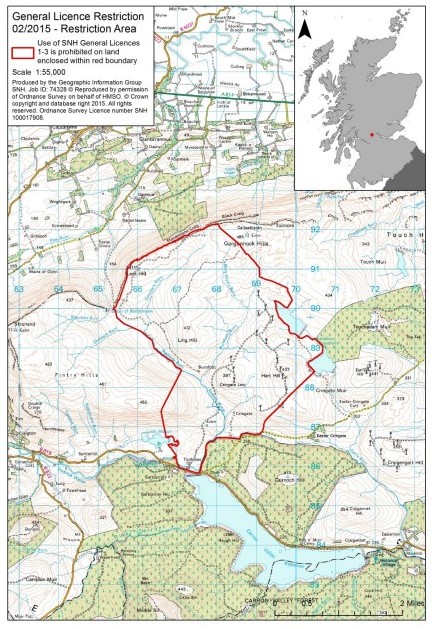
Burnfoot Wester Cringate GL restriction map 2015

Again, consulting Andy Wightman’s excellent website Who Owns Scotland to check estate boundaries, we now know that the delineated area shown in Restriction order #2 includes parts of Burnfoot Estate and Wester Cringate Estate.

This is also interesting. We believe (although it must be stressed that this is educated speculation as SNH has not published the information) that this restriction order probably relates to a series of raptor persecution crimes including a poisoned red kite (July 2014), a poisoned peregrine (February 2015) and an illegally trapped red kite (May 2015) – see here.

So, what do these General Licence Restriction orders mean? Basically, it means that the following activities, usually permitted under General Licences 1, 2 and 3, are now not permitted in the areas shown on the two maps for three years, starting 13th November 2015 and ending 12th November 2018:

The killing or taking of the following species:

Great black-backed gull, carrion crow, hooded crow, jackdaw, jay, rook, ruddy duck, magpie, Canada goose, collared dove, feral pigeon, wood pigeon, lesser black-back gull, and herring gull.

The use of the following methods to kill/take these species are not permitted:

Pricking of eggs, oiling of eggs, destruction of eggs and nests, use of Larsen trap, use of Larsen Mate trap, use of Larsen Pod trap, use of multi-catch crow cage trap, shooting with any firearm, targeted falconry, and by hand.

That sounds great, doesn’t it? But it’s not quite as clear cut as that. As we’ve discussed before, and as is stated in the SNH press release at the top of this blog, although these activities can no longer be carried out in the two denoted areas under the cover of the three General Licences, individuals may still apply for an individual licence to permit these activities, although SNH claims that if granted, these will be “closely monitored”.

What does ‘closely monitored’ actually mean? Closely monitored by whom? Daily inspections by SNH? Police Scotland? That’s hardly going to happen, is it?

Let’s hope that members of the general public, exercising their right to visit these areas under open access legislation, pay close attention to what’s going on around them. If they see a Larsen trap in use, or a crow cage trap in use, or witness any of the above bird species being killed/taken by any of the methods mentioned above, they inform the Police straight away. Actually, let’s hope they forget the police and inform RSPB Scotland and/or the SSPCA instead – they’re more likely to get a quick response from them.

It’ll be interesting to see how this all pans out. On the one hand, we welcome these Restriction orders and applaud the Scottish Government (especially former Environment Minister Paul Wheelhouse for initiating them), SNH and Police Scotland for pursuing what we hope will be the first of many such Restriction orders. But on the other hand, will these restrictions be anything more than a minor inconvenience to the estates involved because they can simply apply for individual licences to continue their game-shooting activities? We’ll have to wait and see.

RSPB Scotland’s response to the two General Licence Restriction orders here

As yet no response from Scottish Land & Estates or the Scottish Gamekeepers’ Association but we’ll post them here if/when they comment.

UPDATE 11.50hrs: The SGA has issued the following statement on their website:

On November 4th 2015, SNH announced general licence restrictions to two areas encompassing four properties.
The SGA has issued the following statement in response to questions.

A Spokesman for The Scottish Gamekeepers Association said: “The SGA cannot condone wildlife crime and has a clear and consistent policy regarding this.
“As regards this case, it is our understanding that legal discussions are taking place regarding the areas affected and, therefore, it is not appropriate for us to comment further.”
END
UPDATE 13.20hrs: Statement from Environment Minister Dr Aileen McLeod:

“The announcement by SNH that the use of general licences has been restricted on specified areas of land in the Borders and in Stirlingshire is a result of work that the Scottish Government commissioned in July 2013 as part of a package of measures to combat wildlife crime.

We welcome the progress that has been made with this work. However we have not been involved in the decision-making and do not have any comment on the individual cases in question. The General Licence system is a light touch form of regulation. It is clearly sensible to apply closer scrutiny to areas where there is good evidence that wildlife crime has taken place, and we believe that this will prove a useful tool in the fight against bird of prey persecution.”

Vicarious liability prosecution: Andrew Duncan (Newlands Estate) part 2

Back in August we blogged (here) about a vicarious liability prosecution against Andrew Walter Bryce Duncan of Newlands Estate, Dumfriesshire.

The prosecution against Mr Duncan began after the conviction in August of Newlands Estate gamekeeper William (Billy) Dick, who was found guilty of illegally killing a buzzard by striking it with rocks and repeatedly stamping on it (see here). Dick was sentenced in September and received a £2,000 fine (here). It also emerged that the Newlands Estate was a member of Scottish Land & Estates (SLE) and an accredited member of SLE’s ‘Wildlife Estates Scotland’ initiative (see here).

The vicarious liability prosecution against Duncan continued last week with an intermediate diet at Dumfries Sheriff Court. Prior to that hearing, a provisional trial date had been set for 23rd November 2015.

However, at last week’s hearing the provisional trial date (November) was dumped and now a notional trial diet has been set for 18th January 2016. A notional trial diet just means that a formal trial date is likely to be set at that hearing.

So why the delay in the case against Mr Duncan? It may be because the gamekeeper, Billy Dick, is rumoured to be appealing his conviction, which if upheld could impact on the allegations against Mr Duncan. Although, confusingly, a vicarious liability prosecution is not dependent on the conviction of the person who committed the primary offence, but the prosecutor must demonstrate that the primary offence took place and that the offence was committed by a third party who has a specific relationship to the person being charged with vicarious liability (see here).

Clear? As mud. Guess we’ll have to wait and see what happens with the gamekeeper’s appeal.

Ross-shire Massacre: local MSP tries again for review of police investigation

In November 2014, Dave Thompson, the local MSP for Skye, Lochaber and Badenoch, wrote to the then Cabinet Secretary for Justice, Kenny MacAskill, to ask for a review of how Police Scotland had handled the investigation into the deaths of 22 raptors that had been found poisoned near Conon Bridge (the Ross-shire Massacre). The Police had been severely criticised for their handling of this case, not just for the investigation itself but also for what many of us believed to be an appalling media strategy. We blogged about it here.

Here is a copy of Dave Thompson’s letter to the Cabinet Secretary:

Dave Thompson MSP letter to Justice Sec

We didn’t hear anything further so an FoI was recently submitted to the Justice Department to find out what had happened.

It turns out that in December 2014 Mr MacAskill’s successor, Michael Matheson, had responded to Dave Thompson’s request by stating that he couldn’t comment about a live, on-going police investigation but suggested that Mr Thompson should raise any concerns with the Chief Constable. Here is a copy of Mr Matheson’s letter:

Justice Minister letter

Almost a year on from his first request, and with no sign that the Police investigation has made any progress in the 18 months since the dead birds were discovered (see here), Dave Thompson has now written to the Chief Constable of Police Scotland to urge him to issue an interim report on the first stages of the Police investigation of this case. His second request for a review was no doubt influenced by the recent release of an excellent short documentary video (see here) about the mass poisoning.

Dave Thompson MSP said: “I appreciate the need to await the full review into the investigation, especially as the case is live, and as such, we must be sensitive to the investigative process.

However, I feel enough time has elapsed that the general public are owed an explanation of where the case is at, which is why I have requested an interim review to be issued by Police Scotland, so we can see how the process has been handled in the early stages.

I have written to the Chief Constable and copied in the Chief Superintendent, Julian Innes, and the Cabinet Secretary for Justice, Michael Matheson, on the matter.

I look forward to hearing back from the Chief Constable as soon as is practically possible on what is an issue that still remains a concern to many of my constituents and beyond“.

Here is the transcript of his latest letter:

Dear Chief Constable,

Given the length of time that has passed and the failure to date to bring a culprit to justice, I am writing to ask if Police Scotland could issue an interim report on the first stages of the investigation, perhaps the first six months, into the raptor deaths around Conon Bridge. 

As you know there is considerable public anger at the incident and I believe this would go some way to helping people understand how seriously the Police are taking the investigation and the constraints you may have been under in the early stages.

Yours sincerely

Dave Thompson SNP MSP

END

Red sky on the Black Isle: new film on the Ross-shire Massacre

A short, 12 minute film has been released about the 2014 Ross-shire Massacre, the mass illegal poisoning of 22 red kites and buzzards.

Entitled ‘Red Sky on the Black Isle’, this is an excellent film and includes interviews with some of the key individuals involved with the investigation which, as you’ll know, still remains unsolved 19 months on (see here).

Watch the film here

Rossshire Massacre film

Stody Estate subsidy penalties: another update

IMG_4752 (2) - CopyA year ago, gamekeeper Allen Lambert was convicted of a series of wildlife crime offences on the Stody Estate in Norfolk, including the mass poisoning of birds of prey (10 buzzards and one sparrowhawk) which had been found dead on the estate in April 2013 (see here and here).

We found out that the Stody Estate had received millions of pounds worth of agricultural subsidies (i.e. money given to them from our taxes to help them farm on the condition they look after the wildlife and wildlife habitats under their management) and we wanted to find out whether the Estate would now face a financial penalty in the form of a reduction in their subsidies for what was a very serious breach of the cross-compliance regulations.

One year later and we’re still trying to find out.

In October 2014, the Rural Payments Agency (RPA) told us they “would consider action against Stody Estate“, although one of our blog readers was told, “there is no investigation ongoing” (see here).

In December 2014, one of our blog readers contacted the RPA again to ask for an update. The RPA responded in January 2015 by saying “We are unable to provide you with any meaningful response as we do not hold any information that answers your questions” (see here).

In July 2015, we again wrote to the RPA to ask whether they had imposed a penalty on Stody Estate. We were told that as the convicted gamekeeper wasn’t the actual subsidy recipient, the RPA was trying to determine whether there was “a link” between the convicted gamekeeper and the subsidy recipient (i.e. his employer) and if so, whether the recipient (Stody Estate) could be considered liable for the actions of the gamekeeper (see here). Amazing.

As the one-year anniversary of the gamekeeper’s conviction approached, in September 2015 we wrote to the RPA again to see whether they’d now worked out “a link” between the convicted employee and his employer. Last week they responded with this:

The Rural Payments Agency (RPA) has notified the Stody Estate in Norfolk that a cross compliance breach occurred, as [sic] result of the actions of their gamekeeper. This is because the estate is vicariously liable for the actions of their employees. Under European cross compliance rules, the RPA is obliged to follow-up reports of cross compliance breaches brought to its attention. The rates of applicable reductions are explained in the scheme rules“.

So, the inefficient RPA has taken a year to decide that there was a cross compliance breach, but we still don’t know whether a financial penalty has been imposed, and if it has, what its value is.

According to the RPA’s ‘scheme rules’, cross compliance breaches can be categorised  as either ‘negligible’ or ‘intentional’, and the severity of the penalty is dependent on this.

For negligible non-compliance (falls below the standard of care expected of a competent claimant) subsidy payment is normally reduced by 3% but could range from 1-5% depending on the extent, severity, re-occurrence and permanence of the non-compliance.

For intentional non-compliance, payments will normally be reduced by 20%, but may be reduced to 15% or increased to 100% depending on the extent, severity, re-occurrence and permanence of the non-compliance.

What do you think? Is laying out banned poisons that kill 11 raptors a negligible or intentional non-compliance?

Given that we don’t know how the RPA will determine if the breaches were negligible or intentional, and given that we don’t know how much of our money was awarded to the Stody Estate in 2013 (the year the breaches occurred), although judging by the amounts they received between 2004-2012 it was probably a considerable sum (see here), it’s difficult for us to establish even a rough guesstimate of what the penalty might be, and that’s assuming that the RPA has decided a penalty is warranted.

So, we’ve written, again, to the RPA to ask whether a penalty has been imposed (and if not, why not) and if it has been imposed, how much is it?

Misleading conclusions from Scot Gov’s 2014 wildlife crime report

Wildlife Crime in Scotland 2014 reportYesterday the Scottish Government published its latest report on wildlife crime: ‘Wildlife Crime in Scotland: 2014 annual report’ (see here).

It was accompanied by a Government press release (here) with a headline statement claiming ‘ Recorded wildlife crime dropped by 20 per cent in the period 2013-2014‘. This claim has been regurgitated, without real examination, in much of the national press, which will give the public the impression that all’s going swimmingly in the fight against wildlife crime in Scotland. This couldn’t be further from the truth.

Let’s start with the report’s name. It claims to be the ‘2014 annual report’, but actually the period covered by the report is the 2013/14 financial year: April 2013 to March 2014. That means the majority of the data are from 2013 (9 months worth) – these are wildlife crimes that took place as long ago as 2.5 years and the most ‘recent’ took place 18 months ago (March 2014). Many more offences occurred during the nine months between April-Dec 2014 but they are not included in this report. Although the report itself does explain the reasons behind this odd time-frame selection, the report’s title does not, which means anyone just browsing the headline news will be given a false impression of how recent these findings are. It’s a small point, but it’s an important one.

However, there are bigger issues than just a misleading report title.

If you take the report’s data at face value (which we don’t – more on that in a second) and accept that it’s representative of all reported wildlife crime in Scotland between April 2013 and March 2014, you might also accept that the claim of a 20% reduction in recorded wildlife crime is accurate. But if you look at the data (Table 1), you’ll notice that this supposed broad reduction (i.e. reduction of recorded wildlife crimes in general) is actually almost entirely due to a large reduction in one particular area of wildlife crime: specifically, fish poaching. To then apply this reduction of a specific wildlife crime to all other types of wildlife crime in a broad sweeping statement is wholly misleading.

Our main issue with this report, as with previous reports, is the Government’s insistence on only using crime data that has been recorded by the Police. Although this report does attempt to address this problem by including separate sections on data collected by others (e.g. Scottish Badgers, SSPCA), these data are still not included in the overall analysis of wildlife crime trends because these incidents weren’t recorded on the Police national crime database. A good example of this is shown in Table 10, which details the number of wildlife cases investigated by the SSPCA. The report accepts that cases investigated solely by the SSPCA (as opposed to cases where the SSPCA has assisted the Police) are not included in the ‘official’ recorded crime data because ‘they are not recorded on the police national crime database’. So in effect, 69 cases that were investigated solely by the SSPCA during the period covered by the report are absent from the national figures. It seems bizarre that even though these data are available (of course they are, they appear in this report, albeit in a separate section!) they are still excluded from the main analysis. This blatant exclusion immediately reduces our confidence in the robustness of the ‘national’ data.

Another blatant exclusion of data is demonstrated in Table 17 in the Raptor Persecution section. This table identifies only 16 bird of prey victims from the mass poisoning in March 2014 known as the Ross-shire Massacre, excluding the other six victims that were found. The report justifies this exclusion by explaining that evidence of poisoning was not found after examinations of those six raptors. That’s fair enough, but surely we’re not expected to believe that those six victims all died of natural causes, in the same small area, and at the same time, as the 16 confirmed poisoning victims? They don’t appear in the figures because a crime couldn’t be identified, but they still died as a result of this crime and to pretend otherwise is nonsense.

An additional problem that erodes public confidence in the accuracy of the ‘national’ data is the issue of how carefully wildlife crimes are recorded. A report published earlier this year (which includes part of the period covered by this latest Government report) revealed systemic problems with the under-recording of several types of wildlife crime as well as failures by the police to undertake follow-up investigations on reports of suspected wildlife crimes (see LINK report here). If the police don’t follow up with an investigation, the incident is unlikely to be recorded as a crime. Until these issues are suitably addressed, the accuracy of ‘official’ ‘national’ wildlife crime data will inevitably be viewed with suspicion.

So, we don’t have much confidence in this report’s data and we certainly don’t agree with the Government’s claim that (overall) recorded wildlife crime has reduced by 20%, but there are some positives. It’s clear that more thought has been put in to the material contained in this year’s report and there is definitely more clarity about the sources used. That’s good progress.

There are also a couple of things in this report that we are particularly pleased to see.

First, let’s go back to Table 10 (SSPCA data). You may remember (if you have a long memory) that in March 2014, the Government opened its consultation on whether to increase the investigatory powers of the SSPCA. That consultation closed in September 2014 and, over a year later, we’re still waiting for a decision. It’s our understanding that one of the main sticking points is with Police Scotland (who, as you’ll recall, strongly objected to an increase of powers – see here). Apparently, the current sticking point is that Police Scotland are worried that they’ll be excluded from wildlife crime investigations because the SSPCA ‘refuses to work with them’. However, if you look at Table 10, you’ll notice that 50% of all wildlife cases taken by the SSPCA during the period covered by this report were undertaken in partnership with the Police. That’s 50%. Does that look like an organisation that is refusing to work with the Police? It doesn’t to us.

The second point of interest in this report appears in Table 18b. This table provides information about recorded bird of prey crimes between April 2013 and March 2014. Have a look at the 7th entry down:

Species: Hen Harrier

Police Division: Aberdeenshire and Moray

Type of Crime: Shooting

Date: June 2013.

Why is this of particular interest? Well, cast your mind back to January 2014 when we blogged about a vague Police Scotland press release that stated a man had been reported to the Crown Office ‘in relation to the death of a hen harrier’ in Aberdeenshire that took place in June 2013 (see here). So it turns out this hen harrier had been shot. Amazing that it took over two years for this information to be made public. But that’s not the most interesting bit. For this unnamed individual to be reported to the Crown for allegedly shooting this hen harrier means that the Police have some level of evidence that they think links him to the crime. If they didn’t have evidence, he wouldn’t have been reported. So, the alleged crime took place 2.4 years ago. The Crown Office was notified 1.9 years ago. What’s happening with this case? Is there going to be a prosecution? Why such a long delay for a crime that is deemed a ‘priority’ by the Scottish Government?

Ross-shire Massacre: 18 months on

It’s been 18 months since the corpses of 22 birds of prey (16 red kites and 6 buzzards) were found in a small area around Conon Bridge in the Highlands.

We know that 16 of these birds were illegally poisoned (12 red kites & 4 buzzards). Still no word on the other six victims.

Still no word on the type of poison used, although Police Scotland did eventually admit that it was an “illegally-held poisonous substance” (see here). Carbofuran is suspected by many of us (see here).

The details of this illegal mass poisoning have still been deliberately excluded from the quarterly SASA reports – the Government reports that are supposed to inform us about recent illegal poisoning crimes in Scotland.

Police Scotland still maintains that the birds “were most likely not targeted deliberately but instead were the victims of pest control measures” (see here) – even though they can’t possibly know this unless they have a suspect who has given a full confession.

We’re still waiting to hear whether MSP Dave Thompson’s request, back in November 2014, for a review of Police Scotland’s handling of this investigation will be undertaken (see here).

We’re still waiting to hear when the thousands of pounds worth of reward funds, that many of us donated, will be released by Police Scotland so that RSPB Scotland can redistribute them to support the work of their investigations team (see here).

Two months ago in July 2015 MSP Bill Kidd called on Police Scotland to tell the public more about the investigation (see here). We’re still waiting.

18 months on and still no arrests.

18 months on and still no charges.

18 months on and still no prosecution.

18 months on and still no conviction.

18 months on and still no justice.

18 months on and still no confidence in Police Scotland’s ability to solve this appalling crime.

Previous posts on the Ross-shire Massacre here.

Red kite dies after persecution incident ‘near Tomatin’

Reports have emerged this afternoon that a red kite has died after it was found injured ‘near Tomatin’ on 30 August 2015.

According to a BBC news article (here), ‘Police said its injuries did not appear to have been as a result of natural causes’.

According to an article in the P&J (here), ‘Early examinations of the bird have found its death is not due to natural causes’.

In other words, this kite has been illegally killed but apparently Police Scotland is ‘unable to disclose the nature of the bird’s injuries’ (according to the P&J). So the cause of death has not been revealed, and neither has the location where the injured kite was picked up, other than ‘near Tomatin’. Tomatin is in the heart of driven grouse moor country – just put it in to google maps and look at the amount of muirburn strips that surround the village – this region also has a long track record of raptor persecution on a par with other grouse moor regions such as the Angus Glens.

So, another example of an embarrassingly vague Police Scotland statement in relation to the illegal killing of yet another raptor. It’s the latest in a series of similar cryptic police statements relating to the illegal persecution of raptors:

In September 2010 the police issued a vague appeal for information following the discovery of an osprey in the Highlands that died from what they described as “deliberately inflicted injuries“. It was later reported that the bird had been shot (see here).

In June 2013 a similarly cryptic press release followed the discovery of a dead red kite in Aberdeenshire: “After recovery of the carcass, a post mortem was carried out. This revealed that the bird’s death was not by natural causes“. It was later reported the kite had been shot (see here).

In January 2014, we got more of the same after the discovery of a dead buzzard ‘near the village of Tomatin’. Ooh, that sounds familiar, doesn’t it? The press statement said: “Police said an examination of the buzzard suggested it had not died of natural causes” (see here). We still don’t know how it was killed.

In June 2014 there was another one, this time a hen harrier found dead near it’s nest in Muirkirk. The police said: “Whilst at this time we cannot divulge how the bird was killed, we do believe it was the result of a criminal act and we need to establish why this has happened” (see here and here). Guess, what? Turns out it had been shot (see here).

Police Scotland will claim that withholding information about the cause of the death is part of their investigative strategy, because it is ‘specialist knowledge’ that only the perpetrator and any potential witness will know. That’s a legitimate strategy, of course, but given the low likelihood of actually catching anyone for this type of offence it seems like a fairly pointless exercise. It will, though, allow the game shooting lobby to deny all knowledge and refute any suggestion that the bird was killed by anyone associated with that industry.

Marvellous.

So what do you reckon? Is the illegal killing of this red kite going to be the crime that finally jolts the Scottish Government in to taking the oft-promised ‘further action if necessary’? Probably not. We’re still waiting to hear the Minister’s response to a question we posed three weeks ago following the discovery of a shot buzzard in the Borders. We asked her how she defined ‘if necessary’? (see here). Her response should make for an interesting read.

Whatever she says, she really does need to start delivering something tangible, and fast.

Red kite photo by David Tomlinson