Yesterday’s police search for missing satellite-tagged sea eagle ‘Blue X’ was a complete waste of time.
Why? Because Police Scotland invited some gamekeepers (also known as potential suspects) to join the search. Since when has inviting potential suspects to help search for potential evidence of a potential crime been a good idea?
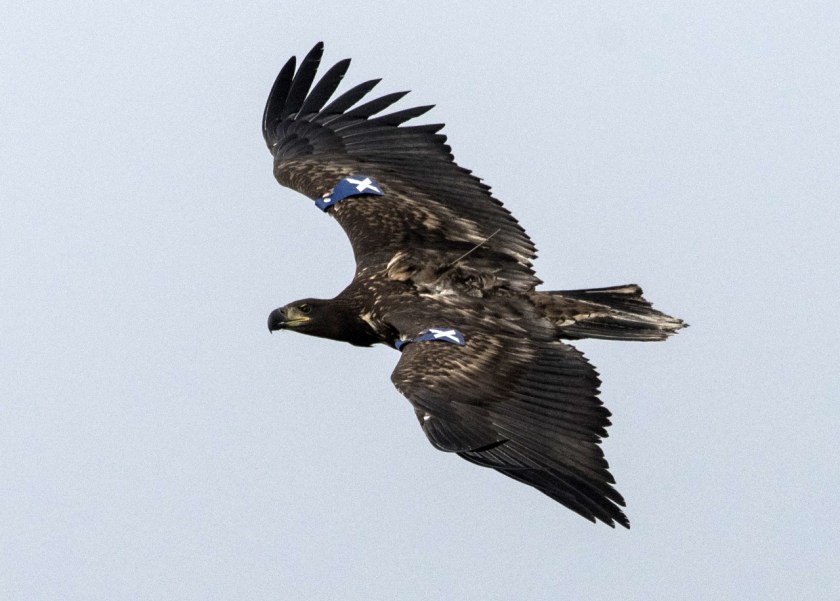
[Photo of white-tailed eagle Blue X, by RSPB Scotland]
Some might think that calling gamekeepers ‘potential suspects’ is a bit harsh, but we’d disagree, and here’s why:
Blue X’s satellite tag had been working perfectly since it was deployed last summer. Suddenly, and inexplicably, it stopped working last month when Blue X was visiting the grouse moor-dominated Glen Quaich, in Perthshire. Had this been the first tagged eagle to ‘disappear’ on a grouse moor in Scotland, then sure, it might be reasonable to assume it was just a rare faulty tag and that nothing untoward had happened to this eagle. But Blue X wasn’t the first sat-tagged eagle to disappear in such circumstances – she is one of over 40 tagged eagles to have mysteriously vanished in recent years, the majority of them on or close to a driven grouse moor. Oh, and Blue X just happened to vanish in an area where three other sat-tagged eagles had also disappeared. Clearly, Blue X’s disappearance was highly suspicious.
[Red stars indicate last known fixes of sat-tagged golden eagles, orange circle denotes area where Blue X vanished; data from Golden Eagle Satellite Tag Review]:
The government-commissioned analysis of where these eagles have been disappearing (mostly on or near to driven grouse moors) was so unequivocally damning that in response to the report, the Scottish Government urgently convened a special panel to review grouse moor management practices with a view to introducing sanctions for those who continue to defy the law. It was the Government’s view (and the view of every other intelligent observer) that some grouse moor gamekeepers were under reasonable suspicion of involvement with the disappearance of these eagles, and thus its reasonable to refer to them collectively as ‘potential suspects’. [NB: this does not imply any level of guilt on any individual; for that, we’d need to see a criminal conviction and as yet there hasn’t been a single successful prosecution for the illegal killing of an eagle in Scotland. Ever.]
You’d think, then, given this bigger picture of eagles routinely disappearing in suspicious circumstances on or near grouse moors, that Police Scotland, on learning of Blue X’s disappearance, would follow the protocol as devised by the Partnership for Action against Wildlife Crime (PAW) to treat this disappearance as suspicious and NOT alert the landowner(s) or their employees prior to any search:
So what did Police Scotland do? Ignored the PAW protocol, notified the potential suspects several weeks ago that a tagged eagle had ‘disappeared’ in the area (thus allowing any potential suspect to hide any potential evidence of a crime) and then invited the potential suspects to ‘help’ on the search several weeks later when the snow had melted. Genius.
If that wasn’t bad enough, the Scottish Gamekeeepers Association issued a press release yesterday, while the search was underway (so against PAW protocol), telling the world that a search was taking place. This information was leaked on Twitter by some half wit, thus allowing any other potential suspect in the area the chance to remove any potentially incriminating evidence.
Is there any wonder there has never been a successful prosecution for the illegal killing of an eagle in Scotland?
Politicians need to be asking some serious questions about this farcical and pointless investigation.
UPDATE 19 April 2018: Deputy First Minister’s constituency a hotspot for ‘disappearing’ sat-tagged eagles (here)
RSPB SCOTLAND ASSISTS IN SEARCH FOR ‘MISSING’ EAGLE
Another satellite tagged eagle has disappeared in highly suspicious circumstances. RSPB Scotland has today (17th April 2018) been assisting Police Scotland in the search for the white tailed eagle in the Glen Quaich area of Perthshire.
Photo of White-tailed eagle ‘Blue X’, by RSPB Scotland
[RPUK map. Red stars indicate last known fixes of satellite-tagged golden eagles that have ‘disappeared’ in suspicious circumstances. Orange circle indicates area of interest. Data from the Golden Eagle Satellite Tag Review, published last year]:
Duncan Orr-Ewing, Head of Species and Land Management at RSPB Scotland said: “This is the fourth satellite tagged eagle (three golden eagles and now one white-tailed eagle) to disappear in highly suspicious circumstances in this very area since 2014. This location around Glen Quaich is dominated by driven grouse moor estates, and has been highlighted previously as a ‘black hole’ for wildlife crime against raptors”.
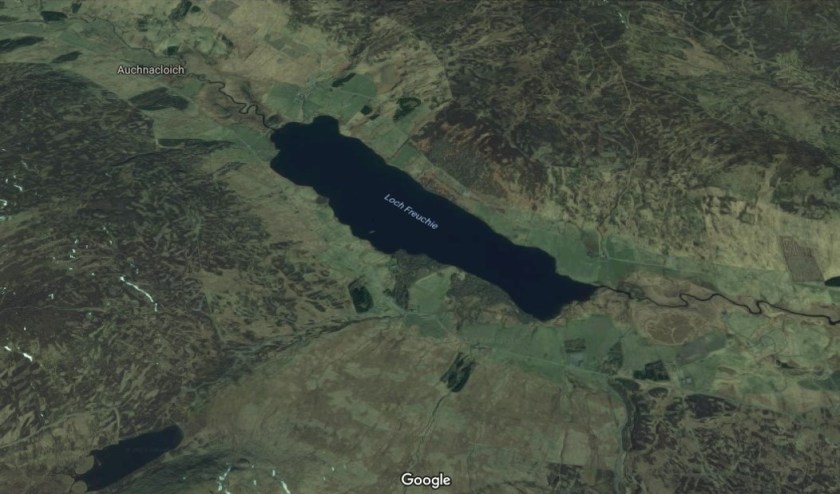
[Google map of Glen Quaich, surrounded by driven grouse moors]
Duncan continues: “A report published by the Scottish Government last May, prompted by the regular disappearance of satellite-tagged eagles, provided unequivocal evidence that the sudden disappearance of these birds when reliable tags suddenly stop transmitting is highly suspicious.
“This is the third of five white-tailed eagle chicks to have fledged from the first successful nest in East Scotland – the product of a Scottish Government-sponsored reintroduction project – to have disappeared in such circumstances, suggesting it has also been illegally killed.
“We call on the Scottish Government to introduce a robust licencing system for driven grouse shooting with sanctions for removal of licences where criminal patterns of behaviour are established to the satisfaction of the authorities. Those that obey the law and conduct their operations within it have nothing to fear from such a regulatory framework.”
ENDS
Eagle Blue X was the 5th chick to fledge from the well known Fife pair. Only one is still alive: one died after landing on power lines (and was recovered for post mortem) and two others disappeared under suspicious circumstances. This is a very high attrition rate for the most important generation in the reintroduction project.
In 2017, 21 volunteers gave up a total of 815 hours to watch the Fife nest and make sure the breeding attempt was successful. They stopped a photographer from continuing to disturb the incubating female and undoubtedly saved the eggs from chilling.
Blue X hatched in 2017 and she was ‘gone’ by March 2018.
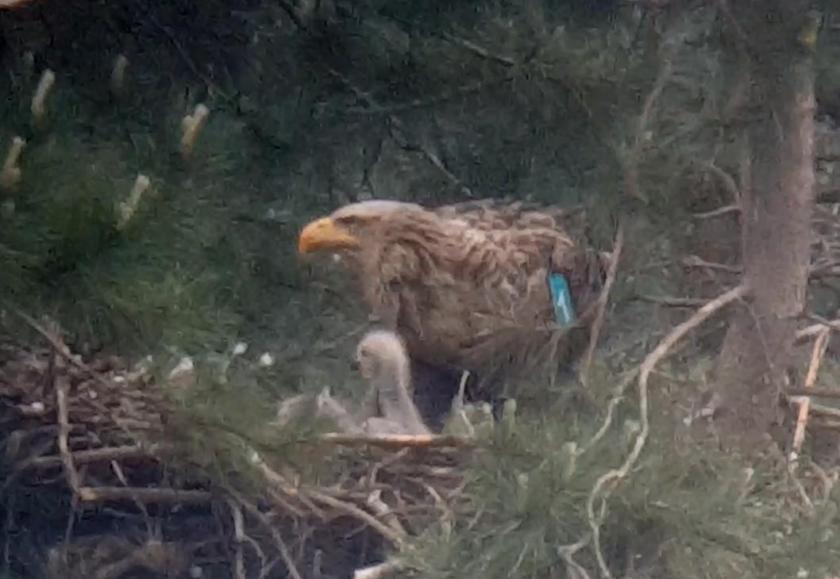
Here she is in the nest as a chick (photo RSPB Scotland). All that effort, for nothing.
For how long do you think the Scottish Government will tolerate this blatant criminality that brings shame and embarrassment to the decent, law-abiding citizens of Scotland?
They’ll tolerate it for as long as we allow them to.
Please, consider writing to Environment Cabinet Secretary Roseanna Cunningham, who undoubtedly will be as appalled as we all are about this ongoing, out of control lawlessness, and ask her to act. Emails to: CabSecECCLR@gov.scot
UPDATE 18 April 2018: Pointless search for missing sea eagle ‘Blue X’ (here)
UPDATE 19 April 2018: Deputy First Minister’s constituency a hotspot for ‘disappearing’ sat-tagged eagles (here)
UPDATE 20 April 2018: “It can’t go on – Mark Ruskell MSP speaks out against illegal raptor persecution (here)
Police Scotland officers at Lanark are seeking the public’s help as they investigate the shooting of a bird of prey.
A deceased buzzard was found near to Station Road in Leadhills. Examination of the bird showed that it had likely been shot, had managed to recover, before then being shot a second time and killed.
Officers are seeking witnesses to any shooting activity which is suspicious.
Those with information on the dead bird are urged to contact police on 101, or Crimestoppers on 0800-55511, quoting incident number 0571 of 03/04/18.
ENDS
There is no information about when this buzzard was found dead although a local source advises it was earlier this year.
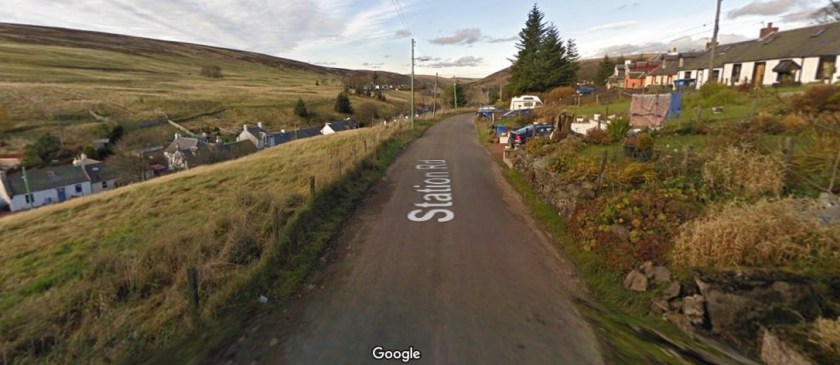
Here is a photo of Station Road, surrounded on either side by the grouse moors of Leadhills Estate:
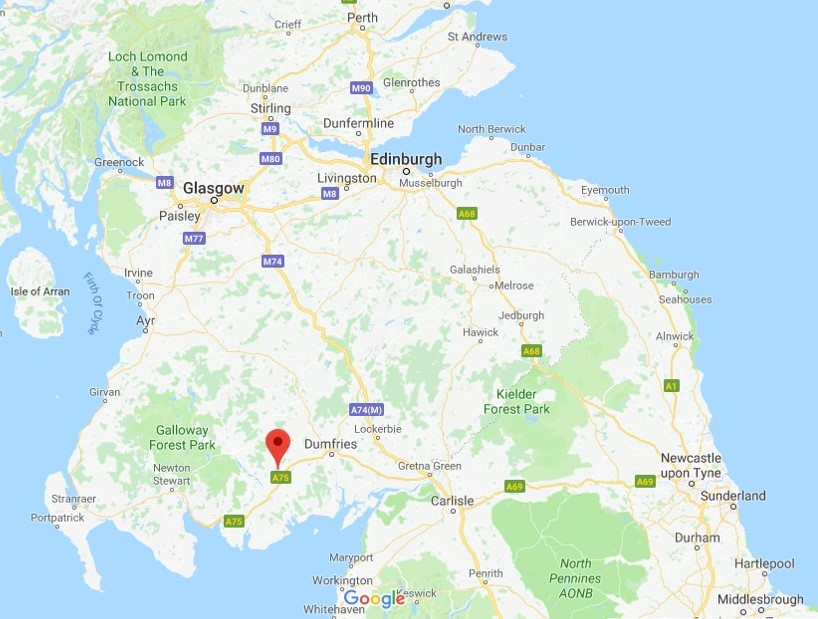
Here is the position of Leadhills Estate (and the neighbouring Buccleuch Estate boundary in red dashes) in south Scotland. [Boundary details from Andy Wightman’s Who Owns Scotlandwebsite]. It’s in close proximity to the Moffat Hills, the proposed release site for the South Scotland Golden Eagle Project, due to begin later this year.
Leadhills is a notorious raptor persecution hotspot, with over 50 confirmed crimes recorded in the area since 2003. Only two of these have ever resulted in a successful prosecution (gamekeeper convicted in 2004 for shooting a short-eared owl; gamekeeper convicted in 2009 for laying out a poisoned bait).
Last year, witnesses reported the alleged shooting of a hen harrier on Leadhills Estate (here) and the alleged shooting of a short-eared owl (here). We’re not aware of any pending prosecutions in relation to these incidents.
We have been waiting to see whether SNH would impose a General Licence restriction but so far SNH has refused to comment, saying it’s not in the public interest to explain these decisions.
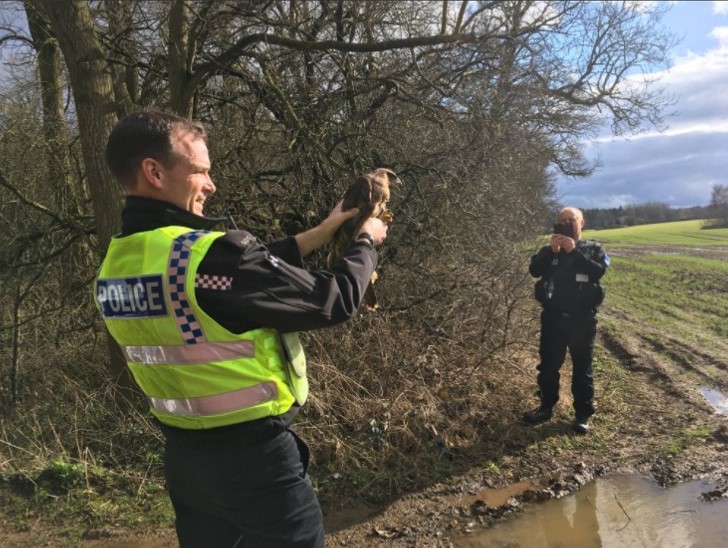
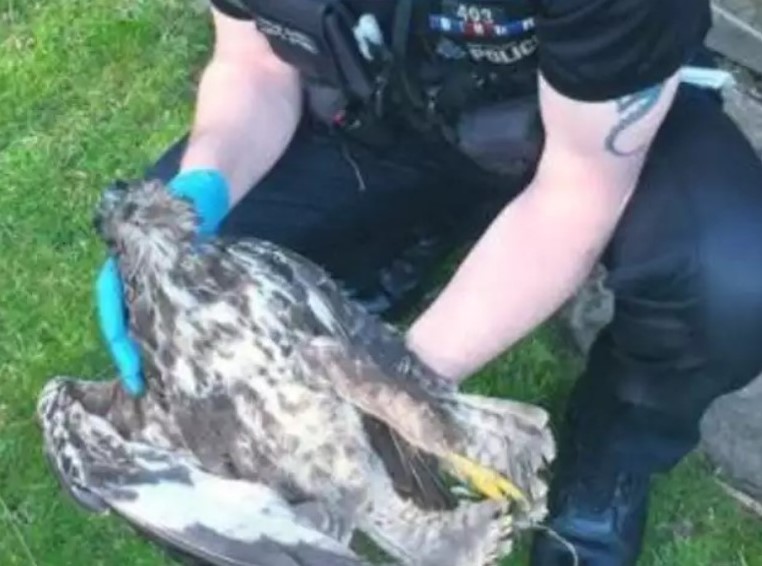
Great partnership working by North Yorkshire Police, RSPCA and Jean Thorpe (Ryedale Wildlife Rehabilitation Centre) resulted in an injured buzzard being released from a trap, rehabilitated and then released back to the wild.
There’s no information about the type of trap, whether it was illegally-set, or the extent of the buzzard’s injuries, but still a job well done by all concerned.
Read the full press release and watch the video of the buzzard’s release on North Yorkshire Police website here
Police Wildlife Crime Officer Jez Walmsley prepares to release the buzzard (photo by Jean Thorpe)
A buzzard has been shot dead in the West Norfolk fens.
A gardener believes he saw a man shoot the protected bird of prey at Boughton, near Downham Market this lunchtime.
It came down near the home of retired insurance broker Paul Coulten, 77, who is now preserving the carcass until it can be examined by police wildlife crime officers.
“My gardener was out walking the dogs on my land when he heard some gunfire,” said Mr Coulten. “The next thing he saw a buzzard come down in the woods and saw a man on a quad bike in the distance.”
Police confirmed the incident had been reported to them and officers had arranged to visit Mr Coulten.
[Photo of the shot buzzard, by Susan Simper]
“I hope someone gets nabbed for it,” he said. “We’re getting fed up with it around here, there are no foxes because they all get shot to death, so I’m hopeful the police will progress it.”
Buzzards are one of our commonest birds of prey. They are frequently seen soaring on their large, broad wings, when warm rising air creates convection currents over woods and farmland.
The species is protected by the 1981 Wildlife and Countryside Act. Anyone convicted of killing one could face an unlimited fine and up to six months’ imprisonment.
Despite this, the RSPB says birds of prey are still persecuted. In 2016 – the latest year for which figures are available – some 40 were shot, including 14 buzzards, 11 red kites, seven peregrines and two hen harriers. Some 22 birds, including 13 buzzards, were also poisoned.
The RSPB, which fears the figures are the tip of the iceberg, says there were no prosecutions during that entire year.
Norfolk is one of the worst areas for bird crime. A total of 262 incidents were recorded between 2011 and 2016 across England and Wales, with 146 of these caused by shooting and 66 by poisoning.
Norfolk recorded the second highest number of incidents at 17 after North Yorkshire at 39.
Its senior investigations officer Mark Thomas said of the latest killing: “Raptor persecution, the illegal killing of birds of prey, is really common, it’s widespread across the UK. What should happen now is it should be X-Rayed, there would have to be an investigation, it’s very likely they’ll find out who’s responsible.”
ENDS
UPDATE 12 April 2018: EDP now reporting the buzzard was not shot (here)
‘WILDLIFE CRIME WILL NOT BE TOLERATED’, SAY SOUTH YORKSHIRE POLICE AFTER BUZZARD IS FATALLY SHOT IN THE HEAD
‘Wildlife crime will not be tolerated in our county’ – that’s the message from South Yorkshire Police after they found a buzzard that had been fatally shot in the head.
The force confirmed yesterday that the buzzard was found dead in the lower part of Hound Hill Lane, Barnsley, with trauma to its head attributed to either a pellet or shot projectile.
Police Constable Mark Winter, Penistone Community Constable and Wildlife Crime Officer said: “Buzzards, being part of the bird of prey family are protected in law and it is quite obviously an offence to shoot, injure or trap one.
This incident has occurred over the last few days and this is an appeal for information to assist with this investigation. Wildlife crime will not be tolerated in our county, please enjoy the countryside safely, responsibly and leave it as you found it”.
Further to yesterday evening’s blog about a dead red kite found in south Scotland in January that “may” have been poisoned (see here), the BBC news article has now been updated (6/4/18) to confirm this bird was definitely poisoned:
POLICE APPEAL AFTER PROTECTED BIRD OF PREY POISONED
Police investigating the death of a protected bird of prey have said it was poisoned.
The body of the red kite was found by a member of the public in the Durham Hill Lane area of Kirkpatrick Durham in Castle Douglas on 20 January.
An investigation has been launched and officers involved in it have appealed for information.
[Red kite photo from Scottish Raptor Study Group]
PC Alan Steel, a specialist wildlife crime officer, said the illegal use of poison can be deadly for wild birds.
He said: “Due to the inherent scavenging nature of red kites, they are particularly vulnerable to the illegal use of poisonous bait.
Red kites are legally protected and Police Scotland works closely with partner agencies, including the Scottish Agricultural College (SAC), Science and Advice for Scottish Agriculture (SASA) and the Royal Society for the Protection of Birds (RSPB) to ensure that those responsible are brought to justice.”
RSPB Scotland’s head of investigations said illegal poison use can also harm pets and people.
“Numbers of detected cases of illegal poisoning of our birds of prey have, thankfully, been very low in recent years, so this case is of serious concern,” Ian Thomson added.
The Galloway Red Kite trail, just a few miles from where this bird was killed, is a popular tourist attraction and of great benefit to the local economy.”
Police investigating the death of a protected bird of prey have said it may have been poisoned.
The body of the red kite was found by a member of the public in the Durham Hill Lane area of Kirkpatrick Durham in Castle Douglas on 20 January.
An investigation has been launched and officers involved in it have appealed for information.
[Red kite photo from Scottish Raptor Study Group website]
PC Alan Steel, a specialist wildlife crime officer, said the illegal use of poison can be deadly for wild birds.
He said: “Due to the inherent scavenging nature of red kites, they are particularly vulnerable to the illegal use of poisonous bait.
Red kites are legally protected and Police Scotland works closely with partner agencies, including the Scottish Agricultural College (SAC), Science and Advice for Scottish Agriculture (SASA) and the Royal Society for the Protection of Birds (RSPB) to ensure that those responsible are brought to justice.”
RSPB Scotland’s head of investigations said illegal poison use can also harm pets and people.
“Numbers of detected cases of illegal poisoning of our birds of prey have, thankfully, been very low in recent years, so this case is of serious concern,” Ian Thomson added.
The Galloway Red Kite trail, just a few miles from where this bird was killed, is a popular tourist attraction and of great benefit to the local economy.”
ENDS
It’s a bit of a strange article, presumably based on a police press release, although we couldn’t find anything on the Police Scotland website.
It’s strange in that it says the kite “may” have been poisoned. Surely, if it was picked up on 20 January, two and half months ago, the toxicology tests will have been done and the results known?
And if poisoning was suspected, why has it taken two and a half months for this news to come out?U
UPDATE 6 April 2018: Red kite now confirmed poisoned (here)
Last Friday we published an update on golden eagle Fred, who ‘disappeared’ from the Pentlands on the outskirts of Edinburgh in highly suspicious circumstances in January.
There have been some predictable responses from certain quarters who probably expect everyone to believe that this is what happened to Fred (many thanks to @gill_lewis for this brilliant cartoon):
The Scottish Gamekeepers Association’s response to the latest news on Fred was this:
Hmm, where to begin. Let’s start with some facts, a concept the SGA seems to struggle with.
First of all, on the accusation that our media coverage has been “shambolic” and that this case has made a “total mockery” of the investigative process for dealing with wildlife crime. Let’s just be clear. We haven’t published any details of this investigation without the express agreement of Police Scotland.
In the SGA’s original press statement on Fred (see here), we were accused of “walking away after presenting judgement to the media“. We didn’t “walk away” at all – we presented further evidence to the police and were asked not to publish it until the police’s special technical analysts had been given an opportunity to examine it. Although we were obviously eager to publish as soon as possible, we fully adhered to the police request as not to do so could have compromised their investigation. There is still information that has not yet been released.
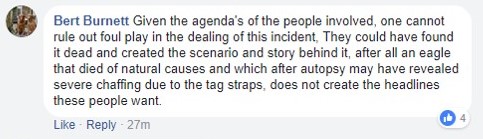
In the meantime, SGA Director Bert Burnett was busily writing outrageous and borderline libellous commentary on social media. He wrote the following on 22 February 2018:
Which leads us on nicely to another statement in the SGA’s latest press statement:
“The SGA has not joined in with theorising on blogs or private social media accounts“.
Really? So how does the SGA explain the following social media posts?
Posted 19th February 2018:
Posted 23rd February 2018:
That seems to be pretty conclusive evidence that the SGA, via its Director, has been quite busy “theorising” about this case, doesn’t it? And not only “theorising”, but also trying to whip up unfounded hysteria by accusing Chris Packham of ‘calling for the wives and children of gamekeepers to become homeless’ and Bert then, ironically, calling for people to lobby the BBC to sack Chris!
‘Ah, but he’s no longer a Director‘ will argue the SGA. That bit, at least, is true – according to documents lodged at Companies House, Bert resigned his Directorship of the SGA on 26th February 2018. However, his social media comments were published prior to the 26th, when he was still an SGA Director. Perhaps this explains Bert’s ‘resignation’? Whatever, who cares.
So after falsely accusing us of commenting inappropriately on a live investigation, the SGA then argues that “…all the evidence in this case should be presented in the open so the truth can be established…”. A good bit of muddled thinking there.
For us, the most revealing section of the SGA’s press statement is this:
“The fact that SNH published a paper on satellite tagged eagles between 2004-2016 has nothing to do with any case happening years later, in 2018.
To suggest otherwise is to institutionalise prejudice against a community of people: Scotland’s gamekeepers. We will not tolerate this and are extremely disappointed and angry that this attitude appears to be at large within some sections of our parliament“.
Sorry, SGA, but the 2017 review on the fate of satellite-tagged golden eagles has EVERYTHING to do with this case. The circumstances of Fred’s disappearance mirror the suspicious circumstances of the other 42+ ‘missing’ golden eagles who have ‘disappeared’ on or near to a grouse moor and whose tags suddenly and inexplicably stopped working despite having a proven reliability rate of 98%. The report demonstrated that tagged golden eagles in Scotland were 25 TIMES more likely to ‘disappear’ in suspicious circumstances than anywhere else in the world where these tags have been deployed on eagles.
It’s no use the SGA now pulling out the victim card and falsely claiming “institutional prejudice”. The facts are clear and have been available for a long, long time to those willing to see.
What’s really interesting is that the SGA’s angry response came just hours after Cabinet Secretary Fergus Ewing’s damning condemnation of the criminals within the grouse-shooting sector who continue to kill birds of prey, including golden eagles. We suspect the SGA’s furious reaction about Fred is more to do with the embarrassing fact that Fergus, the SGA’s long-time cheerleader and main political ally, has spoken so openly and frankly about the ongoing persecution of raptors on grouse moors. The significance of Fergus Ewing’s statement should not be underestimated.
The walls are crumbling and the SGA knows it. It’s just a matter of time…..
NEW INFORMATION REVEALS MORE ABOUT GOLDEN EAGLE FRED’S SUSPICIOUS DISAPPEARANCE
On 21st January, a GPS satellite tag fitted to a young golden eagle called Fred suddenly and inexplicably stopped sending data close to a grouse moor in the Pentland Hills on the outskirts of Edinburgh. Up until that point the tag had been working perfectly and was providing accurate and frequent location information about Fred’s travels.
Photo of Fred by Ruth Tingay:
Strangely, three and half days later, the tag began to transmit again for a short period, but astonishingly, it was in the North Sea, 15 miles offshore from St Andrews. No further GPS data have been received.
Map showing Fred’s movements in the Pentland Hills and the last known position of his tag in the North Sea:
The researchers who had been tracking Fred’s movements (Dr Ruth Tingay of Raptor Persecution UK and broadcaster and campaigner Chris Packham) alerted experts at RSPB Scotland who immediately notified Police Scotland who began an investigation into Fred’s suspicious disappearance.
The analysis of new technical data, provided by the tag manufacturer, has now shed some light on the approximate location of Fred’s tag during those three and a half days of lost GPS transmissions.
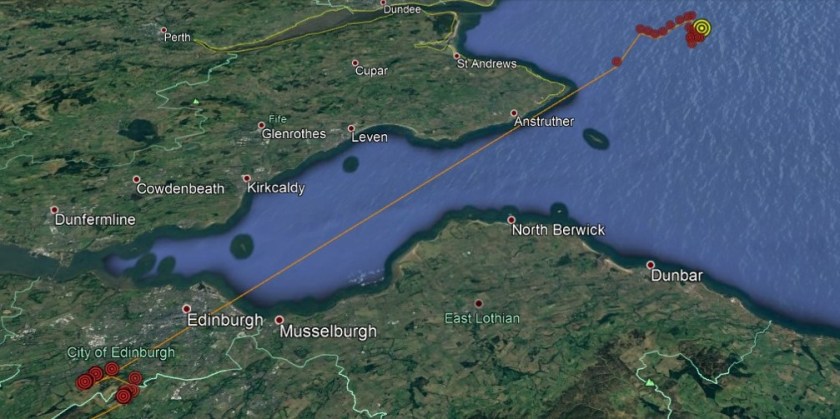
Although the tag’s GPS transmissions were suppressed, the tag’s technical data, which includes time & date, shows that the tag was still functioning and was periodically communicating briefly with a series of mobile phone masts closest to the tag’s then location. These data, that gave locational information for the phone masts, suggest that in the days after Fred’s disappearance his tag moved eastwards away from the Pentlands, along a route similar to that of the Edinburgh City Bypass and subsequently the A1 towards Haddington, before it travelled to the North Berwick area on the East Lothian coast. From there, it is likely that the tag went into the sea as the data then show that the tag began to connect with phone masts along the Fife coast, across the Firth of Forth. Later, the tag was then able, briefly, to resume giving locational GPS transmissions, but by then it was well offshore.
Map showing the phone masts (red dots) with which Fred’s tag was communicating between 21-25 January 2018. The green dot shows the final known GPS position of the tag on 25th Jan. (Map: RPUK)
Dr Tingay said: “That someone might have been travelling around the Edinburgh City Bypass with a dead golden eagle in the boot of a vehicle is sickening.
These new tags we’re using to track golden eagles like Fred offer a highly sophisticated technical opportunity, not just to learn about the eagles’ movements when they’re alive but also, it seems, an insight in to the lengths someone will go to try and remove evidence to cover their crime”.
Chris Packham said: “We don’t know whether this tag was still attached to Fred as it travelled across East Lothian and in to the North Sea but we do know that the tag’s movements are a clear indication of foul play.
Whether it was an amateurish attempt to mask the illegal killing of Fred in the Pentlands by dumping the tag, and possibly Fred, in the North Sea to make it look like he had drowned, we’ll never know. We do know that, once again, we’ve lost a young golden eagle in the vicinity of a grouse moor and nobody will be held to account.
The Scottish Government needs to do more, immediately, to protect Scotland’s birds of prey. It’s crystal clear that raptors continue to be killed and the criminals responsible think they are untouchable”.
Ian Thomson, Head of Investigations at RSPB Scotland said: “This new information makes the probability of Fred’s death being a wildlife crime even more likely.
The continued denials of any suspicion around the case, and attempts at coming up with elaborate alternative versions of events, have been identical to those in virtually every other case where a satellite-tagged raptor has disappeared.
It is a great shame that some representatives of the gamebird shooting industry, who profess to be “true conservationists” and “guardians of the countryside”, are the same individuals who seek more to shoot the messenger than to face up to and marginalise the criminals who exist in plain sight in their community.”
Lothian MSP Andy Wightman said: “The evidence uncovered from Fred’s satellite tag is sufficient to convince me that he died in suspicious circumstances. Further details may never be known but it is beyond contempt that protected species such as Golden Eagles continue to be persecuted across Scotland.
I urge all those who use the Pentlands Regional Park on a regular basis to remain vigilant and am extremely grateful to Dr Ruth Tingay and Police Scotland for their diligence and perseverance in a very difficult case”.
Last year a Scottish Government-commissioned report showed that 41 of 131 satellite-tagged golden eagles had disappeared (presumed dead) in suspicious circumstances in Scotland, predominantly on or near to some driven grouse moors. In response to that report’s findings, the Scottish Government’s Cabinet Secretary for the Environment, Roseanna Cunningham MSP, ordered a review of grouse moor management practices with a view to introducing a licensing scheme for game-shooting estates.
Anyone with information about Fred’s disappearance is urged to contact Police Scotland on 101, or the RSPB’s confidential raptor crime hotline 0300 999 0101.
ENDS
We’ve produced a video about the location of Fred’s tag between 21-25 January:
The new information we’ve been able to retrieve from the tag (as discussed by Chris Packham in the video) deserves a little bit more explanation.
It’s important to understand that the new data do NOT provide detailed GPS locations of the tag – i.e. the new information only tells us which nearby phone mast the tag was communicating with, it does NOT tell us the exact position of the tag when it was ‘talking’ to the phone masts, as the tag’s GPS function was disabled (more on this below).
Nevertheless, the position of the phone masts and the times/dates the tag was communicating with them does show a very clear direction of travel from the Pentlands and out in to the North Sea. For investigative reasons, we are not yet revealing the times/dates those phone masts were ‘pinged’.
The disabling of the tag’s GPS function is interesting. It is surprisingly easy to suppress the tag’s GPS signal. For obvious reasons, we have no intention of providing a description of how to do that, but needless to say you don’t need a Faraday cage or indeed any specialist equipment to block the signal of this particular tag type.
That begs the question, was Fred’s tag deliberately disabled to hide the GPS data transmissions? Let’s assume for a minute that it was. Whoever did that, was smart enough to know how to suppress the GPS signal but not smart enough to know that the tag would still be trying to communicate with the nearest phone mast. Schoolboy error.
An alternative explanation is that the tag was not deliberately disabled at all. Whoever took that tag (and perhaps Fred’s corpse) from the Pentlands might just have been banking on the idea that the tag only sends data at set periods of time inbetween battery-charging periods (as with the Hen Harrier satellite tags), and so they may have thought they could get it to the coast and in to the sea without anybody who was monitoring the tag’s data knowing that something was wrong. They may have decided to dump the tag (and possibly Fred) in to the sea to make it look as though he flew out there of his own accord and simply drowned. Again, schoolboy error. We are not using the same type of tag as those used on Hen Harriers.
We know from reading various, frankly laughable, theories posted on social media over the last few weeks that the majority of commentators have no clue/understanding of (a) the type of tag we are using, (b) the tag’s capabilities, and (c) the high frequency rate that the tag was transmitting data, throughout every day and night.
We’ve released this new information about the route Fred’s tag took from the Pentland Hills to the North Sea in the hope that someone will come forward to help progress the police investigation into Fred’s highly suspicious disappearance. If you know anything, please contact Police Scotland on 101 or the RSPB’s confidential raptor crime hotline 0300 999 0101.
We’d like to put on record our immense gratitude to the two Police Wildlife Crime Officers who have been leading this case. They have gone way above and beyond what we expected them to do (and again, we are not detailing the specifics of their investigation) and they have impressed us with their diligence and professionalism. Many thanks to them for their efforts to date.
We are also grateful to the tag manufacturer and particularly the senior engineers for providing the additional technical data from Fred’s tag and helping us and the police with the analysis.











 Raptor Persecution UK