Blog

Mark Osborne on hen harriers, Mark Avery and Chris Packham

Some of you will be very familiar with the name of sporting agent Mark Osborne. He is feted within the grouse-shooting industry for his ability to turn a ‘poorly performing’ grouse moor in to “something beyond the moor owner’s wildest dreams” (e.g. see here).

Some of you may be more familiar with the names of some of the grouse-shooting estates where Mr Osborne was a shooting tenant (e.g. Leadhills [Hopetoun] Estate in South Lanarkshire), or whose management has been under the control of one of Mr Osborne’s sporting agencies, JM Osborne & Co and William Powell Sporting Ltd, (e.g. Glenogil Estate in the Angus Glens, Raeshaw Estate in the Scottish Borders, Snilesworth Estate in the North York Moors National Park, Park Hall & Hope Woodland in the Peak District National Park [the one where the National Trust pulled the shooting tenant’s lease after an armed man was filmed next to a decoy hen harrier]).

We always enjoy hearing raptor-loving Mark Osborne’s thoughts, especially about hen harriers. Here’s an excerpt from his July newsletter:

The big news in the Grouse world was the Parliamentary debate before Christmas following from Dr Mark Avery’s petition. This has woken many of us up and we now realise that we have got to get our act together if we are to see off the likes of Avery and Chris Packham who seem hell bent on curtailing or indeed banning driven Grouse shooting. I have absolutely no doubt that if they were at all successful in this, they would then turn their attentions to pheasant and partridge shooting. Guns who think otherwise are deluding themselves. We must all get behind this fight even if only a few of us are lucky enough to shoot Grouse. This leads onto the subject on Hen Harriers and it is good news indeed to see major efforts made in the Uplands to increase the number of breeding Hen Harriers on driven Grouse Moors. The Moorland Association who are leading this (alongside Natural England) are to be congratulated on this initiative and I am sure that over the next few years, there will be an increase in numbers, but I doubt that this will do much to satisfy the likes and Avery and Packham whose vitriolic hatred of Grouse Moors and Grouse shooting would seem to have much more to do with class, envy and little the real concern for the Hen Harriers themselves‘.

How perceptive is he, eh? How stupid of us to think that the award-winning careers of Mark Avery & Chris Packham, spanning approx 40 years, have been all about ‘class envy’ and absolutely nothing to do with wildlife conservation.

That argument is about as convincing as the grouse-shooting industry’s commitment to hen harrier conservation.

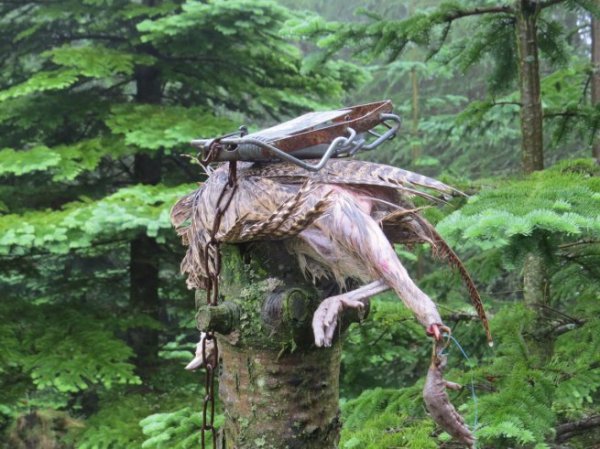
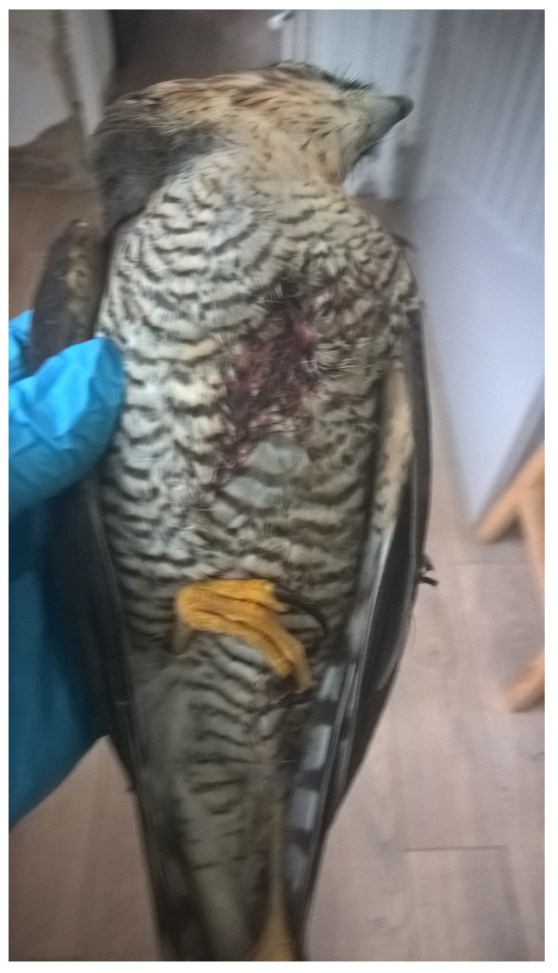
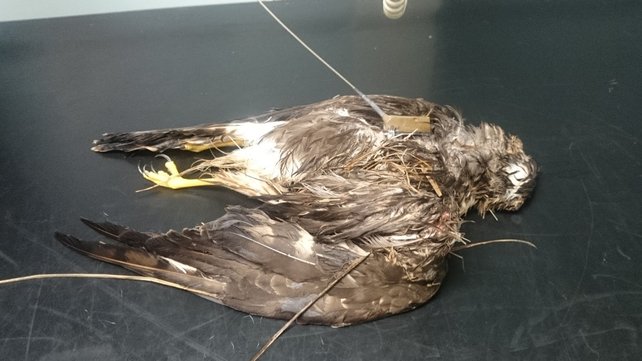
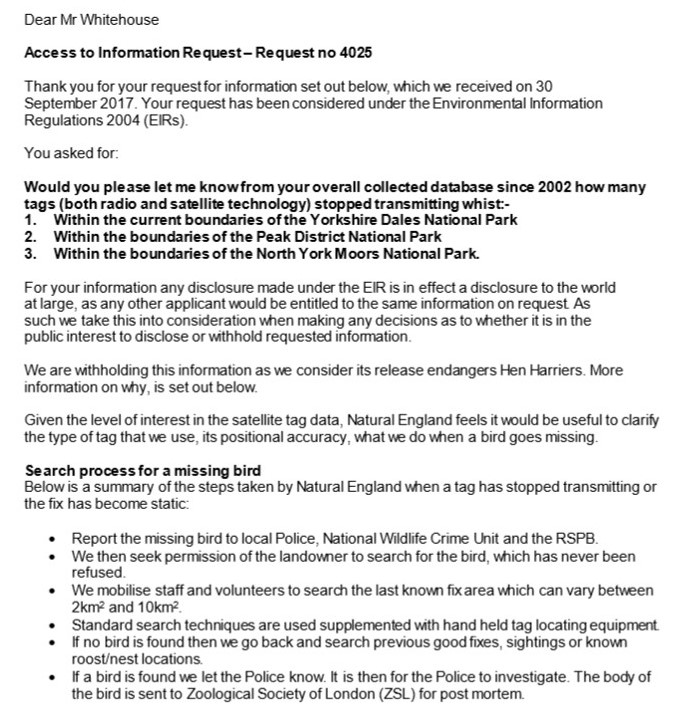
Mark Osborne can toast the Moorland Association and the other Action Plan stakeholders as much as he likes; for most of us, the reality looks a lot different (thanks to Gerard Hobley for the image):

SNH notifies two more estates of intention to restrict General Licence

The ability for SNH to impose a General Licence restriction order on land where there is evidence of raptor persecution taking place came in to force on 1 January 2014. This measure, based on a civil burden of proof, was introduced by then Environment Minister Paul Wheelhouse in response to the continuing difficulties of meeting a criminal burden of proof to facilitate a criminal prosecution.

Whilst these GL restrictions are not without their limitations (because estates can simply apply for an individual licence instead –  see here, but also see here where SNH recently revoked an individual licence for alleged non compliance), Wheelhouse argued that as the restriction notices will be made public, they should act as a ‘reputational driver‘ and to us, that’s still where their value lies.

Since 1 January 2014, SNH has imposed two GL restrictions: one for Raeshaw & Corsehope Estates, and one for Burnfoot & Wester Cringate estates in Stirlingshire. These restrictions began in November 2015 but as regular blog readers will know, Raeshaw & Corsehope made a legal challenge which ended up with a judicial review in January 2017. The court’s decision was announced in March 2017 and SNH was found to have acted properly and lawfully.

Since the findings of the judicial review were made public in March 2017, we’ve been waiting to see whether SNH would notify any further estates of an intention to restrict the use of the General Licence. We’re aware of many raptor persecution incidents that have been recorded since January 2014 that potentially would meet the criteria required for a restriction order.

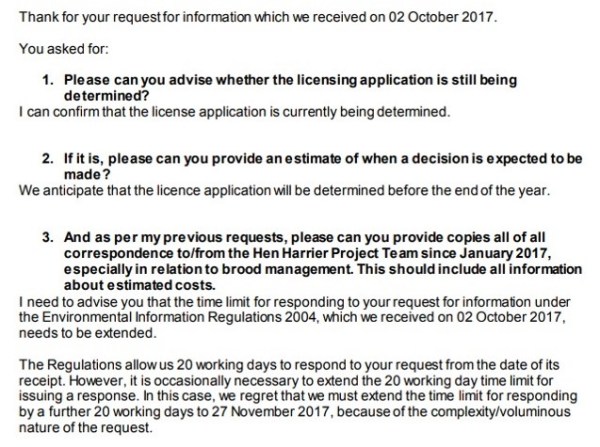
Recently we submitted an FoI to SNH to ask about progress. Here is the response:

As we don’t yet know which estates have been notified, we’ll reserve comment until the final notification decisions have been made, but let’s just say we’re particularly interested in the Aberdeenshire case.

As per the SNH guidelines on restrictions (here), estates have 14 days in which to respond to a notice of intent from SNH. An estate has the right to challenge the decision, which then goes back to SNH for further consideration. If SNH decides to continue with the restriction order, the estate then has another opportunity to appeal, which will be considered by a more senior SNH staff member. The final decision on the appeal should be made within a four week period of SNH receiving notice of an estate’s appeal.

So it’s quite a convoluted process, and we don’t know when, exactly, SNH first notified the two estates of the intention to restrict the General Licence, so we don’t know how far along proceedings have moved. Hopefully we won’t have too long to wait and, as before, if the restriction notices are upheld, we expect SNH will publish the decisions on the SNH website.

Mountain hares killed and dumped in a bin on grouse moor in Peak District National Park

Earlier this month a group called the Hunt Investigation Team (HIT) released disturbing footage they’d filmed during the spring on a grouse-shooting estate in the Peak District National Park (see here). The footage included masked armed men, purportedly gamekeepers, snaring badgers and mountain hares. Derbyshire Constabulary is currently investigating the group’s claims.

HIT have since been releasing other photographs and video footage (see the HIT website here), including the following two photographs appearing to show a bin full of dead mountain hares (and at least one pheasant), presumably killed and now being used as a ‘stink pit’ (midden), where the odour of rotting corpses draws in predators which are subsequently snared, killed and added to the pile.

If you’re a UK tax payer, you are subsidising this gruesome activity (see here).

The mountain hare is listed as a UK Biodiversity Action Plan species (UKBAP), identified as threatened and requiring conservation action. The Peak District National Park Authority has the mountain hare listed as a priority species within the Park and say it is “a locally important species for which we’re taking action” (see here).

How does allowing them to be killed on a grouse moor within the National Park, and then dumped in a bin to be used as bait to catch and kill other wildlife, constitute conservation action?

Emails to Sarah Fowler, Chief Executive of the Peak District National Park Authority: sarah.fowler@peakdistrict.gov.uk

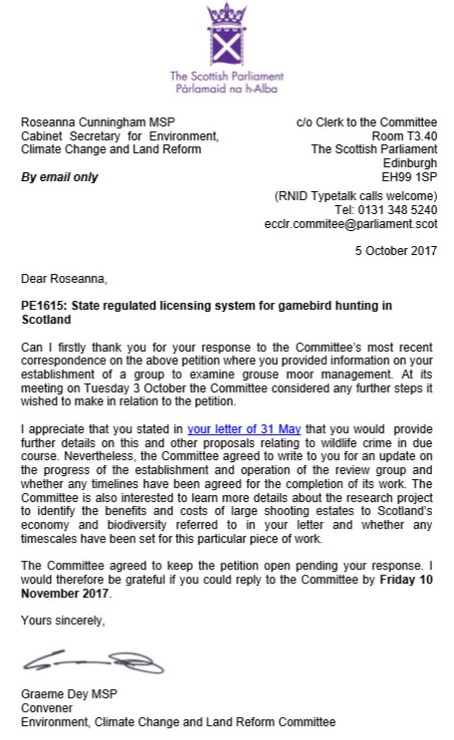
Scottish Raptor Study Group letter in response to estate licensing scaremongering claims

Earlier this month we blogged about two articles that were published in the Scottish Mail on Sunday about so-called ‘draconian’ proposals to introduce a licensing scheme for game shooting estates (see here).

One piece was just a review of various organisations’ positions and the other one was a fairly lengthy comment piece written by Carrieanne Conaghan, a gamekeeper’s wife and coordinator of the Speyside Moorland Group. Carrieanne claimed that the introduction of estate licensing would ‘penalise‘ law-abiding estates, although she didn’t explain how she thought this would work.

Logan Steele, the estate licensing petitioner (on behalf of the Scottish Raptor Study Group) contacted the Mail on Sunday and asked for the opportunity to provide a comment piece in response, especially as Carrieanne had made a number of unsubstantiated (and inaccurate) claims about his motivation for launching the petition. The Mail on Sunday refused (surprise!) but did say he could write a 150-word letter, an option Logan described in a comment on this blog as “a pretty second rate alternative“.

Nevertheless, Logan did submit a letter and it appeared at the weekend. He says it’s been “butchered” (the published version is only 89 words) and they couldn’t even spell his name correctly. Even so, he makes his points well:

A quick bit of background research has led us to believe that Carrieanne’s husband is employed as a gamekeeper at Glenlochy, near Grantown-on-Spey in the Cairngorms National Park. This estate is no stranger to police investigations into alleged raptor persecution (e.g. see here) although nobody has ever been prosecuted. This history, perhaps well before her husband’s employment, might help explain Carrieanne’s concerns about the introduction of an estate licensing scheme.

National Trust to receive petition calling for cessation of grouse shooting

Today (Tuesday 25 July 2017) the National Trust will receive a petition calling for the cessation of grouse shooting on one of their moors in the Peak District National Park.

The petition was launched last year by a newly-formed group called Moorland Vision (see website here). It was triggered by a video we posted on this blog in April 2016 showing an armed man sitting close to a decoy hen harrier on a National Trust-owned moor within the National Park (see here). The National Trust had leased the moor to a tenant for grouse shooting and the moor was supposedly one of several within the Peak District Bird of Prey Initiative – an ambitious partnership plan to restore raptor populations in the region, which unsurprisingly has so far failed to meet its targets.

That video, filmed by two birdwatchers who had the presence of mind to record their observations, led to a police investigation but unfortunately there was insufficient evidence for a prosecution. Many readers of this blog (and others) were infuriated by the content of that video and were frustrated by the lack of criminal proceedings. As a result, the National Trust was inundated with emails calling for the Trust to take action.

A few months later, in June 2016, the National Trust surprised us all by announcing it was to terminate the grouse shooting lease four years early (see here). The tenant was given 22 months notice and is due to leave in April 2018. We viewed this as a significant and welcome move by the National Trust, especially as the decision wasn’t based on the outcome of a criminal prosecution, but rather that the Trust had lost faith in the shooting tenant’s commitment to the National Trust’s upland vision, including the restoration of raptor populations. It was a fantastic example of how public opinion and pressure can effect change.

However, other campaigners didn’t think the National Trust had gone far enough. They wanted to see the removal of the shooting tenancy altogether, rather than the Trust’s idea that a new, more enlightened shooting tenant would be installed in 2018.  This is when the campaign group, Moorland Vision, was formed.

For the last year, members of Moorland Vision have run a local campaign to secure petition signatures calling on the National Trust to remove the grouse shooting tenancy from this moor. They’ve collected nearly 5,000 signatures and have the support of fifteen local organisations:

Derbyshire Ornithological Society, Dark Peak Fell Runners, Darley & Nutwood LNR Management Group, Pleasley Pit Nature Study Group, Sutton-in-Ashfield and District Rambling Club, Ogston Bird Club, Derbyshire Mammal Group, Carsington Bird Club, Wessington Green LNR Management Group, Bakewell Bird Study Group, Buxton Ramblers, Derbyshire Amphibian & Reptile Group, Derbyshire Bat Conservation Group, Stanfree Valley Preservation Group, Derby Natural History Society.

Nick Moyes, the founder of Moorland Vision said: “The National Trust is a major conservation organisation and normally does brilliant work in protecting and enhancing our environment. But with clear evidence that moorland management for grouse shooting leads to the killing of birds of prey and almost every other predator – and especially here on its doorstep – you would think the National Trust would have decided immediately that enough is enough. The fact that it did not immediately recognise the opportunity this provides us with to re-wild and restore these moorlands without the well-documented problems associated with grouse moor management is really disappointing. Hence our petition“.

Bob Berzins from the Dark Peak Fell Runners said: “I and my club members see so much harm done by mis-management on the Peak District moorlands. The worst excesses are definitely on privately-owned shooting estates, where intensive burning, track building, predator snaring and shooting is particularly rife. But this is a one off opportunity for the National Trust to say ‘no more’ to management purely for one hobby and to show its true conservation credentials by establishing a proper rewilding project over 8,000 hectares of iconic moorland which would be far better for biodiversity and would create more natural landscapes – just as the Trust is helping to do on the Eastern Moors where the Peak Park banned shooting many decades ago“.

Congratulations to Moorland Vision for all their hard work over the last year. This is a fantastic grass-roots effort and has done much to increase awareness in the local community and beyond. It’ll be interesting to see how the National Trust responds.

Photo of some of the local campaigners (by Moorland Vision)

Gas gun on Broomhead Estate: an update

Ten days ago we blogged about a gas gun that had been photographed on the Broomhead Estate in the Peak District National Park (see here). This moor is designated as a Site of Special Scientific Interest (SSSI), Special Protection Area (SPA) and Special Area of Conservation (SAC).

The SSSI and SPA designations are, in part, to provide protection for nationally important breeding bird populations, particularly short-eared owls, merlin and golden plover. As such, we believed the use of a gas gun would require consent from Natural England so we asked NE a couple of questions: (a) did the landowner apply for consent?; (b) did NE approve consent and if so, on what grounds? We also asked NE for a copy of the ‘appropriate assessment’.

Many of you also wrote to Natural England (thank you) and NE has now replied with this generic response:

Many thanks for getting in touch; In the case that prompted your enquiry I can confirm that a consent was issued for the use of gas guns to deal with a persistent problem of ravens attacking young lambs. We have contacted the estate who confirmed that although set up the guns have not been used this year. We have asked the estate to remove them as the consent has now expired.

You are right that the use of gas guns in the Peak District within the Protected Site (SSSI) could require Natural England’s consent depending on the specific species notified for that site. As a general rule consent is likely to be required where the following ‘operations requiring Natural England’s consent’ are listed in the notification papers:

  • Erection of permanent or temporary structures
  • Recreational or other activities likely to damage features of biological interest
  • Game management and hunting practice and changes in game management and hunting practice

The use of gas guns within, or immediately adjacent to Protected Sites, notified for their importance for birds requires careful consideration during sensitive periods, for example during the breeding season or where roosting birds are present. Where protected sites form part of the Natura 2000 network a Habitats Regulation Assessment is completed.

In the Peak District consent for gas guns limits use to when they are required, on a reactionary, rather than precautionary approach to deter large groups of juvenile ravens from predating on lambs. Their use is restricted to defined areas and use controlled within those areas to minimise the impact on the notified features. Such restrictions include numbers of gas guns to be used, time which they can be used, buffer zones around nest sites and regular third party monitoring (by the Birds of Prey Initiative for example). The timing of deployment is also restricted to ensure breeding ravens are not disturbed.

Natural England is committed to working with land owners to seek solutions that can both deliver the land owners objectives whilst at the same time protecting important wildlife on the protected site.

Jim

Natural England Enquiries Team

ENDS

 So, this response answers our first question: Did the landowner apply for consent? Yes, he did.
The response attempts to answer our second question: Did Natural England approve consent (yes) and if so, on what grounds?
The response failed to provide a copy of the appropriate assessment.
The idea that Natural England gave consent for the use of gas guns ‘to deal with a persistent problem of ravens attacking young lambs’ is fascinating. According to our local sources, the Dark Peak “is largely raven free”. Indeed, if you look at the latest report from the Northern England Raptor Forum (Annual Review 2015), it says this:
Peak District Raptor Monitoring Group
Extent of coverage: Part upland and part lowland areas
Level of monitoring: Excellent coverage; all or most sites receive annual coverage. Breeding ravens appear to be seriously under-represented in the PDRMG study area. Just two pairs were recorded breeding successfully in the Dark Peak area in 2015. One pair failed at the egg stage. A number of new nests were recorded but there were no birds in attendance and all appear to have failed early. One pair failed at the small young stage in the south west of the Peak District for reasons unknown. However, a further successful pair was recorded by the Group away from the Dark Peak in Cheshire.
We’ve written again to Natural England and asked them, again, to provide a copy of the ‘appropriate assessment’ and/or any other assessment that Natural England staff completed when they approved consent for gas guns on this moor.

Hen harrier ‘reintroduction’ to southern England: Project team visits France

Continuing on from recent blogs (herehere and here) about a series of updates on the proposed ‘reintroduction’ of hen harriers to southern England, here’s some more news gleaned from the latest FoI response from Natural England.

We know from previous FoI responses from Natural England that the Southern England Reintroduction Team has been scouting around looking for a donor population of hen harriers (see here). They’re not allowed to use any hen harrier eggs or chicks that might be ‘brood-meddled’ in northern England so they’ve been looking elsewhere in Europe. The Netherlands, Spain and Poland all said ‘no’ but France seemed to be a distinct possibility, which was a surprise given that the French hen harrier population is showing a long-term declining trend.

Earlier this year Adrian Jowitt (Natural England) wrote to researchers in France about a potential visit. This was to learn more about the captive rearing and release scheme (hen harrier & Montagu’s harrier) that the French have been undertaking for genuine conservation purposes, as the birds are threatened by industrial harvesting machinery before the young are able to fledge the nests in agricultural fields. The French team collects the birds, keeps them in captivity until the harvesting period is over, and then releases them back to the wild once the threat has ended.

Incidentally, the UK grouse-shooting industry often argues that this French conservation project is ‘proof’ that hen harrier brood meddling is a tried and tested conservation tool and they use it as justification for the UK brood meddling scheme. What they don’t seem to understand is that the two situations are incomparable. In France, the threat to the harriers is temporary (just during the crop harvest) and so the birds can be safely released back to the wild whereas in the UK, the threat to hen harriers is year-round, on the grouse moors and, increasingly, at winter roosts. There is no ‘safe’ time to release brood-meddled hen harriers in the UK.

Anyway, back to the France visit. Here’s a copy of Adrian’s email to the French researchers: Planning visit to France_May2017

It makes for quite an amusing read, as Adrian’s choice of words tries to minimise the scale of the problems the proposed project is facing in the UK – he mentions “small pockets of resistance” from some landowners (actually strong enough resistance that the Project Team is now suddenly keen to explore Dartmoor National Park as an alternative release site) but emphasises the ‘positives’ such as the Chair of Natural England declaring that he wants to see more hen harriers in England within the next three years. Yep, that’s what the grouse shooting industry claims too – talk is cheap.

In June this year some members of the Project Team did visit the French project and here’s Project Manager Simon Lee’s thank you email to the French researchers:

Simon says “Let’s not talk of the British politics again“. He probably didn’t mean this in a literal sense, rather it was likely just an acknowledgement that they’d spent a good deal of time talking about it during the visit. But talk of it he, and the rest of us, must, because whether the project is technically feasible or not isn’t the issue here; the ‘politics’ (i.e. legislation & ethics) is still the main issue to be addressed.

We’re not convinced that a reintroduction is legal. The IUCN guidelines are clear: ‘There should generally be strong evidence that the threat(s) that caused any previous extinction have been correctly identified and removed or sufficiently reduced‘. This criterion cannot possibly be met when the current hen harrier population is on its knees, showing no signs of recovery (see results from 2016 national survey), and the main cause of the decline (illegal persecution) has not been dealt with. We used the same argument against the planned re-stocking of golden eagles in southern Scotland, although in that scenario there is a counter argument that golden eagles in the Highlands (the proposed source birds) are just as likely to be killed in the north as they are in the south, whereas hen harriers in France would have much better survival prospects if they remained in France as opposed to being sent to persecution-rife England. (So, sorry, Simon, but your notion that this reintroduction could possibly “benefit European harrier conservation” is just ludicrous).

As for the ethics of reintroducing hen harriers to southern England, well we’ve talked about that over and over and over again. The proposed reintroduction is clearly a plan to move the focus away from the real problem (illegal persecution on grouse moors) – shove a load of hen harriers in the south, hope they survive, and then shout about how the species’ conservation status has improved, whilst ignoring the on-going illegal slaughter in the north. Job done.

And talking of ethics, here’s a rather confusing message from Jeff Knott (RSPB) to the new Southern Reintroduction Project Manager Simon Lees:

While we have said we don’t actively support the reintroduction project, nor are we opposed to it and of course we would want to see it be a success“. Eh?

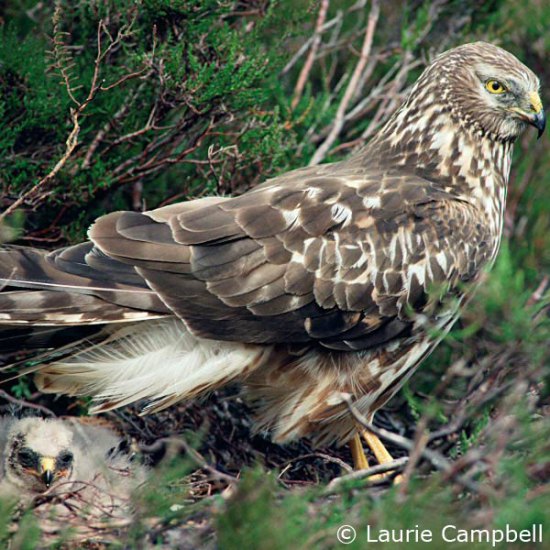
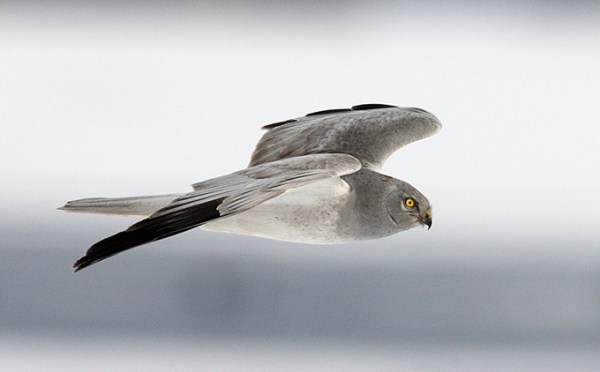
Photo of hen harrier nestlings by Andrew Sandeman.

Hen harrier ‘reintroduction’ to southern England: revised costs

Continuing on from recent blogs (here, here) about a series of updates on the proposed ‘reintroduction’ of hen harriers to southern England, here’s some more news gleaned from the latest FoI response from Natural England.

The estimated cost of a ‘reintroduction’ of hen harriers to southern England has previously been estimated at £515k (see DEFRA’s Hen Harrier InAction Plan).

Since DEFRA’s Inaction Plan was published in January 2016, we haven’t seen any other paperwork relating to these costs, or an explanation of how they were calculated. There was some comment last year from Natural England’s external funding bid, who were asked to provide advice to the Southern Reintroduction Project Team about a potential funding application to the Heritage Lottery Fund, that the final cost was more likely to be in excess of £2 million (see here).

However, in Natural England’s most recent FoI response, the details of a 2013 cost estimate (at the lower end of the scale) has now been released: HH southern reintro estimated project costs 2013

This estimate was described by the author (Ian Carter, who has since left NE) as “back of the proverbial fag packet stuff“. That’s fair enough. With so many project unknowns, it would have been difficult to provide anything more robust at that stage.

Fast forward four years and Natural England is now working to a revised cost estimate. It appears to have jumped from half a million quid to 1.15 million quid, and the only rationale, that we can see, is that this is how much the South Scotland Golden Eagle Project has just secured from the Heritage Lottery Fund:

Hen harrier ‘reintroduction’ to southern England: Dartmoor as potential new release site

Continuing from yesterday’s blog about a series of updates on the proposed ‘reintroduction’ of hen harriers to southern England, here’s some more news gleaned from the latest FoI response from Natural England.

We knew from previous FoIs that Natural England was looking at Wiltshire and Exmoor National Park as the two preferred release sites for translocated hen harriers. These two areas had been identified by an unpublished feasibility study (which in our opinion is a flawed study – see here). The study had initially examined four potential release areas: Dorset, Dartmoor, Exmoor and Wiltshire. Based on multiple assessment criteria, Exmoor National Park was identified as the #1 preferred choice, Wiltshire as #2, Dartmoor as #3, and Dorset was considered unsuitable.

We blogged about Exmoor National Park here and Wiltshire here and there were early signs of some local resistance to the project. The latest FoI response from Natural England reveals that there is still trouble at t’mill in both areas and so now Dartmoor National Park in Devon is being considered as a potential release site.

Local resistance in parts of Wiltshire and Exmoor National Park seems to be coming from those with shooting interests. Some of those involved with pheasant and partridge shooting in Exmoor NP appear to object to the project because it might lead to “undue scrutiny of legitimate activities“. Eh? If the shooting activities are legitimate why would they have any concerns about “undue scrutiny“?

It’ll be interesting to see whether the same concerns are raised by shooting interests in Dartmoor National Park (another popular shooting area). It’s clear that Natural England is hoping that new Project Manager Simon Lee’s contacts in the area will help things along.

Here are the notes from the Southern Reintroduction Team’s last meeting in May 2017 when these issues were discussed:

Hen harrier ‘reintroduction’ to southern England: new project manager appointed

As many of you will know, DEFRA’s Hen Harrier (In)Action Plan was launched in January 2016. We’ve been particularly interested in two of the six ‘action points’: Brood meddling, and a ‘reintroduction’ of hen harriers to southern England.

We blogged recently about how this year Natural England has been refusing to release any more information about the brood meddling plan (see here). Today’s blog (and several to follow) is an update on the southern ‘reintroduction’ project, following the release of various documents under FoI that has taken us seven months to prise from NE.

As a quick recap for the benefit of new readers, here’s what we were able to find out about the southern reintroduction plan last year:

  • That the feasibility/scoping report being used as the scientific justification for a hen harrier reintroduction is flawed (here)
  • Which individuals and organisations are involved with the project group and what the group’s planned work timetable looks like (here)
  • The potential funding options for this project (here)
  • Exmoor National Park as a proposed reintroduction release site (here)
  • Wiltshire as a proposed reintroduction release site (here)
  • From which potential donor countries is NE planning to source hen harriers (here)

So, the first update for this year is that Natural England has appointed a Hen Harrier Southern Reintroduction Project Manager. His name is Simon Lee and he has been an NE employee since 2000, so is probably regarded as a safe, reliable option. Here’s a bit about his career history that we found on an old website:

Simon’s experience working on Dartmoor may well have been a key consideration for this new appointment (that will become clearer in a later blog).

Simon has been busy getting up to speed with the project, having interesting chats (more on this later), visiting a potential donor site in France (more on this later) and, according to this short update he wrote for a recent Natural England Board Meeting, he’ll be helping to establish a technical group to produce a technical project plan. He might be doing other things too but NE redacted the second paragraph:

It’ll be interesting to see who is invited to serve on the technical group. As Mark Avery pointed out at the beginning of the year (here), the composition of the southern reintroduction project group “hardly looks like a list of independent experts“.

More blogs to follow shortly…..