Blog

New rules for bird traps in Scotland

Last week Scottish Natural Heritage (SNH) published some information about its proposed changes to the General Licences, effective from 1 April 2020.

Some of those changes include the removal of some bird species from some licences, and the removal of General Licences from some protected areas (to be replaced by individual licences) but we don’t intend to comment on any of that just now as Wild Justice’s legal team is currently evaluating the lawfulness of the proposals.

However, the news that ravens would NOT be added to the General Licences is very welcome, although we are hearing rumours that the so-called Strathbraan Community Collaboration for Waders (basically a load of gamekeepers) and GWCT might be preparing another application for a specific licence to kill ravens in Strathbraan. Freedom of Information requests have been submitted and we’ll keep you posted.

A considerable war chest is still available from the legal challenge made against the Strathbraan raven cull in 2018 and these funds are ring-fenced which means another legal challenge can be launched with immediate effect if necessary.

Another welcome aspect of SNH’s 2020 General Licences is the decision to register individual operators of bird traps.

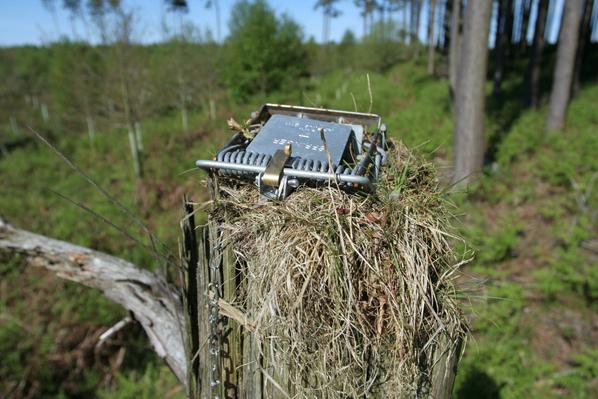
[A multi-catch crow cage trap, baited with a live decoy bird and used to capture hundreds of birds which are then killed, often by being beaten to death with a stick. Photo by OneKind]

Previously in Scotland, the General Licence conditions have stated that live-catch corvid traps (e.g. Larsen traps, Larsen mate traps and multi-catch crow cage traps) have to display an identification number of the trap owner, but this number does not identify an individual trap operator, only the owner, typically the landowner or sporting agent. So if an alleged breach/offence has been detected, and the trap is located on a large grouse shooting estate where multiple gamekeepers are employed, it has been virtually impossible for the Police to identify an individual suspect (and thus charge anyone) because the estate and gamekeepers simply close rank, offer a ‘no comment’ response and fail to identify the actual trap user.

In reality this situation is laughable because very often on large shooting estates gamekeepers are employed specifically to manage a delineated area of an estate, known as a ‘beat’. Their job title is even ‘beatkeeper’ (as illustrated in this January 2020 advert, below) so the idea that, when an alleged offence has been discovered, an individual trap operator at a particular location on an estate can’t be identified is what might be called taking the piss.

Nevertheless, this apparent inability to identify a named suspect has happened time and time and time again, as regular blog readers will be only too aware. It’s why we (e.g. here) and especially the RSPB (e.g. here) have been campaigning for years to have this loophole closed.

The new registration requirements in the 2020 Scottish General Licences still don’t go far enough – there should at least be a requirement for trap operators to submit annual returns so that SNH, and others, can monitor the number of birds killed. But nevertheless, the requirement for individual trap users to be registered is a big step in the right direction. And this level of improved accountability, although still lacking, is way ahead of the General Licences in England and Wales as documented in this timely blog from the RSPB today.

For further information on the Scottish General Licences 2020 see these documents prepared by SNH:

General Licensing Changes Summary – February 2020

General Licensing Changes FAQs – February 2020

Buzzard illegally poisoned in Peak District National Park

A buzzard has been found illegally poisoned in the Peak District National Park.

A poisoned bait (a red-legged partridge) was found close by.

Toxicology tests revealed both the buzzard and the partridge contained the pesticide Alphachloralose.

[The poisoned buzzard. Photo by Peak District Raptor Monitoring Group]

The thing is, this illegally poisoned buzzard wasn’t found in January, or December, or in any other recent month. It was discovered on 14th April 2019.

The police decided, for whatever reason, that it was best to keep quiet about this. There were no public appeals for information and no public warnings that a poisoner was actively placing baits containing dangerous, highly toxic chemicals out in the countryside. Baits that if touched by a child, adult or a dog could result in acute illness and even death.

Two weeks ago the RSPB issued a press statement about this poisoning crime that reads as follows:

BUZZARD POISONED IN PEAK DISTRICT NATIONAL PARK

22 January 2020

A protected bird of prey has been illegally poisoned in one of the UK’s worst raptor persecution blackspots.

In April 2019 a member of the public found a buzzard freshly dead in woodland near Tintwistle, just north of Valehouse Reservoir, in the Peak District National Park. Close by were the remains of a red-legged partridge.

A post-mortem and toxicology tests under taken by Natural England showed that the buzzard and partridge both contained the pesticide Alphachloralose.

Natural England concluded that ‘abuse of chloralose, using a bird bait, has occurred at this location and at least one buzzard has been poisoned’.

All birds of prey are protected by the Wildlife and Countryside Act 1981. To kill or injure one is a criminal offence and could result in an unlimited fine or up to six months in jail. Derbyshire Police were made aware at the time of the discovery and informed of the toxicology result in August.

Alphachloralose is one of the most commonly abused pesticides for illegally targeting birds of prey.

The northern Dark Peak has been the scene of many crimes involving the poisoning, trapping and shooting of birds of prey, making it one of the UK’s worst blackspots, according to the RSPB’s recent Birdcrime report. A scientific article, Raptor Persecution in the Peak District National Park, cemented the link between raptor persecution and land managed for driven grouse shooting in the Peak District National Park.

[Confirmed raptor persecution crimes in the Dark Peak area of the Peak District National Park, 2007-2019. Map produced by RSPB]

Howard Jones, Investigations Officer at the RSPB, said: “The relentless destruction of birds of prey in the Dark Peak needs to stop. This area has become a black hole for birds of prey like buzzards though this is exactly the habitat where they should be thriving. Deliberately poisoning birds is not only illegal but incredibly dangerous to other wildlife, not to mention people and pets. What if a dog or a child had found this and touched it? It doesn’t bear thinking about.”

If you have any information relating to this incident, call Derbyshire Police on 101.

If you find a wild bird of prey which you suspect has been illegally killed, contact RSPB investigations on 01767 680551 or fill in the online form.

ENDS

When you’ve read more of these types of press release than you care to remember, you get a feel for style and content. It seems quite apparent that this is not a joint press release between the RSPB and the police, as so many of them often are. There’s no quote from an investigating police officer, there’s no incident number, and there’s a pointed sentence that Derbyshire Police were informed of the incident in April and updated with the toxicology results in August.

And then there’s this recent blog about the poisoning incident from the Peak District Raptor Monitoring Group, which is a bit difficult to follow because it references unsighted material and various unnamed email correspondents. However, what does seem clear is that someone from the shooting industry is claiming that a police officer said this poisoning incident was suspicious but ‘definitely not illegal persecution’.

Er…..right.

Haven’t we been in this position before, where it looked like deliberate attempts were being made to suppress confirmed raptor crimes in the Peak District National Park?

Let’s hope that isn’t what’s going on here, but nevertheless, there is absolutely no excuse for the police not to have warned the public about the presence of potentially lethal poisonous baits, at the time they were discovered, especially inside one of the country’s most visited National Parks.

UPDATE 16 February 2020: Poisoned buzzard, next to poisoned bait: circumstances ‘inconclusive’ says Derbyshire Constabulary! (here)

UPDATE 23 February 2020: Derbyshire Police respond to criticism over poisoned buzzard investigation (here)

Red Sixty Seven: show some love for the UK’s at risk birds

A new collaborative initiative is about to launch, aimed at raising awareness and funds to help protect the 67 vulnerable bird species currently listed on the UK Red List.

The brain-child of Kit Jewson (@yolobirder), the Red Sixty Seven book draws together 67 writers and 67 artists who have all donated their time and expertise so that 100% of the book profits can be shared between the RSPB and the British Trust for Ornithology (BTO) to further their work on red-listed species.

You can read more about the book on the BTO website (here) and there’s a good write-up in the Guardian (here).

You can pre-order the book (£19.99) here and it’ll be shipped just after Valentine’s Day on 14 February 2020.

You can buy other Red Sixty Seven merchandise here

You can get a preview of the 67 artworks and find out who has written a piece for which species here

The Red List (and thus the Red 67 book) includes three raptor species – white-tailed eagle, merlin and hen harrier:

Show some love, order your copy now!

Revive coalition delivers post-Werritty briefing docs to every MSP in Scottish Parliament

Revive, the coalition for grouse moor reform in Scotland has been busy delivering briefing documents to every member of the Scottish Parliament as we await the Government’s response to Professor Werritty’s recommendations for grouse moor management, published just before Xmas.

In addition to the briefing documents, each MSP received a copy of Revive’s latest report, Untold Suffering, written by coalition members OneKind and League Against Cruel Sports Scotland.

The Untold Suffering report was published in December 2019 and illustrates the industrial scale of animal suffering on Scotland’s grouse moors to sustain the grouse shooting industry. It is believed that tens of thousands of animals are snared, trapped and killed on Scotland’s moors just to ensure that there are more grouse available for sport shooting, although this is only a crude estimate; the precise figures aren’t available because there is no requirement for grouse shooting estates to report on the scale of the killing.

The Revive coalition wanted to highlight this aspect of grouse moor management to MSPs as animal welfare isn’t really covered by the Werritty review but absolutely should be part of the Government’s considerations.

For further information about Revive’s recent activities and how you can support the coalition, please visit here.

Members of the Revive coalition are OneKind, League Against Cruel Sports (Scotland), Common Weal, Raptor Persecution UK, Friends of the Earth (Scotland).

Daily Mail forced to apologise for publishing defamatory ‘extremist’ slur

Last month the Mail Online published a nasty, vindictive article, believed to have been sourced from the loathsome Countryside Alliance.

Written by ‘journalist’ Vivek Chaudhary, it was claimed that Police Detective Superintendent Lou Hubble, Head of the National Wildlife Crime Unit (NWCU) had featured in a video with me and I was described as an “anti-hunt extremist“, as well as an “animal rights extremist“, five times throughout the article.

Here was the original headline:

It’s quite clear that the use of the term “anti-hunt extremist” was used in this context to create a [wholly false] impression of someone who advocates violent and/or illegal action. Add in the words ‘Police chief’ and ‘House of Commons’ and you’ve got a heady cocktail for hysteria.

I complained about the description and asked to see the evidence that’d been used to justify the use of this ‘extremist’ label but I didn’t get anywhere with either the journalist or his editor. After ten days I threatened to escalate my complaint to legal action for alleged defamation – and yes, I had every intention of taking this forward. This resulted in an almost immediate response from the editor, who didn’t apologise but did remove every description of me being an ‘extremist’ and instead referred to me as a wildlife campaigner and a conservation campaigner in a revised version of the article. Here was the new headline:

That was good but it still wasn’t an apology. The editor tried to dissuade me from seeking one because it would mean he would have to refer my complaint to his senior editorial team. I told him I didn’t think it was unreasonable to seek a written apology given the libellous commentary that had been published.

He did pass on my complaint and, presumably having realised they were in an indefensible position, the very next day I received a full written apology from a senior managing editor and the following footnote was added to the (revised) online article:

This is a good result and hopefully those who are routinely the subject of defamatory online commentary will be encouraged to take similar action in future.

However, although the article had included defamatory slurs against me, I was not the direct target of attack. Lou Hubble was the intended victim, presumably because she’s been working to make life difficult for the raptor-killing criminals within the game shooting industry. As a result of this spiteful article in the Mail Online, and the Countryside Alliance making a formal complaint to the Police about Lou’s ‘behaviour’, Det Sup Hubble has found herself at the centre of an investigation by the Police’s professional standards unit.

This is absolutely outrageous, especially as it was based on inaccurate and defamatory accusations. So a hard-working, dedicated and career-focused wildlife cop, whose job it is to develop partnership working relationships with everybody (including the Countryside Alliance!) decided to participate, in her own time, in a video with over 30 other wildlife campaigners and supporters, including BASC(!!), now faces the threat of disciplinary action, and all because the Daily Mail chose to publish some nasty and inaccurate accusations believed to originate from the Countryside Alliance.

The Mail’s subsequent retractions, amendments and apology will be forwarded to the Police’s professional standards unit and hopefully this will draw their investigation in to Lou Hubble to an immediate halt as they’ll see the complaint for the malicious, squalid witch-hunt it so obviously is.

Crowdfunding appeal: Justice for Hen Harriers (the appeal)

Mark Avery’s legal appeal against Natural England’s ludicrous hen harrier brood meddling scheme comes back to court in March (alongside the RSPB’s legal appeal).

Brood meddling is a pointless, costly exercise designed as a sop to the grouse shooting industry. Taking hen harrier eggs/chicks from a grouse moor, rearing them in captivity, then releasing them back in to the uplands will not stop those same hen harriers being illegally killed when they visit another grouse moor.

A bit like this one last year, caught by his leg in an illegally-set trap next to his nest, his leg almost severed. He didn’t survive, despite the best efforts of the Scottish Raptor Study Group and the Scottish SPCA.

[Photo by Ruth Tingay]

Mark has launched a crowdfunding appeal to help cover the costs of his legal appeal. Here’s what he says about it:

The target is £10,500. If you can help please visit the crowdfunder page HERE

Thanks!

Leadhills Estate loses appeal against General Licence restriction

Well this is very welcome news.

The Leadhills (Hopetoun) Estate in South Lanarkshire has lost its appeal to Scottish Natural Heritage (SNH) against a General Licence restriction which had been imposed on the estate after ‘clear evidence of wildlife crime’ was found on the grouse moor.

A quick re-cap:

In late November 2019 Scottish Natural Heritage (SNH) imposed a three-year General Licence restriction on Leadhills Estate, South Lanarkshire, after receiving what it described as “clear evidence” of wildlife crimes from Police Scotland (see herehere and here).

Those alleged offences included the ‘illegal killing of a short-eared owl, two buzzards and three hen harriers’ that were ‘shot or caught in traps’ on Leadhills Estate since 1 January 2014 (when SNH was first given powers to impose a General Licence restriction). SNH had also claimed that ‘wild birds’ nests had also been disturbed’, although there was no further detail on this. The estate has consistently denied responsibility.

[This male hen harrier was found with its leg almost severed, caught in an illegally-set trap next to its nest on Leadhills Estate in 2019. Despite valiant efforts by a top wildlife surgeon, the bird didn’t survive. Photo by Ruth Tingay]

On 10 December 2019 SNH lifted the General Licence restriction due to an on-going appeal by Leadhills Estate against the decision (see here), which meant the estate’s gamekeepers could go back to killing as many so-called ‘pest’ bird species as they liked, under General Licences 1,2 & 3, without any monitoring or reporting requirements whatsoever.

Today, SNH has completed the appeals process and has upheld its original decision to impose the General Licence restriction on Leadhills Estate. SNH issued the following statement:

This General Licence restriction will now remain in place on Leadhills Estate until 26 November 2022, unless the estate tries to challenge SNH’s process via Judicial Review. It means that the estate can continue to kill so-called pest species but it can only do so if SNH grants individual licences to the gamekeepers which will prescribe terms and conditions of use and include a requirement to report on the number and species killed. The estate will also be subject to unnanounced visits by SNH staff to check compliance.

This is a feeble sanction for ‘clear evidence’ of wildlife crime. Although from our point of view it is better than nothing as we can now access any individual licences and the subsequent returns via FoI and gain a better insight in to the extent of [lawful] wildlife killing on this estate.

Of course, had an estate licensing scheme been in place, as recommended by the Werritty Review, Leadhills Estate may well now have been facing a period where it was not permitted to shoot red grouse for a number of years.

Also of great interest to us, now that Leadhills Estate has lost its appeal, is the ongoing relationship between Leadhills (Hopetoun) Estate and Scottish Land & Estates, the moorland owners lobby group in Scotland. We’ve discussed this before (here) – Leadhills is a member of SLE and Lord Hopetoun is Chair of SLE’s Scottish Moorland Group, which is involved in the Gift of Grouse propaganda campaign etc.

We’d like to hear from SLE about whether Leadhills Estate will now be ejected as a member and if not, why not? We’d also like to hear whether Lord Hopetoun will continue as Chair of the Scottish Moorland Group.

Watch this space.

Satellite-tagged hen harrier found poisoned on a pheasant shoot in Ireland

A young hen harrier named Mary that hatched on the Isle of Man in 2019 and had been satellite-tagged by the RSPB’s LIFE Project was found poisoned on a pheasant shoot in Co Meath in Ireland in November 2019. Tests revealed she had consumed the banned poison Carbofuran which was found on a pigeon bait and on other meat baits next to her corpse.

[Hen harrier Mary found dead on a pheasant shoot. Photo by BirdWatch Ireland]

There are a few press releases doing the rounds about this latest killing, one from BirdWatch Ireland (here) and one from the RSPB (here).

There’s also a video documenting the discovery of Mary’s corpse:

Reading between the lines of both media releases there appears to be concern that the National Parks and Wildlife Service (NPWS) and the Gardai (Irish Police) could be doing more in terms of investigation, enforcement and liaison. Without knowing the details of this case it’s difficult to comment further but the pointed commentary in both press releases seems quite deliberate.

In recent years the NPWS has instigated a new monitoring and recording scheme for raptor persecution in Ireland, to which BirdWatch Ireland’s John Lusby alludes in his press quote. It’s worth having a look at the most recent monitoring report (2018) and particularly the long table in Appendix 1 (pages 21-28) documenting the number of recorded persecution incidents between 2007 – 2018; there is clearly a massive persecution issue in the Irish Republic.

Raptor Persecution Ireland 2018 report

This ongoing and relentless persecution affects not only local and regional raptors but, as we have seen with hen harrier Mary, raptors from across our isles that travel without political boundaries. Likewise, a white-tailed eagle from Ireland has recently spent several months in temporary residence in Scotland, the north of England and the Isle of Man, as revealed by his satellite tag data. Amazingly he survived but he could so easily have been unlawfully killed over this side of the water given the extent of the persecution here.

There’s been increasing public pressure on the authorities here to crack down on the illegal killing; let’s hope the same pressure is being felt in Ireland and that the NPWS and Gardai conduct a thorough investigation in to the poisoning of this young hen harrier.

UPDATE 9 JUNE 2020: Poisoned hen harrier ‘Mary’ – open letter calls for action (here)

Shot buzzard found in Peak District National Park

A critically injured buzzard was found at Rushup Edge, near Mam Tor in the Peak District National Park on 13th January 2020.

A veterinary examination revealed shot in the body and a broken wing. Unfortunately due to the extent of its injuries the buzzard had to be euthanised.

Derbyshire Police’s Rural Crime Team issued this appeal for information on Facebook yesterday:

Without any further detail (like seeing an x-ray) it’s not possible to gauge the extent of the buzzard’s injuries and thus estimate how far it might have been able to fly before becoming grounded. However, with a broken wing it’s probably safe to assume that it didn’t fly very far from the area where it was found:

It should be shocking that a protected species has been found illegally shot inside a protected area (a National Park). However, this is the UK, where birds of prey are routinely targeted and killed inside National Parks, and especially inside this one – the Peak District National Park is a notorious hotspot for illegal raptor persecution.

On and on it goes.

With straight faces, shooting orgs profess ‘zero tolerance’ for raptor persecution

Sixty six years after it became illegal to kill birds of prey in the UK, five pro-shooting organisations yesterday issued a statement professing ‘zero tolerance’ for raptor persecution.

For those new to the subject of illegal raptor persecution in the UK this statement might look credible. For those of us who can spot sophistry at 200 yards it’s anything but credible.

You only need read as far as the second sentence of this joint statement to see straight through the greenwash:

“…….and while many reports of such persecution have proven to be false and confirmed cases are decreasing year on year……..” Really?

Actually, here’s an interesting graphic showing confirmed raptor persecution incidents in England & Wales over the five years 2014-2018 (2019 data not yet analysed), from the RSPB’s data hub and accepted by the National Wildlife Crime Unit:

In 2014 there were 58 confirmed incidents

In 2015 there were 58 confirmed incidents

In 2016 there were 69 confirmed incidents

In 2017 there were 62 confirmed incidents

In 2018 there were 72 confirmed incidents

And of course in Scotland we know from the Government’s most recent annual report (2018) that raptor persecution crimes more than doubled on the previous year.

The shooting organisations’ joint statement isn’t fooling anyone. And it’s not like the industry hasn’t claimed ‘zero tolerance’ before, e.g. see here, and yet what we see repeatedly are shooting organisation representatives sneering and ridiculing the RSPB when covert video evidence has been ruled inadmissible in prosecutions for alleged raptor crime (e.g. here), we see high-end barristers (often of QC status) brought in to defend the accused (who pays the legal fees, because they’ll be beyond the gamekeeper’s pocket?) (e.g. here), we get walls of silence from the shooting organisations when clear evidence of raptor crime has been uncovered (e.g. here) and instead of expulsions from shooting organisations following a successful conviction we see statements of support (e.g. here).

What’s probably the most amusing about this joint ploy is reading the ‘further information’ bit where we learn what measures the industry has planned to tackle illegal persecution:

Providing training opportunities for shoots to understand laws that protect raptors‘ – er, it’s pretty straight forward isn’t it? All raptors are protected, don’t kill them. How much more training is required?

Shoot owners, or their representatives, tenants and employees should attend a training course to familiarise themselves with laws that protect raptors‘ – you mean they’re not already familiar with the law that’s been enacted for 66 years?

Delivering a shooting sector awareness campaign on laws that protect raptors‘ – Yes, 66 years is nowhere near long enough for everyone to have got the message.

And perhaps best of all, this:

Continuing to support the collaborative efforts to resolve raptor persecution including as members of the Partnership for Action Against Wildlife Crime and the Raptor Persecution Priority Delivery Group

Would that be the same Raptor Persecution Priority Delivery Group (RPPDG) that these five organisations boycotted last year because they questioned Police Supt Nick Lyall’s integrity as RPPDG Chair and didn’t like the idea of conservation-oriented organisations being invited to join? Is that what they mean by ‘collaborative efforts’.

If you really want to understand just how ‘collaborative’ these organisations have been on the RPPDG then have a read of this damning letter written by Steve Downing, Chair of the Northern England Raptor Forum, written to Det Superintendent Lou Hubble of the National Wildlife Crime Unit who is facing investigation after the Countryside Alliance’s nasty, vindictive complaint about her integrity earlier this month (gosh, anyone seeing a pattern here?). Steve’s letter makes it quite clear why no progress has been made on tackling raptor persecution via the RPPDG.

And hang on a minute – the National Gamekeepers Organisation is a signatory to this joint letter claiming to support the RPPDG but didn’t they actually resign from the RPPDG after the ‘collaborative’ boycott? Ah yes, so they did.

Sorry, BASC, Countryside Alliance, Moorland Association, National Gamekeepers Organisation and Country Land & Business Association – but you’re going to have to do better than this to convince anyone that you’re serious about eradicating illegal raptor persecution. It all just smacks of desperation to avoid incoming regulation – a bit like we saw in Scotland in 2010 when over 200 estate owners wrote to the then Environment Minister Roseanna Cunningham claiming to condemn raptor poisoning at a time when estate licensing was being discussed. Ten years on and Scotland is on the verge of enforced regulation because persecution has continued relentlessly….

UPDATE 12th March 2021: ‘Zero tolerance’ for raptor persecution? They’re fooling no-one (here)