Every report of a shot raptor is shameful, but there’s just something even more senseless about shooting a kestrel.
[Photo by Annette Cutts]
A kestrel has been shot and killed in the Pudsey area of Leeds, West Yorkshire, according to a tweet from West Yorkshire Police’s Leeds Wildlife and Rural Crime Team today.
No further details have been made available yet, i.e. date, specific location or type of weapon etc.
If anyone has any information please contact West Yorkshire Police on 101 and quote the crime reference number #13200496679.
Do you remember back in April, during lockdown, Scottish Greens MSP Andy Wightman secured an amendment to the Coronavirus (Scotland) Bill (Emergency Bill) that meant that ALL muirburn was banned (temporarily, until the emergency regs were revaluated on 30 Sept 2020) (see here). This temporary ban was intended to relieve pressure on emergency services, who frankly had better things to do than attend wildfires that had resulted from poorly-managed muirburning on grouse moors.
And do you remember the Leadhills (Hopetoun) Estate in South Lanarkshire? You know, Lord Hopetoun’s gaffe with it’s very very very long history of people finding illegally poisoned, shot and trapped birds of prey, illegally-set traps and poisoned baits on the estate? A history that continues and has resulted in the estate currently being the subject of a three-year General Licence restriction after Police Scotland told licensing authority SNH there was ‘clear evidence’ of ongoing wildlife crime, although insufficient evidence to identify an individual suspect (see here).
Well, that information provides the backdrop for the next few blogs about Leadhills Estate.
Jaw-dropping audacity on every level.
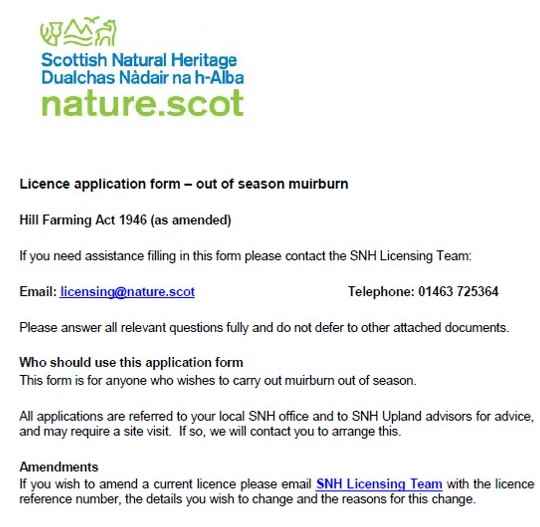
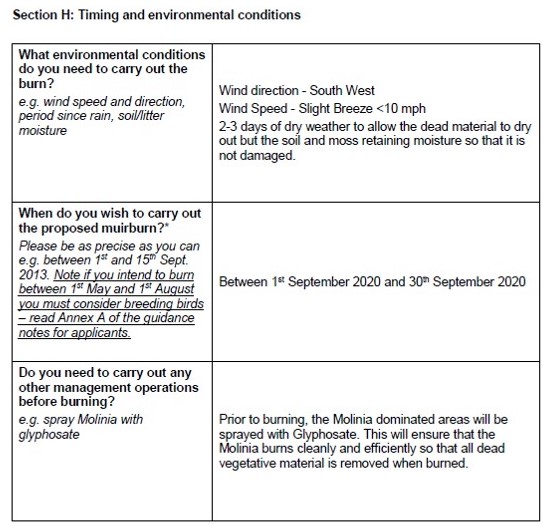
First of all, take a look at this. It’s an application from well-known grouse moor manager/agent Mark Osborne to SNH, made on 15th July 2020, asking for an out-of-season licence to set fire to parts of the grouse moor on Leadhills Estate.
Have a read of the licence application details, consider the necessity of the proposed work, consider the estate’s current status of being sanctioned, and consider whether it would be appropriate for SNH to approve this application.
More to come…..
UPDATE 6 October 2020: What happened next with licence application for out-of-season muirburn on Leadhills Estate (here)
UPDATE 19 October 2020: SNH considers appeal from Leadhills Estate to undertake out-of-season muirburn (here)
UPDATE 11 November 2020: SNH grants licence to Leadhills Estate for out-of-season muirburn (here)
UPDATE 13 November 2020: Political questions being asked about out-of-season muirburn licence issued to Leadhills Estate (here)
Do you remember way back in May, during lockdown, Staffordshire Police asked the public to be vigilant after the discovery of a dead buzzard and two dead peregrines in the Peak District National Park? Officers suspected those protected raptors had been illegally poisoned and the corpses were sent for toxicology (see here).
Then in early June another peregrine was found dead in suspicious circumstances and that, too, was sent for toxicology analyses (see here).
[One of the illegally poisoned peregrines. Photo by Staffordshire Police]
Well guess what? The toxicology results are in and all four raptors were illegally poisoned with the same (unnamed) pesticide, and at least two of the incidents involved a pigeon bait which had been laced with the pesticide.
These illegal raptor poisonings are in addition to the confirmed illegal poisoning of a buzzard and a kestrel in Derbyshire at the beginning of lockdown (see here) and a shot buzzard found with horrific injuries in the Peak District National Park during the middle of lockdown (see here).
Staffordshire Police has issued a press statement about the latest four killings, as follows:
£1,000 reward for information after birds of prey poisoned
Reward offered for information after bird of prey poisoning incidents in Staffordshire during Covid lockdown.
The Royal Society for the Protection of Birds (RSPB) has offered a £1000 reward for information leading to a conviction after four birds of prey were found dead in Staffordshire.
The appeal follows three separate incidents over a three-week period during Covid lockdown.
On Saturday 16 May, a common buzzard and peregrine falcon were sadly discovered dead in a wooded area of Longnor. On Tuesday 19 May a second peregrine falcon was found dead at Beeston Tor near Wetton. On Thursday 4 June, a third peregrine falcon was found dead in a quarry near Waterhouses.
[The latest poisoning victims. Photos via Staffordshire Police]
Two of the incidents occurred in the Peak District National Park, and a few of the locations are believed to be near peregrine falcon breeding sites.
As there were no visible signs of injury, and following contact with Natural England the birds were submitted for post mortem examinations and toxicology tests to establish the cause of death as part of the Wildlife Incident Investigation Scheme (WIIS). The scheme investigates the death or injury of wildlife and companion animals that may have resulted from pesticide poisoning.
The results show that all four birds of prey were illegally poisoned by the same pesticide, and that at least two of the incidents involved a pigeon bait which had been laced with the pesticide.
A police investigation into the circumstances is underway as all birds are protected by the Wildlife and Countryside Act 1981. To kill or injure one is a criminal offence and could result in an unlimited fine and/or up to six months in jail.
Officers are asking local residents and visitors to these areas to report any suspicious behaviour they may have witnessed in the days leading up to the discovery of the birds and to continue to be vigilant for the signs of criminal activity, including dead or injured birds, poisoned bait and traps.
Detective Inspector Tim Boulton, of the Staffordshire Police Rural and Wildlife Crime Unit, said: “To find out that these birds have been deliberately targeted and poisoned is truly dreadful. We are working to ensure those responsible are identified and brought to justice.
“It is extremely concerning that a harmful substance has been placed in the countryside putting not only wildlife, but also people and pets at risk too.
“If a member of the public comes across a dead bird or suspicious object, please do not touch or move anything. Please take photographs if you can and make a note of your surroundings and landmarks to help officers to locate it. Every piece of information may be crucial in prosecuting an offender.
“We would like to thank Natural England and the Peak District Natural Park for their assistance so far and we are incredibly grateful for the reward offered by the RSPB.
“Any information, no matter how small and insignificant it may seem, could help with our on-going investigation. Someone out there knows who poisoned these birds, so please do the right thing and get in touch with the police directly or any of our specialist partners.”
Mark Thomas, RSPB Head of Investigations, commented “Peregrines are the fastest birds in the world, yet all too often the lives of these magnificent creatures are cut short by illegal persecution like poisoning.
“For incidents like this to repeatedly happen in a National Park is all the more alarming. If you have any information about any of these cases, or if you come across what you believe may be a poisoned bird of prey, please call the police immediately. You are our eyes and ears.”
Sarah Fowler, chief executive of the Peak District National Park, added: “I would to thank those individuals who have reported these incidents to the police, and it remains completely unacceptable that illegal activity against wildlife is taking place in and around the Peak District. The nature of poisoning witnessed in these cases is deeply worrying for species both within and outside our National Park boundary.
“These incidents are particularly concerning in a year where many birds of prey – including the peregrine falcon – have successfully bred in other areas. We will continue to support the police in their investigations, and welcome any information from the public that may help capture those involved and bring them to justice.”
Dave Slater, Natural England’s Director for Wildlife Licensing and enforcement cases, said: “Raptor persecution is a national wildlife crime priority and a priority for Natural England. We are a committed partner with the Police and NGOs in tackling these despicable crimes. We would urge anyone witnessing or suspecting persecution to contact the police.”
Anyone with any information is asked to call one of the services listed below:
Staffordshire Police: 101 quoting incident number 232 of 16 May. You can also report online at http://www.staffordshire.police.uk/report or by sending a private message to Staffordshire Police on Facebook and Twitter.
The unregulated annual release of millions of non-native gamebirds in to the UK countryside (~47 million pheasants + ~10 million red-legged partridge) continues to draw attention, much to the dismay of some in the commercial shooting industry who probably wish the scrutiny would all disappear so they could get on with doing what the hell they like, as they have done for decades.
There’s been a flurry of media coverage recently, and there’ll probably be a lot more in the coming weeks as Wild Justice’s legal challenge goes for judicial review at the High Court in early November.
That legal challenge featured in The Guardian the other day:
There’s an especially interesting couple of lines in that Guardian article, as follows:
‘Christopher Graffius, BASC’s communications director, said the Game and Wildlife Conservation Trust had guidelines on how many birds could be safely released and estates that broke the rules had been sanctioned‘.
Yes, there are voluntary guidelines, but as such they are largely unenforceable and a guideline is very different to a ‘rule’. It would have been useful if Christopher had elaborated on how many estates had ‘broken the rules’, which ‘rules’ did they ‘break’, how many estates were subsequently sanctioned, what was the sanction and who imposed it? These details are important if BASC’s claim of the industry’s effective self-regulation is to be taken seriously.
Meanwhile, in Scotland there was a story last week about red-legged partridge being driven by the crateload through the Cairngorms National Park. This blog written by Nick Kempe of ParkswatchScotland is as thought-provoking as ever:
As Nick pointed out in his blog, he didn’t know the final destination for those non-native red-legged partridge but there are no rules about releasing them inside the Cairngorms National Park, or in any other so-called National Park in the UK for that matter. It really is quite astonishing when you consider the hoops that, quite rightly to a point, have to be jumped to reintroduce a native species anywhere in the UK.
It would be interesting to know where those red-legged partridge were heading. Presumably not to be released to replenish a shoot because that would be a breach of one of the ‘five golden rules’ of the Code of Good Shooting Practice, and we all know how law-abiding the shooting industry is, right?
Then yesterday there was another interesting article in The Guardian where it was claimed that pheasants ‘could wipe out Adders in Britain within 12 years’. You can read that article here.
October 1st marked the opening of the pheasant-shooting season in the UK and seeing as though gamebird shooting is exempt from the Covid restrictions that the majority of us are having to live with, there’ll be pheasants being shot from the skies as this is typed.
Keep an eye out for piles of dumped shot gamebirds along hedgerows, roads, laybys, local woodland, fields etc. It happens every year and is a widespread problem; the photographs exposing the reality of unregulated gamebird shooting in the UK. E.g. see previous reports of shot dumped birds in Cheshire, Scottish borders (here), Norfolk (here), Perthshire (here), Berkshire (here), North York Moors National Park (here) and some more in North Yorkshire (here) and even more in North Yorkshire (here), Co. Derry (here), West Yorkshire (here), and again in West Yorkshire (here), N Wales (here), mid-Wales (here), Leicestershire (here) and Lincolnshire (here).
Mayors, councils, local communities, and RSPB unite in support of the call to urgently ban peatland burning on grouse moors.
The RSPB is today calling on Government to implement an immediate end to the burning of precious peatlands on moors managed for grouse shooting. The call, which comes on the first day of this year’s burning season, is being supported by city mayors, councils, and local communities. A ban is also supported by a wide range of environmental NGOs.
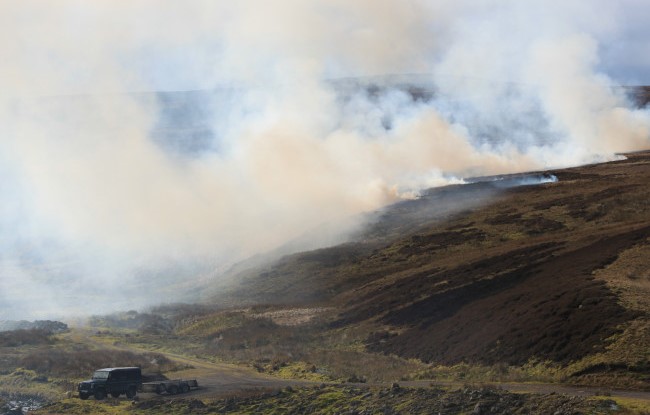
[Routine burning on a Yorkshire grouse moor. Photo by Ruth Tingay]
Beccy Speight, RSPB Chief Executive Officer, said: “In a climate and ecological emergency, the continued burning of precious peatlands is simply not acceptable and undermines the UK Government’s legal obligations to restore nature. The Government has long promised to end the burning of peat, it has widespread public support, and the Secretary of State, George Eustice, now needs to make good on this pledge.”
Healthy wet blanket peat bogs are home to peat-forming sphagnum mosses, cotton-grasses, and carnivorous plants, which support a diverse range of breeding birds, including breeding dunlin and golden plover. They are also a crucial carbon store. UK peatlands (in the uplands and lowlands) store an estimated 3,200 million tonnes (Mt) of carbon.
However, the RSPB says that one of the most significant pressures on these places is that they are routinely and deliberately burned, largely to support a single industry – grouse shooting.
Pat Thompson, RSPB Senior Policy Officer said: “The burning is done to ensure grouse have reemergent young shoots of heather to eat season after season. This not only directly releases carbon into the atmosphere but degrades the remaining peat – making it poorer for wildlife, less able to slow the flow of water thus increasing flood risk and reducing water quality. All these effects are felt both immediately by communities downstream and by wider society in terms of increased carbon emissions and the cost of treating water.
England’s upland peatlands are also increasingly vulnerable to changes in climate, particularly pro-longed periods of drought which dry out the surface vegetation making them vulnerable to accidental fires in spring and summer.”
Peatland in the English uplands can be legally burnt between 1 October – 15 April. Burning in the uplands is increasing with research finding a seven-fold increase in burning on peatland in
England from the 1940s to the present time with burning increasing at a rate of 11% per annum between 2001 to 2011 in Great Britain.
Dr Thompson added: “To give an idea of the scale of this issue, grouse moors in the northern uplands extend to something in the region of 2226 square kilometers. Many of these grouse moors lie within Special Areas of Conservation and Special Protection Areas, a statutory designation that describes their huge importance for wildlife on a European level. The designation restricts a range of activities in these places, and so special consent must be obtained from Natural England in order to carry out burning.
Information from Natural England suggests there are over 400 consents to burn blanket bog on grouse moors in north England’s European protected areas, covering around 950 square kilometers of the deep peat soils this precious habitat depends on. This simply must stop.”
Peat burning is also not welcome in many local communities, and the call for a ban has recently been echoed by Mayors, local councils and residents in the North of England:
Jamie Driscoll, Mayor of the North of Tyne Combined Authority, said: “Burning upland peat habitats is a destructive process. It results in greenhouse gas emissions, brings flood risks, and is damaging to wildlife. I fully support the RSPB’s campaign calling on the government to implement an immediate end to this practice.”
Andy Burnham, Mayor of Manchester, said: “Upland fires in 2018 and more recently in the dry spring this year have created significant issues in upland areas of Greater Manchester – both from an environmental and public safety perspective. We are acutely aware of the environmental impact that upland fires, whatever their cause, can have on the environment.
Recent work by Natural England, which will inform Defra’s forthcoming national peat strategy, highlighted that the 2019 Winter Hill fire alone released c. 90,000 tonnes of Carbon equivalent (tCO2e)”
Councillor Scott Patient, Lead – Climate Change and Resilience, Calderdale Metropolitan Borough Council said: “In Calderdale, we know that moorland fires have a broad range of ecological and public health impacts including degrading peatlands, releasing harmful gasses into the atmosphere and surrounding valleys, putting added pressure on our fire services (themselves stretched throughout the pandemic) and decreasing biodiversity whilst possibly contributing to flooding in communities downstream. We hope to see legislation introduced promptly to end the use of burning in the management of grouse moors. Beyond this, we will continue to work in strong strategic partnerships with small and larger landowners to further develop a complete and sustainable catchment plan to help best protect our residents and natural environment”
Cllr Rob Walker, Colne Valley Ward Councillor, Kirklees Cabinet Portfolio: Environment and Culture, said: “Whilst Kirklees Council do not own any moorland used for grouse shooting I am concerned about the damage done to biodiversity and the regeneration of healthy peat bogs by the practice of burning heather to promote the commercial rearing of grouse. I believe in working with land managers to promote more sustainable techniques that will enrich our countryside.”
Dongria Kondh Co-ordinator, Treesponsibility, and Hebden Bridge resident said: “The peatlands here on the moors above Hebden Bridge form part of the biggest carbon sinks in Britain, they are precious to our community, to wider society and for nature. They cannot be restored to full health while the burning continues. Reports that Environment Minister George Eustice is attempting to backtrack on his predecessor’s commitment to ban managed burning on peat bogs are deeply worrying. In January, this year the UK parliament’s Climate Change Committee called for an immediate cessation of rotational burning, and ignoring their report would seriously undermine the government’s credibility as hosts of the COP26 Climate conference next year. A ban needs to be implemented now.”
ENDS
There’s also some interesting commentary from Mark Avery on this topic this morning (see here)
The temporary ban on muirburn in Scotland, implemented during the Coronavirus lockdown after Andy Wightman MSP drew the Scottish Parliament’s attention to the ongoing burning of grouse moors despite there being a respiratory virus pandemic (here) has now finished and grouse moor managers are now free to set the moors alight again.
RSPB Birdcrime report reveals 85 confirmed incidents of bird of prey persecution in the UK in 2019 including shooting, trapping, and poisoning
RSPB data, peer-reviewed science, and population surveys prove these crimes are concentrated on and near driven grouse moors
Between 2012-2019 half (49%) of the confirmed incidents occurred in protected landscapes
The RSPB calls for urgent action from governments to end bird of prey killing and ensure grouse shooting operates legally and sustainably
Self-regulation from within the grouse shooting community has failed, and urgent action is needed to prevent protected birds of prey being illegally killed and to bring this industry into the 21st century and to help address the nature and climate crises.
That’s the message from the RSPB’s Birdcrime report, out today (1 October), which demonstrates that birds of prey continue to be systematically killed, particularly where land is managed for driven grouse shooting.
The report reveals 85 confirmed incidents of bird of prey persecution, involving birds such as buzzards, red kites, peregrines, golden eagles, and hen harriers being shot, trapped, and poisoned. The highest concentration of these occurred in upland areas of the North of England and Scotland, with North Yorkshire emerging as the worst county for the sixth year running. Half of the confirmed incidents occurred within protected landscapes.
All birds of prey are protected by the Wildlife and Countryside Act 1981. To intentionally kill or injure one is a criminal offence and could result in an unlimited fine or up to six months in jail depending on the jurisdiction.
Yet in the past 10 years, there have been over 1000 confirmed incidents of bird of prey persecution in the UK. Despite hard work by police forces, RSPB Investigations, and volunteers who monitor birds of prey across the UK the law is failing to protect these birds.
The RSPB has stated that, without urgent change, the next decade will be no different. This year, the illegal destruction of birds of prey continued even during COVID-19 lockdown, when the RSPB’s Investigations team reported their busiest ever spring, dealing with multiple reports of bird of prey persecution and assisting police with investigations, many of which took place on land used for gamebird shooting.
As well as illegal killing, a growing number of satellite-tagged birds of prey are vanishing in suspicious circumstances over grouse moors. Since the start of 2018, 45 tagged hen harriers – a rare and heavily persecuted bird of prey – are known to have been illegally killed or disappeared in suspicious circumstances. Only 19 successful nests were recorded in England in 2020, although there is habitat and prey to support more than 300 pairs. The analysis of the government’s own data, published in 2019, showed that illegal killing was the principle factor limiting hen harrier numbers in England.
The RSPB is urging the government to act now, to address the ecologically and environmentally damaging practices involved with the most intensive forms of grouse moor management including raptor persecution and burning of moorland vegetation on peat soils, our most vital carbon stores.
Mark Thomas, RSPB Head of Investigations UK, said: “Once again the Birdcrime report shows that protected birds of prey like hen harriers, peregrines and golden eagles are being relentlessly persecuted, particularly in areas dominated by driven grouse shooting.
“The illegal killing of birds of prey is just one of the symptoms of a wholly unsustainable grouse shooting industry. The burning of internationally important peatlands is another hugely important issue. This destructive grouse moor management practice not only releases carbon into the atmosphere, it degrades the peat, impoverishes wildlife, and increases the flow of water across the bog surface, causing devastating flooding in some cases in communities downstream. In a climate and ecological emergency, this is simply not acceptable. Today, at the start of the annual burning season, the RSPB is renewing its call for moorland burning on peatland soils to be banned by Government.
“At a time when the world – and the UK in particular – is seeing catastrophic declines in wildlife populations, the destruction of rare wildlife looks like the opposite of progress. Healthy bird of prey populations are key indicators of the health of our environment. Yet hen harriers are just a few bad breeding seasons away from disappearing from England as a breeding species as a direct result of illegal persecution on grouse moors. The shooting community has had decades to get its house in order, but it is abundantly clear that they cannot control the criminals within their ranks. Current legislation has failed to protect our birds of prey, and the time has come for urgent, meaningful change.
“UK governments must implement tougher legislation to bring the driven grouse shooting industry in line with the law, stamp out environmentally damaging practices, and deliver on the UK’s nature recovery targets.”
Further to last Friday’s shocking news that a missing golden eagle’s satellite tag had been found in a river in Strathbraan, with aerial and harness cut and the tag wrapped in lead sheeting, presumably in an attempt to block the tag’s signal and conceal any evidence of criminal behaviour (see here), there’s an interesting background story to this particular eagle.
Cast your minds back three and half years to this blog (here) written in March 2017.
Here are the, ahem, ‘highlights’:
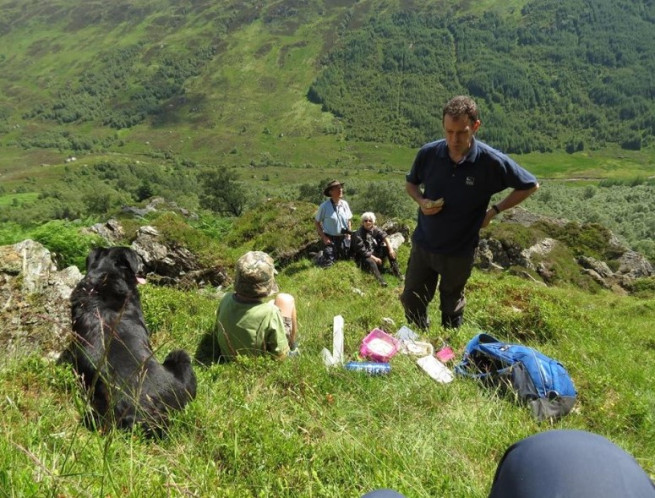
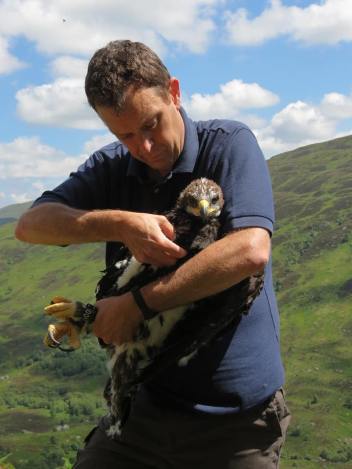
This photograph has been repeatedly posted on Facebook and other social media platforms as an example of ‘bad practice’ at a raptor tagging event. It shows a group of people at an eagle nest site in Perthshire in 2014. According to Bert Burnett of the Scottish Gamekeepers’ Association, who has posted this image several times, these people, including Duncan Orr-Ewing of RSPB Scotland, are “having a picnic underneath an eagle nest” for several hours and thus by implication are causing unnecessary disturbance at the site and causing the adult birds to desert.
What’s actually happening here is a group of people, including four licensed experts and their invited guests, have climbed to an eagle nest site and while the climbers have gone to retrieve the eaglet from the nest so its satellite tag can be fitted in safety on the ground, Duncan is eating a sandwich. That’s it. It’s a few sandwiches short of a picnic, or is that just Bert?
Another photograph that Bert has circulated was also taken at this site on the same day. It shows Duncan quite rightly checking the fit of the young eagle’s sat tag harness before the bird is put back in its nest.
This photograph elicited all sorts of comments on social media, with suggestions that sat tagging golden eagles is harmful to the birds, that it’s detrimental to their survival and one person even claiming that “they [the raptor fieldworkers] are a far greater threat to birds than any shooting interests“.
He posted another photograph (which we won’t post here for legal reasons) that shows a woman and her son on the nest ledge after the eagle had been returned to its nest. Bert said this about it: “What happens to birds after tagging is very questionable. Allowing your families and friends to climb up intae the nest just for photo shoots is totally out of order and shows no concern for the birds future welfare“. On a later post he also claimed the woman had been “hoisted in to the nest“. What the photo actually shows is a Schedule 1 licence holder and her son who have just climbed to the nest to return the eagle after tagging. It’s probably hard for Bert to comprehend that a woman might actually be a Schedule 1 licence holder and that she’d be capable of climbing to the nest without being “hoisted in” (surely her breasts would get in the way?) but when your mindset is firmly stuck in the 18th century then it’s probably no surprise at all.
As for Bert’s comment, “What happens to birds after tagging is very questionable“, well, it’s not questionable in this case. This eagle was satellite tagged in Perthshire in 2014. The bird fledged successfully and its movements were tracked until 2016 when its tag signal suddenly stopped transmitting and the eagle ‘disappeared’ on a grouse moor in Perthshire. We’d respectfully suggest that this eagle’s disappearance (probable death) was not caused by Duncan eating a sandwich at its natal site two years earlier nor by it being put back in to the nest by a woman, but was more than likely caused by illegal poisoning, illegal trapping or illegal shooting on or near a grouse moor in the Highlands.
ENDS
Little did we or Bert Burnett, then a Director of the Scottish Gamekeepers Association, imagine that this eagle would hit the headlines three and a half years later when its tag was found cut and wrapped in lead sheeting having been dumped in the river in one of Scotland’s most notorious raptor-killing hotspots – the grouse moors of Strathbraan, where eight satellite-tagged eagles have ‘disappeared’ in suspicious circumstances in recent years.
This background information clearly exposes the desperate lies and false accusations used by some in the grouse shooting industry to deflect attention from the bleedin’ obvious and instead used to undermine the integrity and professionalism of those conservationists working hard to protect this species in the face of relentless persecution.
These fabrications were made in the build up to the publication of the Government-commissioned Golden Eagle Satellite Tag Review, which was published in May 2017. It’s findings were damning.
Unbelievably, the lies from the grouse shooting industry continue. Over the last few days there have been a number of so-called ‘explanations’ from within the grouse shooting industry for what might have happened to this eagle and how it’s satellite tag ended up in the river wrapped in lead sheeting. They seek to have the public believe that this is ‘a set up’ – that conservationists (and some of them named, libellously, as perverting the course of justice) found the dead eagle several years ago after it died of natural causes and they apparently decided to ‘plant’ the tag in the river to make it look suspicious.
Fortunately, the public, the police and Government Ministers are not fooled.
All eyes on the Scottish Government’s imminent response to the Werritty review on grouse moor licensing.
Press release from RSPB Scotland (25th September 2020)
Shocking discovery reveals lengths raptor killers will go to to conceal crimes
Recovered satellite tag provides answers to what happens when birds of prey ‘disappear’ on Scotland’s grouse moors
A satellite tag removed from a ‘disappeared’ golden eagle has been recovered from a Highland river.
The discovery sheds new light on the activities that criminals will go to in a bid to cover up the illegal killing of protected birds of prey.
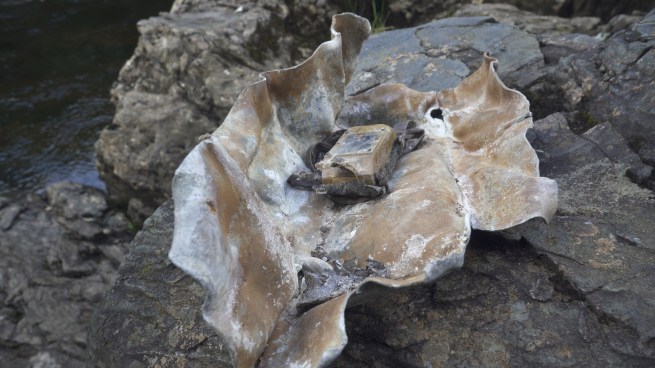
[The eagle satellite tag #129014, wrapped in lead casing, found at the side of the River Braan. Photo by RSPB Scotland]
In 2016 the bird’s tag stopped transmitting suddenly on a grouse moor in Perthshire and despite searches by Police and RSPB Scotland, it was never traced.
Now the tag has been found – wrapped in heavy lead sheeting and disposed of at a popular beauty spot just a few miles from the last known location of the bird.
The recovered tag is further evidence in just how far criminals who routinely kill birds of prey are going to in a bid to cover their tracks and to present driven grouse shooting as a clean industry.
The object was spotted by a walker and his son on the banks of the River Braan near Dunkeld in Perthshire on 21st May.
On closer examination, they found the tag wrapped in a piece of lead sheeting. The tag bore a label bearing contact details and a serial number, subsequently allowing the police and RSPB to jointly attend recover and identify the object.
Police Scotland have since held the tag for several months to conduct forensic analysis, which is ongoing.
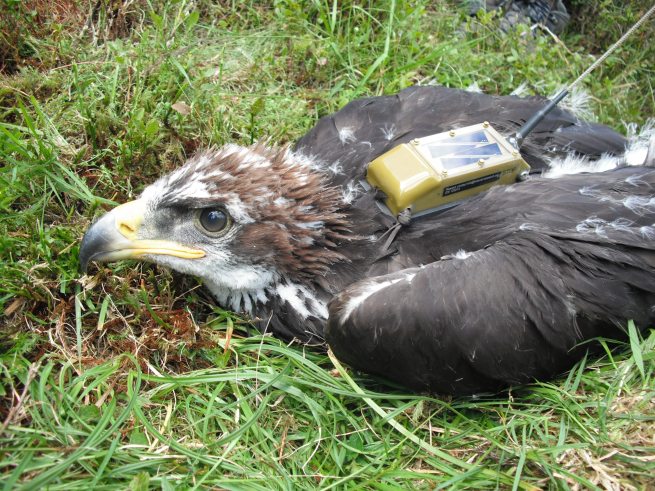
After fledging from its nest, this young eagle had remained on its parents’ territory until November 2014. Over the following 18 months, it explored Scotland’s uplands before it moved into Strathbraan. Within a few days of arriving here, on 1st May 2016 his tag, that had been functioning exactly as would have expected, suddenly and inexplicably stopped. It was suspected that the bird had been killed, and the tag destroyed.
[The young golden eagle fitted with the satellite tag #129014 in 2014. Photo Scottish Raptor Study Group]
As with all such cases, this suspicious disappearance was reported to the police. A search of the land around the bird’s last known location on a remote hill took place and the disappearance was discussed with local land managers. No evidence of what had happened to the bird was uncovered.
Ian Thomson, RSPB Scotland’s Head of Investigations said: “As is the case in virtually every raptor persecution investigation, nobody seemed to know anything and, as is the case with every suspicious satellite tagged raptor disappearance on a grouse moor, spurious alternative theories as to what may have happened to the bird and tag were suggested. However, now we know the truth.
“This young eagle was killed illegally. The tag was clearly removed from the bird, its antenna was cut off, and the tag was then wrapped in a piece of lead sheeting, presumably because the perpetrator thought this would stop it transmitting. The package was then cast into the river, never to be seen again. Or so they thought.
“This discovery gives unequivocal proof not only of what is happening to these birds, but also the lengths to which the criminals involved in the killing of our raptors will go to dispose of evidence and evade justice. It is not unreasonable to conclude that the vast majority of other birds of prey and their tags that have disappeared on Scotland’s grouse moors have suffered similar fates.”
Satellite-tags are used by biological researchers throughout the world to track the movements of animals and birds, from vultures to elephants, and have a proven high reliability. In the UK, their use on birds is strictly regulated by the British Trust for Ornithology and the Government’s statutory nature conservation agencies, with individual projects and taggers requiring demonstrable training and experience and only then under specific licences.
Duncan Orr-Ewing, a member of the Central Scotland Raptor Study Group and RSPB Scotland’s Head of Species and Land Management, said: “The number of satellite tags fitted to raptors, functioning exactly as expected, only to have stopped suddenly on a grouse moor, is an issue of increasing public concern, as evidenced by the Scottish Government commissioning of a review of the fates of satellite-tagged golden eagles, published three years ago.”
“It has long been suspected that tags are routinely destroyed by wildlife criminals in a deliberate attempt to conceal evidence. There is no other reasonable explanation as to why this tag has ended up in the river where it was found, wrapped in metal, and with the harness and antenna cut. For me this incident is doubly distressing as it is a bird that I tagged with a colleague in 2014, and it originates from a nest site in the Loch Lomond and Trossachs National Park where there has been a long history of local community protection from egg collectors.
“More disappearances of tagged birds this year, as well as shooting and poisoning cases, destroy any pretence that the grouse shooting industry is able to self-regulate, even during a national pandemic. It is abundantly clear that the only way to stop this culturally ingrained and organised criminality against Scotland’s protected raptors is through robust, and immediate, regulation. We call upon the Scottish Government to prioritise this as their response to the Werritty Review.”
ENDS
RSPB Scotland has also produced a video:
This tag is not one of the ones that RPUK and Chris Packham have fitted as part of our golden eagle tagging project, but the area where this eagle ‘disappeared’ and where the tag was subsequently found in the river is an area where three of our satellite tagged golden eagles have ‘disappeared’ (Adam, Charlie and Tom), probably suffering the same fate as this one. It’s actually an area where at least eight satellite-tagged eagles have ‘vanished’ in recent years, and was identified as a raptor persecution hotspot by the 2017 golden eagle satellite tag review. Strathbraan is circled in orange below:
We’ll be saying a lot more about this later today.
The Scottish Government has been dragging its feet on raptor persecution for years and years and years. We are expecting a response to the Werritty Review (on grouse moor reform) ‘this autumn’ and in light of this evidence, the latest in a long long line of evidence, we expect a meaningful response. If you’d like the First Minister (Nicola Sturgeon) and her Environment Cabinet Secretary (Roseanna Cunningham) to know how much you expect from them, please send POLITE but strongly-worded emails to:
UPDATE 25th September 2020 10.30hrs: RSPB Scotland’s Head of Investigations Ian Thomson has written a blog about this incident and he puts the discovery of this tag in to a wider context – read here.
UPDATE 30th September 2020: The eagle’s satellite tag found in the river: poetic injustice (here)
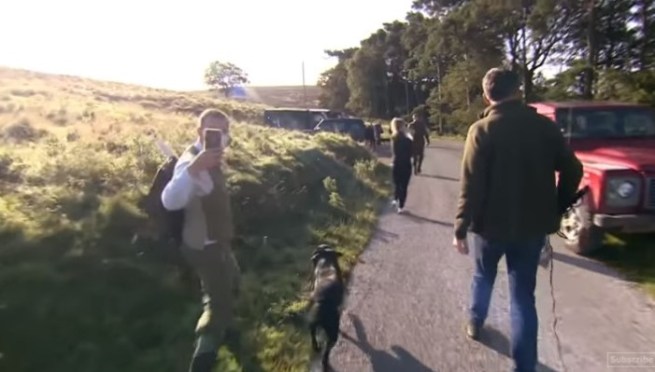
On Monday evening Channel 4 News included an explosive piece about grouse shooting in the North York Moors National Park and its association with the illegal killing of birds of prey.
Fronted by veteran war correspondent Alex Thomson, it was a follow-up to an item that was broadcast back in May where Alex had again focused on the illegal killing of birds of prey on grouse moors in the North York Moors National Park as well as in the Nidderdale AONB (see here).
Monday’s piece was car-crash viewing if you were a member or supporter of the grouse shooting industry, in what was an extraordinary display of arrogance, denial and entitlement from a number of individuals involved with a grouse shoot. All those previous media campaigns, carefully-crafted to showcase this industry to the general public in the best possible light, shot down in tatters during a prime time viewing slot before our very eyes. If you missed it, this six minute film is well worth your time.
Predictably, since the programme aired some members of the shooting industry (which, remember, professes a ‘zero tolerance‘ for raptor persecution) have been in an absolute rage on social media, angrily shouting about how unfair it all was, how dare a high profile journalist question anybody involved in this noble ‘sport’ for their views on illegal raptor persecution, spitting blood that there wasn’t an alternative opinion given (conveniently forgetting that the Moorland Association was given the opportunity to comment, but didn’t).
They were also probably furious that several members of the local community were filmed, dispelling quite a few myths and debunking the propaganda often painted of a moorland community in harmony – a rural idyll where local residents are deliriously enthralled by the activities of the local grouse moor managers and thankful for the boost that grouse shooting brings to the local economy, without which the local community would apparently collapse. Nah, these Goathland residents weren’t having any of it. Kudos to them for standing their ground.
Don’t be surprised to see the launch of a campaign /petition calling for Alex Thomson’s dismissal from Channel 4 – this thuggish industry has a well-deserved reputation for trying to shoot the messenger, usually by generating a nasty little smear campaign to undermine the integrity of those who dare to speak out against the industry’s criminality and environmental destruction.
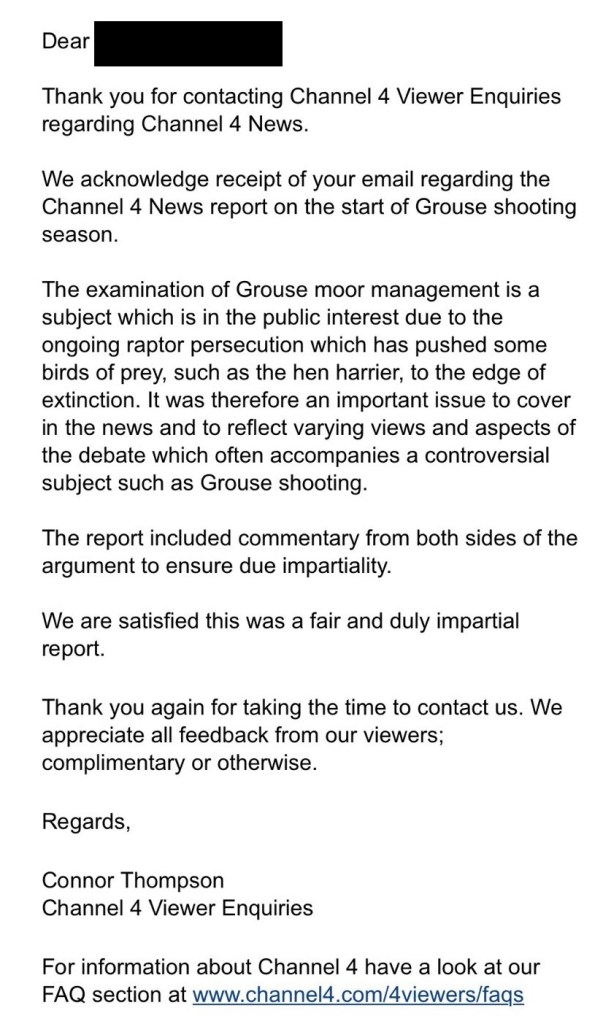
Meanwhile, several individuals have already been making complaints about the programme directly to Channel 4. Channel 4 is having none of it. Here’s the standard response that has been sent back:
Brilliant! If you’d like to send Channel 4 a message of support for (a) broadcasting the footage during its main evening news schedule and (b) having the balls to stand up to the resulting howling hysteria of the grouse shooting industry, you can use this form (here) to show your support and appreciation.
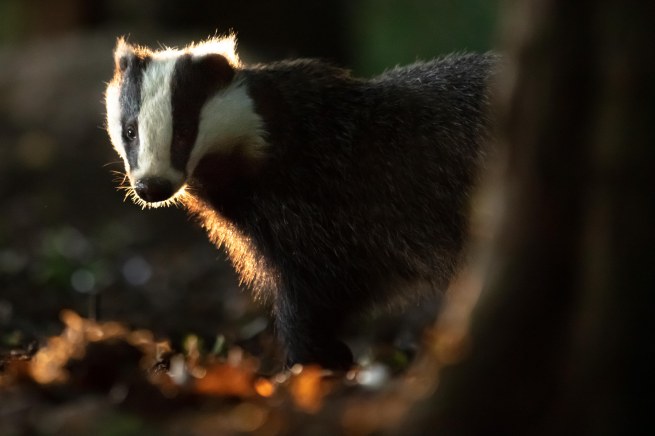
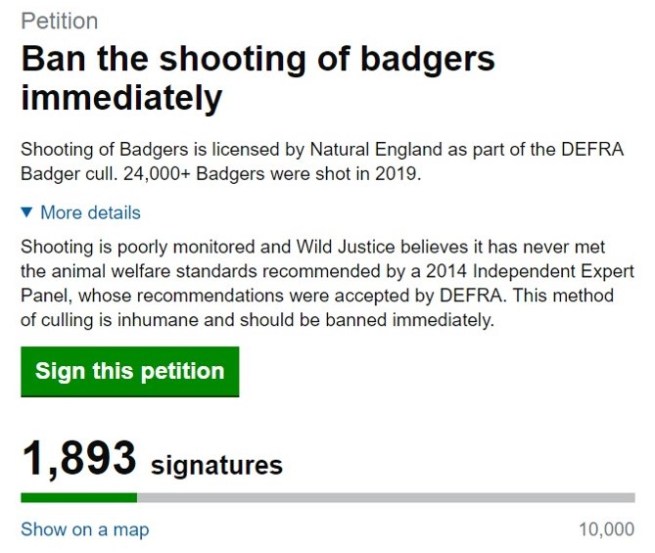
Wild Justice is taking a legal challenge against what it believes is the inhumane shooting of badgers that has been licensed as part of DEFRA’s grotesque badger cull. Permission for judicial review was recently refused but Wild Justice is appealing that decision and has been allocated a court date in October.
This petition, if widely supported, will add additional pressure on the Westminster Government to rethink its approach to tackling bovine tuberculosis.
At 10,00 signatures the Government has to respond with a statement. At 100,000 signatures the issue will be considered for a debate in Westminster Hall.
The petition has only been live for about an hour and already it’s attracting a lot of support.