This is completely understandable, of course. There doesn’t appear to be a system set up for MPs to participate online, and travelling to London to attend in person couldn’t possibly be described as ‘essential travel’.
For further updates on this and other Wild Justice news, please subscribe to their free newsletter here
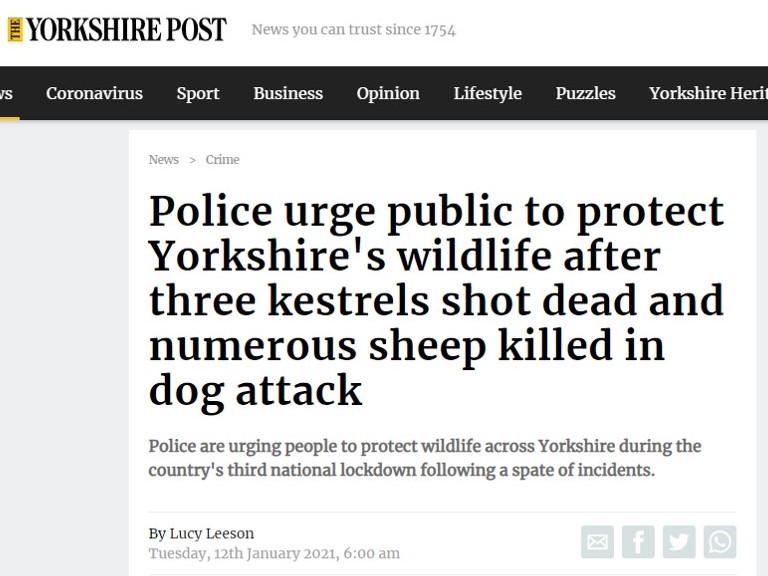
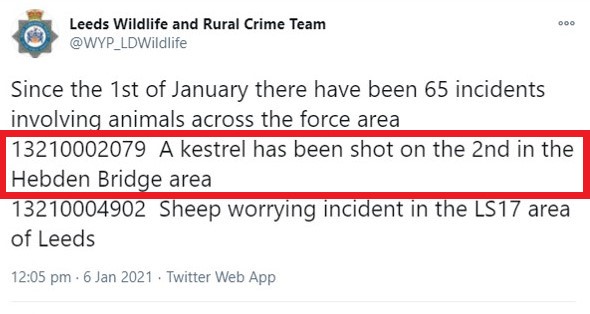
The article reports that two kestrels were shot in the Huddersfield area and one in Leeds. Unfortunately there isn’t any further information such as date, specific location or type of weapon etc, although a tweet from the Leeds Wildlife & Rural Crime Team reports the shooting of a kestrel on 2nd January 2021 ‘in the Hebden Bridge area’.
In autumn last year West Yorkshire Police also recorded the fatal shooting of another kestrel, in the Pudsey area of Leeds (see here).
Many thanks to blog reader Grace Newton, who also happens to be a journalist writing for the Yorkshire Post, who has followed up by writing an article on Tuesday’s blog about hen harrier Harold, who disappeared in suspicious circumstances on a grouse moor in the Yorkshire Dales in September 2020.
The article includes some commentary from Natural England, who said that the grouse moor from where Harold vanished ‘was searched by police several times and nothing was found‘ and that ‘the investigation remains ongoing‘.
The article also suggests that the lame ‘appeal’ (here) put out by Natural England on twitter refers to Harold.
Where is the Natural England appeal about the brood meddled hen harrier #55152 that also vanished in North Yorkshire in September 2020, and hen harrier Fortune who vanished at an undisclosed location in Northumberland, also in September 2020?
The full article in the Yorkshire Post is available here
In September 2020 I blogged that at least 45 hen harriers were ‘missing’ in suspicious circumstances or had been confirmed illegally killed since 2018 (see here).
Today the list is updated to 48 hen harriers, ‘missing’ or confirmed illegally killed since 2018, after the recent news (here, here and here) that three more satellite-tagged hen harriers have ‘disappeared’ since September 2020.
Here’s the blog that’ll be published every time this list is updated:
It’s getting to that time of year when the grouse shooting industry pumps out its patently misleading propaganda relating to hen harrier conservation in the UK. The aim is to hoodwink the public in to believing that the industry loves hen harriers and is doing all it can to protect and nurture the tiny remnant breeding population (but conveniently forgetting to mention that the breeding population is only in such dire straits because the grouse shooting industry has been ruthless in its maniacal intolerance of this supposedly protected species).
And the industry’s pursuit of the hen harrier is not simply ‘historical’ or indicative of past behaviour, as some would have us believe. It is on-going, it is current, and it is relentless.
[This male hen harrier died in 2019 after his leg was almost severed in an illegally set trap that had been placed next to his nest on a Scottish grouse moor (see here). Photo by Ruth Tingay]
To illustrate this fact, I intend to keep a running tally of all the hen harriers that I know (because most of these victims had been fitted with a satellite tag) to have either ‘disappeared’ in suspicious circumstances or have been confirmed as being illegally killed since 2018.
Why only since 2018 when we know that hen harriers have been a persecution target for years and years and years? Well, 2018 is the year that the grouse shooting industry ‘leaders’ would have us believe that the criminal persecution of hen harriers had stopped and that these birds were being welcomed back on to the UK’s grouse moors (see here).
This assertion was made shortly before the publication of a devastating new scientific paper that demonstrated that 72% of satellite-tagged hen harriers were confirmed or considered likely to have been illegally killed, and this was ten times more likely to occur over areas of land managed for grouse shooting relative to other land uses (see here).
I only started compiling this list of dead / missing hen harriers in June 2020 when I learned that all five of last year’s brood meddled hen harrier chicks were ‘missing’, presumed dead (see here). It has since been updated a few times as we found out about more satellite-tagged hen harriers that had vanished during lockdown in suspicious circumstances on grouse moors in the Cairnorms National Park (here), on a notorious grouse moor in South Lanarkshire (see here) and on a grouse moor believed to be involved with the brood meddling in the Yorkshire Dales National Park (here).
It’s now time to update the death list again, as I’ve learned of yet another three satellite-tagged hen harriers that have ‘disappeared’ in suspicious circumstances, only revealed after an FoI request to Natural England who seem reluctant to let the public know about these ongoing losses. I can’t think why. Some might think NE’s silence was connected to a financial agreement it made recently with representatives from the grouse shooting industry. That would be a preposterous suggestion – as ridiculous as Natural England removing hen harrier chicks from the moors at the behest of the grouse shooting industry and calling it conservation. It’d never happen, right?
That brings the gruesome tally to 48 hen harriers. I’m still waiting to hear whether three hen harriers, satellite-tagged by Natural England this year and have since vanished (here), are being treated as suspicious disappearances by the police and if so, they will be added to this list. I’m also aware of at least one ongoing police investigation that has yet to be publicised so that bird will also be added to this list if the circumstances dictate it’s appropriate.
Four eight.
Forty eight.
In the space of two years.
Nobody has been prosecuted for any of these cases. We have every expectation that this list will be updated again in the near future.
For now, here are the 48:
February 2018: Hen harrier Saorsa ‘disappeared’ in the Angus Glens in Scotland (here). The Scottish Gamekeepers Association later published wholly inaccurate information claiming the bird had been re-sighted. The RSPB dismissed this as “completely false” (here).
5 February 2018: Hen harrier Marc ‘disappeared’ on a grouse moor in Durham (here)
9 February 2018: Hen harrier Aalin ‘disappeared’ on a grouse moor in Wales (here)
March 2018: Hen harrier Blue ‘disappeared’ in the Lake District National Park (here)
March 2018: Hen harrier Finn ‘disappeared’ near Moffat in Scotland (here)
18 April 2018: Hen harrier Lia ‘disappeared’ in Wales and her corpse was retrieved in a field in May 2018. Cause of death was unconfirmed but police treating death as suspicious (here)
8 August 2018: Hen harrier Hilma ‘disappeared’ on a grouse moor in Northumberland (here).
16 August 2018: Hen harrier Athena ‘disappeared’ on a grouse moor in Scotland (here)
26 August 2018: Hen Harrier Octavia ‘disappeared’ on a grouse moor in the Peak District National Park (here)
29 August 2018: Hen harrier Margot ‘disappeared’ on a grouse moor in Scotland (here)
29 August 2018: Hen Harrier Heulwen ‘disappeared’ on a grouse moor in Wales (here)
3 September 2018: Hen harrier Stelmaria ‘disappeared’ on a grouse moor in Scotland (here)
24 September 2018: Hen harrier Heather ‘disappeared’ on a grouse moor in Scotland (here)
2 October 2018: Hen harrier Mabel ‘disappeared’ on a grouse moor on the edge of the Yorkshire Dales National Park (here)
3 October 2018: Hen Harrier Thor ‘disappeared’ next to a grouse moor in Bowland, Lanacashire (here)
23 October 2018: Hen harrier Tom ‘disappeared’ in South Wales (here)
26 October 2018: Hen harrier Arthur ‘disappeared’ on a grouse moor in the North York Moors National Park (here)
1 November 2018: Hen harrier Barney ‘disappeared’ on Bodmin Moor (here)
10 November 2018: Hen harrier Rannoch ‘disappeared’ on a grouse moor in Scotland (here). Her corpse was found nearby in May 2019 – she’d been killed in an illegally-set spring trap (here).
14 November 2018: Hen harrier River ‘disappeared’ on a grouse moor in the Nidderdale AONB (here). Her corpse was found nearby in April 2019 – she’d been illegally shot (here).
16 January 2019: Hen harrier Vulcan ‘disappeared’ in Wiltshire close to Natural England’s proposed reintroduction site (here)
7 February 2019: Hen harrier Skylar ‘disappeared’ next to a grouse moor in South Lanarkshire (here)
22 April 2019: Hen harrier Marci ‘disappeared’ on a grouse moor in the Cairngorms National Park (here)
26 April 2019: Hen harrier Rain ‘disappeared’ on a grouse moor in Nairnshire (here)
11 May 2019: An untagged male hen harrier was caught in an illegally-set trap next to his nest on a grouse moor in South Lanarkshire. He didn’t survive (here)
7 June 2019: An untagged hen harrier was found dead on a grouse moor in Scotland. A post mortem stated the bird had died as a result of ‘penetrating trauma’ injuries and that this bird had previously been shot (here)
5 September 2019: Wildland Hen Harrier 1 ‘disappeared’ on a grouse moor nr Dalnaspidal on the edge of the Cairngorms National Park (here)
11 September 2019: Hen harrier Romario ‘disappeared’ on a grouse moor in the Cairngorms National Park (here)
14 September 2019: Hen harrier (Brood meddled in 2019, #183704) ‘disappeared’ in North Pennines (here)
23 September 2019: Hen harrier (Brood meddled in 2019, #55149) ‘disappeared’ in North Pennines (here)
24 September 2019: Wildland Hen Harrier 2 ‘disappeared’ on a grouse moor at Invercauld in the Cairngorms National Park (here)
10 October 2019: Hen harrier Ada ‘disappeared’ on a grouse moor in the North Pennines AONB (here)
12 October 2019: Hen harrier Thistle ‘disappeared’ on a grouse moor in Sutherland (here)
18 October 2019: Member of the public reports the witnessed shooting of an untagged male hen harrier on White Syke Hill in North Yorkshire (here)
November 2019: Hen harrier Mary found illegally poisoned on a pheasant shoot in Ireland (here)
January 2020: Members of the public report the witnessed shooting of a male hen harrier on Threshfield Moor in the Yorkshire Dales National Park (here)
1 April 2020: Hen harrier (Brood meddled in 2019, #183703) ‘disappeared’ in unnamed location, tag intermittent (here)
5 April 2020: Hen harrier Hoolie ‘disappeared’ on a grouse moor in the Cairngorms National Park (here)
8 April 2020: Hen harrier Marlin ‘disappeared’ on a grouse moor in the Cairngorms National Park (here)
19 May 2020: Hen harrier Fingal ‘disappeared’ on a grouse moor in the Lowther Hills, Scotland (here)
21 May 2020: Hen harrier (Brood meddled in 2019, #183701) ‘disappeared’ on a grouse moor in Cumbria shortly after returning from wintering in France (here)
27 May 2020: Hen harrier Silver ‘disappeared’ on a grouse moor on Leadhills Estate, Scotland (here)
7 September 2020: Hen harrier Dryad ‘disappeared’ on a grouse moor in the Yorkshire Dales National Park (here)
16 September 2020: Hen harrier Fortune ‘disappeared’ from an undisclosed roost site in Northumberland (here)
19 September 2020: Hen harrier Harold ‘disappeared’ on a grouse moor in the Yorkshire Dales National Park (here)
20 September 2020: Hen harrier (Brood meddled in 2020, #55152) ‘disappeared’ next to a grouse moor in North Yorkshire (here)
To be continued……..
Anybody still wondering why the grouse shooting industry wants conservationists to stop fitting satellite tags?
Following a Freedom of Information request to Natural England, we now know that three satellite-tagged hen harriers vanished off the face of the earth in September 2020 – one next to a grouse moor in North Yorkshire (here), one on a grouse moor in the Yorkshire Dales National Park (here) and one at an undisclosed location in Northumberland which may or may not have been a grouse moor (here).
These disappearances follow the inevitable and now very familiar pattern of so many before them, which has led scientists to conclude that ‘hen harriers in Britain suffer elevated levels of mortality on grouse moors, which is most likely the result of illegal killing’ (see here).
What seems to have infuriated the public the most about this awful news is Natural England’s silence on the three disappearances. Although yesterday evening NE did manage to put out this vague and utterly unconvincing tweet, presumably in an attempt to save face:
Natural England has known about these three disappearances for four months and has said absolutely nothing about them. Why is that?
Would it have anything to do with the recent financial ‘agreement’ it signed with representatives of the grouse shooting industry? You know, the one where BASC bunged £10K to Natural England to support two NE fieldworkers to undertake hen harrier monitoring at winter roost sites?
The Memorandum of Agreement between the two parties is an extraordinary document. Drafted by lawyers, it’s turgid and seems to focus excessively on the use of BASC’s logo, but it’s also entertaining in parts.
It includes a clause that both parties agree not to slag off one another in public (!) and then a line about not saying anything ‘that is contrary to the principles of the Programme’:
I haven’t been able to find any definition of what the ‘Principles of the Programme’ are, but perhaps publicising the fact that three tagged hen harriers have vanished in suspicious circumstances, at least two of them on or next to grouse moors, would be considered ‘contrary to the principles of the Programme’?
For anyone interested, here’s the Memorandum of Agreement between BASC and Natural England, released under an FoI request:
Perhaps we should donate £10K to Natural England on the understanding that it WILL publicise, in a timely manner, embarrassing details like the loss of yet another hen harrier on yet another grouse moor? Oh but hang on, wouldn’t that be considered a bribe?
To be fair, Natural England’s reluctance to reveal these continued losses is probably absolutely nothing to do with any financial agreement it’s entered in to with representatives from the grouse shooting industry. Let’s face it, NE has been slow to publicise these incidents for years, it’s nothing new.
Another hen harrier has gone ‘missing’, the third to be reported in the last 24hrs.
As with the two most recent reports (see here and here), this information has had to be dragged out of Natural England via a Freedom of Information request.
This time it’s a young female, optimistically named ‘Fortune’, who was tagged (#162150) on 15th June 2020 at a nest site in Northumberland (site 1). In August 2020 she was reportedly in Dumfries & Galloway but on 16th September her tag’s last known fix came from an undisclosed site in Northumberland, listed by Natural England as, ‘Site confidential important hen harrier roost’. She was wearing a tag with known reliability, in contrast to the tag worn by recently-disappeared hen harrier Harold.
There’s no further information.
[A random photo of a young hen harrier by RSPB]
The illegal killing of hen harriers at winter roost sites has long been recognised by raptor fieldworkers as being of huge concern. In 2019 an armed man with dogs was filmed by the RSPB Investigations Team at an undisclosed roost site in Yorkshire (see here). The day before, satellite-tagged hen harrier ‘River’ vanished from the same roost site (here). Imagine that!
So that’s three satellite-tagged hen harriers that all vanished in September 2020, one next to a grouse moor in Yorkshire, one on a grouse moor in the Yorkshire Dales National Park, and one at an undisclosed roost site somewhere in Northumberland.
And they’re not the only ones – more details are yet to see the light of day.
Following yesterday’s news that one of the brood meddled hen harrier chicks had ‘vanished’ next to a grouse moor just beyond the boundary of the Yorkshire Dales National Park (see here), today I bring you news that another satellite-tagged hen harrier has vanished, this time on a grouse moor inside the Yorkshire Dales National Park.
This information has also come from a Freedom of Information request to Natural England.
Hen harrier ‘Harold’ was tagged (#57272) in the Yorkshire Dales on 4th June 2020. His tag’s last known fix came from a grouse moor at NY830036 on 19th September 2020.
Funnily enough, another young hen harrier called Dryad, tagged by the RSPB, was also reported ‘missing’ from the same place on 7th September 2020. Imagine that! (See here).
[Grouse moors rise above small villages and hamlets inside the Yorkshire Dales National Park. Photo by Ruth Tingay]
[The last known fix from Harold’s satellite tag at grid ref NY830036, surrounded by the burnt strips of the grouse moors]
There is a caveat with Harold’s disappearance. The tag that Natural England fitted was one of the tags that has previously been identified as being unreliable due to its limited functionality (see here for a discussion) and has since been removed from the brood meddling trial at the insistence of the scientific advisory group. So why the hell is Natural England still using this tag on other hen harriers?
You’ll have to draw your own conclusions about the fate of Harold. And why Natural England hasn’t deemed it worthy of any publicity, despite me asking about it in December (here) and despite its own extensive research that demonstrates how often these young hen harriers are suspected to be illegally killed on or close to grouse moors (see here).
One of last year’s brood meddled hen harriers has ‘disappeared’ next to a Yorkshire grouse moor.
For new blog readers, hen harrier brood meddling is a conservation sham sanctioned by DEFRA as part of its ludicrous ‘Hen Harrier Action Plan‘ and carried out by Natural England (NE), in cahoots with the very industry responsible for the species’ catastrophic decline in England. For more background see here.
[Cartoon by Dr Gerard Hobley]
As you’ll recall, despite all five of the 2019 brood meddling cohort being ‘missing’ presumed dead, four of them in suspicious circumstances (see here), Natural England decided in 2020 that another load of chicks should be brood meddled to appease the grouse shooting lobby (see here). Those chicks, along with other, non-brood meddled chicks, were fitted with satellite tags.
In September we learned that four of the 2020 tagged cohort were already gone – one dead (likely predated) and three ‘missing’ (here), but none of these had been brood meddled.
Since then, Natural England hasn’t provided any updates and, since the autumn is peak hen harrier-killing season on grouse moors, I submitted an FoI to Natural England in December to find out what was going on, especially as there’d been rumours from fieldworkers that at least one tagged harrier had vanished in a notorious grouse shooting area in the Yorkshire Dales National Park.
According to the information released by Natural England under FoI regs, a number of satellite tagged hen harriers have gone ‘missing’ since September 2020 – further blogs on these will follow shortly.
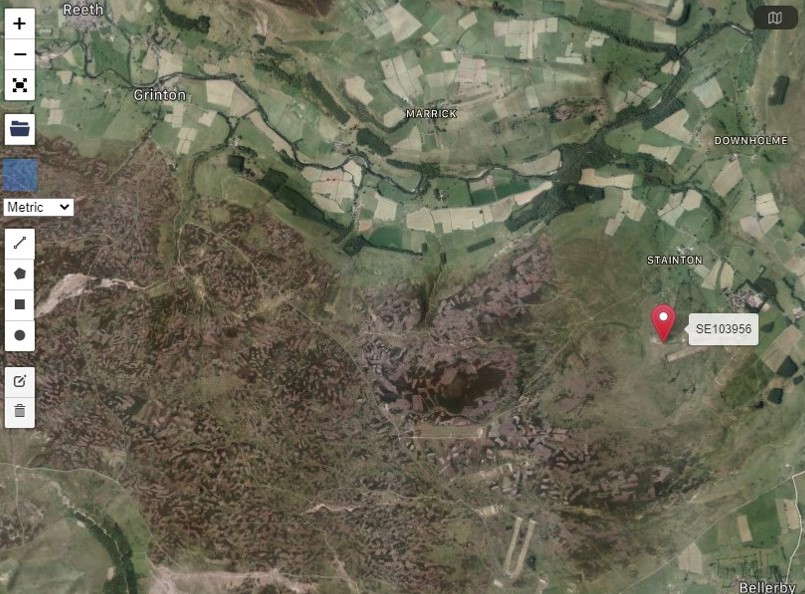
One of those missing is a brood-meddled hen harrier (Tag #55152) originally removed from a nest (BMR1) in North Yorkshire. He was tagged on 11 July 2020 and his tag’s last known fix was on 20th September 2020, right next to a grouse moor in North Yorkshire, grid reference SE103956.
[The last known fix of Tag #55152 on 20th September 2020]
There’s no further information available and I haven’t seen any appeal for information from North Yorkshire Police or Natural England.
The disappearance of this bird means that there are now 46 hen harriers ‘missing’ or confirmed illegally killed since 2018 (see here). I won’t update the victim list just yet because as mentioned above, there are others to add.
Standby.
As for the rest of the nine hen harriers brood meddled in 2020, according to Natural England six are still transmitting (as of December 2020), one died in captivity before release and one died of natural causes in October 2020 (Tag #55154).
The legal basis of hen harrier brood meddling has been challenged in the courts by both Mark Avery and the RSPB. An appeals hearing is due later this month (see here for details).
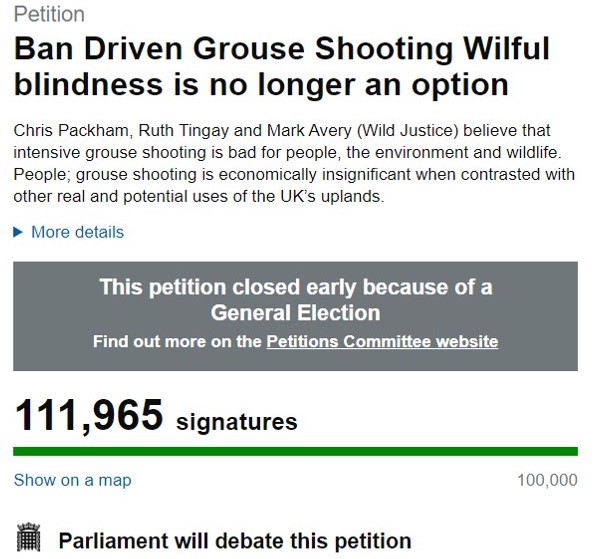
Way back in the summer of 2019, Wild Justice ran a very successful petition calling for the banning of driven grouse shooting, which secured over 100,000 signatures in under three weeks (see here).
Six months later in March 2020, Wild Justice was informed that there would be a parliamentary debate in Westminster Hall in response to the 100,000 signature threshold being reached (see here). This would be the second Parliamentary debate on this issue, following the extraordinarily dishonourable debate that took place in 2016.
However, shortly afterwards the country went in to lockdown and all thoughts of a second debate went out of the window.
Several months later, with most things moved to online platforms, Petitions Committee member Kerry McCarthy MP hosted a video conference call with Chris Packham to discuss the issue of banning driven grouse shooting (see here). Kerry has since been the recipient of malicious online abuse from the usual suspects for having dared to have this discussion!
Last week, the Petitions Committee clerk got back in touch with Wild Justice and announced there’d be a parliamentary debate in Westminster Hall on Monday 25th January 2021 at 6pm. This will be available to watch live, online.
As the Wild Justice blog pointed out in March 2020 (here), don’t assume that this debate will rapidly lead to the banning of driven grouse shooting but do assume that it’ll provide a good opportunity to hear how things have moved on in the four and a half years since the last debate, not least the recent decision from the Scottish Government to introduce a licensing regime for driven grouse shooting ASAP.
Regular blog readers will be aware that there are currently two separate groups with a stated interest in reintroducing golden eagles to Wales, although both have very different, conflicting approaches.
I’ve been particularly interested in the approach of one of these groups, Wilder Britain, which is headed up by Dr Paul O’Donoghue who is known for, amongst other things, his failed application (under the name of Lynx UK Trust) for a trial release of Lynx at Kielder Forest (here) and his failed attempt (under the name of Wildcat Haven Enterprises CIC) to sue Andy Wightman MSP for alleged defamation (here).
Since February 2019, O’Donoghue has made a lot of noise in the media about his ‘plan’ to reintroduce golden eagles to Wales and he’s been fundraising to support this ‘plan’ but so far, in complete contrast to the Eagle Reintroduction Wales Project, very little detail of his background research or his ‘plan’ has emerged.
As a result, in August last year I submitted a Freedom of Information request to Natural Resources Wales (NRW, the Welsh Government’s statutory conservation agency) for information about any correspondence it’d had with O’Donoghue about reintroducing golden eagles.
It took NRW three months to respond (instead of the statutory 20 working days) and when it finally did respond, it refused to divulge any information because it claimed the requested information was exempt (see here).
I didn’t agree that the requested information was exempt so I challenged NRW to review the decision. It did review it and, two months later, I received the following response yesterday:
The accompanying information that NRW released is posted below. It’s not especially interesting; there’s what looks to be a great deal of posturing and bluster, but essentially NRW has not yet received a licence application from Wilder Britain in relation to the reintroduction of golden eagles to Wales.
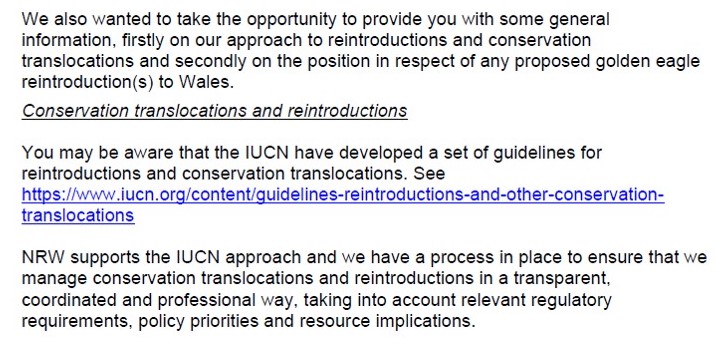
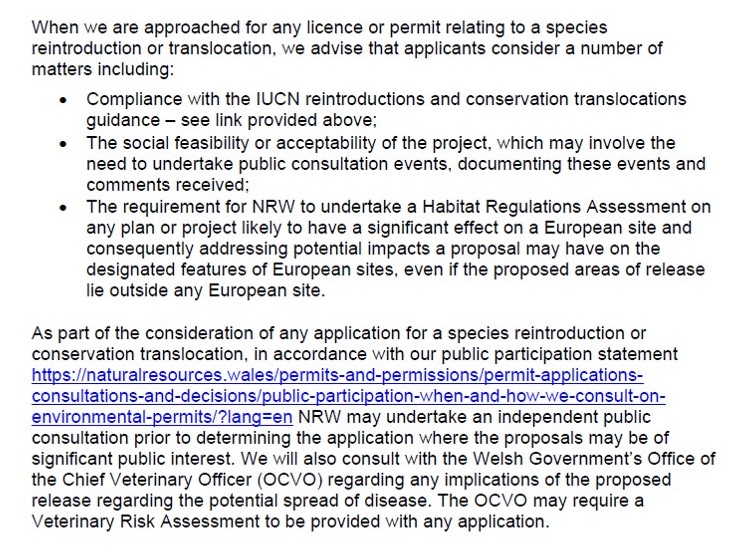
Of much more interest was the second part of the letter from NRW to me, where it sets out its position on reintroductions in general and then specifically on proposed golden eagle reintroductions. This information is useful as it clarifies several issues, including what licences would be required for a reintroduction and the option for NRW to conduct its own public consultation prior to a decision being made. This should be reassuring for many.
It’s also useful to see NRW’s commitment to meeting IUCN standards, and that includes addressing the persecution issue and whether it’s still a risk to golden eagles. Recent revelations exposed on this blog indicate that it is indeed still a significant risk (see here).
In amongst the released documents from NRW is correspondence from Wilder Britain last summer about an intention to submit licence applications to NRW by Xmas 2020 with a view to releasing eagles in summer 2021. This seems ambitious, even without the new Covid lockdown, especially when some key eagle experts in Norway (from where O’Donoghue has claimed to be sourcing donor birds) have apparently said they haven’t agreed to any such project.