Press release from RSPB (18th August 2023)
THREE MORE SATELLITE-TAGGED HEN HARRIERS VANISH ON DRIVEN GROUSE MOORS, ALL WITHIN DAYS OF THE ‘GLORIOUS 12TH’
- Three satellite tagged Hen Harriers have disappeared on private driven grouse moors in Northern England between August 9th and August 15th.
- All three birds were fitted with a satellite tag, which regularly transmit data, allowing their movements to be monitored.
- Two birds had fledged recently on the United Utilities Bowland Estate, and the third was a one-year-old female from the National Trust for Scotland Estate at Mar Lodge.
Three satellite-tracked Hen Harriers have suddenly disappeared over land managed for driven grouse shooting. All three disappearances have happened within days of the Glorious Twelfth, the official start of the shooting season for Red Grouse, and a time where grouse numbers are managed to be at their peak level to ensure a successful shooting season.
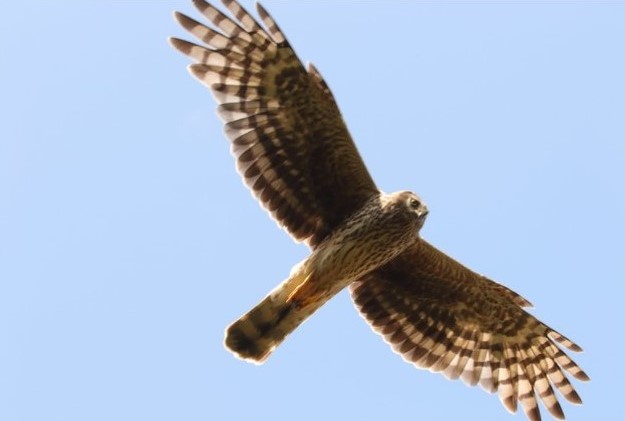
Hen Harriers are a rare, protected species, known for their acrobatic ‘skydancing’ courtship display over the uplands. The Hen Harrier is categorised as a red listed species in the UK, due to its low population levels.

Martha was a one-year-old female Hen Harrier. She was tagged as a chick at Mar Lodge, a National Trust for Scotland estate in Aberdeenshire in the spring of 2022. The satellite tracking data shows that Martha moved into Northumberland in early August 2023 and gave her last transmission from Westburnhope Moor near Hexham, in the North Pennines on 9 August 2023.
Selena was a juvenile female tagged on United Utilities land in Bowland in the spring of this year. Her satellite tag showed that she had just moved to the Yorkshire Dales before her last transmission from Mossdale Moor near Hawes, in the Yorkshire Dales on 11August 2023.
Hepit was another young female Hen Harrier. She had also been tagged as a chick on United Utilities land in Bowland this year, before moving to the Yorkshire Dales last month. Hepit’s last transmission came from moorland at Birkdale Common near Kirkby Stephen, on 15 August 2023 – an area where 9 other satellite-tagged Hen Harriers have vanished or been found dead with injuries consistent with persecution since September 2020.
Despite being legally protected, multiple studies and reports confirm that illegal killing is the main factor limiting the recovery of Hen Harrier in the UK, causing a reduction in nesting success, annual productivity and survival of breeding females. A recent RSPB Centre for Conservation Science study which investigated the illegal killing of satelite-tagged Hen Harriers in association with gamebird management (Ewing, et al 2023) has shown that the survival rates of Hen Harriers in the UK is “unusually low” with birds surviving for just 121 days after fledging. Human persecution accounted for 27-41% of deaths on Hen Harriers aged under one year and 75% of deaths in birds aged between one and two years. It also highlighted a strong overlap between Hen Harrier mortality and the extent of grouse moors.
Sadly, although this pattern of satellite tagged birds disappearing around the start of the Red Grouse shooting season has been seen before, the RSPB have never had a case of three satellite-tagged Hen Harriers going missing within six days.
Beccy Speight, RSPB Chief Executive said – “This is the first time so many hen harriers have gone missing in such a short space of time, all on driven grouse moors. This is on top of the 21 birds that we reported on in April, as having gone missing in the last twelve months. If these magnificent birds are ever going to have a sustainable population in England this has to stop, productivity from nests simply means nothing if the birds don’t survive.
We call on the UK Government to introduce a licencing system for grouse shooting in England similar to measures now being taken forward in Scotland, to act as a meaningful deterrent to raptor crime whilst also protecting the legitimate interests of those landowners who operate legally.”
All three incidents have been reported to the police and the NWCU (National Wildlife Crime Unit). Sadly, there are several other Hen Harrier persecution incidents that we cannot report on at this time.
If you notice a dead or injured bird of prey in suspicious circumstances, call the police on 101 and fill in the RSPB’s online reporting form: https://www.rspb.org.uk/birds-and-wildlife/advice/wild-bird-crime-report-form/
If you have information about anyone killing birds of prey which you wish to report anonymously, call the RSPB’s confidential Raptor Crime Hotline on 0300 999 0101.
ENDS
These latest three victims mean that at least 101 hen harriers have gone ‘missing’ / been killed illegally in the UK since 2018, most of them on or close to driven grouse moors. I’ll update the list shortly.
It’s clear from the statement in the RSPB press release, ‘Sadly, there are several other Hen Harrier persecution incidents that we cannot report on at this time‘, that there are multiple other cases of missing/killed hen harriers still to be publicised, no doubt delayed by certain police forces not doing their jobs.
It’s interesting to see the RSPB take the decision not to wait before publicising these latest three incidents. All three have been reported to the police, quite rightly, but given the appalling track record of both North Yorkshire Police and Northumbria Police in dealing with investigations into suspected raptor persecution crimes, there seems little point in waiting anymore. In fact I’d go as far to say that there should be independent inquiries into the mishandling of investigations into raptor persecution crimes by these two police forces. Some of their latest failures are yet to be reported but some are already in the public domain (e.g. here, here, here).
UPDATE 11.40hrs: 101 hen harriers confirmed ‘missing’ or illegally killed in UK since 2018, most of them on or close to grouse moors (here).