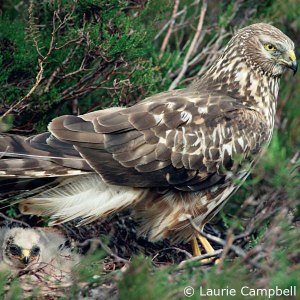
Bird of prey ‘initiative’ in Peak District National Park fails to deliver

IMG_5764 (2)In 2011, a five-year ‘Bird of Prey Initiative’ was launched which aimed to restore declining populations of some raptor species in the Dark Peak region of the Peak District National Park.

This ‘initiative’ was deemed necessary following years of evidence of wide scale raptor persecution within the region (e.g. see RSPB summary reports here and here).

The members of the ‘Bird of Prey Initiative’ comprised five organisations: The Moorland Association, The National Trust, Natural England, Peak District National Park Authority and the RSPB. Two local raptor study groups (the Peak District Raptor Monitoring Group and the South Peak Raptor Study Group) were also involved.

Targets were set to increase the breeding populations of three key raptor species for which the area had been given Special Protection Area status, i.e. it was considered a nationally important site for these raptors.

The targets were set as follows:

Merlin: increase from 22 breeding pairs to 32 breeding pairs by 2015

Short-eared owl: maintain the average breeding population of 25 pairs to 2015.

Peregrine: increase from 13 breeding pairs to 15 breeding pairs by 2015.

These targets were not unreasonable – they reflected the number of breeding pairs that the SPA should have been able to support.

goshawk-legsInterestingly, the group failed to set any targets to improve the breeding populations of local goshawks and hen harriers; there was just an ‘expectation’ that these species would be encouraged to breed. Sure, neither are an SPA-qualifying species in this area but nevertheless the area used to hold historically important populations which have since been reduced, through illegal persecution, to an occasional successful pair, so why exclude them?

Anyway, the ‘initiative’ has now ended and surprise surprise, the targets set for merlin, short-eared owl and peregrine have not been met. And goshawks and hen harriers are still largely absent with just a couple of exceptions. You can download the project report here for details: PDNP-Birds-of-Prey-Report-2012-15

In response to the report’s findings, Rhodri Thomas, an ecologist with the Peak District National Park Authority, is quoted in this BBC article (here) as saying the report’s findings are “concerning and disappointing“. Mark Avery has described the findings as “entirely predictable and totally unacceptable” (see here).

Rhodri Thomas goes on to say that the decline in peregrine numbers (now at only four pairs) was the hardest to explain as numbers in other parts of the Park were increasing and there was no obvious reason why they were staying away from the Dark Peak. He said he was determined to “bottom-out” what was causing the decline.

Here’s an easy starting point for him – try reading the provisional results of the most recent National Peregrine Survey (see here) as well as the recent paper documenting peregrine declines in another region dominated by driven grouse shooting (see here).

Sorry, Rhodri, but it’s not that difficult to understand.

In a press release from the Peak District National Park (see here), there’s talk of ‘renewed commitment’ from the project partners as well as ‘new rigour and energy’ to restore the breeding success of raptors in the Dark Peak. This is, of course, utter bollocks.

Mark Avery has picked up on this in his blog from this morning (see here), and as he says, it’s just an opportunity for the National Park authorities to hide behind a failing project for a few more years and avoid taking any real action, like, for example, banning driven grouse shooting within the National Park.

We’re so tired of all this ‘talking’ and so-called ‘cooperation’. It hasn’t worked and nor will it work. How do you move on from a conversation that goes something like this:

Conservationists to the grouse shooting industry: “Stop illegally killing raptors”.

Grouse shooting industry to conservationists: “We’re not killing them”.

Meanwhile, the killing continues and The Untouchables remain untouchable. The time for talking is over.

Sign the petition to ban driven grouse shooting here

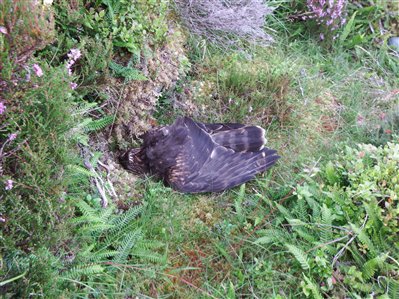
This dead goshawk (photo above) was found in the Peak District National Park in 2014 – both legs were broken and its injuries were consistent with being caught in an illegally set spring trap.

Rare red-footed falcon shot dead – police appeal

A young male red-footed falcon, a rare visitor to the UK, has been found shot dead in Cambridgeshire.

The bird’s carcass was discovered near Whittlesey, Cambs, in September. A post mortem has confirmed shooting as the cause of death.

The RSPB is offering a £1,000 reward for information.

RSPB press release here

red-footed-falcon_shot Sept 2015

Leadhills Estate featured in programme on Land Reform

The BBC’s Landward programme last Friday was a special edition focusing on land reform.

The Leadhills (Hopetoun) Estate featured, including interviews with Pat Wilders, Chair of the Leadhills Community Company, and Donald Noble, the Edinbugh-based Leadhills Estate Factor.

The Leadhills Community Company (website here) was established in June 2014 as part of a formal process in readiness for registering an interest in a community buyout of Leadhills Estate.

Pat Wilders has got some guts. Well done that lady.

The programme is available to watch for the next 28 days here.

Leadhills village & grouse moor from Landward prog

New report highlights raptor persecution in Northern Ireland

PAWNI Report 2009-2013The first ever ‘official’ report on raptor persecution in Northern Ireland has been published.

The report was prepared by the Raptor Subgroup of the Partnership for Action Against Wildlife Crime in Northern Ireland (PAWNI) – group members include the Northern Ireland Raptor Study Group (NIRSG), Police Service of Northern Ireland (PSNI), Northern Ireland Environment Agency (NIEA), Royal Society for the Protection of Birds (RSPB) and the National Wildlife Crime Unit (NWCU).

The report details confirmed raptor persecution crimes between 2009-2013, including location maps. A total of 33 raptors were confirmed to have been illegally killed during this five-year period, with buzzards, red kites and peregrines the most frequent victims but other species included golden eagle, white-tailed eagle, merlin and sparrowhawk.

The report serves a useful purpose to focus attention on the extent of raptor persecution in Northern Ireland and to encourage members of the public to report suspicious activity in their areas. It is anticipated that an annual persecution report will be published in future years.

NIRSG press release here

Read the report here

Buzzard with bait NI

General Licence restrictions on Raeshaw & Burnfoot Estates last only six days

On 4th November, we blogged about SNH’s intention to restrict the use of General Licences in two areas, in response to alleged raptor persecution incidents. The two areas included parts of the Raeshaw and Corsehope Estates in the Borders (Restriction #1), and parts of the Burnfoot and Wester Cringate Estates in Stirlingshire (Restriction #2) (see here for our earlier blog about these restrictions, and see here for SNH’s explanation for the restrictions).

The General Licence restrictions were due to begin on 13th November 2015 and run for three years. They actually only ran for six days.

SNH GL restriction 1 SUSPENSION - Copy

SNH GL restriction 2 SUSPENSION - Copy

On 19th November 2015, the General Licence restrictions were suspended in both areas until further notice, because the Estates have lodged legal appeals, as they said they would last week (see here). While the appeals are underway, the Estates can continue to use the General Licences (i.e. continue to set crow traps and Larsen traps to catch and kill corvids, continue to shoot corvids, and continue to kill lots of other stuff that falls under the remit of activities permitted under the General Licences – see here for a list).

We don’t know what the basis of the appeals are, and nor do we know the procedural process of the appeals system, but presumably SNH now has a fixed period of time to respond. If SNH decides to uphold the appeals then the General Licence restrictions will be removed. If SNH decides to stick to its original decision and impose the three-year restrictions, then the restrictions would be re-instated. However, then these Estates would be entitled to apply for a judicial review to test whether SNH has acted fairly.

Settle yourselves in for a long legal battle.

Red kite found poisoned in the Highlands

Police are appealing for information following the death of a red kite in the Nairn area. Police statement as follows:

The kite was discovered by a member of the public on farmland in the Glenferness area at the end of October. Police were contacted with immediate action being taken to establish the cause of death. Subsequently, test results returned this week have confirmed the bird had ingested an illegal pesticide.

Commenting on the investigation, Area Commander Chief Inspector Colin Gough said:

“Sadly it has been confirmed the red kite had died as a result of consuming a poisonous substance and an investigation is now taking place into the circumstances. It appears to be an isolated incident involving a single bird of prey. Police Scotland and partners are committed to tackling wildlife crime and will utilise all available resources to bring those responsible to justice.”

“Investigations into wildlife crime can be very complex and challenging, with a major part of our enquiries involving liaising with members of the local community who may hold essential information.

“We would appeal to anyone who has any information to make contact as a matter of urgency via 101 or Crimestoppers on 0800 555 111”

Ian Thomson, Head of Investigations for RSPB Scotland said:

“It is very disappointing to hear of yet another incident of raptor persecution in this area. It is thoroughly depressing that in 21st century Scotland, there are still those who have a Victorian attitude towards birds of prey, as well as a criminal disregard of the law.

“The continued targeting of our raptors is a stain on our country’s reputation and has no place in modern Scotland. I urge anyone who has information about this incident to contact the police as soon as possible.”

END

Well done to Police Scotland for putting out a timely appeal for information.

So, yet another illegally-killed raptor. Yet another poisoning with a banned pesticide. Yet more evidence that current deterrents are not working. Are you paying attention, Environment Minister?

Red kite photo by David Tomlinson

Stody Estate subsidy penalty confirmed

Following on from our blog five days ago about the subsidy penalty imposed against the Stody Estate as a result of their gamekeeper’s criminal poisoning activities (see here), the Rural Payments Agency has now clarified the actual size of the penalty:

RPA Stody Estate subsidy penalty - Copy

There’s something odd about this. Converting the penalty from Euros to Sterling using a currency converter app, the subsidy penalty amounts to £184, 745.08 (although the app used by Mark Avery has calculated the conversion to be £192, 160.63). Whatevs! Whichever calculation is accurate, it’s still a huge penalty and that’s good. And it still represents the highest known subsidy penalty imposed in the UK for cross-compliance breaches related to raptor persecution offences.

However, both of these amounts are considerably less than the amount we had calculated in our earlier blog five days ago.

We had previously calculated the penalty to be £221,946.75, which was 75% of the SPS subsidy that Stody Estate had received in 2014. We got the information about the amount of subsidy the Stody Estate had received in 2014 by doing a search on CAP Payments.

When you compare our first calculation of what the penalty was (£221, 946.75), with the amount the Rural Payments Agency now say the penalty is (£184, 745.08 OR £192, 160.63), it becomes clear that around £37,000 worth of potential subsidy penalty has apparently gone missing.

So either the data on the CAP Payments website are inaccurate, or the Rural Payments Agency has miscalculated and imposed a smaller penalty than they should.

Not sure we have the appetite for going back to the RPA to ask for clarification – it’s too much like hard work for a Friday afternoon. We’re quite content just to know that the penalty has finally been imposed and that the Stody Estate has had to suffer serious financial consequences as a result of the criminal actions of their gamekeeper. Good stuff.

Wildlife Crime Penalties Review Group calls for tougher sentences

Wildlife Crime Penalties Review Group Report 2015 - CopyThe Scottish Government has today published the long awaited report from the Wildlife Crime Penalties Review Group – and it is very good news.

You may recall that this Review Group was established in July 2013 by then Environment Minister Paul Wheelhouse, as part of a series of measures aimed at tackling the continued persecution of birds of prey (see here). It was his response to growing levels of public concern and a lack of confidence in the judiciary to deal with raptor-killing criminals. Criticisms of the system have often centred around perceived corruption, vested-interests and biased Sheriffs, and we have come to expect unduly lenient and inconsistent sentencing in most cases (e.g. see here).

The Review Group was tasked to explore how wildlife crime was treated within the criminal justice system, including an examination of whether the penalties available properly reflect the seriousness of the damage caused to vulnerable wildlife and fragile habitats and ecosystems.

The Group was due to report in December 2014 and we’ve been frustrated by the number of subsequent delays involved, but the report has now been published and it was well worth the wait.

The Review Group’s conclusions are clear. The current system of wildlife crime penalties in Scotland is wholly inadequate and the currently available penalties do not act as an effective deterrent to would-be offenders. This will be no surprise to regular readers of this blog, so we’re delighted that this independent Group has reached the same conclusion.

The Review Group has made ten short-term and medium-term recommendations for the Scottish Government to consider. These include raising the maximum penalty for summary convictions to at least £40,000 and 12 months imprisonment. The current maximum penalty is £5,000 and 6 months imprisonment.

The Group also recommends the extended use of ‘forfeiture provisions’, including a provision that where a firearm or shotgun is involved in the commission of a wildlife crime, the court should have the power to cancel the relevant certificate.

They also recommend the development of sentencing guidelines for wildlife crimes to enhance the consistency and transparency of sentencing.

This Review Group’s report is an impressive piece of work – and we’re not just saying that because we agree with its conclusions and recommendations. Unusually for a Government report, it is extremely well-written (and thus easy to understand), detailed, and well-supported by documentary evidence. Professor Mark Poustie (University of Strathclyde Law School) and his fellow Review Group members are to be commended.

The report can be downloaded here: Wildlife Crime Penalties Review Group Report 2015

So what happens next? Well, the Scottish Government now has to consider the report’s recommendations and decide whether to implement any of them. Current Environment Minister Dr Aileen McLeod is quoted this morning:

I will carefully consider all the recommendations and will make a further announcement on how we intend to take this work forward“.

Let’s hope she gets on with it. She still hasn’t made a decision on whether to increase the investigatory powers of the SSPCA, even though the public consultation on this issue closed over a year ago on 1st September 2014 (see here).

And in fact, the SSPCA consultation is highly relevant to the Wildlife Crime Penalties Review Group report. It would be pointless to have a robust set of penalties for wildlife crimes if the enforcement measures responsible for getting the wildlife criminals before a court are ineffective. It wouldn’t matter how strong the available penalties are if the actual criminal involved hasn’t been brought to court. Harsher penalties will not be an effective deterrent if the would-be offender knows that the chance of being caught / charged is virtually nil, which is how things are at the moment. Problems with wildlife crime enforcement by Police Scotland have been well documented (e.g. see here) and there needs to be a massive improvement in this area. Granting an extension of powers to the SSPCA would, in our opinion, greatly enhance the effectiveness of enforcement. If this is also coupled with the recommendations of the Wildlife Crime Penalties Review Group report, then we might, just might, be making some progress.

This is the perfect opportunity for Dr McLeod to make her mark and demonstrate, in a tangible way, the Scottish Government’s oft-claimed commitment to stamping out raptor persecution. Over to you, Minister.

Police Scotland explain failure of vicarious liability in Kildrummy case

waneLast month we blogged about the failure of the Crown Office to initiate a vicarious liability prosecution in the Kildrummy case (see here).

A quick re-cap: in December 2014, Kildrummy Estate gamekeeper George Mutch was convicted of a series of wildlife crime offences that took place on Kildrummy Estate in 2012, including the trapping of a goshawk which he then beat to death with a stick (see here). In January 2015, Mutch was sentenced to four months in prison – the first gamekeeper in the UK to receive a custodial sentence for raptor persecution crimes (see here).

In September 2015, the possibility for a vicarious liability prosecution against Mutch’s employer became impossible as the case had become legally time-barred (i.e. three years had elapsed since the commission of his crimes). We wanted to find out why a vicarious liability prosecution had not been brought in this case so we asked the Crown Office for an explanation. They responded by saying that as nobody had been reported to them for consideration, they couldn’t take forward a prosecution. We speculated (here) about the reasons why nobody had been reported, and thought that it probably had something to do with the fact that Kildrummy Estate is registered as an off-shore company (in Jersey) and thus identification of the actual owner was well hidden; this situation had been expertly uncovered by Andy Wightman’s research earlier this year – see here. However, to find out if this really was the reason why nobody had been reported to the Crown Office, we really needed to hear from Police Scotland, so last month we asked them why they hadn’t reported anyone from Kildrummy Estate to the Crown Office for consideration of a vicarious liability prosecution.

Police Scotland has now responded with a cryptic masterpiece, but if you look closely at their carefully-worded reply it is actually quite revealing:

Police Scotland is committed to tackling wildlife crime whilst recognising that these investigations can often be challenging and prolonged. In 2013, a report about George Mutch was submitted to the Wildlife and Environmental Crime Unit (WECU) at the Crown Office and Procurator Fiscal Service (COPFS) alleging the unlawful taking and killing of birds of prey at Kildrummy Estate, Aberdeenshire in 2012. Following a criminal prosecution Mr Mutch was convicted and sentenced to 4 months imprisonment in January 2015.

In parallel with the investigation surrounding the activities of George Mutch, enquiries were made to establish whether any further charges could be brought in terms of Vicarious Liability legislation (Section 18A of the Wildlife & Countryside Act 1981). However, this legislation does require an offence to have been committed and therefore charges can only be formally libelled once a conviction has been confirmed. Significant international investigations were undertaken by Police Scotland but after consultation with COPFS it was established that due to insufficient evidence the additional charge of Vicarious Liability could not be libelled.

The experience of this case has, however, identified opportunities for refining future Vicarious Liability investigations, a matter currently being explored with COPFS. Please be assured that Police Scotland will continue to ensure that robust and modern investigative tactics are utilised to bring those committing wildlife crime to justice. Police Scotland’s wildlife crime commitment is additionally reflected in our membership of PAW (Partnership for Action Against Wildlife Crime) Scotland.

I hope the above information addresses the issue raised by you in your correspondence.

Yours sincerely,
Sean Scott, Detective Chief Superintendent”.
END
For the purposes of our interest, the first paragraph can be ignored. Where things start to get interesting is in paragraph two. Pay close attention to the wording:
Significant international investigations were undertaken……..it was established that due to insufficient evidence the additional charge of Vicarious Liability could not be libelled“.
International investigations” can only relate to an enquiry about either the land owner, or Mutch’s employer, or who owned the shooting rights; in other words, the individual who could be liable for a potential vicarious liability prosecution. “Insufficient evidence” implies that Police Scotland knew who was responsible for managing Mutch, but just couldn’t prove it. Why? Because the details are hidden in an off-shore holding.
It is apparent then, in the Kildrummy case, that justice has been defeated because the details of land ownership (or at least the hierarchical management structure from Mutch upwards) are concealed. This has big implications for any future vicarious liability prosecutions on estates where the land is registered as an off-shore company (a convenient ploy to escape a potential criminal prosecution) and we’re pretty sure Andy Wightman will have something to say about this in terms of his work on the Land Reform Bill currently being considered by the Scottish Parliament. (Update: Andy Wightman has blogged abut this latest development – see here).
The first line of paragraph three, (“The experience of this case has, however, identified opportunities for refining future Vicarious Liability investigations….“) is interesting and we’ll watch to see what this ‘refinement’ might entail.
As an aside, we were interested to read that Police Scotland thinks that vicarious liability charges “can only be formally libelled once a conviction has been confirmed“. That’s not actually what the legislation says. The legislation allows that the person who committed the primary offence need not be prosecuted in order for a prosecution to be brought against the person in management or control (see here). We’re a bit bemused by Police Scotland’s interpretation of this in their above statement, but, as we say, it’s a bit of a side issue in this case because even if Mutch hadn’t been convicted but an attempt was still made to undertake a vicarious liability prosecution, presumably Police Scotland would still have faced the same issue of being unable to identify the person in management or control because these details are squirreled away in an office in Jersey, apparently beyond the reach of Police Scotland.
So, even though vicarious liability has failed in the Kildrummy case, we feel it’s important to acknowledge that in this case, as far as we currently understand what went on, the failure is through no fault of Police Scotland or the Crown Office. This failure is, though, an indication that Vicarious Liability is not the panacea the Scottish Government would like us to believe it is for putting an end to raptor persecution crimes. Since vicarious liability was introduced as an option on 1st January 2012, there has still only been one single successful prosecution. In almost four years, that’s not a good return rate by anyone’s standards.

Stody Estate receives £221,000 subsidy penalty for mass raptor poisoning

stody buzzardsRegular blog readers will know that in October 2014, gamekeeper Allen Lambert was convicted of a series of wildlife crime offences on the Stody Estate, Norfolk, including the mass poisoning of birds of prey (10 buzzards and one sparrowhawk) which had been found dead on the estate in April 2013. He was also convicted of storing banned pesticides and other items capable of preparing poisoned baits (a ‘poisoner’s kit’) and a firearms offence (see here and here).

Lambert got off pretty lightly when he was sentenced in November 2014. Even though the judge acknowledged that Lambert’s crimes had passed the custody threshold, Lambert received a 10-week suspended sentence for poisoning 11 raptors (suspended for one year), a six-week suspended sentence for possession of firearms and dead buzzards (suspended for one year) and was ordered to pay £930 prosecution costs and an £80 victim surcharge. In our opinion (see here), this was absurdly lenient for one of England’s biggest known mass raptor poisoning incidents, and on top of that, Lambert wasn’t even sacked – it was reported that he’d been allowed to take early retirement from the Stody Estate.

Regular blog readers will also know that for the last year, we’ve turned our attention to the minted Stody Estate to try and find out whether the Rural Payments Agency had penalised the estate for breaches in cross-compliance and had removed any of their £MILLIONS of agricultural subsidies as punishment. To receive these tax-payer handouts, estates must comply with a number of measures (like don’t poison raptors) and if they don’t comply, then cross-compliance subsidies can be removed.

It’s taken a while to get any useful information about potential subsidy penalties at Stody Estate. Getting the RPA to reveal anything about this case has been like getting blood out of a stone, or the truth out of Allen Lambert. The RPA has wriggled and squirmed and done its best to avoid answering straightforward questions: see here for previous blogs about our correspondence with the RPA. However, we’re pretty much there now, although not quite there.

Our latest FoI received a response this week. We had asked the RPA (again) whether they’d now enforced a cross-compliance penalty on Stody Estate. They answered: “Yes“.

We asked what the penalty was for, exactly. They answered: “The penalty that has been applied was for a breach of farmer requirement A1, of the pre-2015 Statutory Management Requirement 1 (wild birds). The requirement reads: ‘You must not intentionally kill, injure or take any wild bird‘”.

We asked how much was the penalty applied to Stody Estate for this breach. They answered: “The financial amount has yet to be confirmed, however the penalty is 75% of the Single Payment Scheme payments made to the Estate in 2014“.

So, we now know a penalty has been imposed, but, unconvincingly, the RPA still claims it isn’t able to tell us how much that penalty is. Either they’re incompetent or unwilling to embarrass the Estate. Or maybe both.

Anyway, we’ve done a bit of digging. We’ve discovered that the Stody Estate received £295,929.01 from the Single Payment Scheme in 2014:

Stody SPS 2014 - Copy

75% of £295,929.01 is £221,946.75.

That’s a massive subsidy penalty! As far as we’re aware, this is the biggest ever civil penalty imposed for cross-compliance breaches in relation to raptor persecution crimes. Previously, the largest was £107,000 imposed on Glenogil Estate in 2008 following the discovery of 32 poisoned baits suspected of being used to target birds of prey (see here). Earlier this year, we blogged about the £66,000 subsidy penalty imposed on vicarious liability landowner Ninian Johnston Stewart, whose gamekeeper had been convicted of poisoning a buzzard (see here).

There may well have been other cases where a penalty greater than £221,946.75 has been imposed for cross-compliance breaches related to raptor persecution, but we’ve been unable to find any information. We’ve blogged previously (here) about why increased publicity is needed when these penalties are applied – the realistic threat of having thousands of pounds worth of subsidies removed from your business has got to be a far greater deterrent than the pathetically weak sanctions handed down in the criminal courts.

For this reason, over the next few months we intend to re-visit some other recent cases where a successful conviction has been secured for raptor persecution crimes and start asking some questions about whether those estates involved have also received a subsidy penalty (e.g. Kildrummy Estate, Cardross Estate for a start, and there are others).

There has previously been some discussion in the comments section of this blog about whether the new system for the Single Payment Scheme (replaced this year by the Basic Payment Scheme) would still allow for subsidy penalties for cross-compliance breaches relating to raptor persecution. Some readers thought the new system wouldn’t allow for penalties and other readers thought it would. It’s our understanding that the cross compliance rules for BPS in England still contain a Statutory Management Requirement (SMR) for Wild Birds (SMR2) stating that you must protect all wild birds, their eggs and their nests, so technically any recipient of BPS could still be fined for non-compliance with SMR2 if they were liable, vicariously or otherwise, for raptor persecution on their land.

However, the new system seems to be slightly different in Scotland where SMR2 states that you must protect all wild birds, their eggs and nests if you have land classified as a Special Protection Area. That could mean that a Scottish recipient of BPS could only be fined for breaching SMR2 if the breach took place in an SPA. If that interpretation is correct, it would exclude rather a lot of land. We’ll be seeking clarification from the Scottish Government about whether raptor persecution on non-SPA land would be considered a breach of the new SMR2.

A final word – thank you to all the blog readers who have exerted pressure on the RPA over the last year regarding the Stody Estate case; we know that a number of you have been involved. Had it not been for this sustained effort, the Stody Estate may well have escaped a penalty altogether, or perhaps been given a much smaller penalty. Well done!

Photo of some of the poisoned buzzards found at Stody Estate is by Guy Shorrock (RSPB Investigations)