 Evidence is emerging of what looks to be a pretty comprehensive police cover-up of the mass poisoning of birds of prey in the Powys region of Wales.
According to the RSPB’s annual Birdcrime report (2012), the following incidents are listed:
Oct 2012: 1 x pheasant bait (Bendiocarb), location: Powys.
Oct 2012: 1 x pheasant bait (Bendiocarb), location: Powys.
Oct 2012: 2 x pheasant bait (Bendiocarb), location: Powys.
Oct 2012: 1 x poisoned red kite (Bendiocarb), location: Powys.
This little cluster is of interest, but becomes of even greater interest when you look at the RSPB’s annual Birdcrime report (2013), where the following incidents are listed:
Aug 2013: 1 x pheasant bait (Bendiocarb), location: Powys.
Aug 2013: 1 x pheasant bait (Bendiocarb), location: Powys.
Aug 2013: 1 x pheasant bait (Bendiocarb), location: Powys.
Aug 2013: 1 x pheasant bait (Bendiocarb), location: Powys.
Aug 2013: 1 x poisoned red kite (Bendiocarb), location: Powys.
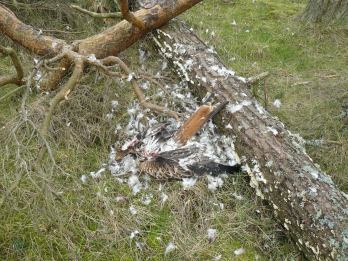
Oct 2013: 7 x poisoned buzzards (Bendiocarb), location: Powys.
Oct 2013: 3 x poisoned red kites (Bendiocarb), location: Powys.
Oct 2013: 1 x poisoned red kite (Bendiocarb), location: Powys.
Oct 2013: 1 x poisoned raven (Bendiocarb), location: Powys.
Oct 2013: 1 x poisoned pheasant bait (Bendiocarb), location: Powys.
Oct 2013: 1 x poisoned red kite (Bendiocarb), location: Powys.
In total then, over a period of 12 months, seven poisoned red kites, seven poisoned buzzards, one poisoned raven, and nine poisoned pheasant baits were found in Powys.
 Now, Powys is a pretty big county and unfortunately the RSPB Birdcrime reports do not specify a more precise location so you can’t tell from these reports whether these poisoning incidents are related, although the use of Bendiocarb each time is striking. We don’t recall reading anything about these crimes in the media.
To find out a bit more, an FoI was submitted to Dyfed-Powys Police. The FoI asked three questions:
- Were all these poisoned baits and poisoned birds all found in the same area? Or
- Are they from multiple locations in different parts of Powys?
- What is the status of any police investigation(s) into these crimes?
Here is the Dyfed-Powys Police response to the FoI:
I can confirm that Dyfed-Powys Police does hold the information requested, the details of which are as follows:
- Yes they were.
- No they do not.
- They have been concluded.
One thing’s for sure – you can’t accuse the FoI officer at Dyfed-Powys Police of being verbose! No matter, the information provided is still useful.
What we’re now interested in is finding out where, exactly, these poisoning offences took place, why there hasn’t been a prosecution, and why there hasn’t been any media statement from the police?
Raptor persecution is one of the UK’s six wildlife crime priorities so you might expect that the mass poisoning of 14 raptors + one raven + the discovery of nine poisoned baits in one area might have warranted some kind of public statement, right? That seems a pretty reasonable expectation, and especially when you consider that the head of the Dyfed-Powys Police force is one Chief Constable Simon Prince. Who he? Why, he’s only the Chair of the Partnership for Action Against Wildlife Crime (PAW) UK Steering Group, and he also happens to be the Association of Chief Police Officers (ACPO) lead on wildlife crime! This mass poisoning is right up there as one of the worst ever recorded in the UK – think Barns Estate, think Ross-shire Massacre, think Stody Estate – all involved the illegal mass poisoning of birds of prey and all received high profile media attention. What is it about this mass poisoning in Powys that the police decided it should be kept quiet?
We thought we’d look to the England and Wales PAW raptor subgroup (Raptor Persecution Priority Delivery Group) to see if they’d commented on it. After all, this is the group that DEFRA has identified as being integral to their highly controversial Hen Harrier Recovery Plan. Part of the RPPDG’s role is to provide publicity about raptor persecution, in order ‘to build trust and transparency’. Unsurprisingly, we couldn’t find any statement from the RPPDG about the mass poisoning of raptors in Powys. Why is it unsurprising? Well just look at the membership of the RPPDG – along with some very good organisations, it also includes DEFRA, Moorland Association, National Gamekeepers’ Organisation and the Countryside Alliance, none of whom are known for being keen to publicise illegal raptor persecution! Although membership of this group also includes the Police and the Welsh Government – both of whom should have commented on the mass raptor poisoning in Powys.
What we did find on our search was a protocol the RPPDG is using for publicity of annual raptor poisoning maps (see here). Strangely, the RPPDG has only once published a raptor poisoning map (covering the period 2007-2011). This map was published in 2013 – see here. The group hasn’t published any maps since then, although according to DEFRA’s Hen Harrier Recovery Plan, “the RPPDG have been publishing information on raptor poisoning since Feb 2013 and this is updated annually“. Really? Where is this published information?
So in summary, we know that the illegal mass poisoning of raptors took place somewhere in Powys between Oct 2012 and Oct 2013. We know it represents one of the worst raptor poisoning incidents discovered in the UK. We know that Dyfed-Powys Police have not issued a media statement about this atrocity. We know that the Raptor Persecution Priority Delivery Group has not issued a media statement. We don’t yet know where the mass poisoning took place but work is underway to find out. Watch this space.
UPDATE 11.50hrs: Please note, we have been asked to clarify that this blog post refers to the POWYS region of Wales and does not relate to the fine work of the North Wales Police Rural Crime Team.
UPDATE 13.07hrs: We’ve received a tweet from Chief Constable Simon Prince: “No cover up. I will look into reports & update on Twitter”.
That speedy and positive response sounds promising. We’ll update here in due course.
UPDATE 10 March 2016: Dyfed-Powys Police respond – see here.
UPDATE 1 July 2016: Mass poisoning of raptors in Wales: location revealed here
UPDATE 2 July 2016: Statement from Glanusk Estate here



 Regular blog readers will know all about the proposal to provide increased investigatory powers to the SSPCA to enable them to investigate a wider suite of wildlife crime than they already do. We’ve been blogging about it since February 2011 when it was first suggested by former MSP Peter Peacock (see
 Some good news for a change!
 Back to the Rural Affairs, Climate Change & Environment (RACCE) committee meeting in January….
