We’ve been sent some fascinating correspondence from one of our blog readers.
Following the news in February 2017 of the ‘non suspicious’ death of a tagged goshawk on the royal Sandringham Estate in Norfolk (see here), a blog reader wrote to Norfolk Constabulary as follows:
“I write in reference to the Mail on Sunday’s coverage (online, Sunday 12 Feb 2017) of the radio-tagged goshawk reported to have been found (first said to be found dead, then said to have been found alive) at Sandringham. Given the confusion that surrounds this case, will the Police be making any further statements to clarify what they believe happened to the bird, to help ascertain what may have caused its decline and then death (important to know as part of the study being carried out on the species) and why its body was incinerated when it had only just died, and was obviously part of a tagging project? A lot of people obviously think there are grounds for suspicion here, and would be interested to know why the Police are said to have taken a different view. I am sure the estate would also welcome the matter to be cleared up. Many thanks for your help in this and for any reassurance you can give the public that the matter is being looked into thoroughly“.
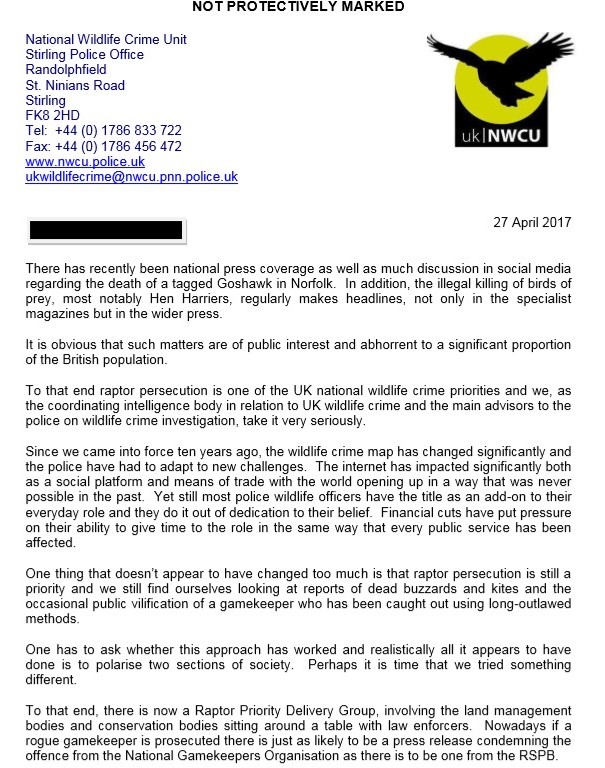
The reply came in the form of a jointly-signed letter from Chief Inspector Martin Sims (Head of National Wildlife Crime Unit) and Inspector Jon Papworth (Wildlife Crime Coordinator, Norfolk Constabulary).
It beggars belief that the Head of the NWCU, the ‘coordinating intelligence body for wildlife crime’ is still talking in terms of ‘rogue’ gamekeepers being responsible for raptor persecution.
How does he explain the virtual extirpation of breeding hen harriers in the grouse moor areas of northern England?
How does he explain the continuing decline of breeding peregrines on the grouse moors of northern England?
How does he explain the repeated reports of shot and poisoned red kites in the grouse moor areas of North Yorkshire?
How does he explain the continued suppression of the golden eagle breeding population in the grouse moor areas of central, eastern and southern Scotland?
How does he explain the continued suppression of the red kite breeding population in the grouse moor areas of northern Scotland?
How does he explain the almost continuous reports of satellite-tagged raptors that ‘disappear’ disproportionately on land managed for driven grouse shooting in England and Scotland?
This isn’t the work of a few ‘rogue’ gamekeepers; this is the result of systematic persecution, affecting entire regional (and sometimes national) raptor populations, at the hands of the game shooting industry. It is industrial scale criminality and the sooner Chief Inspector Sims gets his head around this, the sooner we might see an improvement in enforcement action.
He says that media commentary on these crimes ‘appears to have polarised two sections of society’. Which two sections of society are they, then? The criminals and the law-abiding public? He seems to think we should all stop talking about this criminality and instead place our trust in the game-shooting sector. Yeah, great idea. Let’s not talk about the crimes that criminals commit, whether they be gamekeepers, drug dealers, burglars, rapists, murderers or thieves. Instead, let’s hold support groups, sit around with tambourines and all sing Kumbaya. That’ll sort it.
He talks about trying ‘a different approach’ and refers to the Raptor Persecution Priority Delivery Group (RPPDG) as an example of this. And what has the RPPDG delivered since its inception in 2010? Bugger all. We’ve recently seen some minutes from these RPPDG meetings, obtained via FOI, and all the meetings seem to achieve is to provide an opportunity for the gameshooting industry ‘partners’ to consistently challenge the confirmed persecution data recorded by the RSPB. Presumably that’s why we haven’t seen any national persecution incident maps from the RPPDG since 2011. It’s pathetic.
He talks about the law-abiding gamekeepers within the industry. There must be some, but where are they? How are we expected to tell the difference between the criminals and the law-abiders? How much intelligence on raptor persecution is supplied by gamekeepers to the police? How often do you see gamekeepers and their representative organisations highlighting raptor crimes or calling for tighter regulation?
With views like those of Chief Inspector Sims, it’s no wonder the NWCU hasn’t made even the tiniest dent in addressing illegal raptor persecution. It definitely is time for a different approach.
Here’s a pie chart for CI Sims to contemplate while he’s dreaming up ways of supporting the game shooting industry. It shows the occupations/interests of 176 individuals convicted of bird of prey related offences 1990-2016 (from the RSPB’s 2015 Birdcrime report).
Three days on and our anger has not subsided. If anything, it’s grown. The more we’ve watched that video, and the more we’ve tried to comprehend the reasoning behind the Crown’s decision to drop all criminal proceedings, and the more we’ve contemplated the injustice and wider implications of the Crown’s decision to drop all criminal proceedings, and the longer the silence from a Government that repeatedly claims a ‘zero tolerance’ policy on raptor persecution, the more incensed we’ve become. And we’re not alone.
This 59-second video is actually a microcosm of a war that has been raging for over 60 years, ever since birds of prey were afforded full legal protection. It’s got everything, all the characteristics with which we’re now so familiar: the remote upland landscape, an area with a long history of raptor persecution, the supposedly protected hen harrier so vulnerable as she waits until the last second to abandon her eggs and flee her nest, the violent gunshots, the explosion of feathers as she’s hit, the poignant silent aftermath as her feathers float to the ground, the armed man apparently removing and hiding the evidence of the crime. Only this time the crime was witnessed, captured on film and now, finally, exposed for the world to see.
And then comes the ridiculous pantomime of legal protocol that forces fearful commentators to describe this as an ‘alleged’ crime, which implies it might not have happened. Our eyes work just fine and it is our opinion that it did happen. The only questionable part is who pulled the trigger (twice). The video footage is not conclusive on this point and the man who was charged had pleaded not guilty. It’s fair to comment that the charges against him were alleged (in other words it’s not known whether he was responsible or not) but let’s not pretend that this crime didn’t happen. Somebody shot that hen harrier in June 2013 and whoever it was has escaped justice as the case is now time-barred.
There are several aspects of this case that fan the flames of our exasperation. We’ve already discussed the role of the Crown Office and the questions raised by their decision to drop all proceedings. These matters are deeply concerning and need to be addressed as a matter of urgency.
Other issues concern the long history of confirmed raptor persecution on Cabrach Estate. Two gamekeepers have previously been convicted for such crimes: one for having a poisoned peregrine in the back of his vehicle (here) and one for shooting two buzzards (here). Other crimes were also detected including the discovery of 11 shot buzzards that had been stuffed inside rabbit holes, 24 poisoned baits, three illegal pole traps and an owl with smashed legs (here) but nobody was charged. We want to point out that the current team of gamekeepers is very recently employed and there isn’t, to our knowledge, any evidence of further crimes since the shooting of the hen harrier in 2013. But the appalling history provides a long-term perspective on what had been going on for a number of decades and that is hard to ignore.
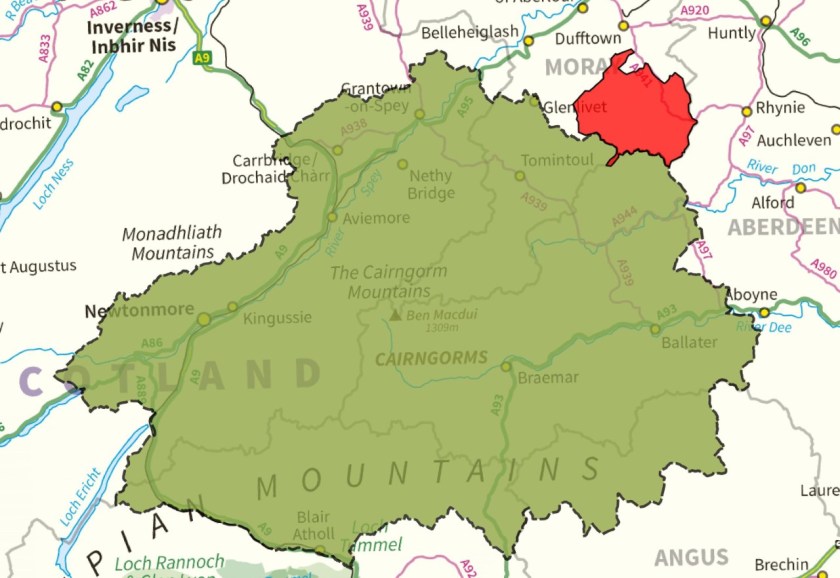
Map showing the location of Cabrach Estate, bordering the Cairngorms National Park (estate boundary based on information from the Who Owns Scotland website).
The publication of this video by RSPB Scotland last Friday has provoked an outpouring of public outrage. Social media has been alight all weekend, and commentary has been provided by many, including a 15-year-old schoolboy (here), a leading figure in conservation (here), another well-known campaigner (here) and a retired police officer (here).
Statements from the game-shooting industry have been thin on the ground but where they have been made, the words chosen have very carefully avoided discussing the killing of a hen harrier.
The Scottish Gamekeepers’ Association said they had no comment to make as they didn’t have a membership interest in this case. The video footage was totally ignored (see here).
Scottish Land & Estates also ignored the video content and instead opened with the vague statement, “Evidence of apparent ill-treatment of any protected species is, of course, deeply concerning“. There then followed the usual denials about the extent of raptor persecution, the same old spin about their involvement with the partnership working sham that is the Heads up for Hen Harriers project (which we have previously addressed, here) and then a bit more spin with this line: “In this instance, the estate in question was praised in an RSPB report last year as a potential model sporting estate given its commitment to species conservation, including Hen Harriers“. We were intrigued by this ‘RSPB report’ until we realised that it wasn’t an official RSPB report written by professional upland scientists based on a long-term & detailed assessment, but rather a report of a day trip to the estate, escorted by the new Head Keeper, of the local RSPB members’ group. Hmm, not quite as compelling an endorsement as SLE try to portray. Has Lord Johnstone been taking spin lessons from Beefy Botham on how to make a report sound more credible than it actually is?
So far, there has been no comment from the Scottish Government.
UPDATE 11 May 2017: Cabrach hen harrier shooting reaches First Minister’s Question Time (here)
Two weeks ago, the public prosecutors in Scotland (Crown Office & Procurator Fiscal Service) decided to discontinue criminal proceedings against a (now former) gamekeeper who was alleged to have shot a hen harrier on a grouse moor at Cabrach Estate in June 2013 (see here).
No explanation was given for this decision.
Earlier this morning, RSPB Scotland released video footage of the incident and issued a press statement (here). Here is the video in case anyone missed it:
After watching this video, it’s hard to find words to express the disbelief, frustration and fury about that decision to discontinue the prosecution. Social media has erupted in outrage and the Crown Office is seen as a laughing stock. Most reasonable, law-abiding people who don’t have a vested interest in driven grouse shooting would be hard pressed to disagree.
The RSPB Scotland statement said that the Crown Office had indicated they could not use the video as evidence, but no further detail was provided. RSPB Scotland quite rightly pointed out that other cases that have relied upon video footage have been used successfully in Scottish courts (the most high profile one being the conviction of gamekeeper George Mutch in 2014), and the RSPB was bewildered by the inconsistency of the COPFS’ approach in this case.
However, this morning, in response to the release of the video, the Crown Office has finally decided to provide an explanation, as published in a BBC news article:
“In accordance with the Crown’s ongoing duty to keep prosecutions under review and after carrying out a detailed review of all of the relevant material, Crown counsel considered that the inevitable conclusion was that RSPB investigators entered the land in question and embarked upon evidence gathering for the purpose of prosecution.
Discussions have taken place over a number of years between RSPB and COPFS about the admissibility of evidence obtained through the use of covert surveillance.
The Crown has consistently made it clear that strict legal tests must be met before evidence which has been obtained irregularly, such as the evidence in this case, is admissible. We will continue to have further dialogue with RSPB.
In the whole circumstances, Crown counsel concluded that the evidence would not be admissible in court.
In light of that conclusion it was entirely appropriate that proceedings were brought to an end.”
This statement begs several questions:
Essentially, this statement implies that RSPB Scotland was lying about the deployment of the video camera. RSPB Scotland had clearly explained that the camera was positioned as part of a routine research/monitoring study focusing on the breeding success of a threatened species. There’s a Scottish Government project (Heads up for Hen Harriers) that is deploying cameras at hen harrier nests for exactly this purpose for Christ’s sake! The Crown Office apparently disputes the RSPB’s explanation for camera deployment. Why? What evidence do they have that makes them think the RSPB is lying? [NB: see update at foot of blog]
If the COPFS believed this camera had been placed “for the purpose of prosecution“, why on earth did it take them three years from the date of the shooting to decide to charge the suspect, and why did it take a further year of court hearings (nine in total) before the decision was made to discontinue proceedings? Why did the COPFS even mark this case for proceedings if they didn’t believe the RSPB’s version of events? What changed in the four years the COPFS have been considering this case?
Why is the admissibility of video footage such a controversial issue in cases of alleged raptor persecution, and yet we see it being used in a current court case of alleged fox-hunting? We’ve spoken to one of the investigators who filmed the footage being used in the hunt case and he has confirmed he was filming covertly on private land without landowner permission as part of a wider research project on the behaviour of hunts, whether the hunts were involved in alleged criminal activity at the time or not. That’s no different to the circumstances of this hen harrier case.
If the circumstances of how this camera footage was obtained were so controversial, why didn’t the COPFS allow the evidence to be assessed by the court? In a very similar case to this current one, in 2006 a gamekeeper was convicted of stalking a hen harrier and his conviction was based on RSPB video evidence. During that trial, there were several hours of legal argument about the admissibility of the video evidence. The Sheriff accepted the video evidence, commenting that the RSPB presence on the gamekeeper’s estate [from where the video was filmed] was “neither illegal nor irregular, and the intent to obtain evidence did not make it so“.
We’ve discussed the issue of the admissibility of video evidence time and time and time again. In 2013, the then Environment Minister Paul Wheelhouse told us that this very issue had been raised with the Lord Advocate (see here). Why then, four years later, is there still such inconsistency and lack of clarity about video admissibility?
Why did it take the publication of this video footage, two weeks after the Crown’s decision to discontinue proceedings, for the COPFS to provide an explanation for their decision? Hen harrier persecution is one of the highest national wildlife crime priorities and there is huge and legitimate public concern about it. By remaining silent for two weeks, we would argue the COPFS has displayed an arrogance and contempt for that public concern. It’s not the first time the COPFS has been criticised for poor communications – the Scottish Environment LINK report on wildlife crime enforcement published two years ago was damning on this issue, and this year’s Scottish Parliament’s Justice Committee report on the role and purpose of the COPFS reached a similar conclusion.
The general public, is, quite rightly, furious about how this case has been handled. It seems to us that the Crown Office is more concerned about how the evidence was obtained than the actual alleged crime of killing a protected, national priority species. Of course, the COPFS has to assess the evidential circumstances on a case by case basis, and we don’t question that at all. What we do question is, in this case, on what basis the COPFS decided to disbelieve the RSPB’s explanation for deploying the camera, and why it took so long, at such huge cost to the public purse, to decide to discontinue proceedings.
And let’s not forget that this case is one of three that the Crown Office has recently discontinued, all in the space of two weeks (see here).
For a comical interlude, have a read of the statement issued by the Scottish Gamekeepers’ Association in response to the video footage. They say, “The SGA has no membership interest in this case. It is not our place to comment, therefore, on individuals involved in the alleged incident or to provide a critique of COPFS“. This is the organisation that is supposedly signed up to the Partnership for action Against Wildlife Crime and who serves on the PAW Raptor Group.
Do we have any confidence in the Scottish criminal justice system to address the on-going persecution of birds of prey? On current evidence, the answer is a resounding NO.
What to do about it? We would urge you to contact your MSP (find out who yours is here) and ask him/her to contact the Scottish Government’s Justice Minister, Michael Matheson to complain on your behalf about the handling of this case. The more MSPs that see this video footage, and hear about the public’s serious concerns, the better.
If you don’t live in Scotland but still want to voice your concerns, please email the Convener of the Scottish Parliament’s Justice Committee, Margaret Mitchell MSP (Scottish Conservatives). Email: margaret.mitchell.msp@parliament.scot
Don’t be fobbed off with platitudes or claims of “We can’t comment on individual cases”. Public scrutiny is fundamental to democracy and the public has every right to be asking questions about this ongoing, disgraceful shambles.
UPDATE 14.30hrs: RSPB Scotland has issued a statement in response to the claims of the Crown Office that the camera had been “deployed for prosecution purposes”. Here’s what it says:
In response to the Crown Office’s statement of 5th May as to why the video evidence would not be admissible in court Ian Thomson, Head of Investigations, RSPB Scotland said: “We do not agree with the opinion from the Crown Office that we were attempting to gather evidence for a prosecution. We installed a camera to monitor a protected breeding bird’s nest site, core business for a conservation organisation. We did not share the information about the nest site with anyone, as would be the case with any rare and vulnerable breeding bird species.
“The fact that an individual came and allegedly shot the female harrier, and that this was captured on film, was an incidental consequence of the camera’s deployment, in the same way that it could easily have captured footage of the nest being naturally predated or failing due to bad weather. It is very disappointing that the opportunity for the court to consider the issue of the admissibility or otherwise of this evidence, as has happened in previous cases, has been removed. Until today, we have received no rationale for the decision to drop the case despite the fact that a number of our staff have provided significant time and expertise in supporting the authorities with the prosecution case.”
ENDS
UPDATE 8 May 2017: Some more thoughts on the shot hen harrier video (here)
UPDATE 11 May 2017: Cabrach hen harrier shooting reaches First Minister’s Question Time (here)
Two weeks ago we blogged about the Crown Office dropping all proceedings against a gamekeeper who was alleged to have shot a hen harrier on the Cabrach Estate in June 2013. At the time, the Crown Office did not offer any explanation for their decision to discontinue the case (see here).
Today, RSPB Scotland has published video footage of what happened at that hen harrier nest in June 2013:
RSPB Scotland has also released a press statement:
ALLEGED ILLEGAL KILLING OF A HEN HARRIER
Court proceedings against a former gamekeeper, accused of shooting a protected hen harrier, have been dropped by the Crown Office, who have indicated that after considering all of the relevant material they could not use RSPB Scotland video evidence to support the prosecution in court.
Since the incident occurred at Cabrach, Morayshire in June 2013, the case has been subject to a prolonged police investigation and nine separate court hearings, at a considerable cost to the public purse. Only now has the Crown Office Procurator Fiscal Service (COPFS) abandoned the prosecution just a few weeks prior to the scheduled trial.
The evidence was obtained as a result of RSPB Scotland staff monitoring the active nest of a breeding pair of hen harriers on the Cabrach Estate, in Morayshire, which contained 4 eggs. On 20th May 2013, a camera was deployed in a moorland area away from human habitation to film the nest to record the outcome of the nesting attempt – a routine part of RSPB Scotland’s work to observe the success of breeding attempts for this protected and threatened species. Over the next three weeks the footage recorded at the nest showed normal hen harrier breeding behaviour.
However, the film revealed that on 10th June 2013, the female hen harrier was flushed from the nest, and immediately afterwards two gun shots were heard. The bird was apparently hit as a shower of feathers can be seen. A few seconds later, a man, carrying a shotgun entered the picture and moved in the direction of where the hen harrier had flown. He then returned into the picture holding the carcass of the dead hen harrier, and was seen to pick up a number of feathers that had been dislodged from the bird.
On reviewing the footage, RSPB Scotland Investigations staff immediately reported the incident to Police Scotland, as we believed the footage showed clear evidence of a wildlife crime having been committed. This case was then reported for trial by the Crown Office following the identification by the police of a suspect.
Duncan Orr-Ewing, Head of Species and Land Management at RSPB Scotland said:
“In our opinion, the video footage clearly shows an individual involved in the illegal killing and then disposal of a hen harrier, one of Scotland’s most threatened bird species. Whilst we know that hen harriers are often illegally targeted by gamekeepers seeking to protect red grouse stocks, such crimes usually take place in remote areas, and it is therefore very difficult to obtain evidence to bring the perpetrators to justice. This incident would never have been uncovered had the nest not been monitored by our camera”.
He continued: “RSPB video evidence has been used in the successful prosecution of previous wildlife crime cases in Scotland, including two very similar incidents of hen harrier persecution, and more recently our film footage assisted in the conviction of an Aberdeenshire gamekeeper for a number of raptor persecution offences. Digital imagery has also been used to assist successful prosecutions on a number of occasions in England. We are appalled and extremely frustrated that the court has not been given the opportunity to give a judgement based on this clear footage, and we are perplexed by the inconsistency in approach to these cases that seems to be taken by the Crown Office (COPFS). The hen harrier is an agreed Partnership for Action Against Wildlife Crime (PAWS) priority and yet despite this, and the quality of the evidence our staff gathered, we were notified, by email on a Friday afternoon, of the decision to take it no further. In our view, justice has not been seen to be done in this case, and the public interest seems to have been very badly served by COPFS. We have written to the Lord Advocate and will be seeking urgent meetings with the Crown Office to consider the implications. There is little point in passing laws to protect our most threatened species if the public authorities ignore the strong public concern about the scale of wildlife crime in Scotland.”
ENDS
We will be commenting on this press release, the video, and the wider consequences of the COPFS’ decision to (a) exclude the video as evidence, and (b) discontinue criminal proceedings, later this morning. We’ll also be advising what you can do in response. More later…….
UPDATE 13.30hrs: Hen harrier shooting: Fury at decision to drop prosecution (see here).
UPDATE 8 May 2017: Some more thoughts on the shot hen harrier video (here)
UPDATE 11 May 2017: Cabrach hen harrier shooting reaches First Minister’s Question Time (here)
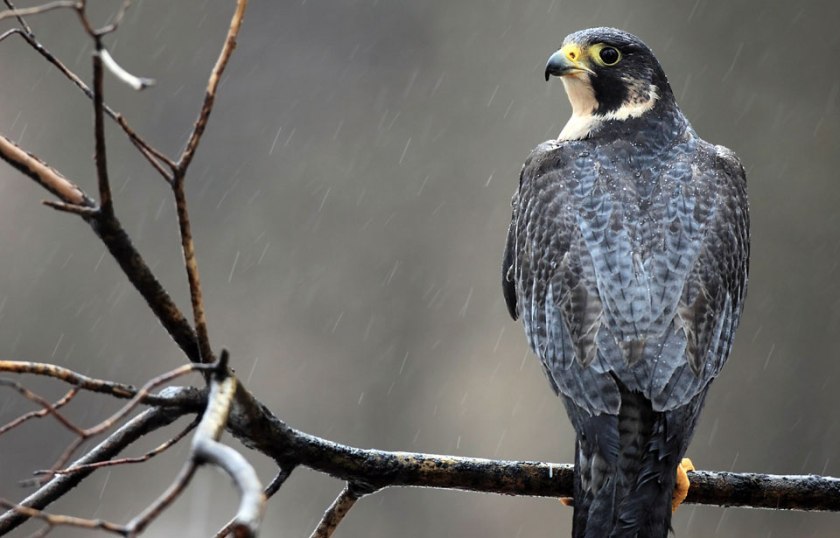
In March 2017, news emerged of two dead peregrine falcons that had been found dead near the Devil’s Pulpit in the Forest of Dean, Gloucestershire. We didn’t blog about these birds as we were waiting for the Police to publish the findings of a post mortem examination. We are still awaiting those results.
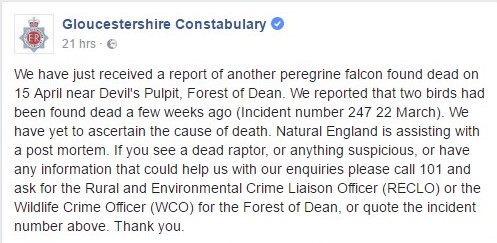
However, yesterday Gloucestershire Constabulary issued another statement about a third dead peregrine found in the same area on 15 April 2017:
Three dead peregrines found in the same area within a month sounds pretty suspicious, especially as there has been a spate of confirmed peregrine persecution incidents in England over the last few months (see here for recent RSPB Investigations blog on these crimes).
Let’s hope the post mortem results on the Gloucestershire peregrines are completed and published without any further delay.
Two weeks ago we blogged about a new crowdfunding initiative that had been set up to help Andy Wightman fight accusations of alleged defamation (see here).
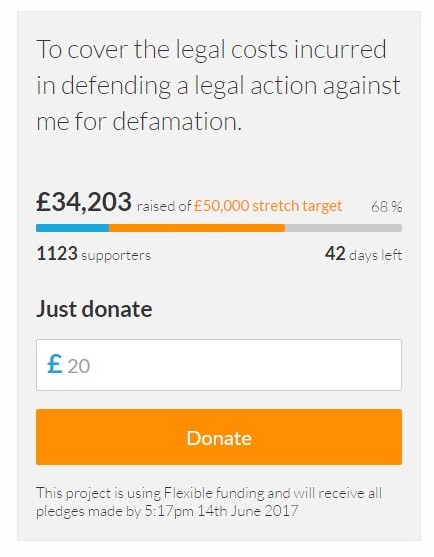
The response to his fundraiser was quite remarkable. Andy’s initial fundraising target was set at £10k, and this target was met within hours. Given the clear swell of public support, he ‘stretched’ the target and within 36 hours over £25k had been raised.
By the time the first hearing was heard in the Court of Session on 26 April 2017, over £30k had been raised. In court, Andy’s legal team pointed out that his pursuer, Wildcat Haven Enterprises CIC, appeared to have assets of less than £5k, so presiding judge Lord Uist agreed that a £50k ‘security bond’ had to be lodged by his pursuer for the case to proceed.
This afternoon, Andy has updated his supporters with the following statement:
As a consequence, a new crowdfunding target of £50,000 has been set and donations are rolling in again. If you’re not sure about contributing, it’s worth having a read of the comments that have been left on his crowdfunding webpage here.
If you’d like to support Andy with a donation, please CLICK HERE
A couple of months ago an article was published in the Mail on Sunday about the ‘mysterious’ death of a satellite-tagged goshawk on the Queen’s Sandringham Estate in Norfolk (see here).
We blogged about it (here) and mentioned a number of other raptor-related police investigations that had been undertaken on or near the estate. On the back of that blog, somebody contacted us and asked why we hadn’t included on our list ‘the confirmed illegal poisoning of a sparrowhawk a few years ago’? We hadn’t included it because we didn’t know anything about it, so we thought we’d do some digging.
First of all we did a general internet search. If there had been a confirmed raptor poisoning on the Queen’s Sandringham Estate then surely that would have made a few headlines, right? We didn’t find any record of it.
So then we started looking at the government’s database on pesticide misuse and abuse (the Wildlife Incident Investigation Scheme, often shortened to ‘the WIIS database’). In that database we found the following entry:
Although this entry showed that a poisoned sparrowhawk and a poisoned bait had been discovered in Norfolk in October 2009, as usual, no specific location was given. We were, however, intrigued by the ‘Notes’ column, that said even though a confirmed poisoning had occurred, the police were ‘not taking this forward’ and instead the CRD (Chemical Regulation Directorate, which is part of the Health & Safety Executive) had ‘sent a warning letter to the estate’.
So we thought we’d submit an FoI to the CRD to ask for a copy of that warning letter, because it might reveal the name of the estate where the poisoned sparrowhawk and poisoned bait had been found. We were also curious about the content of that warning letter – if there had been a confirmed poisoning, why was a warning letter considered to be a preferred option to a prosecution?
We’ve now received the FoI response and have been working our way through the various files.
The first file we looked at was a series of correspondence letters between the CRD and the estate. The estate’s name had been redacted throughout. Hmm. The letters are really worth reading though – there are some pretty hostile attitudes on display and there’s clearly no love lost between CRD and the estate manager! Download here: CRD correspondence with Estate_2010
There’s also a letter from a Natural England officer to the estate, asking for various documents relating to pesticide risk assessments, gamekeeper contracts, and gamekeeper training certificates: Natural England letter to Estate 19Oct2009
We gathered from the CRD/estate correspondence that no further evidence of Bendiocarb had been found during a Police/Natural England search of the estate which is presumably why Norfolk Police didn’t charge anybody for the poisoned sparrowhawk and poisoned bait, because there was no way of linking it to a named individual. Anybody could have placed the poisoned bait. But a series of alleged offences relating to pesticide storage had apparently been uncovered and it was these issues to which the CRD warning letter referred, although it’s clear from the estate’s letters to CRD that the estate disputed the alleged offences.
While that’s all very interesting, we were still in the dark about the name of the estate where all this had happened. That is, until we read another file that had been released as part of the FoI: CRD_lawyer discussion of FEPA exemption
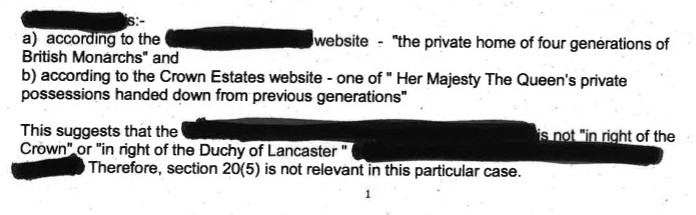
This file contains correspondence between the CRD and a number of lawyers. They were discussing whether the estate had exemption under Section 20(5) of the Food and Environment Protection Act 1985 (FEPA). This exemption applies to land that is owned ‘in Crown interest’. There was a great deal of discussion about whether this estate (name redacted) was owned by the Crown or was privately owned by the Queen.
The lawyers decided that this estate (name redacted) was in fact privately owned by the Queen, and therefore exemption under Section 20(5) of FEPA did not apply. The lawyers had reached this conclusion after several internet searches on the status of this estate (name redacted) had been completed. What the FoI officer failed to do was redact the search phrases that had been used to reach their decision. Those search phrases included:
Now, if you Google the exact search phrase listed under (a) above (“the private home of four generations of British Monarchs“) you are directed to this website:
And if you go to the Crown Estates website and search for the exact search phrase listed in (b) above (“according to the Crown Estates website – one of Her Majesty the Queen’s private possessions handed down from previous generations“), you find this:
It’s all very interesting, isn’t it? This isn’t conclusive evidence that it was Sandringham Estate, of course, and there is no suggestion whatsoever that anyone associated with the Sandringham Estate was involved with placing a poisoned bait, although it is clear a poisoned sparrowhawk and a poisoned bait were found on a Royal estate in Norfolk (how many Royal estates are there in Norfolk?).
But what this does highlight, again, is the complete lack of transparency when the authorities investigate the discovery of highly toxic poisonous baits laid out on private estates with game-shooting interests, or the discovery of illegally killed raptors on privately owned estates with game-shooting interests.
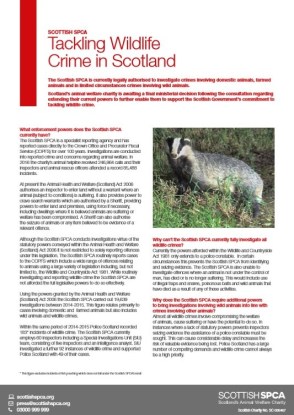
As we await the long-overdue decision on whether the Scottish Government will approve an increase in investigatory powers for the SSPCA (see here), the SSPCA has today published a short briefing note which has been sent to all MSPs to encourage their support of this minor change in legislation.
It’s a fantastic briefing note, short, succinct and covering the main points of this issue. It addresses six key points:
What enforcement powers does the SSPCA currently have?
Why can’t the SSPCA currently fully investigate all wildlife crimes?
Why does the SSPCA require additional powers to bring investigations involving wild animals into line with crimes involving other animals?
How can the SSPCA help improve the rate of successful wildlife crime investigations?
Would collaboration work?
What would be required to authorise the SSPCA to seize evidence of a wildlife offence?
On this last point, the SSPCA has clarified that all that is needed is for the words ‘or inspector‘ to be inserted in appropriate places in Section 19 of the Wildlife & Countryside Act. That’s it. It’s not difficult, it’s not complex (as former Environment Minister Aileen McLeod claimed), it’s just two words that could make such a difference to the effectiveness of wildlife crime enforcement in Scotland, which, let’s face it, is currently appalling:
Also included in the briefing note are the results of a recent poll commissioned by the SSPCA about public attitudes to wildlife crime in Scotland. The results speak for themselves:
The Scottish Government’s decision on whether to increase the SSPCA’s investigatory powers will be announced by Environment Cabinet Secretary Roseanna Cunningham by the end of June 2017.
If you’re living in Scotland, we’d encourage you to please contact your local MSP and let them know that wildlife crime is of concern to you. Please ask your MSP to contact Roseanna Cunningham to offer cross-political support for this very simple change in the legislation, which could bring significant and much-needed improvement to how wildlife crime is investigated. If you’re not sure who your MSP is you can find out here
The Northern England Raptor Forum (NERF) has published a damning criticism of DEFRA’s Hen Harrier Action Plan in what it describes as a Year 1 Assessment.
The Plan, as you know, was wheeled out by DEFRA in January 2016 and has been widely criticised by conservation organisations, not least for including the controversial element of brood meddling, i.e. removing hen harriers from driven grouse moors during the breeding season so there are more red grouse available to be shot by wealthy gunmen, and then releasing the harriers back on to the moors in the autumn to coincide with, er, the grouse shooting season. Genius.
NERF’s criticism of the Plan doesn’t include any surprises apart from the news that NERF was refused a seat at the table when the Plan was being formulated. NERF contends that the Plan in its current format is unworkable and that the estimated £1.39 million pounds being thrown at it from the public purse should be diverted to help monitoring and enforcement. They’ve got a point.
It’s good to see NERF utilise their undisputed expertise and experience and make clear their position on what is one of the most controversial issues in UK conservation. More of that, please!




 Two weeks ago we blogged about a new crowdfunding initiative that had been set up to help Andy Wightman fight accusations of alleged defamation (see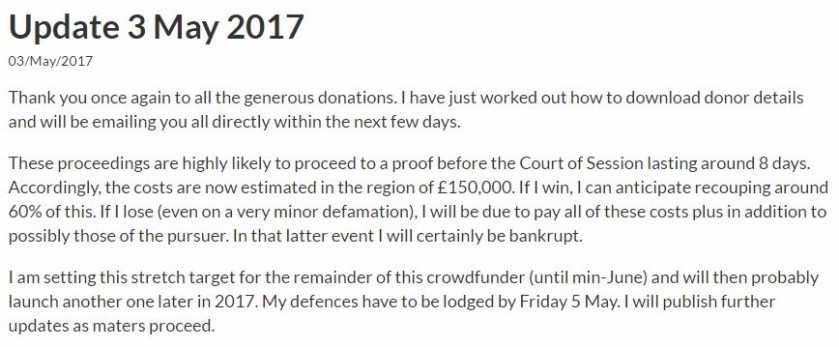



 As we await the long-overdue decision on whether the Scottish Government will approve an increase in investigatory powers for the SSPCA (see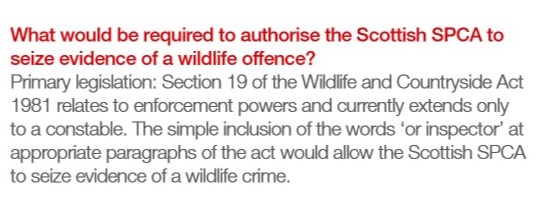

 The
The 

