Some of you may remember the footage of an armed man, believed to be a gamekeeper, lying in wait close to a decoy hen harrier on a grouse moor in the Peak District National Park, back in 2016 (see here).
The footage was so disturbing, and the public reaction so strong, it prompted the National Trust (the landowner) to pull the shooting lease early and replace the shooting tenant with someone else (see here). Incidentally, that new tenant hosted a successful hen harrier breeding attempt last year (see here), even though some of the offspring didn’t survive for very long after leaving the safety of this moor (e.g. Arthur, see here and Octavia, see here).
We’ve also blogged before about what was believed to be the use of a tethered live eagle owl as a decoy on a grouse moor in the Lammermuirs (see here), although the suspected gamekeeper took off pretty sharpish once he realised he’d been spotted.
Well, it seems this method of using to decoys to lure in birds of prey to within close range of a shotgun is more prevalent than we’d thought.
Today the RSPB Investigations Team has published a video of several armed men (identified as gamekeepers by the RSPB) over a period of months spending hours and hours and hours of their time sitting in specially-dug holes in close proximity to a plastic peregrine and a plastic hawk, believed to have been used as decoys to attract other birds of prey. The location? A grouse moor in the Peak District National Park.
Hmm, it’s really no surprise that the Peak District National Park was identified in the recent scientific analysis of hen harrier sat tag data as one of the grouse moor areas where hen harriers were most likely ‘disappear’ in suspicious circumstances (see here).
The RSPB has also written a blog about this footage, and similar evidence of decoy use that has been recorded on other grouse moors in the north of England. Read the eye-opening blog here.
Fantastic investigative work from the RSPB to get such close and clear footage and there’s a strong chance that these gamekeepers won’t be using those particular decoy sites again in the near future!
The publication of the hen harrier satellite tag paper on Tuesday (here) that provided compelling evidence to highlight, yet again, the link between grouse moors and the illegal killing of hen harriers, has resulted in a flurry of responses from various individuals and organisations.
We’ll be looking at these responses in turn.
Yesterday we looked at the response of Supt Nick Lyall, Chair of the Raptor Persecution Priority Delivery Group (here).
Today we’re examining the response from the British Association for Shooting & Conservation (BASC).
BASC was quick to publish a lengthy statement on its website and at first glance it looks convincing. BASC accepts that raptor persecution is a problem and calls for its members to help stamp it out:
The statement starts off very strongly but the message gets progressively lame as you scroll down the page, with BASC feeling the need to justify the ‘benefits’ of grouse shooting and then make some incredulous claims about the so-called ‘success’ of last year’s hen harrier breeding season, which actually looks like something that’s been cut and pasted from the Moorland Association’s website.
Nevertheless, we could forgive BASC its small piece of propagandist nonsense because hey, the main message (about stamping out illegal raptor persecution) is clear and it looks like it’s based on sincerely held views.
But wait a minute! Some of the phraseology in BASC’s statement looks awfully familiar.
“There are criminals among us“, “Terminal damage“, “We must all take personal responsibility“, “Ensuring the criminal minority do not ruin it for the lawful, ethical majority“, “I want my grandchildren to enjoy shooting“.
Haven’t we heard this before? Ah yes, 16 months ago in November 2017 in response to the RSPB’s Birdcrime report, BASC published a strong position statement in The Times (here) (for which BASC earned well-deserved credit) using some of these very same phrases and then a further piece for the BASC website (here) again using some of these very same phrases. For example, here’s what BASC Chairman Peter Glenser wrote for the BASC website at the time:
Sorry, BASC, but it’s just not as convincing when you can’t respond spontaneously to the results of the hen harrier satellite tag paper but instead rely upon regurgitating a previous media statement just because it got you some good press the first time around, and just attribute it to a different member of staff each time.
To be fair to BASC, it is seen by many in the conservation community as the most progressive of the game-shooting organisations although let’s be honest, the bar is set pretty low and some of its individual staff members need to attend a ‘how not to behave in a way that will embarrass your employer and alienate the public on social media and in real life’ course.
But words are just words and they’re easy to churn out (especially if you’re simply cutting and pasting from an earlier piece). What about actions? What action has BASC taken to demonstrate a commitment to rooting out the criminals amongst its membership and wider industry since what it called the “watershed moment” to do exactly that back in November 2017?
Errrrr……boycotting the first meeting of the RPPDG chaired by Nick Lyall in January (see here, here and here)?
Or perhaps appearing to accept a significant donation from a company owned by somebody long-involved with the sporting management of various estates throughout the UK, some of which are notorious for their appalling record of confirmed and alleged raptor persecution crimes?
The publication of the hen harrier satellite tag paper yesterday (here) that provided compelling evidence to highlight, yet again, the link between grouse moors and the illegal killing of hen harriers, has resulted in a flurry of responses from various individuals and organisations.
We’ll be looking at these responses in turn.
To begin with, Police Supt Nick Lyall, the Chair of the Raptor Persecution Priority Delivery Group (RPPDG), a so-called ‘partnership’ tasked with raising awareness of illegal raptor persecution and finding ways to eradicate it.
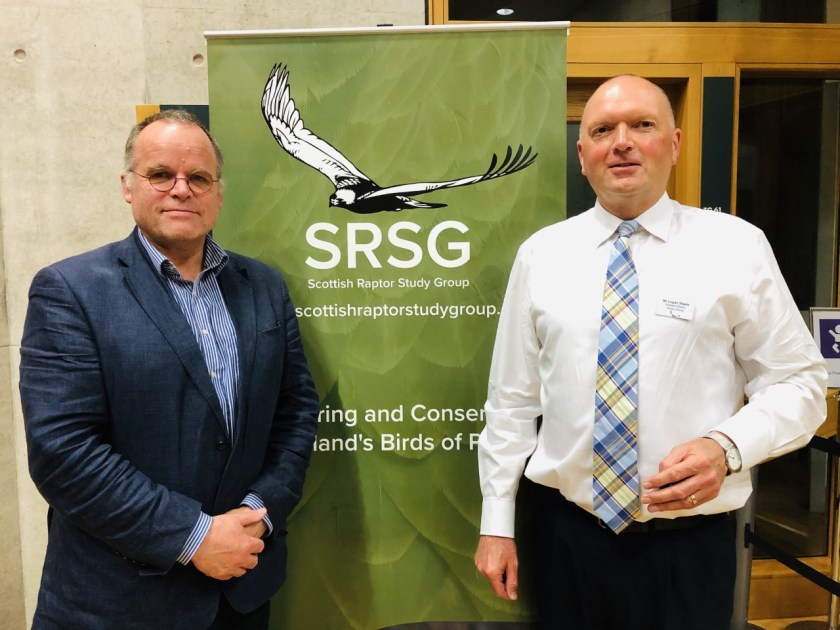
[Nick Lyall and his infamous rapper coat attending the Scottish Raptor Study Group annual conference in Perthshire in February, photo by Ruth Tingay]
Within hours of the hen harrier sat tag paper being published, Nick posted a statement on his blog last night with the heading ‘Time for change‘….. (see here).
He made four key points.
First, an acknowledgement of the high quality of the research and the journal in which it had been published.
Second, an acknowledgement that the research provided evidence of the extent of the raptor persecution issue, which is a significant change from a comment he made five months ago in his first blog about “rogue gamekeepers” (unsurprisingly, written shortly after spending time with the Moorland Association).
Third, and perhaps of greatest importance, that he intended to act upon the research findings via his newly forming RPPDG Enforcement Group, instead of simply discussing the findings and saying ‘Oh, isn’t it all terrible’. Most encouragingly, he also wrote, “I already have a couple of offenders in my sights….”.
Fourth, and the least convincing (to us), was his statement about continuing to work with ‘partners’: “I still firmly believe that an effective partnership response to this issue is the most sustainable way forward“.
We fundamentally disagree with this statement. These are crimes that are being committed – and in our view, serious organised crimes – the people involved should be treated as criminals, not partners.
Nick thinks an effective partnership would be the most sustainable way forward. But in any partnership, no matter what the topic, it will only work if all the partners share the same objectives. The simple fact of the matter is that in the RPPDG, they don’t, and this particular partnership charade has been allowed to continue for ten years without achieving anything of any significance in the world of raptor conservation. Not one thing. Other ‘partnership’ initiatives to tackle illegal raptor persecution go back much further than ten years and they’ve all failed too.
Nick got a taste of the ‘partnership’ at his first RPPDG meeting in January (see here), which was boycotted by several of the so-called ‘partners’ in an attempt to disrupt proceedings simply because they weren’t getting their own way, as they had for the previous ten years. It remains to be seen what will happen at the next ‘partnership’ meeting in April. Our hope is that they’ll get booted out so that the genuine partners, all working towards the same goal, can get on with it without further disruptions. We’ll see.
Regular blog readers will know that we have a huge amount of time for Nick Lyall and for what he’s trying to achieve. There’s no question that he ‘gets it’ and that he understands the challenges ahead, and that he’s working his socks off to start implementing change, most of which (or all of which?) is done in his own time.
Right now, in just six short months, he’s single-handedly putting to shame many of the others in positions of authority who have had, and still do have, the opportunity to bring about change but who have failed, and continue to fail, to even start trying.
At long last, after years of stalling, hiding, prevaricating and obsfuscating (e.g. see here and here) and 13 years after its publicly-funded study began, Natural England’s hen harrier satellite tag data has finally been analysed and published in a peer-reviewed scientific journal.
The results? Entirely predictable (hen harriers are highly likely to be killed on grouse moors – gosh, who knew?), and are more likely to be killed inside protected areas such as National Parks and Areas of Outstanding Natural Beauty (AONBs) with large areas of grouse moors than any other type of landuse, especially these protected areas in North Yorkshire, Bowland and the Peak District:
Unfortunately the results do not have the same fine resolution as those of the golden eagle sat tag review, but that is simply a consequence of using different types of satellite tag and duty cycles. E.g. the golden eagle tags, especially the newer GSM solar powered tags, are ‘on’ constantly and are collecting data every minute when fully charged, whereas the hen harrier tags are using the Doppler/Argos system so the tags are less spatially accurate and have frequent periods when they are not ‘on’, thus not collecting data. Nevertheless, even being forced to undertake an analysis at a coarse scale, the results are still damning.
The most devastating result, in our opinion, is the extent of the criminality and this is what should be grabbing the attention of Ministers. Sure, we’ve all known for years that hen harriers are killed by gamekeepers on many driven grouse moors; everybody knows and acknowledges that, but the scale of the killing has always been challenged (or more usually, denied).
But this paper puts an end to those denials. 72% of the Natural England sat tagged hen harriers are presumed to have been illegally killed, versus 9% natural deaths. 72% is the MINIMUM value. If you exclude the tagged birds that are still alive/being tracked (7), and thus just look at the tagged birds with a known end fate, then the maximum value of illegally killed satellite tagged hen harriers would be 82% versus 9.8% natural deaths. It’ll be interesting to add the RSPB-tagged birds to this in due course.
82% of young tagged hen harriers are likely to have been illegally killed, on grouse moors. Compare that to the 31% of satellite tagged golden eagles that ‘disappeared’ in suspicious circumstances on or near driven grouse moors in Scotland. In a direct response to that 31%, Scottish Environment Secretary Roseanna Cunningham ordered an independent review of grouse moor management, specifically to examine opportunities for licensing.
How do you think her Westminster counterparts, Michael Gove & Dr Therese Coffey will respond to the 82% figure? Let’s see, shall we?
A press release has been issued by the partner organisations involved in the hen harrier sat tag analysis, as follows:
STUDY SUGGESTS WIDESPREAD ILLEGAL KILLING OF HEN HARRIERS ON ENGLISH GROUSE MOORS
A new study reveals that young hen harriers in England suffer abnormally high mortality compared to populations in Orkney and mainland Scotland and the study provides compelling evidence that the most likely cause is illegal killing in areas associated with grouse moor management.
Published today in Nature Communications, this paper represents the culmination of a 10-year Natural England study involving 58 satellite tagged hen harriers. The analyses have been led by the University of Cape Town and Aberdeen University with the provision of land use data by the RSPB. The study showed the likelihood of hen harriers dying, or disappearing, was ten times higher within areas predominantly covered by grouse moor, compared to areas with no grouse moor. The study revealed that 72% of tagged harriers were either confirmed or considered very likely to have been illegally killed.
The hen harrier, sometimes called the ‘skydancer’ because of its amazing acrobatic display in the breeding season, is one of England’s rarest birds and is legally protected. Illegal killing of hen harriers has long been thought to limit their population size, but identifying the scale of these crimes and their impact on harrier populations has been difficult because they occur in remote areas and evidence is likely to be destroyed, thus successful prosecutions are rare. This long-term study has enabled patterns of disappearances to be assessed across a large number of birds. This provides overwhelming evidence that illegal killing is occurring on some grouse moors, where some gamekeepers view hen harriers as a threat to their grouse stocks.
Stephen Murphy from Natural England led the data collection and commented: “Natural England welcomes the publication of this study, which demonstrates the value of tagging as a legitimate conservation tool. These analyses are a significant step in understanding the fate of tagged hen harriers, and confirm what has long been suspected – that illegal persecution is having a major impact on the conservation status of this bird.”
Dr Megan Murgatroyd, from the University of Cape Town, who is the lead author of the study said: “Natural England’s long-term commitment to this tracking study has yielded an important dataset involving over 20,000 individual fixes. This is a remarkable achievement for a species whose population in England has averaged only a handful of pairs for the last few years. Whilst dead harriers can be disposed of, the pattern of hen harrier disappearances revealed by this data could not be hidden. [Ed: She’s clearly been listening to Dr Hugh Webster – that’s his line!] The multiple levels of analyses of the data have all led to the same robust conclusion that hen harriers in Britain suffer elevated levels of mortality on grouse moors, and this is most likely the result of illegal killing.“
Dr David Douglas, RSPB Principal Conservation Scientist and a co-author on the paper, said: “The high rate of illegal persecution on grouse moors revealed by this study goes a long way to explaining why hen harriers are barely hanging on as a breeding bird in England. Satellite tag data is giving us very valuable insights into what is happening to our birds of prey in the UK. It has already provided compelling evidence of the link between suspicious golden eagle deaths and grouse moors in Scotland and now it has done the same for hen harriers in England.”
Rob Cooke from Natural England said: “Natural England will continue its satellite tracking work to further improve our understanding of hen harrier movements and behaviour, and will continue work to improve the conservation status of the species. Natural England welcomes the support of many landowners in this, and will continue to work with all landowners and other interested parties to find ways of enabling hen harrier populations to increase from their current critically endangered levels in England”.
ENDS
[Satellite-tagged hen harrier Carroll, who’d been shot]
UPDATE 20 March 2019: Responses to hen harrier satellite tag paper: Supt Nick Lyall, Chair RPPDG (here)
UPDATE 21 March 2019: Responses to hen harrier satellite tag paper: BASC (here)
UPDATE 21 March 2019: Responses to hen harrier satellite tag paper: DEFRA Wildlife Minister Dr Therese Coffey (here)
UPDATE 22 March 2019: Responses to hen harrier satellite tag paper: Northern England Raptor Forum (here)
UPDATE 24 March 2019: Responses to hen harrier satellite tag paper: Moorland Association (here)
UPDATE 25 March 2019: Responses to hen harrier satellite tag paper: GWCT (here)
UPDATE 9 June 2026: Moorland Association’s amateurish attempt to analyse Hen Harrier tag data is full of holes (much like a shot Hen Harrier) (here)
Duncan Orr-Ewing, Head of Species and Land Management at RSPB Scotland, has written a blog discussing the state of raptor conservation in Scotland, how certain species are still suffering due to the ongoing illegal killing associated with land managed for driven grouse shooting, and how the Scottish Government needs to bring about significant change.
Duncan’s blog is reproduced here:
EFFECTIVE REGULATION MUST BE PUT IN PLACE IN SCOTLAND TO TACKLE THE EXCESSES OF “DRIVEN” GROUSE SHOOTING
Most people accept that the conservation prospects for many raptor species in Scotland have improved in recent decades, and since full protection of these birds in the UK from the 1950s. This is most apparent in the rise in the common buzzard population. This bird of prey species has made a welcome return and can now be seen in almost all of the countryside of lowland Scotland, and even in some of our main towns and cities. Like the common buzzard, various other raptor species have re-established their populations naturally, particularly when the main constraint of human persecution has ceased or been significantly reduced. Red kite and white-tailed eagle have been given a helping hand by conservationists, working with landowners, through well planned reintroduction programmes, and are also on the way back.
Raptor species are now amongst the most studied birds in Scotland, much of this work prompted by the effects of organochlorine pesticides on their populations from the 1960s. We have good information on the population distribution of most raptor species, as well as a clear scientific understanding of the main threats to their conservation status. There are a number of native raptor species whose populations have not recovered, and these include the hen harrier. National surveys of this species have shown that the population of hen harriers in Scotland has declined between 2004 and 2016 from 633 to 460 breeding pairs, or by 27%. When you scrutinise the data more carefully there are significant geographical differences; the breeding hen harrier population is doing relatively well on Orkney and the Western Isles but is struggling in the eastern and central Highlands and southern uplands. The authoritative Conservation Framework for Hen Harriers in the UK (Fielding et al. 2011. JNCC) estimated that the Scottish breeding population of this species should be between 1467 and 1790 breeding pairs based on the availability of suitable nesting habitat. So what is happening?
What is now becoming clearer is that many raptor populations in Scotland are held below their potential population levels and range because of continuing illegal human persecution on land managed for “driven” grouse shooting. For the raptor species that have got commoner, it is clear to those who monitor them that even these species are largely absent from “driven” grouse moor areas as breeding birds. Equally, the raptor populations that hang on in these areas do not behave as you would expect – traditional nesting sites become occupied periodically, and then breeding birds disappear or nesting attempts routinely fail in mysterious circumstances. Young birds attempt to breed that would normally be excluded from good sites by adult birds. For those species, like the hen harrier, where grouse moors are their most suitable breeding habitat, and where populations remain heavily persecuted , it is held that their populations simply cannot increase without changes in land management culture and behaviours. Population “sinks” occur where the best habitats are repeatedly attracting nesting birds and these birds are repeatedly killed illegally. Most recently, new technological advances in the study of the survival and dispersal of birds, in the form of GPS satellite tagging, have reinforced the point that many of these marked raptors simply vanish without trace in grouse moor areas. The report “Analyses of the fate of satellite tagged golden eagles in Scotland” (Whitfield et al. 2017. SNH) highlighted that a third of a large sample of marked golden eagles disappeared in precisely this way.
[RPUK map, derived from data in the golden eagle sat tag review, showing the last known location of satellite-tagged golden eagles that had disappeared in suspicious circumstances on or close to driven grouse moors]
Sadly, it is now clear to many people involved with raptor conservation efforts that progress has stalled. Until now, the Scottish Government has made important, but piecemeal changes, to raptor protection laws. These measures have had the desired impact in large parts of Scotland. However, on land managed for “driven” grouse shooting, it is equally evident that raptor persecution is such an entrenched part of their business model, that tougher measures are now urgently required. Our RSPB Investigations team report that ever more extreme measures are being deployed by grouse moor gamekeepers to kill birds of prey and avoid detection, including the use of thermal imaging gear and night vision equipment to kill raptors at night. Many in the grouse moor community will tell you quite openly that they do not believe that they can manage their estates to deliver high grouse bags for sporting clients without breaking wildlife protection laws. This appalling situation has been further compounded in recent decades by the arrival on the scene of a new breed of sporting manager, and the proliferation of more intensive grouse moor management methods, involving ever increasing grouse bags for clients to shoot. This type of operator has commercialised grouse shooting. They have the resources to disregard public opinion; they have little concern for Scotland’s international reputation; and feel safe in the knowledge that it is very hard for the public authorities to bring the perpetrators of these wildlife crimes to justice.
From a RSPB Scotland perspective, we have put significant investment over many years into working with responsible landowners. We recognise that many landowners understand the harm that is being done to their sector by the more extreme grouse moor interests, but are apparently powerless to stop this momentum. We have engaged with conflict resolution processes, including the Langholm Moor Demonstration Project, designed to investigate ways that grouse moors can be managed both legally and sustainably. However, we have reluctantly concluded that amongst the “driven” grouse moor sector at least, there is little appetite to adapt businesses in line with modern day expectations. We simply do not think that further piecemeal changes to wildlife protection laws will be adequate.
The current independent Grouse Moor Management Review Group, commissioned by Scottish Government, is due to report in May 2019. This could be an important milestone if we are prepared to accept that a significant change must occur if we are to tackle the deeply embedded cultural issues concerning the current model of “driven” grouse moor management. This is also why the RSPB supports the licensing of “driven” grouse moors, including proportionate sanctions to remove such licences to operate, where the public authorities have good evidence of illegal activities taking place.
Last week we learned that Natural England’s decision to licence hen harrier brood meddling had been ruled lawful by Mrs Justice Lang at London’s High Court (see here) following a judicial review instigated by Mark Avery and the RSPB.
Today – some excellent news – Mark Avery has decided to appeal that ruling (see here for his announcement).
We’ve yet to hear whether the RSPB will also appeal.
[UPDATE 27 March 2019: RSPB to appeal hen harrier brood meddling ruling, here]
[A breeding hen harrier as she should be – alive and unmeddled. Photo by Laurie Campbell]
At the weekend, the Revive coalition for grouse moor reform issued the following press release:
CAMPAIGN GROUP CALLS FOR URGENT ACTION TO END MUIRBURN ON GROUSE MOORS
A campaign group has released new footage showing parts of the Cairngorms, an area which has a high density of peat, quite literally on fire, as gamekeepers burn heather moorland as part of intensive management of grouse moors.
The footage obtained by Revive, the coalition for grouse moor reform, shows the extent land managers will go to in their quest to create a habitat suitable for just one species – the red grouse. These grouse will subsequently be shot for entertainment.
Revive campaigner Max Wiszniewski said: “The footage that we captured is extremely disturbing showing vast swathes of heather upland on fire with flames and smoke billowing for miles, all for the single purpose of protecting grouse which will subsequently be shot for entertainment.
“I’m sure the public will be shocked to see the damage which is deliberately inflicted on our uplands to create a habitat suitable for one species to the detriment of our environment and wildlife.”
Grouse moor managers routinely burn patches of heather to create a structurally diverse patchwork habitat to favour red grouse. Tall heather provides concealment from predators while younger heather provides adult grouse with more nutritious shoots for food, and short heather provides greater insect availability for chicks.
The practice known as muirburn is hugely detrimental to the environment. Moorlands are of high conservation value for their vegetation, invertebrate and bird communities with large areas given legal protection under the European Habitats Directive. Muirburn is in direct conflict with concerns about meeting global carbon emissions.
[Gamekeepers setting fire to a grouse moor, photo by Ruth Tingay]
Dr. Richard Dixon, Director of Friends of the Earth Scotland added: “We’re growing increasingly concerned about the extent and intensity of burning on grouse moors, and particularly the effects of burning over deep peat. Where blanket bog is damaged by burning, impacts include a lowered water table and breakdown of the active peat-forming structure, resulting in the carbon store in the peat being released as climate change emissions.
“There is more carbon locked up in Scotland’s peaty soils than in all the trees and vegetation in the whole of the UK. Urgent action is needed to reduce Scottish climate emissions and lock stored carbon into our environment. The Scottish Government must put in place plans to reverse the damaging environmental effects of moorland burning and protect our peatlands as the huge natural treasure they are.”
The footage also shows mountain hares fleeing for their lives as their habitat burns, illustrating the devastating impact this practice has on other wildlife.
Robbie Marsland, Director of the League Against Cruel Sports Scotland said: “To witness wild animals running for their lives to escape such willful and deliberate environmental vandalism is extremely upsetting, made worse by the complete lack of justification for this action.
“As well as the iconic mountain hares, seen on the footage, there’s also the extensive risk to many other species including ground nesting birds and all for nothing more than to line the pockets of land owners looking to enrich their stocks of game birds for paying guns.”
The Revive coalition which includes Common Weal, OneKind, Friends of the Earth Scotland, League Against Cruel Sports and Raptor Persecution UK, will set the agenda for a multi-year strategy aimed at encouraging a national dialogue about how Scotland’s moors should be utilised. It believes that a fresh look at how this land is used could lead to a better Scotland, better for its economy, its people, its environment and its fauna.
ENDS
This article, and the very angry responses from the grouse shooting industry, received extensive coverage in the news, e.g. The Ferret (here), The National (here), The Scotsman (here), The Telegraph (here) and The Times (here).
The Scottish Gamekeepers Association (SGA) also posted a statement on its website:
The SGA makes some interesting claims but the one we’re most interested in because it’s used repeatedly by those within the grouse shooting industry, is that muirburn ‘prevents’ wildfires. The Gift of Grouse (a propaganda campaign funded by Scottish Land & Estates) made a similar claim last year: they claimed that the continued burning of peatland moors is ‘one of the most effective means of reducing the risk of damage from wildfires by providing breaks in continuous moorland cover and reducing the fuel load’ (see here).
It’s a fascinating claim, because it contradicts the Muirburn Code (often cited by the industry as evidence of good practice, even though the Code is rarely, if ever, enforced) which states that:
“Fires escaping from muirburn are a major cause of wildfire in Scotland“.
Let’s just repeat that, in case anyone missed it:
“Fires escaping from muirburn are a major cause of wildfire in Scotland“.
It’s not just the Muirburn Code that states this fact. The SNH-commissioned review of sustainable moorland management (published in 2015) states:
“Whilst large, intense wildfires can be destructive, many may have no greater impact than prescribed burns (Clay et al. 2010) and evidence suggests that over 50% of wildfires with known causes may themselves be caused by loss of control of prescribed burns“.
And who authored that report? None other than Professor Werritty, the Chair of the current Government-commissioned review of grouse moor management!
For anyone interested in more detail or for the full citations, have a look at the Revive report that was published at the launch in November 2018 – it’s all in there.
It’s really generous of the Shooting Times to provide supporting evidence for Wild Justice’s first legal challenge, announced two days ago.
Wild Justice’s first case challenges the casual killing of birds such as Jackdaws and Rooks under a series of General Licences (if you’re unfamiliar with General Licences, Mark Avery has written a useful blog today).
[Jackdaw, by Laurie Campbell]
Some members of the shooting community have been unable to get their heads around the legal challenge, and in amongst their predictable and lamentable personal insults and abuse towards the Wild Justice directors on social media, not many of them have been able to display the tiniest hint of comprehension.
If they’d read the latest edition of Shooting Times though, there’s a perfect example of why the Wild Justice legal challenge is long overdue.
This is p38 and is a regular column written by Liam Bell, chairman of the National Gamekeepers’ Organisation:
Who “needs” more shooting?!
And is this so-called “need” sufficient justification to kill birds under the terms of a General Licence? No, it most definitely isn’t, but that is clearly what has been going on, for decades.
Thanks, Shooting Times, for helping to frame the Wild Justice legal challenge so effortlessly.
Some on social media have been accusing the Wild Justice directors of ‘making money’ from this challenge – they seem to struggle with the concept of Wild Justice being a non-profit company. It’s not that hard to grasp, is it?
Others (although often the same!) have accused Wild Justice of wasting public funds by seeking a judicial review – that’ll be the same people who recently supported a judicial review application by the Countryside Alliance, BASC and the National Gamekeepers’ Organisation to contest a decision by Natural Resources Wales to ban pheasant shooting on the Welsh Government Estate! Gosh, the irony! Their application for judicial review was refused (see here).
Meanwhile, 737 fantastic people have contributed to the Wild Justice crowdfunder, raising £18k of the £36k target within 48 hours. That’s a brilliant start. If you’d like to support the legal challenge, please click HERE
The non-profit company Wild Justice launched last month with the intention of taking legal action, on behalf of wildlife, against public bodies where they are failing to protect species and/or habitats.
Wild Justice’s first case has just been announced and it is a legal challenge against the casual killing of birds permitted under Natural England’s General Licences.
The statutory agency Natural England allows the unlimited killing of a wide variety of bird species under a series of ‘General Licences’ which are published at the start of each year. Birds such as Carrion Crows, Rooks, Magpies, Woodpigeons, Jackdaws, Jays and Ring-necked Parakeets can be killed without applying for a licence, without having to justify why the action is necessary, without having to explain why alternative non-lethal measures such as scaring or proofing are ineffective or impracticable, and without having to report on how many birds are killed. All a person needs to do to ‘qualify’ to kill unlimited numbers of these birds is to claim to have read and understood the relevant General Licence.
[Photo of a Jay, by Laurie Campbell. This is one of several species which may be killed in unlimited numbers under the General Licence]
Wild Justice believes this system is unlawful despite the fact that it has been in existence for decades and has ‘authorised’ the casual killing of millions of birds. Wild Justice contends that it is the licensing authority’s (Natural England’s) legal responsibility to satisfy itself that killing these birds is an appropriate last resort. However, in the General Licences issued on 1 January 2019 Natural England ducks its responsibility and instead places the decision-making completely in the hands of the General Licence user.
Wild Justice is seeking a judicial review of Natural England’s decision to issue General Licences GL04, GL05 and GL06 on 1 January 2019. Similar licences apply to Wales, Scotland and Northern Ireland and this case may have implications in those countries too.
Wild Justice is not asking for the 2019 General Licences to be withdrawn, but rather that Natural England does not issue further General Licences and instead develops a legal system for regulating and monitoring the killing of birds if lethal control is absolutely necessary as a last resort.
Wild Justice sees the General Licence system as a clear example of how wildlife killing is largely unregulated in the UK. The system is lax and allows gamekeepers, farmers and others to kill birds without any proper oversight or regulation.
To bring this legal challenge to court, Wild Justice is crowdfunding, with a target of £36,000 to cover all costs associated with such legal action.
If you’d like to support and contribute towards this legal challenge, please visit Wild Justice’s crowdfunder page HERE.
Mrs Justice Lang has today handed down her ruling on the lawfulness of Natural England’s decision to issue a hen harrier brood meddling licence, after a judicial review was brought by Mark Avery and the RSPB (see here).
She has judged Natural England’s decision to issue a brood meddling licence to be lawful as it has been issued for ‘research’ purposes and not for conservation purposes.
Mark Avery (here) and the RSPB (here) have published their initial responses to this judgement.
We won’t say anything further until we hear whether either or both parties intend to appeal the judgement.
[An unmeddled hen harrier, photo by Laurie Campbell]