
Press release from RSPB (24 June 2026):
RARE HEN HARRIER VANISHES IN WELSH ‘BERMUDA TRIANGLE’ – WITH SATELLITE TAG CUT FROM ITS BODY
- North Wales Police, RSPB and the National Trust are appealing for information after a satellite-tag was found cut from a missing Hen Harrier on a North Wales grouse moor.
- Hen Harriers continue to be persecuted across the UK despite decades of legal protection, with most crimes associated with land managed for grouse shooting.
- To deter these crimes RSPB Cymru is calling for the introduction of a licensing system for Red Grouse shooting and release of non-native gamebirds to protect native wildlife.
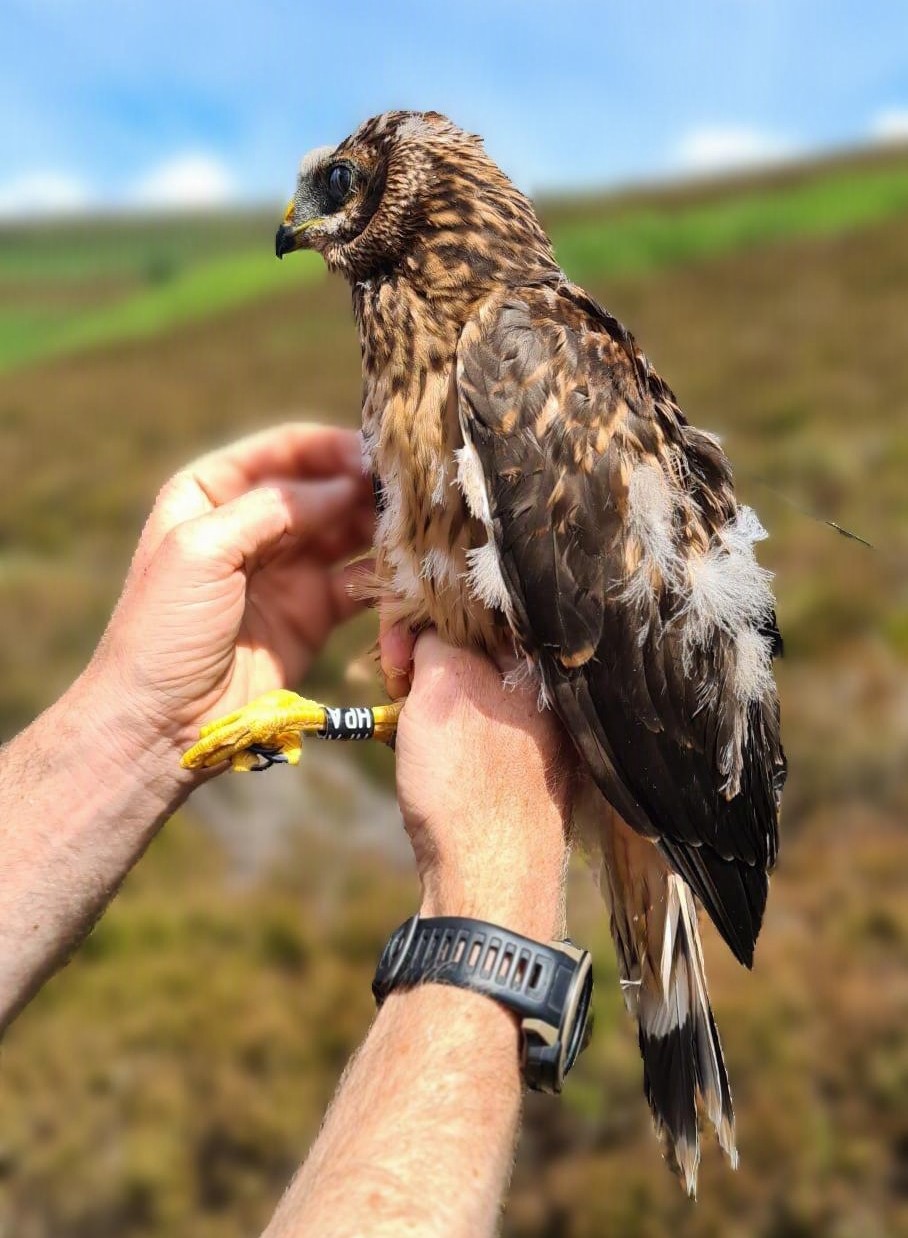
In late August 2025, a satellite-tagged female Hen Harrier vanished whilst on a driven grouse moor at Ruabon Moor near Wrexham. The bird had fledged from a nest on the National Trust High Peak Estate in the Peak District National Park and was satellite tagged by the RSPB, funded by the National Trust.
In late August, data showed that the young bird had left the National Park, settling on Ruabon Moor, a driven-grouse moor in North Wales on 28 August. On the night of 31 August the bird’s satellite tag data revealed that it was no longer alive. A search took place and the tag was located on Ruabon Moor on 2 September 2025 but there was no sign of the bird’s body. The tag was sent for forensic analysis by North Wales Police. Results revealed that the satellite tag’s harness had been deliberately cut (off) using a sharp implement, such as a knife. Despite searching, the body has not been found.
All wild birds are legally protected under the Wildlife and Countryside Act 1981. Anyone found to have killed or injured a bird of prey faces an unlimited fine and/or a maximum six-month jail sentence.
The Hen Harrier is a rare and vulnerable, red-listed species in Wales and across the UK. Its UK recovery is being directly impacted by illegal persecution with most crimes associated with land managed for driven grouse shooting. Decades of evidence such as the RSPB’s recently published Patterns of Persecution report, have shown that individuals on some gamebird shooting estates will illegally kill birds of prey to remove any perceived threat to their gamebird stock in an effort to maximise the number available to be shot. These crimes are often financially motivated.
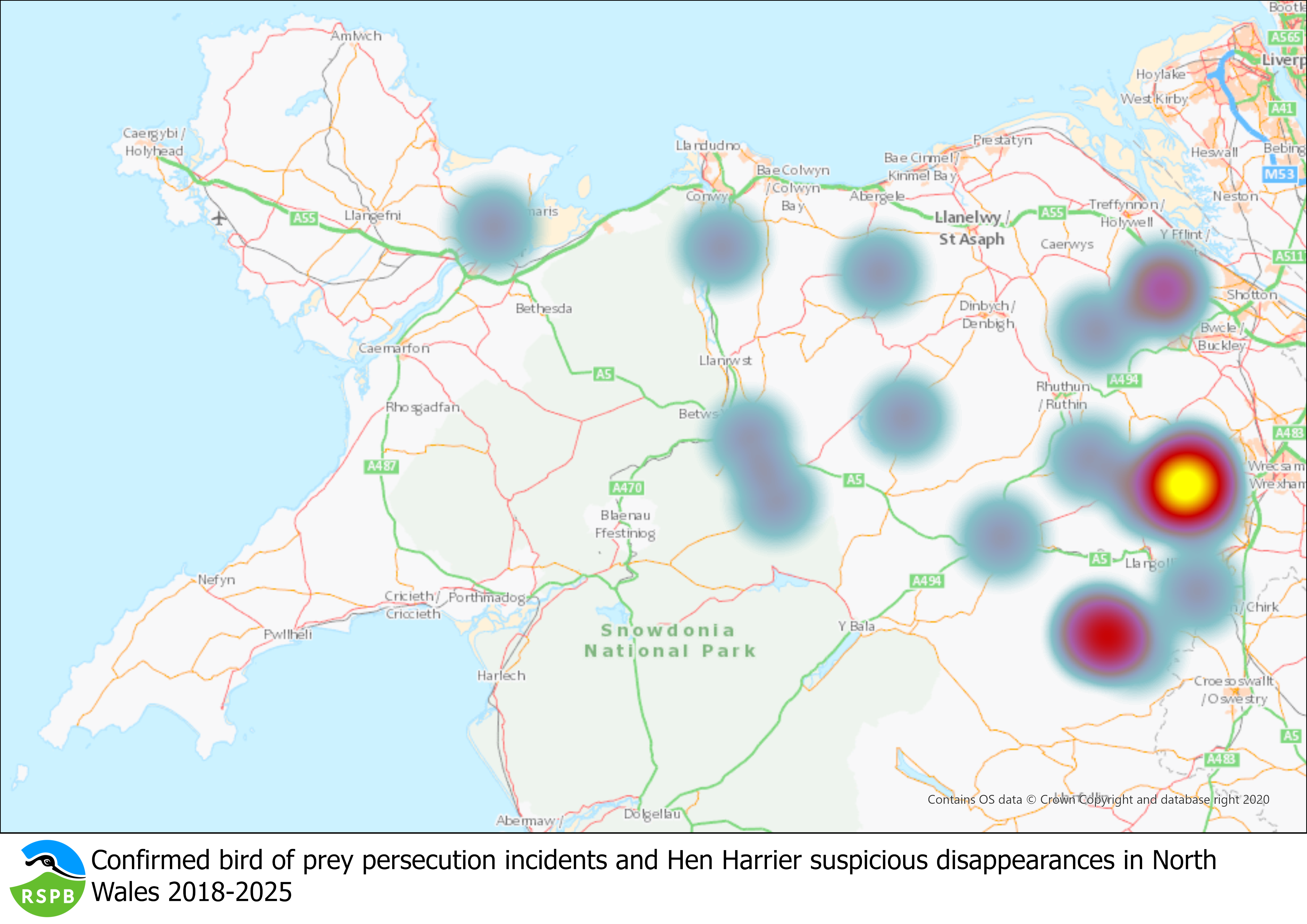
Ruabon Moor is recognised as one of the UK’s most notorious bird of prey persecution hotspots. Between 2018 and 2026 incidents include:
- the suspected persecution of five satellite tagged Hen Harriers
- The satellite tags from three Hen Harriers were recovered. Two had harness damage consistent wiith human involvement; satellite data from the third tag suggested that it had been interfered with prior to the bird’s death.
- Satellite tags on two Hen Harriers suddenly and suspiciously stopped transmitting without sign of malfunction.
- the illegal poisoning of a Raven
- the use of illegal hawk traps found in two consecutive years
These incidents are likely to represent only a fraction of the actual number taking place in this area in recent years – due to them often being committed at anti-social hours and in locations hidden away from the public.
Mark Thomas, RSPB’s UK Head of Investigations:
“Sadly, this incident is a textbook example of Hen Harrier persecution and really shows the massive impact these crimes are having on this species. In this case a healthy young bird fledged from a safe area in the Peak District National Park and sadly chose to settle in Wales ‘Bermuda Triangle’ – the most notorious bird of prey persecution hotspot in the country. This three-month-old bird survived for just three days in the area before it vanished in highly suspicious circumstances. Based on years of evidence and intelligence, we suspect the criminal shot the harrier, cut the harness off the Hen Harrier’s body, discarded the tag and disposed of the body in separate locations to avoid detection. As recent incidents show, this area is a crime hotspot for Hen Harriers and other birds of prey and this has to stop“.
Julian Hughes, RSPB Cymru Head of Species:
“We have provided a dossier of evidence to Natural Resources Wales and have asked the new Cabinet Minister for Rural Resilience and Sustainability to licence gamebird shooting in Wales. Without a clear deterrent and effective regulatory oversight, Hen Harriers and other birds of the prey will continue to be at risk. Through introduction of a statutory licensing system for all gamebird shooting in Wales these crimes could be effectively challenged – strengthening accountability whilst safeguarding the recovery of this species“.
Craig Best, General Manager for the National Trust in the Peak District:
“We are devastated to learn of the fate of this magnificent bird that started its life on moorland in our care in the Peak District. Hen Harriers are an important species in the ecosystem of moorland habitats. We work hard to make sure these birds have good nesting and feeding grounds. Funding from our supporters helps us to restore the landscapes they need to give them the best chance of survival. If persecution is allowed to continue, we stand to lose a very important species that is crucial to the health of these landscapes and it can’t continue“.
Sgt Peter Evans of North Wales Police Rural Crime Team said:
“In September 2025, North Wales Police received a report concerning the disappearance of a Hen Harrier on Ruabon Moor. Working in partnership with the RSPB and the National Wildlife Crime Unit, the harness was recovered and the investigation to date is inconclusive. Despite this, we can confirm that the harness had been intentionally severed, and the circumstances surrounding the bird’s disappearance are being treated as suspicious. Hen Harriers are a rare and protected species in Wales, making incidents of this nature particularly concerning. We urge members of the public to remain vigilant. If you witness any suspicious activity involving birds of prey, please report it to North Wales Police or the RSPB“.
Anyone with information relating to this crime please call North Wales Police on 101 or report a wildlife crime on their website.
Members of the public are urged to report any suspected incidents of bird of prey persecution by contacting the police on 101 and by submitting a report to the RSPB. This can be done via the RSPB’s online reporting form at www.rspb.org.uk/report-crimes or by calling the RSPB’s confidential Raptor Crime Hotline on 0300 999 0101. Reports via the RSPB’s reporting form and Raptor Crime Hotline can be made anonymously.
ENDS
My commentary:
I have no idea why it’s taken nine months for this story to emerge, when the Hen Harrier disappeared in late August 2025 and her ‘deliberately cut off’ satellite tag harness was found in early September 2025. The delay is disappointing, but the subsequent media release by the RSPB is detailed and provides good background history about incidents recorded either on or close to this grouse moor.
I’ve written previously about most of the confirmed and suspected persecution incidents that the RSPB has recorded at/near Ruabon, and I’ve also written about other strange discoveries here, uncovered by other organisations. Here’s the sorry history:
2018 – Satellite-tagged Hen Harrier called Aalin ‘disappeared’. No body or tag found.
2018 – Raven found poisoned (here).
2018 – Satellite-tagged Hen Harrier called Heulwen ‘disappeared’. No body or tag found.
2019 – Satellite-tagged Hen Harrier called Bronwyn ‘disappeared’. The tag was recovered with no body. The tag data indicated that the tag had likely been interfered with, prompting concerns of illegal killing.
2021 – A cage trap was reported to police with concerns over legality (suspected as being used to trap Goshawks). I don’t have further details of this case.
2021 – The RSPB reports a satellite-tagged Hen Harrier ‘disappeared’. Its tag was found and an expert assessment concluded it had been cut off. I didn’t have details of this incident so I asked the RSPB about it. It turns out to be a Hen Harrier called Awyr, tagged in Conwy in 2021. She is currently (incorrectly) listed on the RSPB’s Hen Harrier database as ‘fate unknown’, which is why she hadn’t appeared on my rolling list of dead/missing Hen Harriers. I’ll need to add her. The RSPB tells me its database will be corrected.
2022 – Another cage trap was reported to the police with concerns about its legality. It was close to the area where a similar trap had been reported in 2021. This time a gamekeeper was charged in relation to the alleged use of the trap to catch a Goshawk but he denied the charges and the case was later discontinued in 2024 by the Crown Prosecution Service (here).
2023 – A team called Wildlife Guardian discovered a quad bike parked up on the moor, covered in camouflage netting and ‘strewn with dead birds’. An armed gamekeeper was seen crouching in the heather nearby (here).
2025 – The satellite-tagged Hen Harrier that hatched on National Trust land in the Peak District in 2025 ‘disappeared’ and her tag harness was found, having been “deliberately cut off”.
2025 – North Wales Police launched an investigation after the Green Britain Foundation obtained undercover footage of individuals checking and setting snares at a stink pit next to Ruabon Moor, two years after snaring was banned in Wales (here).
I’m pretty sure that Ruabon Moor hasn’t been identified as a persecution hotspot by the police-led national Hen Harrier Taskforce, although I don’t know for certain because the hotspots have never been made public. When the Taskforce launched in 2024 it was stated:
‘The Hen Harrier Task Force is an initiative led by the UK National Wildlife Crime Unit and supported by seven police forces (Cumbria, Derbyshire, Durham, Northumbria, North Yorkshire, South Yorkshire and West Yorkshire)…‘
which suggests the focus of the Taskforce is on grouse moor areas in northern England, not in north Wales.
Given that five tagged Hen Harriers have ‘disappeared’ on or close to Ruabon Moor since 2018, with the data from one tag (Bronwyn’s) indicating the tag was likely interfered with, and two other tags were deliberately cut off, it seems to me that the focus of the Hen Harrier Taskforce needs to be extended.
UPDATE 14.45hrs: 149 Hen Harriers confirmed ‘missing’ or illegally killed in UK since 2018, most of them on or close to grouse moors (here).


is the person / company that runs this estate publicly known…?
I think so. For details, see:https://bloodbusiness.info/business/ruabon-moor-wrexham/
A Snowdonia Tourist organisation ‘recommends’ grouse shooting in its puff piece for ‘recreation’ on Ruabon Moor:
“Red grouse shooting is a major land use of upland moorlands and is an important source of income for many rural communities. Owned by the Wynnstay Estate, the moor has always been a stronghold for red grouse, where numbers have been on the increase since their decline in the late 1990s. It is the only moorland left in Wales with a full time gamekeeper carrying out the management needed to sustain these birds species. Grouse ‘butts’ can be spotted across the moor where shooters wait for passing birds.”
https://www.snowdonia-active.org/wp-content/uploads/2019/08/Ruabon-Moor-eng-s.pdf
And GunsOnPegs has an entry for Ruabon Mountain “Extensive management and habitat regeneration for some years has begun to see a return of the Red Grouse to the historic sporting landscape of Ruabon Mountain, Wales…”
Of course, they mean ‘sporting landscape’ as in killing fields:-(
go for a walk around Ruabon Moor and you’ll be spotted by the gamekeepers very quickly – surely they must know who is systematically turning up to commit these crimes… XXXXX
I may well be wrong, but hasn’t this grouse moor only reopened in the past few years, for years before that there were no driven grouse moors in Wales? Bit depressing if true a truly retrograde step which clearly wildlife in Wales is paying a heavy price for.
Nine months?
No great detail about location?
Good work someone or other.
This estate is well known to the Hunt Saboteurs, say no more.
https://find-and-update.company-information.service.gov.uk/company/15099606/persons-with-significant-control
I’ve often wondered if organised and sustained trespass (if it is indeed private property) on the moorland when shoots are active, effectively preventing as many shoots as possible might be the strongest deterrent to the killing of raptors? I’d happily be on a rota for action of this sort. The message should be, live with the raptors or cease business.
“I’ve often wondered if organised and sustained trespass (if it is indeed private property) on the moorland when shoots are active, effectively preventing as many shoots as possible might be the strongest deterrent to the killing of raptors?”
Why do you think that hasn’t happened?