The Hawk Conservancy Trust, a well-respected UK charity based in Hampshire, is looking for a part-time research assistant for its British Raptor Programme.
This is mainly a fieldwork position working on birds of prey and helping to manage a network of over 1,200 nest boxes for kestrels, barn owls, tawny owls and Little owls.
Full job description and application details below (closing date 20 Feb 2024):
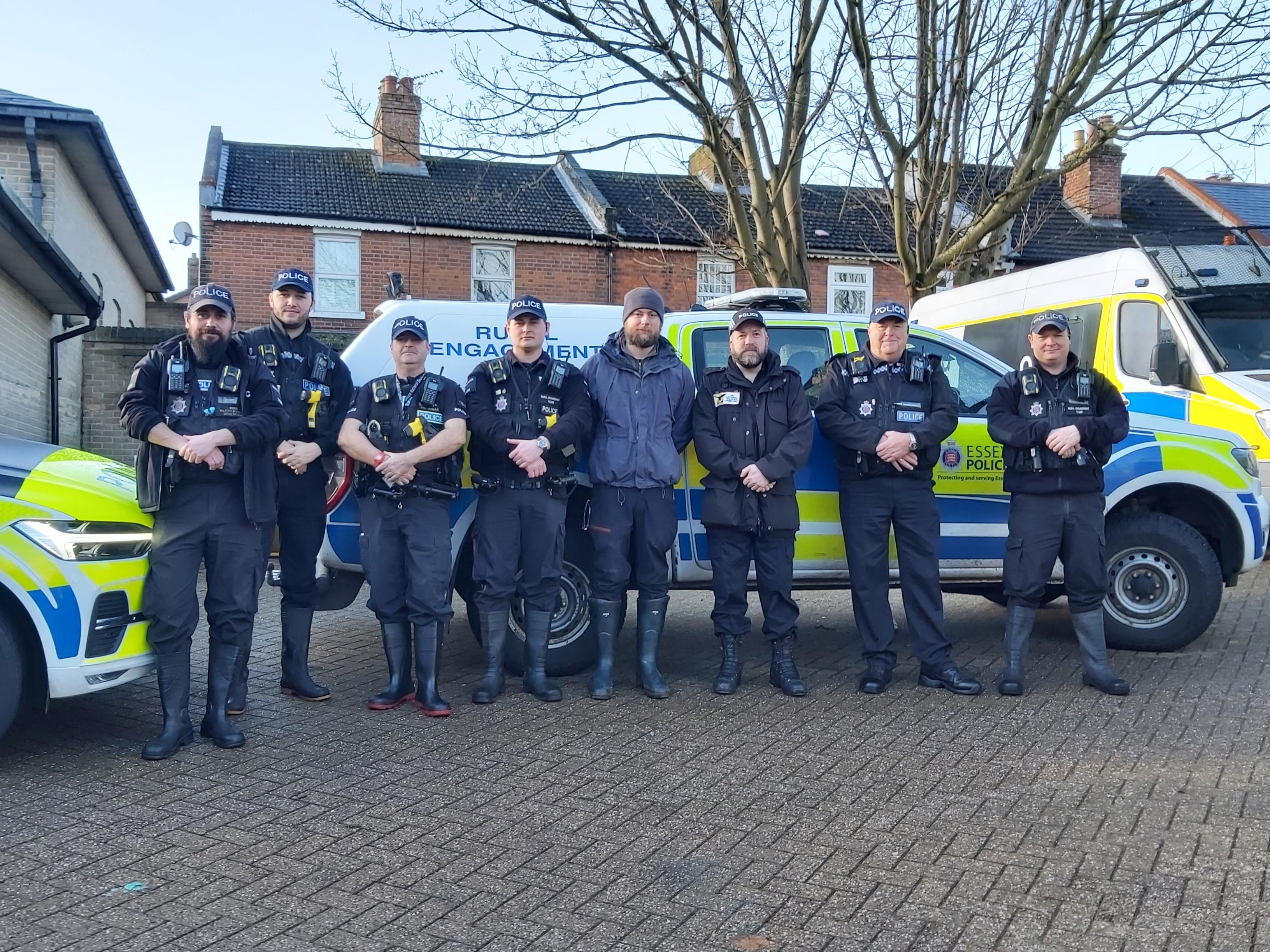
Essex Police’s Rural Engagement Team has been busy again.
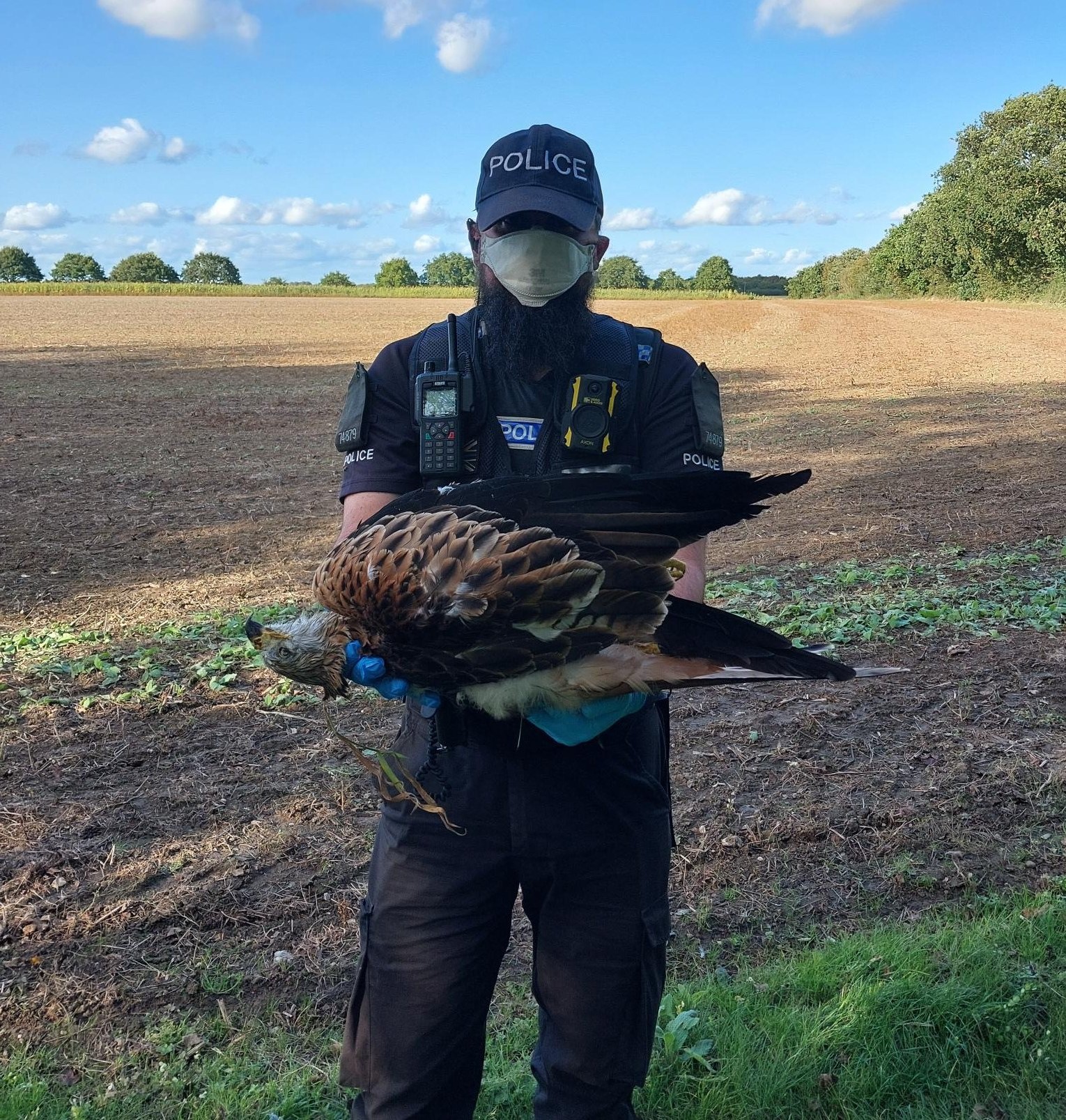
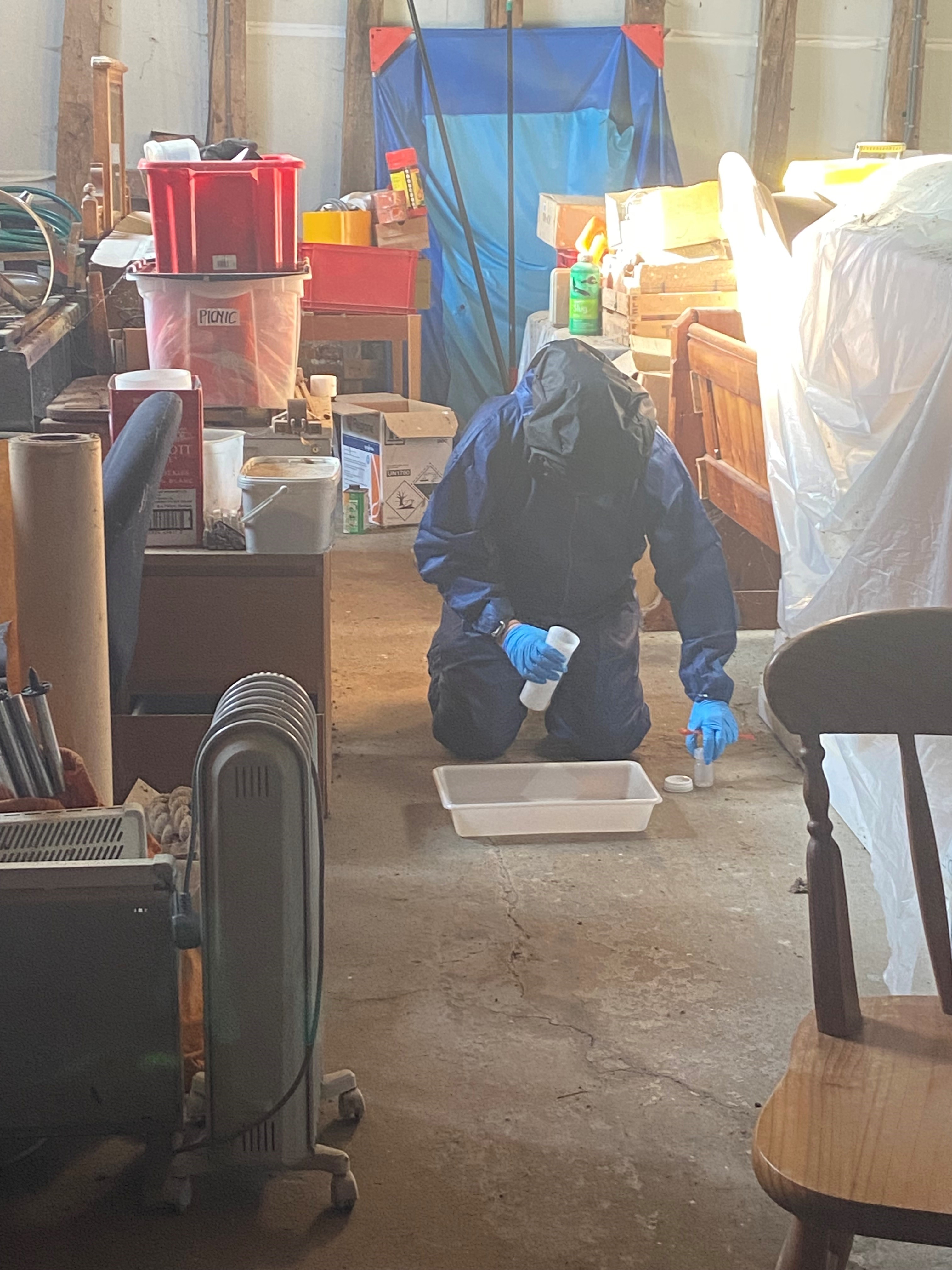
Yesterday, with assistance from other agencies including the National Wildlife Crime Unit and Natural England they searched a farm in the Colchester area after the discovery of two poisoned red kites. Firearms and ‘other articles’ were seized and the investigation is ongoing.
One of two poisoned red kites found. Photo: Essex Police
The county of Essex is becoming a real hotspot for bird of prey persecution.
Other raptor persecution crimes in recent years include the suspected shooting of a peregrine in January 2024 (here), the shooting of a buzzard in December 2023 (here), the shooting of another buzzard in January 2023 (here), the shooting of a red kite in September 2022 (here), the shooting of another red kite in November 2021 (here), another red kite found dead in suspicious circumstances in November 2021 (here), the shooting of another three buzzards in 2020, one in Dec (here), one in September (here) and one in June (here), and the suspected shooting of a Hobby in August 2020 (here).
Further to this morning’s blog about the sentencing of part-time gamekeeper Timothy Hall, 48, and his son Lewis Hall, 23, who had previously pleaded guilty to multiple offences relating to the illegal laundering of wild peregrines stolen from nest sites across Scotland and then sold on under the guise of being legally captive-bred birds (see here), I want to write a few thoughts about this outcome.
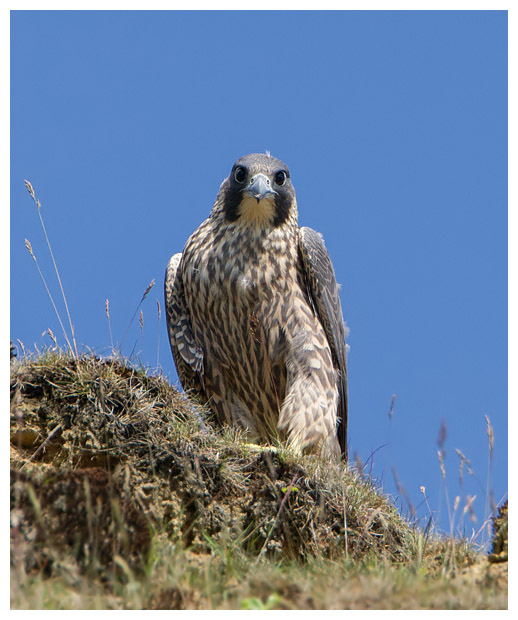
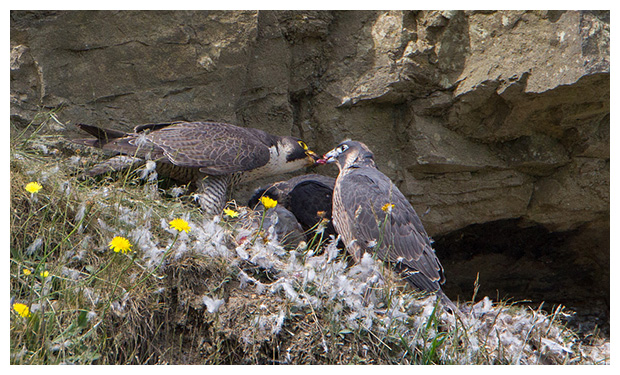
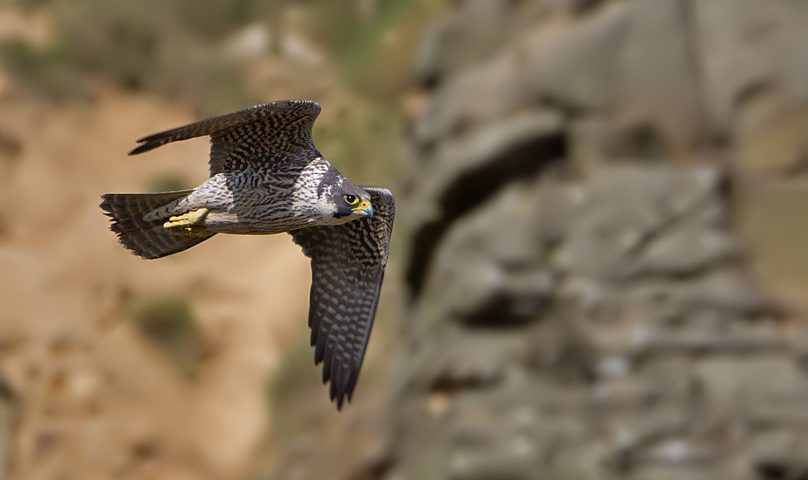
Juvenile peregrine, out in the wild where it belongs. Photo by Pete Walkden
There’s a lot to say about this case but I first want to acknowledge the multi-agency partnership working of all those involved in getting these criminals in to court. Beginning in May 2021, this investigation has been long-running, painstakingly meticulous and exceptionally diverse. The staggeringly inadequate sentences handed down today do not in any way reflect the dedicated and exemplary efforts of these agencies, all of whom deserve our appreciation and thanks.
Very well done to the Scottish Raptor Study Group (SRSG), Scottish SPCA, Police Scotland, National Wildlife Crime Unit (NWCU), Science and Advice for Scottish Agriculture (SASA) and the Animal Plant and Health Agency (APHA).
So, sentencing. We learned earlier today that Timothy Hall had been ordered to complete 220hrs of unpaid work over a period of 18 months and his son, Lewis Hall, 150hrs over a period of 15 months. They were both also banned from having birds of prey in their possession or under their control for a period of five years.
To say this is a disappointing sentence is a massive understatement. It’s not what any of us had expected, especially given that the presiding Sheriff, Peter Paterson, is no stranger to hearing wildlife crime cases (more on that below). It wasn’t as though this case was heard by an inexperienced and naïve member of the judiciary, nor that he wasn’t provided with extensive and compelling evidence about the scale of offending, which had been going on for several years and clearly met the standard of being serious and organised crime.
So why the staggeringly pathetic sentence, then?
I’m not going to try and justify it because I can’t. It’s even more inexplicable given the Sheriff’s track record. This is the Sheriff who presided over the notorious case against gamekeeper Alan Wilson in 2019, whose extensive wildlife crimes on the Longformacus Estate resulted only in an order to carry out 225hrs of unpaid work (and a 10-month curfew) – another monumentally inadequate sentence.
However, in that case Sheriff Paterson had acknowledged that Wilson’s offending warranted a custodial sentence but said that as the Wildlife & Countryside Act only allowed sentences of up to six months, and Scottish Ministers had recently introduced a presumption against jailing offenders for less than 12 months, he felt he had no choice but to impose a different sentence (here).
I argued against that logic (here), suggesting that because Wilson had been convicted of multiple offences, each carrying a maximum six month custodial penalty, a potential custodial sentence for all his offences would have exceeded the 12-month limit and so should have been imposed.
It wasn’t to be, but we consoled ourselves with the knowledge that increased penalties for wildlife crimes in Scotland were imminent (new legislation was enacted in Nov 2020), which elevated custodial sentences for certain wildlife crimes to five years in custody and unlimited fines, and so any future prosecutions would surely result in a tougher sentence, right?
Well apparently not.
There is some legitimate justification (although I don’t agree with it in this case) for Lewis Hall not to receive a custodial sentence. As of 26 January 2022 the Sentencing Young People guidelines in Scotland came into force, which argues that anyone under the age of 25 years should preferentially be given a rehabilitation order instead of a custodial sentence. However, and this is important, the guidelines state that the full range of sentencing options, including imprisonment, remains open to the court, but that a (shorter) custodial sentence should only be imposed on a young person when the court is satisfied that no other sentence is appropriate.
Given that Lewis Hall (23) was up to his neck in serious organised crime, receiving huge payments from the Middle East into his own bank account, for the sale of stolen peregrines (according to the evidence), what possible reason did Sheriff Paterson have for only imposing a sentence of 150hrs unpaid work?? It doesn’t make sense.
And as for Timothy Hall (48), I can’t see any reason whatsoever why he shouldn’t have received a custodial sentence. Under the Animals and Wildlife (Penalties, Protections and Powers) (Scotland) Act 2020, Timothy Hall’s offences, committed over a number of years, included crimes relating to Section 1 of the Wildlife & Countryside Act (Protection of wild birds, their nests & eggs) and Section 6 (Sale, possession etc of live or dead wild birds, eggs etc), both of which now attract penalties of up to five years imprisonment and significant fines. The Sheriff even agreed Hall’s crimes had passed the custodial threshold, so why only impose a sentence of 220hrs unpaid work??
It makes a total mockery of the court’s sentencing powers, of the Government’s will to crack down on wildlife crime, of the investigating agencies’ hard work, of the public’s desire to see wildlife criminals held to account and of effective deterrents put in place for other would-be criminals.
Sure, Lewis Hall is still facing action under the Proceeds of Crime legislation, and both he and his father face an ongoing investigation by HM Revenue & Customs for undeclared income (£41,164 according to COPFS), but that should have all been in addition to punishment under the wildlife crime legislation.
I just can’t comprehend how they got off so lightly. Compare and contrast with two other recent cases, where a falconer was fined over £7,000 for a minor admin error when selling legitimately captive-bred peregrines (here) and a drug addicted tree surgeon was given an eight-week custodial sentence for robbing eggs from a single peregrine nest (here).
Timothy Hall’s wife, a serving police officer whose not guilty pleas were accepted by the court in December 2023 (but has a reserved fraud charge hanging over her, see here), remains suspended from Police Scotland on full pay. I don’t know how long she’s been employed as a serving officer but the pay scale for a constable ranges from £30,039 on commencing service up to £48,237 for up to 11 years of service.
I don’t doubt the Hall family will be celebrating this evening.
Here’s Lewis Hall leaving court after sentencing, screen-grabbed from BBC Reporting Scotland this evening:
UPDATE 26 June 2024: Prosecutors seeking to recover £164,000 from Scottish peregrine launderer Lewis Hall (here)
UPDATE 10 October 2024: Scottish court orders convicted Peregrine launderer Lewis Hall to pay back thousands under Proceeds of Crime Act (here)
UPDATE 23 November 2024: Suzanne Hall, wife & mother of convicted peregrine launderers ‘no longer a serving police officer’ (here).
Part-time gamekeeper Timothy Hall, 48, and his son, Lewis Hall, 23, appeared at Jedburgh Sheriff Court this morning for sentencing after they earlier pleaded guilty to the illegal laundering of wild peregrines which had been stolen from sites across southern Scotland (see here for previous blogs).
Despite their offences passing the threshold for a custodial sentence, Timothy Hall was ordered to complete 220 hours of unpaid work and Lewis Hall was ordered to complete 150 hours.
More on this shortly…
UPDATE 13.40hrs: Press release from Police Scotland –
Two men sentenced for wildlife crime offences in the south of Scotland
Two men have been sentenced with community payback orders after pleading guilty to a series of wildlife crime related offences involving peregrine falcons in the south of Scotland.
Timothy Hall, 48 was given 220 hours, and Lewis Hall, 23, was given 150 hours community payback orders today at Selkirk Sheriff Court [Ed: case moved to Jedburgh Sheriff Court]. Both have been banned from keeping birds of prey for 5 years.
They admitted charges relating to 22 peregrine falcons, including being involved in the illegal sale of the protected species at Selkirk Sheriff Court on Monday, 11 December, 2023.
Timothy Hall also pleaded guilty to charges relating to firearms and animal welfare offences.
The ground breaking investigation led by Police Scotland was launched in 2021 and during a search of a property in Lamberton, Berwick-upon-Tweed, seven chicks were discovered as well as a number of other birds of prey.
While it is legal to sell captive-bred peregrines, possessing or selling wild birds is not.
To confirm the chicks were wild a new innovative DNA tactic was introduced which definitively established that they had not been bred in captivity, even linking some of them to wild adult peregrine falcons known to nest in the south of Scotland.
The investigation spanned two and a half years and through extensive enquiries Police Scotland was able to trace the sale of a number of peregrines to UK establishments trading in the birds and confirmed some had been exported overseas.
Throughout the investigation a range of partners provided invaluable contributions and expertise including the Scottish SPCA, the UK National Wildlife Crime Unit (NWCU), the Scottish Raptor Study Group, Science and Advice for Scottish Agriculture (SASA) and COPFS.
Police Scotland also worked closely with the Animal and Plant Health Agency (APHA) to improve processes and procedures relating to illegal wildlife trade to prevent people engaging in this type of criminality.
Detective Superintendent Bryan Burns said: “The sale of peregrine falcons has become an extremely lucrative business which Timothy and Lewis Hall exploited for their own financial gain.
“If their illegal activities had continued unchallenged, this would have had a massive impact on the population of young birds, and had the potential to wipe out the entire population of peregrine falcons in the south of Scotland.
“This case has been a monumental effort by Detective Constable Steven Irvine who led the investigation and was determined to bring the perpetrators to justice, going into meticulous detail to unravel the true extent of the criminality involved.
“These convictions would not have been possible without the incredible support from the partner agencies involved who all played a vital part in the investigation.”
Assistant Chief Constable for Major Crime, Public Protection and Local Crime, ACC Bex Smith, added: “This case not only has huge ramifications locally but also across the UK and worldwide and shows that Police Scotland is at the forefront of tackling illegal wildlife trade, working with our partners to use new and ground breaking forensic techniques. Wildlife crime remains a key priority for the Service and we will continue to use all resources at our disposal to put a stop to this illegal activity.”
Chief Inspector Kevin Kelly, head of the UK National Wildlife Crime Unit said: “This is part of the largest wildlife crime investigation in UK history, showing the illegal wildlife trade is a thriving business for criminals.
“The UK is home to some of the rarest birds of prey in the world, some of these are being taken and laundered in the legal falconry trade bringing lucrative returns for criminals and having a direct impact on the current nature crisis. The NWCU is committed to tackling this.”
Dr Lucy Webster from Science and Advice for Scottish Agriculture (SASA), part of the Scottish Government, led on the forensic work. She said:
“This is the first case to use our new forensic DNA method to test whether documented breeding records for Peregrine Falcons are true or false. However, we went beyond establishing false breeding records here, and also identified family links to several wild Peregrine nests. This powerful method will continue to support investigations and combat the illegal trade of wild Peregrines in the UK and beyond.”
Anyone with information or concerns about wildlife crime in their area can contact Police Scotland on 101.
ENDS
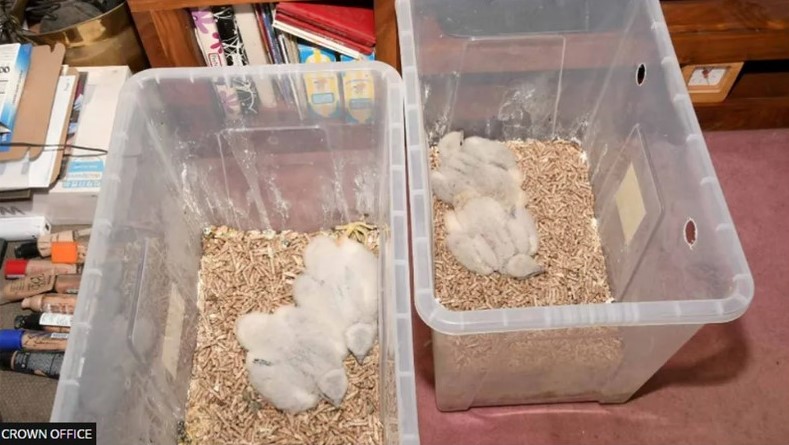
Some of the young stolen Peregrine chicks found at Timothy Hall’s address during multi-agency raid in 2021 (Photo via COPFS). The chicks were later fostered back to wild nest sites.
UPDATE 14.00hrs: Press release from Crown Office & Procurator Fiscal Service COPFS):
Father and son receive bans for illegally selling peregrine falcon chicks
A father and son who, over a number of years, illegally possessed and sold wild peregrine falcon chicks for large sums of money, have been ordered to carry out periods of unpaid work.
Both men are also prohibited from possessing or having under their control any bird of prey for a period of five years.
Timothy Hall, 48, pled guilty to acquiring for commercial purposes, keeping for sale and selling 15 wild peregrine falcon chicks between 2019 and 2020 and to being in possession of a further seven wild peregrine falcon chicks on 18th May 2021.
He also admitted a charge of failing to provide for the needs of nine other birds of prey by not providing a clean and adequate living environment and not providing sufficient clean water for them. He also admitted breaching the Firearms Act by not properly securing a shotgun.
He was ordered to carry out 220 hours of unpaid work over a period of 18 months.
Lewis Hall, 23, pled guilty to acquiring for commercial purposes, keeping for sale, and selling wild peregrine falcon chicks between 2020 and 2021, which included 13 of the previously referred to peregrine falcon chicks sold in 2020 and the seven chicks found on 18th May 2021.
He was ordered to carry out 150 hours of unpaid work over a period of 15 months.
Both men were sentenced at Jedburgh Sheriff Court.
Iain Batho, who leads on wildlife and environmental crime for the Crown Office and Procurator Fiscal Service (COPFS), said:
“It is highly important to preserve Scotland’s natural heritage, including the wildlife that forms part of it. As such, birds of prey are given strict protection by our law.
“The sale of peregrine falcons has become an extremely lucrative business and Timothy and Lewis Hall took advantage of that for their own financial gain and to the detriment of the wild peregrine falcon population in the South of Scotland.
“Their illegal activities had the potential to have a devastating impact on the entire population of nesting peregrine falcons in that part of the country.
“The result in this case is a testament to the collaborative working between COPFS, Police Scotland, the UK National Wildlife Crime Unit (NWCU), the Scottish SPCA and Science and Advice for Scottish Agriculture (SASA).”
The court heard how in April 2021 a member of the Lothian and Borders Raptor Study Group alerted police to suspicious failures of peregrine falcon nests in the Berwickshire area which had previously been productive.
Officers later investigated two nesting sites and discovered they had been disturbed and a number of eggs were missing from both locations.
A police search of Timothy Hall’s home in Berwick-Upon-Tweed subsequently found a total of seven peregrine falcon chicks as well as a number of other birds of prey.
Further enquiries concluded that none of the chicks were captive-born and had been taken from the wild.
The court was also told that an examination of Lewis Hall’s mobile phone contained a note that suggested he had been monitoring known peregrine falcon nest sites.
Data on the same device also showed that a drone linked to the phone had flown 20 separate flights directly over several known peregrine falcon nest sites.
The court also heard evidence that, between 2019 and 2020, Timothy and Lewis Hall were involved in the sale of 15 peregrine falcon chicks for which they received a total of £41,164.
To confirm the chicks were wild, a new innovative DNA tactic was used which definitively established that they had not been bred in captivity and which linked some of them to wild adult peregrine falcons known to nest in the south of Scotland.
Under legislation, selling captive-bred peregrine falcons is legal but possessing or selling wild birds is unlawful.
Lewis Hall will now be subject to action under proceeds of crime legislation.
UPDATE 20.30hrs: Commentary on the staggeringly inadequate sentencing of Timothy and Lewis Hall, convicted for illegal laundering of wild peregrines in south Scotland (here)
UPDATE 14 February 2024: It’s soul destroying to find nests have failed” – inside the battle against Scotland’s falcon thieves (here)
UPDATE 15 February 2024: SSPCA press release on conviction of part-time gamekeeper Timothy Hall and his son Lewis Hall for illegal laundering of Scottish peregrines (here)
UPDATE 26 June 2024: Prosecutors seeking to recover £164,000 from Scottish peregrine launderer Lewis Hall (here)
UPDATE 10 October 2024: Scottish court orders convicted peregrine launderer Lewis Hall to pay back thousands under Proceeds of Crime Act (here)
UPDATE 23 November 2024: Suzanne Hall, wife & mother of convicted peregrine launderers ‘no longer a serving police officer’ (here).
This weekend Sky News ran several pieces about raptor persecution and how the wildlife killers are getting with these crimes, with a prosecution rate of less than 4%.
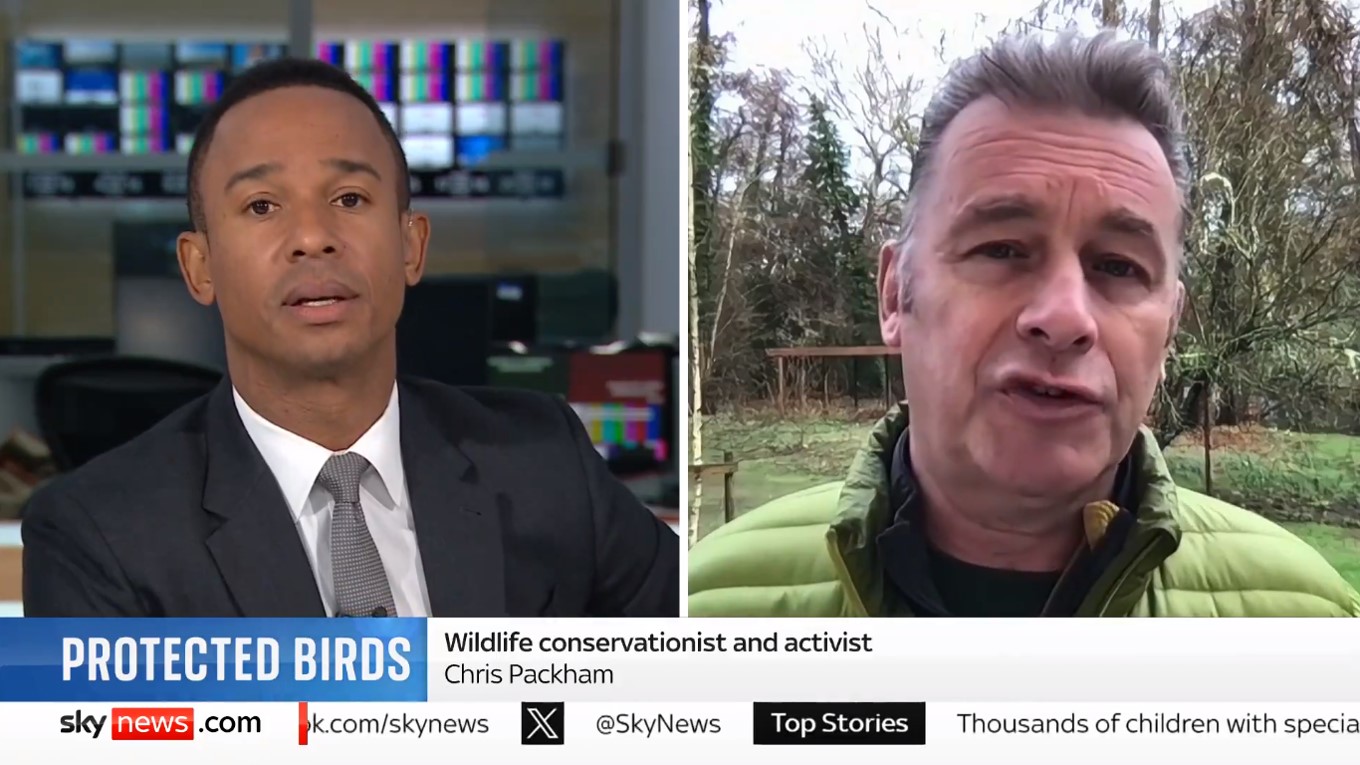
They produced a written piece (here) featuring quotes from the RSPB’s Investigations Team and they also conducted several interviews, one with Howard Jones, RSPB Senior Investigations Officer, one with Mark Thomas, Head of RSPB Investigations and one with Chris Packham.
The interview with Mark Thomas showed some covert video footage by the RSPB showing two gamekeepers removing live buzzards from a crow cage trap, putting them inside fertiliser sacks, tying the top and putting the bags inside a vehicle. It doesn’t show what happened to them next but you can probably imagine; there have been enough previous cases where gamekeepers have been caught on camera bludgeoning trapped birds of prey to death (e.g. see here, here, here) to make an educated guess. These earlier convictions probably explain why these days its common to see the trapped birds being removed from the trap and taken away, presumably to be killed away from potential covert cameras. It’s also telling that the gamekeepers involved in more recent cases typically wear face masks in an attempt to hide their identities. They’ve learned from the mistakes of others.
As Mark discusses during the interview, it’s not an offence to catch birds of prey in crow cage traps – they often get in and can’t then find a way out. If the trap operator releases them, unharmed, immediately after discovering them, then no offence has been committed. Putting them inside a sack and taking them away is a clear offence and is indicative of further offences (i.e. killing the birds elsewhere).
This particular footage hasn’t previously been published, and there’s a reason for that. I’ll return to this case in a separate blog.
I can’t find the full interviews in one place but there are various clips that can be watched via Twitter, which I’ve linked below.
The prosecution continues of Christopher Hodgson, Director of Ashley Game Farm in Devon following the discovery of a poisoned buzzard and two poisoned baits.
The discovery, in October 2020, led to a multi-agency raid of the premises in March 2021 with assistance from Natural England, RSPB and the NWCU (see here) and which identified a number of alleged pesticide and veterinary medicine offences at the address.
Multi-agency search team attended Ashley Game Farm in March 2021. Photo: RSPB Investigations
I understand that the prosecution is against Christopher Hodgson as well as against his company, Ashley Game Farm.
Ashley Game Farm is an exceptionally large breeding facility that, according to its website, ‘specialises in supplying pheasants and partridges to shoots in the west country and all areas of the UK and Europe‘. It claims to have ‘a hatching capacityfor 410,000 eggs per week along with further investment in a second location atTarrington, Hereford‘ and ‘retains around 80,000 chicks at Ashley Game Farm every week‘.
Ashley Game Farm Director and owner Christopher Hodgson, 69, was due in court in Barnstaple on Friday 2 February 2024 to face multiple charges in relation to the alleged use of Carbofuran and the alleged possession, storage and use of various plant protection and veterinary medicine products without authorisation at the game farm.
Mr Hodgson has not yet entered a plea.
The case has now been adjourned until 28 May 2024.
As this case is still live, comments won’t be accepted on this blog until criminal proceedings have concluded. Thanks for your understanding.
UPDATE 28 May 2024: Devon gamebird breeder guilty of using banned pesticide Carbofuran (here).
UPDATE 20 July 2024: Poisoned buzzard leads to discovery of multiple pesticide offences – Ashley Game Farm & Director Christopher Hodgson fined £40,000+ (here)
Another week, and yet another example of shot gamebirds being dumped and discarded in the countryside, this time in the Scottish Borders.
According to this BBC article, on Tuesday morning dog walkers and ramblers found the corpses of ‘about 20 pheasants and a number of ducks’ that had been dumped in a moorland car park above Lauder.
Photo of the dumped birds from the BBC News website
Regular blog readers will know that this is a common and widespread illegal practice. The disposal of animal by-products (including shot gamebirds) is regulated and the dumping of these carcasses is an offence.
Previous reports include dumped birds found in Cheshire (here), Scottish borders (here), Norfolk (here), Perthshire (here), Berkshire (here), North York Moors National Park (here) and some more in North York Moors National Park (here) and even more in North Yorkshire (here), Co. Derry (here), West Yorkshire (here), and again in West Yorkshire (here), N Wales (here), mid-Wales (here), Leicestershire (here), Lincolnshire (here), Somerset (here), Derbyshire’s Peak District National Park (here), Suffolk (here), Leicestershire again (here), Somerset again (here), Liverpool (here), even more in North Wales (here) even more in Wales, again (here), in Wiltshire (here) in Angus (here), in Somerset again (here), once again in North Yorkshire (here), yet again in West Yorkshire (here), yet again in mid-Wales (here), even more in mid-Wales (here), more in Derbyshire (here), Gloucestershire (here) more in Cheshire (here) and some in Cumbria (here).
Unless someone was seen dumping these shot gamebirds, there’s no way of knowing who did it or from which gamebird shoot they originated. There’s no requirement for shoot managers to fit identifying markers to their livestock, which would make them traceable, because gamebird ‘livestock’ absurdly changes legal status to ‘wildlife’ as soon as the birds are released from the rearing pens for shooting (see Wild Justice’s blog on Schrodinger’s Pheasant for details).
For new readers, this is proposed new legislation to regulate grouse shooting and its associated management practices by way of licensing schemes, introduced because of the continued illegal persecution of birds of prey on many Scottish grouse moors.
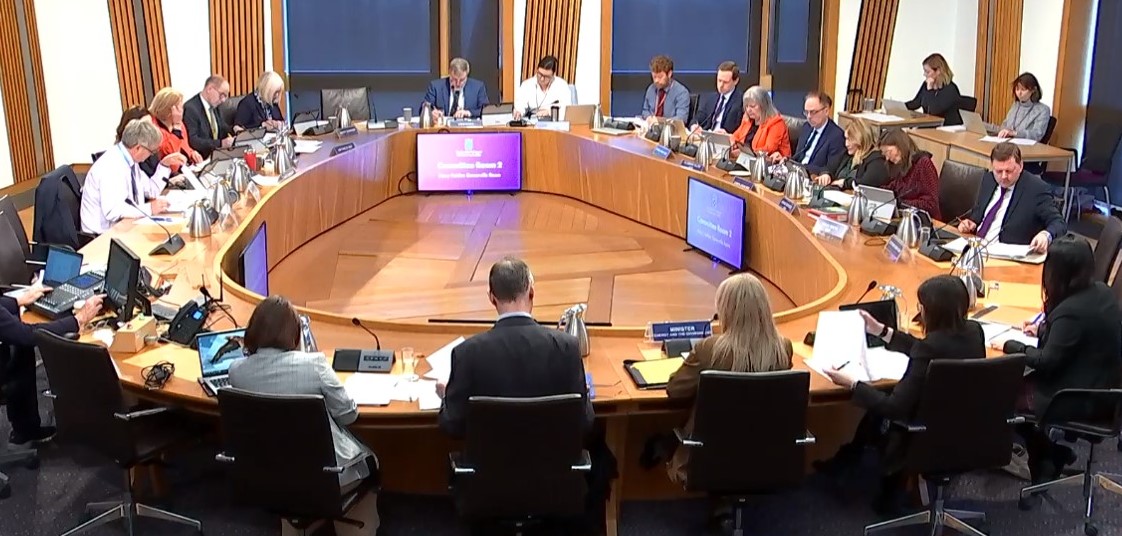
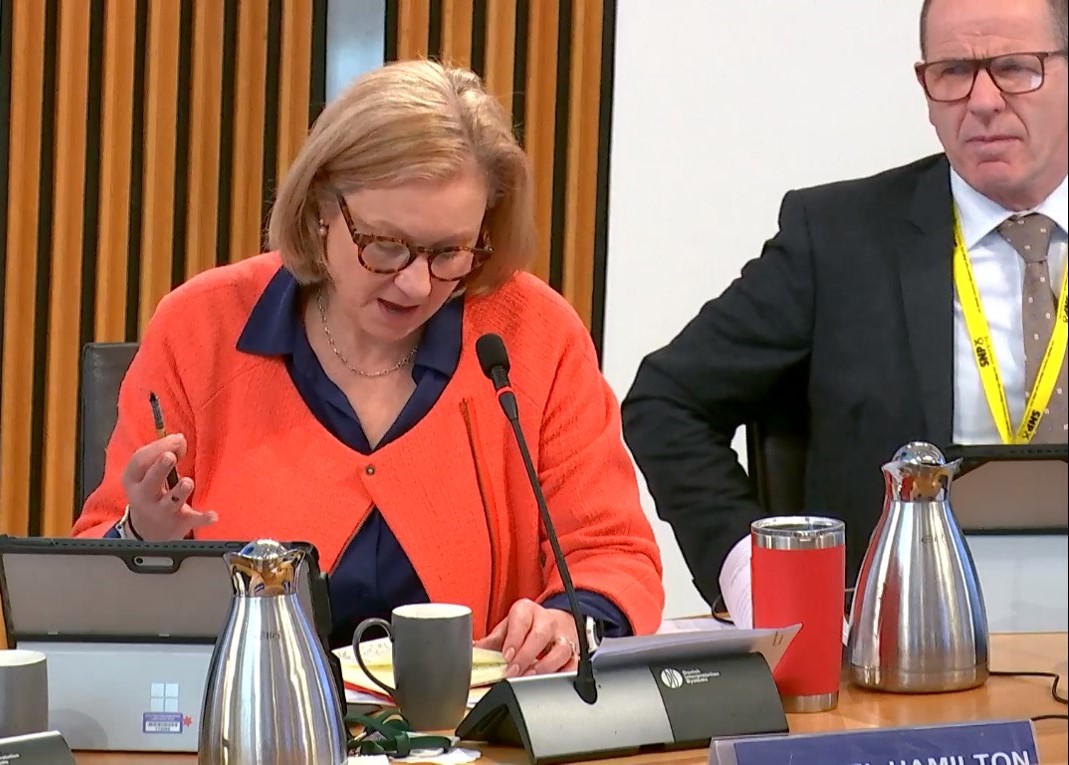
Rural Affairs & Islands Committee, 7 February 2024. Screengrab from Scottish Parliament TV.
The Committee was joined by Environment Minister Gillian Martin MSP and some of her civil servants, and there were other MSPs in attendance (Edward Mountain MSP (Conservative), Stephen Kerr MSP (Conservative), Colin Smyth MSP (Labour) and John Mason MSP (SNP), none of whom were eligible to vote on the Stage 2 amendments but who were present to speak to amendments they have lodged.
There weren’t any big surprises in this first session and it soon became clear that Committee members were voting along party lines.
The Committee dealt with glue traps (nothing to do with grouse moor management but included in the Bill as a sort of related topic in terms of wildlife management) and then got into the nitty gritty of wildlife traps. There are still a few amendments to deal with on wildlife traps at the start of the next session but then it’ll move on to the big issues of grouse moor management and muirburn.
I won’t go through each amendment in turn because I’d be here for hours and besides, those interested will be able to read the transcript when it’s published in the next few days [update – now published at foot of this blog], but I will highlight some of the big decisions made at yesterday’s session.
The main ‘win’ from our perspective was the Minister’s decision to ban all snares on welfare grounds, including the cynically rebranded so-called ‘humane cable restraints‘ (rebranded to make them sound less archaic). The grouse shooting industry’s aggressive campaign to try and have ‘humane cable restraints’ exempted from the ban has failed miserably. Only two Committee members opposed the amendment for a ban – the two Tories, Finlay Carson and Rachael Hamilton. It was a pattern that was repeated throughout the proceedings.
Incidentally, as an aside, I keep reading arguments from the game shooting industry to justify the continued use of ‘humane cable restraints’ because they’re used by researchers and conservationists to trap wildlife, notably foxes, for example to fit radio collars, and the foxes are subsequently released unharmed. Therefore, they argue, ‘humane cable restraints’ are fine to use. What they don’t explain is for how long those foxes are ‘held’ in the ‘humane cable restraint’ (snare) – I’d wager that it’s not for up to 24 hours without access to food, water or shelter (the permitted time a fox can currently be held in a snare in Scotland until this Bill passes). No self-respecting scientific ethics committee would support a research application on that basis.
Another big ‘win’ was an amendment lodged by Karen Adam MSP (SNP) who successfully argued that offences committed under the Animal Health & Welfare (Scotland) Act 2006 should be considered as relevant for a potential suspension or revocation of a wildlife trapping licence (and also for a grouse moor management licence, although that part won’t be considered until the second session). This is a really important amendment because it means that when, for example, someone has been convicted of, say, the sadistic crime of badger-baiting (like the recent conviction of depraved Millden Estate gamekeeper Rhys Davies employed on a grouse moor in the Angus Glens), that person should not be considered fit to hold a trapping or grouse moor management licence. I was astonished (but not really) to see that Tories Finlay Carson and Rachael Hamilton opposed this amendment.
On the issue of full cost recovery for trap licences (i.e. that trap licence applicants should have to pay a fee to cover NatureScot’s administration of the licensing scheme, an amendment lodged by John Mason MSP (SNP)), Rachael Hamilton had lodged a counter amendment to remove this provision. The ensuing debate was hilarious, and Rachael’s argument was muddled and frankly, idiotic. She berated John Mason:
“He [John Mason] also should not, with respect, castigate assertions that illegal behaviours have been related to rural stakeholders“
She then went on a politicking spree, accusing the Scottish Government of “kow-towing” to another party (the Scottish Greens) as part of the Bute House Agreement (the shared policy agreement between the Scottish Greens and the SNP) but by this stage, Jim Fairlie MSP (SNP) had heard enough. He spoke to her directly, barely suppressing his exasperation:
“By the stakeholders’ own acceptance, this Bill was brought forward as a result of raptor persecution, which has been going on for decades, and the fact that there are going to be consequential wildlife benefits of bringing in this Bill does not necessitate the fact that the public purse should pay for it. Now I’m not saying one way or another how or where I’m going to vote on this at this moment in time, but to sit here today, you’re almost, sorry, the Member is almost trying to say that this has been brought forward as a result of the Bute House Agreement on the drive of the Greens. No, it’s not. It’s been brought forward because raptor persecution has been happening in this country, for decades, and the landowners who were responsible, or whose employees were responsible, did not shut it down. So I’m afraid I’ll be supporting the landowners and the rural workers more than most, but on this point I’m afraid I fundamentally disagree with you“.
Jim Fairlie’s facial expression when listening to Rachael Hamilton said it all.
Rachael Hamilton responded:
“Well, thank you to Jim Fairlie for that intervention. I mean of course, the whole objective is to ensure that we get those people who are operating illegally and that is the most important part of this Bill, but there’s no connection between raptor persecution and grouse moors. There are other reasons for persecution and those reasons would be predation, intraguild predation, the habitat etc, so we can agree to disagree on that“.
Eh?? After all the evidence presented to this Committee on the absolutely unequivocal link between grouse moor management and illegal raptor persecution, Rachael Hamilton is STILL denying the link exists, at this late stage of the Bill??! That’s either wilful blindness or embarrassing stupidity. And then describing the ‘reasons for persecution’ as being ‘intraguild predation’ and ‘habitat’ – it’s just mumbo jumbo.
Unsurprisingly, Rachael’s amendment was not supported by other Committee members (apart from Finlay Carson).
However, the issue of full cost recovery for trap licences was not resolved during this session because the Minister stated that her colleague, Biodiversity Minister Lorna Slater MSP, had recently (in January) commissioned a formal review of all species licensing undertaken by NatureScot, which will include assessing the potential for full cost recovery of licences. The review/report is expected within six months. I don’t know how that will impact on the progression of this Bill, given the Government’s stated intention to see the Bill passed before summer recess.
Conservative MSP Edward Mountain’s amendment suggesting that the withdrawal of wildlife trap licences should be based on the criminal burden of proof rather than the civil burden of proof was not supported. Neither was his amendment calling for an exemption from requiring a trapping licence if an applicant was (a) born before 31st December 1983 AND (b) had been using traps for 10 years consecutively. To be fair to him, although I thought his amendments were unsupportable, he did argue coherently and politely without the barbed sniping that was evident from some of his Conservative colleagues.
Labour MSP Colin Smyth didn’t find much support for his amendments on trap licensing, including a proposed condition that a trap licence shouldn’t be issued if its primary purpose was to manage the number of wild birds (Red Grouse) available for sport shooting. His arguments were passionate and eloquent and based on REVIVE’s campaign against ‘Killing to Kill‘ but he accused the Tories of making false claims about the impact of his amendments (it was argued that the amendments would effectively introduce a ban on grouse shooting) – they wouldn’t, and Colin announced his intention to press these amendments again at Stage 3.
The Minister’s amendment to create a specific offence of interfering with a lawfully set trap was approved, with an important caveat, ‘unless a person has reasonable cause to do so’. I’m guessing that a ‘reasonable cause’ may include concern about the immediate welfare of a trapped animal in distress, although a recent case in England based on those grounds led to the prosecution of a person who had released two highly distressed non-target species (a hare and a deer) from snares on the Duke of Norfolk’s estate in West Sussex. The person was subsequently found not guilty on all charges (see here). I may come back to that case in another blog because it’s interesting on a number of levels.
I note with some amusement that several grouse shooting organisations are trumpeting what they perceived as ‘a significant victory’ yesterday after the Minister removed a provision in the Bill that would have allowed the suspension of a trapping licence on the basis that a police investigation had started (into alleged trapping offences). Some of you may recall the Stage 1 discussions during the evidence sessions about the definition of an ‘investigation’ and when an ‘investigation’ could be deemed to have started (e.g. When someone reports an alleged offence? Or when the police issue a crime number? etc). It was a painful process that didn’t actually provide much clarity, even from the police, so for the purposes of having a water-tight Bill I think it was reasonable for this provision to be removed.
But is it a ‘significant victory’ as the grouse industry is claiming? I don’t think so. I think what the removal of this provision actually does is provide the police and NatureScot with a far less prescriptive regime and instead allows them more discretion when making an assessment of whether an offence has been committed and therefore whether a licence suspension or revocation is appropriate. That seems like a bit of an own goal by the grouse shooting industry, but if they want to declare it a victory, in what looks like a desperate attempt to appease their members amidst what is otherwise a catastrophic Bill for them (in their view), then good luck to them.
It’s been anticipated that the Committee will require two sessions to consider all the amendments at Stage 2 of this Bill, although judging by the pace of yesterday’s session I’d be surprised if they get through it all on time. The second session will take place on the morning of 21 February 2024.
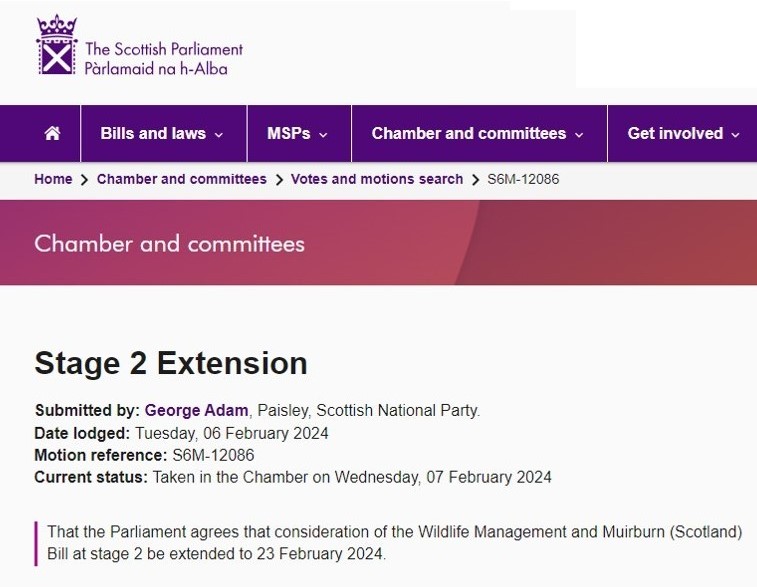
The Scottish Parliament has agreed to extend consideration of Stage 2 to 23rd February 2024 so if they don’t manage to finish on the morning of the 21st there’s a small window in which to potentially squeeze a further session:
You can watch yesterday’s proceedings on a video archived on Scottish Parliament TV (here) and I’ll post the transcript when it becomes available (usually a few days after the meeting).
Press release from the Irish Government’s National Parks & Wildlife Service (2nd February 2024):
Results of the 2022 National Hen Harrier Breeding Survey now published
The latest report on the status of breeding Hen Harrier (Circus cyaneus) in Ireland has just been published in the National Parks & Wildlife Service’s Irish Wildlife Manual Series.
The 2022 National Hen Harrier Breeding Survey was completed with a significant contribution of over 7,700 hours of fieldwork by approximately 250 surveyors. The National Parks & Wildlife Service, and survey partners, the Golden Eagle Trust, the Irish Raptor Study Group and BirdWatch Ireland, would like to acknowledge the valuable contribution made by all surveyors, particularly the eNGO volunteer network.
In a change from previous national surveys, the Hen Harrier European Innovation Project (HHP, funded by Department of Agriculture, Food and the Marine), in operation between 2017-2022, undertook the monitoring of breeding hen harriers across the six breeding Hen Harrier Special Protection Areas (SPAs) and contributed those records to the national survey. The Northern Ireland Raptor Study Group also assisted in coverage in the border counties.
The hen harrier is a territorial bird of prey, and known for its spectacular aerial courtship display, the ‘sky-dance’. It typically bred in open habitats such as heath and bog, with areas of low-intensity farmed grassland also favoured. The 2022 results indicate that:
the national hen harrier population has declined by one third since 2015, to an estimated maximum of 106 breeding pairs (i.e. 85 confirmed, 21 possible).
Its breeding range has contracted by 27% for the same period. A review of data for those sites covered in each of the past five national surveys (i.e. 1998/00 to 2022) indicates a 59% long-term decline for those sites.
The magnitude of declines observed for the subset of sites surveyed across all five national surveys would likely prompt the Red-listing of hen harrier on the Birds of Conservation Concern of Ireland.
The conservation of Hen Harrier is considered one of the most urgent bird conservation priorities in Ireland and on January 12th of this year, Minster Noonan launched the Public Consultation on the Hen Harrier Threat Response Plan. The consultation closes on 20th February 2024, having been previously extended from 13th February.
This iconic bird of prey, once regarded as relatively common in the mid-19th century, now breeds in uplands affected by competing land-use pressures including forestry, agriculture, renewable energy and recreation. Such changes have resulted in both losses in extent or area of open habitats and habitat features (e.g. scrub, hedgerows, copses, heather) for breeding Hen Harrier and in the suitability of what remains, with lower food availability, increased predation pressure and poorer overall habitat condition linked to declines.
Conservation challenges include development of effective measures to address sizeable landscape-scale deterioration in hen harrier habitats, caused by the extensive land-use changes that have precipitated lower breeding success, poor juvenile over-winter survival, and lower recruitment into the breeding population.
This report makes a number of recommendations to halt further declines and support much-needed population recovery, all of which will be considered in the finalisation of the Threat Response Plan.
ENDS
The 2022 National Hen Harrier Breeding Survey can be read/downloaded here:
The National Hen Harrier Survey in England, Scotland, Wales and Northern Ireland was conducted in 2023. This research will provide updated estimates of hen harrier population size and regional trends since the last national survey in 2016 (2016 results can be found here). The results of the 2023 national survey are expected to be published in spring 2024.
Further to the blog I wrote yesterday about the conviction of Gary MacFarlane for the illegal sale of peregrine chicks (here), I’ve just received some more information about this case.
I had written that I wasn’t sure whether or not the case related to the laundering of wild peregrines, although Police Scotland’s press release had alluded to it.
However, I’m now reliably informed that the case against MacFarlane was centred on apparently legitimate captive-bred peregrines and his crimes involved admin offences where he’d entered incorrect details on Article 10 certificates about the paternal genetic lineage of some chicks he was selling, simply because he’d guessed at the identity of the sire, having used semen from a number of males to artificially inseminate the female. His case was NOT related to the laundering of wild peregrines and passing them off as captive-bred birds.
To be honest, the financial consequences of MacFarlane’s admin errors (a fine of £2,100 and the confiscation as proceeds of crime of £5,220 in cash found at his house) seem a bit over the top, especially as the Article 10 system as prescribed by APHA seems ridiculous to say the least.
I won’t go into details because I’m not sure I understand it fully but as a quick summary, APHA has allowed some falcon breeders to enter details on Article 10 certificates of up to 80 individual males as the potential sire of a captive-bred chick. MacFarlane apparently didn’t understand the system and as he’d used semen from six males, he thought he had to indicate on the certificate which one of those males sired the offspring, rather than saying ‘it was one of these six’. He guessed at the identity of the purported sire, got it wrong and has now paid the price. He’s also received an automatic five year ban from keeping Schedule 4 birds so he’s also lost his breeding stock.
The APHA system as it stands is useless, if the idea is to be able to keep track of individual captive-bred birds but then allows breeders to include the details of up to 80 potential sires – it’s bonkers. I understand there is ongoing work between a number of agencies to try and resolve and update the system.
But that’s for discussion elsewhere – it’s not really within the remit of this blog and it’s beyond my area of expertise.






 Raptor Persecution UK