Sentencing in Scotland tomorrow for part-time gamekeeper & son guilty of international peregrine laundering

Part-time gamekeeper Timothy Hall, 48, and his son Lewis Hall, 23, of Lamberton Holdings, Berwickshire will appear for sentencing on Monday 15th January 2024 at Jedburgh Sheriff Court after the pair pleaded guilty in December 2023 to numerous offences relating to the illegal laundering of peregrines, which were stolen from the wild and sold on to clients in the Middle East.

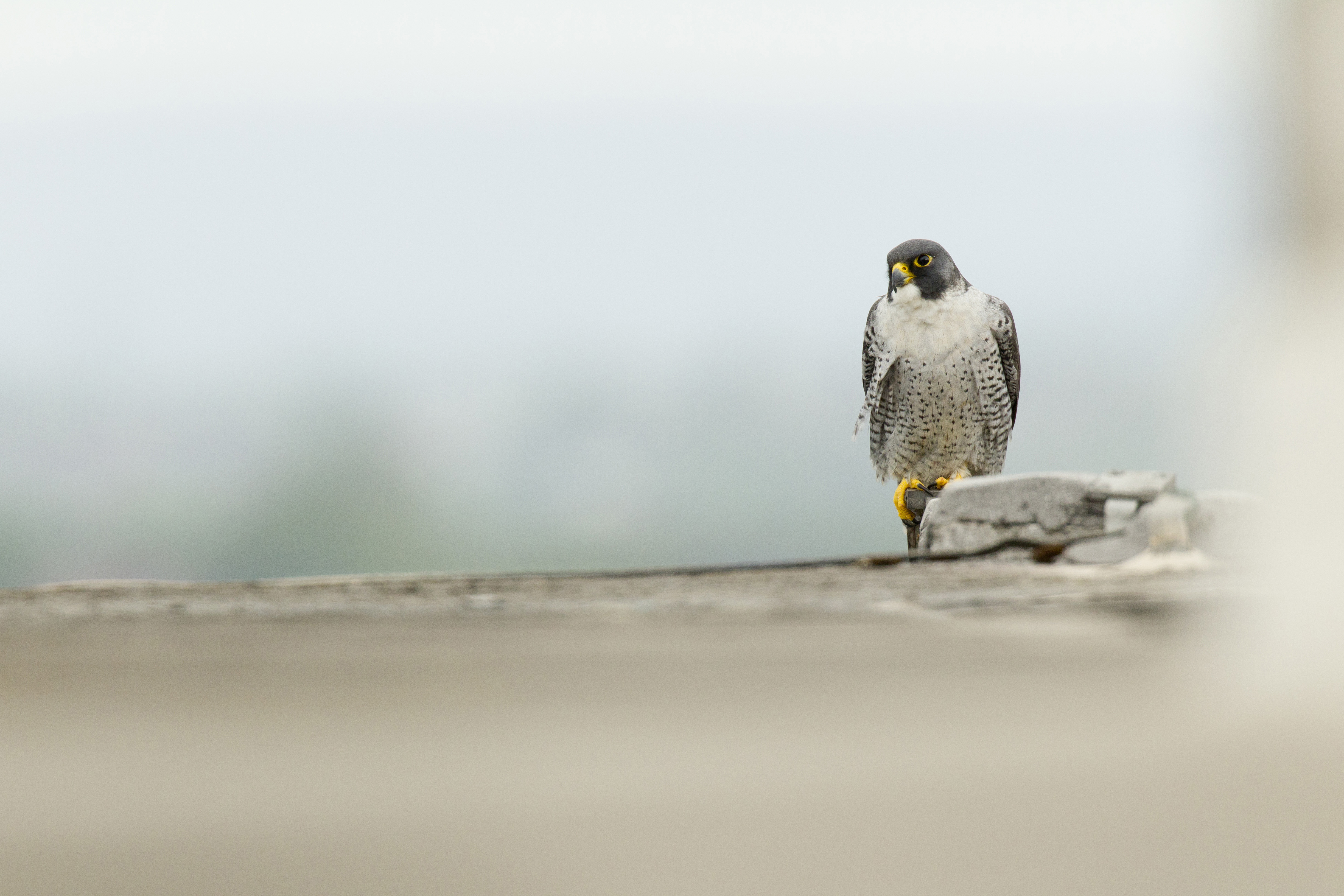
Peregrine photo by Ben Hall, RSPB Images

This is the culmination of a long-running and complex investigation by Police Scotland and the Scottish SPCA, code named Operation Tantallon, which began with a raid at the Halls’ home in May 2021.

Sentencing will take place following background reports on the pair. I’m expecting the full details of this case will be made available after sentencing.

Also appearing in court tomorrow (Chesterfield Magistrates Court in Derbyshire) is Christopher Wheeldon, 34, of Lime Grove, Darley Dale, Matlock who faces charges relating to the alleged disturbance of a peregrine nest and theft of peregrine eggs at a nest site in Bolsover in April 2023. See here for previous blog on this case.

UPDATE 15 January 2024: Sentencing of part-time gamekeeper & son deferred in international peregrine laundering case (here)

UPDATE 15 January 2024: More detail revealed about international peregrine laundering case in Scotland (here)

UPDATE 16 January 2024: Derbyshire ‘drug addict’ jailed for stealing peregrine eggs (here)

New ‘low intensity’ game shooting policy on National Trust moors in Peak District National Park

The National Trust’s (NT) grouse shooting policy in the Peak District National Park has featured a few times on this blog, most notably in 2016 when the National Trust terminated a grouse shooting lease four years before it was due to expire on the Hope Woodlands and Park Hall estates following allegations of illegal raptor persecution (here).

In a direct response to this event, in 2017 the NT modified its grouse shooting tenancy agreements (here) and brought in three new tenants under new, five-year leases.

In 2022, following the ‘disappearance’ of a breeding pair of hen harriers on a National Trust-leased moor in the Peak District (here), the NT came under more public pressure to stop leasing its moors to grouse-shooting tenants.

In 2023 it terminated another grouse shooting lease at Park Hall following more allegations of wildlife crime and announced that no further grouse shooting leases would be issued on this particular NT moor and that it would now be re-wilded (here).

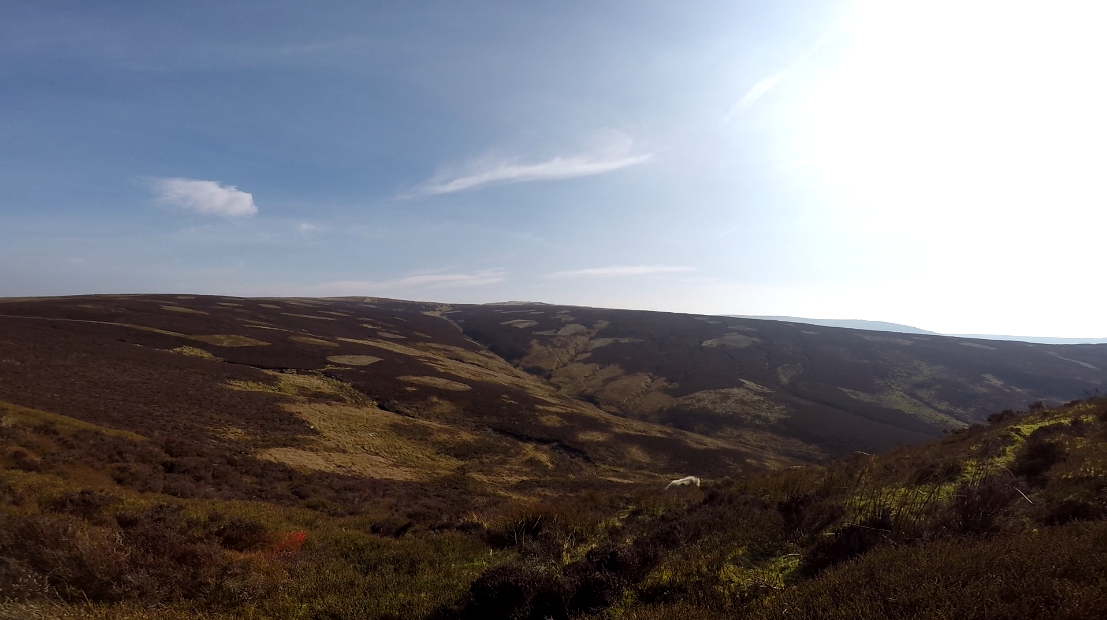
Moorland on the NT’s Park Hall Estate in the Peak District. Photo: RPUK

In November 2023 I attended the Northern England Raptor Forum’s (NERF) annual conference in Barnsley.

One of the presenters was Craig Best, the National Trust’s recently-appointed Peak District General Manager. Prior to taking this post in the Peak District, Craig had spent many years developing and overseeing the delivery of large scale moorland restoration and natural flood management on National Trust moorland in West Yorkshire. If you have an opportunity to hear him speak about his work, I recommend you do so. He’s knowledgeable, thoughtful and passionate about nature restoration.

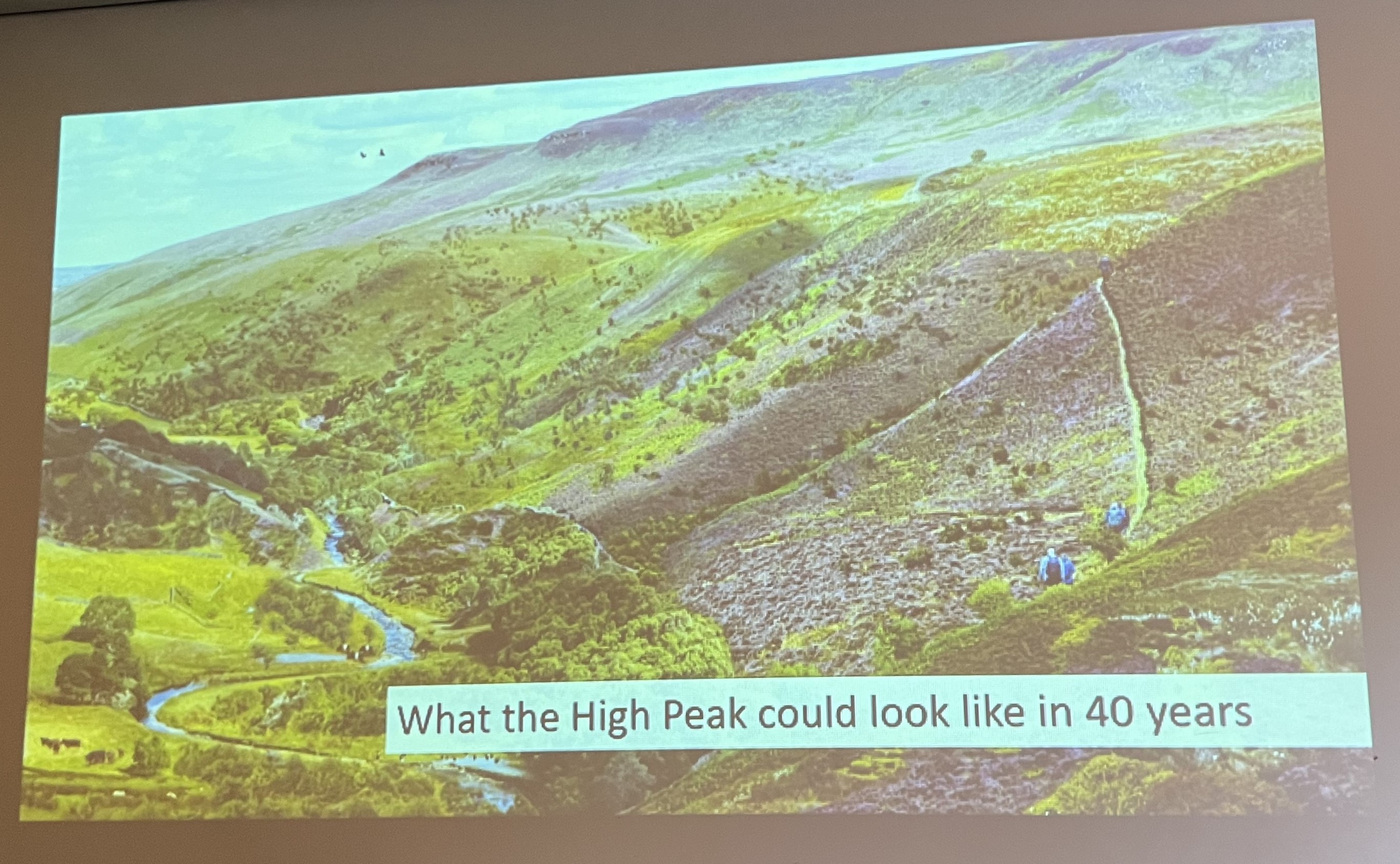
At the NERF conference, Craig spoke about the National Trust’s vision for its Peak District moorlands and he alluded to various new elements of the NT’s game shooting policy.

A slide from Craig Best’s NERF presentation. Photo: Ruth Tingay

I contacted the National Trust afterwards and asked if it had any written documents I could read about this new game shooting policy. Nick Collinson, the NT’s National Manager on Wildlife Management was kind enough to send me the following summary:

We facilitate a range of recreational activities on our land, and we recognise that for some people, shooting is an important part of rural heritage and the rural economy. It has a long history as a recreational activity in the countryside. We also appreciate that there are a range of views on game shooting, and we regularly engage with different groups and individuals who have an interest in the topic. In developing our approach we have spoken to both shooting and nature conservation organisations.

We will continue to consider the leasing of game shooting rights (red grouse, pheasant, red-legged partridge, and limited wildfowling, only), but only where the activity is compatible with our aims for the land, for restoring nature (e.g. we do not permit burning of moorland vegetation on peat soils), and for local access. We will therefore now only consider leases for low intensity shoots with low numbers of birds, which in many places should negate the need for predator control to sustain high numbers of game birds. All shoots must comply with the terms of their lease, the Code of Good Shooting Practice, and the law, and to support this, all shoots will be required to develop a Shoot Plan which will set out, and work through, shoot and National Trust objectives.

We have a set of strict criteria that game shooting leases must adhere to. This includes the location of release pens, which must not impact priority habitats including ancient woods, the use of lead ammunition and medicated grit, which we will no longer permit, and requirements to ensure shoots do not hinder people’s access to our places. Moreover, we do not permit any shooting of red-listed birds of conservation concern and will only permit limited wildfowling of green and amber-listed birds on a species-by-species basis where statutory agency evidence confirms this is not damaging to local populations. We remain totally opposed to the illegal persecution of birds of prey and all other wildlife crimes and take action to combat these criminal practices, working closely with our partners in the Police, statutory agencies, and the RSPB, to report and convict those who commit these offences.  

We will implement these changes when shoot leases come up for renewal, or sooner if break-clauses in agreements allow. Our approach will be kept under constant review, as will any position we might take on licencing of grouse shooting in the uplands‘.

I think this is a sensible and measured step forward by the National Trust. This new policy will effectively put an end to intensively-managed driven grouse shooting on National Trust moors, without actually banning it, and turns the focus back to nature-based, regenerative and sustainable management instead. No more burning on peat soils, no medicated grit, no lead ammunition, limited predator control and no more measuring ‘success’ by the number of birds shot in a day/season.

It doesn’t remove the threat to wildlife (especially raptors) from neighbouring, privately-owned grouse moors but it sets a new standard for grouse moor management and its effects will be interesting to monitor.

Personally I think this model is the only hope the grouse shooting industry has of staying alive and if these or similar practices aren’t quickly adopted more widely then the industry is doomed. I think the driven grouse shooting industry recognises this too, hence its hysteria over proposed regulations to reform grouse shooting in Scotland. The days of intensive and unsustainable driven grouse shooting are numbered, and they know it.

I’m also pleased to see that the National Trust’s new policy extends to all gamebird shooting, including pheasants, red-legged partridges and woodcock and isn’t just limited to driven grouse shooting. Bravo.

This policy shift will undoubtedly put the National Trust in the firing line of the game shooting industry – indeed, I’ve already read one ‘article’ attempting to undermine Craig Best’s professional reputation and expertise in a nasty, vindictive attack. It’s what they do.

I applaud Craig’s efforts on this issue, and those of the wider National Trust management team. Ten years ago to expect this level of progress would have been unthinkable.

Wildlife Management & Muirburn Bill approaches Stage 2: cue ridiculous amendments!

The Scottish Government’s Wildlife Management & Muirburn (Scotland) Bill is making its way through the parliamentary process. For new readers, this is proposed new legislation to regulate grouse shooting and its associated management practices by way of licensing schemes, introduced because of the continued illegal persecution of birds of prey on many Scottish grouse moors.

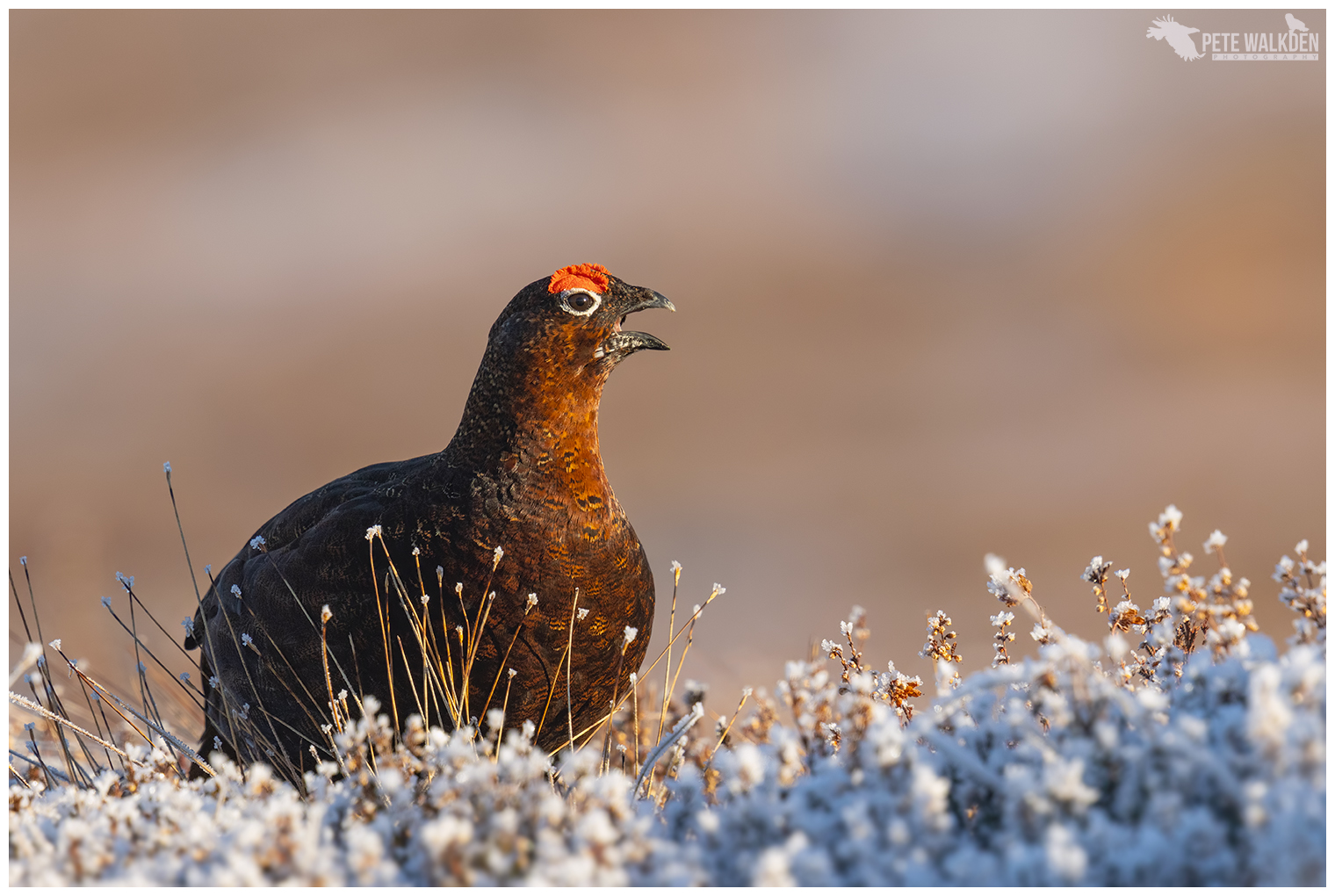
Red grouse photo by Pete Walkden

The Bill passed Stage 1 on 30 November 2023 (here) when the Parliament voted to approve the general principles of the Bill.

Stage 2 is now fast approaching. This is the stage where any MSP can lodge amendments to the Bill (there is no restriction on how many may be lodged and, given the contentious nature of the Bill, it is anticipated that there will be hundreds of them).The cross-party Rural Affairs & Islands Committee will begin to consider the amendments at a meeting on 24th January 2024.

This may cause some alarm, given that some prominent members of the Rural Affairs Committee, including its Chair, voted against even the general principles of the Bill, but whatever amendments the Committee chooses to accept/reject at Stage 2, there will be an opportunity for amendments to be challenged/overturned at Stage 3, especially where they go against Government policy. [For a useful guide to what happens during the progression of a Bill in the Scottish Parliament, see here].

The deadline for submitting amendments for Stage 2 is 18 January 2024 so as you can imagine, there is a huge amount of background lobbying going on at the moment, both by conservationists and by the game shooting sector, in an attempt to (a) strengthen the Bill [the conservationists] and (b) weaken the Bill [the game shooting industry].

The tabled amendments are all being published on this page so it’s well worth keeping an eye on this over the coming week.

Two MSPs have tabled amendments so far – some are very sensible, others are simply bonkers (but entertaining, nevertheless). To help you interpret the amendments, you’ll need to refer to the details of the Bill (as introduced in March 2023) to understand the context of these amendments. Here’s the Bill (as introduced) to help you:

A sensible amendment has been tabled by John Mason MSP (SNP), who is suggesting that any fees charged to those applying for a grouse shooting licence ‘must be sufficient to cover any expenses and costs incurred by the relevant authority in carrying out its functions‘.

I’ve got no disagreement with that at all. Ten years ago journalist George Monbiot pointed out that the taxpayer already subsidises shotgun licencing in the UK as well as grouse moor owners – the Scottish Government needs to ensure that its grouse shooting licensing scheme is fully funded by the industry and not subsidised by taxpayers.

Edward Mountain MSP (Conservative) (who has featured on this blog previously here, here, here and here) has tabled 44 amendments, a few of which are sensible, but most of which are predictably designed to undermine the strength of the Bill.

Here are some amusing examples that I picked out from Ed’s amendments (this is not an exhaustive list by any means, just ones that jumped out).

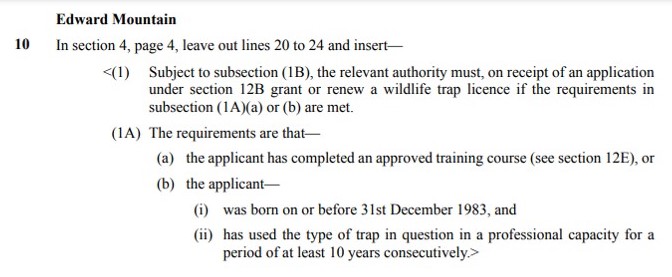
Ed’s amendment #10 suggests that any trap user over the age of 40 years and who has used the trap in question for at least 10 years consecutively can skip having to complete an approved training course and should just get a trap licence automatically:

Eh? Why should anyone over the age of 40 years be exempt from completing a training course?! Nobody should be exempt if they are using traps to kill a sentient being, let alone anyone over the seemingly arbitrarily-chosen age of 40! Given the wide age-range of gamekeepers convicted for wildlife crime, including trap offences, there’s no evidence to support an exemption from training for the over 40s.

Moving on, Ed’s amendment #17 appears to be an attempt to prevent the ability of the Government to add pheasants and red-legged partridges to the licensing scheme if required:

As you may recall, the Government has not included pheasants or red-legged partridges in its proposed grouse moor licensing scheme, despite the recent upsurge of these gamebirds being released on grouse moors (see here), but the Bill does provide the capacity for these species to be added (i.e. a licence would be required to shoot them) if evidence emerges that wildlife crimes are being committed on grouse moors where these species have been released for shooting.

Ed is proposing that only gamebirds listed on the Red or Amber list could be added to the licensing scheme, which would obviously exclude the addition of pheasants and red-legged partridges as these are not endangered in any way – they are non-native, invasive species released in their millions each year for ‘sport’ shooting. The whole purpose of the licensing scheme is not to protect ‘rare’ (Red/Amber listed) birds – it is to enable the sanctioning of estates who commit wildlife crime when shooting these species. I hope this amendment is treated with the contempt it deserves.

Ed’s amendment #21 is to ‘leave out Section 8‘ of the Bill:

What is Section 8? Ah, that’s the Government’s proposal to extend the investigatory powers of the Scottish SCPA:

Given the Scottish Government’s (long awaited) commitment to extending the powers of the SSPCA (see here), this amendment is just a last-ditch attempt to prevent it from happening. Even if it gets past Stage 2, I fully expect it to be overturned at Stage 3 as it goes directly against Government policy and the Minister’s repeatedly stated intentions.

The remainder of Ed’s amendments focus on muirburn licencing where first of all he proposes excluding entire sections of the Bill relating to this (thus removing the requirement for a muirburn licence), but then goes on to suggest changes to the very sections he wants removed, presumably because he knows that the Government will never agree to removing the requirement for a muirburn licence!

Amongst the changes he proposes are the definition of peat depth to be changed from 40cm to 60cm, the ability to extend the muirburn season to 30 April at landowner discretion, and the management of gamebirds to be included as a legitimate reason to burn on peatland. He also suggests a public register of muirburn licences – that, at least, is a sensible amendment. As for the rest, they’re hard to take seriously in light of the climate crisis and I can’t see the SNP, Labour and Greens being supportive.

These amendments provide us with a flavour of what to expect from certain MSPs over the coming week – I dare say there will be even more outlandish attempts to overturn the provisions of the Bill given the ferocity of the grouse shooting industry’s objections to the Bill’s general principles. Let’s see.

UPDATE 15 January 2024: The National picked up on this blog post and published an article about it (here).

Buzzard suffers shotgun injuries in Essex – the 8th known raptor persecution victim in this county in recent years

Essex Police is appealing for information after the discovery of a shot buzzard found injured in a field near to Layer Wood /Layer Marney on 29th December 2023.

An x-ray shows the buzzard’s humerus bone had been shattered with a shotgun pellet, suggesting it was shot close to where it was found:

Photos from Essex Police

The buzzard is still alive and is being cared for by a local wildlife rescue centre.

Essex Police has launched an investigation – any witnesses or anyone with information please contact Essex Police on Tel 101 and quote incident number 42/2817/24.

This latest raptor persecution victim is the 8th in Essex in recent years, following the shooting of another buzzard in January 2023 (here), the shooting of a red kite in September 2022 (here), the shooting of another red kite in November 2021 (here), another red kite found dead in suspicious circumstances in November 2021 (here), the shooting of another three buzzards in 2020, one in Dec (here), one in September (here) and one in June (here), and the suspected shooting of a Hobby in August 2020 (here).

Volunteer (qualified) tree climbers wanted – Gloucestershire Raptor Monitoring Group

Gloucestershire Raptor Monitoring Group (GRMG) is seeking volunteer (qualified) tree climbers to assist with fieldwork which will include climbing to raptor nests to collect chicks for bird ringing and the installation/retrieval of nest cameras.

Raptor monitoring by GRMG is undertaken under licence by highly experienced raptor fieldworkers. Bird handling training will be provided by GRMG if required.

Goshawk nest. Photo by Ruth Tingay
Young goshawks returned to the nest after ringing. Photo: M. Henderson

If you’re a qualified tree climber (CS38 or equivalent) and would like to assist GRMG with its conservation fieldwork, please contact GRMG here.

Job vacancy: Hen Harrier nest monitoring officer, Bowland

The RSPB is recruiting a Hen Harrier nest monitoring officer for this year’s breeding season in the Forest of Bowland, Lancashire, as follows:

Reference:NOV20232757
Application expiry date:23:59, Wed, 31st Jan 2024
Location:Forest of Bowland
Salary:£21,255.00 – £22,818.00 Pro Rata
Benefits:Pension, Life Assurance and Annual Leave
Duration:4 months

This is an exciting opportunity to join the RSPB’s conservation team in the Forest of Bowland, Lancashire, and help with monitoring and protecting nesting hen harriers, one of England’s rarest and most threatened bird species. This is a fixed-term position for 4 months, starting in April.

What’s the role about?

We are looking for an enthusiastic nest monitoring officer to join the RSPB’s conservation team in the Forest of Bowland, where the RSPB is working in partnership with United Utilities to monitor and protect upland breeding raptors.

You will be monitoring hen harrier nesting attempts and help to protect them from disturbance by recreational activities where necessary, ensuring that all work is carried out in a safe manner which minimises disturbance to the birds. You may also be asked to assist with diversionary feeding of hen harrier broods and the monitoring of other upland breeding raptors such as merlin, peregrine, and short-eared owl.

Photo by Pete Walkden

Work will require long and unsociable hours in remote areas, often in adverse weather conditions. The nest monitoring officers will need to work closely with other RSPB staff, volunteers, farming and shooting tenants, as well as engage with members of the general public. 

This post offers a wonderful opportunity to watch hen harriers from when they are settling to nest all the way through to when their young have successfully fledged. The Forest of Bowland is one of the most exciting areas in England for upland wildlife, and the calls and songs of ring ouzels, cuckoos, whinchats and curlews will be a frequent background to the focus of your work. This is a unique opportunity to play a part in helping one of England’s rarest and most threatened bird species nest successfully!

If required, we may be able to provide shared accommodation off-site.

Please note that this is a casual contract offer (zero hour contract). Although we approximate that this role will require 37.5 hours per week, this might vary depending on the existence of hen harrier nests!

What we need from you

Essential skills, knowledge and experience:

• Good identification skills of uplands birds and experience of monitoring birds, particularly birds of prey. You should have experience of observing and interpreting bird behaviour.
• Experience of working to protect threatened species, particularly birds of prey, and knowledge of the threats that hen harriers and other birds of prey face.
• Experience navigating in the British uplands using a map/compass/GPS (hill skills), a sufficient level of fitness, and the ability and willingness to spend whole days working alone in remote upland areas on difficult terrain.
• Ability to be diplomatic and polite, and to remain composed and make sensible decisions in difficult situations.
• Ability and willingness to work flexible hours, including early mornings, evenings and weekends, as required.
• Ability to accurately record data in the field and ensure secure data handling and storage.
• Full driving licence and access to a vehicle as you will be traveling to remote locations with no public transport.

This is a zero hour contract for 4 months, hours can be flexible per week depending on demands during the breeding season.

The RSPB reserves the right to extend or make this role permanent without further advertising dependent on business needs at the end of the contract term.

We are looking to conduct interviews for this position from 12 February 2024. For all application/role enquiries please contact – Sonja Ludwig (Species and Habitats Officer – Bowland) sonja.ludwig@rspb.org.uk.

ENDS

To apply for this role, please click here.

Red kite poisoned in Norfolk – police appeal for information

Press statement from Norfolk Constabulary (2 January 2024):

APPEAL AFTER BIRD OF PREY POISONED

Police are appealing for information after further tests revealed a Red Kite discovered dead in North Creake had died from suspected insecticide poisoning.

Red kite photo by Pete Walkden

Officers from Norfolk Police’s Op Randall team have been investigating the death of the protected bird of prey, which was found dead by a member of the public in a field in North Creake in August 2023, and had suffered no obvious physical injuries.

Further tests were ordered to establish the cause of death and a post-mortem examination carried out through the Wildlife Incident Investigation Scheme (WIIS) at the end of November has subsequently detected a number of pesticides and insecticides, including very high levels of Bendiocarb which has been concluded as the likely cause of death.

Searches carried out out  by police alongside National Wildlife Crime Unit officers and the RSPB investigation team to find the source of the substance have so far proved negative and now officers are keen to speak to anyone with information that may help their investigation or who has witnessed anything similar in the area.

Wildlife officer PC Chris Shelley said: “We’ve been waiting for the results of the toxicological analysis, and now know the levels of Bendiocarb contained within the samples taken from the bird have not come from the approved use of such a product.

I have to conclude that this product has been used illegally in very close proximity to where the bird was recovered.

Bendiocarb has been the active ingredient in a number of insecticide products in the past approved to deal with wasps and ants. In more recent years the number of products including this ingredient has reduced and its approved use has been to tackle such species inside buildings. Products containing this ingredient can only be purchased and used by professional pesticide users, and only then can they use the product inside a building to reduce the risk to non-target species.

Red Kites are listed under Schedule 1 of the Wildlife and Countryside Act. We have a zero tolerance approach to the persecution of birds of prey and I’d appeal to anybody who knows anything that may help get to the bottom of what happened here or indeed has any information about anything similar happening, please get in touch with us.”

Anyone with any information is asked to get in touch via the following channels, quoting reference 38/82207/23:

Website: https://www.norfolk.police.uk/tell-us

Email: OperationRandall@norfolk.police.uk

Phone: 101

Crimestoppers: Contact the independent charity Crimestoppers anonymously on 0800 555 111, or via their online form: www.crimestoppers-uk.org

ENDS