Highly pathogenic avian influenza confirmed in red grouse in Scotland

A case of Highly Pathogenic Avian Influenza (HPAI), otherwise known as bird flu, has been confirmed in red grouse in Scotland, according to DEFRA.

Red grouse. Photo: RSPB Images

The confirmation has appeared in DEFRA’s running tally of confirmed bird flu cases in wild birds, which is a spreadsheet that’s updated weekly (see here).

The spreadsheet entry states that H5N1 was detected in a red grouse in week 30 (July 24 – July 30 2023) in the Scottish Borders:

There isn’t any more detail about the location, nor how many birds have been found infected/dead, just that a single bird has been tested and found to be positive.

If this infected red grouse was found on land managed for driven grouse shooting it’s of serious concern. Highly Pathogenic Avian Influenza causes severe disease and high mortality in birds and has already killed tens of thousands, if not hundreds of thousands, of wild birds in the UK, impacting on the populations of globally significant species.

Highly Pathogenic Avian Influenza is transmitted by the spreading between birds of nasal secretions and droppings, and it also spreads to birds of prey via the predation of infected birds. Some UK raptor species have already been badly affected, including golden eagles and white-tailed eagles (e.g. see here).

We know that many driven grouse moors are (mis)managed to produce an artificially-high density of red grouse for shooting. Another highly contagious disease, Cryptosporidiosis (Bulgy Eye) is rife on many intensively-managed driven grouse moors. It was first detected in wild red grouse in England in 2010 and then spread rapidly, via communal medicated grit trays, and by 2015 had affected high density red grouse on half of the 150 grouse moors in northern England. It has also been detected in Scotland, although the extent of the spread in Scotland is not known because the shooting industry is keeping quiet, and, for reasons unknown, NatureScot isn’t undertaking any surveillance of the disease (see here).

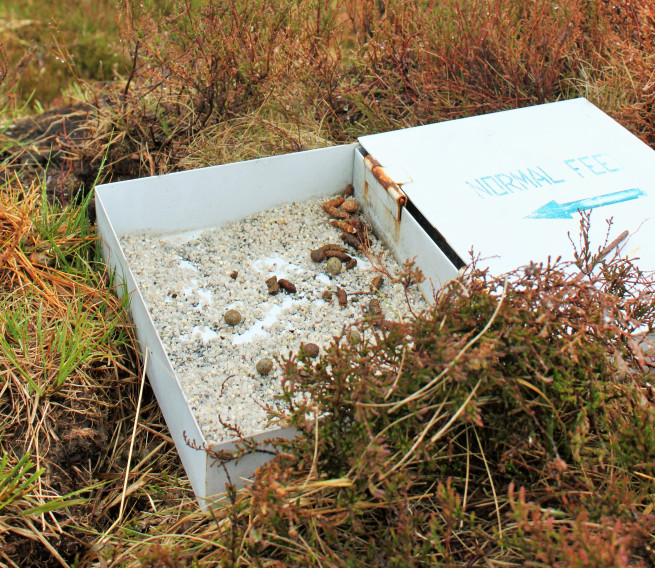
A grit tray on a grouse moor containing red grouse faecal droppings – a disease reservoir. Photo: Ruth Tingay

If the highly contagious Cryptosporidiosis disease can spread so rapidly via red grouse secretions and droppings found in grit trays on the moors, then so can Highly Pathogenic Avian Influenza.

Last year I argued that it would be ‘irresponsible’ for grouse-shooting to go ahead during the avian flu epidemic (see here). In response, the Scottish Government said: ‘…there have been no recorded cases of avian influenza in any grouse species, and there are no restrictions in place on grouse shooting’.

Given that Highly Pathogenic Avian Influenza has now been confirmed in red grouse in the Scottish Borders, and the grouse-shooting season opens on Saturday (the Inglorious 12th), how will the Scottish Government respond?

Shouldn’t they be restricting shooting as a precautionary measure, at least until the extent of the disease is evaluated?

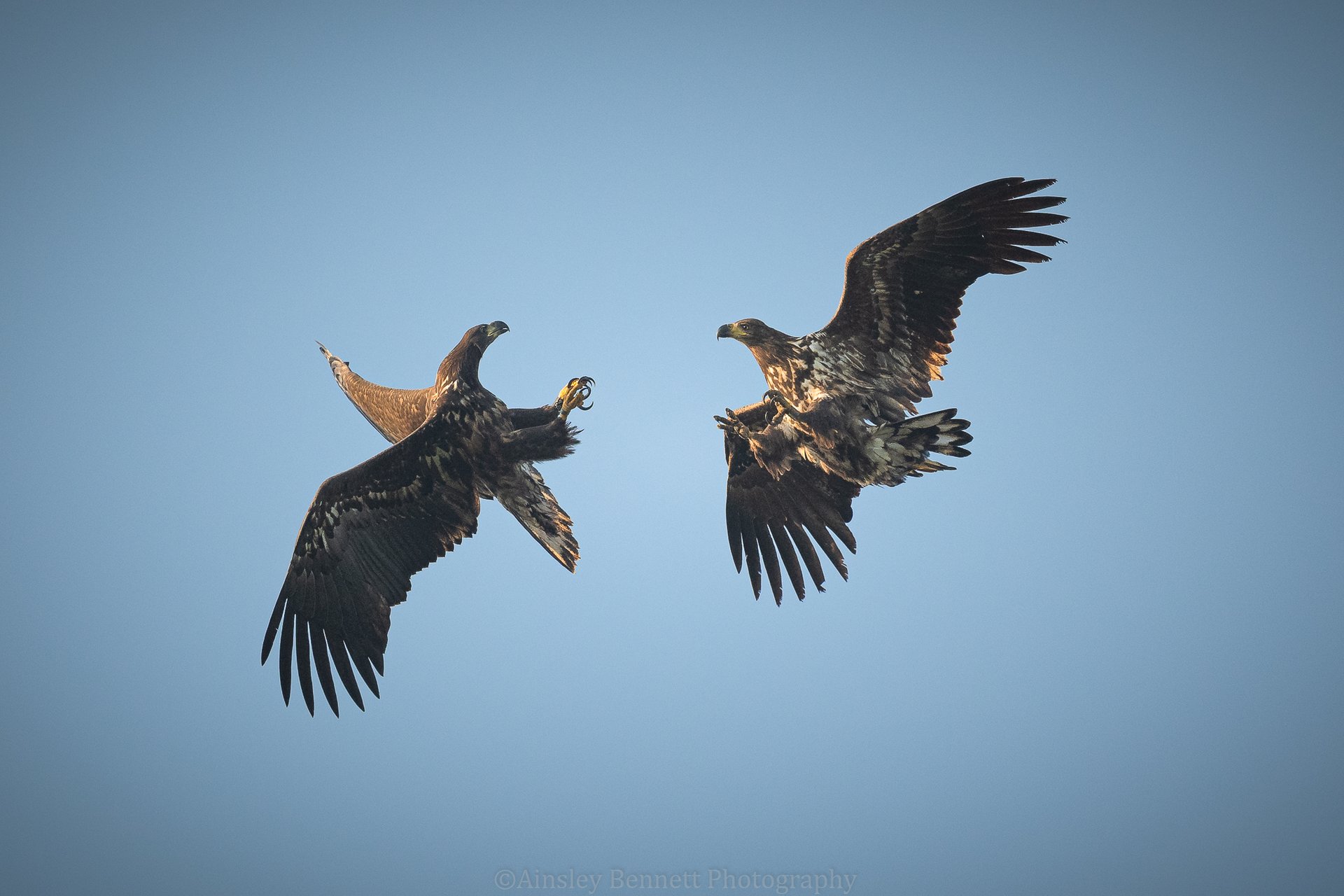
White-tailed eagle fledges in England for first time in 240 years

Press release from Roy Dennis Wildlife Foundation (18th July 2023):

FIRST WHITE-TAILED EAGLE IN 240 YEARS FLEDGES IN ENGLAND

In a landmark moment for conservationists, the first white-tailed eagle for over 240 years has fledged from a nest in the wild in England. The chick is the first successful breeding attempt of the white-tailed eagles released by Forestry England and the Roy Dennis Wildlife Foundation’s project to return this lost species to England.

First WTE chick in England just prior to fledging. Photo: Roy Dennis Wildlife Foundation

White-tailed eagles are Britain’s largest birds of prey with a wingspan of up to 2.5 meters and were once widespread across England. Human persecution caused their extinction with the last pair breeding in southern England in 1780. In 2019, Forestry England and the Roy Dennis Wildlife Foundation began a reintroduction programme to restore these iconic birds to the English landscape.

Two of the birds released by the project in 2020 – female G405, originally translocated from the Outer Hebrides and male G471, from north-west Sutherland – reared the male chick earlier this summer. The location of the nest, on private land with no public access, is not being disclosed for the welfare of the birds and to prevent any disturbance to them or the landowner either this year or if the birds return to breed at the same location. 

The chick was ringed and fitted with a satellite tag by licensed ornithologists from the Roy Dennis Wildlife Foundation enabling the project team to track this historic bird’s daily progress through its life. 

The WTE chick being satellite-tagged. Photo by Forestry England

Roy Dennis MBE, Founder of the Roy Dennis Wildlife Foundation, said: 

This is a very special moment for everyone who has worked on, supported and followed this ground-breaking project. Restoring a breeding population in southern England, where the species was once widespread, has been our ultimate goal. Many thought it was impossible but we knew food for eagles – fresh and salt water fish, cuttlefish, rabbits, hares and wild birds – was plentiful. I visited the Isle of Wight as a young birdwatcher in the 1950s, saw the last breeding location at Culver Cliff and knew they should be restored. It is early days, but this is a very significant milestone and we are heartened by the enthusiastic support shown by so many people and that the sight of these huge eagles in the sky inspires hope for restoring nature. We still have a long way to go, but the feeling of seeing the first pair reach this stage is truly incredible.” 

The birds are one of three territorial pairs that have now become established in southern England and the first to breed. 

Steve Egerton-Read, White-Tailed Eagle Project Officer for Forestry England, said: 

We are thrilled that this moment has happened and at such an early stage in the project. At only three years old, it is remarkable that the pair have successfully bred, with most white-tailed eagles not attempting to do so until they are at least four or five. This pairs’ ability to breed and fledge their chick at this early age is extremely encouraging.”

It is really hard to put into words just what an incredible moment this is for the return of these iconic birds to England. It is evidence of just how well the eagles are starting to fit back into this landscape and how, with a little help, nature can begin to return and thrive. Although it has not been possible to set up a public viewing site at this location, we are hopeful that one of the other pairs that has become established in southern England will choose to nest in a location that we can share with the public in future years.”  

To date, 25 white-tailed eagles have been released by the reintroduction project with 16 still surviving. A further release of young white-tailed eagles is planned for later this summer from the project team’s base on the Isle of Wight. 

The reintroduction of white-tailed eagles is conducted under licence from Natural England, the Government’s wildlife licensing authority. All of the young birds involved in the project are collected under a NatureScot licence from the wild in Scotland and brought to the Isle of Wight.

ENDS

Huge congratulations to everyone involved in this project – what fantastic news! Although it’s telling that the nest location is being kept secret, and quite rightly so in my view, for fear of disturbance.

It’s not been plain sailing for this project, with a number of the translocated eagles inevitably becoming the victims of illegal persecution, most notably the poisoned eagle found dead on a shooting estate in Dorset last year that resulted in one of the biggest police wildlife crime fiascos witnessed in recent years (e.g. see here and here).

The poisoned WTE found dead on a shooting estate in Dorset in January 2022. Photo: Dorset Police

And then there’s the poisoned white-tailed eagle found dead on a shooting estate in West Sussex in October 2021. Toxicology results confirmed it had been killed by ingesting the banned pesticide Bendiocarb (see here). Strangely, Sussex Police have remained coy about publicising this case and nobody seems willing to provide an update on the status of the investigation ever since May last year when the Chief Constable assured conservationists that the investigation was “very much ongoing” (see here).

I’d hope, as we approach the two-year anniversary of this illegal poisoning, that Sussex Police will manage to provide an update. A lot of people care passionately about these eagles and their reintroduction to southern England and rightly expect to see the police do everything in their power to bring the eagle-poisoner(s) to justice. Two years of stubborn silence isn’t a good look and if this young, historic fledgling suffers the same fate there’ll be uproar.

For those who don’t want to poison white-tailed eagles and would much rather enjoy the thrilling experience of seeing one in the wild, one of the best opportunities to see them in southern England is still from one of the regular ‘bird boats’ run by the charity ‘Birds of Poole Harbour‘ throughout the summer (the same charity that has worked with the Roy Dennis Wildlife Foundation to reintroduce ospreys to Poole Harbour). A number of eagles seem to spend a lot of time foraging and just hanging out in the harbour. You’ll need to book quickly though as these boat tours are incredibly popular (for obvious reasons!). Boat tour details here.

10 million blog views

10 million blog views feels like a significant milestone.

Many thanks to all the friends, colleagues, collaborators, supporters, followers, commentators and funders, who make this worthwhile.

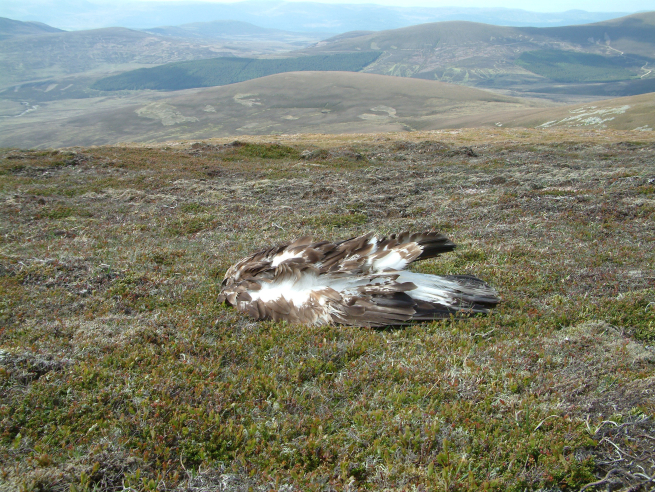
Here’s the photograph that I publish every time a new milestone is reached. This is a golden eagle that was found dead on a grouse moor in the Cairngorms National Park in 2006. It had been illegally poisoned. It epitomises everything in its pitiful, poignant, senselessness.

Photo: RSPB

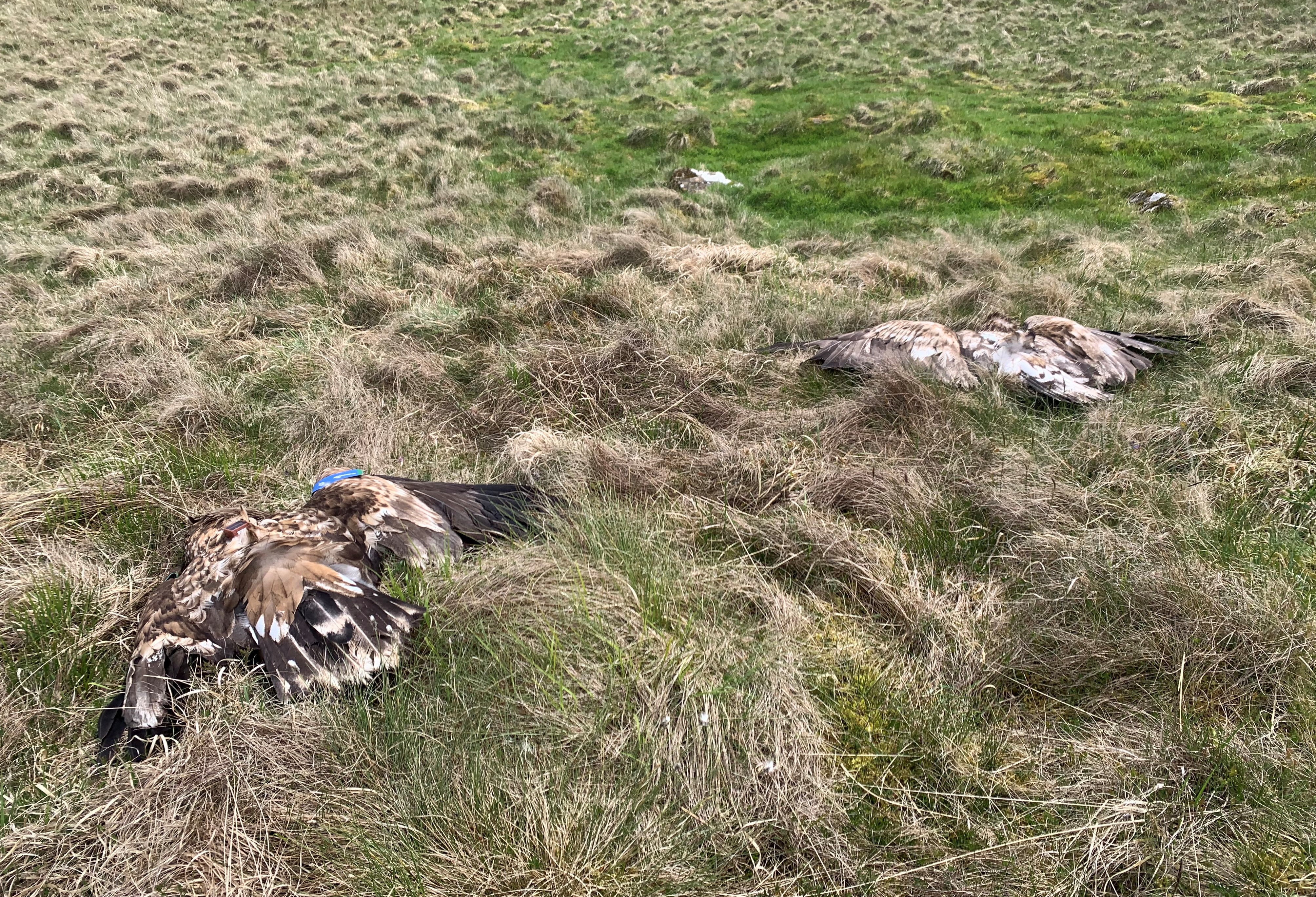
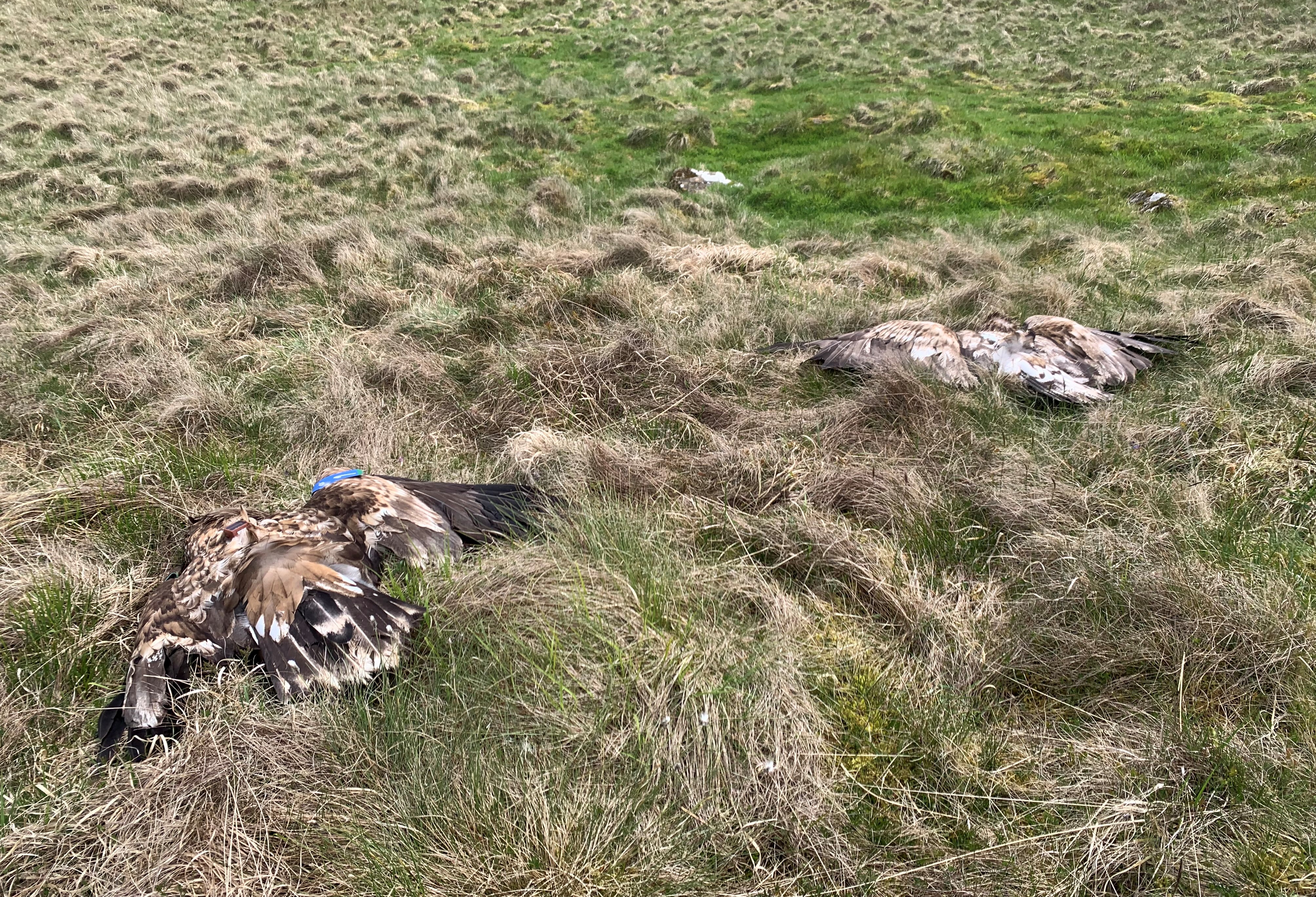
Unfortunately there is still a lot more work to do, as evidenced by the recent discovery of two young white-tailed eagles found poisoned on a grouse moor in Northern Ireland in May 2023:

Photo: RSPB

The illegal killing of birds of prey in the UK continues and so must this blog. It can often feel like no progress is being made, but it is, albeit more slowly than any of us would like.

I read a report over the weekend where representatives of the game-shooting industry said they felt ‘under siege’ from campaigners. That’s good, some of them have been allowed to get away with far too much for far too long, often assisted and shielded by the very authorities who should be holding them to account.

Change will only come when enough of us demand it.

Onwards!

Poisoned eagles found on grouse moor in Northern Ireland: new petition calls for ban on possession of dangerous pesticides

Further to the news on Friday that the two white-tailed eagles found dead on Northern Ireland’s only driven grouse moor at Glenwherry in the Antrim Hills had been illegally poisoned (see here), the Northern Ireland Raptor Study Group (NIRSG) has launched a new petition calling for a ban on the possession of dangerous pesticides.

The two poisoned white-tailed eagles. Photo: Northern Ireland Raptor Study Group

Here is the petition text:

Pesticides which have been deemed toxic to non-target plants and animals have been banned for use across many countries, including Northern Ireland. However, although ‘banned for use’, these dangerous substances are still being used, unlawfully, to target protected birds of prey.

There have been 64 confirmed incidents of abuse of banned or highly toxic chemicals to target birds of prey in Northern Ireland since 2009. However, prosecutions are notoriously difficult to attain because unless an individual is actually seen to be laying out a poisoned bait, it is virtually impossible to determine who laid the bait that subsequently kills a protected species. To date, we are not aware of any successful prosecutions for poisoning protected wildlife in Northern Ireland.

Scotland faced a similar problem with illegal wildlife poisoning so in 2005 it introduced new legislation making it an offence to be ‘in possession’ of certain banned substances (Possession of Pesticides (Scotland) Order 2005). The substances listed were those known to be used to illegally target birds of prey. This legislation has led to the successful prosecution of many individuals who were found to be in possession of the named banned substances, for example where it was discovered in their vehicles, at their work premises and even in their homes. Not only has the poison been confiscated and destroyed, these prosecutions have doubtless saved the lives of countless species and raptors that otherwise would have been targeted.

The banned pesticides are not just a threat to wildlife and the wider environment; many of them can have fatal consequences for any human (adult or child) who happens to inadvertently come into contact with them, for example by touching a poisonous bait laid out in the countryside.

In light of the most recent illegal poisoning of two young white-tailed eagles in County Antrim in May 2023, we are seeking an urgent review of the use of banned pesticides to kill wildlife in Northern Ireland, leading to the creation of a new law which prohibits the ‘possession’ of named, highly toxic poisons.

If a pesticide has already been banned for use on the basis of its toxicity and threat to humans, wildlife and the wider environment, there can be no justification for keeping it.

Please help our campaign by signing this petition (you don’t have to be a resident of Northern Ireland to sign). Thank you.

The poisons we would like to see prohibited for possession are:

·        Aldicarb

·        Alphachloralose

·        Aluminium phosphide

·        Bendiocarb

·        Carbofuran

·        Mevinphos

·        Sodium cyanide

·        Strychnine

·        Chlorpyriphos

·        Diazinon

ENDS

The outrage caused by the illegal poisoning of these young eagles has led to widespread media coverage, e.g. The Irish Post, Belfast Live, Belfast Telegraph, Irish Examiner, ITV news, BBC news, Irish Mirror

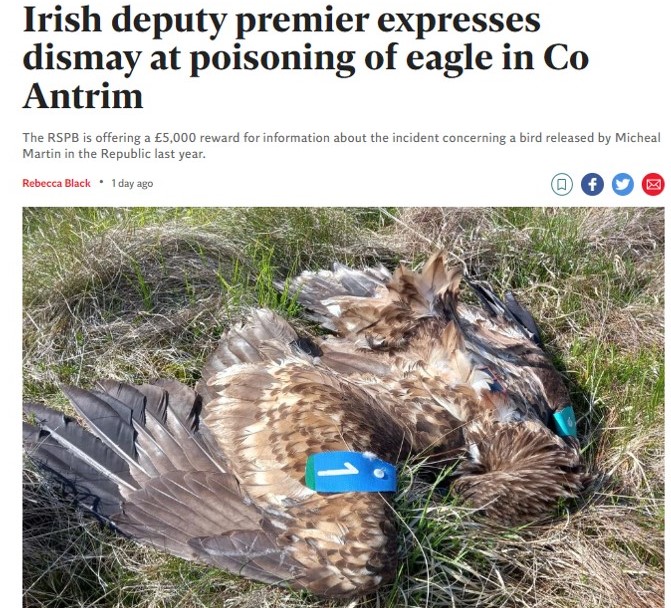
Indeed, condemnation has even come from Michael Martin, the Irish Deputy Premier (the second most senior officer in the Irish Government) who had released one of these eagles last year as part of the reintroduction project in the Irish Republic:

The RSPB is offering a £5,000 reward for information leading to a conviction (see here).

The Northern Ireland Raptor Study Group’s press release (here) describes the location where the two eagles were found poisoned as follows:

Glenwherry Hill Farm is owned by the Department of Agriculture, Environment and Rural Affairs (DAERA) and operated by College of Agriculture, Food and Rural Enterprise (CAFRE). This area has many young student farmers, conservationists and volunteers carrying out field work and studies on a daily basis. It also is the part of the Glenwherry Hill Regeneration Partnership (GHRP) and a site for driven grouse shooting and winter woodcock shooting and a site of the Curlews in Crisis restoration project‘.

I think it’s notable that the NIRSG resigned from the ‘partnership’ in 2020 over ‘incompatible management objectives’. The moorland management has recently shifted from walked-up grouse shooting to becoming managed for driven grouse shooting.

Dr Marc Ruddock of NIRSG is quoted:

We know these parts of the Antrim Hills intimately having monitored birds of prey there for many years and seen various visiting golden eagles and white-tailed eagles there in the past. We are horrified and devastated at the death of these two young eagles. We sincerely hope that this is not a reflection of a renewed intolerance of birds of prey in county Antrim and within Northern Ireland. White-tailed eagles eat fish and seabirds but also other birds, rabbits and hares and more often scavenge dead animals in the countryside. They, along with other native birds of prey, are an essential component of a healthy ecosystem and for such indifference and intolerance to be displayed towards native eagles by somebody in this area is distressing“.

Dr Eimear Rooney of NIRSG said, “These majestic creatures are part of our ancient heritage and deserve to be revered, not poisoned and left to rot on a hillside. The suffering these birds must have felt in their final moments, and then dying side by side, it is just heart-breaking. Birds of prey are essential in balancing a healthy ecosystem and are already under pressure from loss of suitable nesting and foraging habitat. With the additional losses of birds through illegal poisoning, whether targeted at them or not, it is a massive blow to conservation efforts in Northern Ireland and on the island of Ireland.

We have been contacted by many people outpouring their upset at the death of these eagles, and people are incensed that these pesticides, many of which are banned due to toxicity to human health, and which unbelievably remain in use illegally, causing the destruction of our native wildlife, and yet are not illegal to have in your possession”.

If you want to sign the NIRSG’s new petition calling for a ban on the possession of dangerous pesticides in Northern Ireland please click HERE.

UPDATE 3 March 2025: 50,000 people support the Northern Ireland Raptor Study Group’s petition to ban possession of dangerous, raptor-killing pesticides (here)

UPDATE 17 June 2025: 50,000-signature petition calling for ban on possession of poisons, handed in to Stormont, Northern Ireland (here)

Police confirm 2 x white-tailed eagles found dead on a grouse moor in Northern Ireland were illegally poisoned

In May this year, the Police Service of Northern Ireland (PSNI) appealed for information after the discovery of two dead white-tailed eagles found next to one another in suspicious circumstances on moorland in Ballymena, County Antrim (see here).

The corpses were sent for post mortem and toxicology results have now confirmed they were both poisoned by Bendiocarb.

The two poisoned white-tailed eagles. Photo: Northern Ireland Raptor Study Group

The PSNI has issued the following statement this afternoon:

POLICE INVESTIGATE POISONING OF TWO WHITE-TAILED EAGLES

Police are appealing for information from the public, after the confirmed poisoning of two white-tailed eagles.

Police investigating the circumstances following the discovery of two dead white-tailed eagles, in the Glenhead Road area of Ballymena on Monday, 15th May, can confirm the birds were subsequently poisoned.

Following a post-mortem examination, both birds tested positive for the insecticide bendiocarb.

How the birds came into contact with the insecticide remains part of an ongoing investigation, and the Police Service of Northern Ireland is committed to working with partners and members of the public to determine how the birds consumed the toxic insecticide.

Rural and Wildlife Crime Superintendent Johnston McDowell said: “Sadly, police can confirm the two majestic birds found on land in the Glenhead Road area were poisoned, following a post-mortem examination.

“The test results suggest that an individual not only has access to the insecticide bendiocarb but has placed this into the outside environment illegally, so that wild birds have been able to consume it.

“Bendiocarb is present in the trade product Ficam D, a powder which is only permitted for indoor use to control crawling insects such as wasps and ants, so using this active ingredient in fields would be a breach of Biocidal Products Regulation (BPR).

“The illegal killing of these beautiful birds in a popular rural area is disgraceful, and for any individual to think that they can ignore the law and lay poisonous bait which has led to the killing of these birds, is unacceptable and will not be tolerated.

“Officers with support from the National Wildlife Crime Unit, have been on the ground conducting house-to-house enquiries, engaging with local residents and landowners, in the areas of where the birds were gravitating towards, before they were found deceased.

“The Police Service of Northern Ireland will continue to work with our partners to tackle this criminal activity, investigate any reports made to us and prosecute offenders. In this case we have liaised with our partners in the Partnership for Action Against Wildlife Crime (PAWNI) Agri-Food and Biosciences, Royal Society for the Protection of Birds, NI Raptor Study Group, Health and Safety Executive for Northern Ireland, Northern Ireland Environment Agency and received additional support from the National Wildlife Crime Unit. Police have a strong multi-agency support group which we are very grateful for, but we need the help of the public too.

“There must be people in the community who are aware of individuals committing these offences, and who can come forward and assist police with any information they have.

“If you notice any suspicious activity in rural areas, notice a dead or injured bird of prey, please call police on 101, or alternatively you can make a report via Crimestoppers anonymously on 0800 555 111 or online at http://crimestoppers-uk.org. Alternatively, you can submit a report online using the non-emergency reporting form via http://www.psni.police.uk/makeareport/.

“We are also very grateful to our partners in the charity Royal Society for Protection of Birds (RSPB) who are offering a reward of £5000 for information leading to the prosecution of those involved in the poisoning of the two white-tailed eagles. The charity is completely independent from the police and can be contacted on their confidential Raptor Crime Hotline on 0300 999 0101 or online at crime@rspb.org.uk.”

ENDS

I’ll have more to say about this case, not least to discuss the location where the poisoned eagles were found – the only moor that’s managed for driven grouse shooting in Northern Ireland.

More soon…

UPDATES:

Press release from Northern Ireland Raptor Study Group (here)

Press release from RSPB (here)

Poisoned eagles found on grouse moor in Northern Ireland: New petition calls for ban on the possession of dangerous pesticides (here)

UPDATE 3 March 2025: 50,000 people support the Northern Ireland Raptor Study Group’s petition to ban possession of dangerous, raptor-killing pesticides (here)

UPDATE 17 June 2025: 50,000-signature petition calling for ban on possession of poisons, handed in to Stormont, Northern Ireland (here)

Police appeal for information as two White-tailed eagles found dead together in suspicious circumstances

Press release from PSNI (17th May 2023)

POLICE IN BALLYMENA APPEAL FOR INFORMATION FOLLOWING DISCOVERY OF TWO WHITE-TAILED EAGLES

Police are investigating the circumstances following the discovery of two dead white-tailed eagles, in the Glenhead Road area of Ballymena on Monday, 15th May.

The two dead white-tailed eagles. Photo by Northern Ireland Raptor Study Group

Police Service of Northern Ireland Lead for Rural and Wildlife Crime, Superintendent McDowell said: “A report was made to police shortly before 2pm on Monday , after the discovery of two white-tailed eagles found beside one another.

The birds had no obvious signs of injury and suspicions have been raised given the unlikely position where they were found.

An investigation has now commenced, with a post-mortem examination due to be carried out to determine the cause of death“.

The white-tailed eagle is the UK’s largest native bird of prey, with a vast wing span of up to 2.5 metres, and are an incredibly beautiful species, which makes the discovery of these dead birds very distressing.

In particular, we are aware one of the birds was born in Norway and brought as a chick to be released in the lower Shannon estuary in 2022.

Following the launch of Op Subrision last week, our dedicated policing operation to combat rural and wildlife crime, we want the public to be reassured, we take all wildlife crime extremely seriously and are committed to investigating all instances of wildlife crime which are reported to police.

If you have any information that can help with our investigation, please contact police on the non-emergency number 101 and quote 1906 16/05/23.

Alternatively, you can submit a report online using the non-emergency reporting form via http://www.psni.police.uk/makeareport/ .   

You can also contact Crimestoppers anonymously on 0800 555 111 or online.

ENDS

The Northern Ireland Raptor Study Group has also issued a press release, as follows:

YOUNG WHITE-TAILED EAGLES FOUND DEAD IN COUNTRY ANTRIM

Two White-tailed eagles have been found dead lying side by side in the Glenwherry area of Co. Antrim on Monday the 15th of May 2023. Both birds were immature eagles, not yet of breeding age. One of them was a bird released in the Lower Shannon Estuary in August 2022 by National Parks and Wildlife Service (NPWS) as part of the reintroduction programme, having been collected from Norway during 2022. The second bird was an unmarked immature bird of unknown origin, likely from Scotland or Ireland. They were found only a few metres apart and appeared to have died in recent days.

Photo: Northern Ireland Raptor Study Group

Once relatively common on many mountainous and coastal areas White-tailed eagles were celebrated and revered for centuries. However attitudes towards birds of prey changed from admiration to hatred and intolerance by the 17th century and systematic killing, along with widespread habitat change, led to the extinction of White-tailed eagles from the island of Ireland in 1912. Thanks to reintroduction efforts the first successful breeding White-tailed eagles in over 100 years produced a single chick in 2013. These eagles take 4-5 years to reach maturity and typically only produce 1-2 chicks per year. This means that the population remains extremely vulnerable. The loss of these two young birds is a real blow to the recovery of the population in the UK and Ireland.

Birds of prey, which are essential in balancing a healthy ecosystem, continue to be been illegally targeted to such an extent some areas are at risk of losing their natural top predators again. Some of the toxins used to poison birds of prey are banned substances and are extremely dangerous, not only to wildlife but also livestock, pets and people.

Dr Eimear Rooney of the Northern Ireland Raptor Study Group (NIRSG) stated:

Finding such magnificent birds dead is just heart-breaking and we sincerely hope that they are not poisoned or illegally killed although the circumstances of finding two birds dead beside each other is highly irregular and suspicious and they have been collected by the PSNI for post-mortem to establish the cause of death”.

Eimear continued: “I would like to commend the PSNI on their rapid response and recovery of the two birds for testing. The reality is that often these birds are found in remote areas and we rely on information from the public and landowners to understand the circumstances which led to the death of these birds.”

If any member of the public has any suspicions, information, photographs or dash cam footage or knows of illegal or unusual activity or people in the Glenwherry region, (including Starbog Road, Shillanavogy Road, Glenhead Road, Drumcrow Road, or Glenview Road), please report these to the PSNI on 101 or online https://www.psni.police.uk/report, or anonymously to Crimestoppers on 0800 555 111. Please refer to the crime reference number 1096 of the 15-5-23.

Any photographs of these birds would also be very helpful to help establish their whereabouts over recent days and these can be sent to NIRSG here.

ENDS

Glenwherry. Hmm. Let’s wait for the post mortem results…

UPDATE 7th July 2023: Police confirm 2 x white-tailed eagles found dead on a grouse moor in Northern Ireland were illegally poisoned (here)

Job vacancy: Raptor Conservation Officer, Cairngorms National Park

The Cairngorms National Park Authority (CNPA) is advertising a three-year, full time position for a Raptor Conservation Officer, to deliver the actions laid out in the National Park’s latest Partnership Plan (2022-2027) aimed at increasing the home range, occupation and breeding success of golden eagle, hen harrier, merlin and peregrine across the National Park.

This is a promising move by the CNPA, who have previously faced severe criticism for not dealing effectively with ongoing raptor persecution in some areas of the Park, notably on land that’s managed for intensive driven grouse shooting (e.g. see here & here).

Crimes against birds of prey, especially those that take place within the Cairngorms National Park, are often high profile, and quite rightly so. For example the recent poisoning of a golden eagle on a grouse moor within the Park (here) and the poisoning of a white-tailed eagle on another grouse moor within the Park (here) generated widespread outrage and media coverage, as did the sighting of a young golden eagle flying around a grouse moor in the Park with a spring trap clamped to its leg/foot (here).

Last year, the CNPA stated its intention to address intensive gamebird management within the Park as part of its Partnership Plan (here), which was seen as a good move by many of us who know that raptor persecution is disproportionately associated with land managed for gamebird shooting. That, combined with the creation of this new Raptor Conservation Officer post, is indicative of things moving in the right direction.

Make no mistake though, this new post will be a challenging one. There are some fantastic estates in the Cairngorms National Park who have been hosting and protecting breeding raptors (e.g. golden eagles, white-tailed eagles, hen harriers) for some time now, but there are also other estates that stubbornly refuse to tolerate these species and still behave as though it’s the 1890s.

The post is full time for three years, attracting a salary between £33,652 – £40,362. The closing date for applications is Sunday 30th April at 23.59hrs.

A detailed job description and list of essential attributes is provided here:

To apply, please visit the CNPA website HERE

Parliamentary question: what steps is DEFRA taking to fully investigate raptor persecution crimes during avian flu pandemic?

Another timely written question from Caroline Lucas MP (Green Party), as follows:

The presence of avian flu has important consequences for how the corpse of a dead raptor is handled and stored, under strict government rules, and unfortunately this impacts on the ability to conduct standard toxicology analyses for other potential causes of death, notably the detection of certain poisons.

You may recall this was an issue with the investigation into the suspicious death of a white-tailed eagle found dead on the Isle of Wight in March 2022 (here).

The police investigation into the circumstances and cause of death of that white-tailed eagle was hampered because a preliminary test indicated the eagle was harbouring avian flu (although this was ruled out as the cause of death during a later post mortem). However, as avian flu was detected, protocol dictated that the eagle’s tissue samples be stored in formalin, which then restricted the lab’s ability to detect poisons such as Bendiocarb or the significance of rodenticides in its body. As a result, the cause of death of this white-tailed eagle was unsatisfactorily recorded as ‘uncertain’ (see here).

Caroline’s written question was answered last Friday by Trudy Harrison, the Parliamentary Under Secretary of State in DEFRA, as follows:

This is another fluffy response from the DEFRA Minister, that looks substantive on the surface but when you drill down into it, it doesn’t say very much at all, other than the Government is ‘alive to the enforcement challenges’. It doesn’t tell us how those challenges are to be met, or even whether it will be possible to overcome them.

This is of serious concern, especially relating to raptors whose diets leave them more susceptible to contracting avian flu, for example white-tailed eagles . I’m aware that another young white-tailed eagle was found dead in Hampshire last autumn. It’s death was deemed ‘suspicious’ based on its movements and behaviour prior to death but it, too, tested positive for avian flu and as a result APHA refused to even conduct a post mortem to determine the cause of death, which may have been due to avian flu, or, like the dead white-tailed eagle found on the Isle of Wight last spring, it may just have been carrying avian flu but it wasn’t the cause of its death.

Dorset Police response to sentencing of criminal gamekeeper Paul Allen

Well it’s taken them long enough, but finally Dorset Police has managed to issue a statement about the conviction and sentencing of criminal gamekeeper Paul Allen, who pleaded guilty to multiple wildlife, poisons and firearms offences whilst working on the Shaftesbury Estate in March 2021.

You’ll recall I was surprised when Dorset Police failed to mention anything about Allen’s forthcoming court appearance and subsequent conviction back in January, despite the force publishing statements about a wide variety of other criminal cases at various stages of progression through the criminal justice system (see here), but at last, they’ve got around to saying something. Although what they’ve chosen to exclude from this press statement is far more revealing than what they’ve chosen to include.

The following statement was published on the Dorset Police website last Thursday:

A man has been sentenced at court for wildlife and firearms offences in East Dorset following a multi-agency investigation led by rural crime officers.

Paul Scott Allen, aged 54, was sentenced at Weymouth Magistrates’ Court on Thursday 16 February 2023 after admitting a total of seven offences at a previous hearing.

The defendant pleaded guilty to two counts of possessing a live or dead wild bird under schedule 1 of the Wildlife and Countryside Act 1981 and two charges of failing to comply with the conditions of a firearms certificate.

Allen also admitted the following offences:

Using a biocidal product in contravention of the Health and Safety at Work Act 1974.

Possessing an unlawful substance under the Plant Protection Products Regulations 2012

Possessing a regulated substance without a licence under the Poisons Act 1972.

Allen was sentenced to 15 weeks in prison, suspended for 12 months. He was also ordered to pay fines and compensation totalling more than £2,900. 

The investigation was launched by Dorset Police’s Rural Crime Team following reports of suspected bird poisonings on a rural estate in East Dorset.

Following work with partner agencies including Natural England and the National Wildlife Crime Unit, a warrant was executed on Thursday 18 March 2021. During searches a number of dead birds of prey were located.

Officers also searched the address of Allen, a gamekeeper at the estate, and found a shotgun and ammunition, which were not covered by the defendant’s firearms certificate. Further enquiries uncovered a number of prohibited toxins at the premises.

Allen was interviewed by officers and – following detailed enquiries and liaison with experts from the Crown Prosecution Service – was charged with the various offences.

Chief Inspector David Parr, of Dorset Police, said: “We take all reports of wildlife crime and rural criminality very seriously. This case has seen us work with partners including Natural England and the National Wildlife Crime Unit to compile evidence before liaising with the Crown Prosecution Service Specialist Wildlife Prosecutor who agreed to the charges against the defendant.

“Wildlife crime remains a key objective of the recently expanded Dorset Police Rural Crime Team and we will continue to work with our partners to investigate criminal offences and deal with offenders robustly.”

Stephanie Bird-Halton, National Delivery Director for Natural England, said following the hearing: “Natural England is determined to tackle the scourge of persecution of our birds of prey. We assisted Dorset Police in this prosecution, gathering evidence and providing specialist technical advice. We are pleased Allen has been held to account for his offences against our wildlife. 

“Without landowners and land managers complying with the law and reporting illegal activity, the impact on our wildlife will continue.

“If members of the public spot birds of prey they suspect may have been poisoned, we would ask them to contact the police, but not to touch the bird.”

Angharad Thomas, the CPS Wessex Wildlife Lead, said: “We work closely with the police on all wildlife related cases to make sure there is sufficient evidence to meet our legal test for prosecution.

“In this case, the review of extensive and complex evidence made it clear that Allen’s offending posed a significant threat to human and animal life, as well as having a negative impact on the countryside.

“Anyone acting otherwise than in accordance with firearms licences or in contravention of laws intended to protect our wildlife and countryside will be prosecuted.”

ENDS

To a casual observer, this press statement is straightforward, detailed and complimentary about a number of partners involved in the investigation that led to a successful conviction. Hooray! Tea and medals all round! But for those of us who’ve taken more than a passing interest in this case, what this statement actually is is petty and vindictive.

Why do I think that? Well, look closely and you’ll see that one of the significant partners in this multi-agency investigation, the RSPB, has been erased completely from the narrative by Dorset Police.

The statement mentions other partners including the NWCU, Natural England and the CPS, but there’s no mention whatsoever of the RSPB or the specialist role it brought to the case, from initial liaison with the (now former) Dorset Police wildlife crime officer, Claire Dinsdale, to helping plan and then conduct the search under warrant of Allen’s premises, to providing expert guidance on what was found, organising the forensics testing on the exhibits, then having considerable input into the file preparation for submitting to the CPS and then considerable liaison with the CPS itself.

As you can see, the RSPB wasn’t just along for the ride, it made an important and weighty contribution to the case, so why has Dorset Police gone out of its way to exclude it? My guess would be that it’s because the RSPB has been extremely supportive of Claire Dinsdale as she continues to battle senior officers over the botched investigation into the poisoned white-tailed eagle (an on-going saga).

I was also amused to read in the press statement the quote from Chief Inspector David Parr of Dorset Police, who said: “We take all reports of wildlife crime and rural criminality very seriously….. Wildlife crime remains a key objective of the recently expanded Dorset Police Rural Crime Team and we will continue to work with our partners to investigate criminal offences and deal with offenders robustly.”

Yeah, right, as long as it doesn’t involve conducting a police search on a shooting estate to look for evidence about who might have poisoned a white-tailed eagle, especially if a gamekeeper on that estate just happens to already be under investigation for multiple wildlife, poisons and firearms offences, and especially if a local Conservative MP has been kicking off about ‘wasting police resources on investigating wildlife crime’. Yeah, apart from that, Dorset Police will ‘continue to work with our partners [apart from the RSPB] to investigate criminal offences and deal with offenders robustly‘.

RSPB’s response to sentencing of criminal Dorset gamekeeper, Paul Allen

Further to yesterday’s news that criminal gamekeeper Paul Allen had escaped a custodial sentence despite committing multiple wildlife, poisons and firearms offences whilst employed on the Shaftesbury Estate in Dorset (here), the RSPB has issued the following press release:

Gamekeeper fined as dead birds of prey and poisons found on Dorset estate

Gamekeeper Paul Allen (54, of Baileys Hill, Wimborne St Giles) appeared at Weymouth Magistrates’ Court today (16 February 2023) following a guilty plea last month relating to multiple raptor persecution offences.

He was sentenced to 15 weeks in prison, suspended for 12 months for the possession of the buzzards, a £674 fine for failing to comply with firearm regulations, £1,348 for the chemical storage and usage offences, and told to pay £884 compensation [Ed: to Wild Justice’s Raptor Forensics Fund] to cover the cost of the x-rays and post-mortems for the bird carcasses.

The bodies of six shot Buzzards and the remains of three more were discovered in Allen’s yard on the estate in 2021, after a poisoned Red Kite was reported to Dorset Police by a member of the public. The kite contained high levels of brodifacoum, the deadliest rat poison on the market, which also shockingly killed a White-tailed Eagle in the vicinity 10 months later.

The poisoned red kite that triggered a multi-agency search on the Shaftesbury Estate in March 2021, which uncovered gamekeeper Paul Allen’s widespread criminal activities. Photo: RSPB

The search of Allen’s land also uncovered stashes of deadly poisons, including the pesticide bendiocarb – which has been abused for deliberately killing of birds of prey for years – two bottles of the banned substance strychnine, two tins of the banned poison Cymag and the toxic rodenticide brodifacoum. There was also a loaded gun left propped behind a door in Allen’s home.

Allen pleaded guilty to the possession of the dead Buzzards and the poisons.

All birds of prey are protected under the Wildlife and Countryside Act 1981 and killing them is against the law, punishable by an unlimited fine and/or jail. In November, the RSPB published the Birdcrime report 2021, which revealed 108 confirmed incidents of raptor persecution in the UK. 71% of these occurred in relation to land managed for gamebird shooting.

A satelite-tagged White-tailed Eagle, poisoned with seven times the lethal dose of brodifacoum, was found dead 10 months later on the same estate, although it is unknown exactly where it picked up the poison. However, in a disappointing turn of events, the investigation was unexpectedly and prematurely shut down by Dorset Police before a full follow-up search could take place, despite police knowledge that the same substance had been found on the same estate during the investigation at court today.

Mark Thomas, UK Head of Investigations at the RSPB, said: “It is clear that the use of the lethal rat poison brodifacoum needs much tighter regulation and controls over use, as it is clearly being both misused and abused to kill birds of prey. At the very least this product should be restricted to indoor use only, as it was before the Government relaxed its use in 2016. We also suggest that only accredited pest controllers should be able to use it in specific circumstances. If not, then the unnecessary increase in bird of prey deaths, including White-tailed Eagles and Red Kites, will continue.”

ENDS

In addition to this press release, RSPB investigations officer Tom Grose has written an excellent blog about the investigation on Shaftesbury Estate into Allen’s criminal activities, and has also provided some information about the poisoned white-tailed eagle that was found on the same estate 10 months later, the investigation that was prematurely cancelled by Dorset Police, despite them knowing all about Allen’s crimes on the same estate. To read Tom’s blog click here.

The RSPB’s investigation team has also produced a short video about both cases, which can be watched via their Twitter account here: