The proposition to release White-tailed Eagles in Cumbria has been knocking around for a number of years now (e.g. see this feasibility report from 2022).
The Cumbrian White-tailed Eagle Project is being overseen by a credible steering group comprising the University of Cumbria, Cumbria Wildlife Trust, The Lifescape Project, RSPB, the Wildland Institute, the Lake District National Park Authority alongside local estate owners and managers.
According to the steering group, research has indicated that Cumbria has sufficient suitable habitat to support a population of White-tailed Eagles and the county is considered an important strategic location to encourage links between other populations in Scotland, Ireland and Northern Ireland and the south of England.
The group is conducting a social feasibility study, ‘to help us to understand attitudes and values, and the anticipated impacts of a potential white-tailed eagle reintroduction in Cumbria‘.
A questionnaire is available and is aimed at ‘individuals living in Cumbria and the surrounding area’. A further questionnaire for organisations is anticipated in the near future.
This isn’t the first survey of attitudes towards the release of White-tailed Eagles in Cumbria – it seems to be the latest in a long line (e.g. see here and here).
Whilst I’d welcome the sight of White-tailed Eagles in the Lake District, I do have reservations about this project (i.e. one of the requirements to justify the translocation of a species is that the species in question shouldn’t be able to get there of its own accord, e.g. through natural expansion of the population – see more commentary from me here). However, I applaud the project’s openness, transparency, and willingness to consult the public.
Not everyone is supportive of the proposed translocation, for very different reasons to mine. In response to the previous public consultations, the usual fact-free hysteria was whipped up about the supposed threat posed by the eagles to lambs and babies.
More recently, in response to the latest public consultation, this poster was on display at the Millom & Broughton Agricultural Show in the Lake District in August, from the Herdwick Sheep Breeders’ Association (thanks to a blog reader for sending it in):
This level of ignorance and ‘anti-eagle’ views in the UK, often promoted by idiotic journalists, is probably why so many of our native raptors continue to be illegally killed. It’s as if the last 50 years of successful raptor conservation projects never happened to those with this Victorian mindset.
The recent accusations that White-tailed Eagles ‘ate five Shetland ponies’ on South Uist recently is a perfect example. I’ll write more about that ludicrous claim shortly but it’s interesting to note that the Herdwick Sheep Breeders’ Association chose to include it on this poster.
If you’re local to Cumbria or the surrounding area, or even if you’re a visitor to the Lake District, please consider filling in the questionnaire to provide a more balanced and informed view. Closing date is Friday 31 Oct 2025.
Andrew Muir MLA, Minister of Agriculture, Environment and Rural Affairs made the following statement in the Northern Ireland Assembly this week:
“The killing of birds of prey, whether deliberately or through improper use of pesticides or other poisons, is deplorable, it’s a crime, and it diminishes our biodiversity.
I recently met with the Northern Ireland Raptor Study Group, RSPB and Ulster Wildlife last week to discuss this issue and I recognise the need to address bird of prey persecution in Northern Ireland and am determined to take more action to help stamp out this repugnant activity.
My department is exploring ways to strengthen the enforcement and sanctions for the current plant protection product [PPP, also known as pesticides] legislation relating to storage and use of unauthorised plant protection products.
A new working group will also be established to pull together relevant stakeholders and fully consider a potential road map and requirements for any new secondary legislation to prohibit the possession of dangerous pesticides in Northern Ireland in the next Assembly mandate“.
Wow! 14 years of can-kicking by DAERA (Dept of Agriculture, Environment & Rural Affairs) seems to have finally been brought to an end by this decisive commitment to take action from Minister Muir.
Without doubt, this is a direct result of evidence-collecting and campaigning by the Northern Ireland Raptor Study Group (NIRSG), led by the wonderful Dr Eimear Rooney & Dr Marc Ruddock.
Following the discovery in May 2023 of two illegally poisoned White-tailed Eagles at Glenwherry, Northern Ireland’s only driven grouse moor, the NIRSG began a petition calling for Ministers to add a list of proscribed poisons to section 15B of the Wildlife (Northern Ireland) Order 1985, which has been missing from the legislation since it was last updated in 2011.
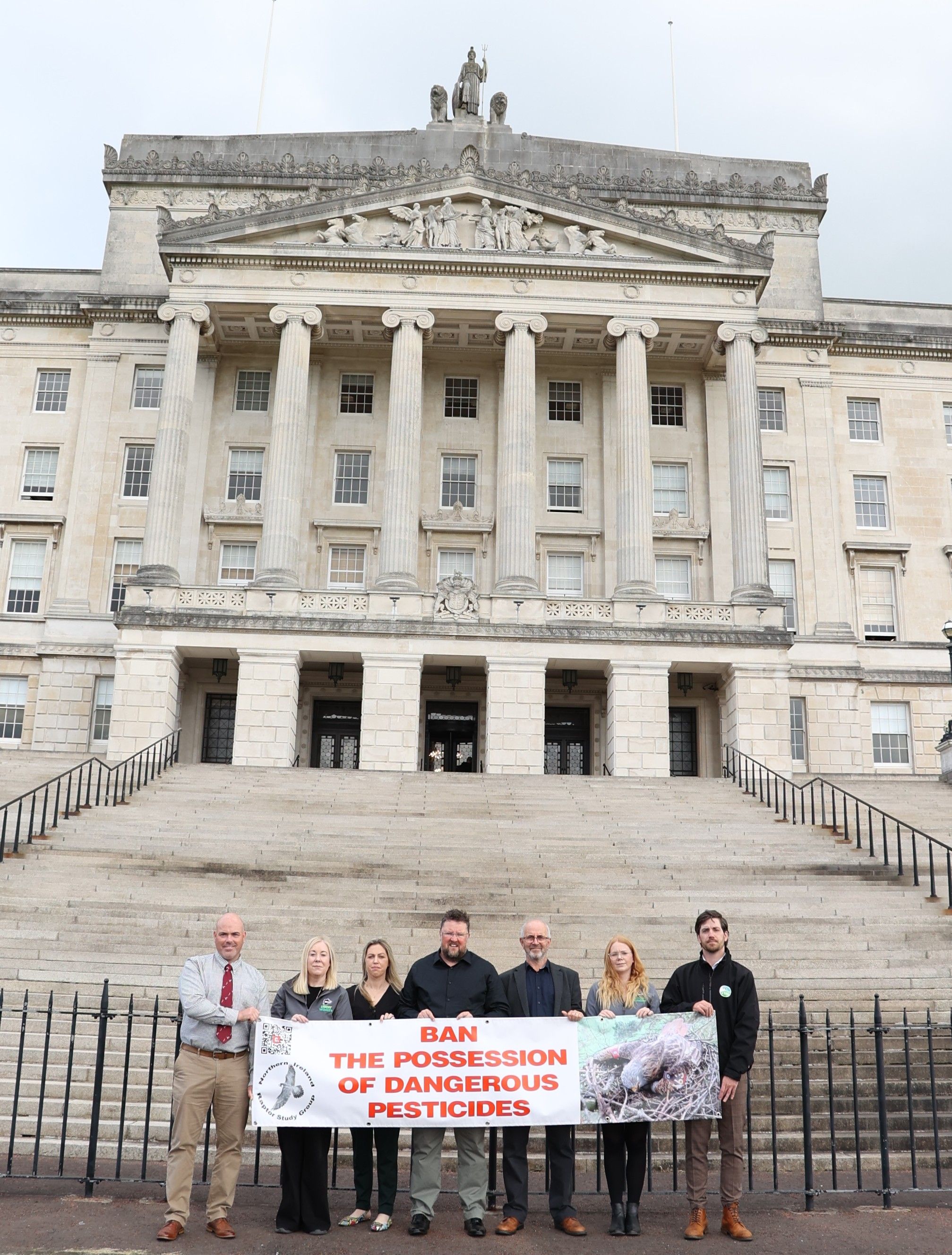
That petition attracted over 50,000 signatures (including many RPUK blog readers – thank you) and was handed in by the NIRSG to Minister Muir at Stormont last month, with support from the RSPB and Ulster Wildlife.
A week later, the Police Service of Northern Ireland revealed that a Red Kite had been found illegally poisoned in a raptor persecution hotspot in County Down (here).
Minister Muir’s recognition of this long-standing and ongoing issue, and his pledge to actually do something about it, is very welcome news and is in stark contrast to Defra’s pathetic filibustering on the same issue in England.
Huge congratulations to the Northern Ireland Raptor Study Group and their partners – this is a big win.
The debate on banning driven grouse shooting took place at Westminster Hall on Monday 30 June 2025, as a result of Wild Justice’s petition passing 100,000 signatures.
Wild Justice shared its views on the debate in its newsletter this morning, as follows:
On Monday afternoon, and in a 34-degree heatwave, Wild Justice headed to the Houses of Parliament to watch our petition be debated by backbenchers in Westminster Hall. This is the third time in nine years that a petition on this subject has met the criteria for a debate (100,000 signatures) but the first time under a Labour government. A massive thank you to everyone who helped it past the threshold (again).
Following Labour’s woeful response to our petition when it reached 10,000 signatures – in which they stated, ‘The Government has no plans to ban driven grouse shooting’ (see our blog here) – we didn’t have high hopes for a particularly reasoned or informed debate.
Only two Labour MPs turned up to contribute on Monday – the brilliant Olivia Blake MP (Sheffield Hallam), and Sam Rushworth MP (Bishop Auckland). [Ed: actually there was a third Labour MP, Joe Morris from the Hexham constituency, who didn’t make a speech but did make one intervention to ask about introducing vicarious liability for landowners as in Scotland].
As usual, Olivia – whose constituency yielded the highest number of signatures on our petition, and whose residents have to live alongside the polluting smoke and flooding caused by driven grouse moors – was brilliant. As the standalone backer of our petition in the debate, she clearly and firmly articulated her support, highlighting the subjects of air pollution, environmental degradation and criminal activity.
An amusingly dry comment was her suggestion to those employed, often on very low wages, by the industry charging up to £7,000 for a day’s grouse shooting; “If I were a beater, I might be unionising to take more of that profit home to my family.”
Mr Rushworth’s arguments were less coherent, stating firmly his dedication to animal welfare and his stance against fox hunting, whilst also defending an industry known for its illegal persecution of birds of prey and its legal, yet unethical, killing of wildlife such as the routine killing of foxes, referred to by the industry as ‘vermin’.
Why did so few Labour MPs – and not a single Green MP – turn up to the debate? Is this subject deemed by them to be in the ‘too difficult’ category? Are Labour perhaps wary of upsetting other ‘countryside’ groups after the reprisals over their unpopular ‘family farm tax’ proposals? Or do they simply not care about the widespread criminality and environmental damage associated with driven grouse shooting?
We know lots of you contacted your MPs over the last few weeks and asked them to attend the debate on Monday – so they can’t argue that they were unaware of the issues or of the debate. It would be interesting to hear how they account for their absence if any of you decide to challenge them on it.
Ban Driven Grouse Shooting – a game of BINGO
Although there was an almost empty house to defend our petition, we did enjoy a full house of grouse shooting BINGO. When challenged on its bad practices and poor track record, the driven grouse shooting industry has a few well-rehearsed and worn-out lines it peddles on repeat. Watching the debate on Monday we enjoyed crossing off the usual list of cliches, tropes and outright lies.
Some of our highlights included:
Claims that the driven grouse shooting industry has a ‘zero tolerance for raptor persecution’. Last week the RSPB published new figures which showed 102 Hen Harriers have been confirmed or are suspected to have been illegally killed between 2020 – 2024, mostly from areas managed for driven grouse shooting in northern England.
By the way, Greg Smith MP gets the star bonus prize for the most absurd statement which made us laugh out loud during the debate: ‘Gamekeepers are not the enemy of the hen harrier; they are its strongest ally in the uplands’. Mr Smith (a self-declared member of the Countryside Alliance & BASC) can look forward to a fruitful career on the panto circuit when his parliamentary career is over.
‘The UK has 75% of the world’s heather moorland, which is ‘rarer than rainforest’’. Upland heather moorland is an artificial, man-made habitat created by management techniques including burning vegetation on vast areas of peatland, causing air pollution and increasing carbon emissions. The ‘75%’ myth is also totally inaccurate and was debunked six years ago in this excellent blog by Professor Steve Carver of Leeds University.
‘Managed grouse moorland also provides a defence against tick-borne diseases’. This desperate claim came from Shadow Defra Minister Robbie Moore MP, and its irony wasn’t lost on us. A recent scientific study suggests that ticks found in woodlands where lots of Pheasants are released are two and a half times more likely to carry Lyme disease bacteria than ticks found in woodlands where no Pheasants are released (see here). Perhaps the ‘guardians of the countryside’ should consider stopping the annual release of 50 million non-native Pheasants if they’re so concerned about the prevalence of tick-borne diseases.
Daniel Zeichner, Defra Minister for Food Security and Rural Affairs, rounded off the ‘debate’ by providing the Government’s position on our petition. He repeated Labour’s earlier stance about having no plans to ban driven grouse shooting but this time adding, “we keep options under close review”. Not close enough, obviously.
He did acknowledge the cast-iron link between driven grouse shooting and the illegal persecution of birds of prey but then feebly muttered, “There are strong penalties in place for offences committed against birds of prey and other wildlife, and anyone found guilty of such offences should feel the full force of the law. Penalties can include an unlimited fine and/or a six-month custodial sentence” (emphasis is ours).
These statements are routinely trotted out by Defra in an attempt to gaslight the public into thinking there’s no need to worry about illegal raptor persecution because measures are in place to tackle it. The very reason that raptor persecution continues on driven grouse moors is because the criminals there know that (a) there is only a miniscule chance of being caught, and (b) even if they are caught, the punishment is of little consequence. The one, and only, custodial sentence ever given to a gamekeeper for committing raptor persecution offences was a case in Scotland in 2014, when a gamekeeper was filmed by the RSPB trapping a Goshawk and clubbing it to death with a stick, amongst other offences. He was given a four-month custodial sentence. Every other gamekeeper convicted since then has received either a small fine (probably covered by his employer) and/or a short community service order.
There’s no effective deterrent and Labour’s trite regurgitation of the words ‘should’ and ‘can’ demonstrates its appalling unwillingness to stop this brazen criminality. That is unforgiveable.
There was one spark of credibility in the Minister’s closing speech, and that was his referral to the Government’s recent public consultation on proposals to extend the Heather and Grass etc. Burning (England) Regulations 2021, including a change to the definition of deep peat from 40cm depth to 30cm depth, which would effectively ban the burning of heather on many driven grouse moors across northern England. It was evident from the speeches made by the Conservatives in the debate that this issue is of HUGE concern to them and their grouse-shooting mates. We look forward to hearing the Government’s announcement on those proposals in the near future.
John Lamont MP (Berwickshire, Roxburgh and Selkirk) first introduced and then concluded the debate, saying in reference to the petition’s 104,000 signatories, “I suspect those people will be a little surprised by the lack of balance in this debate.”
Was Wild Justice surprised at this lack of balance? No, not at all. But motivated? Absolutely. We will of course not be giving up when it comes to the fight to end this environmentally damaging and unjust so-called ‘sport’, mired in wildlife crime and savage animal cruelty.
Onwards and upwards!
ENDS
I must confess that I pretty much zoned out during the ‘debate’, such was the predictability of the propaganda/speeches from the pro-grouse shooting MPs. I was mostly interested in what DEFRA Minister Daniel Zeichner would have to say at the end of the debate. Whilst waiting for him to speak, though, my ears did prick up at the specific mention of some infamous grouse moor areas.
We had Kevin Hollinrake MP (Conservative, Thirsk & Malton) say this:
“I have beautiful moorland, including in Hawnby, Bransdale, Farndale, Snilesworth and Bilsdale—I am very proud of those areas and have visited a number of times“.
The grouse moors of the North York Moors National Park have long been identified as a raptor persecution hotspot, and North Yorkshire as a whole is repeatedly recognised as the worst county in the UK for reported raptor persecution crimes. Not much to be proud of there, Mr Hollinrake.
Sam Rushworth MP (Labour, Bishop Auckland), whose constituency includes some notorious grouse moors in the North Pennines, which is another well-known raptor persecution hotspot, spoke about attending a recent ‘Lets Learn Moor’ event with primary-age schoolchildren. He also mentioned being “disgusted by the criminality that sometimes occurs on the moorland“. I wonder if he realises that these events, funded by BASC, are facilitated by the Regional Moorland Groups, many of whose members have been under police investigation into suspected and confirmed raptor persecution crimes? Awkward. [Ed: Update 3 July 2025 – Pro-grouse shooting Labour MP Sam Rushworth received £10,000 donation from local grouse moor gamekeeper group – here].
And then there was Jim Shannon MP (DUP, Strangford, NI), a fully-signed up member of the Countryside Alliance, BASC and the Ulster Farmers Union, who treated us to this:
“I want to mention the Glenwherry shoot, which is the only grouse shoot in Northern Ireland. It is sponsored by BASC and the landowner. It is a success, but why is that? To start with, Glenwherry had no more than about 10 grouse, but it built that up. As others have said, the magpies, the crows, the greybacks, the foxes and the rats —all the predators—were controlled. It was gamekeepered, and the heath and moorland was burnt in a controlled burning, so that it could regenerate and produce the heather for the young birds and the grouse. Today, that is a successful grouse shoot. Why is it successful? Because grouse shooters know how to do it. They know how to deliver a successful grouse shoot. The lapwings and curlews also gathered momentum as a result. They have a place to breed every year because of the efforts of the gamekeeper and the landowner—the efforts of those who put money into the grouse shooting to make it a success“.
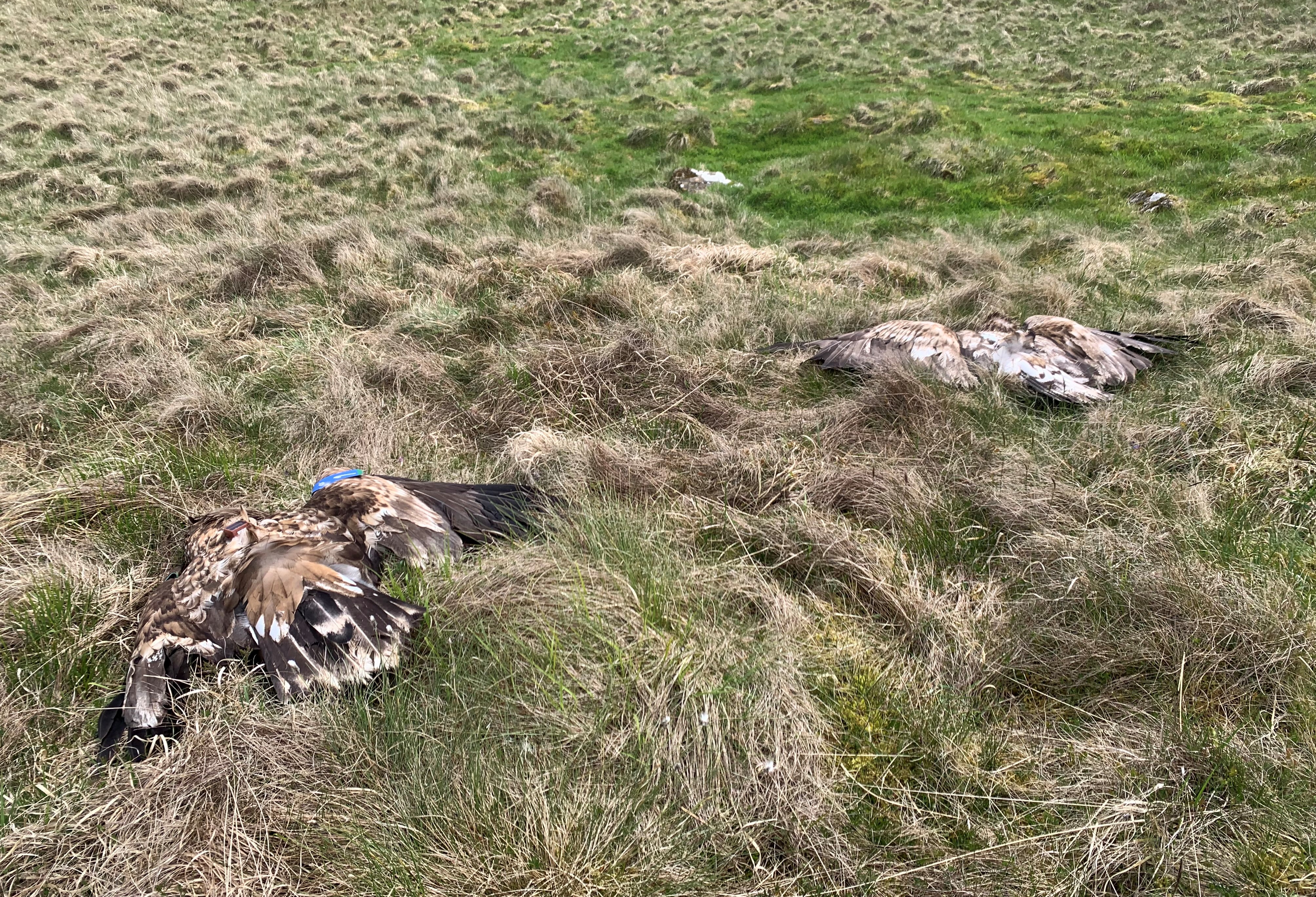
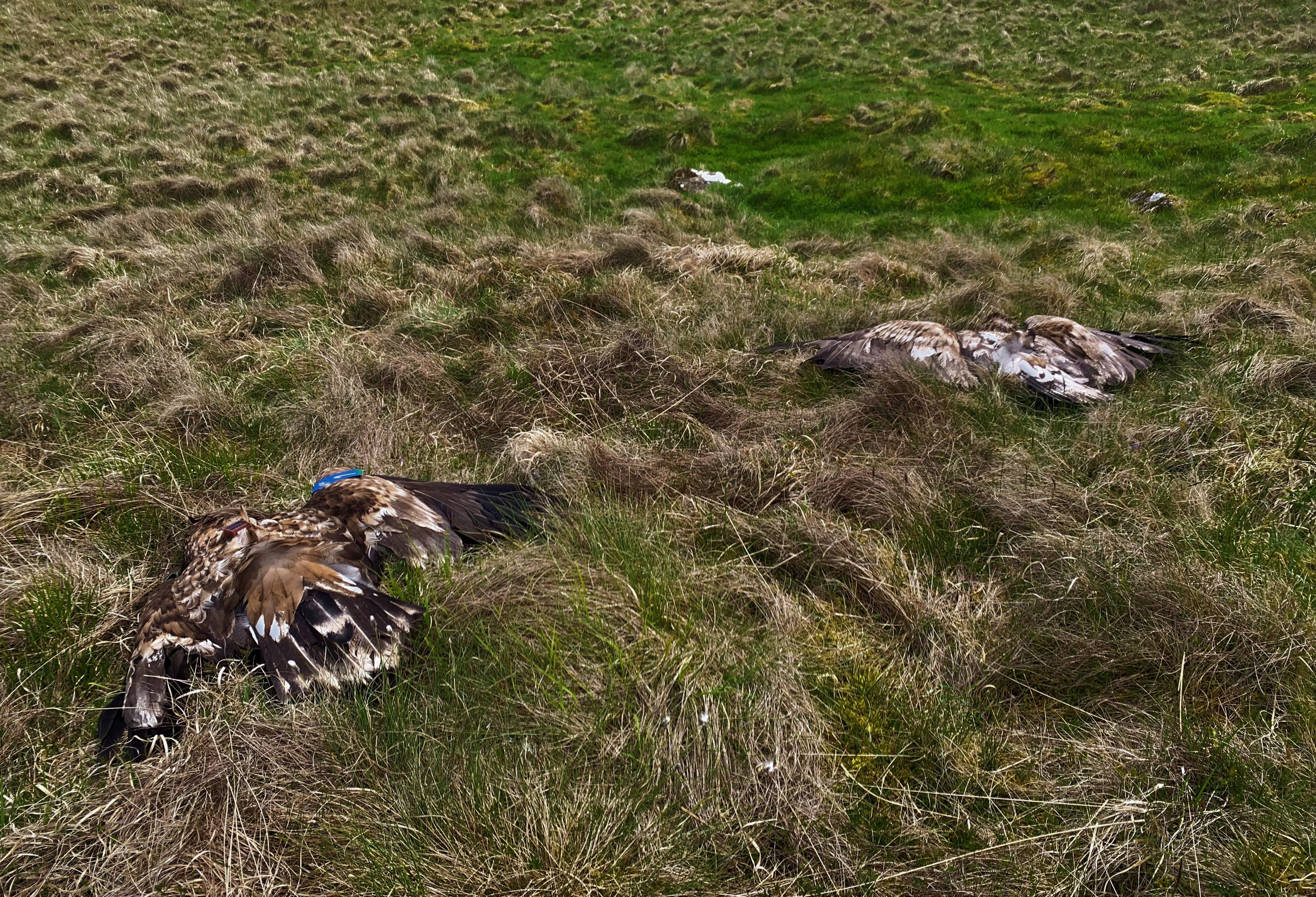
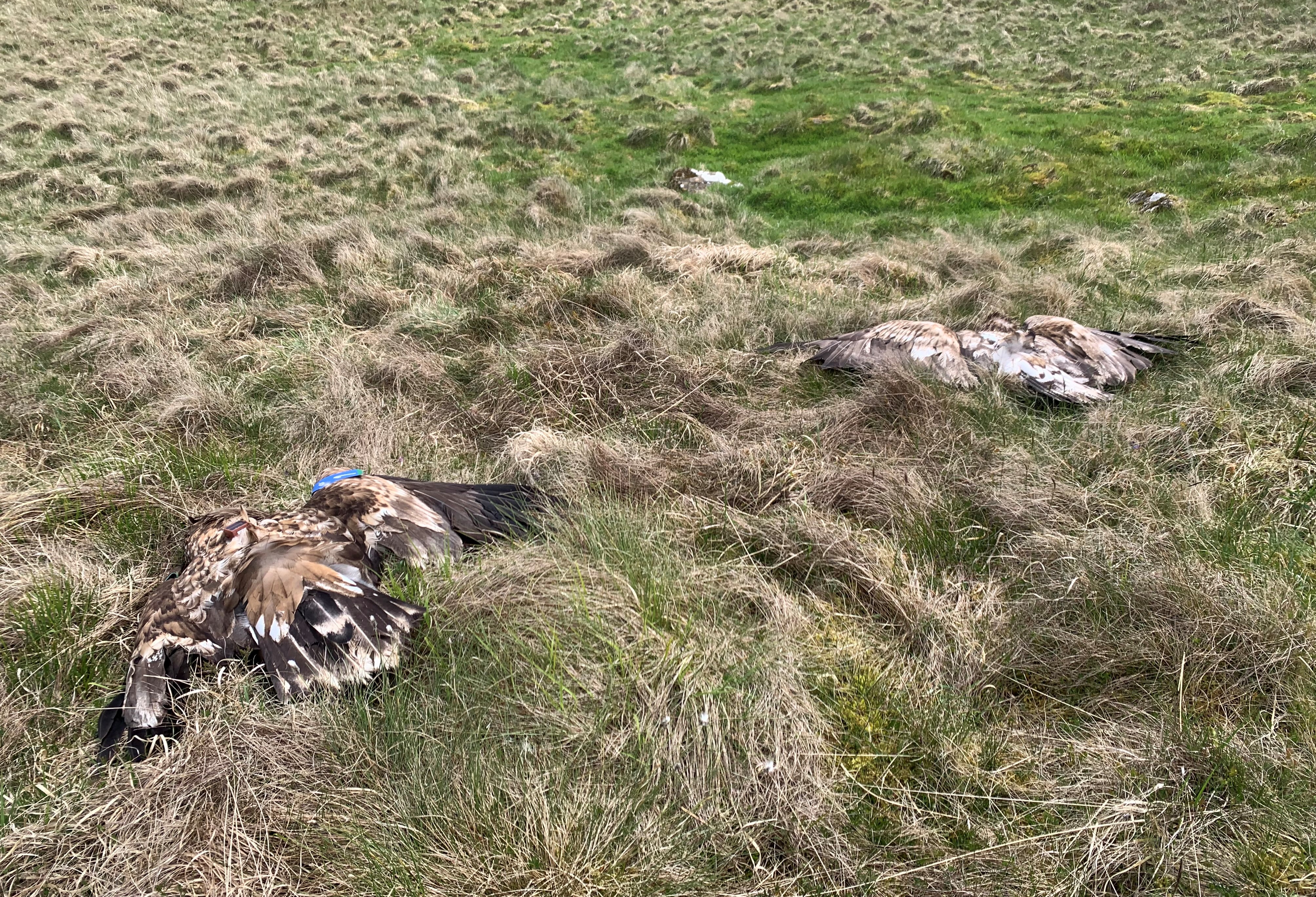
Would that be the same Glenwherry grouse moor shoot where two illegally poisoned White-tailed Eagles were found dead, side by side, in May 2023? Strange that Mr Shannon forgot to mention them.
Two illegally poisoned White-tailed Eagles found dead on Glenwherry, Northern Ireland’s only driven grouse moor. Photo by Northern Ireland Raptor Study Group.
Hen Harriers were mentioned throughout the debate but it was Minister Zeichner’s reference to the Hen Harrier Taskforce, “…which is using technology such as drones and strategic partnerships to detect, deter and disrupt offenders and is targeting hotspot areas and suspected hen harrier persecution” that caught my attention.
Zeichner claimed that, “Early signs suggest that it is having a positive impact“.
Really? That’s not my understanding. The HH Taskforce has been withholding details of multiple suspected and confirmed Hen Harrier persecution incidents over the last year. There are probably legitimate reasons to withhold information about the most recent cases as the police investigations are active but some of the other cases date back many months, some of them from over a year ago. It is simply not credible to argue that making an announcement about those cases will affect an investigation at this stage. I suspect there are other, political reasons for withholding those cases from the public and I’ll set out my reasoning in future blogs – there’s too much to include here.
For those who want to watch the recording of the Ban Driven Grouse Shooting debate you can find it here.
For those who want to read/download the debate transcript, it’s here:
Press release from Northern Ireland Raptor Study Group (17 June 2025)
50,000-signature petition, calling for a ban on poison possession, handed into Stormont.
Today (17th June), a petition begun by the Northern Ireland Raptor Study Group (NIRSG), calling for the possession of various toxic pesticides to be made illegal, was handed in to officials at Stormont by representatives of the Group, alongside staff from RSPB NI and Ulster Wildlife.
The eagles died after consuming a bait laced with Bendiocarb, a chemical prohibited from outdoor use in Northern Ireland, and were the latest victims in a series of poisoning incidents here that has claimed the lives of over 60 protected birds of prey in recent years.
The two poisoned White-tailed Eagles found dead on a grouse moor in May 2023. Photo by Northern Ireland Raptor Study Group
NIRSG’s raptor officer, Dr. Eimear Rooney said: “The day we recovered the bodies of those two eagles from the hillside at Glenwherry was one of the most upsetting of my career working with Northern Ireland’s raptors. White-tailed Eagles are only just making a return to our skies after being made extinct on the island of Ireland by past human actions over 100 years ago. But it’s not just eagles that fall victim to the criminals illegally using these poisons – it’s Red Kites, Buzzards and Peregrine Falcons as well as people’s pet cats and dogs.”
Dawn Miskelly, Ulster Wildlife CEO, said “Poisons have devastating impacts on raptor populations. Protecting these birds from poisoning is not just about conserving individual species – it’s about safeguarding and preserving biodiversity for future generations. We urgently call on the Assembly to recognise the significant public concern around this issue and act by resolving to create legislation to make the possession of these toxic pesticides illegal.”
Ian Thomson, RSPB’s Investigations Manager added “Similar legislation in Scotland has led to the successful prosecution of a sizeable number of individuals linked to the illegal poisoning of wildlife. There is no legal reason to hold onto these chemicals, long banned from use, but we repeatedly see Northern Ireland’s birds of prey fall victim to these same substances. Making their possession illegal here will make identifying the perpetrators of these crimes more straightforward, will hopefully create a significant deterrent to the illegal use of poison, and most importantly, will help protect wildlife, domestic pets and people from harm.”
Dr Marc Ruddock, also from NIRSG, continued: “The Wildlife Order already includes legislation banning the possession of pesticides containing a proscribed ingredient, but, in the 14 years since that legislation was passed, lawmakers have never produced the required list of proscribed ingredients. This means that highly toxic poisons such as carbofuran and aldicarb, banned from legal use, are being stored and utilised by those wishing to do harm to our wildlife. It is clear that the intention of the legislature, in passing these laws back in 2011, was for the possession of these awful chemicals to be a crime, but the final step to do so was never completed. It needs to be done, now, with no further delays and recognise the public’s considerable concerns and acts quickly to create a pathway to finally resolve this issue.”
The organisations that attended today at Stormont are all members of the Partnership for Action Against Wildlife Crime and previously met with DAERA officials. They were also able to discuss their concerns with Minister of Agriculture, Environment and Rural Affairs, Andrew Muir MLA, yesterday.
Dr. Rooney added “Our meeting with the Minster was welcome and constructive, and he acknowledged that the poisoning of our birds of prey is deeply concerning. We are grateful to Minister Muir for meeting us today at Stormont and receiving the petition.”
ENDS
First of all, many thanks to all of you who signed this petition, which reached 50,000 signatures in March this year (see here).
Secondly, well done to the Northern Ireland Raptor Study Group for curating this campaign, supported by the RSPB and Ulster Wildlife. The illegal poisoning of those two White-tailed Eagles, found on Northern Ireland’s only driven grouse moor in May 2023, was both shocking, and yet not shocking. It’s a sad reflection of what we’ve come to expect on many driven grouse moors across the UK.
The groups did well to secure a meeting with Minister Andrew Muir, but it’s surprising to see it described as “constructive”. What does that mean? The Minister was presented with a petition of 50,000 signatures calling for a ban on the possession of these lethal, unlawful chemicals, and he said what, exactly?
‘Oh yeah, thanks, it’s awful isn’t it, let me think about what we can do about it‘?
The remedy is simple, and obvious. Write the list of proscribed poisons and get it added to section 15B of the Wildlife (Northern Ireland) Order 1985.
It’s not that difficult!
UPDATE 25 June 2025: Police launch investigation after Red Kite killed in poisoning hotspot (here)
UPDATE 6 July 2025: Northern Ireland Minister commits to taking action on illegal poisoning of birds of prey (here)
Press release from National Parks & Wildlife Service (30 May 2025)
Minister O’Sullivan calls for co-operation in the investigation of the possible poisoning of a white-tailed eagle
The National Parks & Wildlife Service appeals to the public for information
An investigation is underway following the discovery of one of Ireland’s oldest breeding white-tailed eagles, Caimin (Y) who was found dead in Clare last Saturday. Initial post mortem results from the Regional Veterinary Laboratory indicate a possible death from poisoning.
Caimin held territory at the Mountshannon nest site on Lough Derg for the past seventeen years. During that time, he mated and fledged a number of chicks. He was one of the first chicks to arrive as part of an NPWS Reintroduction Programme to bring back this formerly extinct species to Irish skies and was released from Killarney National Park in 2008. All of the white-tailed eagle chicks reintroduced under the programme are fitted with satellite tags, which enables them to be monitored and tracked.
White-tailed Eagle ‘Caimin’. Photo by Bob Foyle
In 2013, Camin mated with Saoirshe, a female eagle who was also part of the Reintroduction Programme. They became the first white-tailed eagles to successfully raise and fledge chicks in the wild in Ireland in over one hundred years. Caimin raised and fledged chicks into the wild until 2016, when Saoirshe died of Avian Influenza. He held the territory and mated again with Bernardine (B) in 2023 to successfully fledge more chicks to the wild from the same nest site in Mountshannon. Despite the loss of her mate, Bernardine is continuing to raise a chick on the nest site in Mountshannon.
Minister of State for Nature, Heritage and Biodiversity, Christopher O’Sullivan said:
“Any loss in the wild not due to natural causes, is usually the result of human activity and this tragic loss of a wonderfully aged bird, breeding happily in the Irish wild, is deeply regrettable.
“The Reintroduction Programme had been making significant progress in restoring this lost flagship species to Irish skies. These birds are part of Ireland’s natural heritage and are important for our biodiversity, as they are a good indicator species regarding the health of our ecosystems.
“We will continue with our efforts to introduce, nurture and protect these birds and I have tasked the NPWS with leaving no stone unturned to try to get to the bottom of this heinous potential crime.”
Eamonn Meskell, Divisional Manager, NPWS said:
“The knowing destruction of this wonderful bird of prey displays a wanton disregard for our re-introduction and nature protection efforts.
“These noble birds are beloved of the public and each loss is keenly felt by them and indeed by the staff of NPWS who have nurtured these birds from chicks to fledglings, onto adult life and into successfully breeding pairs. We know we can rely on the public’s help in this investigation”.
The main threat to the species in Ireland is persecution, predominantly through shooting and the illegal use of poison and wind turbine strikes. The misuse/illegal use of poisons accounts for nearly 50% of eagle deaths where the cause of mortality was able to be determined. Other causes of death include wind turbine strikes, lead shot poisoning and shooting. Avian Influenza and adverse weather also negatively impacted the breeding population.
If you have any information, please notify your local Garda station or your local National Parks and Wildlife Service office.
Many, many thanks to all of you who signed the Northern Ireland Raptor Study Group’s (NIRSG) petition calling for a ban on the possession of dangerous, raptor-killing pesticides.
The petition has just passed its target of 50,000 signatures and the NIRSG has issued the following press release:
The NIRSG held a recent Raptor Conference which provided incredible insights into a range of topics locally and globally. Many of the talks raised a consistent theme of targeted persecution of birds of prey. Not least amongst these was the on-going issue in Northern Ireland of the Possession of Dangerous pesticides.
Some of the NIRSG 2025 conference attendees supporting the call for a ban on dangerous, raptor-killing pesticides. Photo by Marc Ruddock
The NIRSG highlighted that 63 raptors have been killed between 2009 and 2023 with a range of poisons, dominated by Carbofuran which has been banned for nearly 25 years. There have been at least 30 buzzards, 16 peregrine falcons, 13 red kites, 3 white tailed eagles and 1 golden eagle all poisoned in this time frame.
This evidence is collated by the Partnership for Action Against Wildlife Crime in Northern Ireland (PAW NI) and published in raptor persecution reports, which include ‘hotspots’ of illegal killing of our native birds of prey. These reports are publicly available on the PAWNI webpage available here and also aggregated in the RSPB Bird Crime reports available here.
In 2011, the wildlife legislation in Northern Ireland was strengthened, resulting in increased sentences of £5,000 fines (per offence) and up to 6 months imprisonment. The updated laws included a provision to ban the possession of prescribed ingredients under “Section 15B Possession of pesticides harmful to wildlife” of the Wildlife (Northern Ireland) Order 1985 as amended.
As part of that legislation there should have been an attached Order listing the banned chemicals. That list has never been created. Wildlife has continued to be poisoned by these dangerous and banned substances.
The legislation states in Section 15B Part 2: “A prescribed ingredient is one which is prescribed for the purposes of this Article by an order made by the Department; but the Department may not make an order under this Article unless it is satisfied that it is necessary or expedient to do so in the interests of protecting wild birds or wild animals from harm”. [Emphasis added by NIRSG]
There is significant evidence of continued harm from banned pesticides to birds of prey, based on robust post-mortem and laboratory results, which has been published in many reports. We believe it is indeed expedient for Minister Andrew to implement this Order to protect our birds of prey from harm. 50,000 people agree with us. Thank you to everyone who has supported the petition and helped give a voice to our wildlife.
The NIRSG will be seeking a meeting with Minister Andrew Muir to present the petition now that it has surpassed 50,000 signatures.
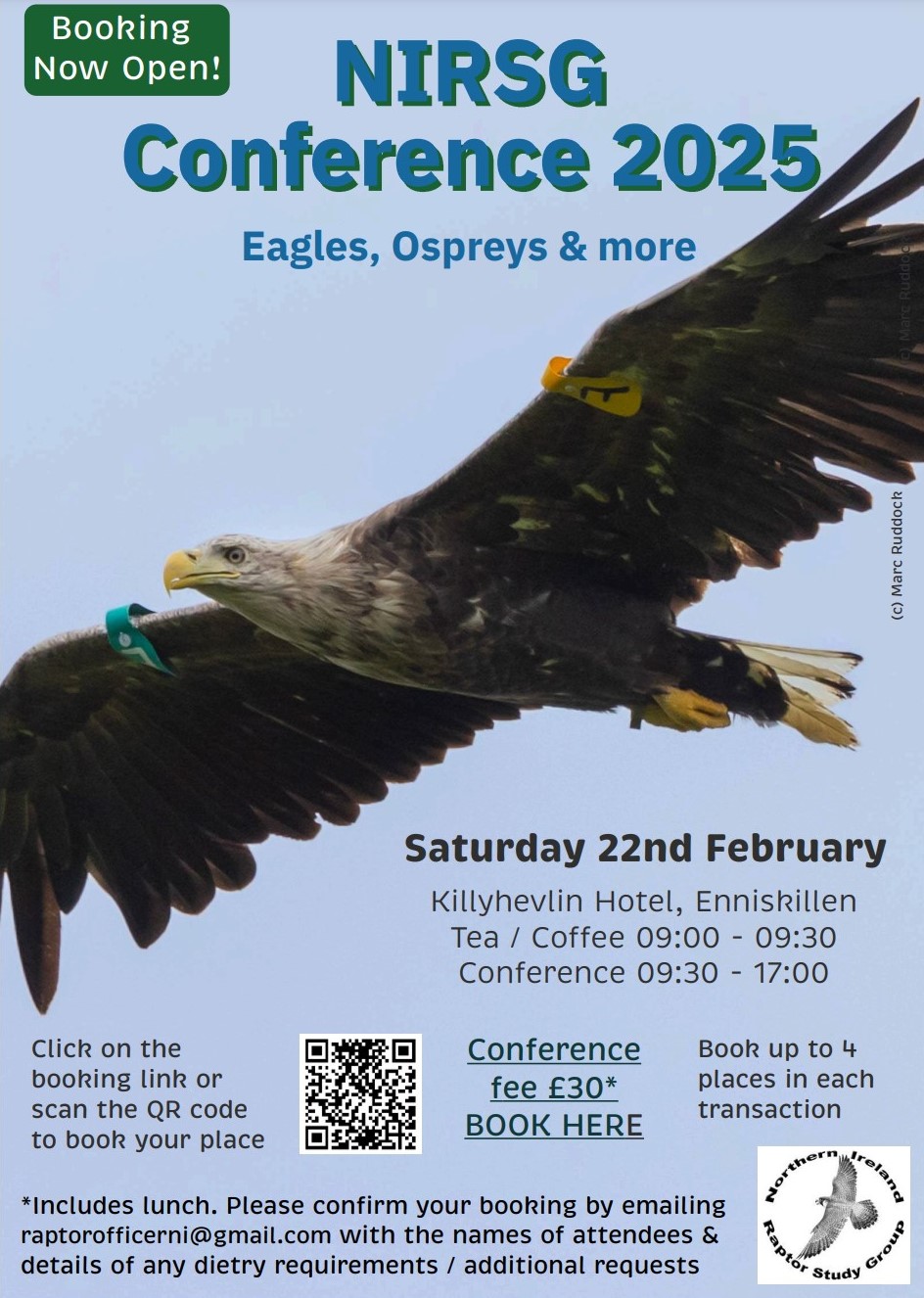
Booking is open for The Northern Ireland Raptor Study Group (NIRSG) conference taking place this Saturday (22 February 2025) at the Killyhevlin Hotel, Enniskillen.
The conference is open to everyone – you don’t need to be a member of the NIRSG to attend. To find out more information and details of how to book, please visit the NIRSG website (here).
You’ll see that Phase 2 of the NIRSG’s campaign to ban dangerous, raptor-killing pesticides will be launched on Saturday morning. I wrote about this campaign a few days ago (see here) and wanted to drum up support to help the petition reach 50,000 signatures before this coming Saturday (it had been stubbornly stuck at 46, 206 signatures for a while).
This petition/campaign was initiated after the discovery of two young white-tailed eagles that were found dead on Northern Ireland’s only driven grouse moor in 2023 – they’d both been illegally poisoned by the toxic pesticide Bendiocarb.
Many, many thanks to the approx 1,500 of you who have signed in the last few days – the current total is 47, 761 signatures. We need a couple more thousand people to pledge their support to reach the target.
Can you help? You don’t need to be a resident of Northern Ireland to sign – the petition is open to anyone, anywhere, who cares about the illegal use of these dangerous poisons to kill birds of prey (and any other wildlife that comes into contact with indiscriminately placed poisonous baits).
If you’d like to sign and/or share the petition with others, please click HERE.
Your help is needed to ensure a petition, calling for a ban on the possession of dangerous, raptor-killing pesticides in Northern Ireland, passes the target of 50,000 signatures before next week.
The petition was launched by the award-winning Northern Ireland Raptor Study Group (NIRSG) in July 2023 following the illegal poisoning of two young White-tailed Eagles that were found dead, side by side, on Northern Ireland’s only driven grouse moor at Glenwherry, in the Antrim Hills.
The two poisoned white-tailed eagles. Photo: Northern Ireland Raptor Study Group
The eagles had both ingested the highly toxic insecticide, Bendiocarb, which is currently only licensed for indoor use in Northern Ireland. This chemical is so dangerous that it’s an offence to even possess it in Scotland, let alone place it out in the open on a bait to attract any passing predators.
The petition calling for a ban on the possession of Bendiocarb and a range of other dangerous chemicals used to illegally target birds of prey currently has 46,206 signatures. The target is 50,000 signatures and ideally this target can be met before next week, when the NI Raptor Study Group will be announcing Phase 2 of its campaign to get these pesticides out of circulation. A petition with 50,000+ signatures will help get the attention of the politicians the NIRSG will be approaching.
You don’t need to be a NI resident to sign the petition; any decent human being with an interest in protecting birds of prey and other wildlife can sign it.
If you haven’t already signed, and want to help this important campaign, please sign the petition HERE.
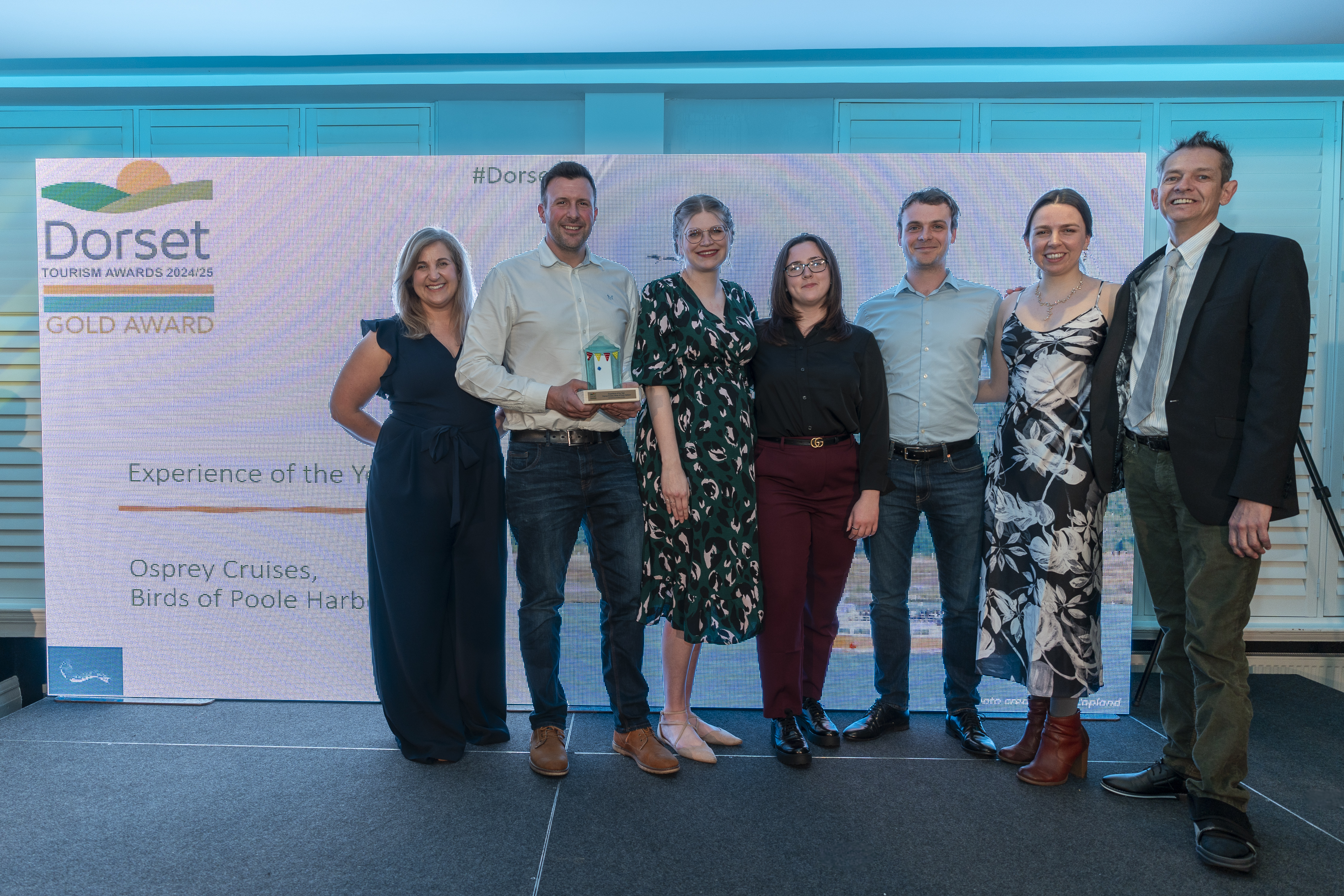
HUGE congratulations to the fantastic team behind the charity Birds of Poole Harbour whose Osprey Cruises have won GOLD in the 2024/25 Dorset Tourism Awards (Experience of the Year category)!
The Birds of Poole Harbour team collecting their gold award earlier this week. Photo by Ian Plested, IPVisuals, Dorset Tourism Awards 2024/25
If ever there was a well-deserved award, this is it, because the work of this small, passionate and knowledgeable team expands far, far beyond the popular Osprey Cruise boat trips that they run every summer.
In the world of UK raptor conservation, the charity is probably best known for successfully bringing back Ospreys to the south coast of England, working in close partnership with the Roy Dennis Wildlife Foundation. Ospreys were translocated from Scotland over a number of years, starting in 2017, and are now regularly breeding in Poole Harbour, with the first chicks hatching in southern England in almost 200 years.
The Osprey project is just one of several high impact conservation projects this team is involved with and they are currently working towards a Chough reintroduction on the Purbeck Coast. They are also heavily involved in various annual bird surveys and bird ringing projects around this important wetland site.
Public engagement and education has always been one of the core objectives of the Birds of Poole Harbour charity, and boy, do they deliver on that front!
They run a School Bird Boat Project during the winter and spring, offering local primary schools free two-hour harbour boat trips, including free coach travel to and from Poole Quay. There are free binoculars for the pupils to use and they’re encouraged to participate in identifying and recording different species whilst on board, as well as learning about natural history, conservation and their local environment. Imagine the impact those boat trips have on those kids.
In addition to the school boats, the charity delivers an extraordinary events calendar throughout the year which members of the public can pay to attend. They do guided walks and ID courses, talks and free pop-up events, but probably the most popular events are the various boat cruises which attract thousands of visitors a year, many of them selling out quickly and attracting visitors from far beyond Dorset.
I’m one of those visitors and I’ve been making the trip down to join these boat trips since 2017. Initially it was to see the Ospreys, but more recently the big draw for me is the resident pair of White-tailed Eagles that have set up home in Poole Harbour. There are plenty of other raptor species too, notably Marsh Harriers and Peregrines, and because of the diversity of habitats around the harbour there are many, many more bird species to see.
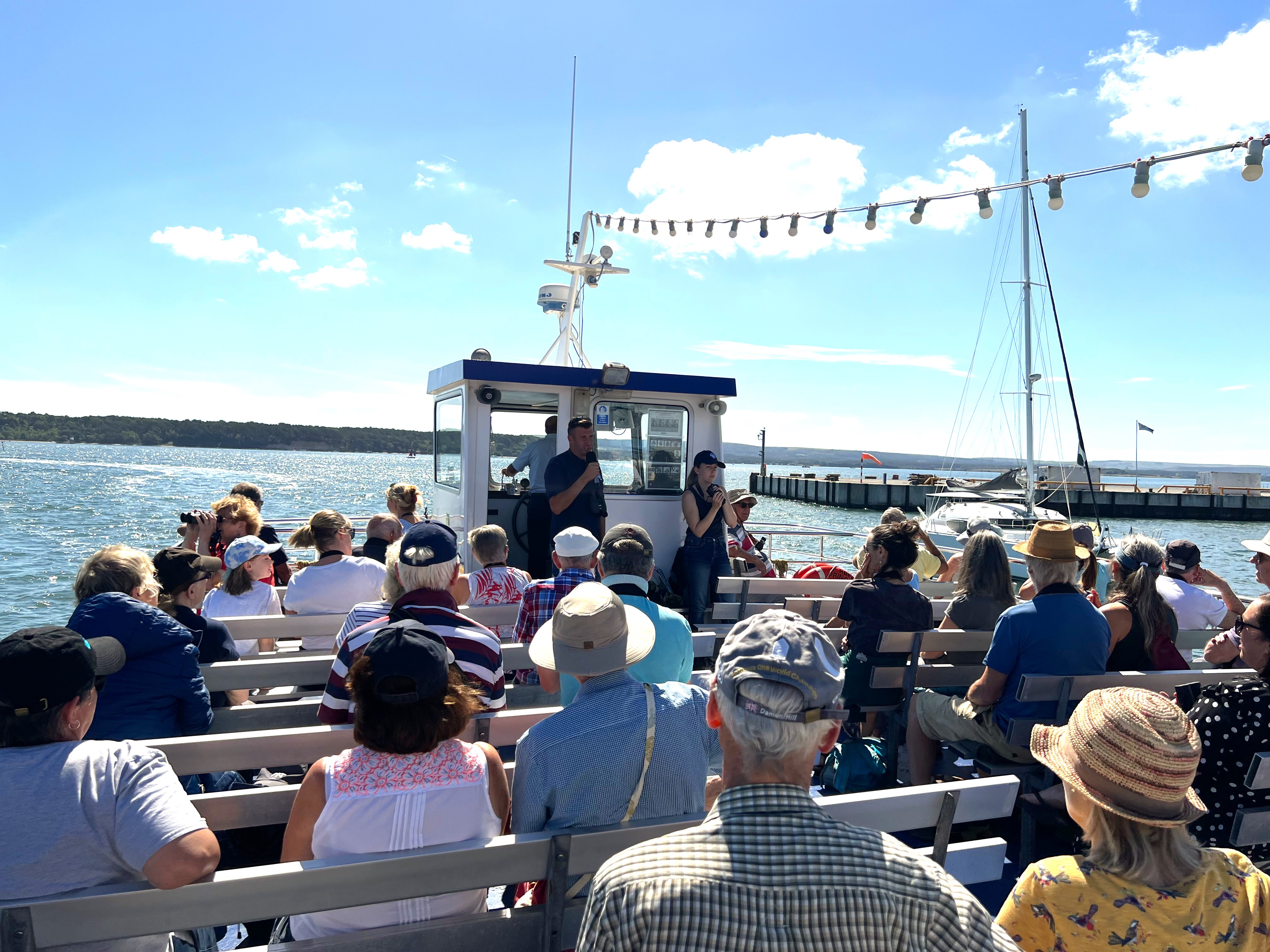
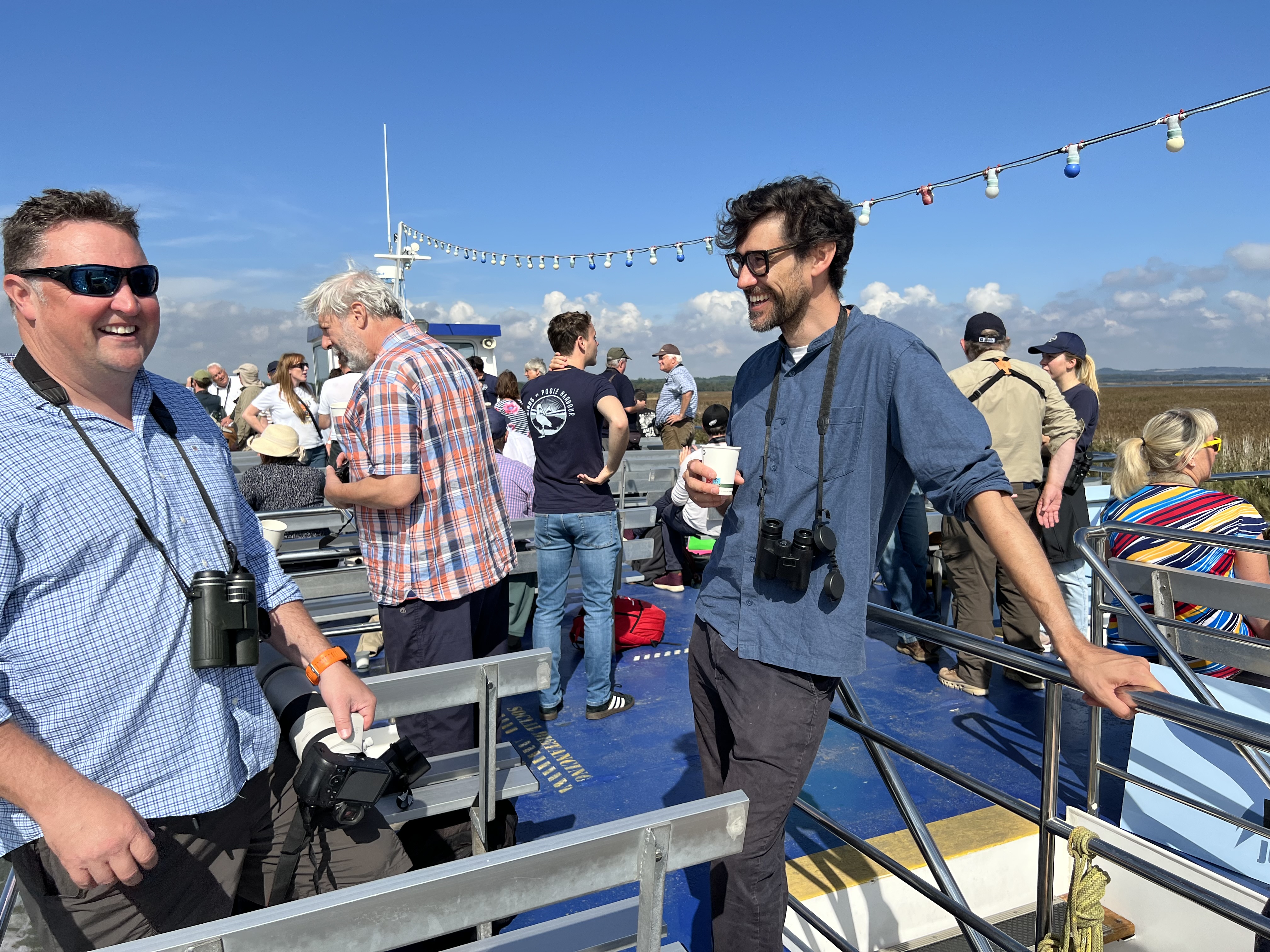
These boat trips usually last for three hours and members of the BOPH team are always on board to provide a running commentary (and they also know where the eagles like to hang out). The trips are hugely enjoyable and massively informative. You don’t need to be an expert birder to attend – the passengers are often an eclectic mix of backgrounds and experience, ranging from the expert to the novice and everything inbetween. If you want a brilliant, fun and engaging day out, look out for this year’s boat trip dates on the BOPH website (being announced shortly). You can also organise a private, bespoke boat trip, e.g. as a corporate event or as an event for supporters as Wild Justice did in 2023.
BOPH boat trips – photos by Ruth Tingay
For those who can’t visit the harbour in person, Birds of Poole Harbour provide a daily blog of bird sightings, a regularly-updated website with news from their various projects, and they provide live-streaming webcams so people from around the world can follow the fortunes of the Ospreys’ breeding seasons.
Another winner at the 2024/25 Dorset Tourism Awards was Careys Secret Garden, based on the western side of the harbour, who won GOLD in the Ethical, Responsible & Sustainable Tourism category, SILVER in the Small Visitor Attraction of the Year category, and took home the WINNER OF WINNERS award, too! Careys Secret Garden works in partnership with Birds of Poole Harbour and offers a wide range of events, courses and activities from March to October, including the Careys Osprey Tours where small groups can book to visit a viewing platform to watch the famous nest belonging to Ospreys CJ7 & 022. If you’re in the area for a BOPH boat trip, I’d highly recommend a visit to this special, secluded location.
Congratulations again to both organisations on winning the richly-deserved recognition these awards will bring.
I wonder if former Conservative MP Chris Loder was at the awards ceremony?
Press release from The National Parks & Wildlife Service (NPWS), 14 January 2025:
INVESTIGATION UNDERWAY FOLLOWING THE DEATH OF A WHITE-TAILED EAGLE IN COUNTY WESTMEATH
The National Parks and Wildlife Service (NPWS) appeal to the public for information.
The NPWS has launched an investigation following the recent shooting dead of a White-tailed Eagle beside Lough Owel, near Mullingar, Co. Westmeath and is appealing to the public for information.
The two-year old female eagle was part of the NPWS White-tailed Eagle Reintroduction Programme. She was released in 2022 on the Shannon Estuary. Investigating officers have established that the bird was shot, but, are awaiting further results of forensic analysis that may provide additional information.
The NPWS deplores the deliberate killing of rare and endangered species, and takes bird of prey persecutions extremely seriously.
NPWS is appealing for any information the public may have in relation to the incident.
As part of the reintroduction programme, White-tailed Eagle chicks are fitted with satellite tags to monitor their movement. Information from the satellite tag for the dead eagle indicates that she died sometime on Friday the 6th of December, the day before Storm Darragh, in the Ballynafid / Portnashangan area at Lough Owel.
Satellite information shows that she was present in the area over the previous couple of weeks having travelled widely across the country since her release in 2022. In early 2023, she left north Kerry, and spent time at various locations along the western seaboard. She also travelled to Donegal and spent a lot of time making trips over and back to north Antrim, Fermanagh, Cavan and other counties, including visiting Lough Ree in the north midlands. Lately she had come back to Westmeath where she moved between local lakes- Lough Owel, Lough Derravaragh and Lough Ennell.
Members of the public can contact the NPWS by emailing wildlifeenforcement@npws.gov.ie. All reports will be treated in the strictest of confidence.
ENDS
There is a further NWPS statement dated 15 January 2025:
MINISTER NOONAN APPEALS TO THE PUBLIC FOR INFORMATION FOLLOWING THE DEATH OF A WHITE-TAILED EAGLE AT LOUGH OWEL IN CO. WESTMEATH
“Like all who cherish our wildlife, I was devastated to hear of the recent shooting dead of a White-tailed Eagle beside Lough Owel, near Mullingar in Co. Westmeath. White Tailed Eagles are magnificent creatures; their presence are such good indicators of the health of our ecosystems and countryside and now part of our wider efforts to restore nature. It is an absolute deplorable act to kill such a rare and endangered species.
“This young female eagle was part of the very successful NPWS White Tailed Eagle Reintroduction Programme in partnership with Norway. I was honoured to be present at the release of these stunning creatures to the wild in my role as Minister of State for Nature and Heritage.
“After being released into the Shannon Estuary in 2022 she had peacefully settled into the Irish landscape travelling from north Kerry, spending time in Western Seaboard before travelling to Armagh, Fermanagh, Cavan and other counties, including visiting Lough Ree in the north midlands. Lately she had returned to Westmeath where she moved between local lakes- Lough Owel, Lough Derravaragh and Lough Ennell. Satellite tags fitted by NPWS indicate that she died on 6th December the day before Storm Darragh, in the Ballynafid/ Portnashangan area at Lough Owel.
“White Tailed Eagles are treasured by local communities and visitors to Ireland alike and any loss resonates throughout. I appeal to the public to come forward with any information that they may have in relation to this incident. I am assured that NPWS are undertaking a thorough investigation led by the Wildlife Crime Directorate with the support of An Garda Siochána and will, where possible, bring the perpetrators of this unacceptable crime to justice. Members of the public can contact the NPWS by emailing wildlifeenforcement@npws.gov.ie. All reports will be treated in the strictest of confidence“.