Poisoned sea eagle: inadequate response from Scottish Government

Further to Monday’s appalling news that a young white-tailed eagle has been found illegally poisoned on a grouse moor in the Cairngorms National Park (see here and here), the Scottish Government has responded.

Of sorts.

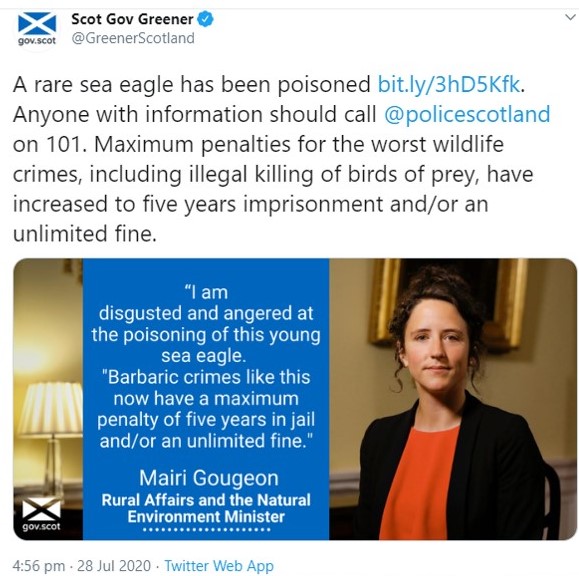
The official twitter channel of the Scottish Government, covering the environment and rural economy (@GreenerScotland) posted this at four minutes to five yesterday afternoon:

If the Scottish Government thinks that is an adequate response it’d better think again.

Superficially, it looks good, as is undoubtedly intended. A photo of a serious-looking Environment Minister and a statement expressing disgust and anger, ending with what looks to be a zero-tolerance policy for those who commit these atrocious crimes.

Job done. That’ll calm the baying public and stem the tsunami of angry emails heading for the First Minister’s inbox, right?

Sorry, but no, it won’t. Whichever civil servant put this together has not only seriously misjudged the mood but has also underestimated the public’s depth of anger about the illegal poisoning of this young eagle. Fobbing us off with a trite statement about custodial sentences for the guilty just isn’t going to cut it.

Why not? Well because we all know, that even though an increase in custodial sentences for wildlife crime is widely welcomed and long overdue, that no matter what the sentence, the chances of the culprit actually being caught is still disproportionately minuscule in comparison to the weight of the sentence.

In fact, there has never been a successful prosecution for the illegal killing of an eagle in Scotland. Ever. Even though scores of them have been found illegally shot, poisoned or trapped over the years, and scores more have ‘disappeared’ in suspicious circumstances (confirmed by a Government-commissioned report), not one single eagle-killer has ever been held to account.

Not one.

Why not? Because the evidence required to convict is almost impossible to attain. For example, ten years ago three golden eagles were found dead on a prestigious grouse-shooting estate in Sutherland. They were found within days of each other and all three had been poisoned with banned chemicals. The police raided the estate and found a stash of 10kg of Carbofuran (a banned pesticide) inside a locked shed. This was the biggest cache of carbofuran ever found in the UK and was described as being ‘enough to wipe out the entire Scottish golden eagle and red kite populations several times over’. They also found poisoned baits laid out on the hill. At least one of those eagles died with the poisoned bait still in its beak – that’s how potent and fast-acting some of these poisons can be.

An estate employee was charged and the case went to court. However, he was only convicted for having possession of the banned poison. He wasn’t even charged with poisoning those eagles simply because there was insufficient evidence to demonstrate that he had laid the bait that killed those eagles.

So when the Scottish Government tells us that the maximum sentence for poisoning an eagle has been increased to a five-year custodial sentence, in this context it’s totally meaningless because the poisoner will evade ever being brought to justice.

Now that’s not to say the increased penalties for wildlife crime are a waste of time – they most definitely are not and are a very welcome addition, but increased penalties alone just aren’t going to save the day here. The Scottish Government cannot continue to ignore the massive elephant in the room. That is, that the majority of these crimes against birds of prey are linked to the ‘sport’ of driven grouse shooting.

We know it, and the Scottish Government knows it.

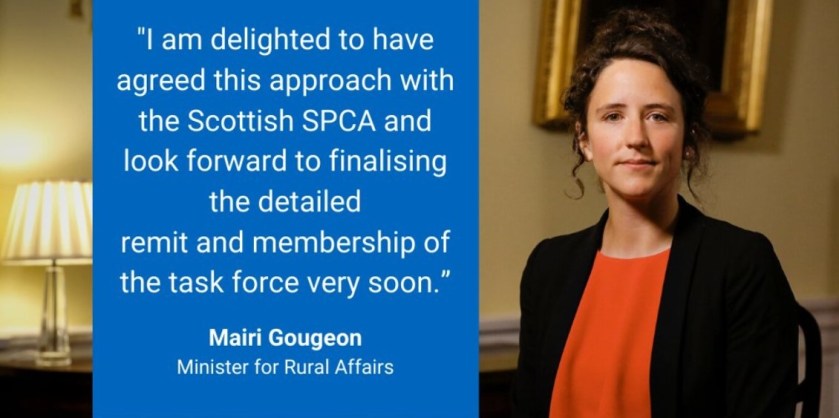
This latest response from the Scottish Government bares strong similarities to a statement made last month about its intention to establish a ‘wildlife crime task force’ to assess whether increased powers for the SSPCA would be worthwhile (see here). What was (deliberately) missed out was the fact that the government had already spent the previous nine years cogitating this very issue! The announcement was even accompanied by the very same photograph of Minister Gougeon as used in yesterday’s announcement. The civil servants must think it adds gravitas.

Well, it doesn’t. And as we said last month, this is no reflection on the integrity and sincerity of Mairi Gougeon. Having met her several times and listened to her talk, there is absolutely no doubt that she finds these crimes as abhorrent as we all do. But she, and her fellow Cabinet Ministers and Secretaries, need to step up to the plate.

We don’t want banal memes or meaningless platitudes or pretence that this is all in hand. It isn’t and the image of that dead sea eagle should haunt every single member of the Scottish Government – they are allowing this depravity to continue.

Thank you to all of you who have written to the First Minister (Nicola Sturgeon) and Environment Cabinet Secretary (Roseanna Cunningham). It is clear that their inboxes have been deluged. Good, they need to be.

If you haven’t written yet, please consider doing so. Mark Avery has published his excellent letter (see here) for those wondering what to say.

Here are the email addresses of the relevant ministers:

To email Nicola Sturgeon, please use this address: firstminister@gov.scot

To email Roseanna Cunningham, please use this address: CabSecECCLR@gov.scot

Thank you.

UPDATE 29th July 2020: Poisoned sea eagle: strong response from Scottish Greens (here)

More on the poisoned sea eagle found dead on a grouse moor in Cairngorms National Park

It’s fair to say that there has been public uproar at the news that yet another eagle has been found illegally killed in Scotland, this time a young sea eagle, found poisoned on a grouse moor inside the Cairngorms National Park (see here). The police have not named the estate on which the poisoned corpse was found, nor the name of the banned pesticide used to kill this eagle.

Some of that public outrage has been from people who previously had no idea that such filthy, barbaric crimes are still taking place in the 21st Century, whilst others are infuriated that this keeps happening and yet time and time and time again the Scottish Government keeps dodging the opportunity to act.

To many of us, it’s no longer a shock to learn that an eagle has been found illegally killed on a grouse moor. And in this particular case, it’s certainly no surprise to learn of the location.

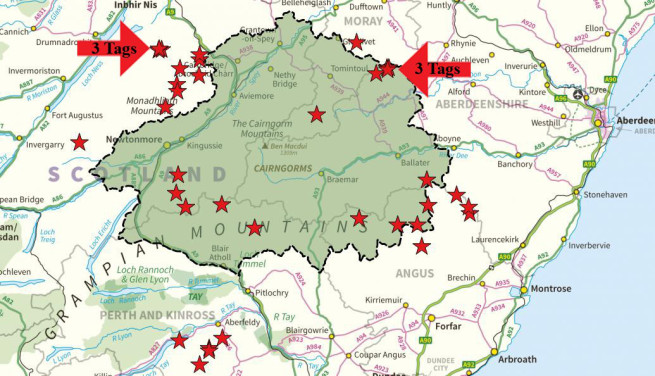
The Strathdon area of the Cairngorms National Park has long been recognised as a raptor persecution hotspot, as this map demonstrates. These are raptor persecution incidents, 2005-2018, including cases recorded by the RSPB, incidents featured in the golden eagle satellite tag review, and other data in the public domain. Geographic clusters are clear to see – in the Angus Glens to the SE of the National Park, in the Strathdon area in the NE (circled), and in the Monadhliaths to the NW of the National Park:

Those incidents in Strathdon include a poisoned raven (2006), a poisoned common gull (2006), multiple poisoned baits (2006), a shot buzzard (2009), a poisoned golden eagle (2011), a poisoned buzzard (2011), poisoned bait (2011), a shot short-eared owl (2011), two satellite-tagged golden eagles ‘disappearing’ (2011), another satellite-tagged golden eagle ‘disappearing’ (2013), a satellite-tagged white-tailed eagle ‘disappearing’ (2014), a goshawk nest shot out by masked men (2014), a shot goshawk (2016), another satellite-tagged golden eagle ‘disappearing’ (2017), a satellite-tagged hen harrier ‘disappearing’ (2018), another satellite-tagged hen harrier ‘disappearing’ (2019), and another satellite-tagged hen harrier ‘disappearing’ (2020).

It’s quite the persecution hotspot, isn’t it?

Nobody has been prosecuted in any of these cases.

If you want to see the full shocking list of reported raptor persecution incidents inside the Cairngorms National Park, the supposed ‘jewel in the crown’ of Scotland’s wildlife areas, see here. Take note again of the lack of prosecutions.

Strathdon was also identified as a golden eagle persecution hotspot in the 2017 Government-commissioned report on the fates of satellite-tracked golden eagles in Scotland. You can read that report here.

With the illegal poisoning of this latest white-tailed eagle we now know that seven eagles have either been illegally killed or have vanished in suspicious circumstances in this area (4 x ‘missing’ golden eagles, 1 x ‘missing white-tailed eagle, 1 x poisoned golden eagle, 1 x poisoned white-tailed eagle), as well as three satellite-tagged hen harriers that have vanished in suspicious circumstances since the golden eagle report was published.

Many new blog readers have been surprised to learn that not only have there been zero prosecutions for raptor crime dating back for years in this part of the National Park, but that managing grouse moors for shooting is not a licensed activity. Comments from newcomers on social media immediately call for ‘licences to be revoked’ because they assume that a relatively progressive country like Scotland will have all this stuff regulated and under control. It’s been a shock for them to find out that in parts of Scotland it’s the armed criminals in control, brazenly and repeatedly sticking up two fingers to the law-makers and the rest of society.

Newcomers also ask why there hasn’t been any targeted action in these known persecution hotspots? It’s not like nobody knows what’s been going on there! It’s a good question – what is the point of all this mapping and recording and reporting if the bleedin’ obvious is still allowed to continue, uninhibited, unrestricted and unpunished?

The Scottish Government did implement a farcical trial scheme of having a bunch of part-time volunteer special constables deployed in the National Park in 2018, to focus on tackling wildlife crime. Despite the undoubted good intentions of those volunteers, the scheme was a predictable waste of time and money (see here) and simply a can-kicking exercise so the Government could pretend it was doing something tangible to tackle these crimes.

And so here we are again. Yet another victim, on yet another grouse moor, in yet another National Park.

And yet again, the Scottish Government has remained silent.

It’s important that we don’t.

If you haven’t already done so, please consider sending an email to the First Minister (Nicola Sturgeon) and her Environment Cabinet Secretary (Roseanna Cunningham) to express your strength of feeling that this disgraceful criminality has been allowed to continue for far too long. The Government must be held to account for its inaction.

You don’t need to be resident in Scotland to email these politicians. In fact, the more correspondence from outside of Scotland, all the better to demonstrate the extent of the country’s embarrassing reputation. Please be polite.

To email Nicola Sturgeon, please use this address: firstminister@gov.scot

To email Roseanna Cunningham, please use this address: CabSecECCLR@gov.scot

It’s clear that many of you have already written to them. Thank you.

UPDATE 29 July 2020: Poisoned sea eagle: inadequate response from Scottish Government (here)

Poisoned sea eagle found on grouse moor in Cairngorms National Park: RSPB response

Further to today’s news that a young white-tailed eagle has been found illegally poisoned on a grouse moor in the Cairngorms National Park (see here), the RSPB has responded.

Head of Investigations Ian Thomson has written a blog – see here – where he talks about the long history of raptor persecution on grouse moors in this part of the National Park as well as providing a few more details of this young eagle’s life before he was killed.

The RSPB has also published a video:

https://vimeo.com/442042197

There’s still much more to say about this latest crime….more soon.

In the meantime, if you’re as infuriated as we are, please consider emailing the First Minister (Nicola Sturgeon) and her Environment Cabinet Secretary (Roseanna Cunningham) to express your strength of feeling that this filthy criminality has been allowed to continue for far too long. The Scottish Government has known about it for years, they know where it goes on and know why it goes on, and yet still, here we are again.

You don’t need to be resident in Scotland to email these politicians. In fact, the more correspondence from outside of Scotland, all the better to demonstrate the extent of the country’s embarrassing reputation. Please be polite.

To email Nicola Sturgeon, please use this address: firstminister@gov.scot

To email Roseanna Cunningham, please use this address: CabSecECCLR@gov.scot

Thank you

Satellite-tagged white-tailed eagle found poisoned on grouse moor in Cairngorms National Park

A satellite-tagged white-tailed eagle has been found poisoned on a grouse moor in the Cairngorms National Park.

This should be the tipping point. The Scottish Government simply cannot ignore this blatant criminality any longer. There are contact details at the foot of this blog if you want to write to the First Minister and her Environment Cabinet Secretary.

We’ll have much, much more to say about this latest crime but for now, here’s the press release just issued by Police Scotland:

RARE WHITE-TAILED SEA EAGLE POISONED

Police Scotland has today confirmed that a rare white-tailed sea eagle found dead earlier this year was poisoned.

The bird of prey was recovered from Donside, Aberdeenshire, in April. A post mortem has now established it died as a result of pesticide poisoning. It had been satellite tagged.

The death is being treated as suspicious. An investigation is ongoing and Police Scotland is appealing for information to help identify those responsible.

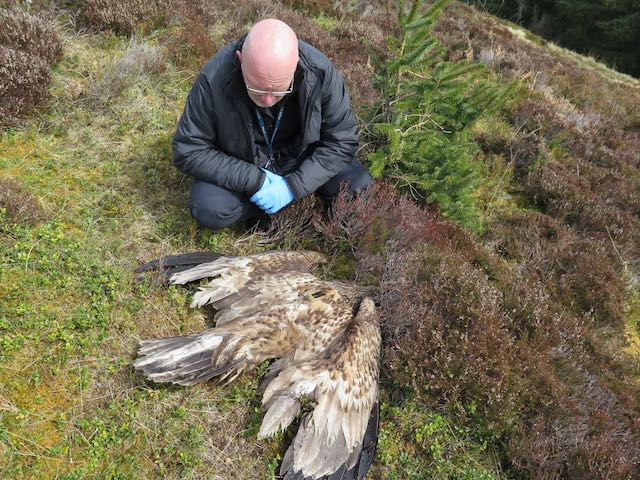
[A police officer examines the corpse of this illegally-poisoned sea eagle, found on a grouse moor in the Cairngorms National Park]

White-tailed sea eagles were re-introduced into Scotland in the 1970s after becoming extinct in the UK in the early 1900s. There are now over 150 breeding pairs in Scotland. Police Inspector Sheila McDerment, who chairs the North East Partnership Against Wildlife Crime, said:

As well as being illegal, poisoning is a cruel way to kill a bird. It also puts the lives of other creatures and plants at risk and impacts negatively on our environment.

This incident is particularly upsetting because these rare and beautiful birds had been re-introduced to Scotland after being extinct throughout the UK.

Raptor persecution is one of six priorities set by the UK National Wildlife Crime Unit. In the North East we work closely with a number of partners to tackle wildlife crime. Members of the public are our eyes and ears. I appeal to anyone out there who may hold any information about this incident to help us bring the offender to justice by coming forward and telling us what they know.”

Ian Thomson, RSPB Scotland’s Head of Investigations said: “The news that this bird has been illegally poisoned is appalling. This crime would never have come to light had the bird not been fitted with a satellite tag, and the killing of this young eagle can be added to a litany of raptor persecution incidents in recent years, including previous poisonings and multiple disappearances of similarly-tagged birds of prey. Poisoning is vicious and indiscriminate and we join with Police Scotland in appealing for information.”

Detective Chief Superintendent Gary Cunningham, Wildlife Crime lead for Police Scotland, said: “Scotland’s rich, rare and diverse wildlife and landscapes are among its biggest attractions. We cannot allow the indiscriminate use of poisons and pesticides to threaten our natural heritage. Police Scotland, working with our key partners, is committed to protecting our wildlife habitats and to bringing those who seek to destroy or harm it, to justice.”

Please contact Police Scotland on 101 if you have information about this crime, quoting crime reference number CF0160960720. You can also report information anonymously by contacting Crimestoppers on 0800 555 111.

ENDS

If you’d like the First Minister (Nicola Sturgeon) and her Environment Cabinet Secretary (Roseanna Cunningham) to know how angry this news makes you feel, please send POLITE but strongly-worded emails to:

firstminister@gov.scot

and

CabSecECCLR@gov.scot

UPDATE 27th July 2020: RSPB responds to news of poisoned eagle found on grouse moor in Cairngorms National Park (here)

UPDATE 28th July 2020: More on the poisoned sea eagle found dead on a grouse moor in the Cairngorms National Park (here)

UPDATE 29th July 2020: Poisoned sea eagle: inadequate response from Scottish Government (here)
UPDATE 29th July 2020: Poisoned sea eagle: strong response from Scottish Greens (here)

UPDATE 29th July 2020: Poisoned sea eagle: Scottish Ministers under increasing pressure to act (here)

UPDATE 29th July 2020: Poisoned sea eagle: Chris Packham’s letter to Scottish Ministers (here)

UPDATE 30th July 2020: Poisoned sea eagle: poor response from Cairngorms National Park Authority (here)

UPDATE 31st July 2020: Cairngorms National Park, Scotland: where eagles are poisoned, trapped & shot (here)

UPDATE 12th August 2020: Former Sea Eagle Project Officer explains devastating personal impact of ongoing illegal persecution on grouse moors (here)

More White-tailed eagles to be released in Ireland to bolster reintroduction project

Press release from National Parks & Wildlife Service, Ireland (26 June 2020)

The eagles have landed in latest phase of reintroduction of the species in Ireland

A group of young White-tailed Eagles have arrived in the south west, landing today at Kerry Airport from Norway.

The White-tailed Eagles are being released again in Munster by the Department of Culture, Heritage and the Gaeltacht’s National Parks and Wildlife Service (NPWS) as part of a Phase Two project to bolster the small existing breeding population in Ireland.

The new release phase aims to build on the successful re-establishment of this once extinct species over a three-year period (2020-2022) by releasing young eagles at three sites, including Lough Derg, the lower Shannon estuary and Killarney National Park.

The mission involved moving the young eagles – who had been monitored for a number of months – from Norway. They were taken to a waiting chartered flight at Trondheim Airport, for transport to Kerry Airport on a journey of four hours 20 minutes, and arrived this afternoon.

Minister of Culture, Heritage and the Gaeltacht Josepha Madigan, TD, welcomed the new arrivals: “This latest operation, under Phase Two of the conservation project, was an incredible team effort between the wildlife personnel both here and in Norway.

Thanks to their logistical work, bringing the latest influx of White-tailed Eagles to these shores, the future is positive for the eagle, which had been extinct in Ireland for over a century. The latest conservation intervention cements the work already done in bringing these graceful birds back to our skies, and I would like to express my appreciation for all involved in lending this hand to nature.”

In 2020 it is planned to release 10 young eagles collected this summer in Norway split between the three Irish sites. These birds from this second release phase will provide an additional boost to the small Irish breeding population when they reach maturity.

Previously, 100 young White-tailed Eagles were released in Killarney National Park in County Kerry between 2007 and 2011. Birds from these releases subsequently dispersed widely throughout Ireland with first breeding in 2012 on Lough Derg, County Clare. Since then a small breeding population of eight to ten pairs have successfully fledged 26 chicks with an additional six chicks likely to fledged into the wild in Munster in the next few weeks.

Some Irish-bred eagles are now reaching maturity and starting to breed in the wild. However, a scientific review of the reintroduction project indicated the small population is still vulnerable to mortality factors such as illegal poisoning and the breeding population was negatively impacted by Avian Influenza in 2018 and storm Hannah in 2019. Thus it was decided to carry out this supplementary release to bolster the existing population.

Young eagles were collected under licence in June 2020 by the Norwegian Institute for Nature Research (NINA) and co-workers. Birds will be held at the sites in Munster before release in early to mid-August. They will be tagged before release to allow the project to monitor their progress and their integration into the existing Irish breeding population.

An important aspect of any such releases is cooperation with the farming communities in the release areas and where birds settle to breed. During the first phase of the release project, managed by the NPWS and the Golden Eagle Trust, a good relationship was established in the release and breeding areas with the farming community, so much so that farmers helped monitor birds and nests at some sites. The Phase Two release hopes to build on this relationship into the future to ensure that farming and eagles continue to coexist to their mutual benefit.

As well as bringing biodiversity and ecosystem benefits,  restoring this flagship species can deliver potential economic benefits. The re-establishment of breeding White-tailed Eagles at sites like Lough Derg and Killarney has proven hugely popular with local residents.

The positive economic benefits of ecotourism was experienced in Mountshannon, County Clare, when the first breeding pair nested within sight of the village in 2012, attracting thousands of visitors over the next few years. In 2020, a year when physical tourism has been non-existent due to the Covid-19 restrictions, live streaming of a White-tailed Eagle nest in Glengarriff, County Cork, has proven to be a huge virtual nature attraction, even making the recent BBC list of top 20 virtual nature attractions in the world. This programme and further reintroduction is a critical project in terms of Ireland’s biodiversity – reintroducing an iconic wild species that was exterminated by man – and will contribute significantly to the economic, tourism and local communities and indeed to human wellbeing. We are particularly grateful to the Norwegian authorities and colleagues for their generous cooperation.

The Irish White-tailed Sea Eagle Reintroduction Programme is a long-term initiative to re-establish a population of this extinct species in the Republic of Ireland managed by the National Parks and Wildlife Service (NPWS) of the Department of Culture, Heritage and the Gaeltacht and in collaboration with others, including in particular the Golden Eagle Trust.

Releases of birds (Phase One) saw 100 young eagles released over five years (2007-2011) in Killarney National Park, County Kerry. As Sea Eagles breed at about five years old it was expected that the first Irish nesting attempts would be in 2012/2013. In 2012 the first nesting attempt occurred in County Clare, the first breeding in the wild in over 100 years. In 2013, the first wild-bred chicks fledged successfully from a nest in County Clare. To date, 26 chicks have fledged from nests in Kerry, Cork, Clare and Galway with an additional six chicks anticipated to fledge from nests in Kerry, Cork and Tipperary in July 2020.

A live streaming nest camera was set up in 2020 at a nest in Glengarriff, County Cork, by the National Parks and Wildlife Service in collaboration with the Office of Public Works (OPW). This is available for viewing at: https://www.glengarriffnaturereserve.ie/sea-eagle-webcam/

ENDS

New paper documents history of eagles in Wales

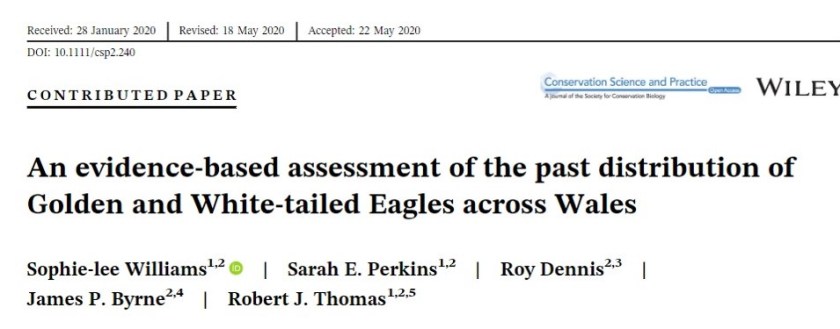
An important new scientific paper has just emerged documenting the history of golden and white-tailed eagles in Wales.

Published in the journal Conservation Science & Practice, this new paper builds on the earlier, painstaking work of the much missed Richard Evans who, along with colleagues (see here), mapped the historical distribution of eagles across Britain and Ireland.

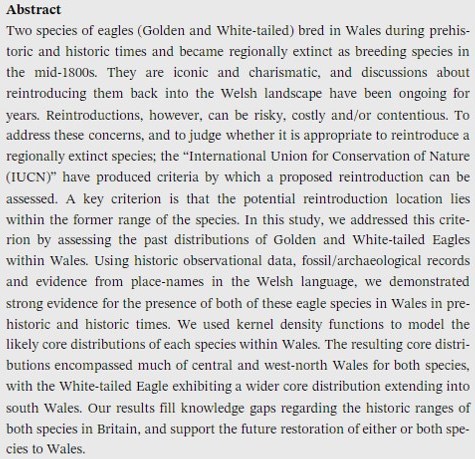
This latest paper, authored by Cardiff University PhD student Sophie-lee Williams et al, thoroughly evaluates the evidence for both species in Wales and maps their likely core distributions. The authors conclude there is strong evidence that both species were widespread across Wales but fell victim to persecution and haven’t bred there for over 150 years.

This paper is open access which means it is freely available to everyone.

Download it here: Williams et al 2020_Past distribution eagles Wales

The significance of this paper relates to a proposed reintroduction of golden and/or white-tailed eagles to Wales. Many blog readers will recall that this prospect has been on the table for a while and whilst there is still a lot more work to complete before licence applications are submitted, understanding the species’ past historical ranges is important.

Some blog readers may recognise some of the names involved in this latest research. They are part of the Eagle Reintroduction Wales Project (ERWP) (website here) who we blogged about last year when news emerged that a different team was also contemplating an eagle reintroduction in Wales, but apparently without the careful research assessment being undertaken by the Cardiff University team (see here). Fortunately, so far, that alternative approach hasn’t advanced very far (see here and here).

Hopefully it won’t be too long before we see more research results from the ERWP that’ll take us another step closer to restoring these eagles back to Wales.

Red Sixty Seven: show some love for the UK’s at risk birds

A new collaborative initiative is about to launch, aimed at raising awareness and funds to help protect the 67 vulnerable bird species currently listed on the UK Red List.

The brain-child of Kit Jewson (@yolobirder), the Red Sixty Seven book draws together 67 writers and 67 artists who have all donated their time and expertise so that 100% of the book profits can be shared between the RSPB and the British Trust for Ornithology (BTO) to further their work on red-listed species.

You can read more about the book on the BTO website (here) and there’s a good write-up in the Guardian (here).

You can pre-order the book (£19.99) here and it’ll be shipped just after Valentine’s Day on 14 February 2020.

You can buy other Red Sixty Seven merchandise here

You can get a preview of the 67 artworks and find out who has written a piece for which species here

The Red List (and thus the Red 67 book) includes three raptor species – white-tailed eagle, merlin and hen harrier:

Show some love, order your copy now!

JOB VACANCY: Sea Eagle Project Officer, Scotland

A rare and exciting opportunity to work with white-tailed eagles in Scotland on a six month full time contract as the RSPB’s Sea Eagle Project Officer in East Scotland.

The salary’s rubbish but nobody works in conservation to make a mint: £19,602-£21,236 pro rata.

Closing date for applications: 16 February 2020

Interview date: 27 February 2020

Job runs April – September 2020

For more details and application forms please click here


Special Constables pilot scheme in Cairngorms National Park a waste of time & money

Two and a half years ago, Environment Cabinet Secretary Roseanna Cunningham announced a pilot scheme whereby Police Special Constables would be deployed in the Cairngorms National Park to tackle wildlife crime.

This initiative was one of a number of measures announced in May 2017 in response to the findings of the golden eagle satellite tag review which showed clear evidence of deliberate and sustained illegal raptor persecution, particularly on some driven grouse moors in and around the Cairngorms National Park (CNP).

This RPUK map shows the last known location of satellite-tagged golden eagles that were either found illegally killed or had disappeared in suspicious circumstances in and around the CNP (data from the golden eagle satellite tag review):

Golden eagles are not the only victims of wildlife crime in and around the CNP. This RPUK map below, based mostly on RSPB data, shows raptor persecution incidents between 2005-2016. Only one of these (just outside the CNP boundary on Kildrummy Estate) has resulted in a successful prosecution. With such clear evidence of wildlife crime it’s easy to see why the CNP was chosen as the first location for this pilot scheme.

This pilot scheme was the Government’s alternative to extending the powers of the SSPCA to allow it to investigate a wider suite of wildlife crime (including raptor persecution) – a decision made after six years of Governmental deliberation under five different Environment Ministers.

It also emerged in 2018 that this pilot scheme was an alternative to the Government’s 2016 manifesto pledge to establish a Wildlife Crime Investigation Unit as part of Police Scotland – a pledge on which it has now reneged (see here).

The idea was that the police special constable scheme could be rolled out across Scotland “if judged to be successful” in the CNP, but we weren’t told the criteria that would be used to judge this ‘success’.

The scheme was formally launched in March 2018 (see here) and nothing more was heard of it.

Just over a year later in April 2019 we asked the Cairngorms National Park Authority the following questions about the scheme:

Here’s the response:

So basically after a year of operation, one of the main project partners couldn’t tell us anything about the scheme.

Fast forward six months to November 2019 and Scottish Greens MSP Mark Ruskell thought it was time more questions were asked. Here are his two Parliamentary questions and Roseanna Cunningham’s answers:

S5W-26349 Mark Ruskell (Mid Scotland and Fife) (Scottish Green Party): To ask the Scottish Government how much funding (a) it and (b) the Cairngorms National Park Authority allocated each year to the Wildlife Special Constables pilot project.

Roseanna Cunningham: The Scottish Government agreed to contribute £18,000 and the Cairngorms National Park Authority agreed to provide £10,000 for the Wildlife Special Constables pilot project.

S5W-26346 Mark Ruskell (Mid Scotland and Fife) (Scottish Green Party): To ask the Scottish Government what the outcome was of the Wildlife Special Constables pilot project; how many constables participated each month in this, and how many suspected crimes they reported, also broken down by how many led to subsequent (a) arrests, (b) charges, (c) prosecutions and (d) convictions.

Roseanna Cunningham: a)The Scottish Government is currently undertaking an evaluation of the Special Constable Pilot Project in conjunction with Police Scotland and the Cairngorms National Park Authority. We will announce a decision on the future direction of the project in due course.

b) There were five special constables in the project, employed on a part-time basis.

c) and d) From the information gathered in the review conducted by Police Scotland, there were no recorded crimes reported by the Special Constables during their patrols in the 12 month trial period. However, Special Constables were involved in meeting stakeholders and partners operating within the Cairngorms National Park to build relationships and understand the needs and demands of National Park users which will aid future intelligence gathering.

Gosh, it’s easy to see why the Scottish Government’s evaluation of the pilot scheme is taking so long, what with having to count ZERO reported wildlife crimes.

Meanwhile satellite tagged raptors continue to disappear in suspicious circumstances in the Cairngorms National Park (white-tailed eagle here; hen harrier here; hen harrier here and hen harrier here); birds are still being illegally poisoned in the Cairngorms National Park (here) and birds of prey are still being caught by illegally-set traps in the Cairngorms National Park (golden eagle here).

But it’s ok, nothing to worry about because £28K has just been spent on ‘building relationships and understanding the needs and demands of National Park users’.

FFS.

Tabloid hysteria over ‘giant psycho eagle’

We’re often asked by colleagues overseas why attitudes in the UK towards birds of prey are so ignorant and outdated.

Here’s one explanation – sensationalist nonsense being published in the media. We’ve seen this many times before, including here and here when the Scottish Gamekeepers Association were writing to the Scottish Government fearing that white-tailed eagles might eat children.

Here’s another classic example of unfounded hysteria from the last few days. This is an unsubstantiated story about an alleged eagle attack on a dog in Essex and unbelievably it made front page news! (Thanks to the blog reader who sent this photo).

At least three other tabloids also covered it:

Note the telling hallmarks of a tabloid story – the woman was pregnant, the alleged incident happened near a primary school, there was blood, the eagle was ‘giant’, it ‘almost blinded’ the dog and it was a ‘savage attack’.

The fact that there was no photographic evidence nor credible ID of the bird matters not, apparently. Some of the tabloids have illustrated the news article with a stock photo of a white-tailed eagle and others have mentioned golden eagles.

Meanwhile, the Irish Farmers Journal ran with an article recently, claiming that white-tailed eagles had been killing sheep:

In an unusual but welcome u-turn, the paper then ran with this follow-up article a couple of days ago after being contacted by Dr Allan Mee who has led the white-tailed eagle reintroduction project in Ireland since 2007. Well done, journalist Amy Forde and the editor of the Irish Farmers Journal for more measured, responsible reporting.