General Licence restriction on Leadhills Estate: some fascinating details

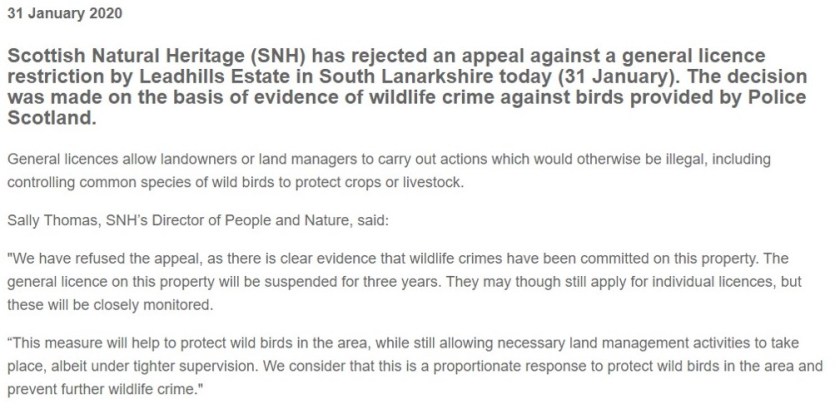
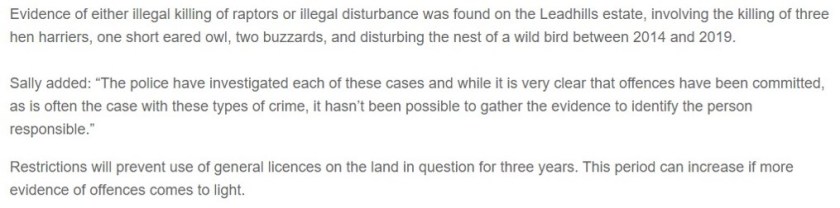
In November 2019, Scottish Natural Heritage (SNH) imposed a three-year General Licence restriction on Leadhills Estate in South Lanarkshire following ‘clear evidence from Police Scotland that wildlife crimes had been committed on this estate’ (see here, here, and here).

Those alleged offences included the ‘illegal killing of a short-eared owl, two buzzards and three hen harriers’ that were ‘shot or caught in traps’ on Leadhills Estate since 1 January 2014 (when SNH was first given powers to impose a General Licence restriction). SNH had also claimed that ‘wild birds’ nests had also been disturbed’, although there was no further detail on this. The estate consistently denied responsibility.

[The shot short-eared owl that was found shoved under some heather on the Leadhills Estate grouse moor. Photo by RSPB Scotland]

In December 2019 Leadhills Estate appealed against SNH’s decision to impose the General Licence restriction (see here) but on 31 January 2020 SNH announced that it had rejected the estate’s appeal and the General Licence restriction still stood (see here).

We were really interested in the details of Leadhills Estate’s appeal so a freedom of information request was submitted to SNH to ask for the documents.

The information released by SNH in response is fascinating. Some material hasn’t been released due to what appear to be legitimate police concerns about the flow of intelligence about wildlife crime in the Leadhills area but what has been released provides a real insight to what goes on behind the scenes.

First up is an eight page rebuttal from Leadhills Estate’s lawyers about why it thinks SNH was “manifestly unfair” to impose the General Licence restriction.

Download it here: Leadhills Estate appeal against GL restriction decision

Next comes SNH’s six-page rejection of the estate’s appeal and the reasons for that rejection.

Download it here: SNH rejects Leadhills Estate appeal against GLrestriction

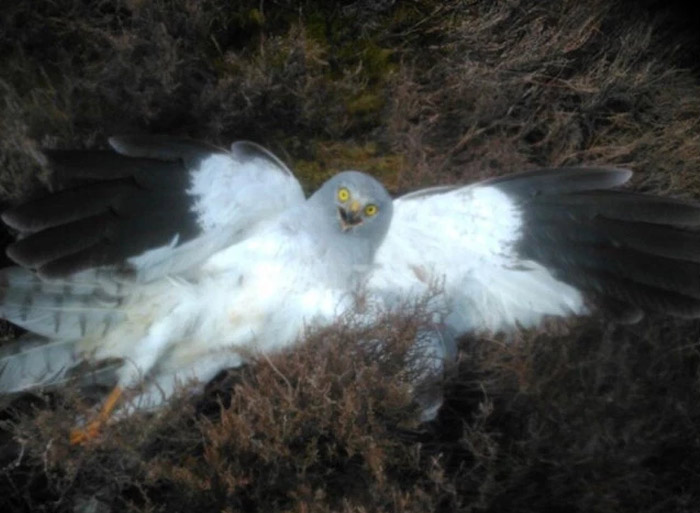
Prepare for some jaw-dropping correspondence from Leadhills Estate’s lawyers, including a discussion about how the raptor workers who found the hen harrier trapped by it’s leg in an illegally-set spring trap next to its nest last year ‘didn’t take steps to assist in the discovery of the suspect, which could have included placing a camera on the nest’.

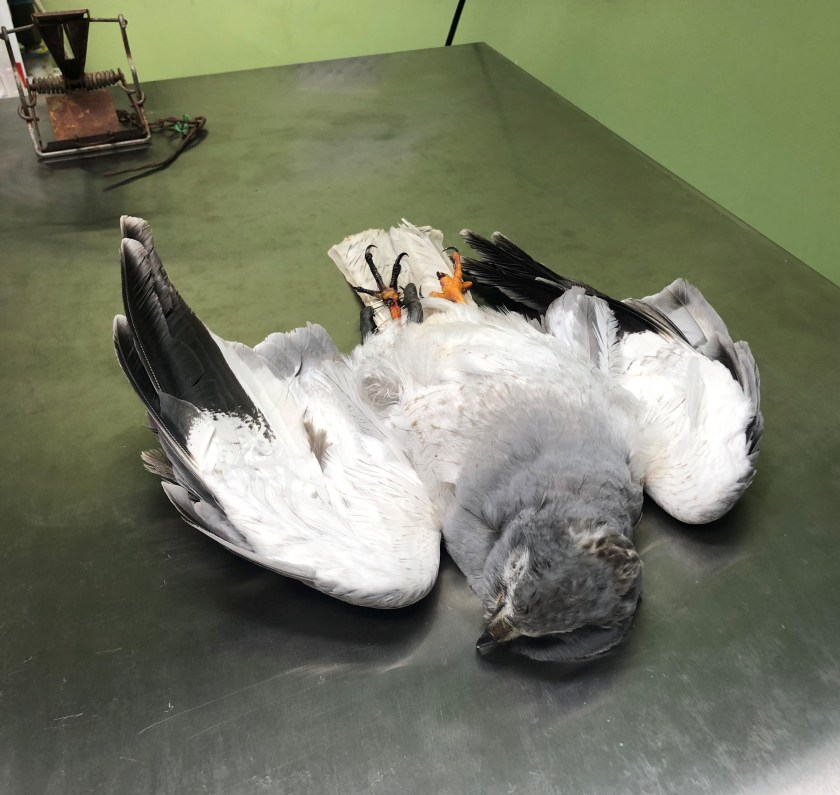
Are they for real??!! Can you imagine the uproar, had those raptor workers placed a camera pointing at the nest and identified a suspect who was subsequently charged? We’ve all seen how that scenario plays out, with video evidence dismissed as ‘inadmissible’ and the game-shooting lobby leering about the court victory. That Leadhills Estate is now arguing that the failure of the raptor workers to install covert cameras is reason for the estate to avoid a penalty is simply astonishing, although the next time covert video evidence is challenged in a Scottish court it’ll be useful to be able to refer to this estate’s view that such action would be deemed reasonable. Apart from anything else though, those raptor workers were too busy trying to rescue that severely distressed hen harrier from an illegally-set trap:

[The illegally trapped hen harrier. Photo by Scottish Raptor Study Group]

Other gems to be found within this correspondence include the news that a container of an illegal pesticide (Carbosulfan) was found on Leadhills Estate in May 2019 and contributed to SNH’s decision to impose the General Licence restriction (this information has not previously been made public – why not?) and that during a police search of the estate (sometime in 2019 but the actual date has been redacted) the police seized some traps. The details of why those traps were seized has also been redacted but SNH write, ‘Although this in itself does not establish criminality it certainly adds weight to our “loss of confidence” [in the estate]’.

The Estate claims that the alleged impartiality of the witnesses should have some bearing on proceedings but SNH bats this away with ease, saying that the evidence on which the restriction decision was made was provided by Police Scotland and that the partiality of witnesses has not been identified as a significant factor of concern for the police, and thus not for SNH either.

It’s also amusing to see the estate claim ‘full cooperation’ by the estate with police enquiries. SNH points out that this so-called ‘full cooperation’ was actually largely limited to “no comment” interviews!

We don’t get to say this very often but hats off to SNH for treating the estate’s appeal with the disdain which, in our opinion, it thoroughly deserves.

Meanwhile, following SNH’s decision in January to uphold the General Licence restriction on Leadhills Estate due to ‘clear evidence’ of wildlife crime, we’re still waiting for Scottish Land & Estates (SLE) to respond to our enquiries about whether Leadhills Estate is still a member and whether Lord Hopetoun of Leadhills Estate is still Chairman of SLE’s Scottish Moorland Group.


2018 worst year in more than a decade for illegal raptor persecution in England

Yesterday the RSPB published more data on its Raptor Persecution Map Hub, which now includes 12 years worth of searchable incidents. You can read about it here on the RSPB Investigations Team’s blog.

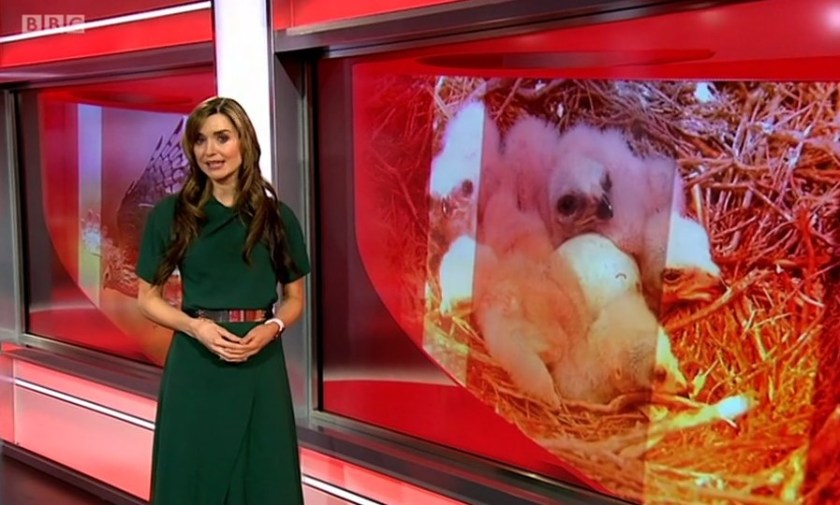
Coinciding with this release was a piece on the BBC’s Six O’Clock News followed up with a feature on BBC North West’s Inside Out programme.

The Inside Out programme is available to watch on iPlayer here for the next 29 days.

The feature runs for about ten minutes and includes interviews with the RSPB’s Investigations Team, North Yorkshire Police’s award-winning Wildlife Crime Officer Sgt Stu Grainger, and the Moorland Association’s top contortionist Amanda Anderson.

To be honest there’s nothing new here at all – it’s a well-rehearsed pantomime with claims made by the RSPB (based on evidential data) and counter-claims from the grouse shooting industry (pretending everything’s fine) but nevertheless, still well worth the airplay on national news that undoubtedly will have reached some people who’d previously been unaware of the level of criminality on many of the grouse moors of northern England.

The journalist, Gareth Barlow, did a reasonable job although just lacked the killer questions that would have exposed the Moorland Association’s nonsense with ease. For example, he picked up that 2018 was the worst year for recorded raptor persecution crimes in over a decade but he let Amanda Anderson get away with some snakeish slithering around the facts, as follows:

Gareth Barlow:A study from last year of data trackers showed that hen harriers are ten times more likely to die or disappear over land associated with grouse moors. How do you react to that data?”

Amanda Anderson:The study of tagged birds up to 2017 raises considerable issues. But actually since then 2018 saw 34 fledged hen harrier chicks in England and last year a record-breaking 47 chicks fledged, mostly from grouse moors“.

Let’s just analyse Amanda’s response. A casual and uninformed listener might think that, based on what she said, the grouse shooting industry has cleaned up its act since 2017, with ‘record-breaking’ [ahem] numbers of chicks fledging and everything’s fine now, nothing to see here, move along, gamekeepers love hen harriers too and the killing has stopped. But what happens to those ‘record-breaking’ number of fledged hen harriers once they leave the nest?

What Amanda ‘forgot’ to mention was the long list of satellite-tagged hen harriers that have either vanished in suspicious circumstances or been found illegally shot or trapped or poisoned, mostly on or close to land managed for game bird shooting, since 2018 (and since DEFRA’s so-called Hen Harrier Action Plan was enacted):

February 2018: Hen harrier Saorsa ‘disappeared’ in the Angus Glens in Scotland (here). The Scottish Gamekeepers Association later published false information claiming the bird had been re-sighted. The RSPB dismissed this as “completely false” (here).

5 February 2018: Hen harrier Marc ‘disappeared’ on a grouse moor in Durham (here)

9 February 2018: Hen harrier Aalin ‘disappeared’ on a grouse moor in Wales (here)

March 2018: Hen harrier Blue ‘disappeared’ in the Lake District National Park (here)

March 2018: Hen harrier Finn ‘disappeared’ near Moffat in Scotland (here)

18 April 2018: Hen harrier Lia ‘disappeared’ in Wales and her corpse was retrieved in a field in May 2018. Cause of death was unconfirmed but police treating death as suspicious (here)

8 August 2018: Hen harrier Hilma ‘disappeared’ on a grouse moor in Northumberland (here).

16 August 2018: Hen harrier Athena ‘disappeared’ on a grouse moor in Scotland (here)

26 August 2018: Hen Harrier Octavia ‘disappeared’ on a grouse moor in the Peak District National Park (here)

29 August 2018: Hen harrier Margot ‘disappeared’ on a grouse moor in Scotland (here)

29 August 2018: Hen Harrier Heulwen ‘disappeared’ on a grouse moor in Wales (here)

3 September 2018: Hen harrier Stelmaria ‘disappeared’ on a grouse moor in Scotland (here)

24 September 2018: Hen harrier Heather ‘disappeared’ on a grouse moor in Scotland (here)

2 October 2018: Hen harrier Mabel ‘disappeared’ on a grouse moor on the edge of the Yorkshire Dales National Park (here)

3 October 2018: Hen Harrier Thor ‘disappeared’ next to a grouse moor in Bowland, Lanacashire (here)

26 October 2018: Hen harrier Arthur ‘disappeared’ on a grouse moor in the North York Moors National Park (here)

10 November 2018: Hen harrier Rannoch ‘disappeared’ on a grouse moor in Scotland (here). Her corpse was found nearby in May 2019 – she’d been killed in an illegally-set spring trap (here).

14 November 2018: Hen harrier River ‘disappeared’ on a grouse moor in the Nidderdale AONB (here). Her corpse was found nearby in April 2019 – she’d been illegally shot (here).

16 January 2019: Hen harrier Vulcan ‘disappeared’ in Wiltshire close to Natural England’s proposed reintroduction site (here)

7 February 2019: Hen harrier Skylar ‘disappeared’ next to a grouse moor in South Lanarkshire (here)

22 April 2019: Hen harrier Marci ‘disappeared’ on a grouse moor in the Cairngorms National Park (here)

11 May 2019: A male hen harrier was caught in an illegally-set trap next to his nest on a grouse moor in South Lanarkshire. He didn’t survive (here)

7 June 2019: A hen harrier was found dead on a grouse moor in Scotland. A post mortem stated the bird had died as a result of ‘penetrating trauma’ injuries and that this bird had previously been shot (here)

11 September 2019: Hen harrier Romario ‘disappeared’ on a grouse moor in the Cairngorms National Park (here)

10 October 2019: Hen harrier Ada ‘disappeared’ on a grouse moor in the North Pennines AONB (here)

12 October 2019: Hen harrier Thistle ‘disappeared’ on a grouse moor in Sutherland (here)

November 2019: Hen harrier Mary found illegally poisoned on a pheasant shoot in Ireland (here)

There are two more satellite-tagged hen harriers (Tony & Rain) that are reported either confirmed or suspected to have been illegally killed in the RSPB’s Hen Harrier LIFE Project Report but no further details are available.

And then there were last year’s brood meddled hen harrier chicks that have been reported ‘missing’ but as they’re carrying a new type of tag known to be unreliable it’s not known if they’ve been bumped off or if they’re still ok. For the purposes of this mini-analysis we will discount these birds.

So that makes a total of at least 29 hen harriers that are known to have either ‘disappeared’ in suspicious circumstances or have been found illegally killed in the last two years, during the period that Amanda Anderson was suggesting the killing had stopped.

That’s a lot of incidents for Amanda to ‘forget’ to mention, isn’t it?

And we’re supposed to trust the Moorland Association when it claims to have ‘zero tolerance’ for raptor persecution!

New rules for bird traps in Scotland

Last week Scottish Natural Heritage (SNH) published some information about its proposed changes to the General Licences, effective from 1 April 2020.

Some of those changes include the removal of some bird species from some licences, and the removal of General Licences from some protected areas (to be replaced by individual licences) but we don’t intend to comment on any of that just now as Wild Justice’s legal team is currently evaluating the lawfulness of the proposals.

However, the news that ravens would NOT be added to the General Licences is very welcome, although we are hearing rumours that the so-called Strathbraan Community Collaboration for Waders (basically a load of gamekeepers) and GWCT might be preparing another application for a specific licence to kill ravens in Strathbraan. Freedom of Information requests have been submitted and we’ll keep you posted.

A considerable war chest is still available from the legal challenge made against the Strathbraan raven cull in 2018 and these funds are ring-fenced which means another legal challenge can be launched with immediate effect if necessary.

Another welcome aspect of SNH’s 2020 General Licences is the decision to register individual operators of bird traps.

[A multi-catch crow cage trap, baited with a live decoy bird and used to capture hundreds of birds which are then killed, often by being beaten to death with a stick. Photo by OneKind]

Previously in Scotland, the General Licence conditions have stated that live-catch corvid traps (e.g. Larsen traps, Larsen mate traps and multi-catch crow cage traps) have to display an identification number of the trap owner, but this number does not identify an individual trap operator, only the owner, typically the landowner or sporting agent. So if an alleged breach/offence has been detected, and the trap is located on a large grouse shooting estate where multiple gamekeepers are employed, it has been virtually impossible for the Police to identify an individual suspect (and thus charge anyone) because the estate and gamekeepers simply close rank, offer a ‘no comment’ response and fail to identify the actual trap user.

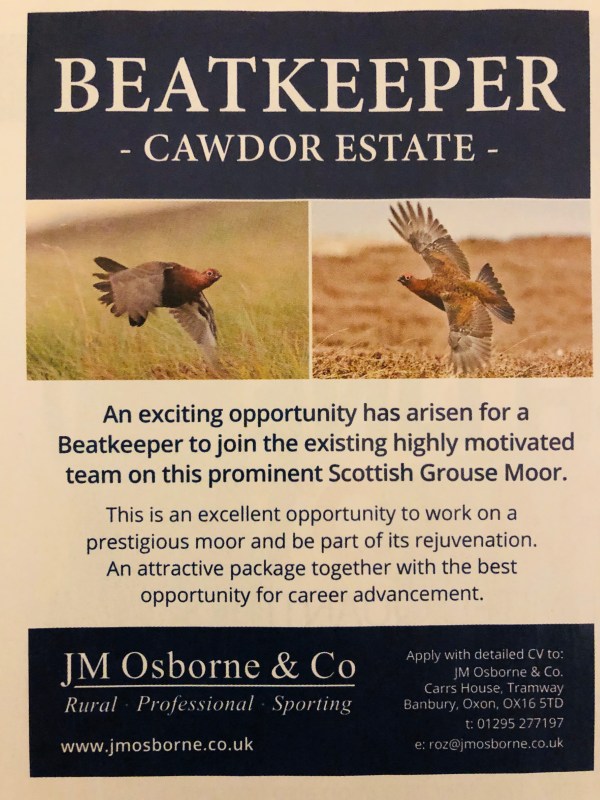
In reality this situation is laughable because very often on large shooting estates gamekeepers are employed specifically to manage a delineated area of an estate, known as a ‘beat’. Their job title is even ‘beatkeeper’ (as illustrated in this January 2020 advert, below) so the idea that, when an alleged offence has been discovered, an individual trap operator at a particular location on an estate can’t be identified is what might be called taking the piss.

Nevertheless, this apparent inability to identify a named suspect has happened time and time and time again, as regular blog readers will be only too aware. It’s why we (e.g. here) and especially the RSPB (e.g. here) have been campaigning for years to have this loophole closed.

The new registration requirements in the 2020 Scottish General Licences still don’t go far enough – there should at least be a requirement for trap operators to submit annual returns so that SNH, and others, can monitor the number of birds killed. But nevertheless, the requirement for individual trap users to be registered is a big step in the right direction. And this level of improved accountability, although still lacking, is way ahead of the General Licences in England and Wales as documented in this timely blog from the RSPB today.

For further information on the Scottish General Licences 2020 see these documents prepared by SNH:

General Licensing Changes Summary – February 2020

General Licensing Changes FAQs – February 2020

Crowdfunding appeal: Justice for Hen Harriers (the appeal)

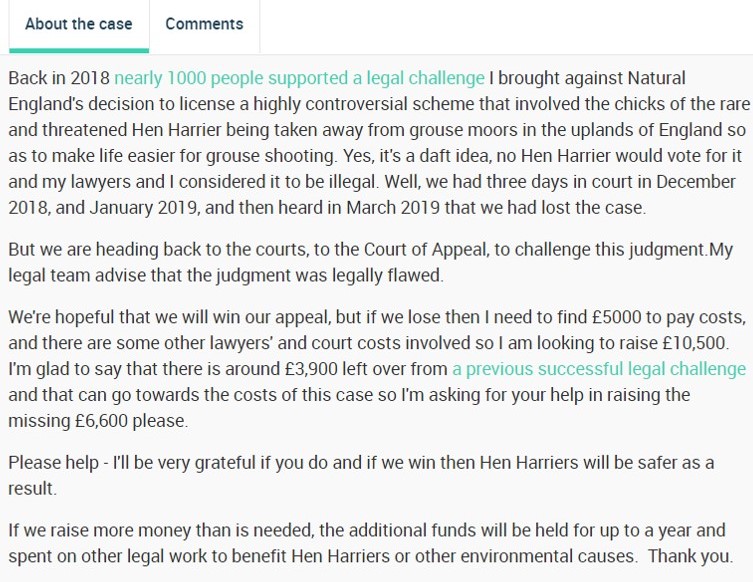
Mark Avery’s legal appeal against Natural England’s ludicrous hen harrier brood meddling scheme comes back to court in March (alongside the RSPB’s legal appeal).

Brood meddling is a pointless, costly exercise designed as a sop to the grouse shooting industry. Taking hen harrier eggs/chicks from a grouse moor, rearing them in captivity, then releasing them back in to the uplands will not stop those same hen harriers being illegally killed when they visit another grouse moor.

A bit like this one last year, caught by his leg in an illegally-set trap next to his nest, his leg almost severed. He didn’t survive, despite the best efforts of the Scottish Raptor Study Group and the Scottish SPCA.

[Photo by Ruth Tingay]

Mark has launched a crowdfunding appeal to help cover the costs of his legal appeal. Here’s what he says about it:

The target is £10,500. If you can help please visit the crowdfunder page HERE

Thanks!

Leadhills Estate loses appeal against General Licence restriction

Well this is very welcome news.

The Leadhills (Hopetoun) Estate in South Lanarkshire has lost its appeal to Scottish Natural Heritage (SNH) against a General Licence restriction which had been imposed on the estate after ‘clear evidence of wildlife crime’ was found on the grouse moor.

A quick re-cap:

In late November 2019 Scottish Natural Heritage (SNH) imposed a three-year General Licence restriction on Leadhills Estate, South Lanarkshire, after receiving what it described as “clear evidence” of wildlife crimes from Police Scotland (see herehere and here).

Those alleged offences included the ‘illegal killing of a short-eared owl, two buzzards and three hen harriers’ that were ‘shot or caught in traps’ on Leadhills Estate since 1 January 2014 (when SNH was first given powers to impose a General Licence restriction). SNH had also claimed that ‘wild birds’ nests had also been disturbed’, although there was no further detail on this. The estate has consistently denied responsibility.

[This male hen harrier was found with its leg almost severed, caught in an illegally-set trap next to its nest on Leadhills Estate in 2019. Despite valiant efforts by a top wildlife surgeon, the bird didn’t survive. Photo by Ruth Tingay]

On 10 December 2019 SNH lifted the General Licence restriction due to an on-going appeal by Leadhills Estate against the decision (see here), which meant the estate’s gamekeepers could go back to killing as many so-called ‘pest’ bird species as they liked, under General Licences 1,2 & 3, without any monitoring or reporting requirements whatsoever.

Today, SNH has completed the appeals process and has upheld its original decision to impose the General Licence restriction on Leadhills Estate. SNH issued the following statement:

This General Licence restriction will now remain in place on Leadhills Estate until 26 November 2022, unless the estate tries to challenge SNH’s process via Judicial Review. It means that the estate can continue to kill so-called pest species but it can only do so if SNH grants individual licences to the gamekeepers which will prescribe terms and conditions of use and include a requirement to report on the number and species killed. The estate will also be subject to unnanounced visits by SNH staff to check compliance.

This is a feeble sanction for ‘clear evidence’ of wildlife crime. Although from our point of view it is better than nothing as we can now access any individual licences and the subsequent returns via FoI and gain a better insight in to the extent of [lawful] wildlife killing on this estate.

Of course, had an estate licensing scheme been in place, as recommended by the Werritty Review, Leadhills Estate may well now have been facing a period where it was not permitted to shoot red grouse for a number of years.

Also of great interest to us, now that Leadhills Estate has lost its appeal, is the ongoing relationship between Leadhills (Hopetoun) Estate and Scottish Land & Estates, the moorland owners lobby group in Scotland. We’ve discussed this before (here) – Leadhills is a member of SLE and Lord Hopetoun is Chair of SLE’s Scottish Moorland Group, which is involved in the Gift of Grouse propaganda campaign etc.

We’d like to hear from SLE about whether Leadhills Estate will now be ejected as a member and if not, why not? We’d also like to hear whether Lord Hopetoun will continue as Chair of the Scottish Moorland Group.

Watch this space.

Decision due on General Licence restriction for Leadhills Estate

On 26 November 2019 Scottish Natural Heritage (SNH) imposed a three-year General Licence restriction on Leadhills Estate, South Lanarkshire, after receiving what it described as “clear evidence” of wildlife crimes from Police Scotland (see herehere and here).

Those alleged offences included the ‘illegal killing of a short-eared owl, two buzzards and three hen harriers’ that were ‘shot or caught in traps’ on Leadhills Estate since 1 January 2014 (when SNH was given the power to impose a General Licence restriction on estates or individuals in Scotland). SNH also claimed that ‘wild birds’ nests had also been disturbed’, although no further detail was provided. The estate has consistently denied responsibility and implied it was the work of ‘bird of prey activists‘.

[This adult male hen harrier was found with his leg clamped in an illegally-set spring trap next to a nest on Leadhills Estate in May 2019. His leg was almost severed and despite the valiant efforts of a world-class wildlife vet, he had to be euthanised]

The General Licence restriction was supposed to be in place for three years but it lasted only 14 days. On 10th December 2019 SNH lifted the restriction because Leadhills Estate had chosen to appeal the decision to restrict.

According to SNH policy, an appeal has the immediate effect of suspending the General Licence restriction from the date SNH receives the appeal letter. SNH then has to consider the appeal and must notify the estate of the appeal outcome in writing, setting out the reasons behind the decision. SNH policy guidelines state it will seek do this within four weeks of receiving the appeal letter.

Those four weeks are now up (Tues 7th Jan was the four week marker) although there was the Xmas break to consider so perhaps it’ll take a bit longer. Although to be frank it shouldn’t take any time at all to reach a decision. SNH has already been through an appeals procedure with the estate – as per SNH policy – when SNH first notified Leadhills that a General Licence restriction was being considered. Leadhills Estate then had an opportunity to state its case and explain why a restriction shouldn’t be made. In this case, SNH chose to crack on and imposed the restriction based on the ‘clear evidence’ of wildlife crime provided to SNH by Police Scotland. Why there now has to be a second appeal process is anyone’s guess.

Maybe it’ll catch on. Maybe suspects at a police station, having had an opportunity to defend themselves before a charge is laid, will then be given a further 14 days after the charge has been laid to appeal the charging decision all over again and by doing so can have the original charge lifted for at least four weeks while the police/CPS consider the second appeal. It’s genius.

It’s quite likely that a lot of people will be paying close attention to SNH’s decision on whether or not to reinstate the General Licence restriction at Leadhills Estate, not least grouse moor owners’ lobby group Scottish Land and Estates (SLE). Leadhills Estate is a member of SLE and Lord Hopetoun of Leadhills Estate is Chair of SLE’s Moorland Group. So far, SLE has not commented publicly on this fascinating relationship.

Top ten most read RPUK blogs in 2019

Thanks for all your continued interest and support in 2019….it’s been another very busy year.

Here are the top ten most read RPUK blogs over the last 12 months:

  1. Young golden eagle flying around Cairngorms National Park with an illegal trap clamped to its leg (here)
  2. Two more golden eagles go ‘missing’, on the same morning, on the same Scottish grouse moor (here)
  3. Chris Packham targeted (here)
  4. Hen harrier suffers savage brutality of an illegally-set trap on a Scottish grouse moor (here)
  5. Convicted Scottish gamekeeper Alan Wilson and his litany of wildlife crimes (here)
  6. More detail emerges about SSPCA/Police Scotland raid at Millden Estate (here)
  7. Disgusting display of savagery on Yorkshire grouse moor (here)
  8. Monumentally inadequate sentence for convicted Scottish gamekeeper Alan Wilson (here)
  9. Hen harrier reintroduction to southern England: Natural England suggests persecution not an issue (here)
  10. At least 72% satellite tagged hen harriers presumed illegally killed on grouse moors (here)

The blog will reach its ten year milestone in March 2020.

Happy New Year!

Werritty Review: response from RSPB Scotland

Press release from RSPB Scotland (19 December 2019) in response to today’s publication of the Werritty Review on grouse moor management in Scotland.

Independent grouse moor review does not go far or fast enough to tackle raptor crimes

We support the recommendations relating to regulation of muirburn and better safeguards for mountain hare populations, however regret that panel behind the report has not been bold enough to recommend the immediate licensing of driven grouse moors.

Previously Scottish Government Ministers have publicly stated that driven grouse moor owners are ‘in the last chance saloon’, and we now expect these commitments to be honoured.

Given the overwhelming evidence of serious organised crimes perpetrated against our birds of prey, as well as the harm caused to upland habitats and species by grouse moor management practices, we will be asking the Cabinet Secretary to consider the ‘wider societal views’ mentioned by Professor Werritty and make the necessary ‘step change’ to grouse moor licensing, conditional on legal and sustainable practices, and to ensure that this is done as soon as possible. A licensing framework would in our view set a new direction for the legal and sustainable management for large areas of our upland landscapes, as well as providing a meaningful deterrent to wildlife crime.

[Photo: satellite-tagged hen harrier Rannoch was found on a Perthshire grouse moor earlier this year – her leg had been caught in an illegally-set spring trap so she’ll have suffered an horrendous death. Photo by RSPB Scotland]

Duncan Orr-Ewing, Head of Species and Land Management at RSPB Scotland, said: “We commend Professor Werritty and his panel for pulling together such a significant volume of scientific evidence and stakeholder testimony which we will consider in detail. However, we are concerned that more urgency is now needed to address the criminality and poor land management practices on Scottish grouse moors that have been highlighted for decades.

It is very important to remember that the background to this review was the overwhelming evidence base of the link between serious organised wildlife crime and grouse moor management; the ever-intensifying management of this land to produce excessive grouse bags leading to the killing of protected wildlife; as well as public concerns about huge culls of mountain hares; and burning of heather on deep peatland soils. Addressing these issues is now even more essential to combat both the climate emergency and nature crisis, which were confirmed as priorities by First Minister Nicola Sturgeon earlier this year.

Duncan added: “The illegal killing of Scotland’s birds of prey simply has to stop. Those perpetrating these criminal acts have shown no willingness over decades to change their criminal behaviours. Letting this issue languish for another half decade will not help, and we fully expect more prevarication. Even whilst this review has been underway serious and well-publicised wildlife crimes have continued unabated, and delay fails to acknowledge the most urgent circumstances which led to its commission. The Scottish public have had enough. It is now vital that the next steps by Scottish Government are sufficient to bring closure to these appalling incidents, which blight Scotland’s international reputation.”

ENDS

Notes:

  1. It is now 20 years since Scotland’s first First Minister, Donald Dewar, described raptor persecution as a “national disgrace”. Subsequently successive Environment Ministers have promised to take firm action if illegal behaviours on grouse moors are not stopped.
  2. The formation of the Werritty Grouse Moor Review Group was announced by the Cabinet Secretary, Roseanna Cunningham MSP, in May 2017, following the publication of a Government-commissioned report examining the fates of satellite-tagged golden eagles. This report showed that of 131 birds tracked between 2004-16, 41 disappeared in ‘suspicious circumstances’, primarily on land managed as driven grouse moors. This was the latest in a succession of scientific reports that have conclusively demonstrated the harm that grouse moor management is causing to various bird of prey species and to mountain hare populations. Scientific reports have also confirmed the damage caused by muirburn (burning of heather on open moor) to Scotland’s peat soils – which act as vital carbon stores and are critical to combating climate change.
  3. RSPB Scotland has made the case to the Review Group that grouse moors should be licensed with the sanction to remove licences to operate where raptor and other wildlife crime is occurring to the satisfaction of the public authorities. This action would act as a genuine deterrent to wildlife crime.
  4. RSPB Scotland has also called for the cessation of large-scale mountain hare culls and muirburn on peatland soils. RSPB Scotland believes that licensing of grouse moors should also put in place a framework involving all stakeholders to protect these important public interests in the way our upland landscapes are managed in the future.

SNH reinstates General Licence use on Leadhills Estate during appeal process

In late November 2019 Scottish Natural Heritage (SNH) imposed a three-year General Licence restriction on Leadhills Estate, South Lanarkshire, after receiving what it described as “clear evidence” of wildlife crimes from Police Scotland (see here, here and here).

Those alleged offences included the ‘illegal killing of a short-eared owl, two buzzards and three hen harriers’ that were ‘shot or caught in traps’ on Leadhills Estate since 1 January 2014 (when SNH was given the power to impose a General Licence restriction on estates or individuals in Scotland). SNH has also claimed that ‘wild birds’ nests have also been disturbed’, although there is no further detail on this. The estate has consistently denied responsibility.

[The body of a shot short-eared owl that was found shoved under some heather on Leadhills Estate in May 2017. Photo by RSPB Scotland]

The General Licence restriction was imposed on Leadhills Estate on 26 November 2019.

It lasted for just 14 days.

On 10 December 2019, a notice appeared on SNH’s website announcing that the restriction had been lifted due to an on-going appeal:

This means that Leadhills Estate can, until further notice, go back to using General Licences 1, 2 & 3 to lawfully kill hundreds if not thousands of certain bird species (e.g. crows) on the estate without having to report its activities to anybody.

Leadhills Estate is perfectly entitled to appeal SNH’s decision to impose the General Licence restriction. SNH has a clearly-explained policy on its appeals procedure, which states an appeal must be made within 14 days of SNH’s decision to impose the restriction and that appeal must be in writing. From the information available in the public domain it looks like Leadhills Estate has met this deadline.

An appeal has the immediate effect of suspending the General Licence restriction from the date SNH receives the appeal letter. SNH now has to consider the appeal and must notify the estate of the appeal outcome in writing, setting out the reasons behind the decision. SNH says it will seek do this within four weeks of receiving the appeal letter.

We’ll be monitoring this case very carefully.

There’s quite a lot of deja vu going on here. You might remember that Raeshaw Estate (Scottish Borders) was one of the first to be slapped with a General Licence restriction back in November 2015 (see here). That restriction only lasted for six days before the estate appealed (see here). The appeal failed and two and half months later the General Licence restriction was re-imposed on the estate (see here).

However, a couple of months later the General Licence restriction was suspended again when Raeshaw Estate took SNH to judicial review (see here). Raeshaw lost the judicial review when the court decided SNH had acted fairly so the General Licence restriction was re-instated on the estate, again, approximately one year later (see here). Interestingly, SNH did not backdate the restriction order so effectively Raeshaw Estate didn’t serve a full three-year restriction at all, thanks to all the legal disruption.

During this time Raeshaw employees also applied for individual licences to permit the continued killing of birds on the estate (e.g. 1,000 birds reported killed under one of these licences, see here), but then even the individual licence was revoked after SNH found ‘multiple instances of breaches of conditions of an individual licence that had been granted to cover essential management activities‘ (see here). SNH also said ‘These breaches may also constitute offences under the Wildlife and Countryside Act, so SNH has reported the details to Police Scotland‘. We’re not aware of any pending prosecution in relation to these alleged offences. And SNH chose not to extend the General Licence restriction further, in light of these breaches, even though it had the powers to do so (see here).

The link between Raeshaw Estate and Leadhills Estate, apart from them both being grouse shooting estates and the subject of a General Licence restriction for ‘clear evidence of wildlife crime’? Leading sporting agent and grouse moor ‘guru’ Mark Osborne, whose company J M Osborne & Co is believed to be involved at both estates (involved as in ‘present’, not involved as in ‘guilty of wildlife crime’ – SNH has made clear that a General Licence restriction does not infer responsibility for the commission of crimes on any individuals).

Also of interest, to us at least, is the ownership of Leadhills Estate, which has belonged to the same family (the Hopetouns) for more than 300 years, according to the estate’s website:

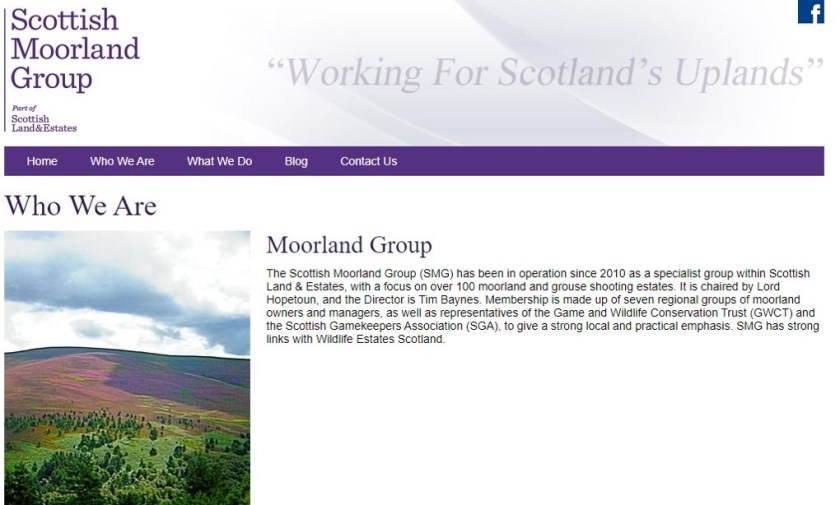
It’s also of great interest that not only is Leadhills Estate a member of Scottish Land & Estates (who, incidentally, have said absolutely nothing about this General Licence restriction so far), but that Lord Hopetoun is chair of Scottish Land & Estate’s Scottish Moorland Group:

If Leadhills Estate’s appeal fails and SNH re-instates the General Licence restriction, we’ll be expecting a full response from both Scottish Land & Estates and the Scottish Moorland Group.

UPDATE 9 January 2020: Decision due on General Licence restriction for Leadhills Estate (here)

Special Constables pilot scheme in Cairngorms National Park a waste of time & money

Two and a half years ago, Environment Cabinet Secretary Roseanna Cunningham announced a pilot scheme whereby Police Special Constables would be deployed in the Cairngorms National Park to tackle wildlife crime.

This initiative was one of a number of measures announced in May 2017 in response to the findings of the golden eagle satellite tag review which showed clear evidence of deliberate and sustained illegal raptor persecution, particularly on some driven grouse moors in and around the Cairngorms National Park (CNP).

This RPUK map shows the last known location of satellite-tagged golden eagles that were either found illegally killed or had disappeared in suspicious circumstances in and around the CNP (data from the golden eagle satellite tag review):

Golden eagles are not the only victims of wildlife crime in and around the CNP. This RPUK map below, based mostly on RSPB data, shows raptor persecution incidents between 2005-2016. Only one of these (just outside the CNP boundary on Kildrummy Estate) has resulted in a successful prosecution. With such clear evidence of wildlife crime it’s easy to see why the CNP was chosen as the first location for this pilot scheme.

This pilot scheme was the Government’s alternative to extending the powers of the SSPCA to allow it to investigate a wider suite of wildlife crime (including raptor persecution) – a decision made after six years of Governmental deliberation under five different Environment Ministers.

It also emerged in 2018 that this pilot scheme was an alternative to the Government’s 2016 manifesto pledge to establish a Wildlife Crime Investigation Unit as part of Police Scotland – a pledge on which it has now reneged (see here).

The idea was that the police special constable scheme could be rolled out across Scotland “if judged to be successful” in the CNP, but we weren’t told the criteria that would be used to judge this ‘success’.

The scheme was formally launched in March 2018 (see here) and nothing more was heard of it.

Just over a year later in April 2019 we asked the Cairngorms National Park Authority the following questions about the scheme:

Here’s the response:

So basically after a year of operation, one of the main project partners couldn’t tell us anything about the scheme.

Fast forward six months to November 2019 and Scottish Greens MSP Mark Ruskell thought it was time more questions were asked. Here are his two Parliamentary questions and Roseanna Cunningham’s answers:

S5W-26349 Mark Ruskell (Mid Scotland and Fife) (Scottish Green Party): To ask the Scottish Government how much funding (a) it and (b) the Cairngorms National Park Authority allocated each year to the Wildlife Special Constables pilot project.

Roseanna Cunningham: The Scottish Government agreed to contribute £18,000 and the Cairngorms National Park Authority agreed to provide £10,000 for the Wildlife Special Constables pilot project.

S5W-26346 Mark Ruskell (Mid Scotland and Fife) (Scottish Green Party): To ask the Scottish Government what the outcome was of the Wildlife Special Constables pilot project; how many constables participated each month in this, and how many suspected crimes they reported, also broken down by how many led to subsequent (a) arrests, (b) charges, (c) prosecutions and (d) convictions.

Roseanna Cunningham: a)The Scottish Government is currently undertaking an evaluation of the Special Constable Pilot Project in conjunction with Police Scotland and the Cairngorms National Park Authority. We will announce a decision on the future direction of the project in due course.

b) There were five special constables in the project, employed on a part-time basis.

c) and d) From the information gathered in the review conducted by Police Scotland, there were no recorded crimes reported by the Special Constables during their patrols in the 12 month trial period. However, Special Constables were involved in meeting stakeholders and partners operating within the Cairngorms National Park to build relationships and understand the needs and demands of National Park users which will aid future intelligence gathering.

Gosh, it’s easy to see why the Scottish Government’s evaluation of the pilot scheme is taking so long, what with having to count ZERO reported wildlife crimes.

Meanwhile satellite tagged raptors continue to disappear in suspicious circumstances in the Cairngorms National Park (white-tailed eagle here; hen harrier here; hen harrier here and hen harrier here); birds are still being illegally poisoned in the Cairngorms National Park (here) and birds of prey are still being caught by illegally-set traps in the Cairngorms National Park (golden eagle here).

But it’s ok, nothing to worry about because £28K has just been spent on ‘building relationships and understanding the needs and demands of National Park users’.

FFS.