Norfolk gamekeeper faces series of raptor persecution charges

A Norfolk gamekeeper is facing seven charges of alleged wildlife crime.

Allen Lambert, 64, of Stody, near Melton Constable, has been charged with killing 16 wild birds (14 buzzards, 1 sparrowhawk and 1 tawny owl), possession of nine birds (buzzards), failure to comply with a firearms certificate, and four counts of possession and storage of banned poisons (Aldicarb and Mevinphos).

The alleged offences took place between January and April 2013.

Lambert is currently on bail and will appear before King’s Lynn Magistrates court on Thursday (19th Dec).

News articles here and here

North Yorks still worst place for raptor persecution in 2012

The RSPB has published its 2012 Birdcrime report documenting bird persecution throughout the UK.

North Yorkshire has once again come top of the league for the number of reported crimes against birds of prey (34), with Aberdeenshire a close second with 31 reported incidents. Both counties, of course, include large areas of land used for driven grouse shooting.

The 2012 report includes statistics that are all too familiar: confirmed shootings of short-eared owls, sparrowhawks, buzzards, barn owls, tawny owls, hen harriers, golden eagles, marsh harriers, and peregrines; confirmed nest destruction of peregrines, goshawks and barn owls; confirmed illegal spring-trapping of buzzards, golden eagle and peregrine; other types of illegal trapping (including crow cage traps) of sparrowhawks, tawny owls, buzzards and goshawks; and the confirmed illegal poisoning of ravens, red kites, buzzards, golden eagles, marsh harriers, peregrines, cats and dogs.

Remember, these are just the confirmed incidents. Plenty more ‘probable’ and ‘unconfirmed’ cases, and of course there are all the incidents that went undiscovered/unreported.

Does that sound to you like the game-shooting industry is cleaning up its act?

Well done to the RSPB for their meticulous work and especially for their willingness to share these data with the general public.

RSPB press release here

Download the RSPB’s 2012 Birdcrime report here

The photograph shows the shot hen harrier Bowland Betty, found on a North Yorkshire grouse moor in 2012. Nobody has been brought to justice for her death.

Another Scottish gamekeeper accused of alleged wildlife crimes

The trial of a Scottish gamekeeper accused of a series of alleged wildlife and animal welfare crimes has been adjourned until later this month.

49-year old gamekeeper James Marsh, of Middle Ballewan near Blanefield, Stirling is facing trial for offences alleged to have taken place near Duntreath Castle in April 2012.

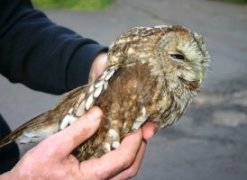
We understand the charges include the trapping of a Tawny Owl in a Larsen trap and related welfare offences, and various other charges relating to the possession of a Jay and associated welfare offences.

Marsh denies the charges.

His trial at Stirling Sheriff Court was adjourned in mid-November and will next be heard on 19th December.

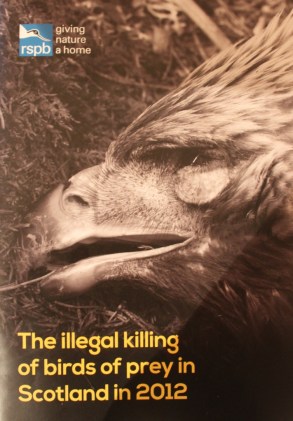
RSPB Scotland publishes 2012 persecution report

sam4RSPB Scotland has today published its annual persecution report which documents the known and suspected incidents of  illegal raptor killing throughout Scotland in 2012.

It’s a shame it’s taken so long to get it published, but that minor criticism aside, massive kudos and appreciation to them for their continued meticulous collection of these data and especially their willingness to publish them. Without these reports the general public, and probably the government, would be unaware of exactly what’s going on in our countryside. If we relied upon the ‘official’ figures (i.e. those ‘approved’ by the likes of Scottish Land & Estates, the Scottish Gamekeepers’ Association, Police Scotland etc) we wouldn’t know the half of it.

The 2012 report, just like all the previous 18 reports, makes for grim reading. Sure, it documents a reduction in the number of birds known to have been illegally poisoned last year; some people (guess who?) have spent much of 2013 shouting about this as being evidence of the game-shooting industry cleaning up its act – we know better – the 2013 figures (to date) show no such reduction and in fact show an increase in known poisoning incidents…but more of that next year. Let’s focus on the 2012 report for now.

Three things caught our attention in this report. The first thing was the Foreword by Stuart Housden, RSPB Scotland Director. This is the hardest-hitting Foreword of his that we’ve read. In the past it’s been a bit wishy-washy, with too many platitudes aimed at the landowning and gamekeeping communities and suggestions that the raptor killers are just an unrepresentative minority. This time it’s quite different:

It is evident that a significant number of individuals or estates illegally persecute birds of prey“.

Is this subtle change of language an indication that RSPB Scotland is tiring of the whole ‘partnership-working’ pretensions? Let’s hope so.

The second thing to catch our attention was an entry in Table 3 (page 24): Confirmed incidents of illegal killing or attempted killing (excluding poisoning) of birds of prey in Scotland, 2012

The entry of interest is this:

‘February. Buzzard caught in illegal spring trap. Nr Edzell, Angus’.

There isn’t any further detail about this incident, and it certainly hasn’t been publicised by the Police (no surprise there). However, for reasons that we can’t go in to right now, we are particularly interested in the details of this incident and would ask any blog reader with specific information to contact us, in confidence: raptor.persecution.scotland@hotmail.co.uk

The third thing that caught our attention was the Case Study: Poisoning in Progress (pages 19-20). This case relates to the discovery of poisoned corvids and poisoned bait found in the Borders in May 2012.

We’d blogged about this case in Sept 2012, criticising the Police for not publicising the discovery of poisoned birds and poisoned bait (see here). We also blogged about it in October this year, after the incident was excluded from the ‘raptor persecution’ section in the  Government’s ‘official’ 2012 Wildlife Crime Report (see here). We asked blog readers to contact the Environment Minister and ask why this incident had been excluded. Here is part of the reply received by one of our readers:

You ask why a bird poisoning incident was omitted from the Scottish Government’s first annual report into wildlife crime. I can advise you that the incident in question was not listed in the section on raptor crime because no raptors were involved“.

Now, have a read of the Case Study in the RSPB’s report. Guess what was found at the scene? “The feathers and bones of two dead buzzards, lying beside the old, dried-out carcases of two rabbits, in a wood beside a partridge rearing pen. A dead crow was also found a short distance away“.

That’s a pretty clear indication that raptors were indeed involved.

According to the Case Study report, the rabbits were covered in dead insects (a sure indication of the presence of poison) and they were submitted for toxicology analysis, along with the crow. The buzzards were not submitted as they were considered too decomposed.

The results – all contained the pesticide Bendiocarb.

There was no police follow-up, no search, no nothing. Why not, when there was clear evidence of long-term poisoning at the site? And even better, the site is a very well-known raptor persecution blackspot in the Borders, where many other poisoned raptors have previously been discovered.

It’s just the same old familiar pattern, same shit, same locations, different year. The sooner the Government launches its public consultation on increasing the powers of the SSPCA to allow them to investigate raptor persecution, the better. (Where is that consultation anyway? We heard it would be launched in mid-Oct. No sign yet…)

Anyway, well done and thanks again to RSPB Scotland – funny, lots of poisoning, trapping and shooting incidents but not a single ‘death by tree’ report!!

Download the report: The Illegal Killing of Birds of Prey in Scotland 2012

Buzzard dies from gunshot injuries in Northumberland

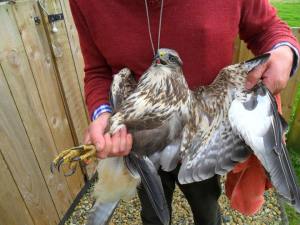
Hexham buzzardAn injured buzzard was found by a member of the public at Blanchland near Hexham, Northumberland at the weekend.
It had been shot.

The bird was taken to a wildlife sanctuary at Ladyhill Farm, Simonburn, Hexham where it later died of its injuries.

More info on the Falconry Days  facebook page here.

UPDATE 25th September: Police have now issued an appeal for information about this case, and a similar one in the same area involving a shot tawny owl. Read the press release here.

John Dodd sells Glenogil Estate

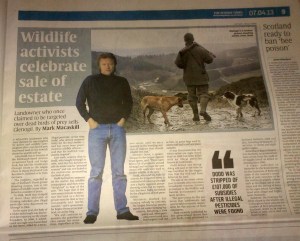
Sunday Times 7th April 2013 Glenogil saleJohn Dodd, the multi-millionaire owner of the controversial Glenogil Estate, has ‘quietly sold up’, according to an article in the Sunday Times.
The new owner is reported to be Baron Ferdinand von Baumbach, someone we know little about. Although we’re not sorry to see Dodd leave, it’s not so much who owns the estate that interests us, but rather whether (a) they intend to maintain it as a driven grouse moor and if so, (b) who will be advising on grouse moor ‘management’.

It’s been widely reported that Dodd took management advice from ‘grouse wizard’ Mark Osborne (e.g. see here) and indeed Glenogil is promoted on Osborne’s William Powell Sporting website as ‘one of the finest shooting estates in Scotland’ (see here), as well as on the William Powell Country website (here). It’s not just Osborne who rates this estate: last year The Field magazine included Glenogil in an article called ‘Britain’s 50 Great Shoots’ (see here) and in 2008 The Telegraph described it as a thriving grouse moor (see here).

However, for those of us with more of an interest in the area’s wildlife rather than with the artificially-high number of grouse that can be killed, you have to look elsewhere for information. A good place to start is the RSPB’s annual persecution reports. Below is a list of confirmed incidents recorded at Glenogil and ‘Nr Noranside’  from 2006-2010, sourced from these reports and also from Scottish Government data. Not one of these reported incidents has resulted in a criminal prosecution and Dodd has repeatedly and strenuously stated his staff are innocent. Dodd had his farming subsidy cut by £107,650 in 2008 when the Scottish Executive suspected that poisoned baits found on and near to the estate in 2006 were being used to target birds of prey (see here).

2006 March: poisoned rabbit bait (Carbofuran)

2006 April: poisoned buzzard (Alphachloralose)

2006 April: poisoned tawny owl (Alphachloralose)

2006 May: poisoned rabbit bait (Carbofuran)

2006 June: poisoned woodpigeon bait (Carbofuran)

2008 May: poisoned white-tailed eagle (Carbofuran, Isophenfos, Bendiocarb) [‘Nr Noranside’]

2008 May: poisoned buzzard (Bendiocarb) [‘Nr Noranside’]

2008 May: poisoned mountain hare bait (Carbofuran, Isophenfos, Bendiocarb) [‘Nr Noranside’]

2008 May: 32 x poisoned meat baits on fenceposts (Carbofuran, Isophenfos, Bendiocarb) [‘Nr Noranside’]

2008 Oct:  poisoned meat bait (Carbofuran) [‘Nr Noranside’]

2009 March: poisoned buzzard (Carbofuran)

2009 March: poisoned buzzard (Carbofuran)

2009 August: poisoned white-tailed eagle (Carbofuran)

2010 May: poisoned red kite (Carbofuran) [‘Nr Noranside’]

2010 September: poisoned buzzard (Chloralose)

2010 October: poisoned buzzard (Carbofuran)

2010 October: poisoned pigeon bait (Carbofuran)

2010 October: poisoned pigeon bait (Carbofuran)

John Dodd was the co-founder of Artemis Investment Management Ltd., a company that has sponsored the GWCT’s Scottish Game Fair (see here).

The Sunday Times article can be read in two parts:

Part 1 Glenogil sale Sunday Times 7 April 2013

Part 2 Glenogil sale Sunday Times 7 April 2013

Case against alleged wild-bird egg trader continues

The lengthy legal proceedings against Inverness man Keith Liddell (see here for background), who is accused on various counts including trading in wild-bird eggs, has continued at Inverness Sheriff Court today.

Liddell, who has denied all the charges against him, will now stand trial on 22 October 2012, with an intermediate diet on 25 September 2012.

According to an earlier STV report, the list of raptor species whose eggs he is alleged to have handled includes merlin, lesser kestrel, snowy owl, griffon vulture, Egyptian vulture, red kite, tawny owl, rough-legged buzzard, black kite and booted eagle. The report states that Liddell was alleged to have been found with 136 wild birds’ eggs at his Inverness home on Holm Dell Drive on June 24 2009 (see here).

More delay in case against Inverness man accused of buying/selling raptor eggs

The long-running case against Keith Liddell, first reported on this blog in July 2011 (see here) has been continued at Inverness Sheriff Court, again.

Liddell is alleged to have bought or offered for sale 202 eggs, including those of Egyptian vultures (a listed endangered species) and tawny owls. He is further accused of having 136 wild birds’ eggs in his possession. These charges, which Liddell has denied, relate to alleged offences between 2004 – 2009. The case has dragged on and on and on with numerous hearings in November and December 2011, and in February and May 2012. The next hearing will be in June 2012.

Why convicted gamekeeper Robert Christie only got a telling off

Two days ago we blogged about Scottish gamekeeper Robert Christie (Lindertis Estate) who was convicted at Forfar Sheriff Court after pleading guilty to wildlife crimes (see here).

Since then there has been a fair bit of press coverage but the media hasn’t really picked up on the fact that Christie’s ‘punishment’ was just an admonishment (effectively a telling off), even though the available penalties included a fine of up to £5,000 and/or a six month prison sentence.

However, an article published in yesterday’s Courier did include commentary about the penalty:

“…Sheriff Kevin Veal at Forfar decided not to impose a penalty on gamekeeper Robert Christie after hearing the ‘immediate and draconian consequences’ connected with breaching a trapping licence could render the 57-year-old unemployable for the rest of his working life”.

Christie’s solicitor, David McKie (who also happens to be the SGA’s solicitor – see here), reportedly commented:

There are implications under the general licence – if the court imposes anything more than an admonition the licence is automatically withdrawn for five years“.

Was what Christie did the crime of the century? No of course it wasn’t, but what it was, without a doubt, was a criminal offence under the wildlife legislation. It seems astonishing that the Sheriff would decide not to impose any penalty, especially given the current high priority that the Scottish Government has placed on tackling wildlife crime.

What we are seeing yet again is an inconsistency in sentencing (compare Christie’s penalty with that of Aswanley Estate gamekeeper Craig Barrie who was recently fined £520 for illegal use of a trap, see here) and the sense that wildlife crime is still not being taken seriously by some Scottish courts. Do you think this defence would be acceptable for other offences, such as a drink driving taxi driver? ‘Oh, sorry m’Lord, yes I was drunk when I drove my car and I really should have known the consequences of doing this as driving is my profession but the immediate and draconian measure of losing my licence will also mean I lose my job’.

Talking of taking wildlife crime seriously, the Scottish Gamekeepers’ Association has not yet issued any public statement of condemnation for Christie’s actions, nor have they said whether he is/was an SGA member. To find out about Christie’s SGA membership status, send an email to: info@scottishgamekeepers.co.uk

Article in the Courier here

Scottish gamekeeper ‘admonished’ for wildlife crimes

Scottish gamekeeper Robert Alexander Christie (58) was convicted today at Forfar Sheriff Court for wildlife crimes relating to the illegal use of a crow cage trap. He was ‘punished’ by receiving an admonishment.

Christie pled guilty to taking a wild bird, possessing a wild bird, and using an illegal trap by failing to adhere to the terms of the general licence (this general licence governs the use of crow cage traps in Scotland).

The offences took place on the Lindertis Estate near Kirriemuir, Angus on 8 August 2010. Lindertis Estate is listed as a sporting estate providing pheasant and partridge shooting (see here). A tawny owl was rescued from inside a crow cage trap in a wood on the estate by a member of the public. The owl was reportedly in poor condition (severely malnourished and unable to hold its own bodyweight on its legs) when it was found and it was sent to a vet for treatment. The owl was released back into the wild on 13 August.

The crow cage trap reportedly did not contain food or shelter, and a tray of water contained green algae, and the trap did not have an identification tag, all contrary to the terms of the general licence.

Christie has 24 years of gamekeeping experience and has been employed as a full-time gamekeeper on this estate for approximately 18 years.

Also due to appear in court was Christie’s employer, who according to Burke’s Peerage is a hereditary peer: The Rt Hon The Lord Colyton, although in the court listing his name was given as Alisdair John Munro Hopkinson. Charges against Hopkinson related to allegedly causing/permitting the gamekeeper to use an illegal trap (Wildlife & Countryside Act). However, charges against Hopkinson were not proceeded, perhaps because Christie pled guilty.

This case was prosecuted by one of the new specialist wildlife fiscals, Shona McJannett. She is quoted as saying:

Today’s conviction highlights the importance of ensuring that crow cage traps are operated legally in terms of the general licence. The protection of our wildlife is a priority and a robust view will be taken by the Crown Office and Procurator Fiscal Service in relation to any reports alleging breach of these general licence conditions.”

Now, it’s refreshing news to hear that COPFS will take a ‘robust view’ of this type of wildlife crime and hopefully they will continue to prosecute these cases, but the penalty handed out by the court doesn’t quite match the Fiscal’s view of the seriousness of the offence. Christie’s ‘punishment’ (the admonishment) is effectively no punishment at all. It’s basically a ‘telling off’ (see here for a definition) and because he wasn’t given a more serious penalty (e.g. a fine) it means he is NOT banned from continuing to operate crow cage traps under the general licence. What sort of deterrent is a telling off? What message does this send to other wildlife criminals? Does anyone think Christie will lose his job now he’s got a conviction for wildlife crime?

It is not known whether Christie is a member of the Scottish Gamekeeper’s Association. Anyone interested in finding out can ask the SGA by emailing: info@scottishgamekeepers.co.uk. We would be very interested to learn whether he is a member, and if so, does his wildlife crime conviction mean that he is now barred from the club professional body?

Despite the pathetic ‘penalty’ (can you even call it that?), big kudos to the SSPCA for leading on this investigation, and well done also to COPFS for prosecuting; it’s not often we have cause to congratulate COPFS but on this occasion its deserved.

If you are out and about in the Scottish hills and glens and  come across a trapped raptor caught inside a crow cage trap (or any other trap for that matter), then you should call the SSPCA hotline immediately: 03000-999-999

SSPCA press release here

News article on Deadline News website here

COPFS press release here

See here for another blog on why Christie only got a telling off

STOP PRESS: One of our readers (thank you!) has contacted us to say he thinks this is the same estate that we blogged about last June (see here). Obviously we’re unable to confirm or refute this as the name of the estate in the June blog was kept a big secret, although the location is very similar!