Killing with impunity: Birdcrime 2013 published

Birdcrime 2013The RSPB has published its latest annual report on crimes against birds in the UK in 2013.

Their press release here.

The killing goes on, with impunity.

76 individual birds & other animals were confirmed illegally poisoned in 2013. This is more than double the figure from 2012 (29 confirmed victims).

Poisoning victims in 2013 included 30 buzzards, 20 red kites, 1 golden eagle and 1 white-tailed eagle.

68 confirmed incidents involved the shooting or destruction of birds of prey. Victims included two hen harriers, two marsh harriers and 5 peregrines.

These are just the confirmed incidents. A total of 338 incidents were reported to the RSPB in 2013, with North Yorkshire once again being the worst location. There’s also a worrying number of incidents from Powys in South Wales, seemingly relating to poisoned baits.

Birdcrime 2013 is a thoroughly depressing read. The RSPB calls on the shooting industry, again, to clean up its act. Judging by the contents of this report, that’s a seemingly futile request.

Well done and thanks to the RSPB for not only compiling these thorough statistics but importantly, for sharing them in the public domain.

Download Birdcrime 2013: Birdcrime 2013

Hen harrier Bowland Betty, found shot dead on a grouse moor in North Yorkshire. (Photo by Natural England).

Bowland Betty

Interesting bedfellows

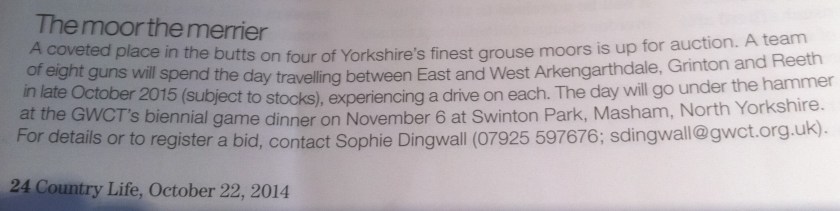
From Country Life Magazine, October 22nd 2014, page 24:

A coveted place in the butts on four of Yorkshire’s finest grouse moors is up for auction. A team of eight guns will spend the day travelling between East and West Arkengarthdale, Grinton and Reeth in late October 2015 (subject to stocks), experiencing a drive on each. The day will go under the hammer at the GWCT’s biennial game dinner on Nov 6 at Swinton Park, Masham, North Yorkshire“.

Fascinating stuff.

Swinton Park is linked with the Swinton Estate. Swinton Estate was where the shot corpse of hen harrier Bowland Betty was discovered in 2012 (see here), although that was likely just an unfortunate coincidence as there was no evidence to link her death to anybody, let alone anyone associated with the estate. According to the Countryside Alliance, she wasn’t shot at all (see here).

A different incident confirmed criminal activity by a Swinton Estate employee. Earlier this year, gamekeeper Ryan Waite was convicted of illegally setting a spring (pole) trap on Swinton Estate (see here).

What an interesting choice of venue for the GWCT to select for their prestigious event, eh?

Buzzard’s injuries suggest it was caught in illegal leg-hold trap

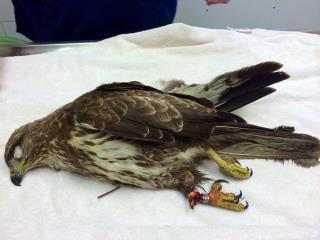
BZ Malton Oct2014A badly-injured buzzard that was found floundering in a field near Malton, North Yorkshire, has had to be euthanised.

A veterinary examination revealed the bird had a badly broken leg and its injuries suggest it had been caught in an illegal leg-hold trap. The injuries were judged to be at least one week old.

News article in Yorkshire Post here.

North Yorkshire has the dubious distinction of being the worst place in the UK for raptor persecution (see here and here). The landscape is dominated by driven grouse moors.

Over 18,500 people have signed a petition to ban driven grouse shooting – if you feel the same way you can sign it here.

SNH launches ‘independent’ (ahem) study into trap use

The long-awaited study into the use of corvid traps in Scotland has finally begun.

This research was first proposed in late 2012, following SNH’s controversial decision to permit the use of clam-type traps on the 2013 General Licences (see here for associated blog posts). There was much opposition to this inclusion, based on concerns that these traps are likely to cause unacceptable risks to non-target species (including raptors). SNH ignored the majority of respondents to a public consultation, who had called for research to be conducted BEFORE the traps were authorised; SNH decided to go ahead and allow the use of these traps and do the research AFTERWARDS.

Following a series of Parliamentary Questions in December 2012 about this decision, Environment Minister Paul Wheelhouse said: “We will commission objective research on these traps“. SNH then announced they would conduct ‘rigorous and independent’ tests.

SNH has now commissioned two organisations to conduct that ‘objective, rigorous and independent’ research. Those two organisations are Science and Advice for Scottish Agriculture (SASA) and the Game and Wildlife Conservation Trust (GWCT).

We have no problem with SASA – they have no vested interests in the removal of predators to enhance the number of gamebirds available for shooting and therefore can be seen as being thoroughly independent on this topic. But GWCT? This is the organisation that has consistently petitioned for buzzards and sparrowhawks to be included on the General Licences (thus allowing them to be culled in the interests of game-shooting) and many of their Trustees are directly involved with game-shooting. Not what we’d call ‘independent’.

According to the SNH press release about this new study, the research will cover all the different types of traps that are currently licensed for use in Scotland (e.g. clam-type traps, Larsen traps, crow cage traps). That’s good – concerns about these traps and their use have been unresolved for many years. These include (but are not limited to) compliance (or not) with European environmental legislation; welfare concerns; poor trap design that allows indiscriminate species trapping; year-round use (as opposed to seasonal use); ineffective regulation of crow trap users; ineffective monitoring of crow trap use (i.e. number and species caught/killed); inability to identify an individual trap user (traps are registered to estates, not to individual users); and a lovely get-out clause for any General Licence user with an unspent criminal conviction. Will this new research address all of those concerns? We’ll have to wait and see.

The press release states that the first phase of the research involves a survey of trap users from the following organisations: British Association for Shooting and Conservation (BASC), Scottish Gamekeepers Association (SGA), Scottish Land and Estates (SLE), GWCT, and National Farmers Union of Scotland (NFUS). Hmm. Does anybody believe that these users are going to admit to having caught a non-target species? Or admit to ‘accidentally’ injuring or killing a trapped non-target species? Given that it is widely accepted (even by the Environment Minister) that these traps are often used for the illegal persecution of raptors, how reliable will these survey results be?

Curiously, there’s no mention of other interest-groups being involved (e.g. RSPB, SSPCA, SRSG, OneKind) – all of whom have previously expressed concerns about how these traps are used – but hopefully that’s just an oversight in the wording of the press release and not an accurate reflection of their actual participation in the study.

Later stages of the study will apparently include ‘field studies of how different traps are used in practice’. We hope the final report will also include information about every single incident of illegal trap-use recorded in Scotland over the last five years, including incidents that resulted in the conviction of a gamekeeper and those cases that remain unresolved.

Download the SNH press release: General Licences – Trapping Project – May 2014 press release

UPDATE 13.40hrs: A previous study looking at the use, abuse and misuse of crow cage traps in Scotland was undertaken by the Scottish Raptor Study Groups and RSPB Scotland in 1998. It was published in 1999 in the journal Scottish Birds (Vol. 20, pages 6-13). Download it here: Dick & Stronach 1999 Use, Abuse & Misuse of Crow Traps

Goshawk found dead in suspicious circumstances on Chatsworth Estate

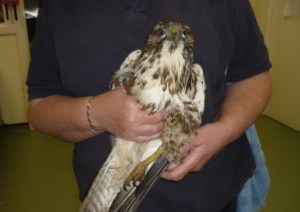
Goshawk Derbyshire spring trap April 2014The RSPB has posted a £1,000 reward for information that leads to a conviction following the discovery of a dead goshawk found in suspicious circumstances on Chatsworth Estate in Derbyshire.

The dead female bird was found on the estate by a member of the public on 2nd April. A post-mortem revealed the bird had two broken legs, and that both breaks were in the same place – injuries that are consistent with being caught in a spring trap.

The bird had been fitted with a leg ring, showing it had hatched in 2003 in the Peak District National Park, 15km to the north of Chatsworth.

Derbyshire Constabulary and the RSPB are appealing for information.

For full details, including quotes from the RSPB, Derbyshire Constabulary and a Chatsworth Estate representative, see the article on the Derbyshire Constabulary website here.

Peregrine shot in Devon as this year’s tally continues to rise

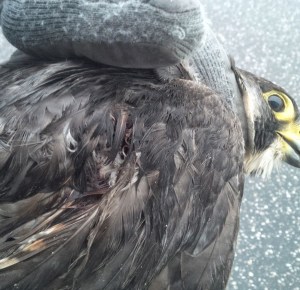
Perg shot seaton Devon May 2014A critically-injured peregrine was found at Seaton Beach in Devon on Bank Holiday Monday. The bird, soaked and unable to fly, was found by members of the public.

It was taken to a vets but had to be euthanized. Its injuries were consistent with a gunshot wound.

The police quickly issued an appeal for information (see here) and local birder Steve Waite has written about the incident on his blog (see here).

So here we are, another month, another reported raptor persecution crime to add to the year’s growing death toll:

Jan 2014: Shot buzzard, Norfolk.

Jan 2014: Dead bird (species unknown) & poisoned bait, South Lanarkshire.

Feb 2014: Shot buzzard, North Yorkshire.

Feb 2014: Shot buzzard, Norfolk.

Feb 2014: Shot sparrowhawk, Norfolk.

Feb 2014: Spring-trapped buzzard, West Yorkshire.

Feb 2014: Poisoned peregrine, South Lanarkshire.

Mar 2014: Shot peregrine, Dorset.

Mar-April 2014: Poisoned red kites (x 16) & buzzards (x 6), Ross-shire.

April 2014: Man arrested for alleged attempted raptor trapping, Aberdeenshire.

April 2014: Shot buzzard, North Yorkshire.

April 2014: Shot red kite, Northamptonshire.

April 2014: White-tailed eagle ‘disappears’ in suspicious circumstances, Aberdeenshire.

April 2014: Peregrine ‘illegally killed’, Stirlingshire.

May 2014: Shot peregrine, Devon.

Meanwhile, over in Northern Ireland a wildlife crime summit has learned that 90 raptors have been found poisoned there since 2006 – see here.

Fatally-injured spring-trapped buzzard, West Yorks: police appeal for info

Buzzard spring trapped Winscar Reservoir 2While all the media focus has been on the mass poisoning of 16 raptors in Highland Scotland, it’s business as usual in other parts of the UK.

West Yorkshire police are appealing for information after the discovery of a spring-trapped buzzard near Winscar Reservoir back in February.

Walkers found the buzzard in distress and unable to fly. When they approached it they discovered its leg was caught in a large spring trap. They removed the trap and took the bird to a vet but its injuries were so severe it had to be euthanised.

The buzzard was less than a year old and had hatched at Dove Stone, an RSPB/United Utilities Partnership site. It had been ringed as a chick by the Peak District Raptor Monitoring Group.

More details of the crime and police contact details here.


SGA donor owns estate ‘among the worst in Scotland for wildlife crime’

SGA donors 2014 EdradynateThe Scottish Gamekeepers’ Association publishes a quarterly magazine for its members. The latest edition (winter/spring 2014) includes a list of recent donors. We were intrigued to see the following entry:

MDCC Campbell Edradynate Estate (Donation: £1720)

Could this be Michael David Colin Craven Campbell, who resides in Hampshire but owns Edradynate Estate? So why would this entry be intriguing? Why wouldn’t they accept funding from Mr Campbell, who was awarded an MBE in 2008 for services to charity, was appointed by the Queen to become High Sheriff of Hampshire 2008-2009 and has an entry in Debretts? No reason whatsoever to reject a generous donation from such an upstanding and distinguished gentleman whose Debrett’s entry lists ‘shooting’ and ‘escaping to Scotland’ amongst his recreational activities. Right?

Edradynate Estate near Aberfeldy in Perthshire was described in 2004 by the then RSPB Investigations Officer Dave Dick as being “among the worst in Scotland for wildlife crime” (see here).

In January 2005, the then Police Wildlife Crime officer for Tayside Police, Alan Stewart, described Edradynate Estate as follows:

Edradynate Estate, which is owned by an absentee landlord from Hampshire, has probably the worst record in Scotland for poisoning incidents, going back more than a decade. In 14 separate incidents since 1998, 16 poisoned victims (9 buzzards, 1 cat, 1 tawny owl, 2 sparrowhawks, 1 common gull, 1 polecat and 1 carrion crow) and 12 poisoned baits (rabbits, wood pigeons and a pheasant) have been found, with traces of the pesticides Mevinphos, Carbofuran and Alphachloralose” (see here, page 3).

These two prominent wildlife crime investigators were commenting following the collapse of a case against two gamekeepers from Edradynate Estate. In 2002, the Head gamekeeper and an under keeper had been charged with nine offences relating to the alleged use of poisoned baits and bird cruelty, including the use of spring traps. These charges followed a police raid on Edradynate Estate where three rabbit baits, a dead buzzard and a dead crow had been found. Lab tests detected Carbofuran and Alphachloralose. A game bag and a knife seized during the search showed traces of these poisons when swabbed.

On 22 July 2004, two years after the original arrests and 13 court hearings later, the Fiscal dropped the case following a series of adjournments called by both the defence and the prosecution. A Crown Office spokeswoman admitted that the time taken to prepare the case for trial had been a major factor in the decision to drop the case.

The 2002 raid was the second police search on Edradynate Estate. In Alan Stewart’s book, Wildlife Detective, he writes the following:

This would be our second major search of the estate under warrant and we hoped this time to find sufficient evidence to bring to an end the catalogue of poisoned baits and victims that had turned up on the estate with the worst record by far not just in Tayside but in Scotland”.

The crimes didn’t end there.
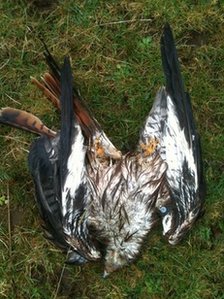
a dead red kiteIn July 2010 a poisoned red kite was discovered in the area (see here). According to Tayside Police, ‘five buzzards and a tawny owl met with the same fate in the same area in the last year’.

In September 2010, an un-named gamekeeper from Edradynate Estate, a self-proclaimed member of the SGA, talked to the Courier about the discovery of the poisoned red kite:

As a member of the Scottish Gamekeepers’ Association, I am against anything illegal. Anybody who does this should be jailed because it’s not on and I have never done anything like this in my life. To find a poisoned bird on my ground is just wrong because I don’t use poison and wouldn’t know how to.

There is something funny about this and I think someone else has killed this bird and planted it on my estate. Why they have done that, I don’t know. We have never seen a red kite, living or dead, in the Strathtay valley so I don’t know where this has come from. The laird is so upset about it, as am I, because it besmirches our reputation and it’s reflecting badly on me.

I am a professional person and I have worked hard for all these years on the estate and never had anything against my name. This is causing me a lot of stress and strain because I don’t know what is going to happen next. I’ve never been involved in anything like this before.

It’s very reassuring to know that I have the full support of the laird because this job is something I love doing.” (see here).

In March 2011 two poisoned buzzards and two poisoned crows were discovered, along with two poisoned pheasant baits. Carbofuran was detected this time. Tayside Police conducted another search (their third on this estate?) and it was reported that a 62 year old man was taken in for questioning but was released pending further enquiries (see here). We’re not aware of any other media statements about this incident.

In September 2013, the Crown deserted a case against Edradynate Estate’s Head gamekeeper on alleged firearms and explosives charges. The reason for this desertion was not made public (see here).

Nobody has ever been convicted for any of the alleged offences on Edradynate Estate.

Alan Stewart wrote about a 1995 incident on Edradynate Estate in his Wildlife Detective book, concerning the discovery of a poisoned cat belonging to the occupier of a cottage on Edradynate Estate. A search in a nearby wood had recovered a poisoned pheasant bait and a poisoned tawny owl – later all found to contain traces of Mevinphos. A further search had recovered two wood pigeon baits and a poisoned sparrowhawk, all found inside a pheasant pen. They all contained traces of Mevinphos. Stewart wrote:

I visited a number of residents on the estate and was absolutely shocked at what I learned. According to the interviews I carried out, my suspect had, at various times, set up a gun with a string attached to the trigger to pepper with wheat any intruder who brushed against the string. He had allegedly driven into Perth to the workplace of a person who lived on the estate, to remonstrate with him after a pheasant had been knocked down and killed by the person’s car. He had allegedly poisoned a tenant farmer’s collie, and also shot dead the dog of a visitor to a neighbouring estate after the dog had run off and was being pursued by its owner. I was taken aback by the vitriol these people had for my suspect but their hatred was tempered with fear and all interviews were ‘strictly off the record’. All those I spoke to were in tied houses and none wanted to become involved in a prosecution. News of my investigation had travelled fast and out of the blue I received a telephone call from a former factor for the estate. He had anticipated the reluctance of those who could potentially help, wished me the best of luck, but doubted that my enquiry would ever result in court proceedings”.

A prosecution in this case was attempted but the case was deserted after it became time-barred due to a lack of available evidence to link the individual suspect to the alleged offences.

Alan Stewart wrote:

The following week [just after the case had been deserted] I learned that another employee had borrowed the suspect’s Land Rover but it had broken down. In his search for tools to repair it, he had lifted up the passenger seat to search the compartment underneath as the most likely place for tools to be stored. Instead of tools there were three dead sparrowhawks. I am sure this would have clinched the case but naturally the employee wanted to keep his job and his house and the information came to me via a third party”.

Stewart wrote about another incident in 2001 – the discovery of a poisoned buzzard on the estate that had been killed by Carbofuran:

The usual enquiries were made and the usual suspect interviewed, but his involvement could not be established……..In the investigations on Edradynate Estate, we could prove beyond reasonable doubt that baits and dead birds and animals were being found with monotonous regularity on the estate. We could prove beyond reasonable doubt that the baits were laced with particular pesticides and that the victims had been poisoned after having consumed part of these baits. What we were so far unable to prove was who set the baits”.

Case against Lloyd Webber’s gamekeeper moves to trial

The case against a gamekeeper employed on Andrew Lloyd Webber’s estate in Hampshire has moved to trial.

Mark Stevens, 42, is accused of a series of trapping offences alleged to have taken place on the Sydmonton Court Estate, Hampshire, in August and September last year. He has denied the charges.

His trial will take place in July 2014.

See here for previous blog.

Gamekeeper accused of pole-trapping on Lloyd Webber’s estate

It has been reported that a gamekeeper is appearing in court tomorrow to face various charges of alleged wildlife crime on Andrew Lloyd Webber’s country estate.

There is no suggestion Andrew Lloyd Webber was involved.

Mark Stevens, 42, is accused of five alleged offences. Three relate to allegations that a tawny owl was caught in a spring trap set on a pole on the Sydmonton Court Estate, Hampshire in August 2013. Two relate to allegations that spring traps were not properly set on the Sydmonton Court Estate in September 2013.

Tomorrow’s hearing will be the first in this case.

Further updates later…