The RSPB has this evening released video footage of an eyewitness’s account of a short-eared owl being shot on the well-known Broomhead Estate in the Peak District National Park last summer.
Screen grab from the RSPB video showing the shot corpse of the short-eared owl.
The eyewitness, who understandably doesn’t want to be identified (probably due to the harassment and intimidation suffered by other eyewitnesses in this region – e.g. see here), watched the owl being shot by an armed man who had arrived on the grouse moor on an all-terrain vehicle, carrying a shotgun and a bag. He shot the owl and shoved its lifeless corpse inside a rabbit hole in an effort to conceal the crime.
Fortunately, this eyewitness was savvy enough to have filmed the event and was able to return to the grouse moor the next day and pinpoint the spot for investigators from the RSPB and South Yorkshire Police.
They retrieved the owl’s corpse and a post-mortem confirmed it had been shot.
A local gamekeeper became the immediate suspect but, as happens so often, there was insufficient evidence to link him conclusively to the crime and so no prosecution could take place. You can read the RSPB’s blog about this case here, including a link to the video.
RPUK map showing location of Broomhead Estate in Peak District National Park
Grouse moors in this part of the Peak District National Park have been at the centre of other police investigations into alleged raptor persecution in recent years, including the suspicious disappearance of a satellite-tagged hen harrier (‘Octavia’) in 2018 (here).
Last year, another satellite-tagged hen harrier (‘Anu’) roosted overnight on a local grouse moor before ‘disappearing’. His tag was found several km away, no longer attached to the harrier and a forensic examination revealed the tag’s harness had been deliberately cut from the bird (here).
Two other hen harriers ‘disappeared’ from their breeding attempts on National Trust-owned grouse moors in the Peak District National Park last year (see here).
I’ve blogged previously about the Broomhead Estate in relation to the apparent mis-use of medicated grit (see here) and the use of gas gun bird scarers (here, here, here and here).
Grouse-shooting butt on Broomhead Estate. Photo: Ruth Tingay
The Scottish Government has finally published its commissioned review on increasing the Scottish SPCA’s investigatory powers to enable the organisation to help tackle wildlife crime, and particularly raptor persecution.
Buzzard killed after eating poisoned rabbit bait. Photo: NIRSG
As a quick recap for new blog readers, the SSPCA’s current powers (under animal welfare legislation) limits their investigations to cases that involve a live animal in distress (including some wildlife crimes). The proposed new powers would allow them to also investigate wildlife crimes under the Wildlife & Countryside Act legislation, e.g. where the victim is already dead, and also incidents where a victim may not be present (e.g. if an illegally-set pole trap or a poisoned bait was discovered). See here for further detail.
The review taskforce, launched in July 2022 and chaired by Susan Davies FRSB, was established after 11 long years of political can-kicking on this issue by the SNP, only because the Scottish Greens insisted on its inclusion in the historic Bute House Agreement, the power-sharing policy document published by the two parties in 2021.
The 13-page published review, which was submitted to the Scottish Government in October last year, can be read/downloaded here:
I haven’t read the review in detail yet but the main recommendation is that the Scottish SPCA NOT be given increased powers due to the lack of support for this provision from Police Scotland, the Crown Office and the National Wildlife Crime Unit (NWCU).
I’ll comment on that when the Scottish Government has published its own response to the review, which it previously said (here) would be published at the same time as the review was published, but I haven’t seen the Government’s response yet.
I think it’s prudent to wait to see the Government’s response before making any comment, although I’ve previously been critical of the apparent bias in favour of game-shooting industry organisations being invited to contribute to the review (all of whom are opposed to increased powers for the SSPCA), whereas opportunities for conservation organisations were apparently limited (see here and here).
Increased powers for the SSPCA is due to be debated at Stage 2 of the Wildlife & Muirburn (Scotland) Bill in the autumn, so this is far from over.
This issue has now been running for the last 12 years – here is the timeline of this sorry saga:
February 2011: Increased powers for the SSPCA was first suggested by MSP Peter Peacock as an amendment during the Wildlife & Natural Environment (Scotland) Bill debates. The then Environment Minister Roseanna Cunningham rejected it as an amendment but suggested a public consultation was in order.
September 2011: Seven months later Elaine Murray MSP (Scottish Labour) lodged a parliamentary motion that further powers for the SSPCA should be considered.
November 2011: Elaine Murray MSP (Scottish Labour) formalised the question in a P&Q session and the next Environment Minister, Stewart Stevenson MSP, then promised that the consultation would happen ‘in the first half of 2012’.
September 2012: Nine months later and nothing had happened so I asked Paul Wheelhouse MSP, as the new Environment Minister, when the consultation would take place. The response, in October 2012, was:
“The consultation has been delayed by resource pressures but will be brought forward in the near future”.
July 2013: Ten months later and still no sign so I asked the Environment Minister (still Paul Wheelhouse) again. In August 2013, this was the response:
“We regret that resource pressures did further delay the public consultation on the extension of SSPCA powers. However, I can confirm that the consultation document will be published later this year”.
September 2013: At a meeting of the PAW Executive Group, Minister Wheelhouse said this:
“The consultation on new powers for the SSPCA will be published in October 2013“.
January 2014: In response to one of this blog’s readers who wrote to the Minister (still Paul Wheelhouse) to ask why the consultation had not yet been published:
“We very much regret that resource pressures have caused further delays to the consultation to gain views on the extension of SSPCA powers. It will be published in the near future“.
31 March 2014: Public consultation launched.
1 September 2014: Consultation closed.
26 October 2014: I published my analysis of the consultation responses here.
22 January 2015: Analysis of consultation responses published by Scottish Government. 233 responses (although 7,256 responses if online petition included – see here).
I was told a decision would come from the new Environment Minister, Dr Aileen McLeod MSP, “in due course”.
1 September 2015: One year after the consultation closed and still nothing.
25 February 2016: In response to a question posed by the Rural Affairs, Climate Change & Environment Committee, Environment Minister Dr Aileen McLeod said: “I have some further matters to clarify with the SSPCA, however I do hope to be able to report on the Scottish Government’s position on this issue shortly“.
May 2016: Dr Aileen McLeod fails to get re-elected and loses her position as Environment Minister. Roseanna Cunningham is promoted to a newly-created position of Cabinet Secretary for the Environment.
12 May 2016: Mark Ruskell MSP (Scottish Greens) submits the following Parliamentary question:
Question S5W-00030 – To ask the Scottish Government when it will announce its decision regarding extending the powers of the Scottish SPCA to tackle wildlife crime.
26 May 2016: Cabinet Secretary Roseanna Cunningham responds with this:
A decision on whether to extend the investigatory powers of the Scottish SPCA will be announced in due course.
1 September 2016: Two years after the consultation closed and still nothing.
9 January 2017: Mark Ruskell MSP (Scottish Greens) submits the following Parliamentary question:
Question S5W-05982 – To ask the Scottish Government by what date it will publish its response to the consultation on the extension of wildlife crime investigative powers for inspectors in the Scottish SPCA.
17 January 2017: Cabinet Secretary Roseanna Cunningham responds:
A decision on whether to extend the investigatory powers of the Scottish Society for the Prevention of Cruelty to Animals will be announced in the first half of 2017.
31 May 2017: Cabinet Secretary Roseanna Cunningham rejects an extension of powers for the SSPCA ‘based on legal advice’ and instead announces, as an alternative, a pilot scheme of Special Constables for the Cairngorms National Park (here). It later emerged in 2018 that this pilot scheme was also an alternative to the Government’s 2016 manifesto pledge to establish a Wildlife Crime Investigation Unit as part of Police Scotland – a pledge on which it had now reneged (see here).
November 2019: The pilot scheme of Special Constables in the Cairngorms National Park was an absolute failure as a grand total of zero wildlife crimes were recorded by the Special Constables but plenty were reported by others (see here).
June 2020: Mark Ruskell (Scottish Greens) proposed further powers for the SSPCA at Stage 2 of the Animals and Wildlife Bill. The latest Environment Minister, Mairi Gougeon persuaded him to withdraw the proposed amendment on the basis that she’d consider establishing a taskforce to convene ‘this summer’ to consider increased powers (see here).
December 2020: Mark Ruskell (Scottish Greens) submits two Parliamentary questions asking about the status of the taskforce and who is serving on it (see here).
January 2021: New Environment Minister Ben Macpherson says the taskforce has not yet been appointed but that it is “expected to be established later this year“ (see here).
September 2021: In the 2021 to 2022 Programme for Government it was announced that the ‘independent taskforce [Ed: still to be appointed] will report before the end of 2022’ (see here).
May 3 2022: In an interview with Max Wiszniewski of the REVIVE coalition for grouse moor reform, new Environment Minister Mairi McAllan said: “It’s imminent and I wish I could tell you today but we are just finalising the last few points for the membership but I’m hoping to be able to make an announcement about that in the next few weeks“ (see here).
1 July 2022: Scottish Government announces Susan Davies has been appointed to lead the taskforce review and will ‘publish a report later this year’ (see here).
27December 2022: A Scottish Government spokesperson tells Scotsman journalist the taskforce has completed its review and its findings will be published ‘within weeks’ (see here).
31 January 2023: An FoI response from the Scottish Government to this blog’s author reveals the Taskforce’s review was submitted to the Scottish Government on 22nd October 2022 and will be published ‘prior to summer 2023’.
1 February 2023: Wildlife crime: key conservation organisations ‘excluded’ from Scottish Government’s review on increasing SSPCA powers (here).
7 February 2023: Scottish Government tells journalist from The Scotsman that it will provide a response at the same time the Taskforce review on SSPCA powers is published (here).
7 March 2023: More detail provided on why key conservation organisations were excluded from Scottish Government’s review on increasing SSPCA powers (here).
21 June 2023: Scottish Government publishes its commissioned review on SSPCA powers.
UPDATE 27th June 2023: New investigatory powers for SSPCA proposed by Scottish Government (here)
North Yorkshire Police has issued the following press statement:
APPEAL FOR INFORMATION ABOUT THE SHOOTING OF A RED KITE
North Yorkshire Police’s Rural Task Force is appealing for witnesses and information about the shooting of a Red Kite which happened near Westerdale, on the North York Moors.
The Red Kite, which was suffering from gunshot wounds, was found by a member of the public on Tuesday 13 June. Despite being immediately taken to the vets it needed to be put to sleep due to the extent of its injuries. The wounds were fresh suggesting it had been shot recently.
It is against the law to intentionally kill, injure or take wild birds.
North Yorkshire Police is requesting the public’s assistance to help establish the full circumstances surrounding this incident. In particular anyone who witnessed shooting in the Westerdale area on either Monday 12 or Tuesday 13 June 2023.
Anyone with information that could assist with this investigation should email Jack.donaldson@northyorkshire.police.uk or call North Yorkshire Police on 101, select option 2, and ask to speak to Jack Donaldson.
If you wish to remain anonymous, you can pass information to Crimestoppers on 0800 555 111.
Please quote the North Yorkshire Police reference number 12230107850 when passing on information.
North Yorkshire has the highest incidence of raptor (birds of prey) persecution of any English county. The dedicated Rural Taskforce and specially-trained wildlife officers are committed to stopping these crimes and bringing offenders to justice.
Operation Owl is a joint initiative by North Yorkshire Police, RSPB, RSPCA and the North York Moors and Yorkshire Dales National Parks.
People can help by being their eyes and ears out on the moors and dales. If you spot a dead or injured bird, poisoned bait or a pole trap, please note the location, take a photo and call North Yorkshire Police on 101 to report it.
ENDS
I’m assuming this is the same red kite that was reported in the papers yesterday morning (here), although those reports had identified the location as ‘the Whitby area’, which is nowhere near Westerdale, but the time and date are the same.
Yesterday’s reports also stated the red kite had been found ‘in suspicious circumstances’. I don’t know who wrote that earlier report but it wasn’t at all helpful, accurate or informative.
The later press release from North Yorkshire Police, as reproduced above, is much better, especially the speed with which it’s been published. It’s also good to see the police provide some context to this crime, discussing Operation Owl, the extent of these crimes in this grouse shooting hell hole (supposedly a National Park), the types of evidence people may see, and what to do about it if they do see it.
It’s unlikely to lead to anyone coming forward though. There’ll be the usual wall of silence from the grouse-shooting community, who persistently refuse to provide any assistance in wildlife crime investigations, and it would be unusual if a member of the public had witnessed anything in such a remote landscape and been able to identify the person pulling the trigger.
Meanwhile, however, the pressure, and evidence, continues to mount on DEFRA Ministers to recognise that raptor persecution is a widespread issue and people are getting more and more pissed off that the shooting industry is allowed to get away with such blatant criminality, time and time and time again.
UPDATE 4th July 2023: 2nd red kite found shot nr Westerdale in North York Moors National Park in recent weeks, with suspicions of a third one (here)
UPDATE 9th October 2023: Buzzard shot & critically injured in North York Moors National Park (here)
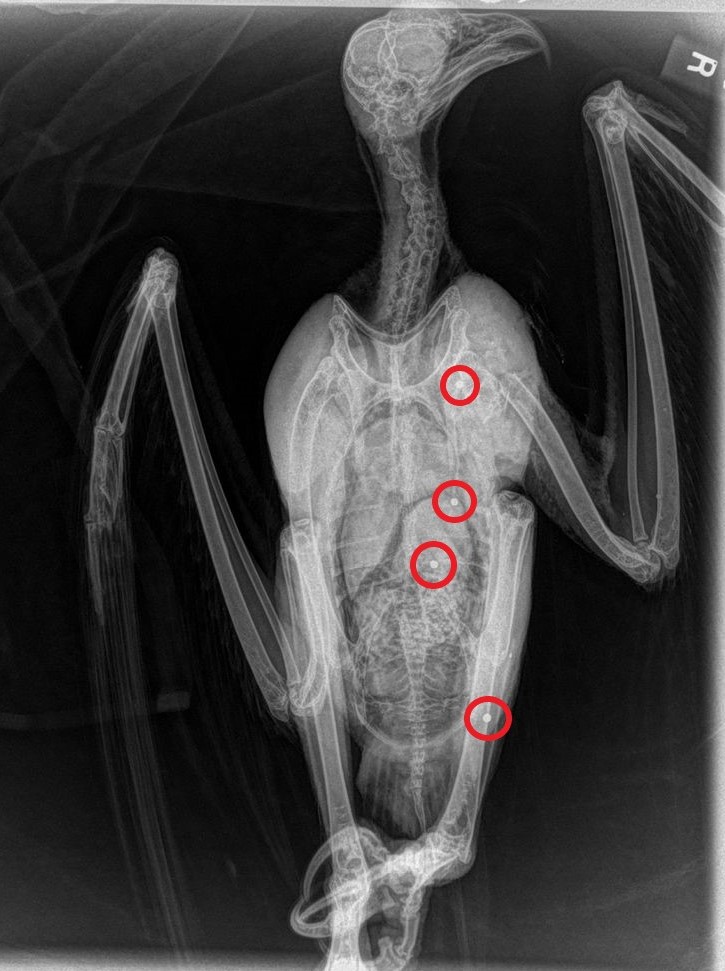
An Osprey has been euthanised after being found with shotgun injuries in Washington, Tyne & Wear on 26th May 2023.
The shot Osprey. Photo: RSPCA
An article on the Planet Radio Metro website (here) states the Osprey ‘was spotted bleeding and lying on his back by a worker at the Crowther Industrial Estate in Washington, Tyne and Wear, after he was thought to have crash landed at the location‘.
However, the article goes on to claim that the Osprey was ‘shot three times with an airgun‘, but if you look at the x-ray it’s pretty clear that the Osprey has been hit by shotgun pellets (at least four of them – I’ve circled them on the x-ray image below), and not by airgun pellets, which have a distinctively different shape.
The article also claims the Osprey had ‘a ruptured right eye, grazes to its body and a fractured left wing‘. I can’t see the left wing fracture on this particular x-ray but the image of the bird’s left ‘wrist’ area is quite distorted so it’s difficult to tell.
It’s reported that the vets who assessed the injured Osprey considered the best course of action was to euthanise it to prevent further suffering.
The RSPCA is apparently investigating and is ‘asking businesses on the estate to check their CCTV for potential information about the person responsible‘, although obviously the shooting could have taken place elsewhere and the bird could have flown some distance before crash-landing on the estate. However, if it did have a fractured wing then it’s unlikely to have been able to fly very far from the location where it was shot. But perhaps the fracture occurred when it crash landed.
This case was also covered by the BBC News website (here) but that seems to be just a condensed version of the Mercury article and repeats the claim that an airgun was used in the shooting.
The shooting of Ospreys in the UK is relatively rare these days – unlike the targeted shooting of Buzzards, Red Kites, Hen Harriers, Goshawks etc which is still so routine, especially on land managed for gamebird shooting. The last Osprey shooting that I recall in the UK was in 2010 (here).
That’s not to say that Ospreys aren’t still the victims of illegal persecution, but mostly it’s now related to nest disturbance and egg collecting (e.g. see here and here), although there was a case in Derbyshire a few years ago where an Osprey was found with two broken legs and injuries consistent with having been caught in an illegally-set spring trap (here), and an Osprey’s nest was felled with a chainsaw in North Wales two years ago just after the first egg had been laid (here).
Thankfully, these days Ospreys are usually in the headlines for all the right reasons following a series of conservation translocation projects in England (e.g. here), with nest cameras providing an opportunity for the public to follow breeding attempts online (here), Osprey visitor centres attracting thousands of visitors each year (e.g. here) and now even ‘Osprey Cruises’ to watch foraging Ospreys from boats, which sell out so quickly that more trips have now been scheduled (e.g. here). It’s clear that this particular bird of prey seems to attract a great deal of public affection.
If anyone has any information about the shot Osprey found in Tyne & Wear please contact the RSPCA but I’d also encourage you to contact the RSPB’s Investigations Team who can provide specialist and expert assistance to the investigation.
UPDATE 09.30hrs: A vet has been in touch (thank you!) with the following comment: ‘My very rusty veterinary eyes (20 years out of practice!) can see a fracture on the R proximal humerus – also the head of the humerus appears not to be in the shallow socket. Maybe the vet got the L and R markers the wrong way around. Shame there is not a better x-ray after euthanasia. I might be wrong’.
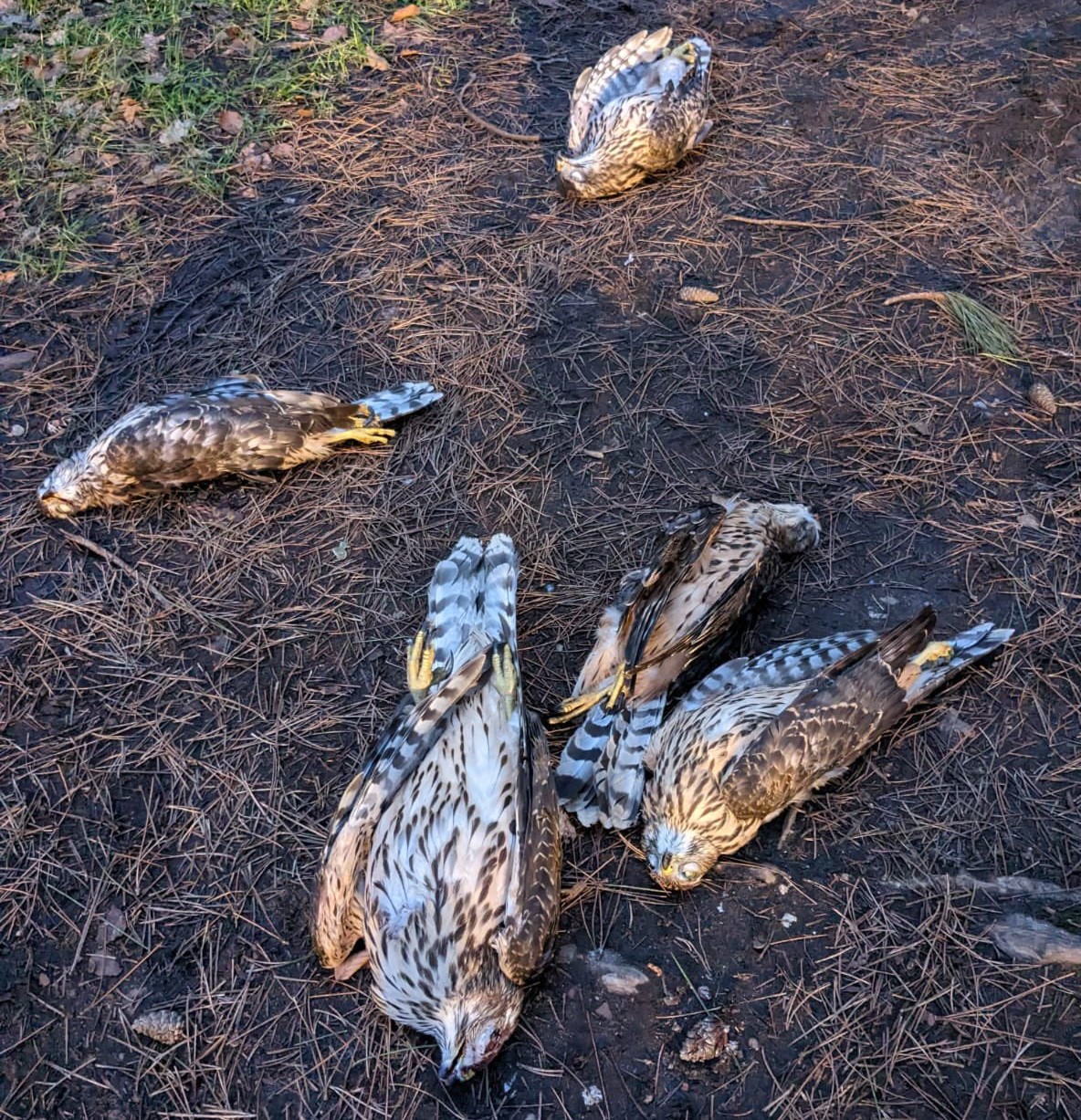
In January this year, Suffolk Police’s Rural, Wildlife & Heritage Unit appealed for information in relation to the discovery of five juvenile goshawks that had been shot and dumped in a car park at the King’s Forest, near Thetford (see here).
The five shot goshawks. Photo: Suffolk Police
This is the investigation that attracted a large reward for information (reward put up by RSPB, Wild Justice, and a crowd funder by Rare Bird Alert, see here).
This is also the investigation about which the shooting industry was ‘offended’ at being asked by the police to help identify the perpetrator (here).
In late March 2023, the police announced that a man had been arrested in relation to this investigation (see here).
A man has now been charged and the police have issued the following statement:
MAN CHARGED WITH OFFENCES IN RELATION TO BIRDS OF PREY FOUND DEAD IN WEST SUFFOLK
A man has been charged with offences in relation to the discovery of five goshawks that were found dead in the west of the county, as well as a number of other offences.
The five birds of prey were found on Monday 16 January, having been left in a parking area just off from the B1106 in Kings Forest, near Wordwell.
X-rays were undertaken which showed all five birds had suffered injuries from multiple pieces of shot.
Officers arrested a 72-year-old man on 27 March in relation to the discovery of the goshawks and on suspicion of breaching firearms license conditions. He was taken to Bury St Edmunds Police Investigation Centre for questioning, before being released under investigation.
Francis Addison, 72, from South Park, Weeting, was subsequently charged with five counts of possession of a dead schedule 1 wild bird (goshawk); one count of killing a non-schedule 1 wild bird (wood pigeon); one count of use of an animal trap in circumstance for which it is not approved; two counts of possession of an article capable of being used to commit a summary offence, namely two air rifles and six animal traps; six counts of failing to comply with the conditions of a firearm certificate; and four counts of failing to comply with the condition of a shotgun certificate.
Addison is due to appear at Norwich Magistrates’ Court on Thursday 29 June.
ENDS
Well done to Suffolk Police’s Rural, Wildlife & Heritage Unit for what has obviously been a detailed investigation, and also for keeping the public informed.
As Mr Addison has now been charged and criminal proceedings are live, I won’t be accepting any comments on this case until proceedings have concluded.
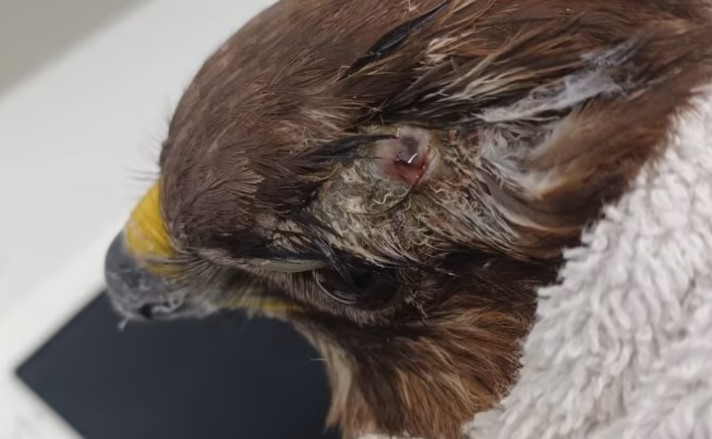
The RSPCA is investigating after a female buzzard was found having being shot in the head with an airgun pellet.
The buzzard was found in the front garden of a house in Walpole St Peter near Wisbech in Cambridgeshire. Unfortunately there are no details about when this discovery was made.
Buzzard with head wound. Photo: RSPCA
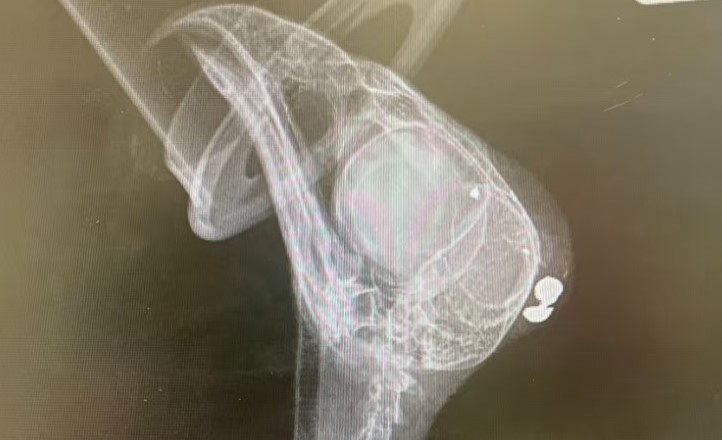
The RSPCA said the bird was thin and weak and was taken to a vet in Ely where an x-ray revealed the buzzard had an airgun pellet lodged in her head. It was considered ‘a miracle’ that it had missed both the skull and the eye.
The charity said the wound was infected and as the bird was emaciated it was likely she had been shot some time ago.
The buzzard has been put on antibiotics and pain relief and may need an operation to remove the pellet.
Vets think the pellet may be interfering with her eyesight, but hope she will be strong enough to be released into the wild eventually.
Buzzard x-ray showing the airgun pellet. Photo: RSPCA
RSPCA inspector David Podmore said: “It is upsetting to think that this beautiful bird was deliberately targeted and shot. While we do not know where the shooting would have happened, this is an offence under the Wildlife and Countryside Act 1981.
“We would urge anyone with any information about how this bird came to be harmed to call the RSPCA Inspector appeal line on 0300 123 8018 or the police.”
This news article was originally reported on the ITV website here.
At the end of March the RSPB issued a press statement about a shot red kite that had been found on a Durham grouse moor (see here).
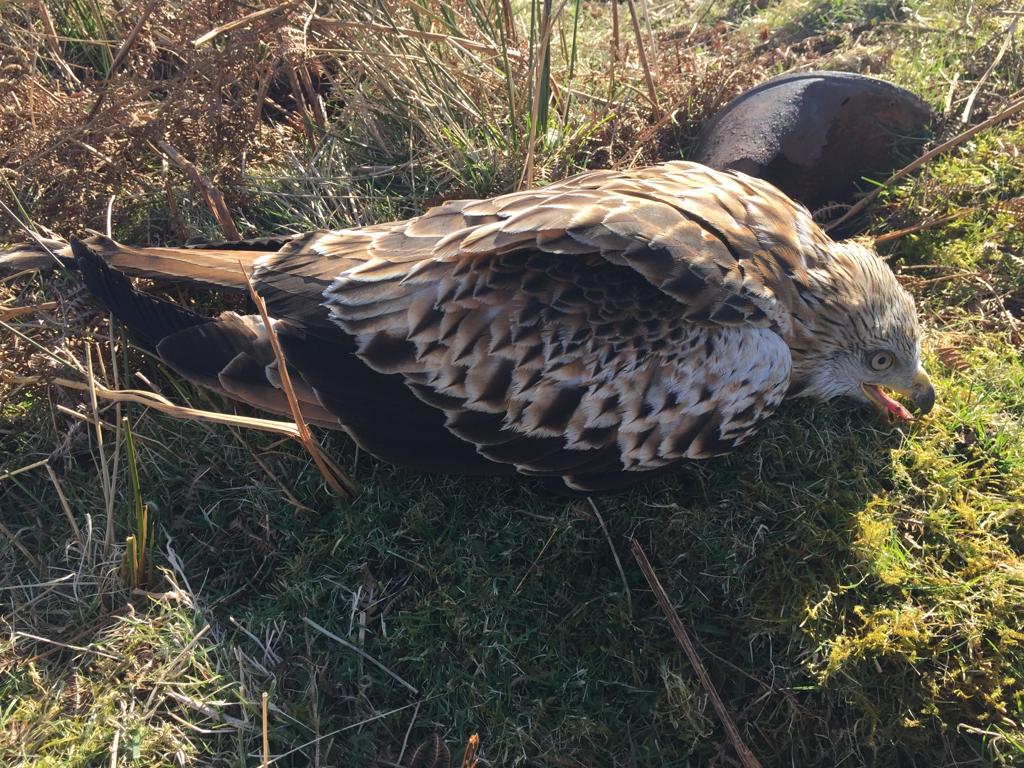
An x-ray revealed multiple shotgun pellets in the kite’s body, resulting in a fractured wing. The kite was described as ‘fighting for its life’.
After several weeks of expert care and attention by the brilliant Jean Thorpe (Ryedale Wildlife Rescue) and her equally as brilliant colleagues at Battle Flatts Veterinary Clinic, today the red kite was successfully released back to the wild.
The RSPB has released this short video on Twitter:
Fantastic news! As of today a Red Kite found shot on a grouse moor in County Durham is flying free once more. Thanks to the member of the public who found it, and @jeanthorpeRR for her expert care – without which this bird wouldn't have had a chance. One of the lucky ones. pic.twitter.com/ON2d5egocC
Durham Constabulary is still appealing for information about the shooting of this kite.
If you have any information, contact Durham Constabulary’s Wildlife Crime Officer, PC Dave Williamson, by emailing david.williamson@durham.police.uk or calling in to Barnard Castle Police Station.
Alternatively, to share sensitive information in confidence, call the RSPB’s Raptor Crime Hotline on 0300 999 0101.
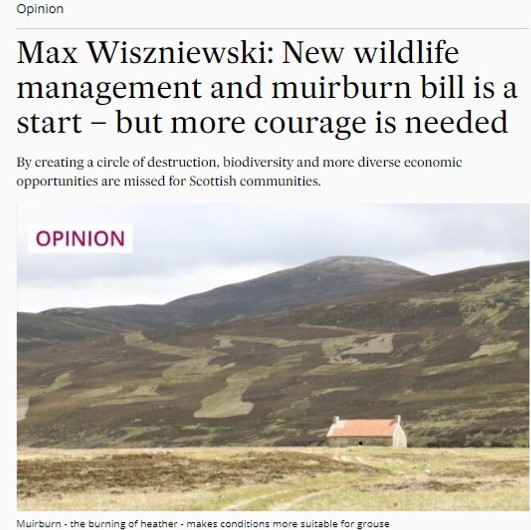
There’s a good opinion piece in the Press & Journal today by Max Wiszniewski, Campaign Manager for REVIVE, the coalition for grouse moor reform.
It’s reproduced below:
The systematic, illegal persecution of birds of prey has been a blight in Scotland’s countryside now for decades, so much so that it was described by former first minister, Donald Dewar, as a “national disgrace”.
Yet, on the same day that our new first minister was sworn into office, news broke that another bird of prey – this time a red kite – had been found dead on a grouse moor [Ed: see here]. The shooting industry is laughing in the face of the legislation it will be fighting tooth and nail to oppose.
The new bill proposes to licence the shooting of grouse. If the terms of that licence are broken – such as a licence holder indulging in wildlife crime – then it can be removed.
So far, it seems sensible. But, beyond the illegal destruction of our protected species, hundreds of thousands of foxes, stoats, weasels, crows and so-called “non-target species” like hedgehogs are killed on grouse estates every year, so more grouse can be shot for sport.
Will this unsustainable practice be addressed by the new bill? The answer is: somewhat.
All legal traps will require a “licence”, serial numbers and, presumably, regular checking. Scottish Government oversight of the monitoring of the many thousands of traps on grouse moors to ensure legality will be no easy feat, and it would be expensive to do effectively. Should we be jumping through hoops just so a few people can shoot more grouse for sport?
Bill is an important intervention that should go further
Some big changes in muirburn could be brought about, though. On grouse moors, burning heather shapes the landscape to make it more suitable for grouse – so more of them can be shot.
About 40% of muirburn for grouse has taken place on deep peat, which is an internationally important carbon sequestration resource. Much of it lies in a degraded state on grouse moors, and continued burning is stopping it from regenerating and from rewetting and, therefore, actually emits carbon.
The Wildlife Management and Muirburn Bill proposes an effective ban on peatland burning but, once again, effective monitoring of huge land areas will be difficult and expensive.
Muirburn may still continue under licence in areas with no deep-peat, but should we be dishing out licences when the purpose is increasing grouse numbers for sport shooting? Scotland shouldn’t be pandering to the needs of this cruel, unsustainable and intensively managed industry.
By creating a circle of destruction around huge areas of our land, biodiversity and more diverse economic opportunities are missed for Scottish people and communities.
Overall, this bill as it stands is an important intervention. With a bit more courage to take on large estates and landed interests, it could become the very intervention Scotland’s people, wildlife and environment desperately need.
Further to last week’s news that Scottish gamekeeper Rory Parker pleaded guilty to committing raptor persecution crime on a grouse moor on Moy Estate in September 2021 (see here), I’ve been looking to see how the game-shooting industry has responded to this conviction.
You’ll recall that this is the game-shooting industry whose organisations routinely state they have a ‘zero tolerance’ policy towards raptor persecution, in which case you’d think they’d be quick to condemn this latest crime and call on their members and the wider shooting public to distance themselves from Moy Estate, and especially as the estate is already serving a three-year General Licence restriction imposed in 2022 after Police Scotland found further evidence of wildlife crime (see here), namely a poisoned red kite and ‘incidents in relation to trapping offences’.
Four days on from Parker’s conviction, I haven’t found any statements of condemnation on the websites of the Scottish Gamekeepers Association, BASC, or the Countryside Alliance.
Their collective silence says a lot, I think. In my opinion it’s related to an ongoing, industry-wide damage limitation exercise as the Wildlife Management & Muirburn (Scotland) Bill begins its passage through the Scottish Parliament. Drawing attention to criminal activity on grouse moors at a time when MSPs are considering the extent of proposed regulation in the form of a grouse-shooting licence is not in their interests, although I’d argue that if they were as resolute about stamping out raptor persecution crimes as they claim to be, they should have been at the forefront of leading the condemnation.
The only game-shooting organisation that has responded to the news of Parker’s conviction is landowners’ lobby group, Scottish Land & Estates (SLE).
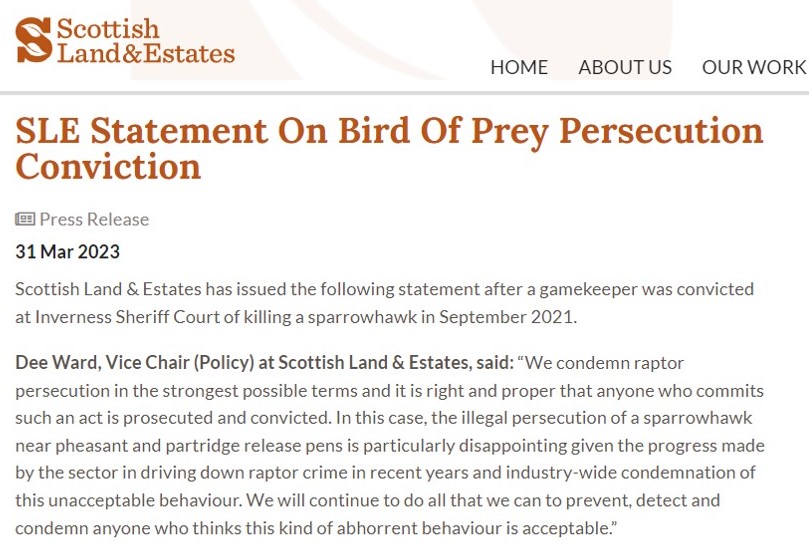
I’ve already written about a media quote attributed to grouse moor owner Dee Ward, who’s also Vice Chair (Policy) at SLE, who seemed keen to distance Parker’s crime from grouse moor management (see here), and this was repeated in a statement that SLE published on its website on the day of Parker’s conviction.
Credit to SLE for not shying away from the news, but its manipulation of the narrative is all too obvious:
I’m not sure what the ‘progress’ is to which Dee refers. I haven’t seen any evidence of ‘the sector driving down raptor crime in recent years‘. What I have seen is an increasing number of shooting estates having General Licence restrictions imposed after Police Scotland has confirmed evidence of continued raptor persecution crimes (there are currently six GL restrictions in place – Leadhills Estate (here), Lochan Estate (here), Leadhills Estate [again] (here), Invercauld Estate (here), Moy Estate (here) and Millden Estate (here)).
The Scottish Government doesn’t appear to have seen the evidence, either, given the Environment Minister’s statement in 2020 when she announced that there could be no further delay to the introduction of a grouse moor licensing scheme because:
“…despite our many attempts to address this issue, every year birds of prey continue to be killed or disappear in suspicious circumstances on or around grouse moors“.
Time will tell if SLE sticks with Dee’s claim that, “We will continue to do all that we can to prevent, detect and condemn anyone who thinks this kind of abhorrent behaviour is acceptable“.
Will that include boycotting the Highland Game Fair, held each year on the Moy Estate? This is an event that SLE, and the other shooting organisations, routinely attend, with apparently total disregard for sanctions imposed on the estate for wildlife crime (see here).
It’s actions, not mere words, that will determine whether the industry’s ‘zero tolerance’ policy is seen as credible, and as far as I’m concerned, the industry’s actions haven’t come close.
On Friday (31st March 2023), gamekeeper Rory Parker, 24, of Drumbain Cottage, Tomatin, pleaded guilty to shooting and killing a sparrowhawk on 16th September 2021 whilst employed on Moy Estate (see here).
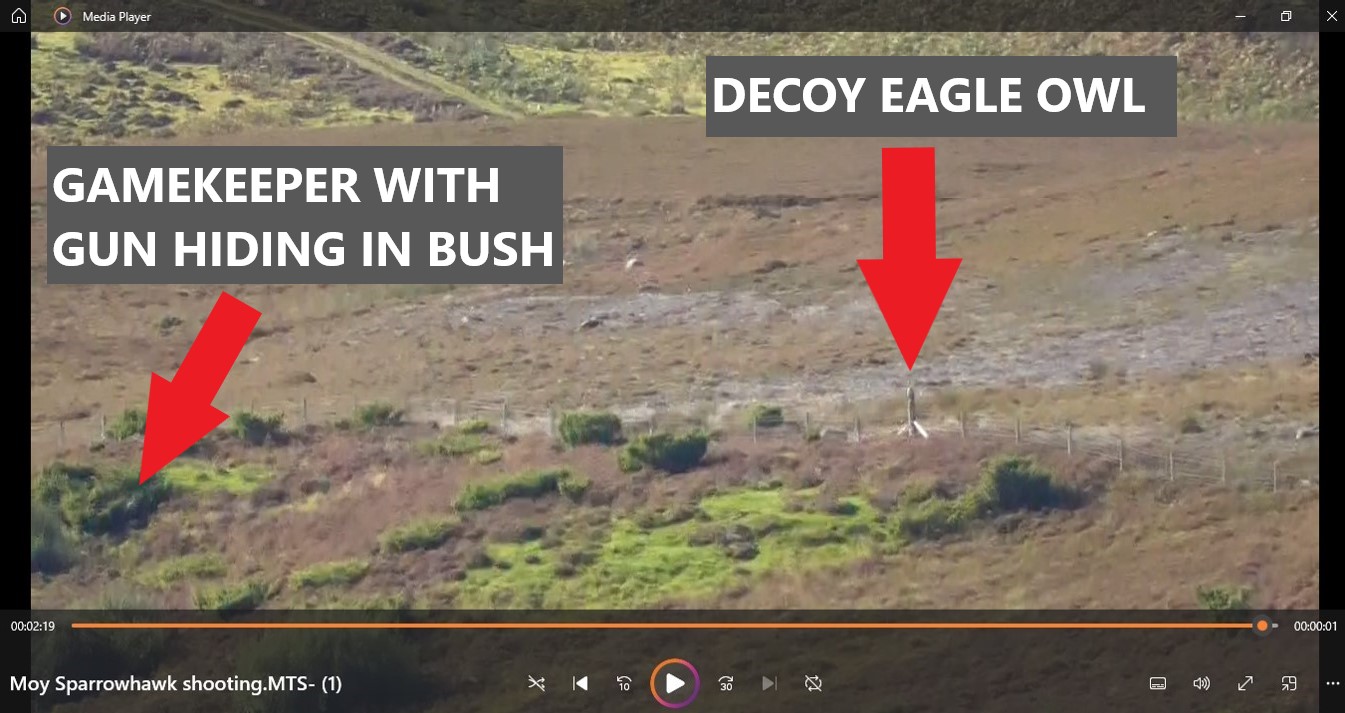
Parker was filmed by an RSPB Investigator as the (at the time 22-year-old) gamekeeper hid in a bush on the grouse moor, a few feet away from a large plastic owl that had been placed on a fencepost. It’s well-known that raptors will be drawn to an owl decoy and will try to mob / attack it. If someone sits quietly nearby with a gun they’ll have a good chance at shooting and killing the raptor whilst it’s distracted by the owl.
We’ve seen this technique deployed on grouse moors many times before, sometimes with plastic decoys, sometimes with live eagle owls (e.g. see here, here, here, here, here, here).
It looks like that’s what happened that September day in 2021. Here’s a screen grab from the RSPB’s video showing the position of Parker and the decoy owl:
If you haven’t yet seen the full video, there’s a copy of it embedded in this tweet below. I’d encourage you to watch it, and take note of Parker’s body language when he goes over to the sparrowhawk he’s just shot, as it’s flapping around, wounded, on the ground. He’s calm and proficient as he stamps his foot/knee on the bird to crush it, before casually picking it up and retuning to his hiding place in the bush. It appears to be quite routine and he does not look at all disturbed at having just committed a serious wildlife crime.
This video, provided by the RSPB, has led to a Scottish gamekeeper pleading guilty to shooting a protected bird of prey 🦅👇 pic.twitter.com/bHC8W5DYyg
In court, Parker was defended by Mark Moir KC. The KC stands for King’s Counsel and denotes an experienced, high-ranking lawyer considered to be of exceptional ability. I wonder who paid for his services? In mitigation for Parker’s offending, Mr Moir KC reportedly told Sheriff Sara Matheson that his client had been in his job since he left school.
“He is deeply shameful of what he has done. He has brought the estate into disrepute and has now resigned.
“His firearms certificate is likely to be revoked as a result of this conviction. He should have been shooting pigeons and crows that day. Feral pigeons are a problem on the estate.
“However, the sparrowhawk flew over and there was a rush of blood. He says it was a stupid thing to do.”
After watching the video, it didn’t look like ‘a rush of blood‘ to me. It looked entirely premeditated.
Apparently the RSPB video wasn’t shown in open court but I’m not sure whether Sheriff Matheson had an opportunity to see it behind closed doors. I suspect she didn’t, given the sentence she handed down to Parker – a pathetic £1,575 fine and three months in which to pay it.
This should have been a test case of the new Animals & Wildlife (Penalties, Protections & Powers) (Scotland) Act 2020; legislation that was introduced to increase the penalties available for certain wildlife crimes, including those under Section 1(1)(a) of the Wildlife & Countryside Act – ‘Intentionally, or recklessly, killing, injuring, or taking a wild bird‘. Parker committed his offence after the enactment of this new legislation.
Prior to the new legislation, the maximum penalty available for the type of offence Parker committed was up to six months imprisonment and/or a fine of up to £5,000.
The new legislation increased the maximum penalty available (on summary conviction, as in Parker’s case) to a maximum of 12 months imprisonment and/or a fine of up to £40,000.
So why was Rory Parker only given a £1,575 fine??*
The penalty increases in the new Act were introduced by the Scottish Government because the previous penalties were not considered sufficient to recognise the seriousness of wildlife crime(s) [and animal cruelty offences].
This view was supported by an independent review by Professor Poustie, published in 2015, which concluded that the then maximum penalties available to the courts may not have been serving as a sufficient deterrent to would-be offenders, nor reflecting the seriousness of the crime(s).
The Poustie Review was first commissioned in 2013 by then Environment Minister Paul Wheelhouse, and as part of a series of measures aimed at tackling the continued persecution of birds of prey (see here). It was his response to growing levels of public concern and a lack of confidence in the judiciary to deal with raptor-killing criminals. Criticisms of the system had often centred around perceived corruption, vested-interests and biased Sheriffs, and we had come to expect unduly lenient and inconsistent sentencing in most cases (e.g. see here).
The new legislation was supposed to address those concerns with a significant increase in the severity of penalties available for courts to hand down to offenders.
I don’t see any evidence of that in the sentencing of raptor-killing gamekeeper Rory Parker.
*UPDATE: Someone who was in court on Friday has just been in touch to provide further insight into sentencing. They told me:
‘When the defence KC was summing up he repeatedly suggested to the sheriff what penalty might be most appropriate, i.e. a fine and maybe a community payback order. He also told her Mr Parker had savings of £2,000. It was therefore no surprise at all she then issued a £1,800 fine (discounted to £1,500 because he wasn’t considered an adult when he committed the crime. Since when is a 22 year old not an adult?!!!) In my opinion, therefore, the Sheriff was basically spoon-fed the sentence by the KC‘.