This is the fourth blog in the series focusing on presentations made at the recent police wildlife crime conference in Scotland, this time from Stewart Stevenson MSP, the Scottish Environment Minister. The following comprises the first two thirds of his presentation; the final third isn’t really relevant here.
Stewart Stevenson, Scottish Environment Minister
[Some jovial preamble that isn’t relevant here]…”This conference doesn’t, er, stand in a vacuum, it’s, er, carrying on from terrific effort over many years to create what is in effect, er, the biggest and most successful, er, wildlife, er, crime event in the UK and I’m sure that under the new management we’ll see, er, us building on past successes in that regard.
And of course, wildlife crime is something which in resource terms is comparatively small, er, in, in the, in the big picture so many people in this room and beyond who are engaged in fighting wildlife crime are doing so as an addition to, er, broader responsibilities, er, that, that constitute regular, er, day jobs and indeed many, er, make huge contribution in unpaid work outside hours, er, to get the job done, get the results and get the convictions, er, that are very important in sending out the right kind of messages, er, to people involved in, er, wildlife crime, but of course again as the Assistant Chief Constable made reference to, it’s often the case, er, that the Mr Bigs of our crime networks, erm, are engaged in wildlife crime, there’s correlation when you look at the maps often between where the Mr Bigs live and clear demonstration of wildlife crime, er, taking place in an area and unlike their activities as Mr Bigs, protected behind lawyers and accountants, really Boards of Management, their engagement perhaps in wildlife crime is, is less protected and may often be a very good way of getting into criminal, criminal networks and more broadly disrupting them so I hope that, er, when the police make operational decisions, because it’s only for me to seek to persuade but not to direct, er, that that is, er, part of the, the, the thinking.
I’ve been the Minister for Environment and Climate Change for coming up for a year now and I’m absolutely gobsmacked as I go across Scotland by the, the work that’s going on in the environment generally, whether it’s conservation work on red squirrels, whether it’s protecting our small number of capercaillies, whether it’s innovative technologies out to produce cleaner sources of fuel, it’s all based on the commitment of dedicated individuals and we in government are immensely, er, proud that people make that commitment and very grateful indeed.
Now this is the first, er, Tulliallan conference since the passage of the Wildlife and Natural Environment Bill in 2011, the Act does contain, er, a number of new provisions that are very relevant to this conference and I know that, er, the Sheriff for example will be explaining the WANE Act, er, a bit later, I’m not over-egging the pudding, Sheriff, I hope, erm, I, er, won’t be able to, to listen to it myself but then I’m not part of the enforcement agency. There was a passionate debate in Parliament about many aspects of it and I think at the end of the day we achieved, er, a good and equitable balance, there was a huge cross-party support, er, for the final form that it took. But the passage of that Bill is a very clear indication, er, that Parliament, er, takes an important view of this and, er, the, the, the importance that, er, the BBC Radio Scotland this morning gave to this conference and the publication, er, of, erm, the poisoning figures for, er, raptors shows that the media see this as an important agenda as well.
The new legislation, er, a number of things are relevant to this conference, comprehensive revision of the law relating to game and the poaching of game, new closed seasons for hares, new regulations for snares, a major revision of the Deer Act backed up by a new code of practice, a new approach to invasive non-native species, I’ll just say a little something, one of the things I tripped over, just to illustrate, er, the issue of invasive non-native species…[goes into anecdote about American Signal Crayfish]…There’s new offences, a new code of practice to come on, on this regard, and there’s a new requirement that we provide an annual report to Parliament on wildlife crime.
Now, I’m not going to talk through the legislation, others are better equipped to do that. There are officials here from the Scottish Government who’ll be happy to interact with you, er, on the subject. But let me just pick up a couple of issues from it – during the course of the Bill it was apparent that there was a prevailing feeling among MSPs that we needed to take some tougher legal powers to combat the problem of illegal raptor persecution in Scotland. Er, it’s been a high priority since we took office, it is of course an issue that not only threatens some of our rarest wildlife such as the hen harrier, but it casts a disproportionately unpleasant shadow on our reputation as a country known for its high quality natural environment. The environment is a key part of our identity, it’s part of our brand and it’s vital to our export success, er, in many ways and of course wildlife tourism is a very important economic contributor.
So, the concept of an attractive, well-managed, er, natural environment can be badly damaged by any idea that it’s a place where some people can still put out dangerously toxic materials to poison some of our more spectacular wildlife. And of course, when you put poisons out in the environment, you never know what the effect will be; a dog walker can be exposed to them, domestic animals can be poisoned and indeed human beings without knowing, er, what’s going on. It is a tiny minority but it disproportionately, er, scars, er, our landscape so we’re continuing to work with our partners in PAW to change attitudes, make that minority even smaller in future, and eventually see it disappear.
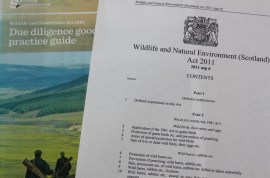 So part of our response has been to introduce vicarious liability, er, provisions. There are two aspects to that. That small minority in the past of land managers who may have given a nod and a wink to their employees in relation to persecution of birds of prey, that addresses that issue, those who turn their back on doing the right thing. But now there is no doubt that their behaviour will not escape the reach of the law, they risk finding themselves in the dock as well as the unfortunate employee, the gamekeeper, whoever.
The second aspect is probably more important in the long run. We want to send a message to all land managers that inaction, benign or otherwise, is simply not good enough. Land managers need to be proactive in ensuring all employees and contractors understand legal obligations and responsibilities, they have to take all reasonable steps and exercise due diligence. And I want to pay a tribute to Scottish Land and Estates, because they have been very supportive in getting that message out, working with government, er, to develop guidance for land managers. So this is not about the industry as a whole being a problem, quite the opposite, they are a huge contributor, er, to determining best practice, to getting the message out, achieving a proportionate and proper legal balance between the many interests that there are in, in, in the country and they’ve been enormously helpful. It is just a tiny minority, and they want to see them eliminated as much as everyone else, er, does.
We’re certainly not looking for a string of prosecutions, indeed, I will measure success if there are none, because that would be absolutely ideal in a context of, of good behaviours in, in our countryside. Sustained improvement, proactive management, especially in areas that we’ve identified as being at high risk where previous history show there’s been bird or prey prosecution, we know that this is one of a range of measures in itself it doesn’t, er, solve the problems.
Now I don’t want to just speak about, er, raptor persecution, a couple of, er, other aspects of, of the work that I want to speak about, the first is the annual poisoning hotspots maps which are published today which show a significant reduction, er, in the number of birds, er, poisoned in the last year, and that’s very, very welcome but there’s still too many, er, it’s not necessarily an inescapably a long-term trend although the suggestions are that it probably is. We want to get to a position where it’s zero, ah, we’re not quite there yet. Partnership working is an important part of making sure that we get the outcomes, the input of the RSPB and Scottish Land and Estates working together give this annual exercise and reporting credibility, demonstrates that shared commitment that’s going to make a real difference, and I particularly like when I see the pack that you have as delegates to have material from RSPB and Scottish Land and Estates, showing that shared commitment, er, to this agenda.
Second, er, raptor related point, just to say something about the success of the Raptor Persecution Priority Delivery Group, it’s been working extremely well and I thank Alan Smailes, formerly of Grampian Police, my local police force, for his tireless commitment and role, he brought energy and frankness to the group and made, er, a real difference. Since, er, Alan’s recent retirement, Superintendent Ewen West from Tayside has taken over the reigns and continues where Alan left off. Real progress is being made, er, as meetings are held usually every six weeks, er, with excellent attendance. There are some developments in the pipeline in the group that have the potential to have a real impact on, on unlawful raptor pred persecution and again it’s partnership working that will make the real difference.”
[On the whole Stewart did quite well, and when you compare his attitude to that of his counterparts in England, he is streets ahead in that he at least acknowledges that raptor persecution is a problem. However, this oft-repeated insistence that raptor persecution is only being carried out by a ‘tiny minority’ is simply not supported by the facts.
There was also concern about his apparent brown-nosing of SLE that didn’t quite fit in with the fact that his government introduced vicarious liability specifically because they recognised that many land owners and land managers are often the instigators of illegal raptor persecution (if it was just a tiny minority then surely the government wouldn’t have bothered with all the hassle of introducing new legislation to combat it). In an interview on BBC Radio Scotland on the morning of the conference, Stewart took every opportunity to promote SLE and in doing so, carefully side-stepped some rather well-informed questions from the interviewer. See here for the full transcript recently posted on the SLE website. He also seems to have conveniently forgotten the communication he had last autumn with SLE Director Lord Hopetoun, who seemed to have a different view to Stewart about the benefit of vicarious liability legislation – see here].
The next instalment in this series will focus on the presentation given by Des Thompson (SNH), who also has an apparent aversion to criticising land owners.

 We are certain that this motion (and its amendment) was triggered by the number of people writing to complain about the two recent shocking incidents involving the illegal persecution of golden eagles in Scotland (see here and here). Don’t think for a minute that you can’t make a difference. Look at what happened with ‘buzzardgate’ – a complete u-turn due to massive public opposition. Look at what happened yesterday with the proposed badger cull – a complete u-turn (although Owen Paterson denies this) and an overwhelming majority parliamentary vote against the cull going ahead.
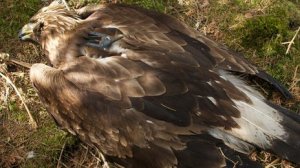 A new motion was lodged in the Scottish Parliament on Monday 22nd October 2012 concerning the death of the Glen Esk golden eagle:
 ‘How many licences have been issued to kill ravens?’ This was one of a series of raven-killing questions asked recently of the Scottish Government by Alison Johnstone MSP (Lothian, Scottish Green Party).
 It’s fascinating to learn what factors are considered by SNH when considering whether to grant one of these licences. Apparently, “SNH relies on expert advice from site visits made by Scottish Government Rural Payments and Inspections Directorate (SGRPID) staff to inform licensing decisions“. Interesting. I wonder how many ornithologists and/or ecologists work for SGRPID?
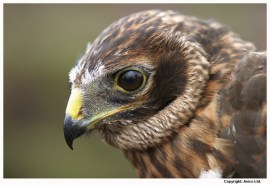 Here’s the latest blog entry from the Langholm Moorland blogspot (link
 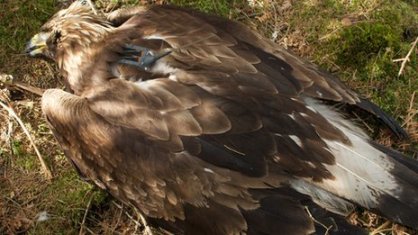 Un-fucking-believable. Yes, it’s a swear word but that’s the least of our concerns. Read what follows and you’ll be swearing in anger too…
 In light of recent events, showing continued evidence that some Scottish police forces are incapable of taking wildlife crime seriously, even though raptor persecution has been identified as a ‘national wildlife crime priority’, the time is right to once again call for additional investigative powers to be given to the SSPCA.
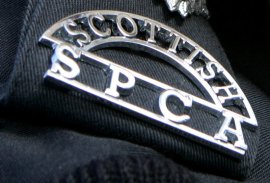 A year ago in February 2011, former MSP Peter Peacock put forward an ammendment to the then Wildlife and Natural Environment (Scotland) Bill [known as the WANE Bill], to increase the investigatory powers of the SSPCA, to help with the effective investigation of wildlife crime, and particularly raptor persecution crime. The ammendment didn’t make it into the final WANE Act but former Environment Minister Roseanna Cunningham said it could be considered, after public consultation, in a later Criminal Justice Bill. Seven months later, in September 2011, MSP Elaine Murray raised the issue again (see
 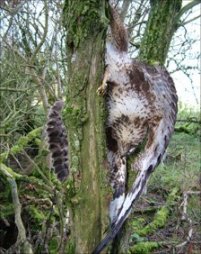 David Alexander Whitefield, the former gamekeeper at Culter Allers Estate in South Lanarkshire, was today sentenced following his December 2011 conviction for illegally poisoning four buzzards (see
  Raptor Persecution UK