2012 wildlife crime conference: Stewart Stevenson (Scottish Government)

This is the fourth blog in the series focusing on presentations made at the recent police wildlife crime conference in Scotland, this time from Stewart Stevenson MSP, the Scottish Environment Minister. The following comprises the first two thirds of his presentation; the final third isn’t really relevant here.

Stewart Stevenson, Scottish Environment Minister

[Some jovial preamble that isn’t relevant here]…”This conference doesn’t, er, stand in a vacuum, it’s, er, carrying on from terrific effort over many years to create what is in effect, er, the biggest and most successful, er, wildlife, er, crime event in the UK and I’m sure that under the new management we’ll see, er, us building on past successes in that regard.

And of course, wildlife crime is something which in resource terms is comparatively small, er, in, in the, in the big picture so many people in this room and beyond who are engaged in fighting wildlife crime are doing so as an addition to, er, broader responsibilities, er, that, that constitute regular, er, day jobs and indeed many, er, make huge contribution in unpaid work outside hours, er, to get the job done, get the results and get the convictions, er, that are very important in sending out the right kind of messages, er, to people involved in, er, wildlife crime, but of course again as the Assistant Chief Constable made reference to, it’s often the case, er, that the Mr Bigs of our crime networks, erm, are engaged in wildlife crime, there’s correlation when you look at the maps often between where the Mr Bigs live and clear demonstration of wildlife crime, er, taking place in an area and unlike their activities as Mr Bigs, protected behind lawyers and accountants, really Boards of Management, their engagement perhaps in wildlife crime is, is less protected and may often be a very good way of getting into criminal, criminal networks and more broadly disrupting them so I hope that, er, when the police make operational decisions, because it’s only for me to seek to persuade but not to direct, er, that that is, er, part of the, the, the thinking.

I’ve been the Minister for Environment and Climate Change for coming up for a year now and I’m absolutely gobsmacked as I go across Scotland by the, the work that’s going on in the environment generally, whether it’s conservation work on red squirrels, whether it’s protecting our small number of capercaillies, whether it’s innovative technologies out to produce cleaner sources of fuel, it’s all based on the commitment of dedicated individuals and we in government are immensely, er, proud that people make that commitment and very grateful indeed.

Now this is the first, er, Tulliallan conference since the passage of the Wildlife and Natural Environment Bill in 2011, the Act does contain, er, a number of new provisions that are very relevant to this conference and I know that, er, the Sheriff for example will be explaining the WANE Act, er, a bit later, I’m not over-egging the pudding, Sheriff, I hope, erm, I, er, won’t be able to, to listen to it myself but then I’m not part of the enforcement agency. There was a passionate debate in Parliament about many aspects of it and I think at the end of the day we achieved, er, a good and equitable balance, there was a huge cross-party support, er, for the final form that it took. But the passage of that Bill is a very clear indication, er, that Parliament, er, takes an important view of this and, er, the, the, the importance that, er, the BBC Radio Scotland this morning gave to this conference and the publication, er, of, erm, the poisoning figures for, er, raptors shows that the media see this as an important agenda as well.

The new legislation, er, a number of things are relevant to this conference, comprehensive revision of the law relating to game and the poaching of game, new closed seasons for hares, new regulations for snares, a major revision of the Deer Act backed up by a new code of practice, a new approach to invasive non-native species, I’ll just say a little something, one of the things I tripped over, just to illustrate, er, the issue of invasive non-native species…[goes into anecdote about American Signal Crayfish]…There’s new offences, a new code of practice to come on, on this regard, and there’s a new requirement that we provide an annual report to Parliament on wildlife crime.

Now, I’m not going to talk through the legislation, others are better equipped to do that. There are officials here from the Scottish Government who’ll be happy to interact with you, er, on the subject. But let me just pick up a couple of issues from it – during the course of the Bill it was apparent that there was a prevailing feeling among MSPs that we needed to take some tougher legal powers to combat the problem of illegal raptor persecution in Scotland. Er, it’s been a high priority since we took office, it is of course an issue that not only threatens some of our rarest wildlife such as the hen harrier, but it casts a disproportionately unpleasant shadow on our reputation as a country known for its high quality natural environment. The environment is a key part of our identity, it’s part of our brand and it’s vital to our export success, er, in many ways and of course wildlife tourism is a very important economic contributor.

So, the concept of an attractive, well-managed, er, natural environment can be badly damaged by any idea that it’s a place where some people can still put out dangerously toxic materials to poison some of our more spectacular wildlife. And of course, when you put poisons out in the environment, you never know what the effect will be; a dog walker can be exposed to them, domestic animals can be poisoned and indeed human beings without knowing, er, what’s going on. It is a tiny minority but it disproportionately, er, scars, er, our landscape so we’re continuing to work with our partners in PAW to change attitudes, make that minority even smaller in future, and eventually see it disappear.
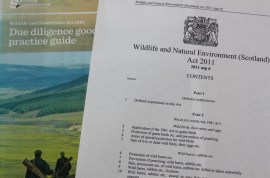
So part of our response has been to introduce vicarious liability, er, provisions. There are two aspects to that. That small minority in the past of land managers who may have given a nod and a wink to their employees in relation to persecution of birds of prey, that addresses that issue, those who turn their back on doing the right thing. But now there is no doubt that their behaviour will not escape the reach of the law, they risk finding themselves in the dock as well as the unfortunate employee, the gamekeeper, whoever.

The second aspect is probably more important in the long run. We want to send a message to all land managers that inaction, benign or otherwise, is simply not good enough. Land managers need to be proactive in ensuring all employees and contractors understand legal obligations and responsibilities, they have to take all reasonable steps and exercise due diligence. And I want to pay a tribute to Scottish Land and Estates, because they have been very supportive in getting that message out, working with government, er, to develop guidance for land managers. So this is not about the industry as a whole being a problem, quite the opposite, they are a huge contributor, er, to determining best practice, to getting the message out, achieving a proportionate and proper legal balance between the many interests that there are in, in, in the country and they’ve been enormously helpful. It is just a tiny minority, and they want to see them eliminated as much as everyone else, er, does.

We’re certainly not looking for a string of prosecutions, indeed, I will measure success if there are none, because that would be absolutely ideal in a context of, of good behaviours in, in our countryside. Sustained improvement, proactive management, especially in areas that we’ve identified as being at high risk where previous history show there’s been bird or prey prosecution, we know that this is one of a range of measures in itself it doesn’t, er, solve the problems.

Now I don’t want to just speak about, er, raptor persecution, a couple of, er, other aspects of, of the work that I want to speak about, the first is the annual poisoning hotspots maps which are published today which show a significant reduction, er, in the number of birds, er, poisoned in the last year, and that’s very, very welcome but there’s still too many, er, it’s not necessarily an inescapably a long-term trend although the suggestions are that it probably is. We want to get to a position where it’s zero, ah, we’re not quite there yet. Partnership working is an important part of making sure that we get the outcomes, the input of the RSPB and Scottish Land and Estates working together give this annual exercise and reporting credibility, demonstrates that shared commitment that’s going to make a real difference, and I particularly like when I see the pack that you have as delegates to have material from RSPB and Scottish Land and Estates, showing that shared commitment, er, to this agenda.

Second, er, raptor related point, just to say something about the success of the Raptor Persecution Priority Delivery Group, it’s been working extremely well and I thank Alan Smailes, formerly of Grampian Police, my local police force, for his tireless commitment and role, he brought energy and frankness to the group and made, er, a real difference. Since, er, Alan’s recent retirement, Superintendent Ewen West from Tayside has taken over the reigns and continues where Alan left off. Real progress is being made, er, as meetings are held usually every six weeks, er, with excellent attendance. There are some developments in the pipeline in the group that have the potential to have a real impact on, on unlawful raptor pred persecution and again it’s partnership working that will make the real difference.”

[On the whole Stewart did quite well, and when you compare his attitude to that of his counterparts in England, he is streets ahead in that he at least acknowledges that raptor persecution is a problem. However, this oft-repeated insistence that raptor persecution is only being carried out by a ‘tiny minority’ is simply not supported by the facts.

There was also concern about his apparent brown-nosing of SLE that didn’t quite fit in with the fact that his government introduced vicarious liability specifically because they recognised that many land owners and land managers are often the instigators of illegal raptor persecution (if it was just a tiny minority then surely the government wouldn’t have bothered with all the hassle of introducing new legislation to combat it). In an interview on BBC Radio Scotland on the morning of the conference, Stewart took every opportunity to promote SLE and in doing so, carefully side-stepped some rather well-informed questions from the interviewer. See here for the full transcript recently posted on the SLE website. He also seems to have conveniently forgotten the communication he had last autumn with SLE Director Lord Hopetoun, who seemed to have a different view to Stewart about the benefit of vicarious liability legislation – see here].

The next instalment in this series will focus on the presentation given by Des Thompson (SNH), who also has an apparent aversion to criticising land owners.

SSPCA continues to perform well in advance of govt consultation to increase their powers in wildlife crime investigations

A year ago in February 2011, former MSP Peter Peacock put forward an ammendment to the then Wildlife and Natural Environment (Scotland) Bill [known as the WANE Bill], to increase the investigatory powers of the SSPCA, to help with the effective investigation of wildlife crime, and particularly raptor persecution crime. The ammendment didn’t make it into the final WANE Act but former Environment Minister Roseanna Cunningham said it could be considered, after public consultation, in a later Criminal Justice Bill. Seven months later, in September 2011, MSP Elaine Murray raised the issue again (see here).
In November 2011, MSP Elaine Murray again raised the issue, and this time was told by the current Environment Minister, Stewart Stevenson, that the Scottish Government intended to begin a consultation during the first half of 2012 (see here).

So far we haven’t seen any movement on the impending consultation but there’s still another four months to go and when we do see some movement, we’ll blog about it here.

Meanwhile, the SSPCA has continued to enhance its hard-earned reputation for successfully bringing criminals involved in wildlife crime to justice. In terms of catching raptor persecutors, this was most recently demonstrated by the successful prosecution of gamekeeper David Whitefield, who was convicted of poisoning four buzzards on a shooting estate in South Lanarkshire (see here).

Their success doesn’t end there. Just last week, the SSPCA was instrumental in securing a ground-breaking conviction of a man who was guilty of keeping dogs used to fight against wild animals, including foxes and badgers (see here, here and here). A conviction for this type of crime isn’t novel – we’ve blogged about it all too often in recent months. What was ground-breaking about this case was that we believe it was the first conviction in Scotland for this type of offence (involving wildlife) under the Animal Health & Welfare (Scotland) Act 2006 – legislation usually reserved for incidents not involving wildlife. Perhaps this will start a trend and we’ll begin to see more use of this Act when dealing with raptor persecutors, for example, in cases where buzzards (or other protected raptor species) are illegally held in crow traps.

We look forward to following the public consultation in the coming few months on increased investigatory powers for the SSPCA.

Joke sentence for second-time convicted gamekeeper

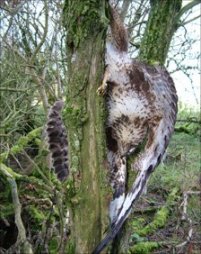
David Alexander Whitefield, the former gamekeeper at Culter Allers Estate in South Lanarkshire, was today sentenced following his December 2011 conviction for illegally poisoning four buzzards (see here for conviction report).
Before we discuss his latest sentence, let’s remind ourselves of Whitefield’s criminal record: This keeper, who was also a member of the Scottish Gamekeepers’ Association, was convicted in October 2008 for offences relating to the unlawful capture and subsequent welfare of a buzzard. His sentence for that conviction was a £300 fine. He kept his job as the sole gamekeeper and he was not expelled from the SGA. Just six months later, in April 2009, RSPB investigators were alerted to the signs of an illegal poisoning spree on this estate. Obviously, these subsequent poisoning activities, for which Whitefield has now been convicted, demonstrate that the £300 fine had zero effect as a deterrent (no great surprise really).

So then you might expect today’s sentence to reflect not only the seriousness of the crime of poisoning wildlife (and potentially any human and/or domestic animals that happened to wander through the well-used public walking trails on this estate), but also to acknowledge that Whitefield, already previously convicted for wildlife crime there, had shown a complete disregard for wildlife legislation.

You might reasonably expect that the sheriff in this case, Nicola Stewart, might utilise her full sentencing powers and go for the most serious sentence available for this type of crime, which includes a custodial sentence and/or a financial penalty for each poisoned bird. That would see Whitefield put away for a while and would send out a very clear message that this type of crime will no longer be tolerated in this country, just as the Scottish Government has claimed over and over again in recent years.

So why then, was Whitefield handed down a 100 hour community service order as his ‘punishment’?

According to an RSPB press release, Sheriff Stewart is reported to have said the punishment was a direct alternative to a custodial sentence and that poisoning is a serious offence. Why was he given a direct alternative to a custodial sentence and where, in his 100 hour community service order, is there any indication that illegal poisoning is considered a serious offence?

This is a joke sentence, to add to all the other joke sentences that have been handed out to the few criminals that are actually prosecuted for these crimes. As we keep seeing, over and over again, these punishments are not providing the required deterrent so surely it’s now time to introduce mandatory sentences for these offences, and that includes custodial sentences. These are already available to the judiciary – so far, for whatever reason, not one custodial sentence has been given to a convicted raptor poisoner. We need to be asking why that is, and we need to keep asking.

Well done to the SSPCA for some serious doggedness with this case – it’s been a long time in the works and looked at one point to be in danger of failing on a legal technicality. Perseverance paid off, and despite the pathetic sentence, those involved with the groundwork deserve much credit.

BBC news article here

RSPB Scotland press release on Birdguides Blog here

Previously convicted gamekeeper guilty again

A previously convicted gamekeeper has today admitted to poisoning four buzzards with Alpha-chloralose laced baits. At Lanark Sheriff Court, David Alexander Whitefield (45) of Coulter, near Biggar in Lanarkshire, pled guilty to the offences that took place between March and November 2009 at Culter Allers Farm, near Biggar, where Whitefield was employed as the sole gamekeeper for pheasant and partridge shooting. He has reportedly blamed his employer (the landowner), whom Whitefield claims told him to reduce the number of buzzards.

In addition to the four poisoned buzzards found on the shooting estate, a large quantity of Alpha-chloralose was found inside unlocked outbuildings, some of it inside a coffee jar – this extremely hazardous poison could have easily been mistaken for sugar or powdered milk by an unsuspecting visitor. Culter Allers is a popular area for walkers and it is fortunate indeed that no person or pet was poisoned. The buzzards were not so lucky.

This case has been in the works for some time, first reported a year ago and then delayed for legal technicalities (see here, here and here). Sentencing for his latest conviction has been deferred for background reports and will take place in early January. We will watch with great interest.

Whitefield’s previous convictions include failing to ensure the welfare of a buzzard and possession of a buzzard. These offences took place at Culter Allers and he was convicted at Lanark Sheriff Court in September 2008. He received a pathetic £300 fine (see here). Just six months later he was poisoning buzzards. At the time of the first conviction (Sept 2008), he was reported to be a self-confessed member of the Scottish Gamekeepers Association. It is not known if he was a member of the SGA at the time of the buzzard poisoning incidents (March-Nov 2009) or whether he is still a member – you can find out by emailing info@scottishgamekeepers.co.uk

Congratulations to the SSPCA for leading this case and for securing a conviction. Let’s hope the Scottish parliament takes heed next year when they’re consulting on extending the powers of the SSPCA for the investigation of wildlife crime.

STV news story about Whitefield’s latest conviction here

BBC news story here

Consultation due on extending SSPCA powers for wildlife crime investigations

The Scottish Environment Minister, Stewart Stevenson MSP, has confirmed that the Scottish government will consult on extending the powers of the SSPCA in relation to the investigation of wildlife crime. The consultation is planned to begin in the first half of 2012, a year after it was first agreed to.
This recent announcement came after MSP Elaine Murray once again raised the question about when the consultation would actually take place (see here for her earlier motion on this issue and for some background reading on why many feel these extended powers for the SSPCA are urgently needed). Thank you, Elaine Murray MSP.

Here is the transcript of the relevant parliamentary question and answer from Thursday 17th November 2011:

Elaine Murray (Dumfriesshire) (Scottish Labour): To ask the Scottish Executive what consideration it is giving to extending the powers of the Scottish Society for the Prevention of Cruelty to Animals in relation to the investigation of wildlife crime and whether it will consult on the introduction of relevant legislation. (S4W-03975)

Stewart Stevenson: As the then Minister for Environment and Climate Change made clear at Stage 3 of the Wildlife and Natural Environment Bill on 2 March 2011, we intend to consult on extending the powers of the Scottish Society for the Prevention of Cruelty to Animals in relation to the investigation of wildlife crime. We plan to launch this consultation in the first half of 2012.

Things to do list #1

Recognising that the criminal persecution of raptors in Scotland shows little sign of ending, the Scottish Parliament voted in March this year to introduce the offence of vicarious liability as part of the Wildlife and Natural Environment (Scotland) Act 2011 (see here and here). Basically, this will allow prosecutors to take action against the landowner and/or sporting tenant, and not just an individual gamekeeper, when persecution incidents are detected. Whether this will be effective or not remains to be seen; if the landowner/sporting tenant can demonstrate that he/she knew nothing about the persecution and can show that steps were taken to try and prevent it from happening on their estate, then they will have a viable defence. Once the WANE Act is commenced in full, it won’t be long before the effectiveness of vicarious liability will be tested. At least we’ve got something to work with and by voting to accept this new legislation, the Scottish Parliament has acknowledged that the problem still exists.

Unfortunately, the same opportunity is not available in England. Earlier this year, we reported on the Defra Minister’s response to a request for the introduction of vicarious liability in England. You can read MP Richard Benyon’s response here, where he suggests that vicarious liability is not required and that he applauded gamekeepers for their wonderful work!

Well, now there just may be an opportunity to bypass Richard Benyon’s incredible lack of foresight and have the issue debated in the House of Commons. A new e-petition website has been provided by HM government, whereby ordinary members of the British public can start an e-petition on a topic of their choice (within the bounds of decency!). If after 12 months their e-petition has attracted at least 100,000 signatures, then the issue becomes eligible as a topic for debate in the House of Commons.

Yesterday, a new e-petition was established to introduce the offence of vicarious liability for raptor persecution in England. If you are a UK citizen, you can help support this effort by signing the petition online. Your personal details are not publicised and the whole process takes less than a minute. If you care about the ongoing illegal persecution of raptors in England, here’s your chance to add your voice and it won’t cost you a penny. Please also share this post with your friends, family and colleagues.

Please sign the e-petition here

WANE Act 2011 will not commence in full until January 2013

For those of us who had hoped to see the full commencement of the Wildlife and Natural Environment (Scotland) Act 2011 in the near future, prepare to be disappointed.

Last Thursday (10th November), the following took place in the Scottish Parliament:

Elaine Murray (Dumfriesshire) (Scottish Labour): To ask the Scottish Executive when the Wildlife and Natural Environment (Scotland) Act 2011 will be commenced in full.

Stewart Stevenson (Environment Minister): It is planned that all of the provisions of the Wildlife and Natural Environment (Scotland) Act 2011 will be in force in January 2013.

Some of the new provisions created by the Act are already in place (e.g. muirburn season) and we now know that some of the snaring legislation will commence in January 2012 (see the link below to parliamentary questions and answers). However, it is not yet clear whether the new provision of vicarious liability will be introduced prior to January 2013, but given the above statement by Stewart Stevenson, there is now a nice little get-out clause for it to be delayed for over a year if neccessary.

Once again we can thank Elaine Murray MSP for raising pertinent questions. Her later questions (see link below) are also well worth a read, as she tackles the issue of whether the organisations providing training courses for snare operators are actually accredited to do so.

Read the parliamentary questions and answers here

Read the Wildlife and Natural Environment (Scotland) Act 2011 here

Poisoning by numbers

Last week the RSPB published its annual UK-wide report on raptor persecution (Birdcrime 2010, see here). We said we’d comment on the report once we’d had a chance to read it. Others chose to comment on the day of its release, or to be more accurate, their commentary was probably written prior to the release and was probably based on the content of the RSPB’s press release, rather than on the actual report’s content (see here).

Birdcrime 2010 held few surprises for many of us. The report carried details of raptor persecution incidents (confirmed, probable and possible) that had been reported throughout 2010, so by not publishing the report until November 2011, many of the items could be considered ‘old news’ (or at least those incidents that had been previously reported in the media – as usual, there were several incidents recorded in this report that were not made public at the time they occurred). That’s not to say the report has no value – it is an immensely important document because it is still the only publication to collate these national statistics in one place. It would just be more useful if it could be published at the beginning of the following year to which the report relates, rather than at the end of the following year, but limited RSPB staff resources may prevent this.

One advantage of publishing the report so late is that information can be provided on the outcome of criminal proceedings for those persecution incidents that actually made it to court. For example, the report provides some previously unpublished information about the trial of gamekeeper Glenn Brown, who was found guilty in June 2011 of operating an illegal trap to take birds of prey (amongst other crimes) on Howden Moor in the Peak District in April and May 2010 (see here, here and here). According to Birdcrime 2010, Judge Caroline Goulbourn “ruled that she viewed the attack on the integrity of the RSPB investigations staff by Bertie Woodcock QC on behalf of Knights Solicitors as an aggravating factor in the case. In addition, she criticised Brown’s employer, Geoff Eyre, who leases Howden Moor from the National Trust, for being evasive and reluctant to answer questions” [Birdcrime 2010, p.17].

Incidentally, there is further detail about this case that has been written in the RSPB’s newsletter, Legal Eagle 65. On page 2 the following has been written: “During the ten day trial, the prosecution relied on expert evidence including Prof Ian Newton, Dr Mick Marquiss, Stewart Scull, Dr Alisdair Wood and Guda van der Burght. The defence case, led by Bertie Woodcock QC, centred on the fact that Brown was not using the trap and the entire investigation was a set up with RSPB officers acting in bad faith throughout”. It’s good to see that Judge Goulbourn ruled against this, although what will happen at Brown’s impending appeal remains to be seen. Legal Eagle 65 reports that this appeal “is expected to take place in 2012”.

In addition to the case studies of earlier persecution incidents, Birdcrime 2010 reports that annual poisoning figures were down from 2009 (128 reported poisoning incidents in 2010, compared to 153 in 2009). It also reports that the 2010 figure is below the average for the last five years (2005-2009 average of 150 incidents). Unsurprisingly, it is this aspect that has been picked up on by the game-shooting lobby (e.g. see here). There has also been much made in the media this year about the ‘low’ poisoning figures for 2011 (e.g. see here) – although the published figures only relate to the first half of 2011; figures from June 2011 onwards are not yet available. So is this a sign of progress, as many of the game-shooting lobby would have us believe, or is it indicative of something else? For example, the lower figures could well be an indication that the gamekeepers have finally seen the light and have decreased their poisoning efforts. On the other hand, it could be an indication that gamekeepers are either (a) getting better at hiding their crimes, (b) switching to other persecution methods such as shooting, which is less likely to be detected, or (c) reporting efforts by the authorities have fallen. At this point I don’t think that either ‘side’ can claim a ‘victory’ in the on-going war of words. It is far too early to tell. For example, if you look at the graph that was published in the RSPB’s earlier report, The Illegal Killing of Birds of Prey in Scotland in 2010 (see here), then this reported decline in poisoning incidents can be seen in much clearer context. The graph I’m referring to appears on page 11 of that report and shows the number of confirmed poisoning incidents in Scotland from 1989-2010. The graph has been recreated for this post – see below (thanks to the contributor who sent it!).

If you look closely at the graph, you will see a great deal of variation between years in the number of confirmed poisoning incidents. Of particular interest are the years 1994 and 1995 – in these two years, confirmed poisoning incidents dropped to a low of 15 from a previous high of 35+. However, if you then look at the following three years, the number of confirmed incidents steadily rose until they reached 35+ again. In 1999, the figure dropped again to 15, and from then until 2010, that figure has steadily risen and fallen, although never reaching the low of 15 again. So what does that tell us? I’m fairly sure that in the years 1994 and 1995, the game shooting lobby would have declared a ‘victory’ as the figures had dropped so much, and would have shouted from the hilltops that they’d changed their ways.  I’m also fairly sure that in the following three years when the figures rose again, the conservationists would have declared a ‘victory’ and pronounced that their claims of widespread persecution had been vindicated. Either way, it is clear that neither ‘side’ can draw conclusions just based on an annual figure; for a trend to be detected, we need to see long-term figures.

But do these figures actually provide the full picture? If you read the recent paper on historical persecution at Atholl Estate (see here), then it’s pretty obvious that the ‘official’ persecution figures are meaningless, in the sense that they don’t tell the whole story. And from a conservation perspective, the figures, whether accurate or not, are not really that important. To steal a line from the recent paper on peregrine persecution on grouse moors (see here), “….it is the population level impact that is important, rather than the number of confirmed persecution cases”. We now have peer-reviewed scientific studies that have shown how persecution on grouse moors is having a population level impact on several vulnerable species (golden eagle, hen harrier, red kite and now peregrine). We have yet to see any peer-reviewed scientific studies that can counter these findings and show that these species are NOT impacted by persecution on grouse moors at a population scale. Why do you think that is, and more to the point, what are our politicians going to do about the published findings, apart from telling us that the Scottish government’s support for grouse shooting “goes beyond words“? (see here). Let’s hope that support doesn’t go beyond action as well.

Shadow Environment Minister speaks out against illegal poisoning

The Shadow Environment Minister, Elaine Murray MSP, has spoken out against illegal poisoning following the report yesterday that a poisoned red kite and raven had been discovered in her constituency.

The following statement has appeared today on her website:

Dumfriesshire MSP Elaine Murray has hit out at the “shocking cruelty” of the poisoning of a red kite and raven in the hills near Durisdeer in Dumfries and Galloway.

The local MSP is warning of the impact on tourism in the area, as visitors to the Galloway Red Kite Trail have spent at least £21M in the region since 2004, with more than £2.6M spent by people who came specifically to see the kites.

Dumfriesshire MSP and Shadow Environment Minister Elaine Murray, who was involved in releasing some of the red kites in Dumfries and Galloway for the RSPB, said:

“This is an act of shocking cruelty that puts the very recovery of the red kite in Dumfries and Galloway at risk. Instances of poisoning like this are a double whammy because not only do they do potentially irreparable damage to our natural environment, but so much of our region’s tourism industry depends on wildlife that illegal killing of birds could have massive knock on consequences on our economy.

“This is a huge blow after the great news earlier this year that red kites have been bred in Nithsdale for the first time in 180 years. People come here to see the magnificent birds of prey in our countryside and it is selfish and barbaric to use illegal poisons to target them. The Police and RSPB Scotland have my full support in tracking down those responsible and I would urge anyone with information that could help to come forward”.

Elaine Murray MSP is no stranger to the fight against illegal raptor persecution, having played an important role during the debates on the WANE bill last year. She was also reported to have made several visits to raptor breeding sites earlier this year in the company of members from the local raptor study group.

Elaine Murray website here

Bye, then

In a feature article in the latest edition of Shooting Times, the Chairman of the National Gamekeepers Organisation, Lindsay Waddell, laments the sale of Millden Estate in Angus (see our earlier story about the sale here).

He questions the reasons behind the sale, “just as the moor is coming good“. It’s a strange description for an estate where two-year-old golden eagle Alma was found poisoned in 2009 (see here). His theory about why Millden has come on the market goes like this:

It would appear the answer lies in the recent legislation passed by the Scottish Parliament which holds landowners liable for the actions of their staff [vicarious liability], and that is something, it appears, some will not entertain at any cost. So it’s sell up, and get out. It may well turn out to be a sad day for the inhabitants of many glens if more and more of the modern-day owners decide to take the same course of action“.

Interesting.

Waddell goes on to acknowledge that there are still landowners (he says “a few”, we say ‘too many’) who won’t manage their land without the use of [illegal] poison and says these individuals have to shoulder a lot of the blame for the introduction of vicarious liability. No disagreement there, Lindsay – the criminals within your industry are finally having to face the music after 60 long years of relentless and systematic illegal raptor persecution.

He also comments that the new legislation (vicarious liability) is ‘open to abuse’. He writes: “It is all very easy for items to be ‘found’ on a piece of land“. By ‘items’, does he mean poisoned birds and poisoned baits, and enormous caches of illegal poison? Much like what was found on Skibo Estate in 2010? The ‘items’ that Dean Barr, sporting manager at Skibo Estate, claimed in the press had been planted by the RSPB (see here)? Obviously his press statement was made before he was found guilty of possessing 10.5 kg of Carbofuran – the UK’s biggest haul of this banned pesticide to date (see here).

Waddell continues by suggesting that Millden may be the first of many Scottish sporting estates to be sold. Let’s hope so. I can think of more than just ‘a few’ whose closure is long overdue.

Shooting Times article here