
Poisoning by numbers

Last week the RSPB published its annual UK-wide report on raptor persecution (Birdcrime 2010, see here). We said we’d comment on the report once we’d had a chance to read it. Others chose to comment on the day of its release, or to be more accurate, their commentary was probably written prior to the release and was probably based on the content of the RSPB’s press release, rather than on the actual report’s content (see here).

Birdcrime 2010 held few surprises for many of us. The report carried details of raptor persecution incidents (confirmed, probable and possible) that had been reported throughout 2010, so by not publishing the report until November 2011, many of the items could be considered ‘old news’ (or at least those incidents that had been previously reported in the media – as usual, there were several incidents recorded in this report that were not made public at the time they occurred). That’s not to say the report has no value – it is an immensely important document because it is still the only publication to collate these national statistics in one place. It would just be more useful if it could be published at the beginning of the following year to which the report relates, rather than at the end of the following year, but limited RSPB staff resources may prevent this.

One advantage of publishing the report so late is that information can be provided on the outcome of criminal proceedings for those persecution incidents that actually made it to court. For example, the report provides some previously unpublished information about the trial of gamekeeper Glenn Brown, who was found guilty in June 2011 of operating an illegal trap to take birds of prey (amongst other crimes) on Howden Moor in the Peak District in April and May 2010 (see here, here and here). According to Birdcrime 2010, Judge Caroline Goulbourn “ruled that she viewed the attack on the integrity of the RSPB investigations staff by Bertie Woodcock QC on behalf of Knights Solicitors as an aggravating factor in the case. In addition, she criticised Brown’s employer, Geoff Eyre, who leases Howden Moor from the National Trust, for being evasive and reluctant to answer questions” [Birdcrime 2010, p.17].

Incidentally, there is further detail about this case that has been written in the RSPB’s newsletter, Legal Eagle 65. On page 2 the following has been written: “During the ten day trial, the prosecution relied on expert evidence including Prof Ian Newton, Dr Mick Marquiss, Stewart Scull, Dr Alisdair Wood and Guda van der Burght. The defence case, led by Bertie Woodcock QC, centred on the fact that Brown was not using the trap and the entire investigation was a set up with RSPB officers acting in bad faith throughout”. It’s good to see that Judge Goulbourn ruled against this, although what will happen at Brown’s impending appeal remains to be seen. Legal Eagle 65 reports that this appeal “is expected to take place in 2012”.

In addition to the case studies of earlier persecution incidents, Birdcrime 2010 reports that annual poisoning figures were down from 2009 (128 reported poisoning incidents in 2010, compared to 153 in 2009). It also reports that the 2010 figure is below the average for the last five years (2005-2009 average of 150 incidents). Unsurprisingly, it is this aspect that has been picked up on by the game-shooting lobby (e.g. see here). There has also been much made in the media this year about the ‘low’ poisoning figures for 2011 (e.g. see here) – although the published figures only relate to the first half of 2011; figures from June 2011 onwards are not yet available. So is this a sign of progress, as many of the game-shooting lobby would have us believe, or is it indicative of something else? For example, the lower figures could well be an indication that the gamekeepers have finally seen the light and have decreased their poisoning efforts. On the other hand, it could be an indication that gamekeepers are either (a) getting better at hiding their crimes, (b) switching to other persecution methods such as shooting, which is less likely to be detected, or (c) reporting efforts by the authorities have fallen. At this point I don’t think that either ‘side’ can claim a ‘victory’ in the on-going war of words. It is far too early to tell. For example, if you look at the graph that was published in the RSPB’s earlier report, The Illegal Killing of Birds of Prey in Scotland in 2010 (see here), then this reported decline in poisoning incidents can be seen in much clearer context. The graph I’m referring to appears on page 11 of that report and shows the number of confirmed poisoning incidents in Scotland from 1989-2010. The graph has been recreated for this post – see below (thanks to the contributor who sent it!).
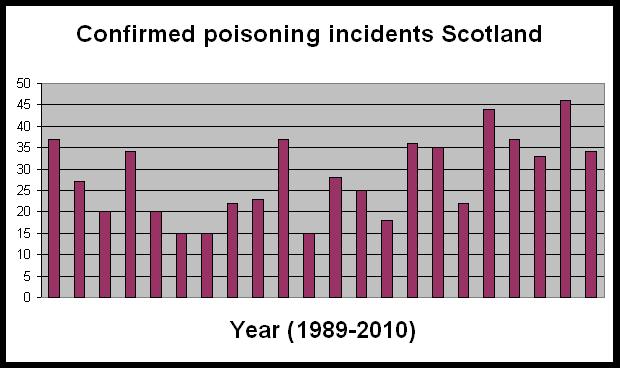
If you look closely at the graph, you will see a great deal of variation between years in the number of confirmed poisoning incidents. Of particular interest are the years 1994 and 1995 – in these two years, confirmed poisoning incidents dropped to a low of 15 from a previous high of 35+. However, if you then look at the following three years, the number of confirmed incidents steadily rose until they reached 35+ again. In 1999, the figure dropped again to 15, and from then until 2010, that figure has steadily risen and fallen, although never reaching the low of 15 again. So what does that tell us? I’m fairly sure that in the years 1994 and 1995, the game shooting lobby would have declared a ‘victory’ as the figures had dropped so much, and would have shouted from the hilltops that they’d changed their ways.  I’m also fairly sure that in the following three years when the figures rose again, the conservationists would have declared a ‘victory’ and pronounced that their claims of widespread persecution had been vindicated. Either way, it is clear that neither ‘side’ can draw conclusions just based on an annual figure; for a trend to be detected, we need to see long-term figures.

But do these figures actually provide the full picture? If you read the recent paper on historical persecution at Atholl Estate (see here), then it’s pretty obvious that the ‘official’ persecution figures are meaningless, in the sense that they don’t tell the whole story. And from a conservation perspective, the figures, whether accurate or not, are not really that important. To steal a line from the recent paper on peregrine persecution on grouse moors (see here), “….it is the population level impact that is important, rather than the number of confirmed persecution cases”. We now have peer-reviewed scientific studies that have shown how persecution on grouse moors is having a population level impact on several vulnerable species (golden eagle, hen harrier, red kite and now peregrine). We have yet to see any peer-reviewed scientific studies that can counter these findings and show that these species are NOT impacted by persecution on grouse moors at a population scale. Why do you think that is, and more to the point, what are our politicians going to do about the published findings, apart from telling us that the Scottish government’s support for grouse shooting “goes beyond words“? (see here). Let’s hope that support doesn’t go beyond action as well.

Shadow Environment Minister speaks out against illegal poisoning

The Shadow Environment Minister, Elaine Murray MSP, has spoken out against illegal poisoning following the report yesterday that a poisoned red kite and raven had been discovered in her constituency.

The following statement has appeared today on her website:

Dumfriesshire MSP Elaine Murray has hit out at the “shocking cruelty” of the poisoning of a red kite and raven in the hills near Durisdeer in Dumfries and Galloway.

The local MSP is warning of the impact on tourism in the area, as visitors to the Galloway Red Kite Trail have spent at least £21M in the region since 2004, with more than £2.6M spent by people who came specifically to see the kites.

Dumfriesshire MSP and Shadow Environment Minister Elaine Murray, who was involved in releasing some of the red kites in Dumfries and Galloway for the RSPB, said:

“This is an act of shocking cruelty that puts the very recovery of the red kite in Dumfries and Galloway at risk. Instances of poisoning like this are a double whammy because not only do they do potentially irreparable damage to our natural environment, but so much of our region’s tourism industry depends on wildlife that illegal killing of birds could have massive knock on consequences on our economy.

“This is a huge blow after the great news earlier this year that red kites have been bred in Nithsdale for the first time in 180 years. People come here to see the magnificent birds of prey in our countryside and it is selfish and barbaric to use illegal poisons to target them. The Police and RSPB Scotland have my full support in tracking down those responsible and I would urge anyone with information that could help to come forward”.

Elaine Murray MSP is no stranger to the fight against illegal raptor persecution, having played an important role during the debates on the WANE bill last year. She was also reported to have made several visits to raptor breeding sites earlier this year in the company of members from the local raptor study group.

Elaine Murray website here

Bye, then

In a feature article in the latest edition of Shooting Times, the Chairman of the National Gamekeepers Organisation, Lindsay Waddell, laments the sale of Millden Estate in Angus (see our earlier story about the sale here).

He questions the reasons behind the sale, “just as the moor is coming good“. It’s a strange description for an estate where two-year-old golden eagle Alma was found poisoned in 2009 (see here). His theory about why Millden has come on the market goes like this:

It would appear the answer lies in the recent legislation passed by the Scottish Parliament which holds landowners liable for the actions of their staff [vicarious liability], and that is something, it appears, some will not entertain at any cost. So it’s sell up, and get out. It may well turn out to be a sad day for the inhabitants of many glens if more and more of the modern-day owners decide to take the same course of action“.

Interesting.

Waddell goes on to acknowledge that there are still landowners (he says “a few”, we say ‘too many’) who won’t manage their land without the use of [illegal] poison and says these individuals have to shoulder a lot of the blame for the introduction of vicarious liability. No disagreement there, Lindsay – the criminals within your industry are finally having to face the music after 60 long years of relentless and systematic illegal raptor persecution.

He also comments that the new legislation (vicarious liability) is ‘open to abuse’. He writes: “It is all very easy for items to be ‘found’ on a piece of land“. By ‘items’, does he mean poisoned birds and poisoned baits, and enormous caches of illegal poison? Much like what was found on Skibo Estate in 2010? The ‘items’ that Dean Barr, sporting manager at Skibo Estate, claimed in the press had been planted by the RSPB (see here)? Obviously his press statement was made before he was found guilty of possessing 10.5 kg of Carbofuran – the UK’s biggest haul of this banned pesticide to date (see here).

Waddell continues by suggesting that Millden may be the first of many Scottish sporting estates to be sold. Let’s hope so. I can think of more than just ‘a few’ whose closure is long overdue.

Shooting Times article here

Scottish government’s support for grouse shooting “goes beyond words”, says Environment Minister

Here’s a fascinating insight into the Scottish Environment Minister’s views on driven grouse shooting.

In a letter addressed to the Earl of Hopetoun (Scottish Land & Estates’ Moorland Group), Environment Minister Stewart Stevenson MSP tells him: “I think it is clear that the Scottish Government’s support for this industry goes beyond words“. He goes on to comment about well-managed moorland as a valuable resource for biodiversity, the significant contribution the industry makes to the rural economy, and how hard the Scottish Government has fought to retain the use of snares for predator control.

It’s all a bit depressing until towards the end of the letter he addresses the issue of vicarious liability. It’s not clear what the Earl of Hopetoun said to Stewart Stevenson, but it seems to have been something along the lines of arguing against the introduction of vicarious liability (which is due to be enacted sometime this winter). Stevenson responds:

Turning to the issue of vicarious liability, I am afraid I do not agree that this poses a threat to the public benefits that well-managed moorlands deliver. The introduction of vicarious liability in this area is a response to a long-standing and continuing problem and reflects the wishes of a clear majority in Parliament. However, any grouse moor manager or owner who takes their staff and land management duties seriously and can show, if required, that they have carried out due dilligence in this respect, as required by the law, will not have any reason to be concerned“.

He continues: “I hope that we are beginning to see a significant reduction in crimes involving birds of prey. Any reduction in the numbers of birds that are found poisoned will be very welcome. We are however clear that the number of birds analysed by SASA is not the complete picture, and we will continue to be guided by the scientific advice from SNH on the overall population levels and distributions of birds of prey“.

Full letter available for download here: Stevenson response to Lord Hopetoun Aug 2011

Interestingly, the Earl of Hopetoun is a Director of Scottish Land and Estates and appears to be connected with the management of estate land in Lanarkshire. His profile biography on the Scottish Land and Estates website says the following:

Andrew Hopetoun is Chairman of Hopetoun Estates and Deputy Chairman of the Hopetoun House Preservation Trust. These two organizations manage Hopetoun House (home of the Hope family for over 300 years and a successful tourism, corporate and private functions business) and its related estates, mostly at Hopetoun near Edinburgh and around Leadhills in the Scottish Borders (See profile here).

This wouldn’t be the Hopetoun Estate (aka the Leadhills Estate), would it? If this information is accurate, then it’s easier to understand the Earl’s interest in vicarious liability, although it has previously been reported  that the Hopetoun family did not run the grouse moor and the shooting rights had been put up for sale (see here).

Elaine Murray MSP keeps up pressure for greater powers for SSPCA

Back in February 2011 when the Wildlife & Natural Environment (Scotland) Bill was still being debated, Peter Peacock MSP put forward an amendment that would provide greater powers for the Scottish Society for the Prevention of Cruelty to Animals (SSPCA) inspectors to investigate a wider suite of wildlife crimes (see here). The SSPCA currently has limited powers that only allows it to investigate certain types of wildlife crime (see here).

Given the concern over public spending cuts that will affect police resources, and the on-going concerns of getting police to even attend wildlife crime incidents (see here for info from SSPCA and RSPB, and info here from OneKind, page 12), Peter Peacock MSP proposed that if increased powers were given to the SSPCA, then perhaps more wildlife crimes (and especially raptor persecution incidents) might stand a better chance of being investigated more effectively.

The Environment Minister at the time (Roseanna Cunningham MSP) said that the proposed amendment raised significant issues of accountability – which seemed a fairly weak argument given that the SSPCA is already empowered to investigate some animal welfare incidents – but she did say that she thought the amendment could be considered, after public consultation, in a future Criminal Justice Bill.

Seven months later and some MSPs may have hoped/wished this proposal was long dead and buried. Not so! Enter stage right Elaine Murray MSP, who lodged the following motion in the Scottish Parliament late last week:

S4M-00932 Elaine Murray: First Dog-fighting Conviction under the Animal Health and Welfare (Scotland) Act 2006—That the Scottish Parliament congratulates the Scottish Society for the Prevention of Cruelty to Animals (SSPCA) on obtaining the first successful conviction for animal fighting under the Animal Health and Welfare (Scotland) Act 2006; notes that two brothers received jail sentences of four and six months for being involved in dog fighting involving pit bull terrier-type dogs; regrets that the perpetrators have only received a ban from keeping dogs for five years; notes that the SSPCA were able to achieve this conviction using powers conferred under the act to search and enter homes under warrant to retrieve evidence, and believes that the granting of similar powers to the SSPCA with regard to the investigation of wildlife crime should be considered.

This proposal seems to me to be a complete no-brainer. The SSPCA has been a reporting agency to the Crown for more than 100 years. They are highly effective – in 2009-2010, the SSPCA reported nearly 200 cases for prosecution to the Crown Office and Procurator Fiscal Service. Surely any sensible individual or organisation, who was committed to cracking down on wildlife crime, would support the proposal to widen the powers of these very productive and experienced investigators? Apparently the Scottish Gamekeepers Association doesn’t agree (see here on page 11).

Well done Elaine Murray MSP for keeping up the pressure – it will be interesting to see how this proposal develops over the coming months.

New Environment Minister in town

Stewart Stevenson MSP is the newly appointed Environment Minister, replacing Roseanna Cunningham MSP. The newly re-elected MSP for Banffshire & Buchan Coast made the following comment about his new role:

“I am delighted to be part of the Rural Affairs team in the new Scottish Government. As an early priority we shall be working closely with UK Ministers in particular to ensure that Scottish interests are properly represented in the European Union. Where we have the powers, we shall seek to work with rural, marine and environmental stakeholders to ensure that we understand and respond to their needs and concerns. For me personally, this is a superb opportunity to work in Government on a range of issues in which I have personal interest. I look forward to working with First Minister Alex Salmond and Cabinet Secretary Richard Lochhead and the rest of our strong team.”

Stewart is no stranger to the raptor persecution issue. In 2003, he was part of a panel listening to a petition put forward by the SGA for licences to kill raptors (yes, here we go again). We have covered this discussion in the past, but we’re re-posting the minutes here because they’re so entertaining they’re worth a second read. Especially the parts where Bert Burnett and Alex Hogg of the SGA have their ‘evidence’ of the ‘raptor problem’ shredded in seconds. Stewart Stevenson MSP is active throughout the discussion, both with the SGA and later with representatives from SNH.

In due course, we look forward to hearing Stewart’s views on how this Scottish government intends to deal with the on-going criminal persecution of Scotland’s raptors, given that the measures introduced by previous governments are clearly no deterrent.

Stewart Stevenson MSP webpage

Vicarious liability for raptor poisoning featured on forthcoming tv programme

The issue of vicarious liability for raptor poisoning incidents will feature in a forthcoming episode of ‘Landward’. It includes an interview with SGA chairman Alex Hogg, who will probably discuss his on-going (but so far thwarted) campaign to legalise raptor killing.
The 30 minute programme airs on Friday 27 May 2011 at 7 pm on BBC 2 Scotland. Also available on Channel 990 for Sky viewers, and BBC iPlayer shortly after transmission.

Landowner Liability: In Scotland, poisoning raptors is a criminal offence punishable with a fine and a jail sentence, yet the slaughter continues. Arguments over birds of prey have raged for decades, but are now coming to a head with the inclusion of vicarious liability for landowners in the Wildlife and Natural Environment (Scotland) Bill, recently introduced by the Scottish Parliament. This means that landowners will be held legally responsible for birds poisoned on their land. Dougie Vipond investigates how this new clause will affect land management in Scotland“.

http://www.bbc.co.uk/programmes/b011lg7s

Roseanna Cunningham MSP stands firm on licences to kill raptors

Following on from the recent publicity about Scottish landowners demanding licences to kill protected birds of prey (see here and here),  last week Elaine Murray MSP (Labour: Dumfriesshire) kicked off the new parliamentary session with the following question:

To ask the Scottish Executive whether it remains its position that ‘the balance of public interest [is] not at present in favour of issuing licences for the control of birds of prey to protect non-native reared game birds’ as stated by the Minister for Environment at the meeting of the Rural Affairs and Environment Committee on 3 November 2010 (Official Report c. 3330“. (Written question SW4-00007)

Roseanna Cunningham MSP gave a succint, one word answer: “Yes“.

Meanwhile, Alex Hogg (Chairman of the SGA) continues with the ridiculous argument that buzzards are “decimating all our wildlife“. He was talking to a BBC Scotland film crew at the time, for a forthcoming edition of Landward. I’m sure we’ll all look forward to watching that and listening to the scientific evidence that Alex puts forward to back up his claim: http://www.scottishgamekeepers.co.uk/content/19th-may

Landowners demand right to kill protected birds

Not content with the annual mass slaughter of millions of animals across Scotland (e.g. hares, rabbits, foxes, crows, stoats), landowners are pushing the Scottish government to issue licences to kill protected birds, including raptors.

According to an article in today’s Scotsman, in a forthcoming documentary on illegal raptor persecution in Scotland, Douglas McAdam of the SRPBA puts forward the argument for licences, claiming that they will reduce the incentive for landowners and gamekeepers to illegally poison and shoot protected species.

So what’s wrong with this logic? Well, in my opinion, nothing if you are a criminal, wanting to commit a crime but not be prosecuted for it. Perhaps we should all ask the government for a licence to walk into shops and take what we want? It would certainly be an incentive to stop the criminal activity of shoplifting but the only ones to benefit would be the shoplifters, not society as a whole. Who would benefit from the licensed killing of protected birds? The landowners. The rest of society would be left all the poorer for the loss of our magnificent species.

There’s nothing illegal about the SRPBA asking for the issue of licences – they are perfectly entitled to do this, and there is even a provision in the Scottish legislation to allow for the issue of licences. Fortunately, so far, our government has not been swayed by the argument and has called instead for a reduction in raptor persecution. So far this year there isn’t any evidence that raptor persecution is on the decline – the discovery of poisoned buzzards, poisoned bait, and most recently another poisoned golden eagle, tells us that these filthy criminal activities are continuing with impunity on Scottish shooting estates.

Of course, this isn’t the first time we have heard about the call for licences. The SGA has been campaigning for over ten years for the right to kill protected raptors, including hen harriers and buzzards. We have covered this topic extensively – see herehere, here, here, here, herehere and here.

No doubt these licence requests will persist – regardless of all the scientific evidence that shows how badly damaged our raptor populations already are thanks to the efforts of landowners and gamekeepers across Scotland.

Scotsman article about forthcoming documentary: http://www.scotsman.com/environment/Landowners-demand-right-to-cull.6764420.jp

BBC news: http://www.bbc.co.uk/news/uk-scotland-13339288

2010 map of shame: raptor poisoning on the increase (again)

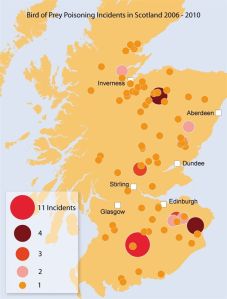
Here we go again…..the Partnership for Action against Wildlife Crime (PAW Scotland) has published the latest raptor persecution ‘hot-spot’ map based on the official poisoning figures from 2010. Surprise surprise, the number of confirmed poisonings in 2010 was higher than in 2009 and, once again, incidents were recorded throughout the length of mainland Scotland.

Once again, the map refers only to confirmed poisoning incidents – it does not indicate the locations where poisoned baits were discovered. Why not? It also does not indicate any other type of illegal raptor persecution incident such as shooting, trapping, beating, trampling, nest destruction, egg-stealing or other types of deliberate interference. Why not? It doesn’t name the estates where poisoned raptors were discovered. Why not? It doesn’t name the estates where poisoned baits were discovered. Why not? Same old, same old – these were the very questions we were asking this time last year and no doubt we’ll be asking them again next year when yet again, nothing has changed: https://raptorpersecutionscotland.wordpress.com/2010/03/17/2009-map-of-shame-why-not-name-the-estates/

The Scottish Government said the latest maps (both the 2010 map and the cumulative 2006-2010 map) were put together based on SASA data, with input from the government, RSPB Scotland and the SRPBA. I wonder what the SRPBA’s contribution was? Perhaps they were looking over the shoulder of the map-designer and making sure the hotspots were edged an inch or two away from some of their members’ estate boundaries? Heaven forbid that the finger of suspicion should point toward an SRPBA member – they all love raptors and its just a very unhappy coincidence that the land they manage seems to be devoid of hen harriers and eagles and red kites and peregrines and goshawks….

In a statement, Environment Minister Roseanna Cunningham said: “It’s disappointing to see that there has been no improvement in the number of birds of prey being deliberately and illegally poisoned in Scotland in the last twelve months. The fact that 132 of these iconic species have been targeted in the last five years is unacceptable.

It’s especially sad that some of the victims, such as sea eagles, are part of reintroduction programmes and there really has to be a change in attitude amongst those who are persistently involved in killing raptors.

We are taking measures to tackle this problem and have introduced a new vicarious liability offence as part of the Wildlife and Natural Environment (Scotland) Bill to make sure that those who direct or turn a blind eye to bird persecution can be held to account.

I also fully support the work of the Raptor Persecution Priority Delivery Group, which is looking at developing innovative ways to address this persistent problem.”

Ah yes, the Raptor Persecution Priority Delivery Group, whose members include representatives from certain organisations who refuse to even accept that hen harrier persecution is an issue, let alone that any of their members could possibly be responsible. Does anybody with an ounce of intelligence really expect this group to ‘deliver’ anything other than bland sound bites about ‘partnership working’?

Meanwhile, back in the real world, reports are filtering through of the latest bird of prey poisoning incident in Scotland – more news on this when we can confirm the source.

Link to the PAW Scotland press release on the 2010 raptor poisoning maps: http://www.scotland.gov.uk/Topics/Environment/Wildlife-Habitats/paw-scotland/news