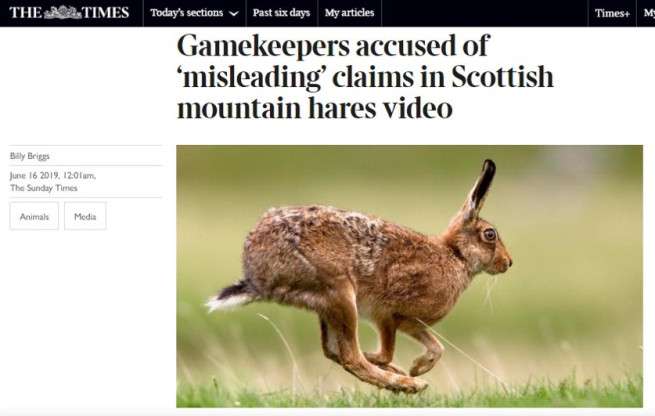
Protection for mountain hares kicked well & truly back in to long grass

Protection for mountain hares, slaughtered in their thousands on Scottish grouse moors (an estimated 26,000 each year), looks to be a long way off.

This is despite scientific evidence revealing catastrophic declines, despite the species’ unfavourable conservation status and despite the Scottish Parliament voting in June for full protection under the proposed Animals and Wildlife (Penalties, Protections and Powers) (Scotland) Act.

The Scottish Government is first insisting on undertaking a consultation with stakeholders to work out the details of how a licensing scheme will work, and has ignored the pleas of conservationists to bring in interim protection for mountain hares now that the open season for killing them has begun again (see here, here, here, here).

Instead, to the utter astonishment of the conservation community, as the hare-killing season opened on 1st August Environment Secretary Roseanna Cunningham asked the grouse shooting community to conduct voluntary restraint (see here) – an utterly futile and indeed facile request to an industry that has, for decades, proven itself incapable of self restraint.

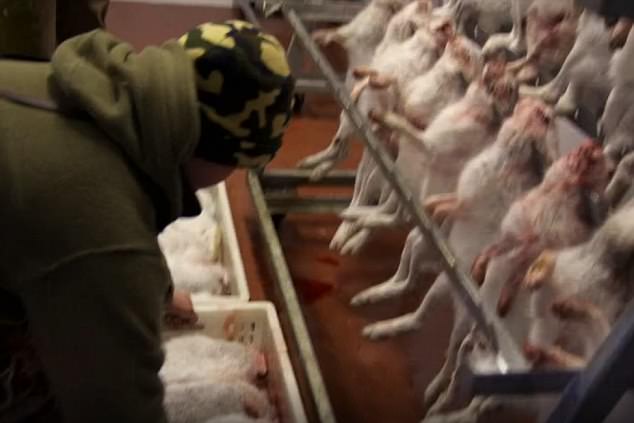
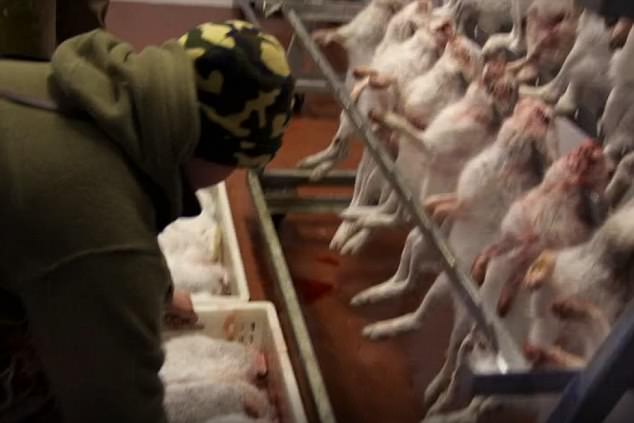
[Shot mountain hares strung up in a chilling larder, screen-grabbed from a controversial feature on Countryfile (2018) showing mountain hares being shot on a Scottish grouse moor]

Meanwhile, a number of politicians have been putting pressure on the Scottish Government to pull its finger out and bring in measures to prevent the inevitable hare-killing sprees on grouse moors across the country, but Environment Minister Mairi Gougeon is trotting out the usual vague and non-committal responses we’ve come to expect from this Government.

For example, here are some pertinent Parliamentary questions from Alison Johnstone MSP (Scottish Greens) and Christine Grahame (SNP) and the Environment Minister’s responses:

Question S5W-30665: Alison Johnstone, Lothian, Scottish Green Party. Date lodged 13/7/20:

To ask the Scottish Government when it plans to commence section 10F of the Animals and Wildlife (Penalties, Protections and Powers) (Scotland) Act.

Answered by Mairi Gougeon (30/7/20):

The Scottish Government will set out its timetable for commencing all sections of the Animals and Wildlife (Penalties, Protections and Powers) (Scotland) Act 2020, including Section 10F, in due course.

Question S5W-30899: Christine Grahame, Midlothian South, Tweeddale and Lauderdale, Scottish National Party. Date lodged: 23/7/20:

To ask the Scottish Government, in light of mountain hare culling restarting on 1 August 2020, when the licensing scheme in compliance with the Animal and Wildlife (Penalties, Protections and Powers) (Scotland) Act 2020 will be enforceable. 

Answered by Mairi Gougeon (10/8/20):

I refer the member to the answer to question S5W-30665 on 30 July 2020. All answers to written parliamentary questions are available on the Parliament’s website, the search facility for which can be found at xxxxxxxx.

Question S5W-30664: Alison Johnstone, Lothian, Scottish Green Party. Date lodged 13/7/20:

To ask the Scottish Government what measures it will put in place to prevent further mass culling of mountain hares when the mountain hare closed season ends on 1 August 2020.

Answered by Mairi Gougeon (10/8/20):

The Scottish Government has always been clear that any large-scale culling that threatens the conservation status of mountain hares is not acceptable. However, as I stated during the stage 3 debate in Parliament there are a number of issues that must be fully considered ahead of the introduction of a licensing regime. I am now giving careful thought as to how that regime will work and when the protection will come into force and I will be discussing that in detail with stakeholders over the coming months. We will be following the situation carefully for any indication of attempts to carry out excessive culls and will take steps to address this if necessary.

God this is tedious. ‘Over the coming months’ and ‘in due course’ and ‘we will take steps to address this if necessary’. These are holding statements designed to hide the fact that the issue is being kicked in to the long grass.

Do these phrases sound familiar? They should – these are the exact same lethargic, ambiguous phrases that have come to characterise the Scottish Government’s inaction over the ongoing and illegal killing of birds of prey on driven grouse moors.

So far this season there are no confirmed reports of mountain hares being culled on Scottish grouse moors (there were a couple of unconfirmed reports in early August but these proved to be unsubstantiated – see here). However, with the grouse-shooting season now open this isn’t the time when most hares are slaughtered. That bloodbath usually takes place in January and February, once the grouse-shooting season has ended, as depicted in this shocking video.

Can we expect to see more of the same this season?

Disappearance of golden eagle Tom prompts Parliamentary motion

Earlier this week we blogged about the suspicious disappearance of Tom, a golden eagle we’d been satellite-tracking since last year with Chris Packham and who vanished in to thin air, along with his fully-functioning satellite tag, with his last known location being on a driven grouse moor in Strathbraan, a well-known raptor persecution hotspot (see here).

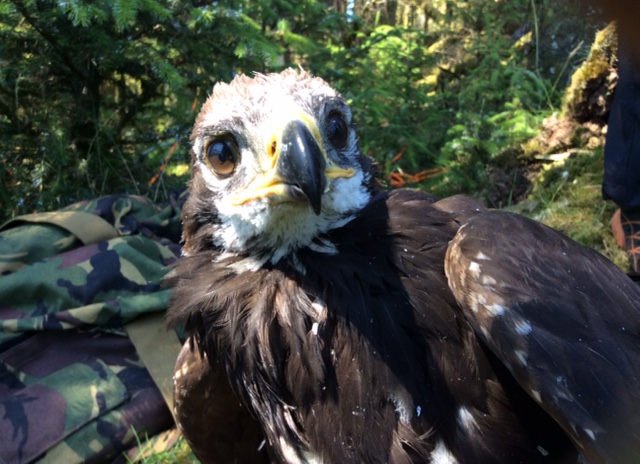
[Golden eagle Tom at approx 8 weeks old having his satellite tag fitted in 2019 under expert licence. Photo Raptor Persecution UK]

We produced a video about Tom’s suspicious disappearance and this, along with the RPUK blog on his disappearance, received good media coverage both online and in the printed media throughout the week, even though a journalist at The Times simply cut and pasted the text from the RPUK blog, regurgitated it in an article and attributed this to ‘a spokesman from RPUK‘. Ha!

Here’s the video for those who may have missed it:

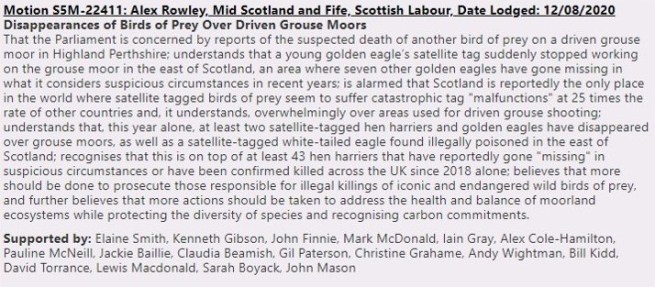
And now Tom’s disappearance has prompted a Parliamentary motion, lodged by Labour MSP Alex Rowley as follows:

It’s not just Tom’s disappearance that has led to this. As you can see, Alex also mentions the suspicious disappearance of seven other satellite-tagged golden eagles in the same area, the disappearance of another satellite-tagged hen harrier on another Scottish driven grouse moor (here), the illegal poisoning of a satellite-tagged white-tailed eagle found dead on another Scottish grouse moor (here), and the 43 hen harriers that have either gone missing or have been killed in the UK in the last two years (here).

He’s done his homework.

For a Parliamentary Motion to be considered for debate, at least 30 MSPs from at least two different political parties need to support it. So far, Alex’s motion has attracted the support of 17 MSPs, representing Labour, SNP, Greens, Liberal Democrats and one independent.

If your MSP’s name isn’t on the list as a supporter, please email them and prompt them to sign up. If they refuse, ask them why. Put them on the spot and most importantly of all, let them know that this issue matters to you.

If you don’t know who your MSP is you can find out here

If you want to do more, and if you’re sick to the back teeth of illegal raptor persecution on driven grouse moors, please consider participating in this quick and easy e-action to send a letter to your local Parliamentary representative (MSP/MP/MS) urging action. Launched last Saturday by Wild Justice, RSPB and Hen Harrier Action, over 41,000 people have signed up so far.

This means that over 41,000 pre-written letters complaining about illegal raptor persecution and the environmental damage caused by intensive grouse moor management, are winging their way to politicians of all parties across the UK. If you want your local politician to receive one, Please join in HERE

Thank you

Cross-party political pressure on Scottish Government to respond to Werritty review on grouse moor licensing

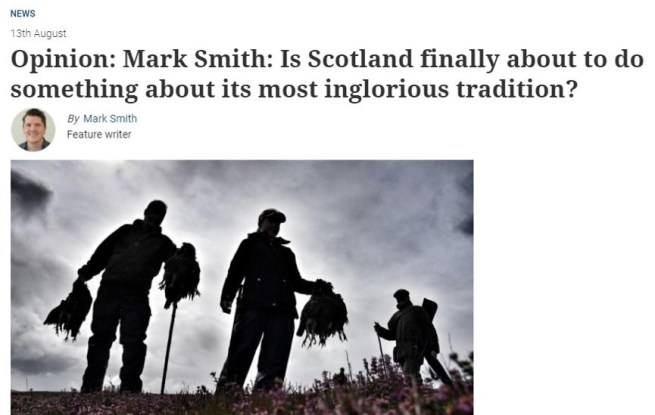
There was an interesting opinion piece in The Herald on 12th August, written by Mark Smith who was scathing both about grouse shooters (‘that rare and rather sad creature’) and the Scottish Government’s ‘lack of urgency’ in its failure to respond to the Werritty Review. It’s well worth a read (here).

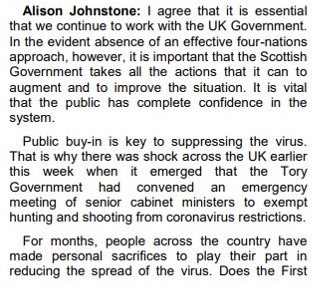
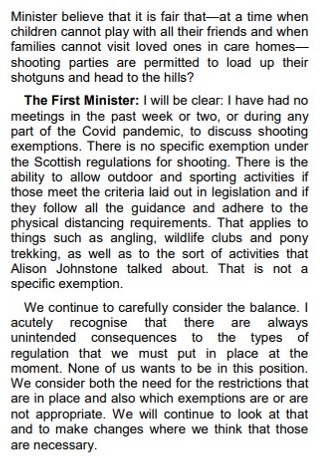
Meanwhile, further to First Minister’s Questions on 12th August when Alison Johnstone MSP (Scottish Greens) put Nicola Sturgeon on the spot about the ongoing illegal persecution of birds of prey on grouse moors (see here), and the subsequent feeble response from Environment Cabinet Secretary Roseanna Cunningham (here), yesterday saw more cross-party pressure piled on to the Scottish Government over this issue.
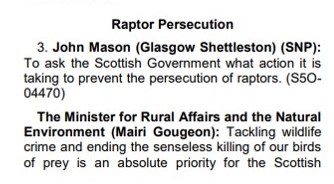
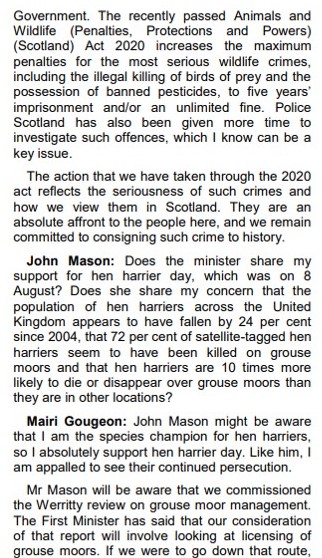
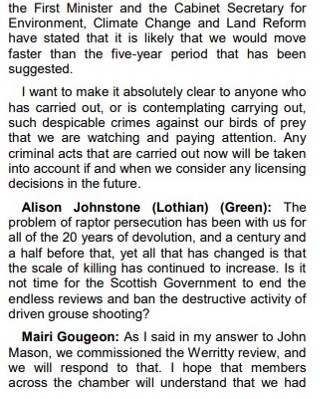
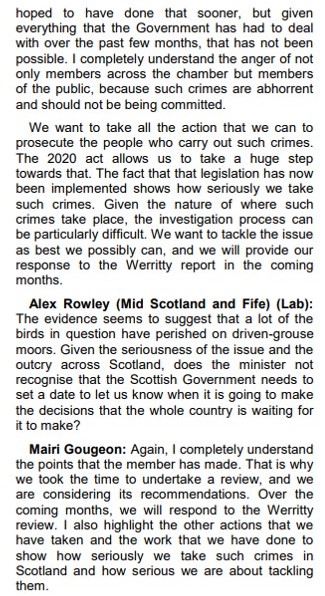
John Mason (SNP), Alison Johnstone (Greens) and Alex Rowley (Labour) all pushed Environment Minister Mairi Gougeon and made it clear that patience has run out:

Transcript from the Scottish Parliament’s Official Report, 13th August 2020.

There’s absolutely no doubt the pressure is mounting to unprecedented levels.

One of these MSPs has taken the matter a step further. More on that in the next blog….

Meanwhile, if you want to add to that mounting pressure, and if you’re sick to the back teeth of illegal raptor persecution on driven grouse moors, please consider participating in this quick and easy e-action to send a letter to your local Parliamentary representative (MSP/MP/MS) urging action. Launched last Saturday by Wild Justice, RSPB and Hen Harrier Action, over 41,000 people have signed up so far.

This means that over 41,000 pre-written letters complaining about illegal raptor persecution and the environmental damage caused by intensive grouse moor management, are winging their way to politicians of all parties across the country. If you want your local politician to receive one, Please join in HERE

Thank you

Unconfirmed reports of mountain hare culls on several Scottish grouse moors

The season for killing mountain hares in Scotland opened on Saturday (1st August) despite a recent Parliamentary vote to provide more protection for this species.

In this particular case, greater protection (i.e. those who want to kill mountain hares will need to apply for a licence) will not be available until the Scottish Government has undertaken a consultation to consider the terms and conditions of any such licencing scheme.

Meanwhile, while everyone waits for the Scottish Government to conduct that consultation, the shooting season has opened and the Government has ignored campaigners’ pleas to offer interim protection to those mountain hares.

Instead, the Environment Cabinet Secretary has, with a straight face, called on the grouse-shooting industry to practice ‘voluntary restraint’ (see here).

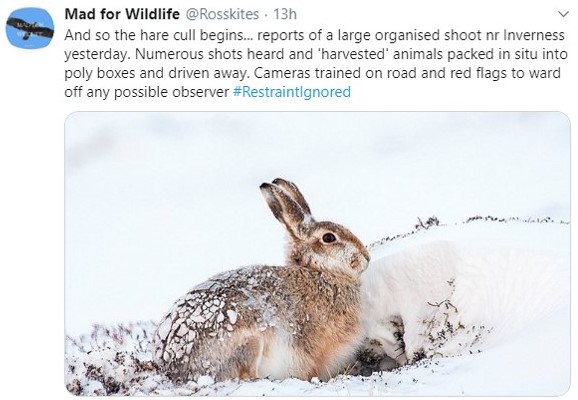
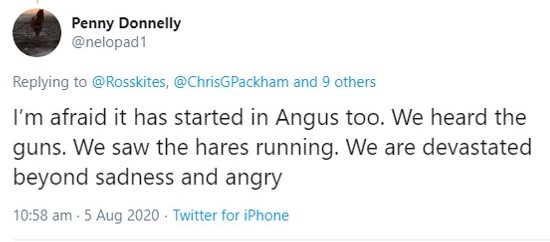
So it came as no surprise to see a number of (as yet unconfirmed) reports on Twitter yesterday that mountain hare culling had begun, apparently on a grouse moor in the Monadhliaths and a grouse moor in the Angus Glens.

Under the current legislation, these estates are entitled to kill as many mountain hares as they like, without needing permission or a licence, and there is no obligation for them to record or report the number of hares killed.

Nor is there any obligation to report what they do with those shot hares. Some will end up on sale for human consumption (complete with embedded toxic poisonous lead shot, yum yum), others will simply be discarded, and some will be used to bait traps and stink pits to lure other wildlife to a gruesome death.

[Shot mountain hares strung up in a chilling larder, screen-grabbed from a controversial feature on Countryfile (2018) showing mountain hares being shot on a Scottish grouse moor]

UPDATE August 2020: Neither of these unconfirmed reports have been substantiated and there is no evidence that mountain hares were being culled in the Monadhliaths or the Angus Glens at the beginning of August 2020.

“It’s time Scotland took on landed interests over animal protections” says Alison Johnstone MSP

Last month the Scottish Parliament voted overwhelmingly (see here) to provide full protected status for mountain hares, thus effectively ending the unregulated slaughter of ~26,000 hares on grouse moors every year.

However, hare-culling under licence will still be permitted under certain circumstances and the conflict over the protection of this species is far from over.

[Shot mountain hares strung up in a chilling larder, screen-grabbed from a controversial feature on Countryfile (2018) showing mountain hares being shot on a Scottish grouse moor]

In preparation for a more detailed blog in the run up to the opening of the hare-killing season this Saturday (1st August), have a read of this opinion piece written last month by Alison Johnstone MSP, whose amendment to the Animals and Wildlife (Penalties, Protections & Powers) (Scotland) Bill led to the [as yet to be implemented] increased protection for mountain hares.

This article is reproduced from The National (26 June 2020).

It’s time Scotland took on landed interests over animal protections

by Alison Johnstone MSP

THE response to mountain hares finally becoming a protected species in Scotland has been nothing less than astonishing.

After MSPs backed my amendment, thanks and congratulations came flooding in from across Scotland and around the world for winning vital protection for this iconic native species.

In parts of the Highlands, mountain hare populations have crashed since the 1950s, with an average of 26,000 killed every year, largely for fun and as part of mass killing on grouse moors. Last year their conservation status was downgraded to “unfavourable”.

Protecting these animals is the least we should do as a progressive country that values our wildlife and countryside, yet there has also been an astonishing response to this move from landed vested interests and the grouse shooting lobby, who have reacted with fury.

Gamekeepers claimed the vote in Parliament was “undemocratic” and threatened to set up their own political party, while the countryside alliance called into question my integrity, presumably because their only alternative is to defend the indefensible.

Preventing the slaughter of native wildlife in decline is perhaps the most basic act of conservation. Even under the highest level of wildlife protection available in Scotland, land managers could still apply for a licence to kill hares as a last resort, so the scale of response from the grouse shooting lobby is very revealing. It shows this is a community which is not used to being beaten. It demonstrates the power and influence they are used to having.

In December, the two-year review of Scotland’s grouse moors led by Professor Alan Werritty was published, but it brought absolutely nothing new to the table. It couldn’t even define what a grouse moor is, even though they cover around a fifth of Scotland’s land mass.

Incredibly, the Scottish Government has yet to respond to this watered-down review, which perhaps shows how unwilling the SNP is to take on this powerful lobby.

Last week, however, Scottish Government ministers came under incredible pressure after a Scottish Greens petition in support of hare protection garnered more than 25,000 signatures in just a few days. It was clear that public opinion does not align with the interests of those who enjoy shooting grouse on an industrial scale.

Although Parliament voted for an end to indiscriminate killing of mountain hares, the fight is not yet over. Shooting clubs have ominously warned our celebrations will be “short-lived”, and August will see the start of hare-killing season.

The RSPB and others have expressed concerns that these enthusiasts will use any delay in implementing the new restrictions to kill as many mountain hares as possible. There are already signs on social media that they are mobilising to do this.

They know this would be met with outrage, but this is a sector which has shown little interest for public concerns. The number of birds of prey which vanish around grouse moors is testament to that, which no doubt contributes to the lobby’s claim that mountain hares “thrive” on grouse moors. It is a circle of killing dressed up as conservation.

The fact muirburn continued into the pandemic lockdown and in dangerously dry conditions, despite the warnings of the fire service and Parliament backing my colleague Andy Wightman’s temporary ban, is another example of this industry’s disregard for wider community concerns and democratic process.

In accepting my amendment during the debate, natural environment minister Mairi Gougeon suggested the Scottish Government might delay implementation of this vital protection for mountain hares.

LIKE many, I’m really worried that this delay will only encourage an unprecedented killing spree by those who want one last hurrah. The ban must come in by August 1 and the Scottish Government need to issue a warning to these powerful vested interests that they must control themselves. They can’t always have their own way.

Grouse moors are left deliberately barren as a plaything for the very few. It’s ridiculous that so much of Scotland is taken up with this this mindlessly cruel Victorian hobby, when that land is needed to restore forests and peatland to tackle the climate emergency. Changing its use would also provide thousands of rural jobs at a time when unemployment is rising at an alarming rate.

Although mountain hare protection is a vital first step in tackling the problem of grouse moors, when we look back at last week’s animal and wildlife bill, it’s clear there is a long way to go for our Parliament to truly take on the powerful lobbyists who defend them.

For example, once again the SNP joined forces with the Conservatives to protect the rights of the shooting lobby to dock the tails of puppies. This practice involves cutting or crushing muscle, nerves and bones, without anaesthetic, in puppies under five days old. If done badly, it can cause the dog chronic pain throughout its life. Animal welfare experts are clear that there is no scientific basis for tail docking and the British Veterinary Association agree the practice should be banned in all circumstances except for treating an injury.

Our proposals to further protect badgers and beavers were also rejected. It’s time for Scotland to take on the powerful landed interests that hold back progress, for which animal protection is the front line.

ENDS

New taskforce to consider increased powers for SSPCA (sound familiar?)

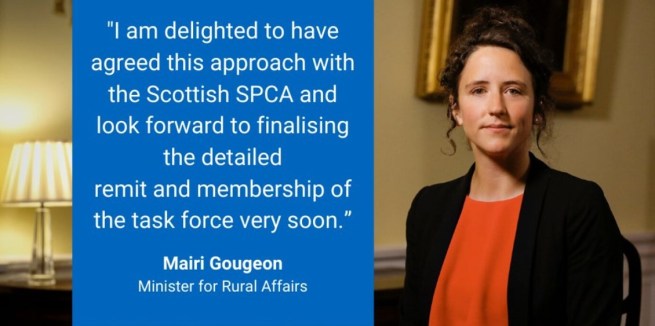
The Scottish Government’s Environment Minister, Mairi Gougeon, has announced a commitment to establish an independent taskforce to consider an extension of powers for the SSPCA which could lead to them being allowed to investigate a wider remit of wildlife crime than at present, including raptor persecution.

This announcement is a result of yet another strong amendment made by the Scottish Greens on the Animals and Wildlife Bill currently passing through Parliament. Mark Ruskell MSP proposed further powers for the SSPCA at Stage 2 during an evidence session of the Environment, Climate Change & Land Reform (ECCLR) Committee on 26 May 2020. Mairi Gougeon persuaded him to withdraw the proposed amendment on the basis that she’d consider establishing a taskforce. You can read their discussion here: ECCLR 26 May 2020_discussion SSPCA increased powers_Ruskell_Gougeon

Mairi Gougeon has now confirmed her commitment to establishing an ‘independent’ taskforce this summer, with a view to seeing it report in the New Year as long as Covid19 and Brexit shenanigans don’t disrupt. You can read her confirmation letter to the ECCLR (and her correspondence with a seemingly very grateful SSPCA) here: Gougeon correspondence to ECCLR SSPCA on proposed taskforce

[The Scottish Government published this on social media last night]

Sounds good, right? We’re all sick of the raptor killing criminals getting away with it so announcing a taskforce to consider extending the SSPCA’s powers so that its officers can investigate a wider remit of wildlife crime (instead of being restricted to investigating crimes that only include live animals, as at present) must be brilliant news, surely.

But is it, really?

For those of you with long memories, you’ll know that the issue of increased powers for the SSPCA to tackle more wildlife crime has been around for many, many years. Since 2011, in fact. It has been debated and consulted to death and yet has gone absolutely nowhere, despite six (yes, six) Environment Ministers presiding over it (Roseanna Cunningham, Stewart Stevenson, Paul Wheelhouse, Aileen McLeod, Roseanna Cunningham [again, but this time as Cabinet Secretary] and now Mairi Gougeon).

For those new to this, here’s a quick recap of how the Scottish Government has dealt with this issue so far:

February 2011: Increased powers for the SSPCA was first suggested by former MSP Peter Peacock as an amendment during the Wildlife & Natural Environment (Scotland) Bill debates. The then Environment Minister Roseanna Cunningham rejected it as an amendment but suggested a public consultation was in order.

September 2011: Seven months later Elaine Murray MSP (Scottish Labour) lodged a parliamentary motion that further powers for the SSPCA should be considered.

November 2011: Elaine Murray MSP (Scottish Labour) formalised the question in a P&Q session and the next Environment Minister, Stewart Stevenson MSP, then promised that the consultation would happen ‘in the first half of 2012’.

September 2012: Nine months later and nothing had happened so we asked Paul Wheelhouse MSP, as the new Environment Minister, when the consultation would take place. The response, in October 2012, was:

The consultation has been delayed by resource pressures but will be brought forward in the near future”.

July 2013: Ten months later and still no sign so we asked the Environment Minister (still Paul Wheelhouse) again. In August 2013, this was the response:

We regret that resource pressures did further delay the public consultation on the extension of SSPCA powers. However, I can confirm that the consultation document will be published later this year”.

September 2013: At a meeting of the PAW Executive Group, Minister Wheelhouse said this:

The consultation on new powers for the SSPCA will be published in October 2013“.

January 2014: In response to one of our blog readers who wrote to the Minister (still Paul Wheelhouse) to ask why the consultation had not yet been published:

We very much regret that resource pressures have caused further delays to the consultation to gain views on the extension of SSPCA powers. It will be published in the near future“.

31 March 2014: Public consultation launched.

1 September 2014: Consultation closed.

26 October 2014: We published our analysis of the consultation responses here.

22 January 2015: Analysis of consultation responses published by Scottish Government. 233 responses (although 7,256 responses if online petition included – see here).

We were told a decision would come from the new Environment Minister, Dr Aileen McLeod MSP, “in due course”.

1 September 2015: One year after the consultation closed and still nothing.

25 February 2016: In response to a question posed by the Rural Affairs, Climate Change & Environment Committee, Environment Minister Dr Aileen McLeod said: “I have some further matters to clarify with the SSPCA, however I do hope to be able to report on the Scottish Government’s position on this issue shortly“.

May 2016: Dr Aileen McLeod fails to get re-elected and loses her position as Environment Minister. Roseanna Cunningham is promoted to a newly-created position of Cabinet Secretary for the Environment.

12 May 2016: Mark Ruskell MSP (Scottish Greens) submits the following Parliamentary question:

Question S5W-00030 – To ask the Scottish Government when it will announce its decision regarding extending the powers of the Scottish SPCA to tackle wildlife crime.

26 May 2016: Cabinet Secretary Roseanna Cunningham responds with this:

A decision on whether to extend the investigatory powers of the Scottish SPCA will be announced in due course.

1 September 2016: Two years after the consultation closed and still nothing.

9 January 2017: Mark Ruskell MSP (Scottish Greens) submits the following Parliamentary question:

Question S5W-05982 – To ask the Scottish Government by what date it will publish its response to the consultation on the extension of wildlife crime investigative powers for inspectors in the Scottish SPCA.

17 January 2017: Cabinet Secretary Roseanna Cunningham responds:

A decision on whether to extend the investigatory powers of the Scottish Society for the Prevention of Cruelty to Animals will be announced in the first half of 2017.

31 May 2017: Cabinet Secretary Roseanna Cunningham rejects an extension of powers for the SSPCA ‘based on legal advice’ and instead announces, as an alternative, a pilot scheme of Special Constables for the Cairngorms National Park (here). It later emerged in 2018 that this pilot scheme was also an alternative to the Government’s 2016 manifesto pledge to establish a Wildlife Crime Investigation Unit as part of Police Scotland – a pledge on which it had now reneged (see here).

November 2019: The pilot scheme of Special Constables in the Cairngorms National Park was an absolute failure as a grand total of zero wildlife crimes were recorded by the Special Constables but plenty were reported by others (see here).

So here we are again, nine years on and the latest Environment Minister has announced a taskforce. Given the unimpressive history, it’s really difficult to be excited by this announcement. That’s no reflection on Mairi Gougeon’s commitment to the issue – her integrity is not in doubt – but this Government’s appalling track record of constant can-kicking on SSPCA powers, on tackling wildlife crime and particularly on raptor persecution within the game-shooting industry, is wearing very thin indeed.

Perhaps a more optimistic perspective would be to say that even after all these years of debate, delays, parliamentary questions, delays, reviews, delays, consultation, delays, alternative schemes, delays, this issue simply refuses to go away, as do those of us determined to hold this Government to account and insist that everything possible is done to bring the raptor killing criminals to justice.

Kudos to the Scottish Greens and especially to Mark Ruskell MSP who has maintained the pressure on this particular issue for all these years.

Scottish gamekeepers desperate to keep slaughtering mountain hares on grouse moors

The Scottish Gamekeepers Association (SGA) has come out all guns blazing to try and prevent the Scottish Parliament from voting to protect the mountain hare in tomorrow’s debate on Stage 3 of the Animals and Wildlife Bill.

Scottish gamekeepers are terrified that they’ll no longer be able to enjoy what everyone else sees as a grotesque bloodbath.

SGA Chairman Alex Hogg has penned a typically deluded letter to MSPs in which he claims to be ‘a representative of the people of all of Scotland‘ (eh?) and how stopping the mass slaughter of mountain hares on grouse moors ‘will affect human beings’ lives’ (er…) and ‘worsen the conservation status of the mountain hare‘. Really?

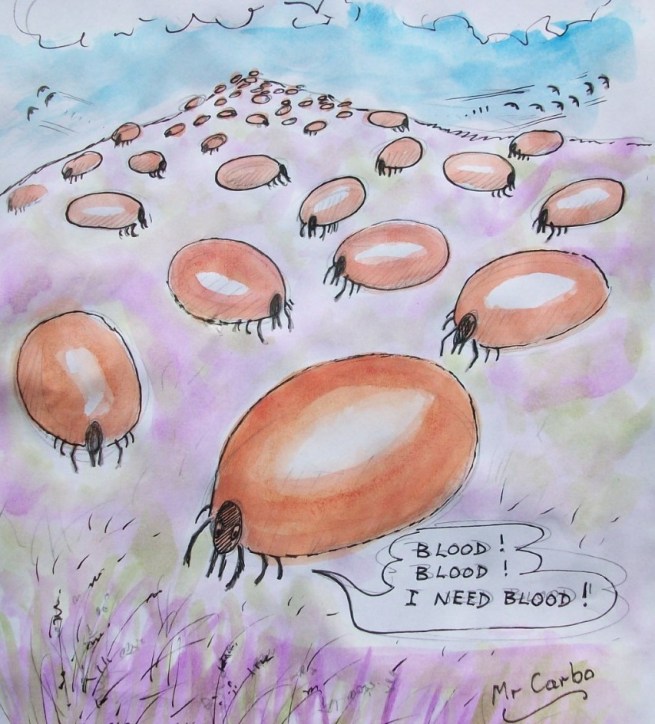
Oh, and further justification for the slaughter is the protection of walkers, ramblers and mountain bikers from the perils of Lyme disease:

Of course, it’s not the first time the SGA has been accused of making ‘misleading’ and ‘greatly exaggerated’ claims’ about mountain hares (see here and here).

Meanwhile back on planet humanity, support is growing for MSP Alison Johnstone’s amendment to increase protection for the mountain hare that would effectively end the mass killing on grouse moors (see here and here).

The RSPB has published a good blog in support (here), as has animal welfare charity OneKind (here), and the signatures on the Scottish Green’s petition calling for support has now passed 12,000 in just a few days. If you’d like to sign it, please visit HERE.

Please keep writing to your MSPs – we know that mail bags have been inundated on this topic and it’ll be of great interest to see who votes in support of this amendment in tomorrow’s debate.

Parliamentary questions on lead ammunition & medicated grit on grouse moors

The Scottish Greens just keep piling on the pressure.

Some interesting Parliamentary questions from Mark Ruskell MSP on the toxic hazard of lead ammunition and the use of medicated grit on grouse moors:

Question S5W-29820, Date Lodged: 09/06/2020

To ask the Scottish Government what proportion of the active ingredient in the medicated grit that is used on managed grouse moors is excreted by the birds. [Expected answer date 24/6/2020]

Question S5W-29821, Date Lodged: 09/06/2020
To ask the Scottish Government what assessment SEPA has made regarding the wider environmental impacts of the medicated grit that is used on grouse moors. [Expected answer date 24/6/2020]
Question S5W-29822, Date Lodged: 09/06/2020
To ask the Scottish Government what testing is carried out on the levels in the human food chain of the active ingredient in the medicated grit that is used on grouse moors. [Expected answer date 24/6/2020]
Question S5W-29823, Date Lodged: 09/06/2020
To ask the Scottish Government when it expects the use of lead ammunition to be entirely phased out on (a) public and (b) private land. [Expected answer date 24/6/2020]
Question S5W-29824, Date Lodged: 09/06/2020
To ask the Scottish Government what level of lead from shot gameboards [sic] is present in the human food chain, and what regular analysis it carries out of this. [Expected answer date 24/6/2020]
The Scottish Government is going to struggle not to look completely incompetent and/or wholly unconcerned about the unregulated toxic hazards that feature on driven grouse moors. This can be stated with confidence because the answers to Mark’s questions are already known.
The active ingredient in medicated grit is Flubendazole, a drug that has been identified as ‘an emerging environmental contaminant of acute and chronic toxicity’ and has been shown to be particularly toxic to aquatic organisms. Previous Freedom of Information requests submitted by this blog have revealed that the Scottish Government is not monitoring the impact of medicated grit, even though it’s known that some in the industry are using a super-strength dose up to twenty times the original dose! Surveillance undertaken by the Veterinary Medicines Directorate (VMD), responsible for the national (UK) monitoring of veterinary drugs in food products, has been woefully inadequate, and that’s being kind. In a country that shoots an estimated three quarters of a million red grouse each year, the VMD proposed to test just ten birds in 2018 (see here).
The use of lead ammunition to shoot gamebirds in the UK is unregulated, despite the well-documented high toxicity of this metal and the consequential health implications of consuming it. With most of the previously significant sources of lead in the environment now having been eliminated decades ago (e.g. lead-based paints and leaded petrol), lead-based ammunition is the most significant unregulated source of lead deliberately emitted in to the environment. It’s a poison, it’s as simple as that.
If that wasn’t bad enough, the most jaw-dropping revelation is that all gamebirds (including red grouse) appear to be exempt from statutory testing for lead shot, in sharp contrast to other meat types destined for human consumption. Research (here) has shown that shot red grouse destined for the food chain may contain excessive amounts of toxic poisonous lead (over 100 times the lead levels that would be legal for other meat)!
Talk about vested interests! The law makers of the day clearly put their own pleasure and convenience above the health and welfare of the general public and the environment. It’s an absolute shocker that this continues.
The game shooting industry knows that time is up on this issue and earlier this year we saw a high profile media campaign suggesting that the industry supported a ‘voluntary ban’ on the use of lead ammunition (yeah, because this industry’s adherence to voluntary restraint is legendary, right?) and wanted to see it phased out within five years. Unfortunately, not everybody in the industry was singing from the same hymn sheet and it turned in to a bit of a car crash when the Scottish Gamekeepers Association refused to sign up (see here).
It’ll be interesting to see how the Scottish Government responds to Mark’s questions.
For those who want to find out more about the use of medicated grit and lead ammunition, download fully referenced summary report (here) from Revive, the coalition for grouse moor reform.
UPDATE 13 July 2020: Disingenuous parliamentary answers from Scot Gov on toxic hazards of grouse moor management (here)

YOUR vote to end mass slaughter of mountain hares on Scottish grouse moors

As you know, Scottish Greens MSP Alison Johnstone has recently lodged an amendment to the Animals & Wildlife Bill, which would make mountain hares a protected species, effectively ending the mass slaughter on grouse moors (see earlier blog here).

An estimated 26,000 mountain hares are killed on grouse moors every year. Here’s one of them, shot and left to rot on Glenogil Estate in the Angus Glens. Photo by OneKind:

Alison’s amendment is due to be debated and then voted upon by the Scottish Parliament on Wednesday 17 June 2020.

There has been a LOT of activity on social media since the amendment was announced, with many constituents contacting their MSPs and asking for an indication of how they intend to vote on this issue.

As a further demonstration of public support for the amendment, the Scottish Greens have launched a public petition where YOU can have your say. It has gathered over 7,000 votes in the last two days. If you’d like to sign it, please click HERE

For those who want to learn more about the mass killing of mountain hares on Scottish grouse moors, this 2017 report (here) provides a good introduction, as does this video:

Scottish Parliament to vote on banning mass slaughter of mountain hares on grouse moors

Press release from the Scottish Greens (10 June 2020)

Parliament to vote on mountain hare mass killing ban

The controversial practice of mass killing of mountain hares may finally end thanks to a proposal from Scottish Green MSP Alison Johnstone, who has lodged an amendment to the Animals and Wildlife Bill. The amendment would make mountain hares a protected species, effectively ending recreational killing and mass killing on grouse moors.

[Shot mountain hares strung up in a chilling larder, screen-grabbed from a controversial feature on Countryfile (2018) showing mountain hares being shot on a Scottish grouse moor]

The Lothians MSP has a proposed member’s bill to end the killing of the iconic animal but will seek to introduce the protections sooner in stage 3 of the Animals and Wildlife (Penalties, Protections and Powers) (Scotland) Bill.

Alison Johnstone said: “Mountain hares are iconic animals, native to the Highlands. Yet rather than being treasured they are barely protected by the Scottish Government, and persecution and mass killings are rife. This is our chance to end the killing and protect this species for future generations.

In 2019 the conservation status of the mountain hare was downgraded to ‘unfavourable’ after new data published by the EU revealed populations have experienced a major decline [see here]. This followed shocking evidence of large-scale killing on shooting estates [here] apparently to increase the numbers of grouse available.

Mountain hares are routinely being killed in huge numbers on grouse moors in particular, with an average of 26,000 killed every year. Efforts to get shooting estate managers to practice voluntary restraint has failed.

I hope that the SNP and other parties will ignore special pleading from the shooting lobby and do the right thing next week. Either this amendment passes and mountain hares are protected, or Parliament turns a blind eye to the continued slaughter of a native species

ENDS

Stage 3 of the Animals & Wildlife Bill will take place next Wednesday and MSPs will vote on Alison Johnstone’s amendment to make the mountain hare a protected species.

If you’d like to encourage your MSP to support this amendment, please contact them now. If you’re not sure who your MSP is, you can find out by typing in your postcode here.