Jim Crumley has written a brilliant opinion piece for the Courier (published 10th May 2021) in response to the discovery of the deliberately poisoned golden eagle found on Invercauld Estate in March.
The article is reproduced below:
THERE is a job of some urgency for the new Environment Secretary at Holyrood.
You may have read about the golden eagle found poisoned at Invercauld estate in the Cairngorms National Park.
The guiding principles for a national park should centre around the wellbeing of the landscape and its ecology. Nothing else. Otherwise, why bother to have a national park at all?
But what Scotland has instead is two national parks obsessed by tourism and the rural economy.
As it happens, I have just been reading a book called “A Life in Nature”, a collection of writings by Peter Scott, founder of the Wildfowl and Wetlands Trust and the Worldwide Fund for Nature. He wrote this:
“For conserving wildlife and wilderness there are three categories of reason: ethical, aesthetic, and economic, with the last one (at belly level) lagging far behind the other two.”
And this:
“Conservationists today are involved in a gigantic holding operation – a modern Noah’s Ark to save what is left of the wildlife and wild places, until the tide of new thinking begins to flow all over the world.”
Long wait for tide to turn
He wrote that 60 years ago.
But because I read it at the same time as Nicola Sturgeon’s astonishing election achievement was playing out, I began to think that there is an opportunity right here, right now.
If we are on a tide of new thinking, it has never been more important that the Scottish Government appoints an Environment Secretary with a radical agenda.
And please don’t let Fergus Ewing anywhere near it, because he is far too chummy with the Scottish Gamekeepers Association.
The golden eagle found poisoned at Invercauld this spring is the latest in a breathtaking catalogue of around 80 crimes against wildlife in the national park’s young life
The first thing I think the new Environment Secretary should do is to familiarise himself or herself with the track record of the Cairngorms National Park in conserving wildness and wildlife, and then to consider how the land within the park is managed.
The result of that familiarising process should be cause for a great deal of concern for the new Environment Secretary.
If it isn’t, the Scottish Government will have appointed the wrong person, because the golden eagle found poisoned at Invercauld this spring is but the latest in a breath-taking catalogue of around 80 crimes against wildlife in the national park’s young life (it was established in 2003).
Twelve golden and white-tailed eagles have been killed in that time along with 24 buzzards; and 10 hen harriers in the last five years alone.
A sea eagle nest tree was deliberately felled and nests of peregrine and goshawk were destroyed.
All that inside the national park, in the last 18 years, and all of these birds have the highest level of legal protection.
Victorian values
That alone should be enough to persuade the new Environment Secretary that the situation calls for new thinking.
The estates’ attitudes towards birds of prey are symptomatic of a far wider contempt for those species of nature which they judge to be inconvenient for what remains a depressingly Victorian attitude to land and wildlife.
The Cairngorms National Park Authority’s response to the eagle-killing was dismal. A statement on its website says: “The CPNA condemns this senseless and irresponsible behaviour and condemns it in the strongest possible terms. Raptor persecution has no place in 21st century Scotland and no place in this national park.”
How can you revere a landscape when the principal management tools of its private owners are fire and guns and poisons, burning the land, killing the wildlife?
No, it doesn’t condemn it in the strongest possible terms.
If it had done, the park authority would be screaming down the phone to the Scottish Parliament that grouse moor and deer forest should have no place in 21st century Scotland or inside the national park.
They are completely incompatible with thoughtful conservation of a landscape that should be revered for its wildlife and wild landscape.
How can you revere a landscape when the principal management tools of its private owners are fire and guns and poisons, burning the land, killing the wildlife. And why aren’t national parks owned by the nation?
That might have amounted to something like the strongest possible terms.
The other problem with the park authority’s statement is that, alas, there IS a place for raptor persecution in 21st century Scotland, in many places, and one is the Cairngorms National Park.
Reality doesn’t match ambition
The first words you read on the home page of the Cairngorms National Park Authority website are these: “An outstanding national park, where people and nature thrive together.”
It is a very worthwhile ambition, but it is a long way from the reality on the ground.
The new Environment Secretary might also like to consider that one of the reasons for such a toll of wildlife is that as things stand, the estates know they will almost certainly get away with it, for there are hardly ever prosecutions.
If our newly-elected government wants to project the image of a forward-thinking independent Scotland on the European stage – and I sincerely hope it does given my lilac and yellow votes for the SNP – then the tide of new thinking should perhaps begin by blowing away that embarrassing Victorian stain from the face of the land.
Further to the news that a poisoned golden eagle was found dead on Invercauld Estate in March 2021 and the subsequent police raid that took place on the estate earlier this week (Tues 4th May – see here), I want to examine a statement that subsequently appeared in the press (e.g. here), attributed to Invercauld Estate Manager, Angus McNicol.
[The poisoned golden eagle, lying dead next to a poisoned mountain hare bait, on heather moorland on Invercauld Estate. Photo by RSPB Scotland]
The statement was interesting because it appeared in the late afternoon just a few hours after the raids had taken place and importantly, prior to ANY media output from the Police, even though the estate’s statement alluded to a ‘police appeal’. What police appeal? It could be argued that this was a damage limitation exercise by Invercauld Estate.
The statement went as follows:
Angus McNicol, estate manager at Invercauld, said: “We have been informed by the police that the bird that was found contained pesticide. We are very disturbed indeed to learn that a bird of prey has been found on Invercauld in these circumstances.
“We wholeheartedly support the appeal about this bird and anyone with information should contact Police Scotland on 101 urgently. Naturally we are offering our cooperation to the police as they conduct their inquiries and hope they are able to identify anyone who is involved.
“The area where the bird was found is on a let farm in an area which is managed for sheep farming and is on the edge of an area of native woodland regeneration. It is not managed for driven grouse shooting. Within the last two weeks, we have had to call the police to report an incident of damage to gamekeeping equipment and another of anti-social behaviour on a wetland habitat and this more recent report is a further serious concern for us.
“Given the relative proximity of the location to houses and the A93 main road, we are hopeful that a member of the public may have seen something which might help the investigation.”
Mr McNicol continued: “So much of what we do at Invercauld is about conservation so this news is particularly distressing. Staff and contractors are actively involved in activities that help conserve many species in the Estate’s valleys, woodlands, moorland and montane habitats. We pride ourselves in the biodiversity this creates and this news is therefore especially disheartening.
“We are committed to our conservation work on the Estate and would like to see this incident investigated as thoroughly and quickly as possible.”
I want to look closely at Mr McNicol’s claim that the area where the poisoned golden eagle was found “Is not managed for driven grouse shooting“.
The precise location on Invercauld Estate where the poisoned eagle (and the poisoned bait that killed it) has not been revealed, but the RSPB photograph of the poisoned eagle clearly shows heather and Mr McNicol does give away some information about the proximity of houses and the A93 main road and an area of native woodland regeneration.
We also know, from the official police statement published the following day, that the area was ‘near to Crathie’. That narrows it down considerably.
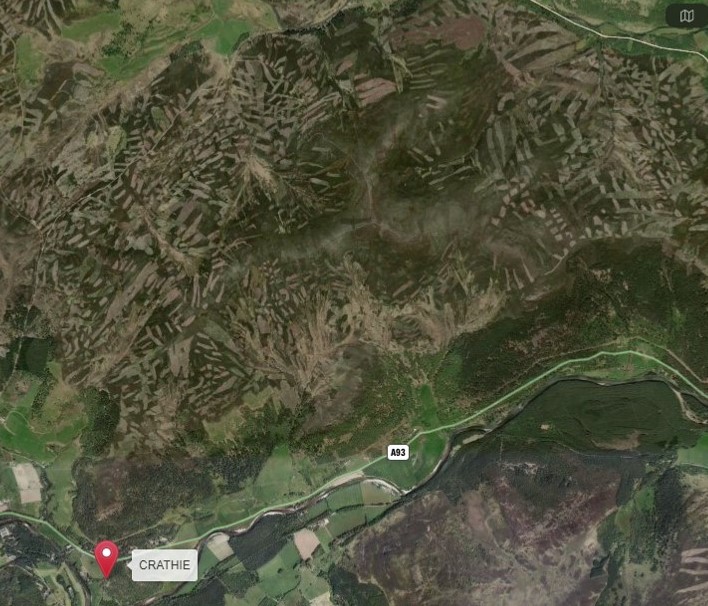
Here are a couple of Google Earth maps showing Crathie and an area of Invercauld Estate to the NE of Crathie (north of the A93 main road) that I understand to be a woodland regeneration area, and then oh, look, right next to that is a vast area of muirburn strips. You know, the tell-tale burned scars of a moorland managed for, er, driven grouse shooting:
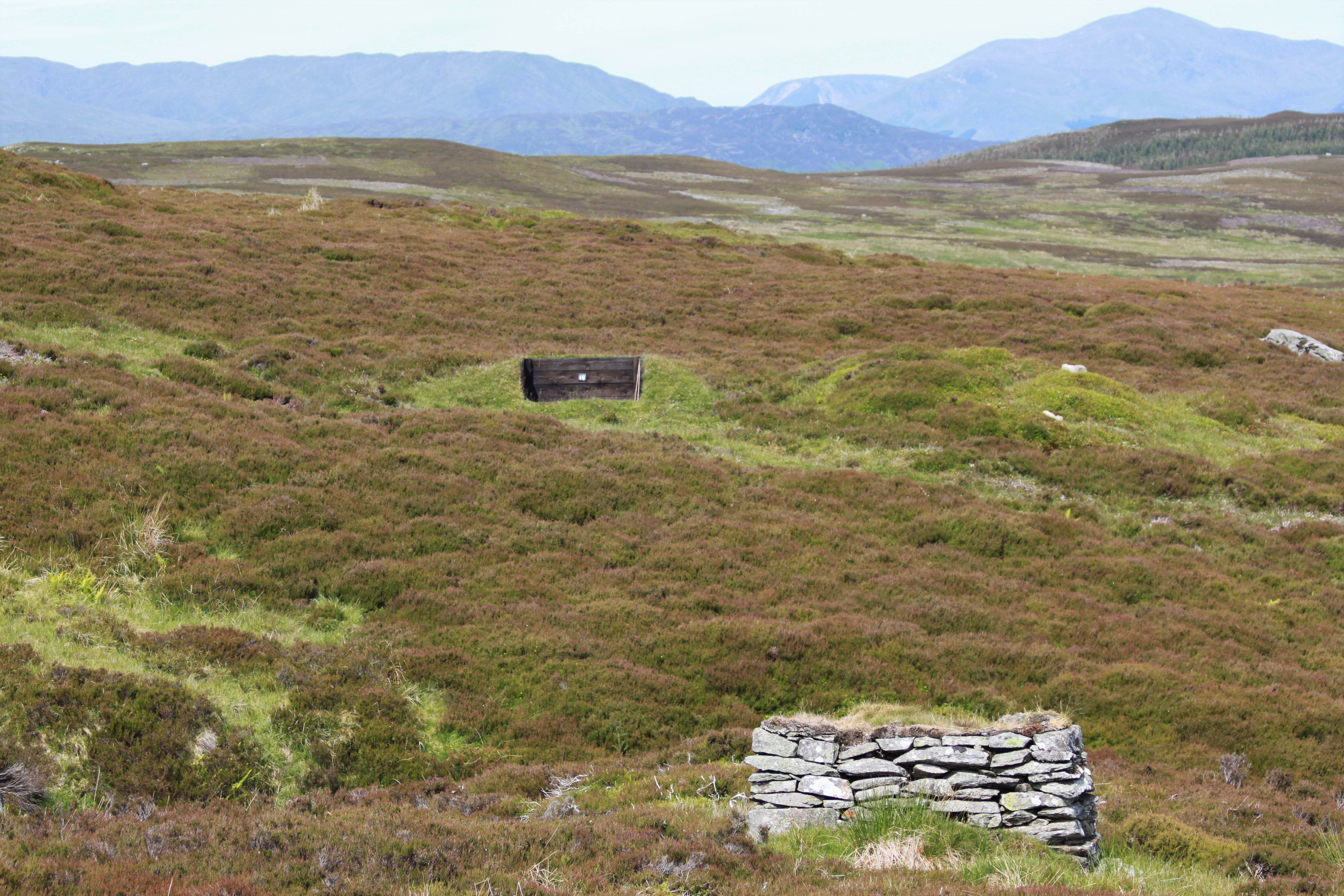
Or have I got that wrong? Is this not a vast area managed for driven grouse shooting at all, but just a large area of moorland that is routinely set alight to create so-called ‘wildfire breaks’? I’m sure I saw some lines of grouse butts when I zoomed in, too. Probably historical, kept for nostalgic purposes, eh?
You can draw your own conclusions about the accuracy of Mr McNicol’s claim that ‘the area is not managed for driven grouse shooting‘.
I also just want to comment about something I’ve read on social media about the timing of the publicity surrounding this crime, and how ‘convenient’ it is that it coincides with the Scottish Parliamentary elections. The clear accusation has been made that ‘anti-grouse moor campaigners’ have somehow conspired to get this in the news this week.
This is absolute nonsense, of course. It was the statement from Invercauld Estate that triggered news coverage of this crime – at that time (Tuesday afternoon, the day of the police raids), nobody had said anything about it. Not campaigners, not the police, just Invercauld Estate. Had the estate kept quiet, I would bet that this news wouldn’t have seen the light of day until at least next week, well after the elections. Indeed, I’m told by my media contacts that Police Scotland was forced to issue an official statement the day after Invercauld Estate’s statement, simply because of the media interest generated by Invercauld’s statement. The police received so many enquiries their hand was forced early and they had to issue a statement.
I’ll be writing about Police Scotland’s response to the crime in a forthcoming blog. I’ll also be returning to the claimed conservation credentials of Invercauld Estate.
UPDATE 6th May 2021: Poisoned golden eagle: confirmation it was found dead on a grouse moor on Invercauld Estate (here)
Cast your mind back to August 2020 for a minute. We were still waiting for the Scottish Government’s response to the Werritty Review (would they licence grouse shooting or not?) and bad news linking raptor persecution and grouse shooting was all over the press in the run up to the Inglorious 12th, the opening of the grouse-shooting season.
[Grouse-shooting butts in Strathbraan. Photo by Ruth Tingay]
For example, Chris Packham pressing First Minister Nicola Sturgeon to take action after the discovery of a poisoned white-tailed eagle on a grouse moor in the Cairngorms National Park (here), Hen Harrier Day going online and attracting an audience of around 150,000 (here), an e-action by the RSPB, Hen Harrier Action and Wild Justice mobilising over 120,000 people to put pressure on their politicians to take action on raptor persecution (here), police investigated more wildlife crime allegations at Leadhills Estate (here), the suspicious disappearance of yet another satellite-tagged golden eagle (‘Tom’) on a grouse moor in Strathbraan (here), Nicola Sturgeon having to discuss raptor persecution during First Minister’s Questions (here), Cabinet Secretary Roseanna Cunningham being forced to make a statement about the ongoing killing of raptors on grouse moors after thousands of letters pour in from the public (here), a parliamentary motion prompted by the suspicious disappearance of golden eagle Tom (here), a shocking new report by the League Against Cruel Sports suggesting that up to a quarter of a million animals may be killed (legally) on Scottish grouse moors every year to increase the number of red grouse available to be shot (here), a damning article in The Times reporting on the atrocities at Leadhills and the local community’s horror (here) etc etc.
You get the picture. The pressure was on, of that there’s no doubt.
So what do you think the grouse moor owners’ lobby group, Scottish Land & Estates (SLE) was making of all this? New information, released in an FoI this week, is pretty revealing.
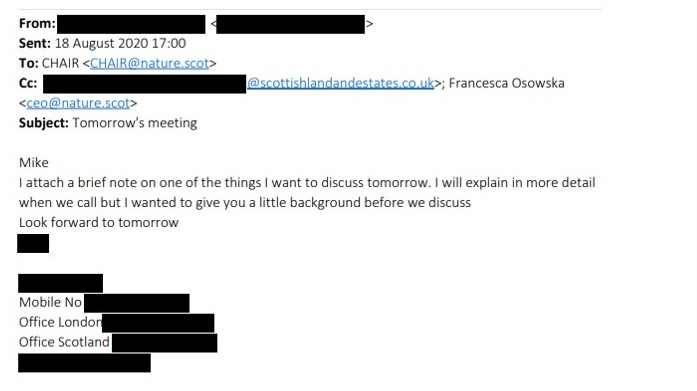
Here is a copy of an email sent to Mike Cantlay, Chair of NatureScot, on 18th August 2020. It was sent either by Tim Baynes (Moorland Director, SLE) or Mark Tennant (Chair, SLE). I know this because of the way my FoI was worded and even though NatureScot has redacted the sender’s name, my money would be on Mark Tennant.
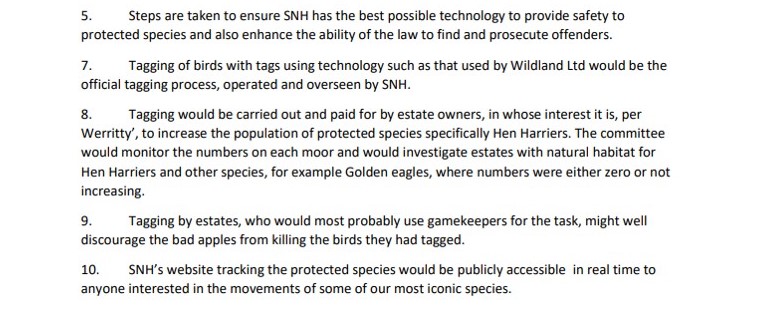
Aside from the breath-taking arrogance, this letter reveals the desperation and delusion of SLE’s position.
The opening line is the standard position of denial we’ve come to expect from SLE whenever raptor persecution is raised – I’ve blogged about it time and time and time again. There hasn’t been any ‘real progress’ on the prevention of raptor persecution and no matter how many times SLE claims there has, it doesn’t change the fact that there hasn’t! That is precisely why the grouse shooting industry is under so much scrutiny and pressure – because it has been unable to self regulate and boot out the criminals that seem to be allowed to operate in plain sight.
The idea of removing one dysfunctional group (PAW Scotland Raptor Group) and replacing it with another dysfunctional one (COPBAN) is hilarious. I did laugh, a lot, when I read about those plans. And by the way, SLE, nobody has asked Wild Justice whether it’d be interested in participating and I guess nobody has asked the groups already serving on the (dysfunctional) PAW Raptor Group how they’d feel about being side-lined. I’m pretty sure BASC, GWCT, Scottish Raptor Study Group etc would all have something to say!
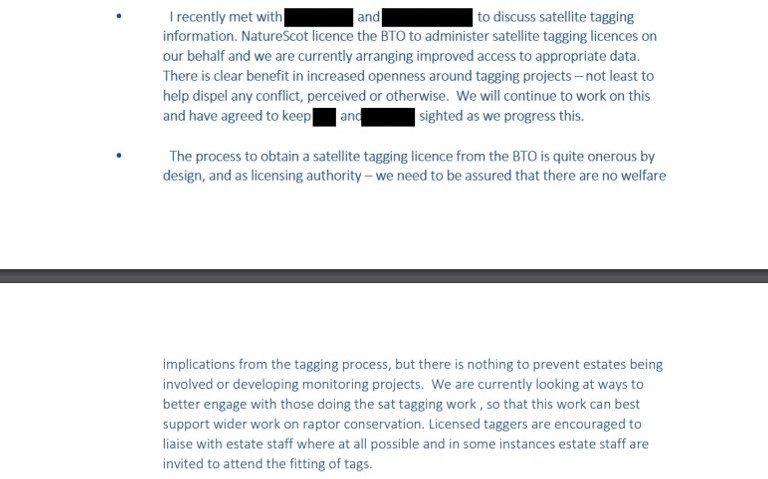
The idea that estates would fund raptor satellite tagging (presumably excluding all legitimate scientific researchers??) and that gamekeepers would fit the tags demonstrates the high level of ignorance about how satellite tagging is regulated in the UK. There is currently only a handful of expert taggers in the UK, probably less than 20, who are sufficiently qualified, licensed and experienced to fit satellite-tags to birds of prey. Quite rightly, it takes years and years and years to reach the high standards required by the licensing authority. That SLE still hasn’t grasped this very simple concept is jaw-dropping.
And as for having a public website showing the live positions, day and night, of highly-threatened species like golden eagles and hen harriers – yeah, what could possibly go wrong?!
Here is NatureScot’s response to this outlandish proposal from SLE:
I’ll be blogging about some more communications between these two organisations in due course, also uncovered via FoI and related to grouse moor management, the Werritty Review and raptor satellite tracking.
There was a fascinating political hustings last night where candidates from the five main parties were quizzed for an hour and a half about their views on various aspects of grouse moor management and reform.
Imagine that happening in England? No, me neither. But the fact that this took place in Scotland, with political candidates from all the main parties prepared to spend a few hours of their time discussing this one issue, is testament to the growing public concern about the role of grouse moor management in the climate and nature emergencies and thus its subsequent position on the political agenda.
The hustings was hosted by REVIVE, the coalition for grouse moor reform, whose members are OneKind, League Against Cruel Sports, Friends of the Earth, Common Weal and Raptor Persecution UK.
Max Wiszniewski compered the event with additional support from Louise Robertson and the candidates were as follows:
Mairi McAllan, SNP (former lawyer & special advisor to First Minister on Environment, Climate Change and Land Reform)
Laura Moodie, Scottish Greens
Ian Davidson, Scottish Labour (who also featured at the Scottish Gamekeepers Association hustings last month – see here)
Alan Reid, Scottish Liberal Democrats
Edward Mountain, Scottish Conservatives (who also featured at the SGA’s husting last month and describes himself as a ‘proud member’ of the SGA – see here)
As expected, there was a variety of views and approaches, some credible, some not, and some of these views were quite different from the views put forward by different candidates of the same parties at the Scottish Gamekeepers’ hustings last month (see here).
On the subject of raptor persecution, all candidates were clear on having a zero tolerance policy…..and yet still it goes on.
The event was recorded and is available to watch below:
Last Thursday (15th April 2021), Scottish animal welfare charity OneKind hosted a political hustings to allow the public to quiz candidates from the five main political parties on their animal welfare policies ahead of the election on 6th May.
The hustings was organised by More for Scotland’s Animals (MFSA), a coalition of 11 leading animal welfare organisations (see here).
The MSP candidates were:
Maurice Golden (Scottish Conservative and Unionist Party)
Alison Johnstone (Scottish Green Party)
Ben Macpherson (SNP)
Molly Nolan (Scottish Liberal Democrats)
Colin Smyth (Scottish Labour)
I watched this hustings event and it was incredibly popular, with over 60 questions put forward for the candidates on a range of issues such as snaring, grouse shooting, fox hunting and greyhound racing but there simply wasn’t enough time for all the questions to be asked and answered.
I understand that OneKind is currently seeking permissions for a recording of the event to be posted online but in the meantime, journalist Mark Smith wrote an opinion piece for The Herald yesterday, focusing largely on the issue of grouse shooting. Mark’s opinions are his, of course, but where he reports on who said what, I think it’s an accurate account.
It is reproduced below:
IF you haven’t yet decided who to vote for, perhaps I can be of some assistance. Late last week, I put the same single question to five different politicians, one from each of the five main parties, and maybe their answers can tell us a little bit about the problems of modern Scottish politics. You can see familiar patterns at play in what they say – some new, some extremely old – and for voters trying to make up their minds, it’s very frustrating indeed.
What happened was that the charity OneKind asked the politicians along to an online hustings event to discuss the main issues around animal welfare and I took the opportunity to ask them about an issue I’ve written about many times: grouse shooting. My question was: do the candidates think there is a place for driven grouse shooting in Scotland or should it be banned? I was curious to see how far the parties would be willing to go.
Their answers were interesting, and in some cases passionate, but they also revealed something of the dilemmas that Scottish voters face, not only if they care about animal welfare but also if they care about the constitution. What if you’re a Scot who wants reform on animal welfare and other important issues – drugs, criminal justice, schools – but you’re also worried that voting for the SNP and the Greens (who have some good policies on these issues) could break up the UK? And what on earth are you to do if you’re concerned about independence but also not inclined to support the Conservatives? It’s not easy.
Alison Johnstone, the Green MSP, is a good example. She is a superb campaigner on animal welfare – informed, passionate, and committed – and her answers on driven grouse shooting were impressive. Her party, she said, want a complete ban on the practice, not only because there’s no justification for animals being killed for pleasure, but also because driven grouse shooting is an unproductive and inefficient way to use land. “We also see stink pits, snares and poor practice on every level,” she said. “I cannot wait to ban it.”
I have to say: I agree with every word Ms Johnstone says, having spoken to lots of people on every side of the argument over the years – gamekeepers, campaigners, police, lawyers, etc – and in any normal situation, she’d have my vote. The problem is that, for many people, the Greens’ policies – and there’s a lot to like in their manifesto – are tainted by the party’s stance on the constitution, meaning I could vote for animal welfare and end up with independence. Are there any unionists in the Scottish Greens, I wonder? And if so, how do they feel? If you’re out there, email me.
The other problem, obviously, is that the Greens are in bed with the SNP – all tucked up, nice ’n’ cosy – and this makes me doubt that anything significant will be done on animal welfare. The SNP representative at the hustings was the MSP Ben Macpherson who seems like a nice enough guy, but he’s saddled with defending what his party hasn’t done. In many ways, the SNP behave like a party in opposition, but Mr Macpherson also has to deal with the age-old problem of ruling parties during elections. They need to promise things are going to change (but not promise too hard in case they actually have to do it) but they also need to explain why they haven’t changed things already.
In the case of Mr Macpherson, this led to a lot of wibbly-wobbly government speak. On fox hunting, for example, the SNP “remain committed to closing the loopholes”. On cruelty to greyhounds, “we need to look at it very seriously”. On snares, “we accept the need for greater regulation”. And, sadly, there was the same lack of urgency on driven grouse shooting; Mr Macpherson said his party “remain committed” to bringing in a licensing system.
In any normal world, the SNP would be punished for all of this, for its lack of progress on important issues people care about – but Scottish politics is not a normal world. Alison Johnstone belongs to a party that has genuinely radical and transformative polices and Ben Macpherson belongs to a party that’s pretty much shagged-out on policy after 14 years in power, and yet neither party will be judged on any of that. They are the parties of Scottish independence and it means their promises on policy, and their delivery on those promises, doesn’t matter very much. How on earth did we get here?
The primacy of independence has also meant the banishment of the Lib-Dems and Labour to the outer reaches of Scottish politics, which is a pity. The Lib-Dems were represented at the hustings by Molly Nolan, the party’s candidate for Caithness, Sutherland and Ross, and she had some sensible stuff to say about how animal welfare can be improved, such as giving wildlife police officers the resources they need. She also pointed out that any licensing system for driven grouse shooting needs to be robust; there’s no point in introducing licences and then carrying on as normal.
But by far the most impressive performer was Labour’s Colin Smyth whose concern for animal welfare clearly comes from a genuine place. The legislation on fox hunting, he said, was “unfinished business” and, as for driven grouse shooting, he said the current situation was unsustainable and a licensing system was not good enough. I don’t know much about Mr Smyth – and it’s obviously easier to promise things when you’re a long way off from having to deliver them – but listening to his old-school campaigning politics, passionately delivered, was refreshing and pretty inspiring I have to say.
I wish I could say the same for the Tories. Their representative, the MSP Maurice Golden, said he wanted new legislation on pets, but he also said snares were “necessary land-management tools”. He said the laws on fox hunting don’t need changing. And as for my question about driven grouse moors, Mr Golden said the industry improves bio-diversity and is a “fulcrum for jobs”. His answers were deeply disappointing.
But maybe we shouldn’t be surprised by any of this: Tories defending vested interests and governments defending a lack of action. What makes it different, though, is that many Scottish voters will be guided by other factors. Some people who care about animal welfare will vote Tory and some people who think the nationalists have done poorly in government will vote SNP. That’s where we are now. It’s disappointing. It’s distorting. And it’s exhausting. One day, maybe, politics in Scotland will go back to normal.
ENDS
UPDATE 24th April 2021: Political hustings on animal welfare in Scotland now available to view (here)

Here is your opportunity to quiz parliamentary candidates from Scotland’s five main political parties about their position on grouse moor reform.
REVIVE, the coalition for grouse moor reform, is hosting an online political hustings next Thursday (22nd April 2021) between 6-7.30pm on Zoom.
Candidates will be asked specifically to discuss the following aspects of grouse moor management:
Raptor persecution
Muirburn
Mountain hare slaughter
Snaring, trapping and killing of wildlife on grouse moors
Mass outdoor medication (medicated grit stations)
The use of lead ammunition
Unregulated tracks and roads
The following candidates have agreed to attend:
Mairi McAllan, SNP (former lawyer & special advisor to First Minister on Environment, Climate Change and Land Reform)
Laura Moodie, Scottish Greens [updated 19th April – change of candidate from Ariane Burgess]
Ian Davidson, Scottish Labour (who also featured at the Scottish Gamekeepers Association hustings last month – see here)
Alan Reid, Scottish Liberal Democrats [updated 19th April – change of candidate from Molly Nolan]
Edward Mountain, Scottish Conservatives (who also featured at the SGA’s husting last month and describes himself as a ‘proud member’ of the SGA – see here)
The event will be chaired by Max Wiszniewski, REVIVE’s campaign manager and any questions you have for the candidates may be sent to Max in advance for consideration.
To attend this event you will need to register (for free!) HERE.
For those who can’t make it, the session will be recorded and will be available on YouTube later.
The REVIVE coalition for grouse moor reform comprises OneKind, Common Weal, League Against Cruel Sports, Friends of the Earth Scotland and Raptor Persecution UK. For more information on their work please visit their website here.
As campaigning for the forthcoming Scottish election gets in to full swing, I’ve been reading more and more about poor ‘downtrodden’ gamekeepers, how they’re not listened to, how hard done by they are, how they’ve been ‘vilified’ etc etc.
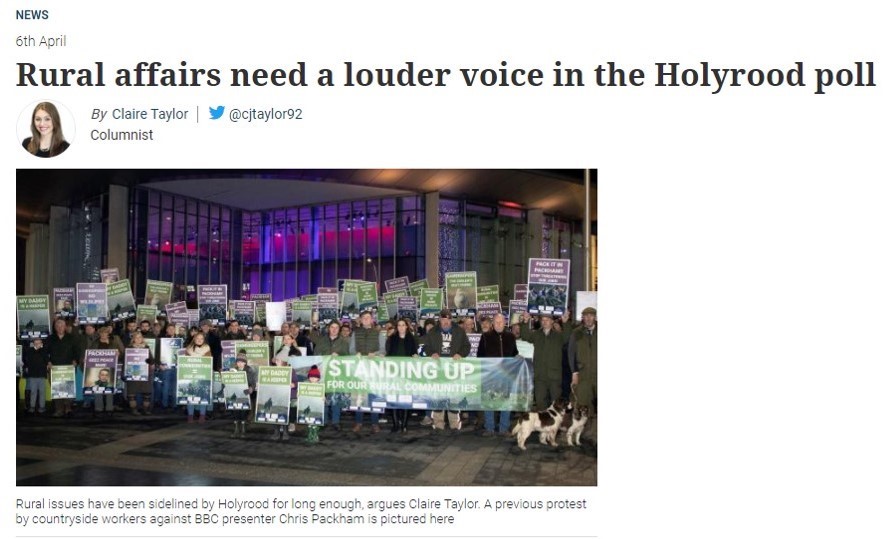
This article in last week’s Herald is a classic example, although pay close attention to who wrote it – Clare Taylor, Political Affairs Editor at The Scottish Farmer – her reference to farmers being “plagued” by the return of White-tailed eagles and commentary about “a growing obsession with rewilding” gives you a good idea about her environmental aspirations.
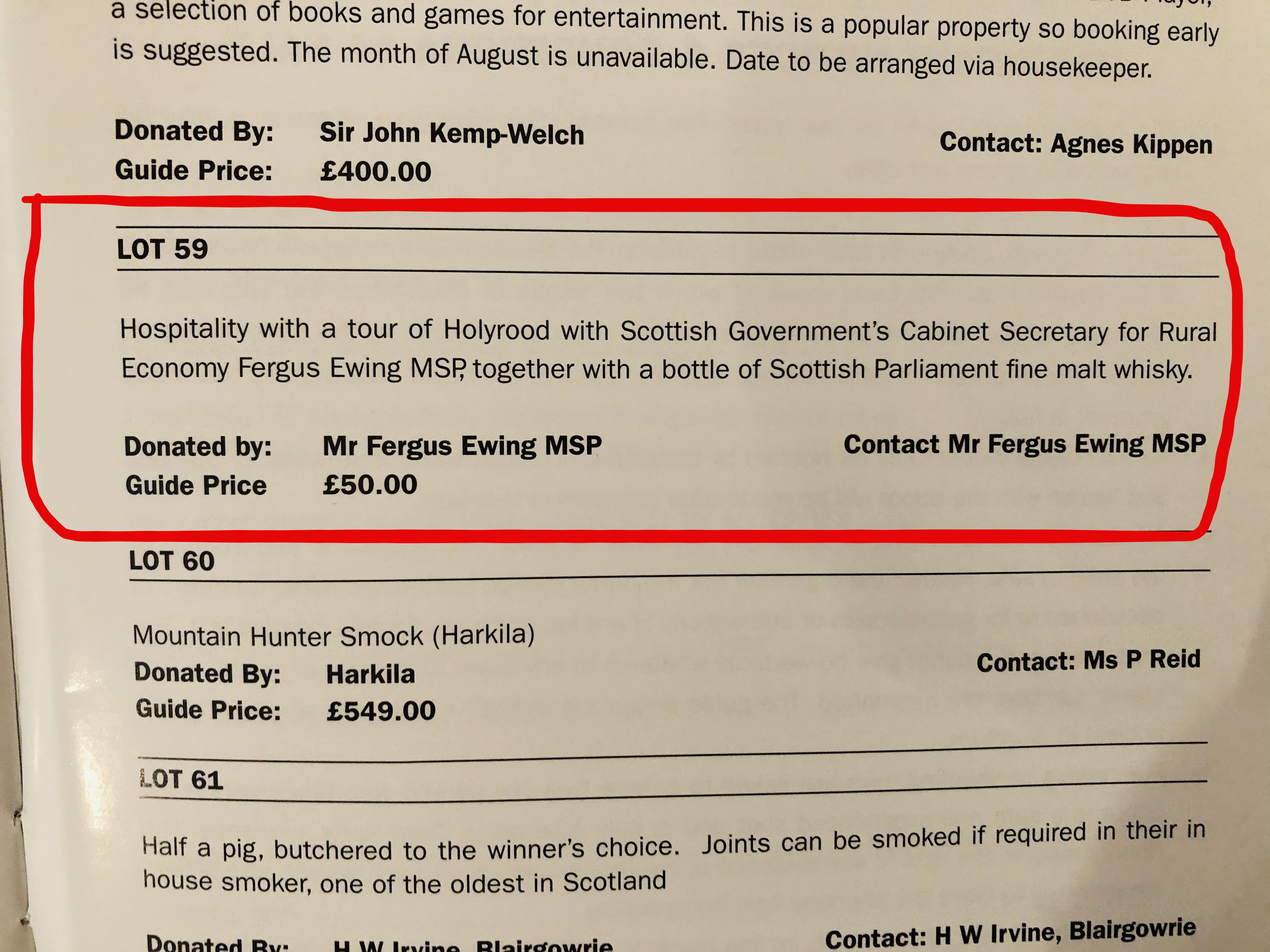
The truth is, rural affairs already have a very loud voice in the Scottish Parliament, in the shape of Fergus Ewing, Minister for Tourism and the Rural Economy who called himself “a friend in Government” to the Scottish Gamekeepers Association recently. Such a good friend in fact that he’s auctioning off a Holyrood tour (that should be free) to help the SGA’s fundraising activities (see here).
Clare Taylor’s tweet, promoting her biased article in the Herald, made me laugh:
After proclaiming that the Scottish Government ‘must stamp out the vilifying of individuals’, what does she think the accompanying photograph shows? Er, could it be a bunch of Scottish gamekeepers vilifying Chris Packham outside Perth Concert Hall, protesting about him having a job?
And are these the same gamekeepers who routinely vilify and abuse those of us campaigning against environmentally-damaging, unlawful and unsustainable grouse moor management (see here and here)?
And are these the same gamekeepers who continue to shoot, trap and poison birds of prey in the Scottish countryside?
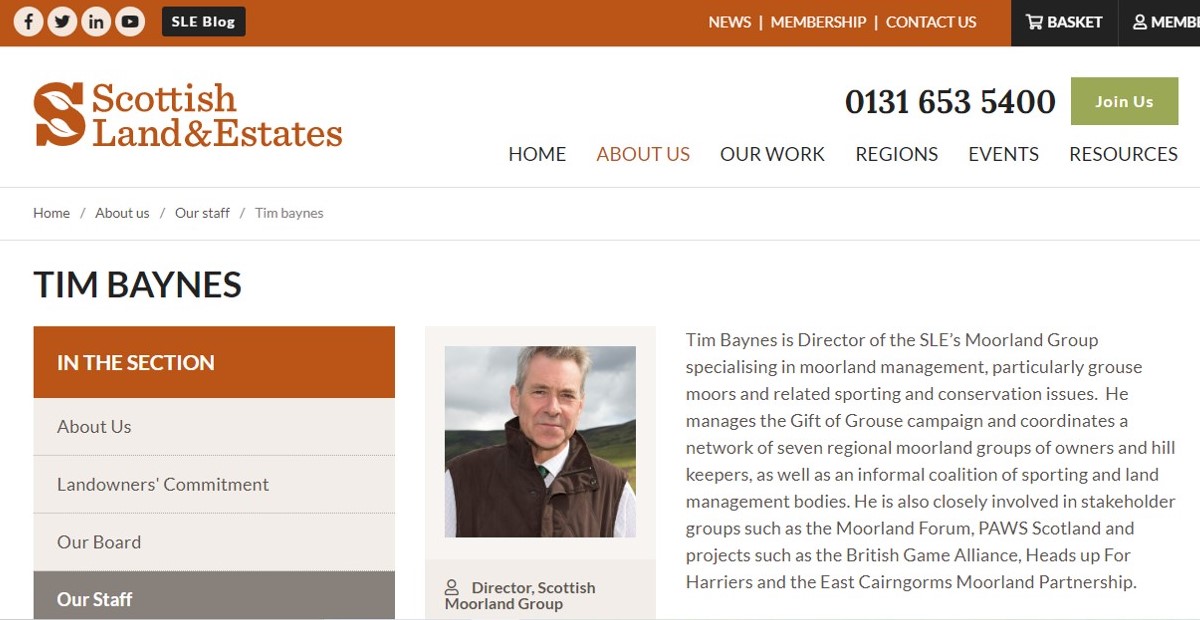
Clare’s article includes a quote from the co-ordinator of Scotland’s Moorland Groups. That’ll be Tim (Kim) Baynes then, a Director of the landowners’ lobby group Scottish Land & Estates – hardly someone without connections to politicians and civil servants, is he? Yet another influential voice speaking to power on behalf of gamekeepers.
Although Scottish Land & Estates’ CEO, Sarah-Jane Laing, was on here last week in the comments section claiming that ‘The Regional Moorland Groups which exist across Scotland are not part of the SLE structure‘.
Really? Well why then does Tim Baynes’s job description, on the SLE website, say that he’s the co-ordinator of those seven moorland groups??
And what about those seven regional moorland groups? They’re an interesting bunch. Grouse moors in five of those seven regions have been in the last three years, or currently are, under police investigation for alleged raptor persecution crimes (grouse moors in the regions covered by the Angus Glens Moorland Group, Grampian Moorland Group, Tomatin Moorland Group, Tayside & Central Moorland Group and the Southern Uplands Moorland Group).
And there are more ongoing police investigations linked to grouse moor management and raptor persecution that are yet to be publicised. Believe me, the public will be appalled when the news comes out and it’ll be a bloody brave (or desperate) politician that puts their name down to support this continued criminality.
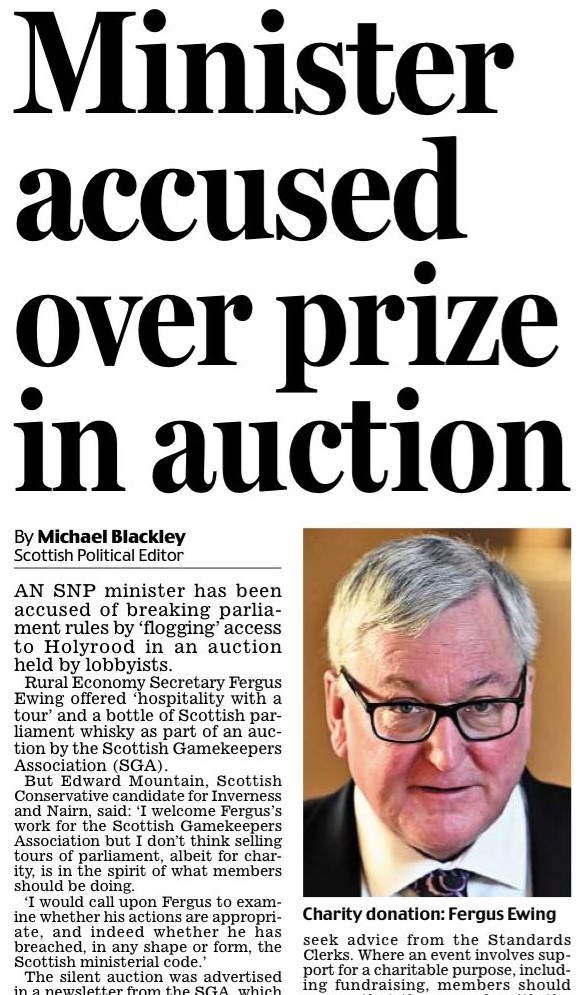
Cabinet Secretary Fergus Ewing has been accused of breaching Parliamentary rules by ‘flogging’ access to Holyrood in a silent auction organised by the Scottish Gamekeepers Association (SGA).
Lot #59 in the SGA’s annual auction, donated by Fergus Ewing MSP, is squeezed in between a week’s holiday in a cottage in Strathbraan (a well-known raptor persecution hot-spot) and an offer of a smock and half a pig. Here’s what Fergus Ewing is offering (closing date 7th May 2021):
Amusingly, one of the people who has questioned whether the Minister’s actions are appropriate is Edward Mountain MSP, a Conservative candidate who will be challenging Fergus Ewing for the Inverness and Nairn constituency in the May election.
Along with Fergus Ewing, Ed Mountain is also a long-time supporter of the SGA, and is even a “proud” SGA member (see here).
It isn’t clear who went to the press about this (although as an SGA member, Ed Mountain would certainly have had access to the silent auction lots because the auction booklet was included in the mail out of the SGA’s most recent quarterly rag) but today the Scottish Daily Mail was running a story on it:
‘That tour has not taken place’, says the SNP spokesman. No, because the auction doesn’t close until 7th May!
To be honest, there are much bigger fish to fry than this but the reason I’m blogging about it is because the SGA has been wailing quite a lot recently about how it has been ‘overlooked’ by the Scottish Parliament. In my opinion this is completely untrue – the SGA has just as much access to politicians as any other organisation, illustrated quite well by the players in this latest tale.
The latest target in the Scottish Gamekeepers Association’s (SGA) rifle sights is the Scottish Green Party.
I say latest, I’m not sure I can remember the SGA ever supporting any policy of the Greens, and some members of this political party have long been targets for personal abuse by some SGA Committee Members and supporters, so this current attack is just more of the same.
It all stems from a short piece in a regional campaign newsletter, currently being distributed by supporters of the Scottish Greens:
Of course, anybody challenging the status quo of grouse shooting is going to be a target for hatred and it will come as no surprise whatsoever to learn that candidate Maggie Chapman has been subjected to disgraceful misogynistic abuse on Facebook by SGA supporters, on the SGA’s own Facebook page. It appears that real women can’t have short hair AND breasts. It’s all too confusing if you still think it’s the 1950s. I’ll bet she was wearing trousers too. Shocking. The misogyny centred on Maggie’s appearance – god help us if they’d realised she was actually standing for election.
The SGA’s reaction to the Scottish Green Party’s campaign newsletter has been astonishing, although actually it shouldn’t be astonishing at all in light of their recent antics in relation to the death threat received by Chris Packham (see here). It seems they’ll complain about anything in their quest to resist progressive modernisation and so this time they’ve threatened to write to the Electoral Commission to complain about what they call ‘misleading information’ about grouse moors.
Here’s what the SGA published on its website earlier this week:
On the face of it, this SGA statement might seem like reasonable comment, especially as it was citing the results of a recent Government-funded study in to the socio-economic and biodiversity impacts of grouse shooting.
The thing is, the SGA isn’t accurately reporting that study’s findings. At all. In fact some might argue it was deliberately mis-reporting the findings.
How so?
Well, in the summary report of that study being cited by the SGA, the authors are quite clear about how the study results should be interpreted. In fact they couldn’t have been clearer (underlining added by me):
Furthermore, the small set of case study samples that the study used are also kind of skewed in favour of grouse shooting. This is not a criticism of the study authors, they have been totally upfront about it, but it just emphasises the caution urged by the authors on how these results should be interpreted; caution which the SGA has ignored:
There were nine case studies that involved some sort of grouse shooting, but only two involving rewilding/conservation. There’s absolutely no way that the study results can be seen as being representative of these land-use differences across Scotland, as the SGA is trying to claim.
I’d encourage the Scottish Green Party to study the summary report closely, and also read some wider research commissioned by REVIVE (especially this one) to rebut any complaint the SGA may make to the Electoral Commission about so-called ‘misleading information’.
The supreme irony of this latest attack is that the SGA is accusing the Scottish Greens of promoting ‘misleading information’ about grouse moors. The SGA are the masters of ‘misleading information’ (i.e. utter rubbish), and here is a small selection from over the years:
‘Professional gamekeepers do not poison raptors’ (May 2011)
‘It is unfair to accuse gamekeepers of wildlife crime’ (June 2011)
‘Will these very large creatures [white-tailed eagles] differentiate between a small child and more natural quarry?’ (September 2011)
‘Raptors are thriving on game-keepered land’ (July 2013)
‘I strongly believe the goshawk was never indigenous to the United Kingdom and there is absolutely no hard evidence to suggest otherwise’ (September 2013)
When asked whether gamekeepers are involved with the poisoning, shooting & trapping of raptors: ‘No they aren’t. We would dispute that’ (March 2014)
‘In the last ten years we have stamped out poisoning. We’ve absolutely finished it’ (October 2014)
‘We kill animals because probably we’re the doctors and nurses of the countryside’ (January 2015)
‘Grouse moors are a birdwatcher’s paradise’ (December 2020)
The Scottish Gamekeepers Association (SGA) held its AGM last Friday (5th March 2021) – here are two earlier blogs about that event (here and here).
The vast majority of the 2.5 hour event was taken up by a political hustings. Candidates from five different parties were invited to introduce themselves and tell the SGA members ‘what they would do for gamekeepers’ if elected in May, and then there was a tortuous period of questions for the candidates that had been submitted by SGA members.
The participants of the hustings were (from top left): Peter Fraser (Vice Chair, SGA), Carol (one of the ‘girls‘ from the SGA office who’s actually a woman, who was in charge of time-keeping and recording – unseen in this screengrab), Jamie Blackett (All For Unity [George Galloway’s new party, say no more] and author of spectacularly crap articles in Shooting Times), Alex Hogg (Chair, SGA), Edward Mountain MSP (Scottish Conservatives and the un-fiercest critic of raptor persecution), Catriona Bhatia (Scottish Lib Dems), Ian Davidson (Scottish Labour) and Fergus Ewing (Cab Sec for Rural Economy & Tourism, SNP).
You’ll notice the Scottish Greens weren’t represented and at one point Catriona Bhatia asked why they weren’t there. Alex Hogg admitted they hadn’t been invited because before Xmas the SGA had asked for a meeting with Andy Wightman and apparently he hadn’t responded. Er, ok. He does realise Andy left the Greens in December, doesn’t he? Still, the Greens’ absence didn’t stop some of the panellists slagging them off, even though they weren’t there to defend themselves.
I’m not going to post about the entire tedious session because I fear I’d lose the will to live but as an overview of what each of these candidates had to say about what they’d deliver for gamekeepers, I think it’s useful to blog about their introductory speeches.
Jamie Blackett (All for Unity): I’m Jamie Blackett, I’m the leader of All for Unity, we’re a new party founded by my good friend George Galloway, with the intention of unifying the pro-UK anti-nationalist vote to feed[?] the SNP green government and install a government of national unity in May.
Some of you will know me, I write a column each month in the Shooting Times, I’ve written a book, Red Rag to a Bull, about the countryside, I’m a passionate campaigner for the countryside and I hope that if we achieve what we want to achieve in May we will all have a much stronger voice for the countryside and get the government off all our backs so we are no longer looking over our shoulders as we look after the countryside and conserve its wildlife. Thank you.
Alex Hogg: What would you do for gamekeepers if you got elected, Jamie?
Jamie Blackett: Well, we’re running a full slate of candidates across all regions. We’re still looking for some candidates and we hope very much that there may be some people in the SGA who will join us. As I say, I have a strong stake in the countryside, I actually run my own shoot here. George Galloway, as you all know, is not a countryman but he has moved to the countryside and believe it or not I’m teaching him to shoot, er, or I will do when Covid conditions allow.
And we feel very strongly that the justice system needs reforming so that gamekeepers are no longer presumed guilty before they’ve even started in court, we must sort out the burden of proof, corroboration of evidence and all these things so that we in the countryside no longer have this threat hanging over us.
We also want to, er, completely obliterate the Greens in George Galloway’s terminology, the SNP gardening section, who we believe are grinos, greens in name only, they know absolutely nothing about the environment and care even less. We will act rather as the Greens do on the list. The Greens mop up all the spare separatist votes. We will do the same with on the unionists side of the argument and return more pro-UK MSPs to the Parliament. And, er, as I say, we want to get rid of the Green party, diminish the voice of the RSPB and others, and hear more of the voices of people like your members who are the true experts who care about the environment because they spend every waking moment looking after it.
Edward Mountain MSP (Scottish Conservatives): I’m Edward Mountain, I’m a Conservative member of the Parliament on the regional list at the moment, and I’m standing in Inverness and Nairn at the next election. If I can say, at the outset, Alex, that I’m really sad that we’re not all meeting in person. I’ve had some really happy memories of past AGMs. I’ve been a proud member of your Association as you know, almost since its inception, and for 40 years I’ve shared your passions and your experiences.
And I stood for election because I felt that the Scottish Parliament was letting the countryside down. It was clear to me that many politicians relied on briefings by pressure groups such as Revive, RSPB and the League Against Cruel Sports and not from those people who work the lands, people like your membership. And in the Parliament I haven’t been surprised, we’ve had debates on deer management, led by the Green party who’d be happy to see all deer shot all year round. And when I questioned them about it their retort to me is that it was clear that I know nothing about deer management. Well, I wonder. I wonder what 40 years of experience gives you. Perhaps I would suggest to you and your members, as they know, it gives you more than you can read in a book.
And when it comes to hare control the decision to set culls should be done locally, that’s something that I believe, not by a national ban, something that Fergus Ewing, despite his warm words outside the Parliament, meekly followed his party line on and voted for.
And when it came to wildlife crime which I’ve always called out, Claudia Beamish called me out when I suggested that accidental damage of a badger sett should be viewed differently to malicious damage to a badger sett. Her suggestion was that all farmers should walk through the field before harvest to ensure they were free from badgers and setts. Well Claudia, what I say to you is lead the way. I’m happy to follow you through every field in Scotland.
So in summary in the last five years I’ve stood up for you and your industry based on my knowledge and belief. I’ve had your group leaders, Alex and his team, in to the Parliament on numerous occasions to brief me and my members. I’ve never promised to do one thing when I talk to you and do another in the Parliament. And I’ve ensured that my party fully considers your views at all times. And in the next five years if our party is in a strong position and I’m re-elected I will ensure that you get not just warm words of platitudes but actions and results, which is what I think we’ve delivered in the last five years. Thank you.
Fergus Ewing (Cab Sec Rural Economy & Tourism, SNP): Good morning everybody and thank you very much indeed for this invitation. May name is Fergus Ewing. I have spent around 20 years working as a solicitor with my own legal practice and the last 21 years as the MSP for Inverness and Nairn, 13 years as a Scottish Government Minister and for the last five years the Rural Secretary in the Scottish Government.
I have been a supporter of country sports. I am and always will be a supporter of the good work, the excellent work, Alex, that your members do. And I made it my business as somebody who didn’t have that background to learn about it by visiting estates, speaking to you, by learning from the late great Ronnie Rose, from Peter, from many others, and I think it’s essential going forward that we continue to listen to what you have got to say in formulating all policy.
Over the past couple of decades in public life I have done a few things which I hope have helped and I think action speaks louder than words. In the Watson Bill I worked cross-party with others to secure the future of legitimate, necessary and valuable control of foxes by more than one dog flushing the foxes to be despatched. I learnt why that was necessary and we delivered that result.
Over the years I’ve launched the good guidance on snaring at Moy, I voted against the ban on tail docking, I thought that caused cruelty to hunting dogs because their elongated tails became wounded by gorse and bracken and the nerves in the tail mean it was difficult to heal. So it was actually a cruel measure and I really campaigned very hard with you and others to restore that and the tail shortening can now be carried out and I’m pleased about that.
It’s essential that we carry on with muirburn. We might come to that later. It’s absolutely essential to protect peatland. I’ve seen the Mars Bar film – I get it.
Lastly, on positive things, over the past year in Covid, last year I made sure that country sports qualified for support as a branch of hospitality and tourism. This year and very recently working with you and BASC and others, who understand the countryside very well, we’ve set up a million pound support for compensation, particularly for businesses that have really lost all their custom, guides, agents, who bring in valuable business to Scotland. Country sports are worth £155 million a year to the Scottish economy, there’s four million participants, and contrary to what some may believe, they’re not all titled or landowners. They’re ordinary people, up and down the UK, who enjoy taking part in lawful country sports.
In conclusion, I know that there are serious criticisms of your members of my Government but I hope I can say and I genuinely believe that I am a friend in Government and my objective is to continue to be your friend, in Government, acting on the basis of the evidence and making sure that we can continue to see country sports form a hugely important part of the life of Scotland’s rural societies. Thank you very much.
Catriona Bhatia (Scottish Lib Dems): I’m Catriona Bhatia and I’m the lead candidate for the Lib Teams in the south of Scotland and I’m also their spokesperson for the rural economy and tourism. Formerly I was a councillor in the Scottish Borders for about 14 years and Deputy Leader of the council there.
In terms of what I can do for gamekeepers, ghillies and other land managers, well I grew up in the Scottish Borders, my family are keen shooters, keen anglers and my daughters like to partake in the odd hunting when they get the opportunity on hunting land so I 100% get the contribution that country sports make to the rural economy and not just the rural economy but the wider economy in Scotland. I don’t think we should look at ourselves as just distinct. If you look at the 11,000 jobs that are within the industry that’s equivalent to say a shipyard on the Clyde, there’s no politician who would say we’re gonna just close that overnight because we don’t like what they do and I think we should avoid doing the same sort of attrition that we’re trying, that some members of Parliament and political parties are trying to do to the country sports sector.
So I think in terms of what I would like to see, I think we need to lower the temperature, we need to work together because it’s in everybody’s interest to address some of the issues which, you know, there are in any profession, and as politicians we have problems in our profession the same way that you all have within the country sports sector so we need to lower the temperature, we need to work together to look at the issues around raptors, around licensing on grouse moors, but what we don’t need to do is to say that we’re just not gonna have grouse shooting, we’re not going to have deer-stalking, we’re going to ban all these things because people don’t understand them, it’s not just a question they don’t like them, they don’t understand them.
These 11,000 jobs are not just jobs, it’s a way of life. And I think the other key thing which I’d really like to see is more promotion and education, as Fergus was saying it’s not just the titled landlords, there’s many people working in here who probably need better housing, who may need better wages, here are people who partake in the sports who are just ordinary mean and women in the countryside who just like a day out and I think we need to educate the wider public on that and I think we also need to provide better routes in to the country sports industry from schools and from colleges and that again is across Scotland, there’s no reason why a young girl growing up in Glasgow shouldn’t become a ghillie in the Highlands and yet they probably don’t even know there is such a thing so I think we need to look at how we can get more in to schools and that way get more understanding so that’s what I would like to see, I would like to see a lot more dialogue, a lot more positive engagement with yourselves but also with the wider public within Scotland and stop us being quite so distinct from the urban areas but get them to see that we’re part of the wider Scottish economy not just the rural economy.
Ian Davidson (Scottish Labour): Ian Davidson, I was born and brought up in the Borders, I may be the only candidate here that’s prepared to admit having been chased off land by some of your members at various points when I was a youngster but like so many in the Borders and in rural areas I had to leave and go abroad and into the city to get employment, I then became a Labour MP for 20 years representing part of Glasgow and I retired by public demand in 2015, and now I’m a candidate in Ettrick, Roxburgh and Berwick for the Labour party.
Boris Johnstone [sic] said, not somebody I am often quoting, said that allegedly that devolution was a disaster. I don’t disagree that devolution has been a disaster but I do think it has been a disappointment. I think it has grossly under-delivered, particularly for rural issues and for rural areas. And particularly, for the south of Scotland and the rural areas there, that’s the neglected part of a neglected area.
And I think that your members are more than just simply their jobs, they’re also sons and daughters or spouses or parents, they’re concerned about where they live as well as just simply how they’re employed and that’s why I think that for your members, the fact that Scottish education has deteriorated considerably over the years of devolution, that health over the last decade has consistently failed to meet the targets for waiting times, is relevant.
I think the fact that rural transport is a disgrace affects your members and their families. The idea that it’s free for the elderly is a great thing. The idea that it’s gonna be extended to be free for young people is excellent as well and we would support it. But there’s no point in having free travel if there’s no buses.
And I think that the way in which all of these services have been allowed to deteriorate, partly by the under-funding of local Government in Scotland has been a disgrace and it has impacted considerably on the life opportunities of your members and their children and the quality of life that’s experienced by people in the countryside and that’s not to mention the question of care of the elderly in the countryside which is a particular issue even pre-Covid.
And I don’t think that all of these difficulties are the fault of the English, or somebody else, I think that these questions could have, and should have, been addressed under devolution.
Turning to your jobs, I think that there’s growing interest in nature, in rural and in land issues. Change is coming and I think that your organisation has got to take some strategic decisions about whether or not you’re going to be campaigning basically for a better yesterday or whether or not you’re going to be dragged resisting into the future, or you’re going to try and mould the future in the interests of your members.
And can I just say as an aside, when I was just preparing for this I got one of your staff to send me some information about salaries, I’m surprised how badly paid many of your members are considering the experience and ability that they’ve got. In a way I shouldn’t be surprised because the feudalism, the class divisions that are so prevalent in rural areas in Scotland…..
[Carol (SGA) interrupts to say he’s got five seconds left]