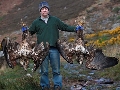
hen harrier & buzzards illegally killed in 1992

According to the Hansard Report April 2004 (Hansard is the edited verbatim report of proceedings in UK parliament), the following illegal raptor persecution incidents were recorded in 1992:

Dalswinton Estate (Dumfries, Dumfriesshire) – 1 x buzzard killed by Chloralose.

Invercauld Estate (nr Braemar, Aberdeenshire) – 1 x buzzard killed by Chloralose.

Dochfour Estate (Inverness-shire) – 1 x buzzard killed by Chloralose.

Cawdor Estate (Nairn, Inverness-shire) – 1 x buzzard killed by Strychnine.

Balival Estate (nr Kingussie, Inverness-shire) – 1 x hen harrier killed by Strychnine.

Careston Estate (Brechin, Perthshire) – 1 x buzzard killed by Chloralose.

Over Cardney Estate (Dunkeld, Perthshire) – 1 x buzzard killed by Chloralose.

Glenbeich &Ardveich Farms (Lochearnhead, Perthshire – 1 x buzzard killed by Chloralose.

Straloch Farm (Blairgowrie, Perthshire) – 1 x buzzard killed by Chloralose.

This report was published in the days when the government publicised the names of the Estates where illegal raptor persecution incidents had been recorded. Shame they don’t do that anymore – you have to wonder why? The Hansard report documenting these and other persecution incidents, can be read here: http://hansard.millbanksystems.com/written_answers/1994/apr/28/bird-killing

Golden eagle & buzzards illegally killed in 1991

According to the Hansard Report April 2004 (Hansard is the edited verbatim report of proceedings in UK parliament), the following illegal raptor persecution incidents were recorded in 1991:

Seafield Estate (Speyside) – 1 x buzzard killed by Chloralose.

Rosehaugh Estate (Black Isle, Ross-shire) – multiple buzzards killed by Mevinphos.

Dougarie Estate (Isle of Arran) – 1 x golden eagle killed by Chloralose.

This report was published in the days when the government publicised the names of the Estates where illegal raptor persecution incidents had been recorded. Shame they don’t do that anymore – you have to wonder why? The Hansard report documenting these and other persecution incidents, can be read here: http://hansard.millbanksystems.com/written_answers/1994/apr/28/bird-killing

Hen harriers, golden eagles & buzzards illegally killed in 1990

According to the Hansard Report April 2004 (Hansard is the edited verbatim report of proceedings in UK parliament), the following illegal raptor persecution incidents were recorded in 1990:

Cromlix Estate (nr Dunblane, Perthshire) – 1 x buzzard + 1 x hen harrier killed by Chloralose.

Rosehaugh Estate (Black Isle, Ross-shire) – 1 x buzzard killed by Chloralose.

Ledmore Estate (Lairg, Sutherland) – 1 x golden eagle + 1 x buzzard killed by Chloralose.

Hopetoun Estate (Abington, South Lanarkshire) – 1 x buzzard killed by Chloralose.

Glenfernate Estate (Blairgowrie, Perthshire) – 1 x buzzard killed by Chloralose.

Grimerston Estate (Isle of Lewis) – 1 x golden eagle killed by Chloralose.

This report was published in the days when the government publicised the names of the Estates where illegal raptor persecution incidents had been recorded. Shame they don’t do that anymore – you have to wonder why? The Hansard report documenting these and other persecution incidents, can be read here: http://hansard.millbanksystems.com/written_answers/1994/apr/28/bird-killing

poisoned red kite returned to wild

Gamekeeper sentenced for poisoning buzzard at Frogden Farm, Kelso

14 December 2006.

Dead buzzard

A gamekeeper who laced a carcass with poison which killed a wild buzzard has been given 100 hours community service by Sheriff Kevin Drummond. Jedburgh Sheriff Court heard how the 62-year old keeper set a poisoned bait at Frogden Farm, Kelso, where he looked after a pheasant shoot.

The first-time offender, who reportedly lives in one of the farm cottages, also admitted possession of three dangerous pesticides, which he claimed he had inherited from his predecessor. Sheriff Drummond said the keeper was an experienced gamekeeper who had closed his eyes to environmental issues.

http://news.bbc.co.uk/1/hi/scotland/south_of_scotland/6180203.stm

police probe red kite poisoning in Cairngorm National Park

Police are investigating the suspected poisoning of one of the UK’s rarest birds of prey. The red kite, which had been radio tagged by RSPB Scotland, was found near Tomintoul, Moray in May 2007. A post mortem examination found it had died from ingesting the highly toxic and illegal substance Carbofuran. Grampian Police said it strongly suspected that the red kite had eaten bait laced with the chemical and intended to kill birds of prey.

The dead bird, which had originally come from the Black Isle, was found in dense woodland in the Cairngorm National Park in May. It is believed its corpse had been lying dead at the site since April.

Carbofuran had previously been licensed for use as a root crop insecticide in the vegetable growing industry but its use and even it’s possession is now a crime in the UK

Full story. http://news.bbc.co.uk/1/hi/scotland/north_east/6755775.stm

poisoned red kite

Eighth red kite to die in scotland from poisoning in 2001

A red kite released in the summer of 2001 as part of a programme to reintroduce the species to Britain was found poisoned later the same year. The rare bird of prey was found in the Balmagie area, north of Castle Douglas in Dumfries & Galloway, and was the 8th red kite to be poisoned in Scotland during 2001. The bird was one of 33 radio-tagged kites released this summer in Dumfries & Galloway. It is the fifth bird of prey that has been found poisoned in the area after the bodies of two buzzards, a tawny owl and a sparrowhawk were found.

Also in 2001, a red kite was found poisoned in the Borders, and six red kites were found poisoned on or near shotting estates in Perthshire, Stirlingshire and Inverness-shire.

Red kites were persecuted to extinction north and south of the border and were reintroduced into Scotland in the late 1980s. In 2001, there were around 40 breeding pairs.

http://www.telegraph.co.uk/news/uknews/1360351/Eighth-red-kite-dies-in-Scotland-from-poisoning.html

Gamekeeper convicted for dead peregrine on Glenfiddich and Cabrach Estate

According to a report in the Scotland on Sunday newspaper, raids on the Glenfiddich & Cabrach Estate in NE Scotland in February and March 1998 revealed widespread poisoning across the 41,500-acre estate owned by London property tycoon, Christopher Moran. Ten rabbits, six pigeons, six grouse and two hares were reportedly laced with the lethal pesticide Carbofuran and left out on the hill. Three illegal pole traps and an owl whose legs had been smashed by a trap were also reportedly found, along with a dead peregrine inside an estate landrover. Tests revealed the peregrine had been poisoned with carbofuran.

The head gamekeeper was convicted at Elgin Sheriff Court in October 1998 and fined £700.

The estate is owned by multi-millionaire Christopher Moran, a businessman with an interesting past: see here and here.

8 buzzards & 1 red kite dead on Corrybrough Estate, Tomatin

8 buzzards and 1 red kite were found dead on the Corrybrough Estate, Tomatin, near Inverness in March 1998. One buzzard was found in a spring trap with its legs chewed up. Many of the dead birds were found on a rubbish dump and later tests showed they had been poisoned with Carbofuran.

http://findarticles.com/p/articles/mi_qn4156/is_19990919/ai_n13941450/

At the time of the discovery, Corrybrough Estate was owned by former English magistrate, John Tinsley. It’s not the first time Tinsley has been in trouble with the police: http://www.heraldscotland.com/sport/spl/aberdeen/english-landowner-cleared-over-struggle-with-police-officers-at-his-highland-estate-laird-feared-kidnap-bid-1.349215

The Corrybrough Estate was sold in 2009. Let’s hope the new owner is a law-abiding one.

Gamekeeper receives pitiful fine for poisoning offences on Fairnington Estate, Kelso

In August 2003, dead pheasant poults covered in blue granules were found on the Fairnington Estate, Kelso (owned by Mr Nigel Salvesen), close to a pen used to rear pheasants for shooting. Later tests showed the blue granules contained the banned pesticide, Carbofuran. Further searches revealed more carbofuran in a vehicle and in an unsecured shed, as well as alphachloralose and strychnine. The gamekeeper was charged with 48 offences under the Wildlife & Countryside Act 1981, the Food and Environment Protection Act 1985 (FEPA), and the Firearms Act.

At Jedburgh Sheriff Court in June 2005, after plea-bargaining, the keeper admitted just 4 offences under FEPA and the Firearms Act. His pitiful fine was £190, after reference was made to his poor health and that it was his first known offence.

http://campaignwithus.rspb.org.uk/Images/legaleagle46_tcm9-132969.pdf