
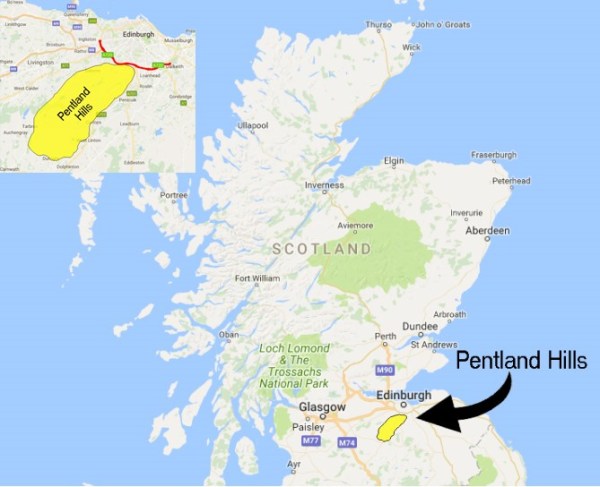
Earlier this month we blogged about the discovery of a dead peregrine in the Pentland Hills Regional Park just south of Edinburgh (see here). The dead adult male, part of a breeding pair, had been found in May and toxicology results confirmed he had been killed with a highly toxic banned poison, capable of killing a human.
[Photo of poisoned peregrine found dead next to footpath]
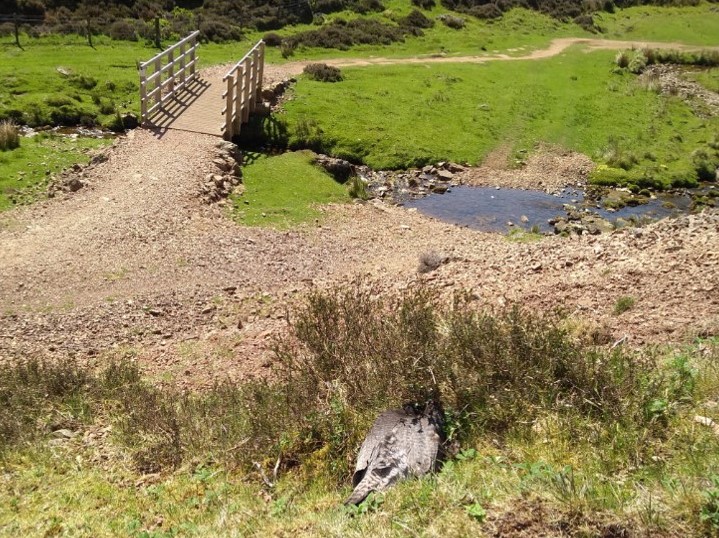
There was widespread concern that Police Scotland hadn’t bothered to mention this illegal poisoning incident for many months (not until prompted to do so by us). Given the toxicity of the posion and the frequency with which the public use the footpath where the poisoned bird was found, this silence was unacceptable.
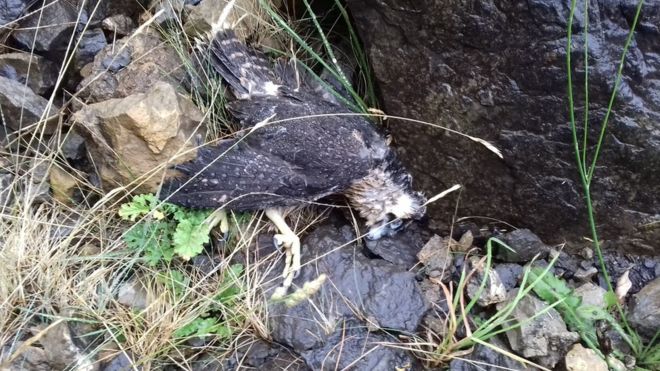
The illegal killing of the peregrine is just the latest in a growing list of wildlife crime incidents uncovered close to grouse moors in the Pentland Hills. In addition to the poisoned peregrine and the subsequent disappearance of its mate and chicks in the nest, other incidents include a raven that was found shot dead on its nest, a merlin’s nest that had been shot out, and a satellite-tagged golden eagle (Fred) who had ‘disappeared‘ in highly suspicious circumstances.

It could be argued that there is political gain to be had from keeping quiet, especially at a time when the Scottish Government-supported South Scotland Golden Eagle Project is underway and project partners SNH are keen to pretend that raptor persecution “is no longer an issue” in the area, despite overwhelming evidence to the contrary.
In addition to the incidents in the Pentland Hills, elsewhere in south Scotland there’s Raeshaw Estate, currently operating under a General Licence restriction and an Individual Licence restriction, due to evidence of alleged ongoing raptor persecution (here); there’s a forthcoming prosecution of a gamekeeper in the Borders for a long list of alleged wildlife crime (here); there’s the land managed for driven grouse shooting in South Lanarkshire (close to the golden eagle translocation area) where over 50 confirmed reported incidents of dead raptors and poisoned baits have been recorded since 2003, including a shot golden eagle in 2012 (it didn’t survive, here), the reported shooting of a short-eared owl in 2017 (here), the reported shooting of a hen harrier in 2017 (here), and the reported shooting of a buzzard in 2018 (here); and then there’s been at least four raptor poisonings in south Scotland this year alone (here), five if you include the Pentlands peregrine.
Fortunately not all MSPs are content to remain silent on this issue. Alison Johnstone MSP (Scottish Greens) spoke out earlier this month when news broke of the poisoned peregrine, stating that she would be asking questions of the Scottish Government’s failure to protect birds of prey (see here). She’s as good as her word. Alison has since lodged several Parliamentary questions as follows:
S5W-19574: To ask the Scottish Government, in light of the reported recent cases of illegal raptor persecution, what action it is taking to address wildlife crime in the Pentland Hills Regional Park.
S5W-19575: To ask the Scottish Government what assessment it has made of the risk to (a) the public and (b) wildlife of the use of banned poisons in the countryside, and what action it is taking to address this issue.
S5W-19576: To ask the Scottish Government, in light of it attracting an estimated 600,000 visitors annually, what its response is to reports that the public was not advised about the presence of a highly toxic banned poison in the Pentland Hills Regional Park
Expected answer date for all three questions is 7 November 2018.
Well done, Alison, and thank you.










 Raptor Persecution UK