The office of the Dorset Police & Crime Commissioner: incompetent or something more sinister?

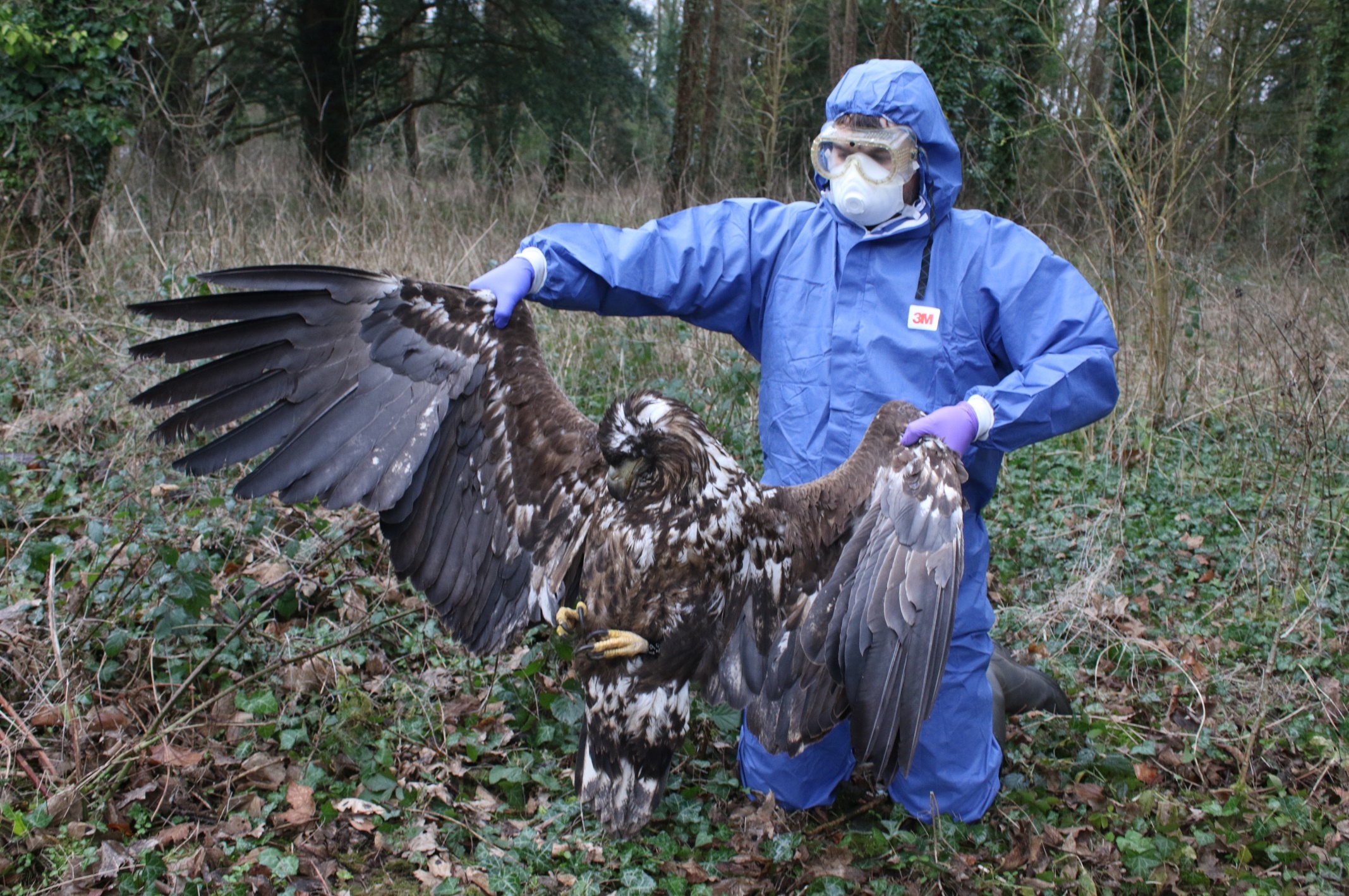
On 4th March I submitted a Freedom of Information request to the office of the Dorset Police & Crime Commissioner (PCC), Conservative David Sidwick, in relation to Dorset Police’s investigation into the poisoning of a white-tailed eagle that had been found dead on a shooting estate in January 2022 (see here).

I asked for copies of all correspondence relating to this matter between the PCC and (a) Dorset Police and (b) Chris Loder MP. You’ll recall that Mr Loder was the Conservative MP who took to Twitter to attack Dorset Police’s Rural, Wildlife & Heritage Crime team’s investigation into the poisoned eagle (see here and here).

By law (the Freedom of Information Act), the PCC’s office had to respond within 20 working days (by 1st April 2022) to either (a) provide the information I’d requested, (b) ask for an extension of a further 20 working days to send their response, or (c) refuse my request (and explain the legal grounds for that refusal).

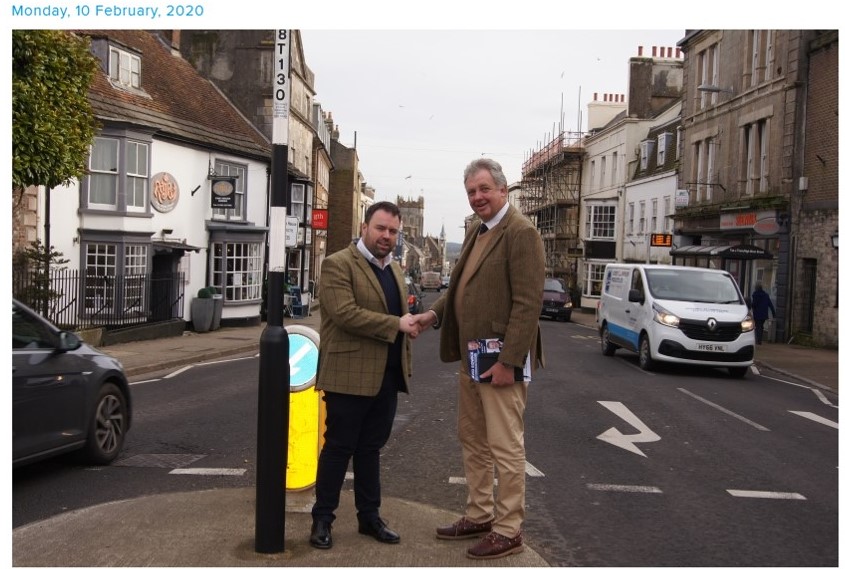
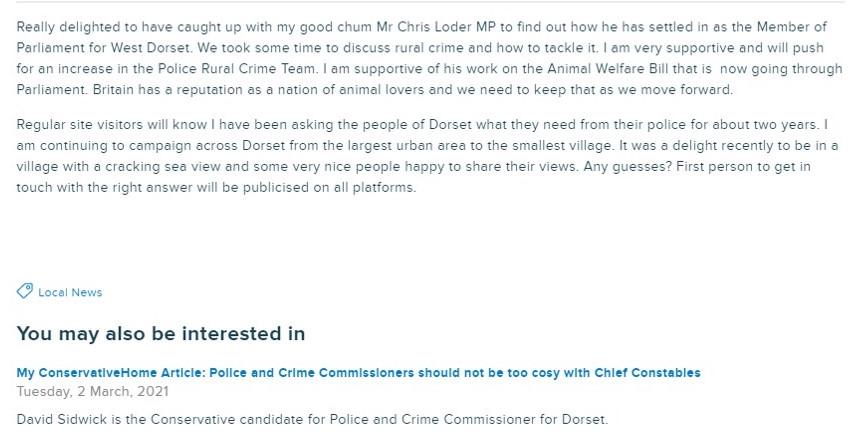
I asked for this information because David Sidwick had previously described Chris Loder MP as his ‘good chum’ in February 2020:

The FoI response from the PCC’s office did not arrive by 1st April. I gave them the benefit of the doubt and assumed it would arrive shortly afterwards.

On 7th April 2022 I wrote to the PCC’s office again, to remind them their FoI response was overdue. I just received an automated response.

On 11th April 2022 I wrote again, and again I received another automated response.

On 13th April 2022 I did receive an actual response from someone in the PPC’s office, apologising for the delay and saying:

The response is just being pulled together and we will come back to you asap“.

That was two weeks ago and I haven’t heard anything more. It must be a massive file. Or something.

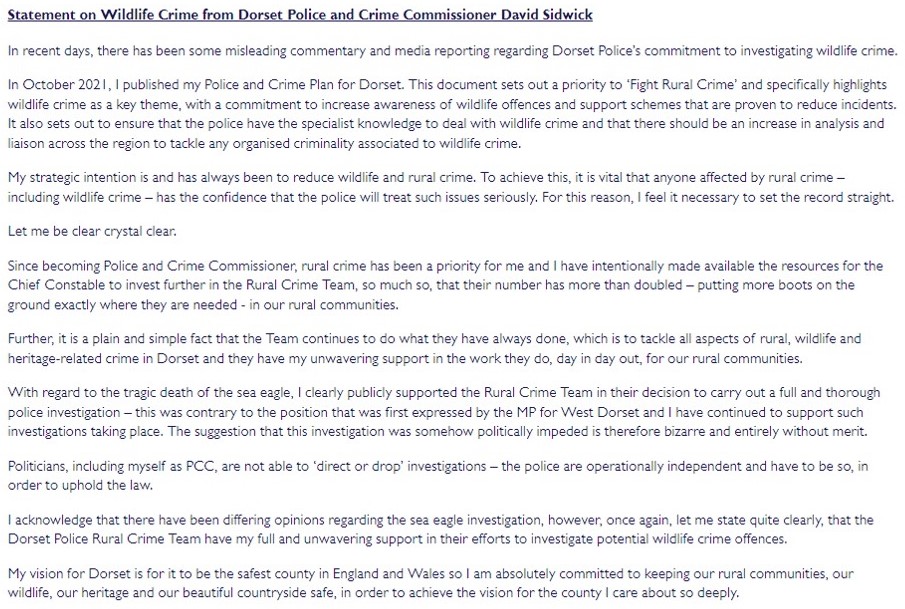
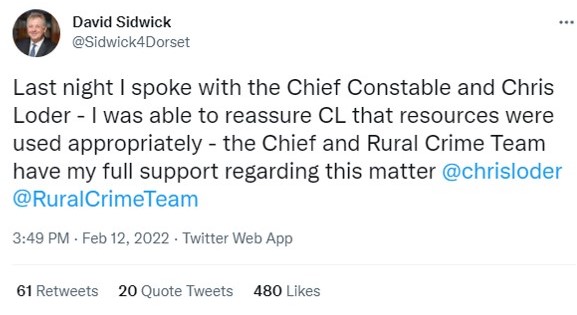
It’s been 53 days (35 working days) since I submitted my original FoI request. I know that there has definitely been communication between the PCC David Sidwick and Chris Loder MP about this issue because Mr Sidwick tweeted about it in February:

In this tweet, David Sidwick is clearly supportive of Dorset Police’s investigation into the poisoned eagle, despite his ‘good chum’ Chris Loder MP going ballistic on Twitter about ‘wasting police resources’.

A few weeks later, the police investigation was prematurely shut down, the Force’s award-winning wildlife crime officer was off on extended sick leave and is reported to have been told if/when she returns she’ll no longer be the wildlife crime lead, and the Force dropped the word ‘wildlife’ from the title of its Rural Crime team with a counter-intuitive explanation that simply doesn’t add up (i.e. “to reflect the broader work we are undertaking“). Surely if you’re increasing the scope of your work you add words to the title, not remove them?

So what went on in those few weeks between a live investigation supported by the PCC, to a complete shut-down of the case?

And why is the office of the Dorset Police & Crime Commissioner, David Sidwick, unlawfully delaying providing me with a response to my FoI request?

It could be incompetence. But it’s looking increasingly like something else, especially when Dorset Police refused my FoI request with the most ludicrous fob-off (here).

Today I emailed the PCC’s office, again, and asked them to respond to my FoI without further delay.

More questions asked about Dorset Police’s mishandling of the poisoned eagle investigation

If Dorset Police think this issue is going away, they’d better have a re-think.

There’s a good article in The Guardian today, discussing the rebranding of Dorset Police’s Wildlife Crime Team, which now excludes the word ‘wildlife’, and the news that the team’s former, award-winning investigator, Claire Dinsdale, has apparently been told that she will no longer be a wildlife crime team lead when/if she returns from long-term sick leave.

You can read the Guardian article here.

Chris Packham submits FoI requests to Dorset Police & the Crime Commissioner about poisoned eagle

Last week I blogged about Dorset Police’s refusal to respond to my Freedom of Information request, where I’d asked for copies of all correspondence between the Police and Dorset Conservative MP Chris Loder in relation to the poisoned eagle found dead on a shooting estate in January (see here).

Dorset Police tried to fob me off with what I consider an explanation that lacked any credibility (see here). I have since appealed that refusal notice and have asked for a review. Dorset Police are obliged to respond within a certain time period and I await their answer.

I also submitted an identical FoI request to the Dorset Police and Crime Commissioner (PCC), Conservative David Sidwick. That response is well overdue and I’ll be following that up again this week.

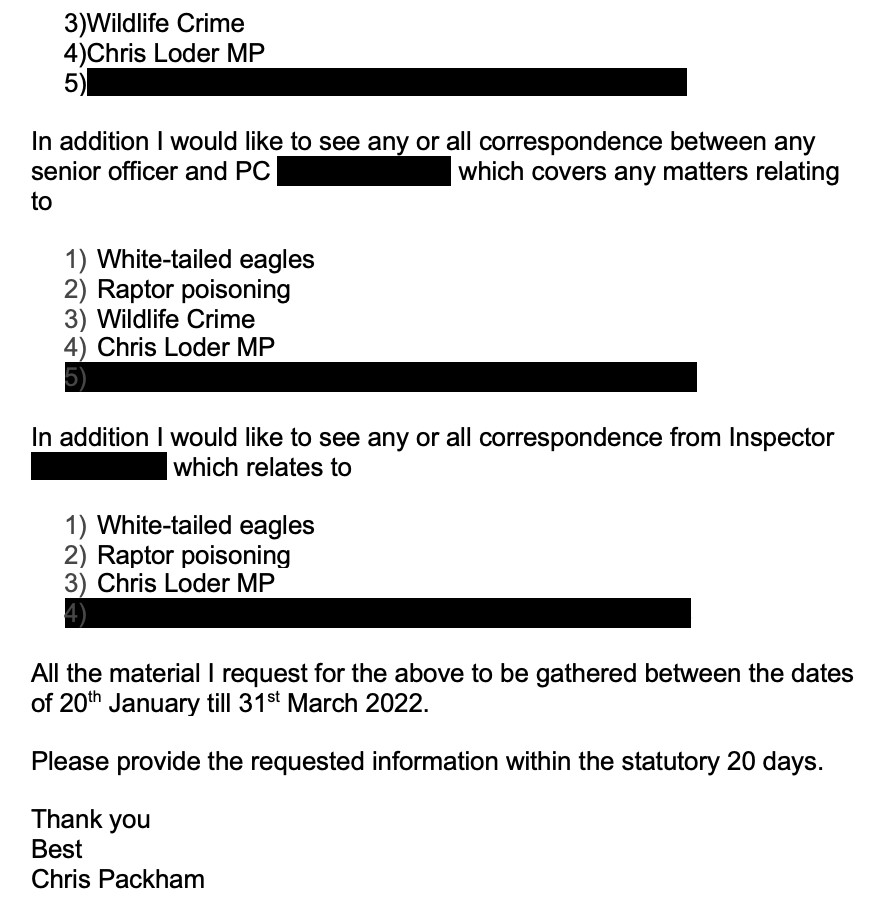
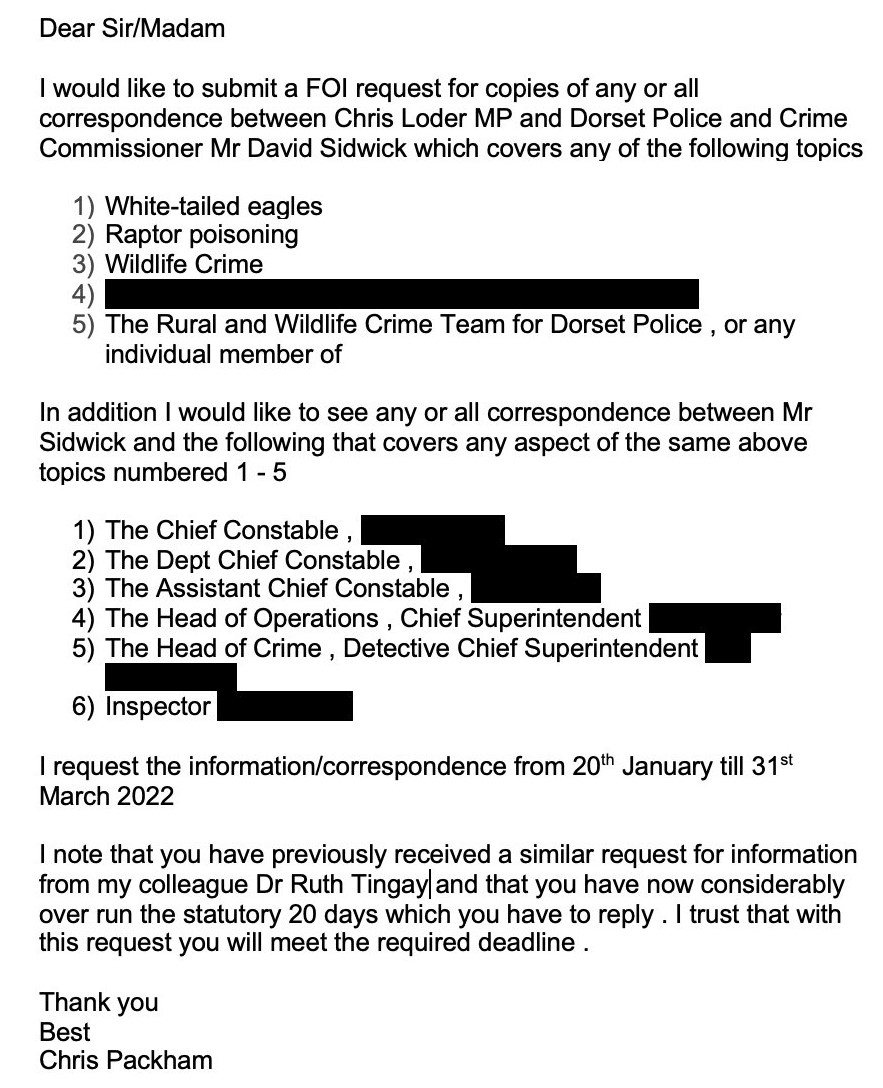
Meanwhile, this week my colleague Chris Packham has also submitted FoIs to both Dorset Police and the PCC. Chris has previously spoken out about Dorset Police’s decision to end their investigation which came shortly after Mr Loder’s Twitter outburst about how the police shouldn’t be using resources to investigate suspected wildlife crime.

Chris’s FoIs are similar to mine but are more targeted, identifying named police officers who are likely to have been involved in the decision-making process about terminating the investigation on the poisoned eagle.

Here is a redacted copy of Chris’s FoI request to Dorset Police:

Here is a redacted copy of Chris’s FoI request to the Dorset Police and Crime Commissioner (PCC), Conservative David Sidwick:

UPDATE 25th May 2022: Dorset Police and the Dorset Police & Crime Commissioner in breach of Freedom of Information Act by failing to respond to Chris Packham’s request for info on poisoned eagle (here)

Tediously predictable response from Minister to Natalie Bennett’s House of Lords question on poisoned eagle

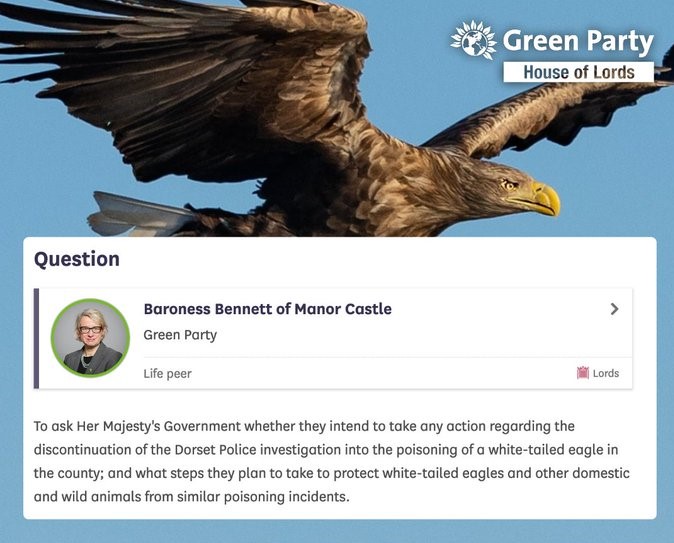
In late March, Life Peer Baroness Bennett of Manor Castle (known to many of us as the former Green Party leader Natalie Bennett) posed a written question in the House of Lords about Dorset Police’s unthinkable decision to drop its investigation into the poisoning of the white-tailed eagle that was found dead on a shooting estate in Dorset (see here).

Here is Natalie’s question:

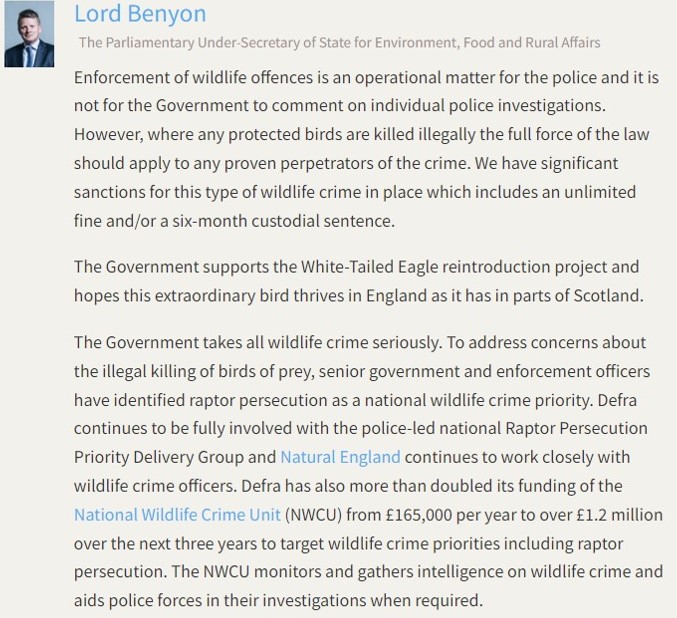
Natalie’s question has now been answered by the Parliamentary-Under-Secretary-of-State for Environment, Food and Rural Affairs, Lord Benyon, who also happens to own a pheasant-shooting estate and a grouse-shooting estate.

Here is Lord Benyon’s response:

It’s predictably tedious and is just the latest version of the same old tosh repeated every time the Government is asked to respond to ongoing raptor persecution incidents, e.g. see this from Environment Minister Rebecca Pow in September 2021, and this from Richard Benyon in February 2022, and this from Rebecca Pow in February 2022.

There’s a running theme in all of these responses that is supposed to persuade us that the Government takes raptor persecution crimes seriously. For example, by the provision of custodial sentences (that have never been applied in England to a raptor-killing criminals and only once in Scotland, in 2014), by DEFRA’s participation in the sham-partnership that is the Raptor Persecution Priority Delivery Group (RPPDG) that has been in place since 2011 and has delivered precisely nothing of any use, and by the continued funding of the National Wildlife Crime Unit (NWCU) which is supposed to ensure that regional police forces have sufficient support and expertise to undertake investigations into alleged raptor persecution crimes – clearly ineffective when it comes to Dorset Police.

It’s obvious to anyone who cares to look that the raptor-killing criminals continue to stick up two fingers to the law, time after time after time after time, and yet still the Government pretends it’s all under control. Meanwhile, inept police forces like Dorset can make stupendously stupid /suspiciously dodgy-looking decisions and not be held to account.

Or can they? More soon…

Unconvincing statement from Dorset Police on closure of investigation into poisoned eagle

A journalist from one of the nationals contacted me to ask my opinion on a statement he’d been sent by Dorset Police about the premature closure of the investigation into the poisoned white-tailed eagle found dead on a shooting estate in North Dorset in January (see here).

You may recall that Dorset Police published a short public statement on 29th March 2022:

The latest police statement sent to the journalist reads as follows:

Deputy Chief Constable Sam de Reya, of Dorset Police, said: “Dorset Police has responded robustly to allegations that a White-tailed Sea Eagle had been deliberately poisoned and killed by unknown persons. As a result of the sea eagle being found dead on land in the North Dorset area, our team has carried out a full and proportionate investigation under Section 1 of the Wildlife Countryside Act 1981 in conjunction with Natural England, National Wildlife Crime Unit, the RSPB and the Roy Dennis Wildlife Foundation to identify any offences and perpetrators who may be responsible. 

As you can imagine detecting the deliberate poisoning of a bird of prey is extremely difficult without local intelligence and information to support the investigation. GPS data provided information that over an 11-day period the White-tailed Sea Eagle spent time across a multitude of locations in the North Dorset area. Despite working with experts, we have been unable to confirm deliberate intent to kill this beautiful bird or identify potential offenders. A detailed examination and tests have been carried out on the bird, which were inconclusive, and it has therefore not been possible to confirm that any criminal offence has been committed. While high levels of brodifacoum were detected, it has not been possible to establish whether this was as a result of a deliberate act or due to secondary rodenticide poisoning. We would still encourage anyone with new information to come forward to support enquiries.

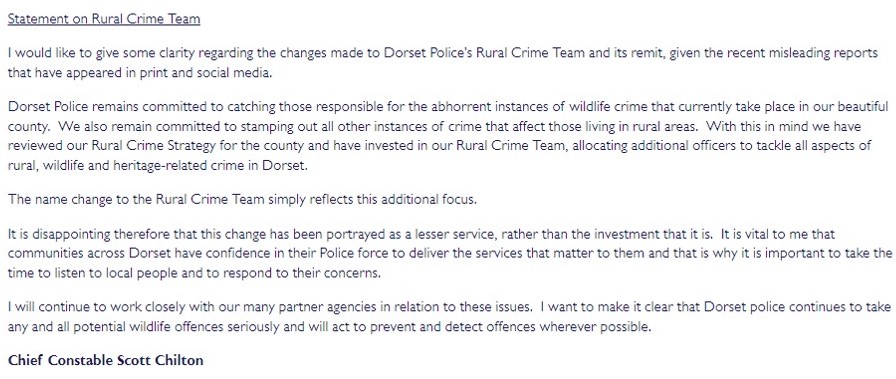
The Force is committed to keeping everyone in our county safe, including our wildlife, which brings so much to our beautiful countryside and our communities. As part of the police uplift programme and working together with the Office of the Police and Crime Commissioner we have reviewed our Rural Crime Strategy for the county and allocated increased numbers of officers to the Rural Crime Team to tackle the issues that matter. This includes all aspects of rural, wildlife and heritage-related crime. We will continue to work closely with many different partner agencies in relation to these issues. As always, should any new information be received in relation to this investigation, this will be considered.

We want to make it clear that we take any and all potential wildlife offences seriously and will act to prevent and detect offences wherever possible.”

As you can see, this statement provides a bit more detail than the first, but nevertheless, it’s still full of holes.

I don’t know how they can claim to have ‘carried out a full and proportionate investigation‘ when the planned multi-agency search of the estate where the poisoned eagle had been found dead was pulled shortly after Dorset MP Chris Loder had tweeted his lack of support for the investigation.

Dorset Police say that ‘detecting the deliberate poisoning of a bird of prey is extremely difficult without local intelligence and information‘. Yes, it is difficult but not impossible, and in this case Dorset Police have plenty of local intelligence and information, not least from on-going investigations into alleged raptor poisoning in the same area over the last few years.

Dorset Police say the poisoned eagle’s satellite tag data showed that in the 11 days prior to its death, the eagle had ‘spent time across a multitude of locations in the North Dorset area‘. What the tag data actually showed was that the eagle had visited just 2-3 locations.

Dorset Police say, ‘We have been unable to confirm deliberate intent to kill this beautiful bird or identify potential offenders‘. The high-level of Brodifacoum (x 7 the lethal dose!) is indicative of an illegal act, whether it was mis-used or targeted. And no, if you don’t conduct a search you’re not likely to be able to identify potential offenders, are you!

Dorset Police say, ‘A detailed examination and tests have been carried out on the bird, which were inconclusive…’. That’s simply not true. The eagle clearly died from Brodifacoum poisoning.

Dorset Police say, ‘While high levels of brodifacoum were detected, it has not been possible to establish whether this was as a result of a deliberate act or due to secondary rodenticide poisoning‘. It doesn’t matter if it was deliberate or not, it’s still an offence (mis-use).

There’s more to come on this case…

Dorset Police refuse FoI request for correspondence between them & Chris Loder MP on poisoned eagle

Last month, Dorset Police did the unthinkable and prematurely closed their investigation into the poisoning of a white-tailed eagle that was found dead on an undisclosed shooting estate in North Dorset in January 2022 (see here).

This was an astonishing decision for a number of reasons (e.g. see here), not least because prior to this incident, Dorset Police’s Rural & Wildlife Crime Team enjoyed a good reputation for it’s proactive stance in the investigation of raptor persecution crimes, and indeed the team had been preparing to conduct a multi-agency search of the estate where this dead eagle had been found, until the head honchos at Dorset Police decided to pull the plug.

It’s even more surprising when you learn what other police investigations into alleged wildlife crime have taken place on that unnamed estate – more on that soon.

Dorset Police’s decision to close the investigation came soon after an extraordinary outburst from local MP Chris Loder, who had argued on Twitter that Dorset ‘wasn’t the place for eagles’ and that Dorset Police should be focusing their resources on other types of criminality (see here) and not on suspected wildlife crime. And it wasn’t an off-the-cuff remark made in haste; he continued his tirade for sometime afterwards (e.g. see here). A quick look at Chris Loder’s Register of Interests on the Parliamentary website showed that his local Conservative party had received large donations from at least one shooting estate in North Dorset.

Unsurprisingly, there was widespread suspicion that Dorset Police’s decision to close the poisoned eagle investigation had been influenced by undue political interference so I submitted two Freedom of Information requests to find out if there was any evidence to support that suspicion. One FoI request was submitted to Dorset Police and the other to the Dorset Police & Crime Commissioner.

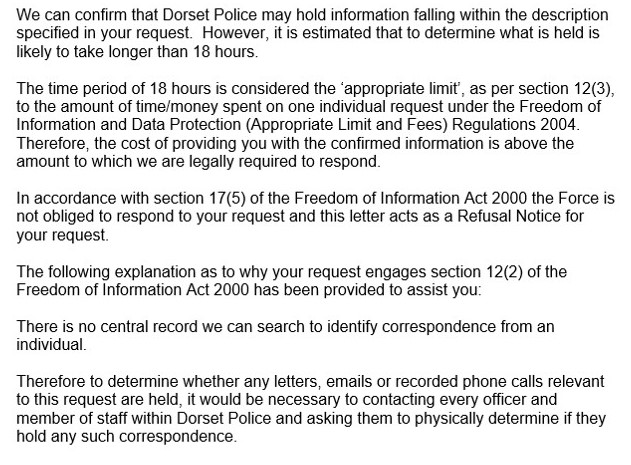
Dorset Police have since attempted to fob me off with this idiotic response:

Obviously, I have requested a review of Dorset Police’s Refusal Notice. I don’t accept the likelihood that an MP might have written to any one of 2,500 Dorset Police employees about this poisoned eagle. That would include those employed as call handlers, personal safety trainers, crime analysts, enquiry officers, IT consultants, project managers, administrations staff, mechanics, accountants, lawyers, to name just a few.

It’s common sense that an MP interested in the investigation of a poisoned eagle would be more likely to have corresponded with senior officers responsible for the supervision of the Force’s Rural & Wildlife Crime Team, and that probably means a handful of officers, let’s say ten, max (and that’s being generous). So Dorset Police can probably strike 2,490 people from their search, leaving ten people to spend two minutes searching their inboxes, amounting to 20 minutes of total search time, well within the statutory 18 hours of search time permitted for a Freedom of Information request.

I’ve also pointed out to Dorset Police’s Freedom of Information Officer that MPs are not classed as public authorities under the Freedom of Information Act so advising me to submit an FoI to Chris Loder MP was non-sensical, although surely an FoI Officer would already know this?!

I’ll blog about the outcome of my review request in due course.

As mentioned above, I’d originally submitted two FoI requests. My second one was an identical request for information about correspondence between Chris Loder MP and the Dorset Police and Crime Commissioner (PCC), Conservative David Sidwick.

Initially I received an automated response from the PCC office confirming receipt of my request. Then it all went quiet. I have since emailed two further times to highlight that their response is overdue (they’re allowed 20 working days). Yesterday I finally had a response, apologising for the delay and saying:

The response is just being pulled together and we will come back to you asap“.

I’ll blog about that response when it finally arrives.

UPDATE 21st April 2022: Chris Packham submits FoI requests to Dorset Police and the Crime Commissioner about poisoned eagle (here)

UPDATE 26th April 2022: The office of the Dorset Police & Crime Commissioner: incompetent or something more sinister? (here)

UPDATE 29th April 2022: Email correspondence between Chris Loder MP and Dorset Police & Crime Commissioner re: poisoned eagle (here)

UPDATE 25th May 2022: Dorset Police and the Dorset Police & Crime Commissioner in breach of Freedom of Information Act by failing to respond to Chris Packham’s request for info on poisoned eagle (here)

UPDATE 26th May 2022: Further breach of Freedom of Information Act by Dorset Police re: poisoned eagle (here)

13% increase in recorded wildlife crime incidents in Scotland – new Government report

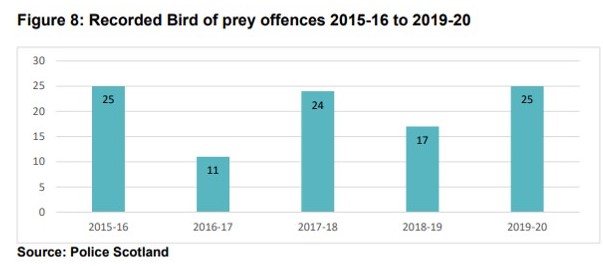
The Scottish Government has published its latest annual wildlife crime report, covering the period April 2019-March 2020, which reveals an increase of 13% in recorded wildlife crime incidents.

Raptor persecution offences increased during this period, with shooting and poisoning being the joint highest recorded crime type. Obviously, these figures only represent offences that have been discovered; there will be many more that went undiscovered, as acknowledged by the report’s foreword written by Environment Minister Mairi McAllen.

Here are a few excerpts from the Minister:

After a drop in recorded wildlife crime incidents of over 60% between the 2014-15 report and 2018-19, it is frustrating to see an increase of 13% in recorded wildlife crime incidents in 2019-20. Wildlife crime is not only abhorrent, it is also completely at odds with our work to address the biodiversity crisis, which is supported by so many people and organisations across Scotland.

While it is reassuring that incidents of wildlife crime have not returned to previous higher levels, we remain aware that recorded wildlife crime does not provide the full picture. This is an area where the victims are unable to speak for themselves and we know that many wildlife crimes are not witnessed and not reported. This has been especially true in the area of raptor persecution where tagged birds have disappeared in unexplained circumstances and where expected numbers of some species are not present in certain areas.

The Scottish Government has always been clear that wildlife crime is unacceptable, and we have brought forward a number of measures to tackle the issue over the years. These measures have included a poisons amnesty, vicarious liability, restrictions on general licences and most recently, significant increases in penalties for wildlife crimes. I am sure many of you reading this share my frustration that despite these measures there are some who continue to take a selfish, cruel and callous approach to our wildlife.

It is disappointing to see a rise in raptor persecution offences from the previous year. We have committed to taking forward the recommendations made by the Grouse Moor Management Group as a matter of urgency, to tackle this type of offence. We will bring forward legislation during this parliamentary term with the aim of putting in place a meaningful, effective and workable sanctions through a licensing system to deter and punish those who deliberately commit crimes in our uplands, without placing unworkable and disproportionate burdens on the majority who work within the law‘.

Yada, yada, yada. The Scottish Government’s idea of what constitutes ‘a matter of urgency’ is very different to mine. The Werritty report on grouse moor management, on which the Government made it’s decision to implement a licencing scheme for grouse shooting in Scotland, was submitted in November 2019. Here we are in April 2022 and nothing has happened except repeated statements from Ministers, now over a period of years, about it being a ‘matter of urgency’.

It’s obvious that raptor persecution isn’t going to stop without further statutory intervention, and depending on what that looks like and how it’s implemented and enforced, it probably still won’t stop without a ban on certain types of gamebird shooting. The longer the Scottish Government procrastinates, the longer these crimes will persist.

Pick a date and get on with it.

You can read/download the Scottish Government’s 2020 annual report on wildlife crime here:

Invercauld Estate in Cairngorms loses appeal against General Licence restriction imposed for wildlife crime

Invercauld Estate in the Cairngorms National Park has lost its appeal against a General Licence restriction that was imposed on the estate in February 2022 (see here) after Police Scotland provided the licensing authority (NatureScot) with evidence of wildlife crime against birds of prey on the estate, notably the discovery of a ‘deliberately poisoned’ golden eagle lying next to a poisoned hare bait in March 2021 (see here).

[Photo of the poisoned eagle & hare bait found on a grouse moor on Invercauld Estate in the Cairngorms National Park. Photo by RSPB Scotland]

Regular blog readers will know that the three-year General Licence restriction on the Gairnshiel & Micras part of Invercauld Estate took effect on 9th February 2022, prohibiting the use of General Licences 01, 02 and 03 on the estate until 9th February 2025 (see here).

The estate submitted a formal appeal against NatureScot’s restriction decision on 25th February 2022 and the official ‘restriction notice’ was removed from NatureScot’s website. I looked today and the notice has been reinstated, which I take to mean that the estate’s appeal has failed, in the same way that Lochan Estate’s recent appeal against restriction also failed (see here).

Here is the map from Naturescot showing the area of restriction on the Gairnshiel & Micras area of the estate:

If you’re at all familiar with Invercauld Estate you’ll recognise that this restriction area is only a small part of what is a massive grouse-shooting estate in the Cairngorms National Park (data from Andy Wightman’s excellent Who Owns Scotland website) rather than the restriction being applied across the entire estate, as seems to have been the case with other sanctioned estates:

I was curious about why the General Licence restriction was, well, restricted for want of a better term, to just the small area of Garnshiels and Micras, so I asked the licensing team at NatureScot about that decision.

The response from NatureScot was prompt (thank you!) and went like this:

‘…The decision was made on the basis that the evidence of crime provided [by Police Scotland] related to this one beat, rather than across the whole estate; and that the separate beats on this estate are managed independently of each other. Hence, the ultimate decision was to restrict to the beats where the evidence of crime occurred‘.

As many of you already know, the three-year General Licence restriction is barely worth the paper it’s written on because the estate can simply apply for ‘Individual licences’ (instead of relying on the General Licences) to continue its activities as before, albeit with the minor inconvenience of having to have a bit of a paper trail. This has been a major criticism of the General Licence restriction process ever since it began in 2014. This, combined with the shooting industry’s apparent reluctance to shun any estates where restrictions have been imposed for wildlife crime, means that the General Licence restriction is an utterly ineffective sanction (e.g. see here).

We were even provided with first-hand evidence of its ineffectiveness when further evidence of suspected wildlife crime was detected on two estates that were already serving a General Licence restriction for wildlife crime! Raeshaw Estate in the Scottish Borders had its Individual licences revoked (here) and Leadhills Estate was given a three-year extension to its original three-year General Licence restriction (here), a decision which it subsequently appealed and lost (here).

You may remember that in February, Scottish Greens MSP Mark Ruskell asked Parliamentary questions about this absurd so-called sanction (see here); more on that shortly.

Buzzard & red kite suspected poisoned on North Dorset estate

Well this saga gets more interesting by the day.

I’ve written about the poisoned white-tailed eagle found dead on an as-yet undisclosed shooting estate in North Dorset and Dorset Police’s decision to close the investigation prematurely (see here, here, here, here and here).

I’ve also written about the suspected poisoning of another white-tailed eagle on another as-yet undisclosed shooting estate in North Dorset and a subsequent multi-agency raid in which items of interest have been submitted for toxicology assessment (see here).

Now there’s this – the suspected poisoning of a buzzard and a red kite on an as-yet undisclosed shooting estate in North Dorset, as revealed on Twitter this afternoon by Ian Denton:

More to follow……

Another eagle suspected poisoned on a Dorset shooting estate

The story of the week has been the confirmed poisoning of a white-tailed eagle found dead on a shooting estate in Dorset in January, and Dorset Police’s astonishing decision to close the investigation even though toxicology results had proved that poisoning was the cause of death (see here,  herehere, here and here).

There’s still much more to come out about this story and I’ve spoken to a few journalists in the last few days who are making some headway. Let’s see what they produce in the coming days.

Meanwhile, in the course of these conversations I’ve learned that another white-tailed eagle is suspected to have been poisoned on a shooting estate in Dorset.

I’ve deliberately used the word ‘suspected’ in this case because unlike the first eagle, poisoning hasn’t been confirmed and the eagle hasn’t died.

This second case is not on the same shooting estate where the dead (confirmed poisoned) eagle was found, but it is on another game-shooting estate and it is nearby.

I understand that initially, this second eagle’s satellite tag data indicated that the eagle’s movements were unusual and this was a cause for concern given the eagle’s location and proximity to the area where the poisoned eagle had been found dead. A multi-agency team made a site visit to look for this second eagle and they found it, still alive but displaying some of the characteristic physical traits of a raptor that has ingested a large amount of an anticoagulant rodenticide (e.g. lethargic, head-drooping).

While on site searching for the sick eagle, a number of undisclosed items were apparently discovered which sparked a multi-agency raid on the estate a short while later and I understand that as a result of that search, multiple toxicology results are now pending from the lab.

The second eagle appears to have since made a recovery and has recently moved away from the estate, although long-term health issues may still be an issue. Time will tell.

It’s important to emphasise that at this stage poisoning (rodenticide or another substance) has not been confirmed but it is suspected.

What’s interesting about this second investigation is that the police considered there was sufficient evidence to conduct a multi-agency search, even though toxicology results were still pending. This is in direct contrast to the police’s response to the first case where toxicology results from the dead eagle had confirmed that poisoning was the cause of death and that the high concentration of rodenticide in the eagle’s liver (7 x the lethal dose) was clearly indicative of suspicious activity, and yet Dorset Police decided not to progress that investigation.

This is quite hard to fathom, although I suspect that this multi-agency search on the other estate took place in early March under the direction of the diligent and highly-competent wildlife crime officer, Claire Dinsdale. The ridiculous decision not to progress the first investigation (into the circumstances of the dead, confirmed-poisoned eagle) appears to have been made later in March after Claire Dinsdale had apparently been signed off on indefinite sick leave.

I look forward to the publication of the latest toxicology reports, which should be available by now, surely, and full disclosure from Dorset Police about the status of this second investigation, as well as an explanation about why the first investigation was closed prematurely, especially when Dorset Police would have known about this second case of suspected poisoning on an estate in close proximity to where the dead poisoned eagle had been found.