Peregrine found critically injured with shotgun injuries in North Yorkshire

Press statement from North Yorkshire Police (20th May 2021)

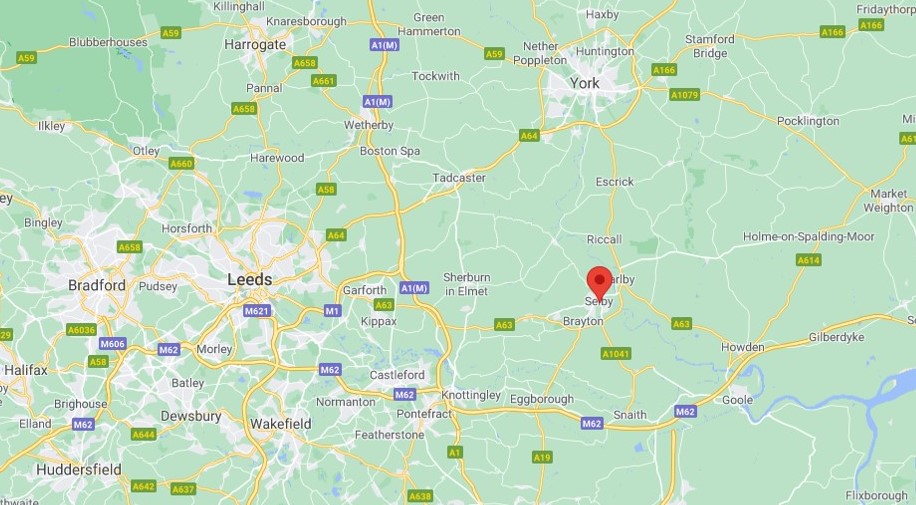
Police appeal for information after peregrine falcon found shot near Selby Abbey

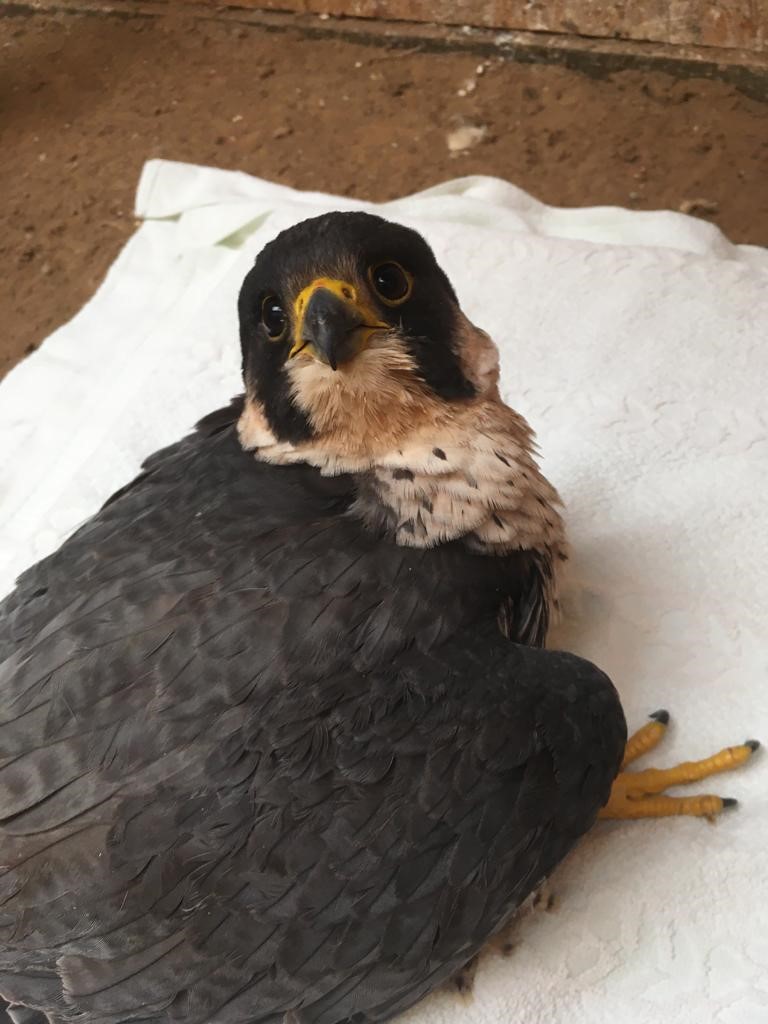
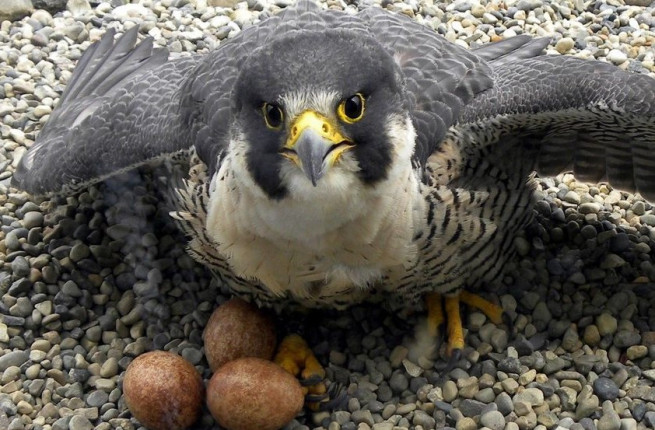
On 7 May 2021, an 8 year old female peregrine falcon was discovered in the grounds of Selby Abbey with injuries which meant she was unable to fly.

[Photograph from North Yorkshire Police]

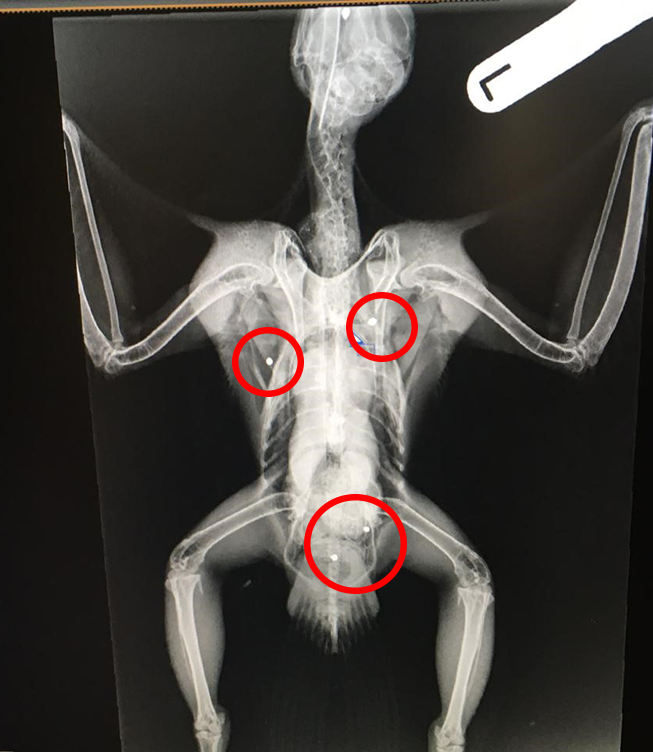
The peregrine was rescued and x-rayed by a local falconry specialist vet, Mark Naguib, who found a number of shotgun pellets throughout the bird’s body. The peregrine is ringed by the British Ornithology Trust so was able to be traced back to being released as a chick near Newark eight years ago.

The peregrine falcon is now in the expert care of local wildlife rehabilitator, Jean Thorpe, who will give her the best possible chance of making a recovery.

[X-ray from North Yorkshire Police]

North Yorkshire Police Constable Sarah Ward said:

“Peregrine falcons are a protected schedule one species and it is shocking that anyone would target one in this cruel and callous way.

“Our county should be a haven for birds of prey and this type of cruelty will not be tolerated.

“If anyone has information about this worrying incident please get in touch and report to us. You can either call 101 or if you wish to remain anonymous please call Crimestoppers on 0800 555 111.”

RSPB Investigations Officer, Jack Ashton-Booth said:

“We are appalled at this deliberate and illegal attack on a protected peregrine falcon. The bird was riddled with shot, including one piece lodged in its head. Incredibly, it is still alive but it’s touch and go.

“We urge anyone with information to contact North Yorkshire Police immediately. Alternatively, if you wish to speak out in confidence, please don’t hesitate to call our Raptor Crime Hotline on 0300 999 0101.

“Peregrines are incredibly good at adapting and are increasingly living alongside us in our towns and cities, and are a joy to see nesting on tall buildings like cathedrals. Nature is in trouble, and we must embrace it or risk losing it.”

If you have any information about this incident please call North Yorkshire Police on 101 quoting ref: 12210119786.

ENDS

UPDATE 29th June 2021: Shot peregrine successfully rehabbed and released back to wild (here)

X-ray of injured peregrine reveals he had previously been shot

A peregrine falcon that suffered injury after colliding with a window was found to have previously been shot.

In a shoddy piece of reporting on the LeicestershireLive website, the RSPCA has apparently claimed the peregrine ‘died after it was shot with an airgun and the pellet became embedded in its wing’ and that they are now appealing for information about the ‘airgun thug’ responsible (see here).

However, if you look at the accompanying x-ray released by the RSPCA, there is what appears to be a pellet embedded in the bird’s right ulna but it doesn’t have the shape of an air gun pellet – it looks more like the spherical shape of a shotgun pellet (see red circle, added by RPUK).

The examining vet thought it was an old injury and you can see there aren’t any associated bone breaks with the pellet, whereas the peregrine has clearly fractured its left radius and there was damage to its neck, presumably caused by the window collision (see the yellow circles, added by RPUK).

The peregrine didn’t survive its injuries.

In what must be the most optimistic appeal for information ever, given that nobody knows when or where the peregrine had previously been shot, the RSPCA is appealing for information!

Police appeal as peregrines believed to have been poisoned again at notorious Shropshire blackspot

Press release from West Mercia Police (6th May 2021)

Appeal following protected bird deaths

On the morning of Saturday 1 May, officers received information that a female peregrine had been found dead on the hillside below the nest near to Clee Hill Quarry.

PC Grant said: “The body was recovered together with a pigeon that had been used as bait. The male bird has not been found, but is also believed to have been killed. The baited pigeon at the scene indicates that poison was used to kill both birds. The incident is currently under investigation by both West Mercia Police and RSPB Investigations.

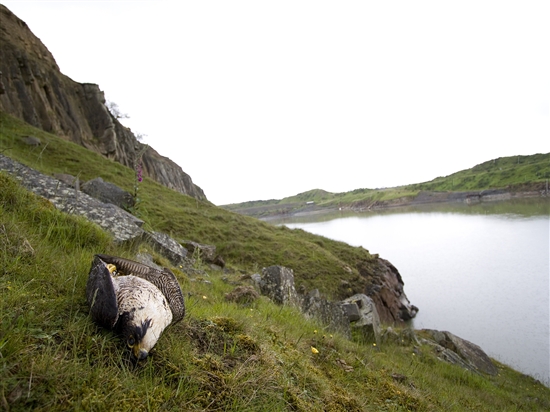
[This is a photograph of another peregrine found poisoned at this site in 2017 (see here). Photo by RSPB]

Peregrine Falcons are specifically protected under the Wildlife & Countryside Act 1981, and the maximum penalty for killing or deliberately injuring a protected species is a fine of £5,000 and six months imprisonment.

We are asking members of the public walking on Clee Hill common with children and pets to be aware and to take care that poison bait may still be around and not to touch any dead animals that they may come across if they do see any such animals or anything suspicious, to please call police.  

If anyone has any information regarding this incident please contact the police on 101 and quote incident number 258i of 1 May 2021 or contact us via our ‘Tell us about’ section on our website.”

If you do have information but don’t feel comfortable speaking to police, you can speak to the independent charity Crimestoppers. It is 100% anonymous, they never ask your name and they cannot trace your call or I.P address. You can contact them online or by calling 0800 555 111.

ENDS

There is also an article in the Shropshire Star (here) about this latest poisoning crime at Clee Hill. It’s well worth a read and includes commentary from John Turner, Chair of the Shropshire Peregrine Group, about the use of tethered pigeons smeared with poison to lure the peregrines and how this has happened over and over again at this site (2010, 2011, 2015, 2017, 2021)…

We are shocked that it’s happened again. The deadly poison being used is a danger to people walking their dogs and to animals in the area and somehow we are going to have to inform Defra to get the place decontaminated as it should not be scattered in the countryside like it has been and is contaminating the moorland where these pigeons were found.

On Wednesday evening another poisoned pigeon was found along with a dead fox which had eaten it.

We know who is responsible, and local people know who is responsible. I urge local residents of Clee Hill to call out the individuals responsible for these crimes, many of whom are well known in the area, and provide the police with information about their criminal activities which are bringing shame to the village.”

 “It [the female peregrine] was found by the site warden on Saturday morning. There was the body of a poisoned pigeon very near the dead female peregrine. The male will have been killed as well but we have not recovered the body yet.

We think this is a repeat of what happened four years ago in 2017. We thought we had put a stop to it. We have had at least a dozen peregrines poisoned since 2010 – we have lost about a quarter of the Shropshire population of about 40 peregrines.

ENDS

In previous poisoning offences at Clee Hill the toxin Diazinon has been used. Suspicion has been laid at the door of the local pigeon racing community but nobody has ever been prosecuted.

Previous blogs on these poisoning crimes here, here, here, here

Peregrine shot & killed in North Wales

North Wales Police have published a tweet about a peregrine that was found dying on Tuesday lunchtime near the Osprey Centre at Porthmadog, North Wales.

It was taken to the RSPCA’s Stapeley Grange Wildlife Centre for a veterinary examination.

According to the Police, the vets said it had ‘probably been shot’ as there was an entry and exit wound. There are no further details.

Unfortunately this young peregrine died of its injuries.

If you have any information that could help this investigation, please contact North Wales Police and quote reference 21000222577.

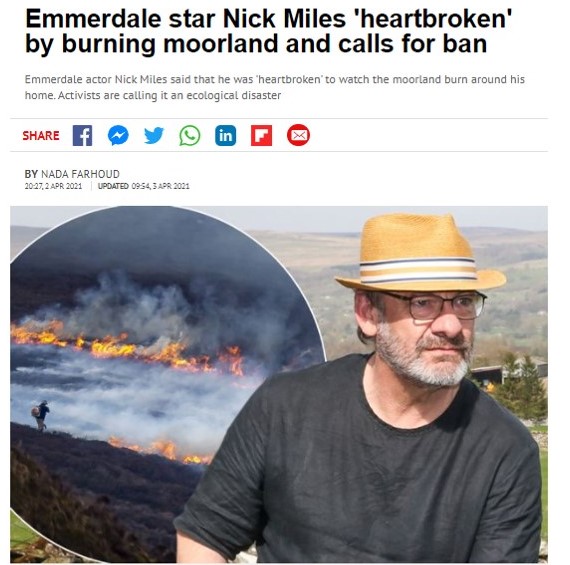
Emmerdale actor speaks out against grouse moor burning & raptor persecution

Hot on the heels of her last article on how burning Britain’s moorland is ‘an environmental disaster’ (here), the Daily Mirror’s Environment Editor, Nada Farhoud has a follow up article out today.

This time she interviews Emmerdale actor Nick Miles, who lives in the Yorkshire Dales National Park and has been a long-time supporter of conservation campaigns such as Hen Harrier Day.

Nick talks about his village ‘disappearing under a blanket of smoke’ when the gamekeepers have set the moors alight and how letters to his MP, Rishi Sunak, have fallen on deaf ears.

He also talks about how few red kites he sees in Upper Wharfdale (hardly surprising given its proximity to Nidderdale, where killing red kites on grouse moors is de rigueur) in comparison to Harewood, where Emmerdale is filmed and from where red kites were reintroduced and are doing well.

Read today’s article in the Mirror here (and watch out for the comedy input from Moorland Association Director Amanda Anderson).

Meanwhile in Scotland the fires also continue. I’ve been sent some horrific photographs that were taken in the Angus Glens two days ago – I’ll be publishing those later this weekend.

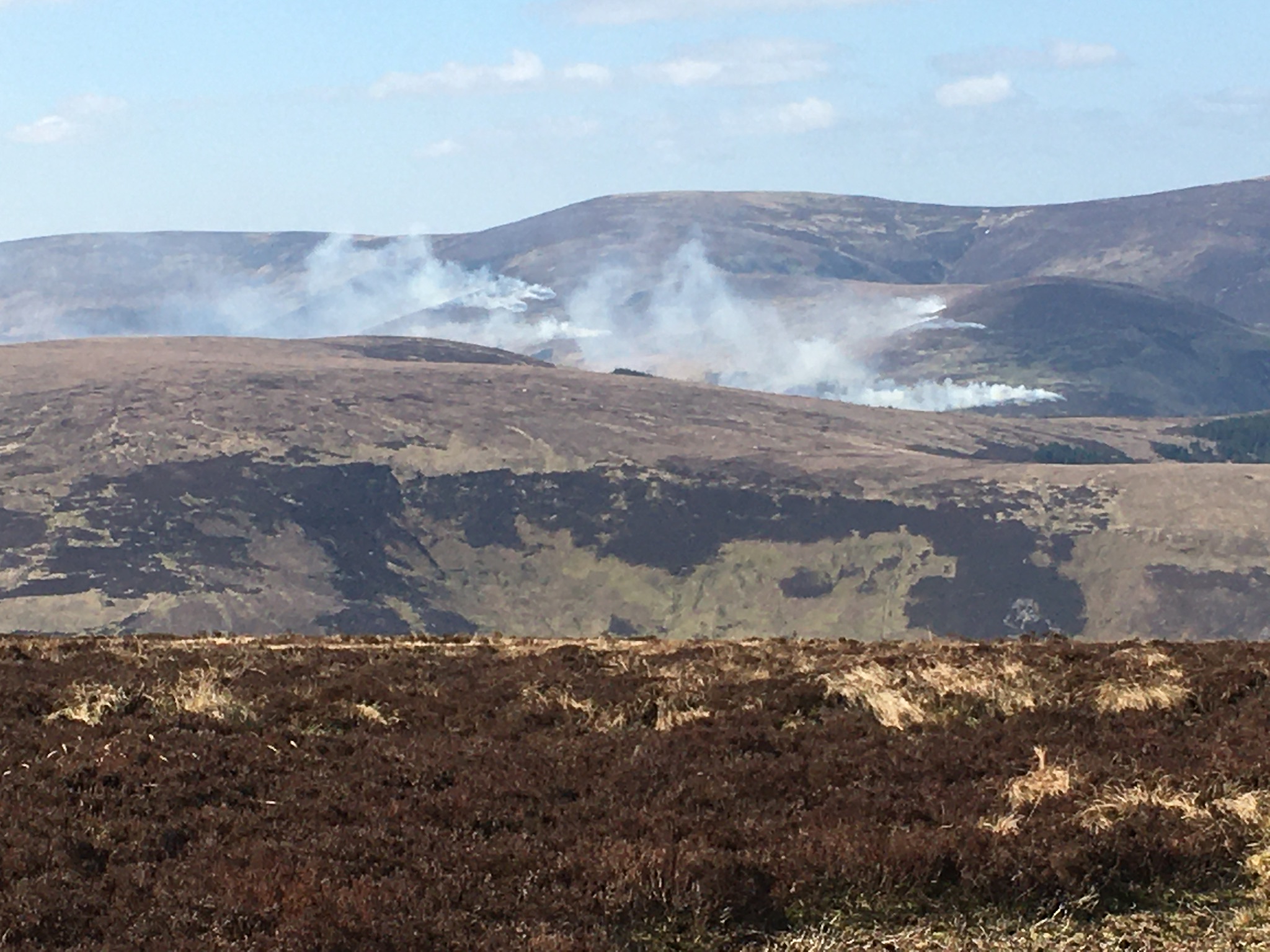
And here’s a photo sent in by another blog reader (thank you) taken yesterday in Manor Valley in the Borders:

It’s astonishing that not only is this burning still legal (although for how much longer remains to be seen) even though we’re in a climate and nature emergency, but that gamekeepers in Scotland can lawfully continue to set the moors alight until 15th April, and then with landowner’s permission can continue to light fires until 30th April.

Still, it’s a cracking wheeze for torching out hen harrier nests, peregrine breeding ledges and golden eagle eyries, which can then be explained away as ‘accidents’ (see here).

Pass the matches.

Peregrine found poisoned on grouse moor in Peak District National Park

Press release from RSPB (2nd March 2021)

Peregrine poisoned in Peak District National Park

A peregrine falcon, which was found dead on a driven grouse moor in the Upper Derwent Valley, has just been confirmed as illegally poisoned following official toxicology analysis – adding to the growing list of protected birds of prey illegally killed during 2020’s spring lockdown – many of which were in the Peak District National Park.

The adult male bird was found dead, on top of the remains of a wood pigeon, on 31 May 2020 by a fell runner on National Trust land. This was close to a known nest site which, like several other sites in the Dark Peak, has a long history of poor breeding success.

[The poisoned peregrine, photo by the Peak District Raptor Monitoring Group]

It was reported to Derbyshire Police, who recovered the carcass assisted by raptor workers, and the body was submitted for government toxicology testing. The results have just been published and confirm that the peregrine was illegally poisoned with the toxic insecticide bendiocarb: a substance we know is illegally used to kill birds of prey.

Mark Thomas, Head of RSPB Investigations, said: “This latest incident adds to an appallingly long and growing list of crimes against birds of prey which took place during the first national Covid lockdown in 2020. At the time, the RSPB was working flat-out with police to investigate a high volume of incidents, the details of which are now beginning to emerge.

It is clear that certain criminals took lockdown as an excuse to ramp up their efforts to kill birds of prey, wilfully ignoring lockdown and the laws which protect these birds.

Time and again, we are seeing birds of prey shot, trapped or poisoned on grouse moors. The link between illegal killing of peregrines and other raptor species and driven grouse shooting has never been clearer, and we urge the UK government to implement a licensing system for grouse moors in England, as is proposed in Scotland. Law-abiding estates would have nothing to fear from this, and it would act as a greater deterrent, keeping birds safe, in the sky, for all to enjoy.”

Peer reviewed studies, crime data and court convictions show that raptor persecution is more concentrated on and near driven grouse moors, where birds of prey are seen by some as a threat to commercially managed red grouse stocks. In fact, a recent paper statistically linked crimes against birds of prey in the Peak District National Park with land managed for Driven Grouse Shooting.

It is believed that the wood pigeon was a poison bait, laid deliberately with the intention of killing any bird of prey or raven which fed on it.

Steve Downing, Chair of the Northern England Raptor Forum, said: “Incidents like this are sadly not uncommon in the Dark Peak, where peregrine populations have crashed in recent years. What’s more, a poison bait like this, on open-access land, could easily be picked up by someone’s dog with disastrous consequences.”

Jon Stewart, National Trust General Manager, said: “We protect and care for places so nature and people can thrive. In a year when three pairs of peregrine successfully raised young on Trust land in the Dark Peak, half of all successful pairs on the Peak District moors, we were very upset to hear of this incident.

We continue to work closely with the RSPB, police and statutory agencies to take action to combat wildlife crime. We urge anyone with relevant information about this incident to contact the police and help end the illegal persecution of birds of prey.’’

All birds of prey are protected by the Wildlife and Countryside Act 1981. To intentionally kill or injure one is a criminal offence and could result in an unlimited fine or up to six months in jail.

If you have any information relating to this incident, call Derbyshire Police on 101.

If you find a wild bird of prey which you suspect has been illegally killed, contact RSPB Investigations on crime@rspb.org.uk or fill in the online form: www.rspb.org.uk/birds-and-wildlife/advice/wild-bird-crime-report-form/

If you know of someone killing birds of prey, please don’t stay silent: call the confidential Raptor Crime Hotline on 0300 999 0101.

ENDS

This latest crime should come as no surprise whatsoever to anyone even vaguely familiar with the Dark Peak area of the Peak District National Park. Dominated by driven grouse moors, this Park is notorious for raptor persecution and has been for decades, particularly impacting on goshawk and peregrine populations (e.g. see here), despite all the years of so-called ‘partnership’ efforts that have led to…..well, nothing but more of the same.

What is disappointing is that the poisoned bait and the dead peregrine were found on National Trust land – the NT has worked hard in the Park to restore raptor populations, even booting off a prominent sporting tenant three years ago (see here).

The press release is interesting, though. Once again, Derbyshire Police are conspicuously absent, the RSPB has had to lead on the publicity, and once again there has been a ridiculously long time lag between the commission of the crime and the publicising of it. There was a similar case in Derbyshire not so very long ago (see here) when this police force said that the circumstances of a poisoned buzzard being found dead next to a poisoned bait were ‘inconclusive’!

The 10-month time delay in publicising this latest poisoning case is very poor. The peregrine was found poisoned in May 2020 and the public isn’t made aware until March 2021? Now, we all know that Covid has had an impact on laboratory work and that’s unavoidable but I don’t believe for one second that it has taken the WIIS lab this long to produce the results. I think there’s more to it than that and I just wonder whether Derbyshire Police have played a role in the delay.

Something isn’t right and it needs sorting out, pronto.

UPDATE 11.30hrs: Mark Thomas, Head of RSPB Investigations has just tweeted:

The falcon was found on top of a plucked Wood Pigeon on National Trust land. Despite the investigation being closed, Derbyshire Police declined the opportunity to put this release out, we feel it is critical that the public are made aware due to the risk to them and their dogs‘.

I’ve asked Derbyshire Police’s Rural Crime Team, and the Chief Constable, why they refused to publicise this crime. Not only are there obvious public safety concerns but wildlife crime is supposed to be national wildlife crime priority.

Responses awaited.

Trial date set as man pleads not guilty to theft of peregrine eggs in Peak District National Park

A trial date has been set after a 60-year-old man pleaded not guilty yesterday to charges relating to the alleged theft of peregrine eggs in the Peak District National Park in Derbyshire last spring (see here).

Proceedings were brought following an investigation by Derbyshire Constabulary, supported by video evidence provided by the RSPB.

A trial date has been set for 28th July 2021.

NB: As this is a live case comments won’t be published until criminal proceedings have ended, thanks.

Wildlife crime on grouse moors in the Peak District National Park – an illustrated talk by Bob Berzins

Bob Berzins is a conservation campaigner who has spent a number of years highlighting the ecological damage caused by grouse-shooting interests on the moors of the Peak District National Park (e.g. see guest blogs he’s written for Mark Avery here, here, here, here, here, here, here and here).

Regular blog readers will be well aware that the Peak District National Park has been identified as a hotbed of illegal raptor persecution for many years (e.g. see here) and this reputation continued, in and around this National Park (!) even when the country was in lockdown last spring (see here).

[A shot buzzard found critically injured at Rushup Edge, near Mam Tor in the Peak District National Park on 13th January 2020. It had to be euthanised. Photo via Derbyshire Constabulary]

Bob’s willingness to speak out about his findings on these Peak District grouse moors has led to him being targeted, like so many of us, by a campaign of harassment and intimidation from members of the grouse shooting industry, presumably in an attempt to silence him.

It’s a measure of the man that he hasn’t quietly slinked off, even in the face of the most malicious abuse, but has instead stood his ground and continued to share his experience and knowledge.

A few days ago he gave an illustrated presentation (online, of course) to the Sheffield Green Party. His talk was entitled ‘Wildlife Crime in the Peak District’ and it’s now available to watch on YouTube:

Derbyshire man due in court in February for alleged theft of peregrine eggs in Peak District

Earlier this year Derbyshire Constabulary reported the theft of peregrine eggs from three different nests in the Peak District National Park (see here).

[Photograph by Barb Baldinger]

Ten days ago the police wrote on Facebook that an unnamed man had been charged in connection with the egg theft and also for a firearms offence. The suspect was identified after the RSPB had filmed an individual robbing one of the nests (see here).

This afternoon Derbyshire Constabulary issued a more formal statement on its website, as follows:

Man charged for theft of Peregrine Falcon eggs

A man has been charged with theft in connection with an incident in the spring where Peregrine Falcon eggs were allegedly stolen in the Peak District.

John Fenton, of Bridgemont, Whaley Bridge, was charged with the offence following an investigation by the Derbyshire Rural Crime Team and work by the RSPB.

It follows an incident in the Stoney Middleton area in May earlier this year.

Detective Constable Paul Flint of the Derbyshire Rural Crime Team said: “We take all reports of wildlife crime seriously and will seek to take action against offenders. This is a senseless crime and will not be tolerated. We would like to thank the RSPB for their support throughout.”

The 60-year-old is due to appear before magistrates at Chesterfield Justice Centre in February next year.

ENDS

As this is a live prosecution no comments will be published until criminal proceedings have ended.

UPDATE 20th February 2021: Trial date set as man pleads not guilty to theft of peregrine eggs in Peak District National Park (here)

Police raid property in poisoned peregrine investigation

At the end of October 2020, South Yorkshire Police published an appeal for information in relation to an investigation into the illegal poisoning of a young peregrine that had been found in Barnsley on 4th July 2020. Toxicology tests confirmed it had been killed with the highly toxic poison, Bendiocarb (see here).

[The poisoned peregrine. Photo via South Yorkshire Police]

Today, South Yorkshire Police has raided a property, under warrant, and seized what have been described as ‘a number of suspicious items’.

Here’s the police press release:

Warrant executed in connection to poisoned bird

A warrant has today (17 November) been executed at a property in Barnsley in connection to the poisoning of a protected wild bird.

Last month officers appealed for your help in finding those responsible for poisoning a juvenile peregrine falcon in the Fish Dam area of Barnsley.

Intelligence from the public assisted officers from the Barnsley Central Neighbourhood Team, the force’s Wildlife and Rural Coordinators, Crime Scene Investigation and members of the RSPB to carry out a search of a property on Abbots Road, under the Wildlife and Countryside Act 1981.

[‘Officers briefing before the warrant at Ring Farm, Cudworth’. Photo via South Yorkshire Police]

PC Fran Robbs de la Hoyde explains: “Peregrine Falcons are an important part of our local ecosystems, and are protected under The Wildlife and Countryside Act 1981.

It is a shame that someone would wish to harm these animals in such a deliberate act. The bird is believed to have ingested bait laced with toxic substances.

This morning we executed a warrant and found a number of suspicious items. Enquiries into persons involved in the offence are ongoing.

We are committed to protecting our wildlife and will ensure that those responsible are brought before the courts.”

We are stronger with our communities help and we are always grateful for those who take the time to read, respond and share information in which they have to help officers with their enquiries.

ENDS

NB: As this is a live investigation comments won’t be published until criminal proceedings have ended.