Police investigate missing peregrine eggs in Dumfries & Galloway

Police have launched an investigation after a clutch of peregrine eggs have been reported stolen from a monitored nest site near Thornhill, Dumfries & Galloway.

PC Plod will have his work cut out catching the culprits, as there are so many to choose from – in the past, peregrines have been targeted by egg collectors, falconers, pigeon fanciers and gamekeepers.

Full story: http://news.bbc.co.uk/1/hi/scotland/south_of_scotland/8691393.stm

spate of recent poisonings kills eagles, kites, buzzards & peregrine

One of the dead white-tailed sea eagles undergoing post mortem

A disgraceful spate of recent poisonings in Ireland has resulted in the death of 2 white-tailed sea eagles, 1 golden eagle, 3 red kites, 3 buzzards and a peregrine.

The sea eagles were poisoned by the illegal pesticide carbofuran. The golden eagle, kites, buzzards and peregrine were killed by alphachloralose, a pesticide still manufactured and legally available in Ireland.

Police investigations are underway.

For the full sorry story: http://www.goldeneagle.ie/news_viewnews.php?x=6&z=132&news_id=11&article=267

shooting times magazine names the countryside’s “most wanted pests”

Game shooting’s top magazine, The Shooting Times, has published an article on the countryside’s “most wanted pests”, which speaks volumes on the true attitude of the game shooting industry to our protected wildlife.

The Shooting Times, 6th February 2006 reports,  The golden eagle, red kite, osprey, heron, peregrine falcon and buzzard stand accused with the hedgehog, otter, badger and the domestic cat of being “voracious predators” that affect the game shooting and fishing industries.

The 114-year-old title describes the animals on its list as “pricey pests” that devour pheasant, partridge, grouse, salmon, trout, hare, pigeon, woodcock, snipe, duck, goose and deer or snatch wild birds’ eggs. The losses hit the profits of estate owners and shooting and fishing syndicates.

Jim Knight, the Rural Affairs Minister, joined animal welfare groups and the Countryside Alliance in criticising the magazine for vilifying wildlife. He was shocked by the article’s emotive language. “The list includes a number of precious species that are protected by law. Readers of this article may agree that some species can be a nuisance — but this does not excuse their destruction.”

Camilla Clark, editor of Shooting Times, said: “The purpose was to assess the economic impact of predators and pests on game birds in the UK. Shooting Times would never advocate the illegal killing of a protected species.”

two peregrines poisoned on nature reserve, Aberdeenshire

dead peregrine

Two recently-fledged peregrines were found poisoned on the Scottish Wildlife Trust’s Longhaven Reserve, Aberdeenshire, in July 2004. They were found by two climbers and tests proved they had been poisoned by eating from a pesticide-laced bait.

Police wildlife crime officer, George Sangster, said peregrines had been the victims of illegal persecution for many years, and he and his colleagues had seen “a worrying trend in the last few years in the north east of Scotland, with an increase in the persecution of peregrines”. Full story: http://news.bbc.co.uk/1/hi/scotland/3896793.stm

Six years later, not much has changed. According to a 2009 RSPB report, recent estimates suggest that 27% of nests in southeast Scotland, 24% of nests in northeast Scotland and over 10% of examined sites in Cumbria were subject to interference or killing. More info: http://www.birdguides.com/webzine/article.asp?a=1674

Two Peregrine Chicks Poisoned in the Nest

 03 August 2007.  Grampian Police are appealing for information following the discovery of two poisoned four week old peregrine falcon chicks in their nest in the Inverurie area.

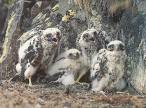
Peregrine chicks
The birds were discovered at the end of May when members of the North East Raptor Study Group visited the nest to ring and weigh the birds.

The two chicks had full crops and, following a post mortem examination and toxicology report, it was discovered that their food source was contaminated with an illegal pesticide, resulting in their death.

Peregrines are a “Schedule One” bird under the Wildlife and Countryside Act 1981 and are specially protected. New penalties for killing peregrines include up to a £10,000 fine or 12 months in prison.

Dave MacKinnon, Force Wildlife Crime Officer for Grampian Police said: “We are unable to give the exact location of the nest as these birds are specially protected. What I can say is that it appears the chicks had been fed poisoned bait by their parents, laced with a banned pesticide.

Haystoun Estate gamekeeper fined for offence

According to an article written by an RSPB investigator and published in  Scottish Bird News by the Scottish Ornithological Society (see link below), in June 2003, RSPB investigators received a tip-off that a peregrine nest site with a history of suspected deliberate interference was likely to be attacked imminently. Shortly afterwards, a 41 year old gamekeeper from the Haystoun Estate, Peebles, was allegedly filmed clambering across to the nest, removing the single peregrine chick, putting it inside a sack and walking off. The police arrived within minutes but the peregrine chick was never found.

The keeper was charged but when the case came to court on 24 March 2004, after two hours of legal argument Sheriff Farrell ruled that the video footage was inadmissable evidence because the RSPB did not have permission to be on the land for the purpose of detecting an offence.

It seems more than a little bit strange that a member of the public can be barred from telling a court about a crime, just because the landowner had not given permission for that person to be there! Surely, it is in any landowner’s interest to have criminals apprehended and dealt with by the courts? All very strange.

The gamekeeper was ultimately fined £300 and had his firearms certificates revoked after police officers found a weapon and ammunition in his unattended Landrover at the time of the incident. http://www.the-soc.org.uk/docs/SBN80.pdf

The keeper later attempted to get his firearms certificates back: http://news.scotsman.com/scotland/Gamekeeper-fined-300-seeks-gun.2567258.jp

gamekeeper not guilty of poisoning on Clova Estate, Aberdeenshire

At Aberdeen Sheriff Court in 2007, a 34 year old gamekeeper of Lumsden, Huntley, was accused of killing a peregrine at Clova Estate, Huntley, Aberdeenshire in October/November 2006. He was also accused of having a bottle of poison at his home address and at Tomatin Estate (Invernesshire), and further accused of having an illegal pesticide (Carbofuran) in his possession at his home address and elsewhere.

After long court delays, in early 2009 he was found not guilty of a charge under Section 15(A) of the Wildlife & Countryside Act 1981.

“Map of Shame” doesn’t say anything new

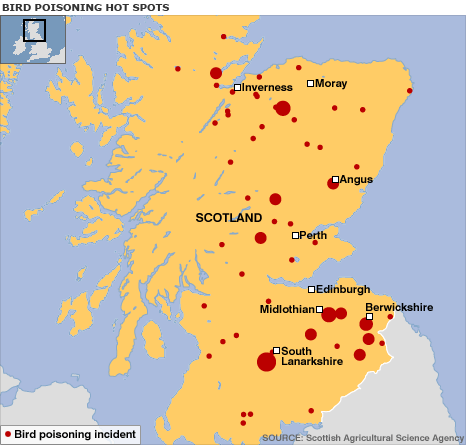
Map of Shame 2004-2008

In January 2009, the Scottish government released its ‘Map of Shame’ showing confirmed poisoning incidents between 2004-2008. The map, using data from the Scottish Agricultural Science Agency (SASA), was hailed as a “significant step” in the fight against wildlife crime as it showed the scale of raptor persecution.

In reality, the map doesn’t tell us anything new at all. The RSPB has been producing these maps for years; the difference with this one is that for the first time, the Scottish Rural Property & Business Association (SRPBA) which represents landowners, agreed to its contents.

The map locates 88 incidents in which raptors were poisoned over the previous 5 years, including iconic species such as the golden eagle, white-tailed sea eagle, red kite, buzzard, tawny owl and peregrine.

http://news.scotsman.com/birdsofprey/Bird-of-prey-poisoning-map.4864489.jp

What the map fails to tell us is the name of the shooting estates involved. What is the point of providing such a vague map? There is no point, other than to confirm what was already known – raptor persecution incidents are widespread across Scotland. If the SRPBA is as committed to stamping out wildlife crime as it claims it is, why wouldn’t it take every opportunity to name and shame those known to be involved?

It is not just wildlife-interest groups that are asking for the estates to be named. In September 2009, MSP Sarah Boyack (Scottish Labour) called for the government to name and shame the offending estates and said taking steps to reduce the number of incidents of wild raptors being shot and poisoned was a “matter of urgency”. http://news.stv.tv/scotland/121040-msp-name-and-shame-bird-killers/

The government is due to release the official 2009 raptor poisoning figures shortly….

golden eagles, peregrines & buzzards illegally killed in 1989

According to the Hansard Report April 2004 (Hansard is the edited verbatim report of proceedings in UK parliament), the following illegal raptor persecution incidents were recorded in 1989:

Roxburghe Estate (nr Kelso, Scottish Borders) – 1 x buzzard killed by Mevinphos.

Carbeth Estate (Stirlingshire) – 1 x buzzard killed by Chloralose.

Langholm Estate (Dumfries & Galloway) – 1 x peregrine killed by Mevinphos.

Drumochter Estate (Dalwhinnie, Inverness-shire) – 1 x golden eagle killed by Chloralose.

Islay Estate (Strathclyde) – 1 x buzzard killed by Mevinphos.

Islay Estate (Strathclyde) – 1 x peregrine shot.

Monzie Estate (Crieff, Perthshire) – 1 x buzzard killed by Chloralose.

This report was published in the days when the government publicised the names of the Estates where illegal raptor persecution incidents had been recorded. Shame they don’t do that anymore – you have to wonder why? The Hansard report documenting these and other persecution incidents, can be read here: http://hansard.millbanksystems.com/written_answers/1994/apr/28/registers-of-scotland

Gamekeeper convicted for dead peregrine on Glenfiddich and Cabrach Estate

According to a report in the Scotland on Sunday newspaper, raids on the Glenfiddich & Cabrach Estate in NE Scotland in February and March 1998 revealed widespread poisoning across the 41,500-acre estate owned by London property tycoon, Christopher Moran. Ten rabbits, six pigeons, six grouse and two hares were reportedly laced with the lethal pesticide Carbofuran and left out on the hill. Three illegal pole traps and an owl whose legs had been smashed by a trap were also reportedly found, along with a dead peregrine inside an estate landrover. Tests revealed the peregrine had been poisoned with carbofuran.

The head gamekeeper was convicted at Elgin Sheriff Court in October 1998 and fined £700.

The estate is owned by multi-millionaire Christopher Moran, a businessman with an interesting past: see here and here.