Young peregrine shot in County Antrim

The Northern Ireland Raptor Study Group has sent us the following press release and photo:

‘During July a peregrine nest site, in Glenwherry, Co. Antrim, Northern Ireland was the site of a gruesome discovery.

Two young peregrines were being watched over recent months in the nest and one of the chicks which had only recently flown from the nest was found dead below the cliff. X-rays have revealed the bird was shot.

The quarry owner who keeps a close eye on the peregrines alerted the Northern Ireland Raptor Study Group and condemned this event saying “I cannot believe one of these chicks which we all were watching has been shot. I appeal to those responsible to think about what they have done or come forward with what they might know and report any further information to the police”.

Jim Wells, chairman of the NIRSG and MLA was angered at yet another peregrine falcon senselessly killed. He said “Every summer it is the same – illegally poisoned or shot falcons. This has to stop. It is an absolute disgrace that anyone thinks they have justification for shooting a rare and specially protected bird.”

The PSNI are appealing for anyone, particularly in the Broughshane, Glenwhirry or Larne area, who may have information as to who is responsible for shooting this protected bird. This latest incident of raptor persecution clearly indicates that some people are still prepared to break the law risking a custodial sentence, their livelihoods and their right to possess firearms.

Anyone that has any information about this incident, peregrine persecution in Northern Ireland or any other wildlife crime should report it directly to the police or anonymously through Crimestoppers on 0800 555 111 to bring these criminals to justice’.

The Belfast Telegraph (here) is reporting a £1,000 reward is on offer to anyone who can help catch those responsible.

The Northern Ireland Birdwatchers’ Association is suggesting that all four peregrines from this nest site (two adults and two chicks) have been killed (see here).

Thanks to NIRSG and to our Twitter followers in Northern Ireland and the Irish Republic for the information.

Some not so depressing news for a change

Sick of reading all the depressing news on this site? So are we, so as a one-off-feel-good-Friday special, here’s a link to some positive raptor news in Scotland, thanks to the efforts of Forestry Commission Scotland and their partners.

Follow this link (here) to find out about this year’s Aberfoyle ospreys & buzzards, Tweed Valley ospreys, Huntly peregrines and Mull sea eagles.

Tune in next week for a return to depressing news. Monday will be a big day…

Police investigate attempted peregrine poisoning

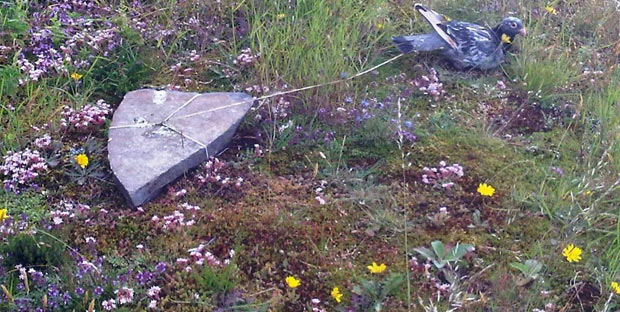
Police are investigating the attempted poisoning of peregrines after the discovery of a live pigeon, covered in poison, was found tethered to a rock at a quarry in North Wales.

Well done to Sgt Rob Taylor, the local Police Wildlife Crime Officer, for highlighting the incident and for warning the public about the danger to walkers and dogs.

The newspaper report suggests this isn’t the first tethered & poisoned pigeon to be used as live bait at this site.

News report in the North Wales Daily Post here

Stuff and nonsense

The airwaves are busy with criticism of last night’s episode of Countryfile, which featured a few pieces on evil birds of prey, especially buzzards and peregrines.

It’s too tedious to reproduce all the arguments here – we’ve heard it all before, although the SGA chairman Alex Hogg’s apparent inability to count was quite amusing. In a voiceover we were told that Alex was due to release 700 pheasant poults into his woodland pens (prior to letting them loose into the wider countryside so they can be shot dead). The interviewer (Tom Heap) then asked Alex if he had any idea how many poults he might be losing to buzzards. Alex’s response: “We’re probably losing, getting on for over a thousand pheasants in a year to buzzards“. Hmm.

At least the RSPB’s Duncan Orr-Ewing was able to provide some balanced and constructive discussion, but it was disappointing that the producers failed to include any meaningful discussion on the persecution issue. Tom Heap took to his Twitter account after the programme and offered this:

Am intrigued…many accusing #countryfile of buzzard bias. Why? Real country issue, meticulous balance. Proud of our work“.

For anyone who missed it, the episode can be seen on BBC iPlayer for the next seven days (here).

Another peregrine site attacked

The BBC is reporting an attack on a peregrine site at a quarry in Staffordshire.

Someone tried to steal or kill three chicks at the site between Monday evening and Tuesday morning. Quarry staff found a rope above the nest site, and the three chicks were found scattered across the site. It’s understood all three are now safe. Police are investigating.

BBC news article here

Devon & Cornwall police issue bird poisoning alert

Devon & Cornwall Police continue their impressive proactive stance against wildlife crime by today issuing a press release to warn the general public to be on the look out for poisoned birds and poisoned baits.

The alert has been issued to the local community in an area with a history of raptor poisoning, including previous attempts to poison peregrines. The public have been warned about the potentially fatal consequences of coming in to contact with the poisons used, and have been reassured that regular police patrols will be undertaken in the area.

We don’t see enough of this sort of proactive approach (although last year West Yorkshire Police did send out a public warning after poisoned bait was discovered – see here, as did Northern Constabulary, see here).

Once again, Police Wildlife Crime Officer PC Josh Marshall deserves huge plaudits for his efforts. Earlier this year Josh was behind a scheme to attach covert cameras at vulnerable raptor nest sites that resulted in catching two men disturbing a peregrine site within 48 hours of installing the equipment (see here). Somebody needs to get him and his enlightened bosses up to Scotland to provide training workshops for every single police force.

See here for the police poisoning alert.

Peregrine chicks stolen from nest site in southern Scotland

The BBC is reporting that peregrine falcon chicks have been reported stolen from a nest site in Moniaive, Dumfries & Galloway, sometime between 25 May and 5 June.

An un-named police spokesman has appealed for information and said the force was committed to fighting wildlife crime, although the appeal for information doesn’t seem to have yet reached the Dumfries & Galloway Constabulary’s website…

BBC news article here

Police cautions for Devon peregrine disturbers

Back in March we blogged about the activities of Police Wildlife Crime Officer Josh Marshall, who had been installing covert cameras at active raptor nest sites in Devon in a pro-active effort to deter/catch would-be wildlife crime offenders. Within 48 hours, two suspicious characters were caught on camera visiting an active peregrine site (see here).

Today, PC Marshall has announced that the two men have both received police cautions and were issued with ‘strong words of advice’ (see here).

Well done Josh, keep up the good work!

Head, sand, buried

Yesterday we blogged about the availability of the written evidence submitted to the UK parliament’s audit on wildlife crime (see here).

Today we’ve read all the written evidence and our expectations of who might have said what were fully met. Although there’s no substitute for reading things for yourself and drawing your own conclusions, there were a few things that stood out…

One common theme was the use of RSPB vs NWCU (National Wildlife Crime Unit) raptor persecution statistics, with groups such as the National Gamekeepers’ Organisation and the Moorland Association claiming that only the NWCU figures should be used to determine the ‘true scale’ of the problem. The Countryside Alliance goes one step further and says that it objects to what it calls ‘scene-of-the-crime involvement of third party campaigning organisations and charities such as the RSPB’ and calls for urgent guidance to clarify ‘that all crimes and suspected crimes should be reported to the police’. No great surprises there – it’s the usual knee-jerk reaction to the RSPB, but what is interesting is that they forgot to mention just how unrepresentative the NWCU figures actually are! Why are they unrepresentative? Well according to the written evidence of the Association of Chief Police Officers (ACPOS), not all police forces submit their wildlife crime data to the NWCU, and even if data have been submitted, it’s not always possible to identify which incidents were wildlife crimes as they are not allocated to a specific code! So yes, it is easy to see why these groups want to get rid of the RSPB stats and replace them with the NWCU figures!

Another point of interest was a statement from the Moorland Association on hen harriers. We thought the second paragraph contained particularly sinister undertones:

The scale of crime against the hen harrier and its impact on the hen harrier population has been overstated and is misleading. A lack of breeding success on grouse moors does not automatically mean that laws have been broken. There are many, many more birds in England than four successfully nesting pairs, which can be seen over grouse moor during migration and at winter roost sites.

Until a full set of special rules allowing the positive management of hen harriers breeding on grouse moors is forthcoming from the Environment Council’s Hen Harrier Dialogue, moorland owners are within their rights and the law to deter the birds from settling on their moors to breed.”

We assume that ‘positive management’ in this context refers to either killing or otherwise removing (translocating) any harriers that are considered ‘surplus’ to an agreed acceptable number (known as a ‘ceiling’). We understand that the Environment Council is seriously considering a ‘ceiling’ on hen harrier numbers for grouse moors; a controversial and long-running argument that we’ll write about another time. But what does the Moorland Association mean when it says ‘moorland owners are within their rights and the law to deter birds from settling on their moors to breed’?

The other comment we found particularly interesting was one made by the Countryside Alliance:

The recent publication of out of date research into the breeding success of peregrine falcons on grouse moors is a further example of counterproductive allegations against shooting which resulted in misleading coverage in the media. As a result of this, the National Wildlife Crime Unit circulated a clarification to all Police Wildlife Crime Officers in the UK, and to all Partnership for Action Against Wildlife Crime members, in which it was drawn to the attention of those studying the research paper that the data used was out of date, and that in using such information there was a clear danger that the research paper might be misunderstood as representing the current situation, which it did not.”

The publication being referred to is the recent paper by Amar et al (2011) which showed that the breeding productivity of peregrines nesting on grouse moors in Northern England was 50% lower than the productivity of peregrines breeding on non-grouse moors (see here for earlier blog on this). Now, why would the NWCU feel it necessary to send an email to wildlife crime police officers and other PAW partners about how to interpret this paper? Did they think that these people were so stupid that they couldn’t read and understand the paper for themselves? Why did the NWCU think that the data used in the paper (collected between 1980-2006 from 141 nesting ranges) were unrepresentative of the current situation? Has the NWCU collected and analysed more recent data to demonstrate that the current situation is different? How does sending this email fit in with the NWCU’s stated primary role of ‘assisting in the prevention and detection of wildlife crime’? What sort of message does this email give to those involved with the fight against raptor persecution? Here is a peer-reviewed scientific publication in a prestigious journal that points directly to the significant relationship between grouse moors and raptor persecution. Isn’t this exactly the sort of publication that the NWCU’s Charlie Everitt was referring to in his speech at the recent wildlife crime conference when he said: “We’ve also been looking to the use of science to try and benefit from what science can deliver to us”?

The thing is that the data used in the paper were part of a long-term data set that clearly showed a trend in poor productivity (i.e. not a snap shot but a long-term picture over 26 years), and this trend also mirrored that of other studies that have shown a clear relationship between low raptor survival and grouse moors (go and read some of the golden eagle papers that have been produced over the last ten years). The NWCU appear to have missed this point in their scrabble to appease the grouse-shooting lobby; so much for their intelligence-led approach to combating raptor persecution, eh?

All the written evidence submitted to the audit committee so far can be read here.

Covert camera at peregrine nest catches offenders within 48 hours

A proactive police and RSPB crackdown on wildlife crime in Devon & Cornwall, called Operation Wilderness, has had its first success after two men were filmed visiting an active peregrine nest site without the appropriate licences.

The men were caught on film just 48 hours after a covert camera had been installed at the site. Police were able to identify them from the camera images and the two men, aged 44 and 43, were found to be in possession of a camera containing images of the peregrine nest site. Both men have been released pending further enquiries.

Full details available on Devon Police Wildlife Crime Officer Josh Marshall’s blog here

Well done Josh and all involved – excellent work! For more information about why Operation Wilderness was launched, see earlier blog post here.