
Disingenuous SGA uses flawed analysis to misrepresent raptor crime data

There’s a shockingly poorly-researched article in today’s Telegraph, penned by Scottish journalist, Auslan Cramb.

He claims that ‘Wind turbines have killed more birds of prey than persecution‘ this year. The basis of his flawed claim is his analysis of the latest SASA data, covering the period Jan-June 2014.

Cramb states that, “Four raptors were killed by turbines between January and June. Over the same period, two birds were confirmed to have been poisoned or shot“.

Dear God. Let’s just have a closer look at the SASA data, shall we?

March 2014: Dead peregrine found in Strathclyde – Carbofuran poisoning.

April 2014: Dead peregrine found nr Stirling – [shot on the nest].

April 2014: Dead buzzard found in Fife. Poisoned [“banned poison” not named by police].

June 2014: Dead hen harrier found in Muirkirk – [shot].

That’s four confirmed illegal killings in the report. Can’t Mr Cramb count? There’s also a further entry:

January 2014: Dead rook, rabbit bait & hare bait (Carbofuran) found in Strathclyde. Not a raptor, granted, but its misleading not to mention this incident especially as Carbofuran-laced baits are routinely used to kill raptors. This incident is no less serious than a poisoned raptor.

But what’s missing from the SASA report? According to our research, the following:

January 2014: 1 dead bird [species unidentified] & suspected poison bait, South Lanarkshire.

March 2014: 16 red kites poisoned in Ross-shire [“banned poison” not named by police].

March 2014: 6 buzzards poisoned in Ross-shire [“banned poison” not named by police].

April 2014: 1 dead buzzard, allegedly shot, bludgeoned and stamped on, Dumfries & Galloway. A criminal trial is underway.

That makes a total of 27 confirmed illegally-killed raptors between Jan-June 2014, plus one rook and one unidentified bird.

Now, it’s quite possible that Mr Cramb is unaware of some of those additional persecution incidents (although if he was a half-decent journalist he would have done some homework – information about all of those crimes can be found on this blog).

However, it is inconceivable that the 22 raptors poisoned in the Ross-shire Massacre in March this year escaped his attention. He’s a journalist – it’s his job to keep abreast of the news.

Sure, the 22 poisoned raptors are not listed in the SASA report because mysteriously, SASA has chosen to exclude them, probably at the request of Police Scotland – we blogged about this exclusion here and the ramifications of their secrecy just keep coming, as evidenced here), but it’s very poor journalism for him to have excluded them from his analysis on windfarm deaths vs persecution deaths.

Cramb’s poor research skills are one thing. However, his flawed analysis appears to have been readily accepted by the Scottish Gamekeepers’ Association, and used by them to misrepresent the truth about raptor persecution stats. In the article, Cramb says this of the SGA:

A spokesman for the SGA said the report revealed the truth behind the “prejudice” aimed at landowners and farmers which painted the shooting industry as “guilty until proven innocent“.

He added: “It is important the public can understand for themselves the true picture regarding wildlife crime.

“After the appalling finger-pointing at the shooting and farming industries following Conon Bridge this year by the highly politicised conservation movement, we will be interested to see if those groups now call for the same licensing measures against the government-backed wind farm industry”‘.

So, the SGA have accepted Cramb’s analysis even though they are fully aware that the 22 illegally-poisoned raptors at Conon Bridge are not included in his results. They can’t deny knowledge of the Ross-shire Massacre because the SGA spokesman even mentioned it in his quote!

We would argue that the SGA is being disingenuous, readily accepting Cramb’s flawed analysis because it suits their agenda to keep denying the extent of raptor persecution crimes in Scotland. That’s outrageous. Why is this organisation still allowed to sit on the PAW Scotland Raptor Group, whose objective is to raise awareness of raptor persecution, not to deny it? They’re a disgrace.

Telegraph article here

UPDATE 3rd November 2014: RSPB Scotland has also blogged about this here

Killing with impunity: Birdcrime 2013 published

Birdcrime 2013The RSPB has published its latest annual report on crimes against birds in the UK in 2013.
Their press release here.

The killing goes on, with impunity.

76 individual birds & other animals were confirmed illegally poisoned in 2013. This is more than double the figure from 2012 (29 confirmed victims).

Poisoning victims in 2013 included 30 buzzards, 20 red kites, 1 golden eagle and 1 white-tailed eagle.

68 confirmed incidents involved the shooting or destruction of birds of prey. Victims included two hen harriers, two marsh harriers and 5 peregrines.

These are just the confirmed incidents. A total of 338 incidents were reported to the RSPB in 2013, with North Yorkshire once again being the worst location. There’s also a worrying number of incidents from Powys in South Wales, seemingly relating to poisoned baits.

Birdcrime 2013 is a thoroughly depressing read. The RSPB calls on the shooting industry, again, to clean up its act. Judging by the contents of this report, that’s a seemingly futile request.

Well done and thanks to the RSPB for not only compiling these thorough statistics but importantly, for sharing them in the public domain.

Download Birdcrime 2013: Birdcrime 2013

Hen harrier Bowland Betty, found shot dead on a grouse moor in North Yorkshire. (Photo by Natural England).

Bowland Betty

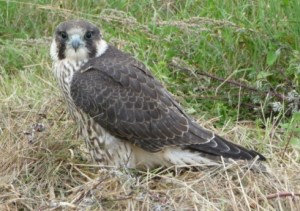
Another peregrine poisoned in Derry

Last week we blogged about the suspected poisoning of a famous peregrine that had been found dead in the grounds of St Columb’s Cathedral in Derry (see here).

Seven days on and we’ve been told by one of our contributors (thank you) of another dead peregrine in Derry, this time confirmed to have been poisoned.

The dead bird was discovered at the Carmean Road in Moneymore on the afternoon of Tuesday July 15th. The carcass was taken to a vet at the Department of Agriculture and Rural Development for a post mortem. Tests revealed it had been killed by ingesting the banned poison Carbofuran.

Police in Magherafelt have launched an appeal for information about this incident and about any suspicious activity around the local quarries. Anyone with information is asked to contact Magherafelt Police Station on Tel: 101.

This is the 19th peregrine known to have been targeted in these isles this year. And these are only the ones that have been reported. Details of the first 17 can be found here, details of the 18th here.

Peregrine photo by Steve Waterhouse

Famous Derry peregrine found dead: poisoning suspected

A well-known peregrine has been found dead in the grounds of St Columb’s Cathedral in Derry and is suspected to have been poisoned.

The bird was found on Saturday and the carcass has been sent for toxicology tests.

BBC news story here

Police investigate shooting of young peregrine in Suffolk

shot perg suffolk aug 2014Suffolk police and the RSPB are appealing for information after the discovery of a young, injured peregrine near the village of Long Melford in Suffolk on 20th August. The bird had been shot.
The peregrine has survived and is currently being rehabilitated at a nearby falconry centre in the hope it can make a full recovery and be released back to the wild.

The RSPB is offering a £1,000 reward for information leading to a conviction.

Full news article here.

This is the 17th peregrine known to have been targeted in these isles this year. And these are only the ones that have reported – how many more have been killed?

In February, a poisoned peregrine was found dead in South Lanarkshire, Scotland (here). In March, a shot peregrine was found dead in Dorset, England (here). In April, a shot peregrine was found dead near Stirling, Scotland (here). In May, a shot peregrine was found critically injured in Devon, England (here). In June, the public foiled an attempted poisoning of six peregrines in Co. Dublin, Ireland (here). In June, a poisoned peregrine was found dead in North Wales (here). In July, four dead peregrines suspected to have been poisoned were found in Gwynedd, NW Wales (here). In August a shot peregrine was found critically injured in Co. Wexford, Ireland (here).

Ross-shire Massacre: five months on

It’s been five months since the discovery of 22 dead raptors (16 red kites + 6 buzzards) near Conon Bridge in Ross-shire – an incident we have termed the Ross-shire Massacre.

Since then, we’ve learned that 16 of these birds (12 red kites + 4 buzzards) were killed after ingesting an “illegally-held poisonous substance“. That information had to be dragged from Police Scotland in June, following some pretty outrageous allegations from the game-shooting industry (and at least one MSP) that the birds had been ‘accidentally poisoned’ by eating contaminated meat at the Tollie Red Kite Feeding Station.

Other than that, Police Scotland has refused to provide any further information, other than to say last month that the investigation “was continuing“.

In June, a member of the public made an FoI request to SASA (the government lab responsible for undertaking the toxicology anlayses on these birds) to ask for the name of the poison(s) and the name of the species affected, amongst other things. He received a reply from SASA on 30th June and he was told that it wasn’t in the public interest to disclose such information. SASA claimed that the public interest test was “outweighed by the public interest in ensuring that the ongoing police investigation is not jeopardised and that incomplete data are not released“. The member of the public submitted a request for a review of this decision and on 24th July 2014 he received a response from Hugh Dignon, a senior civil servant. Mr Dignon upheld the decision made by SASA and added:

By withholding evidence that might, if prematurely released, prejudice a live investigation, we are maximising the likelihood that a conviction could be secured if a prosecution is taken forward“.

Come on, Hugh! There’s not a chance in hell of getting a prosecution, let alone securing a conviction, so many months after the crime took place. Who are you trying to kid? And since when has releasing the name of a banned poison ever jeopardised a live investigation? Er, that’ll be never. SASA has, for years, routinely published the name of the poisons that were used in crimes that are still subject to on-going investigations – why is this case so different? Why all the cloak and dagger? What’s to hide?

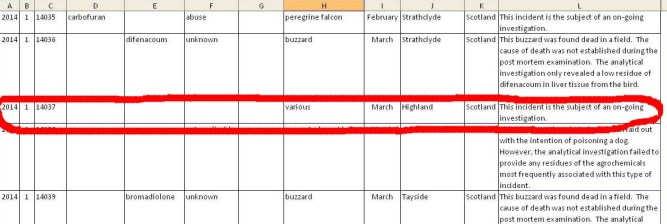
Here’s a screen grab of SASA’s latest poisoning data, which relate to toxicology tests undertaken in the first quarter of 2014. The reference circled in red is the information about the Ross-shire Massacre. SASA has redacted all the detail about the type of poison(s) detected (column 4), whether the incident was ‘abuse/mis-use’ etc (column 6), and they’ve even removed the names of the species they’ve tested – preferring to write ‘various’ instead (column 8). Compare and contrast these redactions to the entry at the top of the image, which relates to a poisoned peregrine found in Strathclyde in February – that case is also an on-going police investigation (ahem) and yet we’re allowed to see the name of the poison (Carbofuran), the type of incident (abuse) and the species affected (peregrine). Astonishing, isn’t it?

 SASA Q1 2014 ROSS-SHIRE MASSACREa

For previous posts on the Ross-shire Massacre click here

More poisoned peregrines in North Wales

North Wales Police are appealing for information following the discovery of a poisoned peregrine in June.

The bird was found at a quarry in Penmaenmawr and toxicology tests revealed it had been poisoned with a rodenticide.

It’s possible then that this was the result of an accidental poisoning (as rodenticides can be used under certain controlled conditions), but the death is being treated as suspicious because two years ago a pigeon was found, at the same quarry, smothered in poison and tethered to a rock – obviously placed as a poisoned bait (see here).

Press release from North Wales Police on the latest peregrine poisoning here.

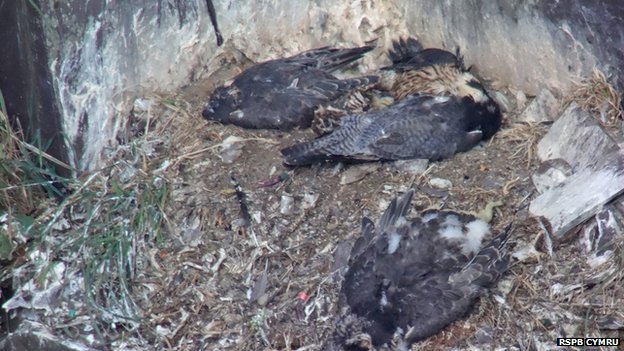
In July this year, four peregrines (3 chicks and 1 adult) were found dead on their nest ledge at a quarry site in the Nantlle Valley, Gwynedd. Police suspect they too had been poisoned (see here).

peregrines x 4 Nantlle valley July 2014

Young peregrine shot in Co Wexford

Perg Co WexA young peregrine falcon has had to be euthanised after it was illegally shot in Co Wexford, Ireland.

The news article in the Irish Times (here) doesn’t say when the bird was found but it can be assumed it was quite recently – the young bird had been ringed with a unique identification number so presumably the authorities know it was one of this year’s fledglings.

The bird was found at Ballynastraw near Enniscorthy and an x-ray revealed it had been hit with shotgun pellets in its wings and leg. A vet decided the injuries were too severe for the bird to be rehabilitated.

The National Parks and Wildlife Service has appealed for information. Dominic Berridge of NPWS said: “The finding of this bird is not an isolated incident. There have been attempts to poison and shoot birds at a number of nests and if people see anything suspicious like a tethered pigeon or a trap, NPWS staff should be called”.

Wheelhouse responds to latest raptor killings….by doing nothing

Paul-Wheelhouse-MSP Earlier today we blogged about the latest poisoning victim to have been uncovered in Scotland….a dead buzzard that was found in Fife in April (see here).
This evening, Environment Minister Paul Wheelhouse has issued the following statement:

I have been hugely angered to learn about another case of a poisoned buzzard following on from a separate incident involving the illegal death of a hen harrier in Ayrshire. I have made it very clear that I will not tolerate these criminal and selfish acts and this form of criminality has also been roundly condemned by parliament in a recent debate.

These crimes are not the actions of people who value Scotland’s wildlife and natural environment and I encourage anyone with any information on these despicable crimes to contact Police Scotland on 101.

My officials are working on a pesticide disposal scheme to rid illegal substances from our countryside and I hope to see this up and running very soon while the implementation of changes to the General Licences is in the process of implementation.

Our ongoing review of wildlife crime penalties is due by December and these latest incidents only add to the evidence supporting a toughening of sanctions and penalties on perpetrators.

We don’t doubt that he’s “hugely angered” – we all are – but we most certainly do question his commitment to taking meaningful action against the raptor killers.

A year ago, give or take a few days, the Minister introduced a series of what he described as ‘further measures’ to combat raptor persecution (see here). Since then, not one of these measures has yet been fully implemented. Also since then, we’ve seen examples, over and over again, of how these crimes are still taking place right across Scotland. Here are some of them:

June 2013: Shot buzzard in the Borders (see here), later revealed to also have been poisoned (see here)

July 2013:  Buzzard shot in the throat in North Ayrshire (see here)

August 2013: Red kite found shot at Leadhills (see here)

September 2013: Poisoned buzzard found in Stirlingshire (see here)

October 2013: Langholm hen harrier ‘Blue’ disappears (see here)

October 2013: Half-made raptor trap discovered in Angus (see here)

December 2013: Buzzard died of ‘unnatural causes’ near Tomatin (see here) [we now know it had been shot]

December 2013: Golden eagle ‘Fearnan’ found poisoned on Angus grouse moor (see here)

January 2014: Man reported for hen harrier death in Aberdeenshire (see here)

January 2014: Dead bird (species unknown) & suspected poisoned bait found in South Lanarkshire (see here)

February 2014: Poisoned peregrine found near Leadhills (see here)

March 2014: 22 poisoned raptors (16 red kites + 6 buzzards) found in Ross-shire (see here)

April 2014: Man arrested for alleged attempted raptor trapping in Aberdeenshire (see here)

April 2014: ‘Illegally-killed’ peregrine found near Stirling (see here) [we now know it had been shot]

April 2014: East Scotland sea eagle chick ‘disappears’ on Aberdeenshire grouse moor (see here)

April 2014: Gamekeeper charged for allegedly shooting, bludgeoning & stamping on buzzard in Dumfries (see here)

April 2014: Poisoned buzzard found in Fife (see here)

June 2014: Allegations emerge of ‘coordinated hunt & shooting’ of a hen harrier in Aberdeenshire last year (see here)

June 2014: Hen harrier died “as result of criminal act” near Muirkirk (see here)

These are just the ones that have been made public – we expect there to be a number of others that have not yet been revealed to the public.

Each time, we’ve asked Wheelhouse to act. Each time, he’s told us we need to ‘wait’ for the new measures to take effect but he has adamantly refused to give a time-frame of how long that wait should be. It’s crystal clear, even to a child, that The Untouchables are out of control and waiting for them to stop of their own accord is ridiculous.

The Minister’s response this evening is simply not good enough. A ‘poisoning amnesty’? It sounds good, but the truth is it’s been done before and with no effect. Carbofuran has been banned since 2001 – that’s 13 years ago! Does he really think that these disgusting poisoners are going to hand over their private stashes of poison when they know full well they can continue to use them without fear of consequence? The whole industry denies that poisoning is even happening!

We think the amnesty is being implemented so the Government can be seen to be doing ‘something’ but actually it’s just a bit of cynical window dressing in an attempt to delay taking the proper action that is needed. It’s just another excuse to do nothing.

And actually, this amnesty hasn’t been announced as a reaction to the recently-reported killing of the buzzard and the hen harrier. He announced his intention to launch an amnesty in his speech at the Police Wildlife Crime Conference several months ago. So what has he actually announced in response to the poisoned buzzard and the illegally-killed (probably shot) hen harrier? Absolutely nothing.

The Minister says he “won’t tolerate these criminal and selfish acts“. Sorry, Minister, but that is exactly what you’re doing.

If you feel strongly about this and agree that this government is still failing to address the widespread persecution of protected raptor species, we’d encourage you to email Mr Wheelhouse, cite the list of crimes (above) and demand he takes meaningful action or resign his position as Environment Minister. Email: ministerforenvironment@scotland.gsi.gov.uk

Members of public foil attempt to poison peregrine family

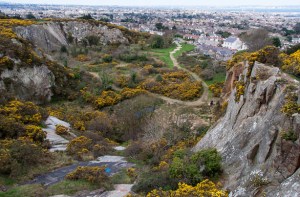
dalkey_quarryAn attempt to poison a family of peregrines (two adults and four youngsters) at Dalkey Quarry, part of the Killiney Hill Park in Co. Dublin, has been foiled thanks to three observant members of the public.

On the evening of 11th June, three walkers noticed two pigeons in distress at the quarry, close to the well-known peregrine’s nest ledge. On closer inspection, the pigeons were found to be tethered with fishing line and had had their wings clipped to prevent them from flying. While rescuing the pigeons, a wet substance was noticed on the back of their necks. It is suspected that this was poison, placed there in a deliberate attempt to kill the peregrines. The substance is being tested at a specialist lab.

If it was poison, those members of the public are lucky not to have been affected.

Full details of the story can be found on the BirdWatch Ireland website here.

It wouldn’t be the first time this barbaric method has been used to kill raptors. In 2011, two buzzards and a sparrowhawk were killed in Ireland after being attracted to live tethered pigeons that had been smeared with the banned poison Carbofuran (see here).